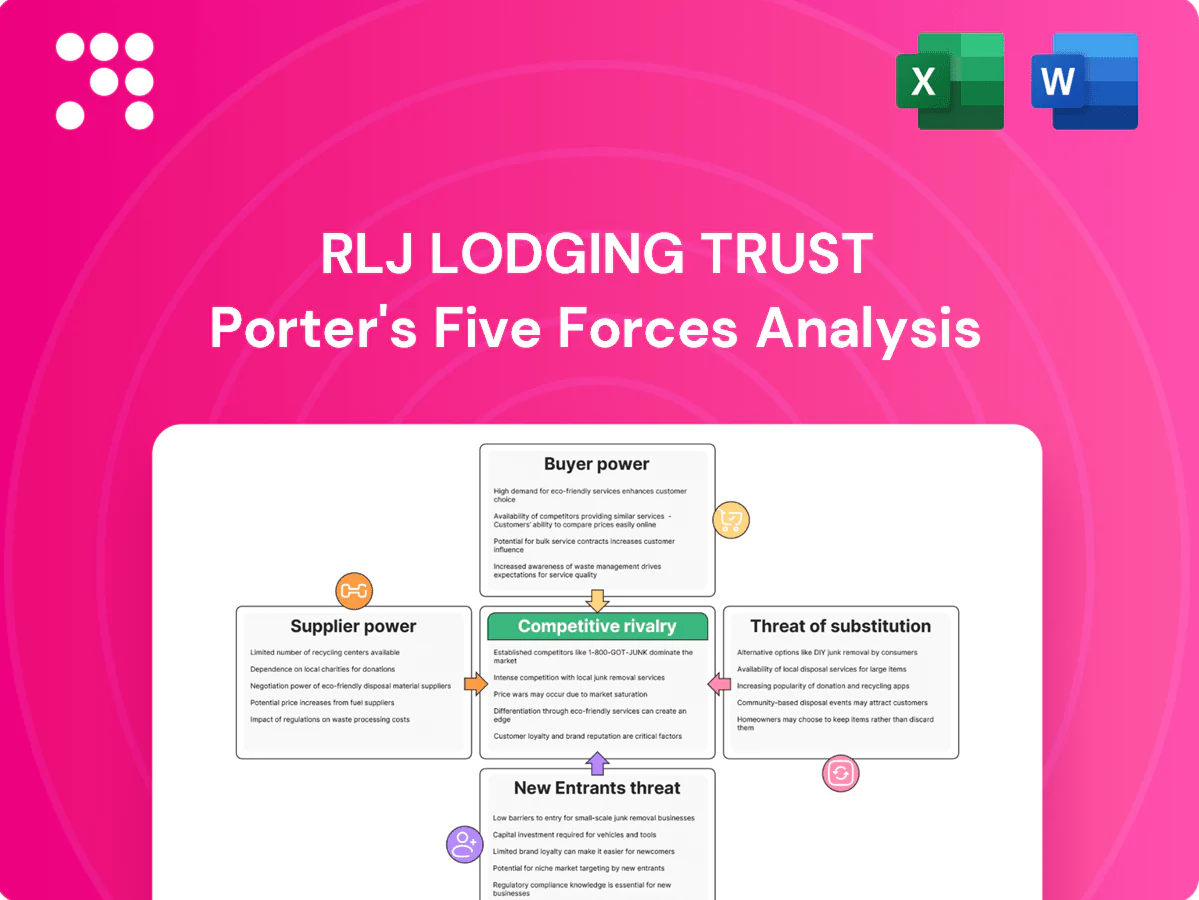
RLJ Lodging Trust Porter's Five Forces Analysis

From Overview to Strategy Blueprint
RLJ Lodging Trust faces moderate buyer power, fragmented supplier influence, and steady substitute risk amid hotel market recovery, while barriers to entry and rivalry shape margins; this snapshot highlights key pressures but omits granular metrics. Unlock the full Porter's Five Forces Analysis for force-by-force ratings, visuals, and actionable strategy insights.
Suppliers Bargaining Power

Brand franchisors’ leverage
Premium franchisors like Marriott and Hilton control flags, standards and central reservation systems, giving them leverage over franchise fees (commonly 4–6% of room revenue) and PIP timing and scope. Their 2024 loyalty ecosystems continue to funnel demand, reinforcing RLJ’s dependence. Brand allocation limits can constrain RLJ’s flexibility in tight submarkets. Contracts are often multi-year with strict performance and capex clauses.
Third-party managers’ terms
Hotel management companies shape RLJ Lodging Trust operating costs, staffing models and guest experience; in 2024 typical base fees ran 2–4% of total revenue with incentive fees of roughly 10–20% of GOP, putting margin pressure in downturns. Switching managers is costly and requires brand approvals, yet competitive manager markets in 2024 provide viable alternatives.

Construction and FF&E vendors
Renovation cycles and PIPs concentrate demand for contractors, designers and FF&E suppliers, with 2024 FF&E lead times commonly stretching up to six months and PIP costs typically ranging $10,000–$25,000 per room, elevating costs and delaying revenue recapture. Limited qualified vendors for premium brands amplify supplier leverage, though RLJ-scale bulk purchasing and standardized specs partially offset that bargaining power.

Labor and staffing constraints
Tight 2024 labor markets (US unemployment ~3.9%) and hospitality wage gains (leisure and hospitality average hourly earnings up ~6% YoY in 2024) boost bargaining power of staffing agencies and, in some urban markets, unions; service standards in select-service hotels limit scope for automation, raising reliance on labor. High turnover and training intensity create switching frictions while benefits and scheduling compliance increase structural operating costs for RLJ Lodging Trust.
- US unemployment ~3.9% (2024)
- Leisure & hospitality wages +~6% YoY (2024)
- High industry turnover → higher hiring/training costs
- Benefits/scheduling compliance raise fixed labor expenses
Utilities and insurance providers
Energy, water and property insurance are essential inputs with few short-run substitutes, leaving utilities and insurers with meaningful leverage over hotel operators; catastrophe exposure and reinsurance cycles can sharply raise premiums for coastal and urban assets. ESG-driven upgrades often require certified vendors, increasing switching costs and CAPEX timing risk. RLJ’s multi-asset scale aids negotiation but limits full cost pass-through to room rates.
- Essential services: limited short-run substitutes
- Catastrophe risk: spikes premiums for coastal/urban assets
- Reinsurance cycles: elevate cost volatility
- ESG upgrades: vendor-specific and cost-additive
- Scale: negotiation power, not full pass-through
Supplier squeeze: fees 4–6%, managers take GOP share
Suppliers exert moderate-to-high power: brands/franchisors (4–6% fees) and managers (2–4% base + 10–20% GOP) set rules and costs; FF&E/PIP costs $10–25k/room with 6-month lead times; tight 2024 labor (US unemployment ~3.9%; leisure & hospitality wages +6% YoY) and insurance/reinsurance cycles add volatility, partially offset by RLJ scale.
| Supplier | 2024 metric | Impact |
|---|---|---|
| Franchisors | 4–6% rev fee | High |
| Managers | 2–4% rev +10–20% GOP | Moderate |
| FF&E/PIP | $10–25k/room; 6mo lead | High |
| Labor | Unemp 3.9%; wages +6% | High |
| Insurance | Premiums volatile | Moderate |
What is included in the product
 Detailed Word Document
Tailored Porter’s Five Forces assessment of RLJ Lodging Trust, uncovering competitive intensity, buyer and supplier power, threat of new entrants and substitutes, and implications for RevPAR and margins; highlights disruptors, market entry barriers, and leverage points for strategic positioning.

 Customizable Excel Spreadsheet
Clear one-sheet Porter's Five Forces for RLJ Lodging Trust—quickly assess competitive pressures and customize force levels as market or asset-level data shifts.
Customers Bargaining Power

OTAs and distribution intermediaries
OTAs and intermediaries aggregate demand but extract commissions typically in the 15-25% range and control visibility rules, pressuring RLJ Lodging Trust ADRs and margins. Their price transparency lets guests compare rates instantly, with Booking Holdings and Expedia together capturing roughly 70% of OTA booking share in 2024. RLJ's direct-booking initiatives reduce but do not eliminate material dependence on OTA distribution.
Corporate and group buyers
Corporate travel managers and group planners extract negotiated rates, concessions and strict attrition clauses from RLJ Lodging Trust, leveraging volume-based contracts particularly during off-peak windows in 2024.
Meeting-space limits at many of RLJ’s select-service hotels constrain hoteliers’ ability to offer premium group packages, narrowing hotel negotiating room.
Cycle-sensitive corporate demand amplified buyer power during downturns in 2024, forcing greater concessions on rates and cancellation terms.

Brand loyalty members
Brand loyalty members expect point accruals, upgrades and consistent brand standards, and 2024 industry data shows loyalty channels drive a material share of bookings for RLJ-managed flags, shifting economics via lower reimbursement rates on redemptions. Redemption liability and reimbursement compress margins, while low switching costs across same-brand competitors keep price sensitivity high. Strong loyalty funnels steady demand yet constrains short-term rate flexibility.

Leisure guests’ price sensitivity
Leisure guests are highly price elastic and responsive to promotions; 2024 industry surveys indicate about 70% of leisure travelers compare rates and hunt deals. Social reviews and metasearch intensify deal-seeking, with review-readership commonly above 80%. Weekend and shoulder periods heighten discount pressure, while distinct amenities and locations can materially moderate elasticity.
- Price-aware ~70%
- Review-readership >80%
- Weekend/shoulder = higher discount pressure
- Amenities/location reduce elasticity
Local demand mix variability
Urban and event-driven markets create sharp peak/off-peak volatility; STR 2024 shows convention weeks can lift ADR and RevPAR by roughly 30–70% versus baseline, while typical periods favor guests with occupancy near 60–65% nationally.
Customers routinely time purchases or switch neighborhoods to save, keeping bargaining power with buyers most of the year; citywide conventions briefly flip power to sellers.
Revenue management and dynamic pricing tools (industry studies 2022–24) boost RevPAR ~3–7%, partially rebalancing bargaining power.
- Peak ADR lift: ~30–70% (STR 2024)
- National occupancy: ~60–65% (2024)
- RevPAR uplift from RM: ~3–7% (2022–24 studies)
Customers lose margin as OTAs control 70%, reviews > 80%
Customers hold substantial bargaining power: OTAs (Booking+Expedia ~70% share in 2024) and corporate buyers force rate concessions and commissions, while loyalty redemptions and high leisure price-sensitivity (≈70%) compress ADR and margins. Review-readership >80% and metasearch increase price transparency; dynamic pricing recoups only ~3–7% RevPAR.
| Metric | 2024 |
|---|---|
| OTA share (Bk+Exp) | ~70% |
| Leisure price-aware | ~70% |
| Review readership | >80% |
| Peak ADR lift | 30–70% |
Same Document Delivered
RLJ Lodging Trust Porter's Five Forces Analysis
This preview shows the exact Porter’s Five Forces analysis for RLJ Lodging Trust you'll receive after purchase—no placeholders or samples. The full document is professionally formatted and ready to download instantly upon payment. Use it immediately for investment, valuation, or strategic planning.

From Overview to Strategy Blueprint
RLJ Lodging Trust faces moderate buyer power, fragmented supplier influence, and steady substitute risk amid hotel market recovery, while barriers to entry and rivalry shape margins; this snapshot highlights key pressures but omits granular metrics. Unlock the full Porter's Five Forces Analysis for force-by-force ratings, visuals, and actionable strategy insights.
Suppliers Bargaining Power
Brand franchisors’ leverage
Premium franchisors like Marriott and Hilton control flags, standards and central reservation systems, giving them leverage over franchise fees (commonly 4–6% of room revenue) and PIP timing and scope. Their 2024 loyalty ecosystems continue to funnel demand, reinforcing RLJ’s dependence. Brand allocation limits can constrain RLJ’s flexibility in tight submarkets. Contracts are often multi-year with strict performance and capex clauses.
Third-party managers’ terms
Hotel management companies shape RLJ Lodging Trust operating costs, staffing models and guest experience; in 2024 typical base fees ran 2–4% of total revenue with incentive fees of roughly 10–20% of GOP, putting margin pressure in downturns. Switching managers is costly and requires brand approvals, yet competitive manager markets in 2024 provide viable alternatives.
Construction and FF&E vendors
Renovation cycles and PIPs concentrate demand for contractors, designers and FF&E suppliers, with 2024 FF&E lead times commonly stretching up to six months and PIP costs typically ranging $10,000–$25,000 per room, elevating costs and delaying revenue recapture. Limited qualified vendors for premium brands amplify supplier leverage, though RLJ-scale bulk purchasing and standardized specs partially offset that bargaining power.
Labor and staffing constraints
Tight 2024 labor markets (US unemployment ~3.9%) and hospitality wage gains (leisure and hospitality average hourly earnings up ~6% YoY in 2024) boost bargaining power of staffing agencies and, in some urban markets, unions; service standards in select-service hotels limit scope for automation, raising reliance on labor. High turnover and training intensity create switching frictions while benefits and scheduling compliance increase structural operating costs for RLJ Lodging Trust.
- US unemployment ~3.9% (2024)
- Leisure & hospitality wages +~6% YoY (2024)
- High industry turnover → higher hiring/training costs
- Benefits/scheduling compliance raise fixed labor expenses
Utilities and insurance providers
Energy, water and property insurance are essential inputs with few short-run substitutes, leaving utilities and insurers with meaningful leverage over hotel operators; catastrophe exposure and reinsurance cycles can sharply raise premiums for coastal and urban assets. ESG-driven upgrades often require certified vendors, increasing switching costs and CAPEX timing risk. RLJ’s multi-asset scale aids negotiation but limits full cost pass-through to room rates.
- Essential services: limited short-run substitutes
- Catastrophe risk: spikes premiums for coastal/urban assets
- Reinsurance cycles: elevate cost volatility
- ESG upgrades: vendor-specific and cost-additive
- Scale: negotiation power, not full pass-through
Supplier squeeze: fees 4–6%, managers take GOP share
Suppliers exert moderate-to-high power: brands/franchisors (4–6% fees) and managers (2–4% base + 10–20% GOP) set rules and costs; FF&E/PIP costs $10–25k/room with 6-month lead times; tight 2024 labor (US unemployment ~3.9%; leisure & hospitality wages +6% YoY) and insurance/reinsurance cycles add volatility, partially offset by RLJ scale.
| Supplier | 2024 metric | Impact |
|---|---|---|
| Franchisors | 4–6% rev fee | High |
| Managers | 2–4% rev +10–20% GOP | Moderate |
| FF&E/PIP | $10–25k/room; 6mo lead | High |
| Labor | Unemp 3.9%; wages +6% | High |
| Insurance | Premiums volatile | Moderate |
What is included in the product
Detailed Word Document
Tailored Porter’s Five Forces assessment of RLJ Lodging Trust, uncovering competitive intensity, buyer and supplier power, threat of new entrants and substitutes, and implications for RevPAR and margins; highlights disruptors, market entry barriers, and leverage points for strategic positioning.
Customizable Excel Spreadsheet
Clear one-sheet Porter's Five Forces for RLJ Lodging Trust—quickly assess competitive pressures and customize force levels as market or asset-level data shifts.
Customers Bargaining Power
OTAs and distribution intermediaries
OTAs and intermediaries aggregate demand but extract commissions typically in the 15-25% range and control visibility rules, pressuring RLJ Lodging Trust ADRs and margins. Their price transparency lets guests compare rates instantly, with Booking Holdings and Expedia together capturing roughly 70% of OTA booking share in 2024. RLJ's direct-booking initiatives reduce but do not eliminate material dependence on OTA distribution.
Corporate and group buyers
Corporate travel managers and group planners extract negotiated rates, concessions and strict attrition clauses from RLJ Lodging Trust, leveraging volume-based contracts particularly during off-peak windows in 2024.
Meeting-space limits at many of RLJ’s select-service hotels constrain hoteliers’ ability to offer premium group packages, narrowing hotel negotiating room.
Cycle-sensitive corporate demand amplified buyer power during downturns in 2024, forcing greater concessions on rates and cancellation terms.
Brand loyalty members
Brand loyalty members expect point accruals, upgrades and consistent brand standards, and 2024 industry data shows loyalty channels drive a material share of bookings for RLJ-managed flags, shifting economics via lower reimbursement rates on redemptions. Redemption liability and reimbursement compress margins, while low switching costs across same-brand competitors keep price sensitivity high. Strong loyalty funnels steady demand yet constrains short-term rate flexibility.
Leisure guests’ price sensitivity
Leisure guests are highly price elastic and responsive to promotions; 2024 industry surveys indicate about 70% of leisure travelers compare rates and hunt deals. Social reviews and metasearch intensify deal-seeking, with review-readership commonly above 80%. Weekend and shoulder periods heighten discount pressure, while distinct amenities and locations can materially moderate elasticity.
- Price-aware ~70%
- Review-readership >80%
- Weekend/shoulder = higher discount pressure
- Amenities/location reduce elasticity
Local demand mix variability
Urban and event-driven markets create sharp peak/off-peak volatility; STR 2024 shows convention weeks can lift ADR and RevPAR by roughly 30–70% versus baseline, while typical periods favor guests with occupancy near 60–65% nationally.
Customers routinely time purchases or switch neighborhoods to save, keeping bargaining power with buyers most of the year; citywide conventions briefly flip power to sellers.
Revenue management and dynamic pricing tools (industry studies 2022–24) boost RevPAR ~3–7%, partially rebalancing bargaining power.
- Peak ADR lift: ~30–70% (STR 2024)
- National occupancy: ~60–65% (2024)
- RevPAR uplift from RM: ~3–7% (2022–24 studies)
Customers lose margin as OTAs control 70%, reviews > 80%
Customers hold substantial bargaining power: OTAs (Booking+Expedia ~70% share in 2024) and corporate buyers force rate concessions and commissions, while loyalty redemptions and high leisure price-sensitivity (≈70%) compress ADR and margins. Review-readership >80% and metasearch increase price transparency; dynamic pricing recoups only ~3–7% RevPAR.
| Metric | 2024 |
|---|---|
| OTA share (Bk+Exp) | ~70% |
| Leisure price-aware | ~70% |
| Review readership | >80% |
| Peak ADR lift | 30–70% |
Same Document Delivered
RLJ Lodging Trust Porter's Five Forces Analysis
This preview shows the exact Porter’s Five Forces analysis for RLJ Lodging Trust you'll receive after purchase—no placeholders or samples. The full document is professionally formatted and ready to download instantly upon payment. Use it immediately for investment, valuation, or strategic planning.
Original: $10.00
-65%$10.00
$3.50Description
From Overview to Strategy Blueprint
RLJ Lodging Trust faces moderate buyer power, fragmented supplier influence, and steady substitute risk amid hotel market recovery, while barriers to entry and rivalry shape margins; this snapshot highlights key pressures but omits granular metrics. Unlock the full Porter's Five Forces Analysis for force-by-force ratings, visuals, and actionable strategy insights.
Suppliers Bargaining Power
Brand franchisors’ leverage
Premium franchisors like Marriott and Hilton control flags, standards and central reservation systems, giving them leverage over franchise fees (commonly 4–6% of room revenue) and PIP timing and scope. Their 2024 loyalty ecosystems continue to funnel demand, reinforcing RLJ’s dependence. Brand allocation limits can constrain RLJ’s flexibility in tight submarkets. Contracts are often multi-year with strict performance and capex clauses.
Third-party managers’ terms
Hotel management companies shape RLJ Lodging Trust operating costs, staffing models and guest experience; in 2024 typical base fees ran 2–4% of total revenue with incentive fees of roughly 10–20% of GOP, putting margin pressure in downturns. Switching managers is costly and requires brand approvals, yet competitive manager markets in 2024 provide viable alternatives.
Construction and FF&E vendors
Renovation cycles and PIPs concentrate demand for contractors, designers and FF&E suppliers, with 2024 FF&E lead times commonly stretching up to six months and PIP costs typically ranging $10,000–$25,000 per room, elevating costs and delaying revenue recapture. Limited qualified vendors for premium brands amplify supplier leverage, though RLJ-scale bulk purchasing and standardized specs partially offset that bargaining power.
Labor and staffing constraints
Tight 2024 labor markets (US unemployment ~3.9%) and hospitality wage gains (leisure and hospitality average hourly earnings up ~6% YoY in 2024) boost bargaining power of staffing agencies and, in some urban markets, unions; service standards in select-service hotels limit scope for automation, raising reliance on labor. High turnover and training intensity create switching frictions while benefits and scheduling compliance increase structural operating costs for RLJ Lodging Trust.
- US unemployment ~3.9% (2024)
- Leisure & hospitality wages +~6% YoY (2024)
- High industry turnover → higher hiring/training costs
- Benefits/scheduling compliance raise fixed labor expenses
Utilities and insurance providers
Energy, water and property insurance are essential inputs with few short-run substitutes, leaving utilities and insurers with meaningful leverage over hotel operators; catastrophe exposure and reinsurance cycles can sharply raise premiums for coastal and urban assets. ESG-driven upgrades often require certified vendors, increasing switching costs and CAPEX timing risk. RLJ’s multi-asset scale aids negotiation but limits full cost pass-through to room rates.
- Essential services: limited short-run substitutes
- Catastrophe risk: spikes premiums for coastal/urban assets
- Reinsurance cycles: elevate cost volatility
- ESG upgrades: vendor-specific and cost-additive
- Scale: negotiation power, not full pass-through
Supplier squeeze: fees 4–6%, managers take GOP share
Suppliers exert moderate-to-high power: brands/franchisors (4–6% fees) and managers (2–4% base + 10–20% GOP) set rules and costs; FF&E/PIP costs $10–25k/room with 6-month lead times; tight 2024 labor (US unemployment ~3.9%; leisure & hospitality wages +6% YoY) and insurance/reinsurance cycles add volatility, partially offset by RLJ scale.
| Supplier | 2024 metric | Impact |
|---|---|---|
| Franchisors | 4–6% rev fee | High |
| Managers | 2–4% rev +10–20% GOP | Moderate |
| FF&E/PIP | $10–25k/room; 6mo lead | High |
| Labor | Unemp 3.9%; wages +6% | High |
| Insurance | Premiums volatile | Moderate |
What is included in the product
Detailed Word Document
Tailored Porter’s Five Forces assessment of RLJ Lodging Trust, uncovering competitive intensity, buyer and supplier power, threat of new entrants and substitutes, and implications for RevPAR and margins; highlights disruptors, market entry barriers, and leverage points for strategic positioning.
Customizable Excel Spreadsheet
Clear one-sheet Porter's Five Forces for RLJ Lodging Trust—quickly assess competitive pressures and customize force levels as market or asset-level data shifts.
Customers Bargaining Power
OTAs and distribution intermediaries
OTAs and intermediaries aggregate demand but extract commissions typically in the 15-25% range and control visibility rules, pressuring RLJ Lodging Trust ADRs and margins. Their price transparency lets guests compare rates instantly, with Booking Holdings and Expedia together capturing roughly 70% of OTA booking share in 2024. RLJ's direct-booking initiatives reduce but do not eliminate material dependence on OTA distribution.
Corporate and group buyers
Corporate travel managers and group planners extract negotiated rates, concessions and strict attrition clauses from RLJ Lodging Trust, leveraging volume-based contracts particularly during off-peak windows in 2024.
Meeting-space limits at many of RLJ’s select-service hotels constrain hoteliers’ ability to offer premium group packages, narrowing hotel negotiating room.
Cycle-sensitive corporate demand amplified buyer power during downturns in 2024, forcing greater concessions on rates and cancellation terms.
Brand loyalty members
Brand loyalty members expect point accruals, upgrades and consistent brand standards, and 2024 industry data shows loyalty channels drive a material share of bookings for RLJ-managed flags, shifting economics via lower reimbursement rates on redemptions. Redemption liability and reimbursement compress margins, while low switching costs across same-brand competitors keep price sensitivity high. Strong loyalty funnels steady demand yet constrains short-term rate flexibility.
Leisure guests’ price sensitivity
Leisure guests are highly price elastic and responsive to promotions; 2024 industry surveys indicate about 70% of leisure travelers compare rates and hunt deals. Social reviews and metasearch intensify deal-seeking, with review-readership commonly above 80%. Weekend and shoulder periods heighten discount pressure, while distinct amenities and locations can materially moderate elasticity.
- Price-aware ~70%
- Review-readership >80%
- Weekend/shoulder = higher discount pressure
- Amenities/location reduce elasticity
Local demand mix variability
Urban and event-driven markets create sharp peak/off-peak volatility; STR 2024 shows convention weeks can lift ADR and RevPAR by roughly 30–70% versus baseline, while typical periods favor guests with occupancy near 60–65% nationally.
Customers routinely time purchases or switch neighborhoods to save, keeping bargaining power with buyers most of the year; citywide conventions briefly flip power to sellers.
Revenue management and dynamic pricing tools (industry studies 2022–24) boost RevPAR ~3–7%, partially rebalancing bargaining power.
- Peak ADR lift: ~30–70% (STR 2024)
- National occupancy: ~60–65% (2024)
- RevPAR uplift from RM: ~3–7% (2022–24 studies)
Customers lose margin as OTAs control 70%, reviews > 80%
Customers hold substantial bargaining power: OTAs (Booking+Expedia ~70% share in 2024) and corporate buyers force rate concessions and commissions, while loyalty redemptions and high leisure price-sensitivity (≈70%) compress ADR and margins. Review-readership >80% and metasearch increase price transparency; dynamic pricing recoups only ~3–7% RevPAR.
| Metric | 2024 |
|---|---|
| OTA share (Bk+Exp) | ~70% |
| Leisure price-aware | ~70% |
| Review readership | >80% |
| Peak ADR lift | 30–70% |
Same Document Delivered
RLJ Lodging Trust Porter's Five Forces Analysis
This preview shows the exact Porter’s Five Forces analysis for RLJ Lodging Trust you'll receive after purchase—no placeholders or samples. The full document is professionally formatted and ready to download instantly upon payment. Use it immediately for investment, valuation, or strategic planning.











