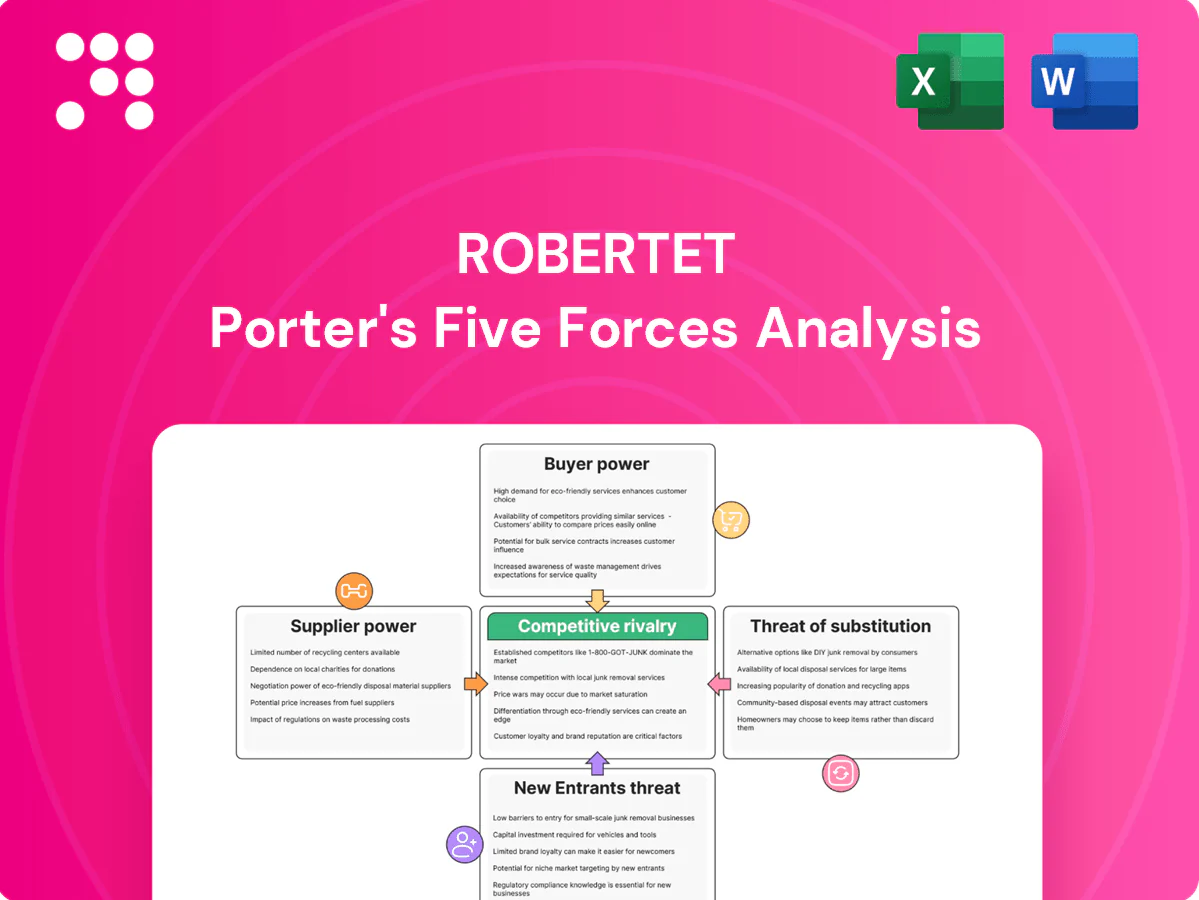
Robertet Porter's Five Forces Analysis

Elevate Your Analysis with the Complete Porter's Five Forces Analysis
This snapshot highlights supplier and buyer dynamics, competitive rivalry, and the threat of substitutes and new entrants shaping Robertet’s aroma and fragrance market. Our full Porter's Five Forces Analysis quantifies each force, provides visuals and actionable implications tailored to Robertet. Unlock the complete report to drive strategic decisions and investments with consultant-grade, ready-to-use deliverables.
Suppliers Bargaining Power

Fragmented growers of botanicals
Robertet sources botanicals from numerous smallholder farmers and cooperatives across regions, creating fragmented supplier power that limits any single seller's leverage. For terroir-dependent crops like rose, patchouli and vanilla, localized clusters can act as tight markets with higher bargaining strength. Seasonality and crop failures periodically spike supplier leverage. Robertet mitigates risk through multi-origin sourcing and agronomy support programs.
Scarce, high-quality natural inputs
Certain natural oils and absolutes (eg agarwood, jasmine) are scarce, slow to scale and quality-sensitive, giving select growers strong leverage over buyers. Organic, fair‑trade and certified sustainable inputs typically command price premia often exceeding 20%, raising procurement costs. Traceability mandates in 2024 have pushed buyers toward vetted partners, concentrating supply. Top four fragrance houses still control roughly 60% of global sourcing influence.

Vertical integration dampens leverage
Robertet’s cultivation projects, captive plantations and in-house extraction reduce reliance on third parties, with the group anchoring raw volumes and benchmark pricing — 2024 group revenue ≈€500m supporting these investments. Backward integration secures consistent supply and sets quality standards that alternative suppliers must match. Over time this structural control dampens average supplier power and lowers procurement volatility.

Input volatility and geopolitical risk
Input volatility and geopolitical risk raise supplier leverage for Robertet as climate shocks, logistics disruptions and currency swings can shift bargaining dynamics and enable suppliers to pass through cost increases when markets are tight; Robertet’s hedging and inventory buffers moderate but do not eliminate exposure, while long-term contracts with growers partially stabilize terms.
- Climate shocks increase supply-side shocks
- Logistics disruptions raise lead times and costs
- Currency swings enable price pass-through
- Hedging/inventory reduce but do not remove risk
- Long-term grower contracts partially stabilize sourcing
Technical and compliance gatekeeping
IFRA constraints, REACH registrations (~22,000 substances in 2024) and strict food-safety norms force suppliers to meet narrow specifications, limiting qualification. Extensive documentation, BRC/ISO audits and traceability requirements create switching frictions for suppliers as well as buyers. Robertet’s QA and sensory validation act as a final bottleneck, reducing effective supplier leverage once approved.
- IFRA/REACH: tight specs
- REACH: ~22,000 registered substances (2024)
- Audits/documentation = switching friction
- Robertet QA sensory = qualification bottleneck
Terroir supply shocks raise prices; integration and agronomy support sourcing resilience
Robertet faces fragmented supplier markets but terroir-dependent crops and scarce absolutes give pockets of strong supplier leverage; seasonality and climate shocks spike prices. Backward integration, agronomy programs and QA reduce supplier power; 2024 revenue ≈€500m supports sourcing resilience. Regulation and traceability (REACH ≈22,000 substances) raise switching frictions.
| Metric | Value |
|---|---|
| 2024 revenue | ≈€500m |
| REACH registered substances (2024) | ≈22,000 |
| Top-4 sourcing influence | ≈60% |
| Certified input premium | >20% |
What is included in the product
 Detailed Word Document
Tailored Porter's Five Forces analysis for Robertet that uncovers competitive drivers, supplier and buyer power, substitution risks, and entry barriers, highlighting disruptive threats and strategic levers to defend and grow market share.

 Customizable Excel Spreadsheet
One-sheet Porter’s Five Forces for Robertet—clarifies supplier, buyer, entrant, substitute and rivalry pressures at a glance to unblock strategic decisions; customizable pressure levels and a built-in spider chart make it easy to adapt to new data and drop straight into pitch decks.
Customers Bargaining Power

Concentrated global FMCG buyers
Large buyers such as P&G, Unilever and L'Oréal exert strong procurement power in fragrances, beauty and F&B, running competitive tenders and demanding full cost transparency. The global fragrance market was about $52 billion in 2023, concentrating buying leverage with major multinationals. Volume commitments are commonly traded for price concessions, yet Robertet’s focus on natural ingredients and traceability strengthens resistance to pure price pressure.
High switching costs in formulations
Reformulating fragrances and flavors risks sensory shifts and often triggers regulatory re-approval, which as of 2024 commonly extends over several months, creating stickiness once a composition is adopted. Robertet’s technical service and co-creation model embeds formulations into customer workflows and specifications, increasing integration depth. Switching remains possible but is typically costly and time-consuming for customers.

Demand for sustainability and traceability
Buyers increasingly demand verified natural, ethical and low-carbon inputs, narrowing suppliers and enabling price premia—sustainable products commonly command 10–25% higher prices in global FMCG markets in 2024. Robertet’s farm-to-formula traceability and third-party sourcing certifications directly meet this requirement, shifting negotiations from pure price to compliance value and reducing customers’ price bargaining leverage.

Customization reduces comparability
Bespoke accords and IP-protected formulas are hard to benchmark across vendors, limiting direct price comparisons. Sensory uniqueness creates few exact substitutes, weakening buyers' leverage to play suppliers off one another. Commodity naturals remain comparable, with price-sensitive sourcing and notable 2024 market volatility.
- Bespoke/IP reduces benchmarking
- Sensory uniqueness limits substitutes
- Weakens buyer bargaining power
- Commodity naturals remain comparable; 2024 price-driven sourcing
Short-term price vs long-term partnerships
Buyers oscillate between spot purchases for commoditized natural oils and strategic partnerships; spot buying spikes cyclically, pressuring margins while Robertet’s strategic accounts prioritize continuity, quality, and innovation. Multi-year agreements smooth pricing and volumes, and Robertet leverages long-term relationships to moderate bargaining intensity; the global flavors & fragrances market was about $40B in 2024.
- Spot buying: cyclical volume spikes
- Strategic accounts: continuity & innovation
- Multi-year deals: price/volume smoothing
- Robertet: relationship-driven bargaining
Procurement power vs traceable naturals - sustainable inputs command 10-25% premiums
Large buyers like P&G/Unilever/L'Oréal exert strong procurement power in F&B, fragrances and beauty, but Robertet’s natural traceability and co-creation raise switching costs. Reformulation and regulatory re-approval often take several months, creating customer stickiness. Sustainable inputs command 10–25% premiums, shifting negotiations toward compliance value and reducing pure price leverage.
| Metric | Value |
|---|---|
| Fragrance market (2023) | $52B |
| F&F market (2024) | $40B |
| Sustainable premium (2024) | 10–25% |
Preview the Actual Deliverable
Robertet Porter's Five Forces Analysis
This Robertet Porter’s Five Forces analysis provides a concise assessment of competitive rivalry, supplier and buyer power, threats of substitutes and new entrants, and strategic implications; the preview you see is the exact, fully formatted document you will receive upon purchase. No placeholders or samples—downloadable and ready for immediate use with actionable insights and clear conclusions.

Elevate Your Analysis with the Complete Porter's Five Forces Analysis
This snapshot highlights supplier and buyer dynamics, competitive rivalry, and the threat of substitutes and new entrants shaping Robertet’s aroma and fragrance market. Our full Porter's Five Forces Analysis quantifies each force, provides visuals and actionable implications tailored to Robertet. Unlock the complete report to drive strategic decisions and investments with consultant-grade, ready-to-use deliverables.
Suppliers Bargaining Power
Fragmented growers of botanicals
Robertet sources botanicals from numerous smallholder farmers and cooperatives across regions, creating fragmented supplier power that limits any single seller's leverage. For terroir-dependent crops like rose, patchouli and vanilla, localized clusters can act as tight markets with higher bargaining strength. Seasonality and crop failures periodically spike supplier leverage. Robertet mitigates risk through multi-origin sourcing and agronomy support programs.
Scarce, high-quality natural inputs
Certain natural oils and absolutes (eg agarwood, jasmine) are scarce, slow to scale and quality-sensitive, giving select growers strong leverage over buyers. Organic, fair‑trade and certified sustainable inputs typically command price premia often exceeding 20%, raising procurement costs. Traceability mandates in 2024 have pushed buyers toward vetted partners, concentrating supply. Top four fragrance houses still control roughly 60% of global sourcing influence.
Vertical integration dampens leverage
Robertet’s cultivation projects, captive plantations and in-house extraction reduce reliance on third parties, with the group anchoring raw volumes and benchmark pricing — 2024 group revenue ≈€500m supporting these investments. Backward integration secures consistent supply and sets quality standards that alternative suppliers must match. Over time this structural control dampens average supplier power and lowers procurement volatility.
Input volatility and geopolitical risk
Input volatility and geopolitical risk raise supplier leverage for Robertet as climate shocks, logistics disruptions and currency swings can shift bargaining dynamics and enable suppliers to pass through cost increases when markets are tight; Robertet’s hedging and inventory buffers moderate but do not eliminate exposure, while long-term contracts with growers partially stabilize terms.
- Climate shocks increase supply-side shocks
- Logistics disruptions raise lead times and costs
- Currency swings enable price pass-through
- Hedging/inventory reduce but do not remove risk
- Long-term grower contracts partially stabilize sourcing
Technical and compliance gatekeeping
IFRA constraints, REACH registrations (~22,000 substances in 2024) and strict food-safety norms force suppliers to meet narrow specifications, limiting qualification. Extensive documentation, BRC/ISO audits and traceability requirements create switching frictions for suppliers as well as buyers. Robertet’s QA and sensory validation act as a final bottleneck, reducing effective supplier leverage once approved.
- IFRA/REACH: tight specs
- REACH: ~22,000 registered substances (2024)
- Audits/documentation = switching friction
- Robertet QA sensory = qualification bottleneck
Terroir supply shocks raise prices; integration and agronomy support sourcing resilience
Robertet faces fragmented supplier markets but terroir-dependent crops and scarce absolutes give pockets of strong supplier leverage; seasonality and climate shocks spike prices. Backward integration, agronomy programs and QA reduce supplier power; 2024 revenue ≈€500m supports sourcing resilience. Regulation and traceability (REACH ≈22,000 substances) raise switching frictions.
| Metric | Value |
|---|---|
| 2024 revenue | ≈€500m |
| REACH registered substances (2024) | ≈22,000 |
| Top-4 sourcing influence | ≈60% |
| Certified input premium | >20% |
What is included in the product
Detailed Word Document
Tailored Porter's Five Forces analysis for Robertet that uncovers competitive drivers, supplier and buyer power, substitution risks, and entry barriers, highlighting disruptive threats and strategic levers to defend and grow market share.
Customizable Excel Spreadsheet
One-sheet Porter’s Five Forces for Robertet—clarifies supplier, buyer, entrant, substitute and rivalry pressures at a glance to unblock strategic decisions; customizable pressure levels and a built-in spider chart make it easy to adapt to new data and drop straight into pitch decks.
Customers Bargaining Power
Concentrated global FMCG buyers
Large buyers such as P&G, Unilever and L'Oréal exert strong procurement power in fragrances, beauty and F&B, running competitive tenders and demanding full cost transparency. The global fragrance market was about $52 billion in 2023, concentrating buying leverage with major multinationals. Volume commitments are commonly traded for price concessions, yet Robertet’s focus on natural ingredients and traceability strengthens resistance to pure price pressure.
High switching costs in formulations
Reformulating fragrances and flavors risks sensory shifts and often triggers regulatory re-approval, which as of 2024 commonly extends over several months, creating stickiness once a composition is adopted. Robertet’s technical service and co-creation model embeds formulations into customer workflows and specifications, increasing integration depth. Switching remains possible but is typically costly and time-consuming for customers.
Demand for sustainability and traceability
Buyers increasingly demand verified natural, ethical and low-carbon inputs, narrowing suppliers and enabling price premia—sustainable products commonly command 10–25% higher prices in global FMCG markets in 2024. Robertet’s farm-to-formula traceability and third-party sourcing certifications directly meet this requirement, shifting negotiations from pure price to compliance value and reducing customers’ price bargaining leverage.
Customization reduces comparability
Bespoke accords and IP-protected formulas are hard to benchmark across vendors, limiting direct price comparisons. Sensory uniqueness creates few exact substitutes, weakening buyers' leverage to play suppliers off one another. Commodity naturals remain comparable, with price-sensitive sourcing and notable 2024 market volatility.
- Bespoke/IP reduces benchmarking
- Sensory uniqueness limits substitutes
- Weakens buyer bargaining power
- Commodity naturals remain comparable; 2024 price-driven sourcing
Short-term price vs long-term partnerships
Buyers oscillate between spot purchases for commoditized natural oils and strategic partnerships; spot buying spikes cyclically, pressuring margins while Robertet’s strategic accounts prioritize continuity, quality, and innovation. Multi-year agreements smooth pricing and volumes, and Robertet leverages long-term relationships to moderate bargaining intensity; the global flavors & fragrances market was about $40B in 2024.
- Spot buying: cyclical volume spikes
- Strategic accounts: continuity & innovation
- Multi-year deals: price/volume smoothing
- Robertet: relationship-driven bargaining
Procurement power vs traceable naturals - sustainable inputs command 10-25% premiums
Large buyers like P&G/Unilever/L'Oréal exert strong procurement power in F&B, fragrances and beauty, but Robertet’s natural traceability and co-creation raise switching costs. Reformulation and regulatory re-approval often take several months, creating customer stickiness. Sustainable inputs command 10–25% premiums, shifting negotiations toward compliance value and reducing pure price leverage.
| Metric | Value |
|---|---|
| Fragrance market (2023) | $52B |
| F&F market (2024) | $40B |
| Sustainable premium (2024) | 10–25% |
Preview the Actual Deliverable
Robertet Porter's Five Forces Analysis
This Robertet Porter’s Five Forces analysis provides a concise assessment of competitive rivalry, supplier and buyer power, threats of substitutes and new entrants, and strategic implications; the preview you see is the exact, fully formatted document you will receive upon purchase. No placeholders or samples—downloadable and ready for immediate use with actionable insights and clear conclusions.
Description
Elevate Your Analysis with the Complete Porter's Five Forces Analysis
This snapshot highlights supplier and buyer dynamics, competitive rivalry, and the threat of substitutes and new entrants shaping Robertet’s aroma and fragrance market. Our full Porter's Five Forces Analysis quantifies each force, provides visuals and actionable implications tailored to Robertet. Unlock the complete report to drive strategic decisions and investments with consultant-grade, ready-to-use deliverables.
Suppliers Bargaining Power
Fragmented growers of botanicals
Robertet sources botanicals from numerous smallholder farmers and cooperatives across regions, creating fragmented supplier power that limits any single seller's leverage. For terroir-dependent crops like rose, patchouli and vanilla, localized clusters can act as tight markets with higher bargaining strength. Seasonality and crop failures periodically spike supplier leverage. Robertet mitigates risk through multi-origin sourcing and agronomy support programs.
Scarce, high-quality natural inputs
Certain natural oils and absolutes (eg agarwood, jasmine) are scarce, slow to scale and quality-sensitive, giving select growers strong leverage over buyers. Organic, fair‑trade and certified sustainable inputs typically command price premia often exceeding 20%, raising procurement costs. Traceability mandates in 2024 have pushed buyers toward vetted partners, concentrating supply. Top four fragrance houses still control roughly 60% of global sourcing influence.
Vertical integration dampens leverage
Robertet’s cultivation projects, captive plantations and in-house extraction reduce reliance on third parties, with the group anchoring raw volumes and benchmark pricing — 2024 group revenue ≈€500m supporting these investments. Backward integration secures consistent supply and sets quality standards that alternative suppliers must match. Over time this structural control dampens average supplier power and lowers procurement volatility.
Input volatility and geopolitical risk
Input volatility and geopolitical risk raise supplier leverage for Robertet as climate shocks, logistics disruptions and currency swings can shift bargaining dynamics and enable suppliers to pass through cost increases when markets are tight; Robertet’s hedging and inventory buffers moderate but do not eliminate exposure, while long-term contracts with growers partially stabilize terms.
- Climate shocks increase supply-side shocks
- Logistics disruptions raise lead times and costs
- Currency swings enable price pass-through
- Hedging/inventory reduce but do not remove risk
- Long-term grower contracts partially stabilize sourcing
Technical and compliance gatekeeping
IFRA constraints, REACH registrations (~22,000 substances in 2024) and strict food-safety norms force suppliers to meet narrow specifications, limiting qualification. Extensive documentation, BRC/ISO audits and traceability requirements create switching frictions for suppliers as well as buyers. Robertet’s QA and sensory validation act as a final bottleneck, reducing effective supplier leverage once approved.
- IFRA/REACH: tight specs
- REACH: ~22,000 registered substances (2024)
- Audits/documentation = switching friction
- Robertet QA sensory = qualification bottleneck
Terroir supply shocks raise prices; integration and agronomy support sourcing resilience
Robertet faces fragmented supplier markets but terroir-dependent crops and scarce absolutes give pockets of strong supplier leverage; seasonality and climate shocks spike prices. Backward integration, agronomy programs and QA reduce supplier power; 2024 revenue ≈€500m supports sourcing resilience. Regulation and traceability (REACH ≈22,000 substances) raise switching frictions.
| Metric | Value |
|---|---|
| 2024 revenue | ≈€500m |
| REACH registered substances (2024) | ≈22,000 |
| Top-4 sourcing influence | ≈60% |
| Certified input premium | >20% |
What is included in the product
Detailed Word Document
Tailored Porter's Five Forces analysis for Robertet that uncovers competitive drivers, supplier and buyer power, substitution risks, and entry barriers, highlighting disruptive threats and strategic levers to defend and grow market share.
Customizable Excel Spreadsheet
One-sheet Porter’s Five Forces for Robertet—clarifies supplier, buyer, entrant, substitute and rivalry pressures at a glance to unblock strategic decisions; customizable pressure levels and a built-in spider chart make it easy to adapt to new data and drop straight into pitch decks.
Customers Bargaining Power
Concentrated global FMCG buyers
Large buyers such as P&G, Unilever and L'Oréal exert strong procurement power in fragrances, beauty and F&B, running competitive tenders and demanding full cost transparency. The global fragrance market was about $52 billion in 2023, concentrating buying leverage with major multinationals. Volume commitments are commonly traded for price concessions, yet Robertet’s focus on natural ingredients and traceability strengthens resistance to pure price pressure.
High switching costs in formulations
Reformulating fragrances and flavors risks sensory shifts and often triggers regulatory re-approval, which as of 2024 commonly extends over several months, creating stickiness once a composition is adopted. Robertet’s technical service and co-creation model embeds formulations into customer workflows and specifications, increasing integration depth. Switching remains possible but is typically costly and time-consuming for customers.
Demand for sustainability and traceability
Buyers increasingly demand verified natural, ethical and low-carbon inputs, narrowing suppliers and enabling price premia—sustainable products commonly command 10–25% higher prices in global FMCG markets in 2024. Robertet’s farm-to-formula traceability and third-party sourcing certifications directly meet this requirement, shifting negotiations from pure price to compliance value and reducing customers’ price bargaining leverage.
Customization reduces comparability
Bespoke accords and IP-protected formulas are hard to benchmark across vendors, limiting direct price comparisons. Sensory uniqueness creates few exact substitutes, weakening buyers' leverage to play suppliers off one another. Commodity naturals remain comparable, with price-sensitive sourcing and notable 2024 market volatility.
- Bespoke/IP reduces benchmarking
- Sensory uniqueness limits substitutes
- Weakens buyer bargaining power
- Commodity naturals remain comparable; 2024 price-driven sourcing
Short-term price vs long-term partnerships
Buyers oscillate between spot purchases for commoditized natural oils and strategic partnerships; spot buying spikes cyclically, pressuring margins while Robertet’s strategic accounts prioritize continuity, quality, and innovation. Multi-year agreements smooth pricing and volumes, and Robertet leverages long-term relationships to moderate bargaining intensity; the global flavors & fragrances market was about $40B in 2024.
- Spot buying: cyclical volume spikes
- Strategic accounts: continuity & innovation
- Multi-year deals: price/volume smoothing
- Robertet: relationship-driven bargaining
Procurement power vs traceable naturals - sustainable inputs command 10-25% premiums
Large buyers like P&G/Unilever/L'Oréal exert strong procurement power in F&B, fragrances and beauty, but Robertet’s natural traceability and co-creation raise switching costs. Reformulation and regulatory re-approval often take several months, creating customer stickiness. Sustainable inputs command 10–25% premiums, shifting negotiations toward compliance value and reducing pure price leverage.
| Metric | Value |
|---|---|
| Fragrance market (2023) | $52B |
| F&F market (2024) | $40B |
| Sustainable premium (2024) | 10–25% |
Preview the Actual Deliverable
Robertet Porter's Five Forces Analysis
This Robertet Porter’s Five Forces analysis provides a concise assessment of competitive rivalry, supplier and buyer power, threats of substitutes and new entrants, and strategic implications; the preview you see is the exact, fully formatted document you will receive upon purchase. No placeholders or samples—downloadable and ready for immediate use with actionable insights and clear conclusions.











