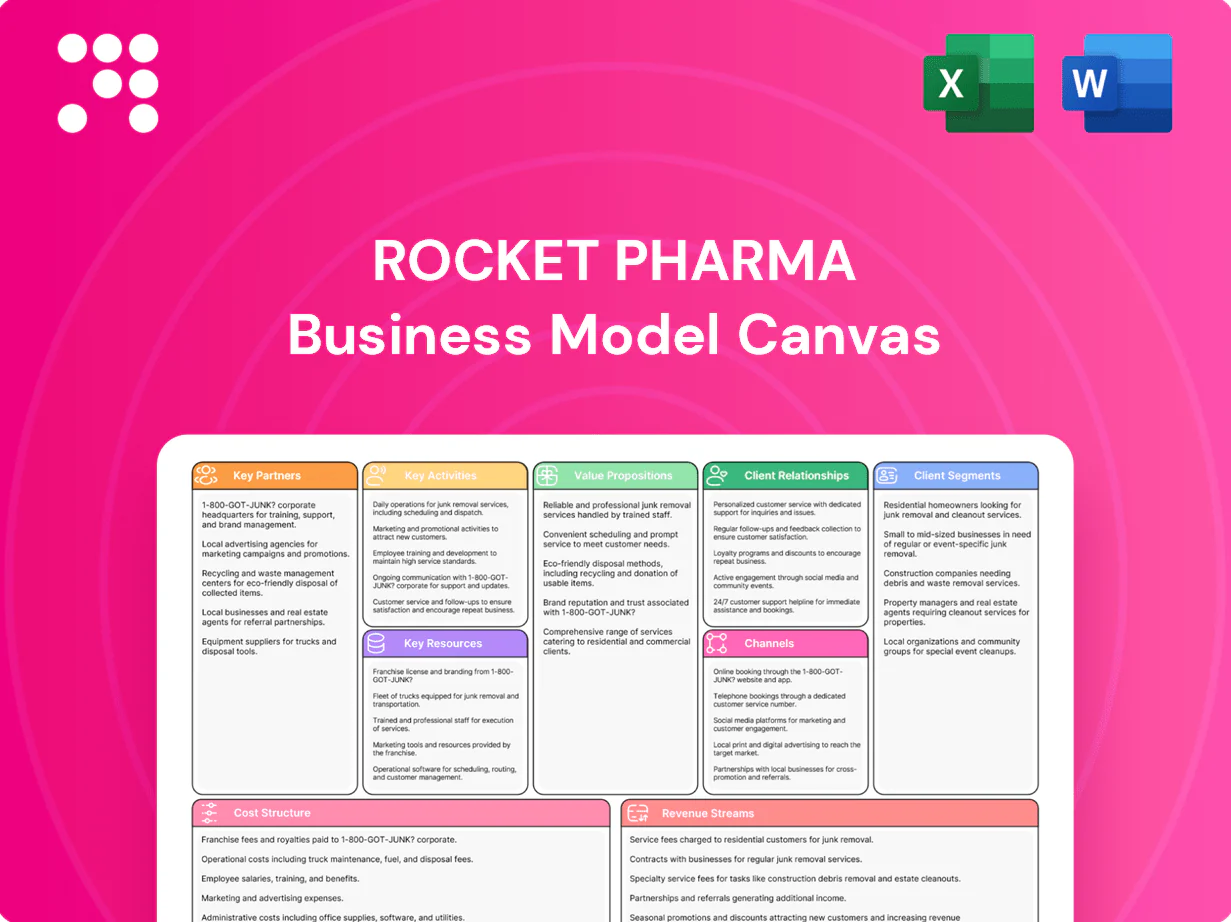
Rocket Pharma Business Model Canvas

Gene-therapy Business Model Canvas: KOL partnerships, payer strategies & revenue
Unlock Rocket Pharma's strategic blueprint with our concise Business Model Canvas preview. See how targeted gene therapies, key KOL partnerships, and payer strategies create value and revenue streams. Download the full canvas (Word/Excel) for a section-by-section breakdown, financial implications, and actionable insights to benchmark or invest.
Partnerships

Academic and hospital research centers
Collaborations with over 15 top-tier academic and hospital research centers accelerate patient identification, trial enrollment, and protocol design, reducing site startup timelines and broadening recruitment for rare-disease indications. Investigators contribute disease expertise and access to natural history datasets critical for statistical powering. Co-development of endpoints with these sites improves regulatory readiness and positions them as future treatment hubs.
CDMOs for LVV/AAV manufacturing
Specialized CDMOs enable scalable GMP LVV/AAV production with strict quality controls, supporting process development, fill-finish, and release testing to meet regulatory standards. In 2024 there are over 300 clinical AAV/LVV programs, making flexible CDMO slots essential to manage program surges. Dual sourcing across multiple CDMOs reduces supply-chain risk and mitigates batch failures and capacity bottlenecks. CDMO partnerships lower time-to-clinic and capital outlay for Rocket Pharma.

CROs and specialty labs
CROs run multi-center trials efficiently across geographies, managing monitoring, data capture and bioanalytics; the global CRO market was about 70 billion USD in 2024, reflecting broad capacity and scale. Specialty labs deliver biodistribution, vector shedding and immunogenicity assays with typical turnaround of 2–4 weeks. These partnerships shorten timelines and strengthen data integrity for Rocket Pharma.

Patient advocacy and foundations
Patient advocacy groups build community trust and education for rare diseases, reaching about 300 million patients across more than 7,000 conditions. They support patient registries and natural history studies that accelerate recruitment and enrich phenotype data. Co-created materials boost trial awareness and literacy, while foundation grants and co-funding help de-risk early-stage programs.
- Trust & education
- Registries & natural history
- Co-created outreach
- Grants/co-funding
Payers and health technology bodies
Early value dialogues with payers and HTA bodies shape evidence packages and pricing models, enabling outcomes-based frameworks that align payment with real-world benefit and have been adopted increasingly by payers in 2024 to manage gene therapy budget impact; joint planning readies coverage pathways pre-approval and improves time-to-reimbursement at launch.
- Early dialogues
- Outcomes-based payment
- Pre-approval coverage planning
- Faster reimbursement
Academic hubs, CDMOs & CROs scale gene therapy; patient groups and payers enable outcomes access
Academic hubs (>15 partners) accelerate enrollment and provide natural history data; CDMOs enable GMP scale amid 300+ clinical AAV/LVV programs in 2024; CROs (global market ~$70B in 2024) and specialty labs speed data generation; patient groups reach ~300M across 7,000 conditions and enable registries; early payer dialogues drive outcomes-based payment adoption in 2024.
| Partner | Role | 2024 Metric |
|---|---|---|
| Academia | Enrollment, expertise | >15 partners |
| CDMOs | GMP vector supply | 300+ AAV/LVV programs |
| CROs | Trials, bioanalytics | $70B market |
| Patient groups | Registries, outreach | ~300M patients |
| Payers/HTA | Reimbursement frameworks | Rising outcomes-based adoption |
What is included in the product
 Detailed Word Document
A concise Business Model Canvas for Rocket Pharmaceuticals outlining value propositions in gene therapies for rare pediatric diseases, key partners (research institutions, CDMOs), patient and payer channels, revenue streams from licensing and product sales, and operational and regulatory cost structures to support investor presentations and strategic planning.

 Customizable Excel Spreadsheet
High-level view of Rocket Pharma's business model with editable cells—quickly pinpoint therapeutic focus, clinical milestones, partner and royalty structures to streamline prioritization and reduce strategic ambiguity.
Activities

Vector design and optimization
Engineering LVV and AAV vectors to maximize transduction and durability is core to Rocket Pharma, with capsid selection, promoters and regulatory elements tuned to each target disease to enhance tissue specificity and expression longevity. Off-target risks are mitigated through rational design, in vitro/in vivo testing and biodistribution studies. Iterative optimization of constructs and manufacturing drives improvements in potency and safety, and in 2024 AAV/LVV approaches remained dominant in gene therapy clinical pipelines.
GMP manufacturing and CMC
Developing robust, scalable GMP processes (ICH Q7) ensures consistent product quality and manufacturability. In-process controls and release assays are validated to ICH Q2(R1) and 21 CFR Part 211 standards. Tech transfers to experienced CDMOs de-risk capacity and accelerate scale-up. Continuous CMC improvements align with ICH Q10 for lifecycle management.

Preclinical and clinical development
Translational studies define dose, biodistribution and safety using GLP toxicology in two species and IND-enabling assays to meet FDA/EMA expectations. Adaptive trial designs are used to accelerate learning in ultra-rare populations, reducing sample size and timelines. Global multi-site trials (North America, Europe, Australia) broaden patient access. Integrated data packages support IND/CTA and eventual BLA/MAA filings.

Regulatory strategy and submissions
Regulatory strategy and submissions drive Rocket Pharma's clinical design through proactive agency interactions that align endpoints and comparators, with IND/CTA filings and RMAT/PRIME requests sequenced toward eventual BLA/MAA submissions in 2024; safety reporting and long-term follow-up protocols are maintained continuously, and label negotiation begins early to de-risk commercialization.
- Proactive agency engagement
- Sequenced IND/CTA → RMAT/PRIME → BLA/MAA
- Continuous safety reporting & long-term follow-up
- Early label negotiation
Market access and real-world evidence
Value dossiers are tailored to payer and HTA criteria, linking endpoints to long-term benefit; outcomes registries track durability and safety post-launch with RWE cohorts exceeding 100 patients in select programs by 2024; contracts test outcomes-based payments to de-risk ~2M+ one-time gene therapy price points; insights loop back to clinical and CMC teams to refine endpoints and manufacturing.
- Value dossiers: payer/HTA alignment
- Registries: RWE cohorts >100 (2024)
- Contracts: outcomes-based pilots vs ~$2M price points
- Feedback: clinical/CMC optimization
Tissue-targeted AAV/LVV gene therapy: CMC scale-up, GLP tox, adaptive trials, payer-ready RWE
Engineering AAV/LVV constructs for tissue-specific, durable expression; iterative CMC and GMP scale-ups (ICH Q7/Q10, ICH Q2(R1), 21 CFR) with CDMO tech-transfers. GLP IND-enabling tox, adaptive ultra-rare trials across NA/EU/AUS, RMAT/PRIME sequencing toward BLA/MAA. Payer-aligned value dossiers, RWE registries >100 (2024), outcomes-based pilots vs ~$2M price points.
| Activity | Metric | 2024 |
|---|---|---|
| Vector platform | AAV/LVV | Dominant |
| RWE registries | Cohort size | >100 |
| Price pilots | One-time | ~$2M |
| Regulatory/CMC | Standards | ICH Q7/Q10/Q2(R1), 21 CFR |
Full Version Awaits
Business Model Canvas
The document you're previewing is the exact Rocket Pharma Business Model Canvas you'll receive after purchase. It's not a mockup—it's the live, fully formatted deliverable with all content included. Upon purchase you'll download the same file ready to edit, present, or share in Word and Excel.

Gene-therapy Business Model Canvas: KOL partnerships, payer strategies & revenue
Unlock Rocket Pharma's strategic blueprint with our concise Business Model Canvas preview. See how targeted gene therapies, key KOL partnerships, and payer strategies create value and revenue streams. Download the full canvas (Word/Excel) for a section-by-section breakdown, financial implications, and actionable insights to benchmark or invest.
Partnerships
Academic and hospital research centers
Collaborations with over 15 top-tier academic and hospital research centers accelerate patient identification, trial enrollment, and protocol design, reducing site startup timelines and broadening recruitment for rare-disease indications. Investigators contribute disease expertise and access to natural history datasets critical for statistical powering. Co-development of endpoints with these sites improves regulatory readiness and positions them as future treatment hubs.
CDMOs for LVV/AAV manufacturing
Specialized CDMOs enable scalable GMP LVV/AAV production with strict quality controls, supporting process development, fill-finish, and release testing to meet regulatory standards. In 2024 there are over 300 clinical AAV/LVV programs, making flexible CDMO slots essential to manage program surges. Dual sourcing across multiple CDMOs reduces supply-chain risk and mitigates batch failures and capacity bottlenecks. CDMO partnerships lower time-to-clinic and capital outlay for Rocket Pharma.
CROs and specialty labs
CROs run multi-center trials efficiently across geographies, managing monitoring, data capture and bioanalytics; the global CRO market was about 70 billion USD in 2024, reflecting broad capacity and scale. Specialty labs deliver biodistribution, vector shedding and immunogenicity assays with typical turnaround of 2–4 weeks. These partnerships shorten timelines and strengthen data integrity for Rocket Pharma.
Patient advocacy and foundations
Patient advocacy groups build community trust and education for rare diseases, reaching about 300 million patients across more than 7,000 conditions. They support patient registries and natural history studies that accelerate recruitment and enrich phenotype data. Co-created materials boost trial awareness and literacy, while foundation grants and co-funding help de-risk early-stage programs.
- Trust & education
- Registries & natural history
- Co-created outreach
- Grants/co-funding
Payers and health technology bodies
Early value dialogues with payers and HTA bodies shape evidence packages and pricing models, enabling outcomes-based frameworks that align payment with real-world benefit and have been adopted increasingly by payers in 2024 to manage gene therapy budget impact; joint planning readies coverage pathways pre-approval and improves time-to-reimbursement at launch.
- Early dialogues
- Outcomes-based payment
- Pre-approval coverage planning
- Faster reimbursement
Academic hubs, CDMOs & CROs scale gene therapy; patient groups and payers enable outcomes access
Academic hubs (>15 partners) accelerate enrollment and provide natural history data; CDMOs enable GMP scale amid 300+ clinical AAV/LVV programs in 2024; CROs (global market ~$70B in 2024) and specialty labs speed data generation; patient groups reach ~300M across 7,000 conditions and enable registries; early payer dialogues drive outcomes-based payment adoption in 2024.
| Partner | Role | 2024 Metric |
|---|---|---|
| Academia | Enrollment, expertise | >15 partners |
| CDMOs | GMP vector supply | 300+ AAV/LVV programs |
| CROs | Trials, bioanalytics | $70B market |
| Patient groups | Registries, outreach | ~300M patients |
| Payers/HTA | Reimbursement frameworks | Rising outcomes-based adoption |
What is included in the product
Detailed Word Document
A concise Business Model Canvas for Rocket Pharmaceuticals outlining value propositions in gene therapies for rare pediatric diseases, key partners (research institutions, CDMOs), patient and payer channels, revenue streams from licensing and product sales, and operational and regulatory cost structures to support investor presentations and strategic planning.
Customizable Excel Spreadsheet
High-level view of Rocket Pharma's business model with editable cells—quickly pinpoint therapeutic focus, clinical milestones, partner and royalty structures to streamline prioritization and reduce strategic ambiguity.
Activities
Vector design and optimization
Engineering LVV and AAV vectors to maximize transduction and durability is core to Rocket Pharma, with capsid selection, promoters and regulatory elements tuned to each target disease to enhance tissue specificity and expression longevity. Off-target risks are mitigated through rational design, in vitro/in vivo testing and biodistribution studies. Iterative optimization of constructs and manufacturing drives improvements in potency and safety, and in 2024 AAV/LVV approaches remained dominant in gene therapy clinical pipelines.
GMP manufacturing and CMC
Developing robust, scalable GMP processes (ICH Q7) ensures consistent product quality and manufacturability. In-process controls and release assays are validated to ICH Q2(R1) and 21 CFR Part 211 standards. Tech transfers to experienced CDMOs de-risk capacity and accelerate scale-up. Continuous CMC improvements align with ICH Q10 for lifecycle management.
Preclinical and clinical development
Translational studies define dose, biodistribution and safety using GLP toxicology in two species and IND-enabling assays to meet FDA/EMA expectations. Adaptive trial designs are used to accelerate learning in ultra-rare populations, reducing sample size and timelines. Global multi-site trials (North America, Europe, Australia) broaden patient access. Integrated data packages support IND/CTA and eventual BLA/MAA filings.
Regulatory strategy and submissions
Regulatory strategy and submissions drive Rocket Pharma's clinical design through proactive agency interactions that align endpoints and comparators, with IND/CTA filings and RMAT/PRIME requests sequenced toward eventual BLA/MAA submissions in 2024; safety reporting and long-term follow-up protocols are maintained continuously, and label negotiation begins early to de-risk commercialization.
- Proactive agency engagement
- Sequenced IND/CTA → RMAT/PRIME → BLA/MAA
- Continuous safety reporting & long-term follow-up
- Early label negotiation
Market access and real-world evidence
Value dossiers are tailored to payer and HTA criteria, linking endpoints to long-term benefit; outcomes registries track durability and safety post-launch with RWE cohorts exceeding 100 patients in select programs by 2024; contracts test outcomes-based payments to de-risk ~2M+ one-time gene therapy price points; insights loop back to clinical and CMC teams to refine endpoints and manufacturing.
- Value dossiers: payer/HTA alignment
- Registries: RWE cohorts >100 (2024)
- Contracts: outcomes-based pilots vs ~$2M price points
- Feedback: clinical/CMC optimization
Tissue-targeted AAV/LVV gene therapy: CMC scale-up, GLP tox, adaptive trials, payer-ready RWE
Engineering AAV/LVV constructs for tissue-specific, durable expression; iterative CMC and GMP scale-ups (ICH Q7/Q10, ICH Q2(R1), 21 CFR) with CDMO tech-transfers. GLP IND-enabling tox, adaptive ultra-rare trials across NA/EU/AUS, RMAT/PRIME sequencing toward BLA/MAA. Payer-aligned value dossiers, RWE registries >100 (2024), outcomes-based pilots vs ~$2M price points.
| Activity | Metric | 2024 |
|---|---|---|
| Vector platform | AAV/LVV | Dominant |
| RWE registries | Cohort size | >100 |
| Price pilots | One-time | ~$2M |
| Regulatory/CMC | Standards | ICH Q7/Q10/Q2(R1), 21 CFR |
Full Version Awaits
Business Model Canvas
The document you're previewing is the exact Rocket Pharma Business Model Canvas you'll receive after purchase. It's not a mockup—it's the live, fully formatted deliverable with all content included. Upon purchase you'll download the same file ready to edit, present, or share in Word and Excel.
Description
Gene-therapy Business Model Canvas: KOL partnerships, payer strategies & revenue
Unlock Rocket Pharma's strategic blueprint with our concise Business Model Canvas preview. See how targeted gene therapies, key KOL partnerships, and payer strategies create value and revenue streams. Download the full canvas (Word/Excel) for a section-by-section breakdown, financial implications, and actionable insights to benchmark or invest.
Partnerships
Academic and hospital research centers
Collaborations with over 15 top-tier academic and hospital research centers accelerate patient identification, trial enrollment, and protocol design, reducing site startup timelines and broadening recruitment for rare-disease indications. Investigators contribute disease expertise and access to natural history datasets critical for statistical powering. Co-development of endpoints with these sites improves regulatory readiness and positions them as future treatment hubs.
CDMOs for LVV/AAV manufacturing
Specialized CDMOs enable scalable GMP LVV/AAV production with strict quality controls, supporting process development, fill-finish, and release testing to meet regulatory standards. In 2024 there are over 300 clinical AAV/LVV programs, making flexible CDMO slots essential to manage program surges. Dual sourcing across multiple CDMOs reduces supply-chain risk and mitigates batch failures and capacity bottlenecks. CDMO partnerships lower time-to-clinic and capital outlay for Rocket Pharma.
CROs and specialty labs
CROs run multi-center trials efficiently across geographies, managing monitoring, data capture and bioanalytics; the global CRO market was about 70 billion USD in 2024, reflecting broad capacity and scale. Specialty labs deliver biodistribution, vector shedding and immunogenicity assays with typical turnaround of 2–4 weeks. These partnerships shorten timelines and strengthen data integrity for Rocket Pharma.
Patient advocacy and foundations
Patient advocacy groups build community trust and education for rare diseases, reaching about 300 million patients across more than 7,000 conditions. They support patient registries and natural history studies that accelerate recruitment and enrich phenotype data. Co-created materials boost trial awareness and literacy, while foundation grants and co-funding help de-risk early-stage programs.
- Trust & education
- Registries & natural history
- Co-created outreach
- Grants/co-funding
Payers and health technology bodies
Early value dialogues with payers and HTA bodies shape evidence packages and pricing models, enabling outcomes-based frameworks that align payment with real-world benefit and have been adopted increasingly by payers in 2024 to manage gene therapy budget impact; joint planning readies coverage pathways pre-approval and improves time-to-reimbursement at launch.
- Early dialogues
- Outcomes-based payment
- Pre-approval coverage planning
- Faster reimbursement
Academic hubs, CDMOs & CROs scale gene therapy; patient groups and payers enable outcomes access
Academic hubs (>15 partners) accelerate enrollment and provide natural history data; CDMOs enable GMP scale amid 300+ clinical AAV/LVV programs in 2024; CROs (global market ~$70B in 2024) and specialty labs speed data generation; patient groups reach ~300M across 7,000 conditions and enable registries; early payer dialogues drive outcomes-based payment adoption in 2024.
| Partner | Role | 2024 Metric |
|---|---|---|
| Academia | Enrollment, expertise | >15 partners |
| CDMOs | GMP vector supply | 300+ AAV/LVV programs |
| CROs | Trials, bioanalytics | $70B market |
| Patient groups | Registries, outreach | ~300M patients |
| Payers/HTA | Reimbursement frameworks | Rising outcomes-based adoption |
What is included in the product
Detailed Word Document
A concise Business Model Canvas for Rocket Pharmaceuticals outlining value propositions in gene therapies for rare pediatric diseases, key partners (research institutions, CDMOs), patient and payer channels, revenue streams from licensing and product sales, and operational and regulatory cost structures to support investor presentations and strategic planning.
Customizable Excel Spreadsheet
High-level view of Rocket Pharma's business model with editable cells—quickly pinpoint therapeutic focus, clinical milestones, partner and royalty structures to streamline prioritization and reduce strategic ambiguity.
Activities
Vector design and optimization
Engineering LVV and AAV vectors to maximize transduction and durability is core to Rocket Pharma, with capsid selection, promoters and regulatory elements tuned to each target disease to enhance tissue specificity and expression longevity. Off-target risks are mitigated through rational design, in vitro/in vivo testing and biodistribution studies. Iterative optimization of constructs and manufacturing drives improvements in potency and safety, and in 2024 AAV/LVV approaches remained dominant in gene therapy clinical pipelines.
GMP manufacturing and CMC
Developing robust, scalable GMP processes (ICH Q7) ensures consistent product quality and manufacturability. In-process controls and release assays are validated to ICH Q2(R1) and 21 CFR Part 211 standards. Tech transfers to experienced CDMOs de-risk capacity and accelerate scale-up. Continuous CMC improvements align with ICH Q10 for lifecycle management.
Preclinical and clinical development
Translational studies define dose, biodistribution and safety using GLP toxicology in two species and IND-enabling assays to meet FDA/EMA expectations. Adaptive trial designs are used to accelerate learning in ultra-rare populations, reducing sample size and timelines. Global multi-site trials (North America, Europe, Australia) broaden patient access. Integrated data packages support IND/CTA and eventual BLA/MAA filings.
Regulatory strategy and submissions
Regulatory strategy and submissions drive Rocket Pharma's clinical design through proactive agency interactions that align endpoints and comparators, with IND/CTA filings and RMAT/PRIME requests sequenced toward eventual BLA/MAA submissions in 2024; safety reporting and long-term follow-up protocols are maintained continuously, and label negotiation begins early to de-risk commercialization.
- Proactive agency engagement
- Sequenced IND/CTA → RMAT/PRIME → BLA/MAA
- Continuous safety reporting & long-term follow-up
- Early label negotiation
Market access and real-world evidence
Value dossiers are tailored to payer and HTA criteria, linking endpoints to long-term benefit; outcomes registries track durability and safety post-launch with RWE cohorts exceeding 100 patients in select programs by 2024; contracts test outcomes-based payments to de-risk ~2M+ one-time gene therapy price points; insights loop back to clinical and CMC teams to refine endpoints and manufacturing.
- Value dossiers: payer/HTA alignment
- Registries: RWE cohorts >100 (2024)
- Contracts: outcomes-based pilots vs ~$2M price points
- Feedback: clinical/CMC optimization
Tissue-targeted AAV/LVV gene therapy: CMC scale-up, GLP tox, adaptive trials, payer-ready RWE
Engineering AAV/LVV constructs for tissue-specific, durable expression; iterative CMC and GMP scale-ups (ICH Q7/Q10, ICH Q2(R1), 21 CFR) with CDMO tech-transfers. GLP IND-enabling tox, adaptive ultra-rare trials across NA/EU/AUS, RMAT/PRIME sequencing toward BLA/MAA. Payer-aligned value dossiers, RWE registries >100 (2024), outcomes-based pilots vs ~$2M price points.
| Activity | Metric | 2024 |
|---|---|---|
| Vector platform | AAV/LVV | Dominant |
| RWE registries | Cohort size | >100 |
| Price pilots | One-time | ~$2M |
| Regulatory/CMC | Standards | ICH Q7/Q10/Q2(R1), 21 CFR |
Full Version Awaits
Business Model Canvas
The document you're previewing is the exact Rocket Pharma Business Model Canvas you'll receive after purchase. It's not a mockup—it's the live, fully formatted deliverable with all content included. Upon purchase you'll download the same file ready to edit, present, or share in Word and Excel.











