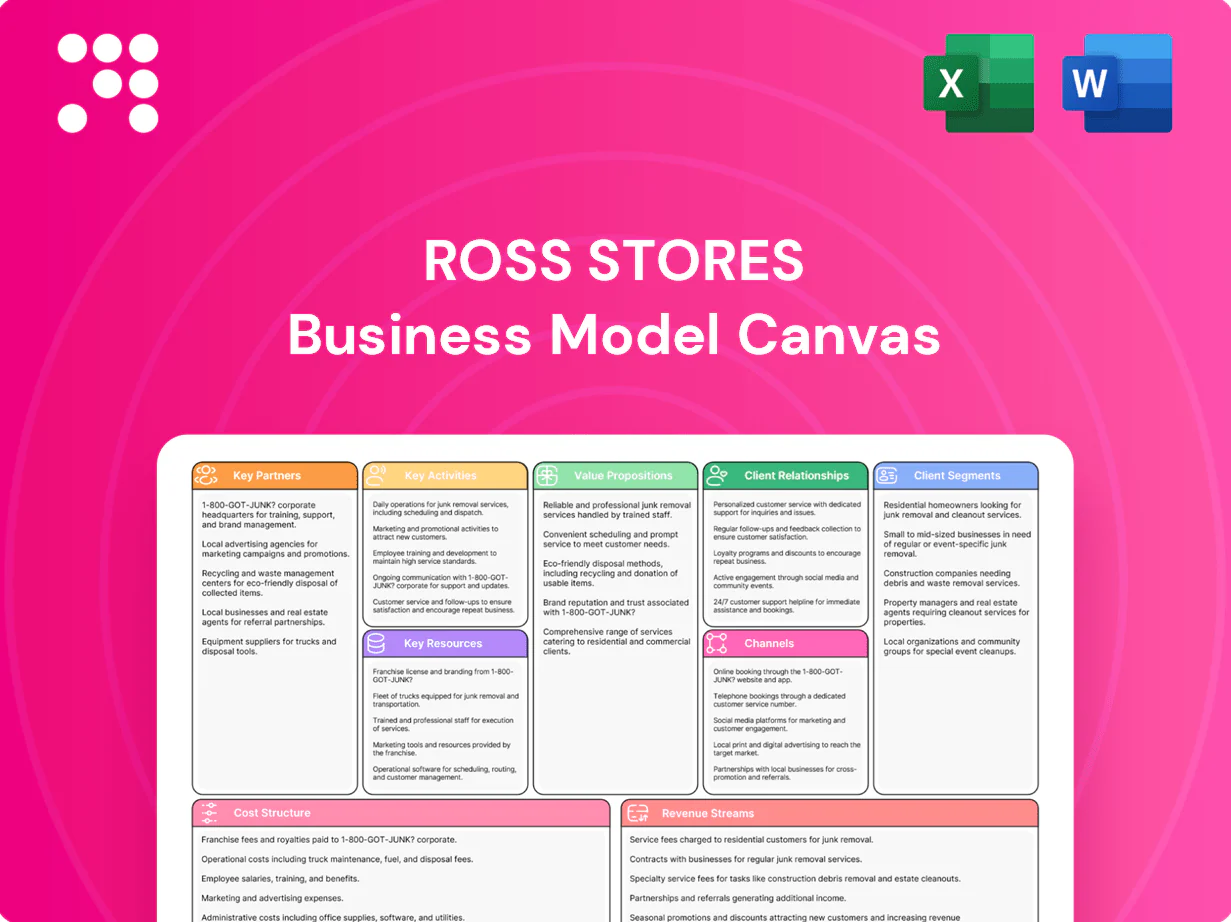
Ross Stores Business Model Canvas

Discover a retailer Business Model Canvas: three value drivers, low-cost ops, agile inventory
Discover Ross Stores’ strategic playbook in a concise Business Model Canvas—three clear value drivers, low-cost operations, and an agile inventory model that fuels market share gains. Purchase the full Canvas to access all nine blocks, financial implications, and ready-to-use Word/Excel templates for benchmarking and investor presentations.
Partnerships

Branded vendors & overstock suppliers
Relationships with brand owners and wholesalers give Ross access to first-quality, in-season goods, supporting its FY2024 net sales of about $18.5 billion. Ross buys excess, cancellations and packaway at deep discounts to protect margins, often sourcing inventory well below MSRP. Consistent vendor access enables broad category depth, while trust and speed let Ross capture opportunistic buys quickly.
Manufacturers & importers
Direct factory and importer ties expand Ross Stores supply beyond brand channels, supporting rapid inventory breadth that helped deliver roughly $18.5 billion in net sales in fiscal 2024. These relationships enable private or exclusive runs when branded inventory is tight, while lead-time flexibility supports weekly-to-monthly assortment refreshes. Compliance partners verify quality and ethical sourcing across the vendor base.

Freight, 3PLs & parcel carriers
Freight, 3PLs and parcel carriers move merchandise rapidly from ports to Ross distribution centers to roughly 2,000 stores (2024), enabling fast replenishment and high inventory turns. Variable carrier capacity is tapped for seasonal peaks and opportunistic buys, smoothing supply spikes and markdown risk. Tight transportation-cost controls preserve Ross low-price positioning by limiting logistics margin pressure. Real-time visibility tools drive improved on-time, in-full performance and fewer stockouts.

Landlords & real estate developers
Lease partners provide Ross access to high-traffic, value-oriented trade areas, enabling consistent customer flow into off-price formats; favorable rents and co-tenancy terms help sustain industry-leading low occupancy costs. Flexible footprints accommodate both Ross and dd’s formats, while standardized, rapid buildouts allow quick capture of market whitespace and scalable expansion.
- High-traffic trade areas
- Favorable rents & co-tenancy
- Flexible footprints for formats
- Rapid buildouts to seize whitespace
Tech, payments & data providers
Point-of-sale, inventory, and analytics vendors drive real-time allocation and dynamic pricing across Ross Stores' ~2,300-store footprint, improving stock turns and markdown efficiency.
Payment processors deliver secure, low-friction checkout and card-approval rates critical for conversion, while loss-prevention tech cuts shrink and marketing tools enable localized promotions and alerts.
- ~2,300 stores footprint
- Real-time inventory/analytics
- Secure payment processing
- Loss-prevention to reduce shrink
- Localized marketing/alerts
Opportunistic inventory, rapid replenishment drove FY2024 sales $18.5B
Brand owners, wholesalers and direct factories supply opportunistic, in-season inventory that supported FY2024 net sales of ~$18.5B. Freight/3PLs and DCs enable fast replenishment to ~2,300 stores, preserving turns and margins. Lease partners and tech/payment vendors secure low occupancy, rapid expansion and high-conversion checkout to protect value positioning.
| Partner | Role | Impact | Data |
|---|---|---|---|
| Brands/Wholesalers | Supply | Low-cost inventory | FY2024 sales ~$18.5B |
| 3PL/Carriers | Logistics | Fast replenishment | ~2,300 stores |
| Landlords | Real estate | Low occupancy | Flexible footprints |
| Tech/Payments | Ops | Conversion/shrink | Real-time analytics |
What is included in the product
 Detailed Word Document
A concise Business Model Canvas for Ross Stores mapping value propositions (off-price, treasure-hunt retailing), customer segments, omni-store channels, key partners, cost structure and revenue streams, plus competitive advantages, linked SWOT insights to support investor and strategy discussions.

 Customizable Excel Spreadsheet
High-level view of Ross Stores' business model that highlights off-price retail pain points and cost drivers in editable cells, enabling teams to quickly pinpoint margin, inventory, and supplier efficiency issues for fast strategic fixes.
Activities

Opportunistic off-price buying
In 2024 Ross merchants source branded goods at 20–60% below regular prices, moving quickly on closeouts, overruns and in-season deals to capture margin opportunities; disciplined buying criteria protect quality and brand mix; tightened vendor negotiations secure committed volumes and locked-in cost advantages that sustain inventory turns and off-price value.
Assortment curation & allocation
Category teams balance depth and breadth across apparel, footwear and home to match local demand, leveraging assortments that support Ross Stores' more than 2,000 stores (2024). Allocation engines route the right units to the right stores based on sell-through signals and store profiles. Frequent refreshes sustain the treasure-hunt experience for shoppers. Packaway planning evens seasonal volatility by smoothing receipts and markdowns.

Pricing & markdown optimization
Everyday low ticketing at Ross, across about 1,900 stores in 2024, anchors shopper value perception and supports high inventory turns. Data-led markdown algorithms target slow movers to clear stock while preserving gross margin. Ongoing competitive checks keep price gaps versus department and specialty peers, and signage with compare-at labels reinforces perceived savings.

Store operations & merchandising
Lean store models at Ross emphasize self-service and speed, with visual standards that make new finds easy to discover; labor concentrates on recovery, stocking, and checkout while service teams resolve returns and issues efficiently. In 2024 Ross operated roughly 2,200+ stores, driving high SKU velocity and rapid merchandising resets to sustain off-price margins.
- Self-service & speed
- Visual standards = discoverability
- Labor: recovery, stocking, checkout
- Service: fast returns resolution
Supply chain & inventory flow
DCs receive, sort, ticket, and ship at scale to support Ross Stores supply chain operations; in fiscal 2024 (52-week reporting period) these networks sustained rapid throughput to enable high assortment velocity.
Fast turns keep assortments fresh and reduce holding risk; strict compliance and QA minimize defects and chargebacks while shrink control protects margins.
- 2024 reporting period: centralized DC throughput maintained rapid inventory turns
- Compliance/QA: reduces chargebacks and SKU defects
- Shrink control: preserves gross margin
Opportunistic buys lift margins: branded goods 20-60% off across ~2,200 stores
Opportunistic buying captures branded goods at roughly 20–60% below regular prices, driving margin and assortment depth.
Category allocation, frequent refreshes and DC throughput support about 2,200 stores in fiscal 2024 (52-week reporting period).
Everyday low ticketing, targeted markdown algorithms and shrink/compliance controls preserve turns and gross margin.
| Metric | 2024 |
|---|---|
| Stores | ~2,200 |
| Buying discount | 20–60% |
| Reporting period | 52 weeks |
Delivered as Displayed
Business Model Canvas
The Ross Stores Business Model Canvas you’re previewing is the exact section from the final deliverable, not a mockup. When you purchase, you’ll receive this same complete document—structured, formatted, and ready to edit. The file delivered matches this preview precisely and is suitable for presentation, analysis, or customization in Word and Excel.

Discover a retailer Business Model Canvas: three value drivers, low-cost ops, agile inventory
Discover Ross Stores’ strategic playbook in a concise Business Model Canvas—three clear value drivers, low-cost operations, and an agile inventory model that fuels market share gains. Purchase the full Canvas to access all nine blocks, financial implications, and ready-to-use Word/Excel templates for benchmarking and investor presentations.
Partnerships
Branded vendors & overstock suppliers
Relationships with brand owners and wholesalers give Ross access to first-quality, in-season goods, supporting its FY2024 net sales of about $18.5 billion. Ross buys excess, cancellations and packaway at deep discounts to protect margins, often sourcing inventory well below MSRP. Consistent vendor access enables broad category depth, while trust and speed let Ross capture opportunistic buys quickly.
Manufacturers & importers
Direct factory and importer ties expand Ross Stores supply beyond brand channels, supporting rapid inventory breadth that helped deliver roughly $18.5 billion in net sales in fiscal 2024. These relationships enable private or exclusive runs when branded inventory is tight, while lead-time flexibility supports weekly-to-monthly assortment refreshes. Compliance partners verify quality and ethical sourcing across the vendor base.
Freight, 3PLs & parcel carriers
Freight, 3PLs and parcel carriers move merchandise rapidly from ports to Ross distribution centers to roughly 2,000 stores (2024), enabling fast replenishment and high inventory turns. Variable carrier capacity is tapped for seasonal peaks and opportunistic buys, smoothing supply spikes and markdown risk. Tight transportation-cost controls preserve Ross low-price positioning by limiting logistics margin pressure. Real-time visibility tools drive improved on-time, in-full performance and fewer stockouts.
Landlords & real estate developers
Lease partners provide Ross access to high-traffic, value-oriented trade areas, enabling consistent customer flow into off-price formats; favorable rents and co-tenancy terms help sustain industry-leading low occupancy costs. Flexible footprints accommodate both Ross and dd’s formats, while standardized, rapid buildouts allow quick capture of market whitespace and scalable expansion.
- High-traffic trade areas
- Favorable rents & co-tenancy
- Flexible footprints for formats
- Rapid buildouts to seize whitespace
Tech, payments & data providers
Point-of-sale, inventory, and analytics vendors drive real-time allocation and dynamic pricing across Ross Stores' ~2,300-store footprint, improving stock turns and markdown efficiency.
Payment processors deliver secure, low-friction checkout and card-approval rates critical for conversion, while loss-prevention tech cuts shrink and marketing tools enable localized promotions and alerts.
- ~2,300 stores footprint
- Real-time inventory/analytics
- Secure payment processing
- Loss-prevention to reduce shrink
- Localized marketing/alerts
Opportunistic inventory, rapid replenishment drove FY2024 sales $18.5B
Brand owners, wholesalers and direct factories supply opportunistic, in-season inventory that supported FY2024 net sales of ~$18.5B. Freight/3PLs and DCs enable fast replenishment to ~2,300 stores, preserving turns and margins. Lease partners and tech/payment vendors secure low occupancy, rapid expansion and high-conversion checkout to protect value positioning.
| Partner | Role | Impact | Data |
|---|---|---|---|
| Brands/Wholesalers | Supply | Low-cost inventory | FY2024 sales ~$18.5B |
| 3PL/Carriers | Logistics | Fast replenishment | ~2,300 stores |
| Landlords | Real estate | Low occupancy | Flexible footprints |
| Tech/Payments | Ops | Conversion/shrink | Real-time analytics |
What is included in the product
Detailed Word Document
A concise Business Model Canvas for Ross Stores mapping value propositions (off-price, treasure-hunt retailing), customer segments, omni-store channels, key partners, cost structure and revenue streams, plus competitive advantages, linked SWOT insights to support investor and strategy discussions.
Customizable Excel Spreadsheet
High-level view of Ross Stores' business model that highlights off-price retail pain points and cost drivers in editable cells, enabling teams to quickly pinpoint margin, inventory, and supplier efficiency issues for fast strategic fixes.
Activities
Opportunistic off-price buying
In 2024 Ross merchants source branded goods at 20–60% below regular prices, moving quickly on closeouts, overruns and in-season deals to capture margin opportunities; disciplined buying criteria protect quality and brand mix; tightened vendor negotiations secure committed volumes and locked-in cost advantages that sustain inventory turns and off-price value.
Assortment curation & allocation
Category teams balance depth and breadth across apparel, footwear and home to match local demand, leveraging assortments that support Ross Stores' more than 2,000 stores (2024). Allocation engines route the right units to the right stores based on sell-through signals and store profiles. Frequent refreshes sustain the treasure-hunt experience for shoppers. Packaway planning evens seasonal volatility by smoothing receipts and markdowns.
Pricing & markdown optimization
Everyday low ticketing at Ross, across about 1,900 stores in 2024, anchors shopper value perception and supports high inventory turns. Data-led markdown algorithms target slow movers to clear stock while preserving gross margin. Ongoing competitive checks keep price gaps versus department and specialty peers, and signage with compare-at labels reinforces perceived savings.
Store operations & merchandising
Lean store models at Ross emphasize self-service and speed, with visual standards that make new finds easy to discover; labor concentrates on recovery, stocking, and checkout while service teams resolve returns and issues efficiently. In 2024 Ross operated roughly 2,200+ stores, driving high SKU velocity and rapid merchandising resets to sustain off-price margins.
- Self-service & speed
- Visual standards = discoverability
- Labor: recovery, stocking, checkout
- Service: fast returns resolution
Supply chain & inventory flow
DCs receive, sort, ticket, and ship at scale to support Ross Stores supply chain operations; in fiscal 2024 (52-week reporting period) these networks sustained rapid throughput to enable high assortment velocity.
Fast turns keep assortments fresh and reduce holding risk; strict compliance and QA minimize defects and chargebacks while shrink control protects margins.
- 2024 reporting period: centralized DC throughput maintained rapid inventory turns
- Compliance/QA: reduces chargebacks and SKU defects
- Shrink control: preserves gross margin
Opportunistic buys lift margins: branded goods 20-60% off across ~2,200 stores
Opportunistic buying captures branded goods at roughly 20–60% below regular prices, driving margin and assortment depth.
Category allocation, frequent refreshes and DC throughput support about 2,200 stores in fiscal 2024 (52-week reporting period).
Everyday low ticketing, targeted markdown algorithms and shrink/compliance controls preserve turns and gross margin.
| Metric | 2024 |
|---|---|
| Stores | ~2,200 |
| Buying discount | 20–60% |
| Reporting period | 52 weeks |
Delivered as Displayed
Business Model Canvas
The Ross Stores Business Model Canvas you’re previewing is the exact section from the final deliverable, not a mockup. When you purchase, you’ll receive this same complete document—structured, formatted, and ready to edit. The file delivered matches this preview precisely and is suitable for presentation, analysis, or customization in Word and Excel.
Original: $10.00
-65%$10.00
$3.50Description
Discover a retailer Business Model Canvas: three value drivers, low-cost ops, agile inventory
Discover Ross Stores’ strategic playbook in a concise Business Model Canvas—three clear value drivers, low-cost operations, and an agile inventory model that fuels market share gains. Purchase the full Canvas to access all nine blocks, financial implications, and ready-to-use Word/Excel templates for benchmarking and investor presentations.
Partnerships
Branded vendors & overstock suppliers
Relationships with brand owners and wholesalers give Ross access to first-quality, in-season goods, supporting its FY2024 net sales of about $18.5 billion. Ross buys excess, cancellations and packaway at deep discounts to protect margins, often sourcing inventory well below MSRP. Consistent vendor access enables broad category depth, while trust and speed let Ross capture opportunistic buys quickly.
Manufacturers & importers
Direct factory and importer ties expand Ross Stores supply beyond brand channels, supporting rapid inventory breadth that helped deliver roughly $18.5 billion in net sales in fiscal 2024. These relationships enable private or exclusive runs when branded inventory is tight, while lead-time flexibility supports weekly-to-monthly assortment refreshes. Compliance partners verify quality and ethical sourcing across the vendor base.
Freight, 3PLs & parcel carriers
Freight, 3PLs and parcel carriers move merchandise rapidly from ports to Ross distribution centers to roughly 2,000 stores (2024), enabling fast replenishment and high inventory turns. Variable carrier capacity is tapped for seasonal peaks and opportunistic buys, smoothing supply spikes and markdown risk. Tight transportation-cost controls preserve Ross low-price positioning by limiting logistics margin pressure. Real-time visibility tools drive improved on-time, in-full performance and fewer stockouts.
Landlords & real estate developers
Lease partners provide Ross access to high-traffic, value-oriented trade areas, enabling consistent customer flow into off-price formats; favorable rents and co-tenancy terms help sustain industry-leading low occupancy costs. Flexible footprints accommodate both Ross and dd’s formats, while standardized, rapid buildouts allow quick capture of market whitespace and scalable expansion.
- High-traffic trade areas
- Favorable rents & co-tenancy
- Flexible footprints for formats
- Rapid buildouts to seize whitespace
Tech, payments & data providers
Point-of-sale, inventory, and analytics vendors drive real-time allocation and dynamic pricing across Ross Stores' ~2,300-store footprint, improving stock turns and markdown efficiency.
Payment processors deliver secure, low-friction checkout and card-approval rates critical for conversion, while loss-prevention tech cuts shrink and marketing tools enable localized promotions and alerts.
- ~2,300 stores footprint
- Real-time inventory/analytics
- Secure payment processing
- Loss-prevention to reduce shrink
- Localized marketing/alerts
Opportunistic inventory, rapid replenishment drove FY2024 sales $18.5B
Brand owners, wholesalers and direct factories supply opportunistic, in-season inventory that supported FY2024 net sales of ~$18.5B. Freight/3PLs and DCs enable fast replenishment to ~2,300 stores, preserving turns and margins. Lease partners and tech/payment vendors secure low occupancy, rapid expansion and high-conversion checkout to protect value positioning.
| Partner | Role | Impact | Data |
|---|---|---|---|
| Brands/Wholesalers | Supply | Low-cost inventory | FY2024 sales ~$18.5B |
| 3PL/Carriers | Logistics | Fast replenishment | ~2,300 stores |
| Landlords | Real estate | Low occupancy | Flexible footprints |
| Tech/Payments | Ops | Conversion/shrink | Real-time analytics |
What is included in the product
Detailed Word Document
A concise Business Model Canvas for Ross Stores mapping value propositions (off-price, treasure-hunt retailing), customer segments, omni-store channels, key partners, cost structure and revenue streams, plus competitive advantages, linked SWOT insights to support investor and strategy discussions.
Customizable Excel Spreadsheet
High-level view of Ross Stores' business model that highlights off-price retail pain points and cost drivers in editable cells, enabling teams to quickly pinpoint margin, inventory, and supplier efficiency issues for fast strategic fixes.
Activities
Opportunistic off-price buying
In 2024 Ross merchants source branded goods at 20–60% below regular prices, moving quickly on closeouts, overruns and in-season deals to capture margin opportunities; disciplined buying criteria protect quality and brand mix; tightened vendor negotiations secure committed volumes and locked-in cost advantages that sustain inventory turns and off-price value.
Assortment curation & allocation
Category teams balance depth and breadth across apparel, footwear and home to match local demand, leveraging assortments that support Ross Stores' more than 2,000 stores (2024). Allocation engines route the right units to the right stores based on sell-through signals and store profiles. Frequent refreshes sustain the treasure-hunt experience for shoppers. Packaway planning evens seasonal volatility by smoothing receipts and markdowns.
Pricing & markdown optimization
Everyday low ticketing at Ross, across about 1,900 stores in 2024, anchors shopper value perception and supports high inventory turns. Data-led markdown algorithms target slow movers to clear stock while preserving gross margin. Ongoing competitive checks keep price gaps versus department and specialty peers, and signage with compare-at labels reinforces perceived savings.
Store operations & merchandising
Lean store models at Ross emphasize self-service and speed, with visual standards that make new finds easy to discover; labor concentrates on recovery, stocking, and checkout while service teams resolve returns and issues efficiently. In 2024 Ross operated roughly 2,200+ stores, driving high SKU velocity and rapid merchandising resets to sustain off-price margins.
- Self-service & speed
- Visual standards = discoverability
- Labor: recovery, stocking, checkout
- Service: fast returns resolution
Supply chain & inventory flow
DCs receive, sort, ticket, and ship at scale to support Ross Stores supply chain operations; in fiscal 2024 (52-week reporting period) these networks sustained rapid throughput to enable high assortment velocity.
Fast turns keep assortments fresh and reduce holding risk; strict compliance and QA minimize defects and chargebacks while shrink control protects margins.
- 2024 reporting period: centralized DC throughput maintained rapid inventory turns
- Compliance/QA: reduces chargebacks and SKU defects
- Shrink control: preserves gross margin
Opportunistic buys lift margins: branded goods 20-60% off across ~2,200 stores
Opportunistic buying captures branded goods at roughly 20–60% below regular prices, driving margin and assortment depth.
Category allocation, frequent refreshes and DC throughput support about 2,200 stores in fiscal 2024 (52-week reporting period).
Everyday low ticketing, targeted markdown algorithms and shrink/compliance controls preserve turns and gross margin.
| Metric | 2024 |
|---|---|
| Stores | ~2,200 |
| Buying discount | 20–60% |
| Reporting period | 52 weeks |
Delivered as Displayed
Business Model Canvas
The Ross Stores Business Model Canvas you’re previewing is the exact section from the final deliverable, not a mockup. When you purchase, you’ll receive this same complete document—structured, formatted, and ready to edit. The file delivered matches this preview precisely and is suitable for presentation, analysis, or customization in Word and Excel.











