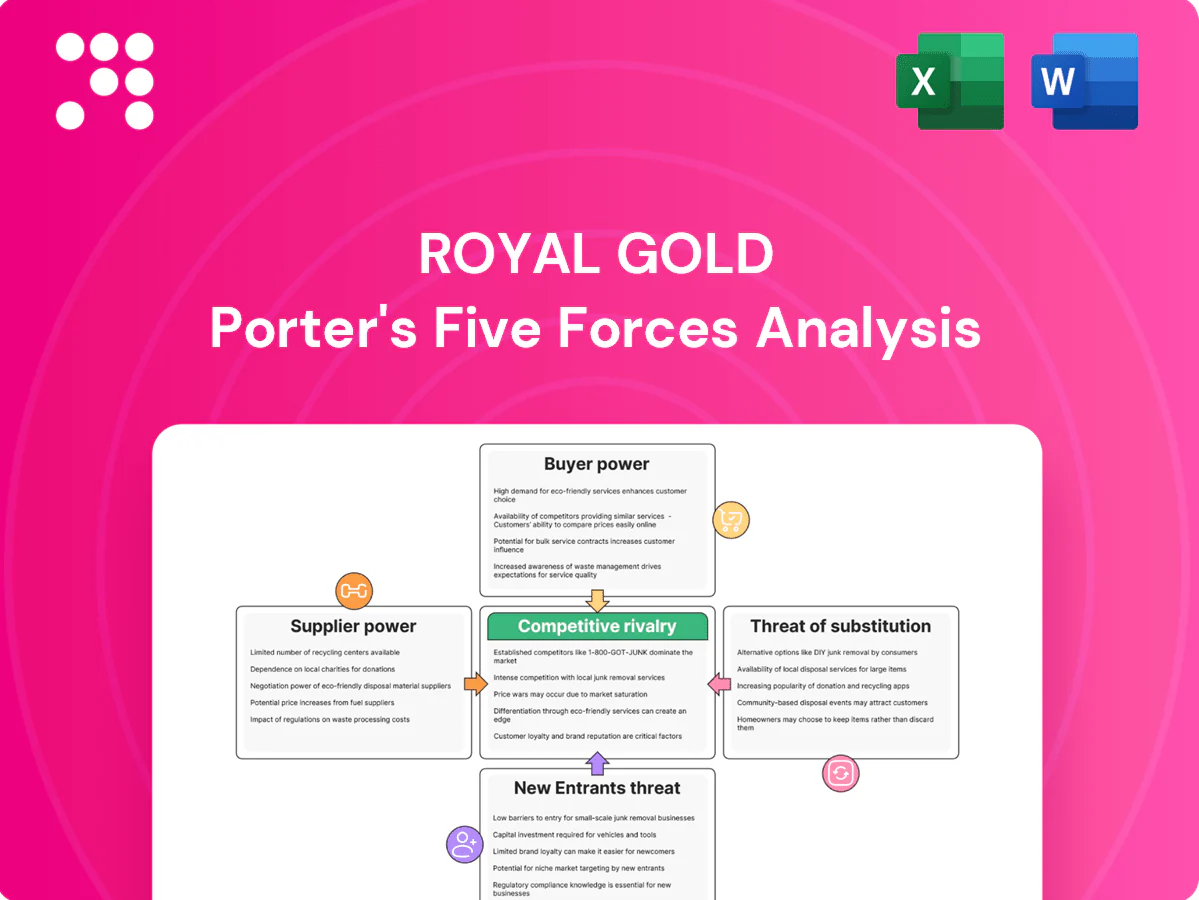
Royal Gold Porter's Five Forces Analysis

Don't Miss the Bigger Picture
Royal Gold’s Porter's Five Forces snapshot highlights concentrated supplier leverage, moderate buyer power, and niche barriers that shape margins and growth prospects. Competitive rivalry and substitute risks are evolving with commodity cycles and M&A activity. This brief only scratches the surface. Unlock the full Porter's Five Forces Analysis to explore Royal Gold’s competitive dynamics and strategic implications in detail.
Suppliers Bargaining Power

Concentrated high-quality counterparties
Royal Gold relies on a limited pool of tier-one miners for large, long-life assets, giving those operators tangible leverage in negotiations; top 10 gold miners account for roughly 50% of global production in 2024. Scarcity of proven, low-cost projects pushes supplier power on stream percentages and upfront deposits, often increasing required upfront capital. Portfolio diversification cushions exposure, but trophy assets remain few. Concentration can tighten pricing and covenants when cycles favor miners.
Alternative financing options for miners
Miners can opt for bank debt, bonds, equity, prepay offtakes or private royalty funds, which tempers Royal Gold’s negotiating power. With open 2024 capital markets (gold averaged ~$2,100/oz), suppliers pushed for richer streaming terms or rejected offers. In stressed 2024 credit windows streaming looked more attractive, reducing supplier leverage. Supplier power cycles with commodity prices and credit conditions.

Switching costs and contract rigidity
Once signed, streams and royalties are typically life‑of‑mine instruments that are hard to renegotiate, limiting ongoing supplier power and locking terms for both parties. Before signing, miners commonly auction competitive financing options to streaming firms like RGLD, increasing miner leverage in pricing and structure. After closing, operators retain operational control—mine plans, throughput and capex timing directly affect delivered ounces and realized value. This operational asymmetry leaves the streamer exposed to operator decisions despite contractual longevity.

Jurisdictional and permitting risk leverage
Suppliers in complex jurisdictions can demand protective contract terms or price premiums, and 2024 data show permitting delays typically run 3–5 years, raising effective costs and risk-adjusted return hurdles for buyers. Political risk, royalties and community agreements have concentrated investor appetite—ESG‑cleared projects are scarce, boosting miner leverage on de‑risked permits and forcing Royal Gold to price conservatively, often adding 200–400 basis points of risk premium.
- Permitting delays: 3–5 years (2024)
- Typical risk premium applied: 200–400 bps
- ESG‑cleared project scarcity: increases supplier leverage
Information asymmetry and technical control
Miners hold superior real-time data and control mine sequencing, directly influencing stream volumes and timing; Royal Gold in 2024 relied on contractual diligence rights, audit access and technical oversight but cannot operate mines, leaving asymmetry that can reallocate value across mine life. Strong monitoring frameworks reduce supplier advantage yet cannot eliminate the information gap.
- 2024: contractual diligence, audit & technical review
- Supplier control: sequencing + real-time data
- Impact: value shifts across mine lifecycle
Concentrated miners (~50%), ~$2,100/oz gold and 3-5yr permits lift 200-400bps streaming risk
Royal Gold faces concentrated supplier power: top 10 miners ~50% of 2024 global gold output and gold averaged ~$2,100/oz in 2024, allowing miners to demand richer stream terms. Streams lock life‑of‑mine terms, reducing renegotiation but leaving Royal Gold exposed to operator sequencing and data asymmetry. Permitting delays (3–5 yrs) and scarce ESG‑cleared projects add 200–400 bps risk premium.
| Metric | 2024 Data |
|---|---|
| Top10 share | ~50% |
| Gold price avg | ~$2,100/oz |
| Permitting delay | 3–5 yrs |
| Risk premium | 200–400 bps |
What is included in the product
 Detailed Word Document
Tailored Porter’s Five Forces analysis for Royal Gold, uncovering competitive intensity, buyer/supplier power, substitute risks, and entry barriers with strategic commentary to inform investor and management decisions.

 Customizable Excel Spreadsheet
A concise one-sheet Royal Gold Porter’s Five Forces summary that turns complex competitive dynamics into instant decisions, with customizable pressure levels and a built-in spider chart for clear visual prioritization. No macros, simple edits, and seamless Excel/report integration make it ideal for busy investors and boardrooms.
Customers Bargaining Power

Highly liquid commodity markets
Royal Gold sells into deep, transparent metals markets where prices are set globally and trading runs in the tens of billions of dollars daily, constraining individual buyer leverage. Refiners, bullion banks and traders act as interchangeable counterparties, with standardized assays and London Good Delivery norms reducing reliance on any single buyer. Standardized settlement and minimal transport or processing differentiation make switching buyers easy and low cost.
Commodity homogeneity and minimal differentiation
Gold and silver trade as fungible LBMA/COMEX-grade metals with standardized specifications, limiting buyers to competition over logistics, credit terms and small premia or discounts. Buyers’ leverage on contract terms is muted because pricing follows spot market moves and refiners’ discounts, keeping netbacks close to spot less standard costs. For Royal Gold the pricing power sits with the market, not the offtaker.

Diversified sales channels
Royal Gold can route production to multiple refiners and traders, reducing concentration risk as noted in its 2024 Form 10-K. No single customer dominates volumes, keeping buyer leverage low. Contracting flexibility and tolling arrangements sustain negotiate power. Rigorous credit vetting and counterparty limits in 2024 further reduce downstream credit exposure.

Real‑time hedging and optionality
Real-time hedging and timing optionality reduce Royal Gold customers' bargaining power: management can shift sales to spot or hedge in 2024 markets, lowering reliance on any single buyer and limiting buyers' ability to impose non-market terms; liquidity enables rapid reallocation of sales and improved price capture.
- Hedging optionality limits buyer leverage
- Timing flexibility cuts dependency on single counterparties
- Market liquidity enables fast sales reallocation
Limited after‑sale services required
Customers provide standard refining and settlement services with minimal bespoke requirements, so Royal Gold faces buyers who rarely demand tailored after‑sale support; disputes center on assay and settlement standards rather than service scope, keeping switching costs low and lock‑ins weak. This structural simplicity in 2024 maintains buyer bargaining power at a low level for royalty/stream companies.
- Low bespoke demand — limited customization
- Primary disputes — assay/settlement standards
- Low switching costs — minimal lock‑in
- Net effect — structurally low buyer bargaining power
Deep LBMA/COMEX liquidity — tens of $bn daily, client 10%
Royal Gold sells into deep, transparent LBMA/COMEX markets with daily trading in the tens of billions, limiting individual buyer leverage. Per Royal Gold’s 2024 Form 10-K no single customer accounted for over 10% of revenue, and standardized assays/settlement keep switching costs low. Hedging and timing optionality let Royal Gold avoid dependence on any single offtaker, keeping buyer bargaining power structurally low.
| Metric | 2024 |
|---|---|
| Global daily metal turnover | tens of $bn |
| Top-customer concentration | no >10% revenue |
| Switching costs | low |
| Buyer bargaining power | low |
Full Version Awaits
Royal Gold Porter's Five Forces Analysis
This preview shows the Royal Gold Porter’s Five Forces Analysis exactly as delivered after purchase; no placeholders or mockups. The full document is fully formatted, professionally written, and ready for immediate download and use. What you see here is what you’ll receive.

Don't Miss the Bigger Picture
Royal Gold’s Porter's Five Forces snapshot highlights concentrated supplier leverage, moderate buyer power, and niche barriers that shape margins and growth prospects. Competitive rivalry and substitute risks are evolving with commodity cycles and M&A activity. This brief only scratches the surface. Unlock the full Porter's Five Forces Analysis to explore Royal Gold’s competitive dynamics and strategic implications in detail.
Suppliers Bargaining Power
Concentrated high-quality counterparties
Royal Gold relies on a limited pool of tier-one miners for large, long-life assets, giving those operators tangible leverage in negotiations; top 10 gold miners account for roughly 50% of global production in 2024. Scarcity of proven, low-cost projects pushes supplier power on stream percentages and upfront deposits, often increasing required upfront capital. Portfolio diversification cushions exposure, but trophy assets remain few. Concentration can tighten pricing and covenants when cycles favor miners.
Alternative financing options for miners
Miners can opt for bank debt, bonds, equity, prepay offtakes or private royalty funds, which tempers Royal Gold’s negotiating power. With open 2024 capital markets (gold averaged ~$2,100/oz), suppliers pushed for richer streaming terms or rejected offers. In stressed 2024 credit windows streaming looked more attractive, reducing supplier leverage. Supplier power cycles with commodity prices and credit conditions.
Switching costs and contract rigidity
Once signed, streams and royalties are typically life‑of‑mine instruments that are hard to renegotiate, limiting ongoing supplier power and locking terms for both parties. Before signing, miners commonly auction competitive financing options to streaming firms like RGLD, increasing miner leverage in pricing and structure. After closing, operators retain operational control—mine plans, throughput and capex timing directly affect delivered ounces and realized value. This operational asymmetry leaves the streamer exposed to operator decisions despite contractual longevity.
Jurisdictional and permitting risk leverage
Suppliers in complex jurisdictions can demand protective contract terms or price premiums, and 2024 data show permitting delays typically run 3–5 years, raising effective costs and risk-adjusted return hurdles for buyers. Political risk, royalties and community agreements have concentrated investor appetite—ESG‑cleared projects are scarce, boosting miner leverage on de‑risked permits and forcing Royal Gold to price conservatively, often adding 200–400 basis points of risk premium.
- Permitting delays: 3–5 years (2024)
- Typical risk premium applied: 200–400 bps
- ESG‑cleared project scarcity: increases supplier leverage
Information asymmetry and technical control
Miners hold superior real-time data and control mine sequencing, directly influencing stream volumes and timing; Royal Gold in 2024 relied on contractual diligence rights, audit access and technical oversight but cannot operate mines, leaving asymmetry that can reallocate value across mine life. Strong monitoring frameworks reduce supplier advantage yet cannot eliminate the information gap.
- 2024: contractual diligence, audit & technical review
- Supplier control: sequencing + real-time data
- Impact: value shifts across mine lifecycle
Concentrated miners (~50%), ~$2,100/oz gold and 3-5yr permits lift 200-400bps streaming risk
Royal Gold faces concentrated supplier power: top 10 miners ~50% of 2024 global gold output and gold averaged ~$2,100/oz in 2024, allowing miners to demand richer stream terms. Streams lock life‑of‑mine terms, reducing renegotiation but leaving Royal Gold exposed to operator sequencing and data asymmetry. Permitting delays (3–5 yrs) and scarce ESG‑cleared projects add 200–400 bps risk premium.
| Metric | 2024 Data |
|---|---|
| Top10 share | ~50% |
| Gold price avg | ~$2,100/oz |
| Permitting delay | 3–5 yrs |
| Risk premium | 200–400 bps |
What is included in the product
Detailed Word Document
Tailored Porter’s Five Forces analysis for Royal Gold, uncovering competitive intensity, buyer/supplier power, substitute risks, and entry barriers with strategic commentary to inform investor and management decisions.
Customizable Excel Spreadsheet
A concise one-sheet Royal Gold Porter’s Five Forces summary that turns complex competitive dynamics into instant decisions, with customizable pressure levels and a built-in spider chart for clear visual prioritization. No macros, simple edits, and seamless Excel/report integration make it ideal for busy investors and boardrooms.
Customers Bargaining Power
Highly liquid commodity markets
Royal Gold sells into deep, transparent metals markets where prices are set globally and trading runs in the tens of billions of dollars daily, constraining individual buyer leverage. Refiners, bullion banks and traders act as interchangeable counterparties, with standardized assays and London Good Delivery norms reducing reliance on any single buyer. Standardized settlement and minimal transport or processing differentiation make switching buyers easy and low cost.
Commodity homogeneity and minimal differentiation
Gold and silver trade as fungible LBMA/COMEX-grade metals with standardized specifications, limiting buyers to competition over logistics, credit terms and small premia or discounts. Buyers’ leverage on contract terms is muted because pricing follows spot market moves and refiners’ discounts, keeping netbacks close to spot less standard costs. For Royal Gold the pricing power sits with the market, not the offtaker.
Diversified sales channels
Royal Gold can route production to multiple refiners and traders, reducing concentration risk as noted in its 2024 Form 10-K. No single customer dominates volumes, keeping buyer leverage low. Contracting flexibility and tolling arrangements sustain negotiate power. Rigorous credit vetting and counterparty limits in 2024 further reduce downstream credit exposure.
Real‑time hedging and optionality
Real-time hedging and timing optionality reduce Royal Gold customers' bargaining power: management can shift sales to spot or hedge in 2024 markets, lowering reliance on any single buyer and limiting buyers' ability to impose non-market terms; liquidity enables rapid reallocation of sales and improved price capture.
- Hedging optionality limits buyer leverage
- Timing flexibility cuts dependency on single counterparties
- Market liquidity enables fast sales reallocation
Limited after‑sale services required
Customers provide standard refining and settlement services with minimal bespoke requirements, so Royal Gold faces buyers who rarely demand tailored after‑sale support; disputes center on assay and settlement standards rather than service scope, keeping switching costs low and lock‑ins weak. This structural simplicity in 2024 maintains buyer bargaining power at a low level for royalty/stream companies.
- Low bespoke demand — limited customization
- Primary disputes — assay/settlement standards
- Low switching costs — minimal lock‑in
- Net effect — structurally low buyer bargaining power
Deep LBMA/COMEX liquidity — tens of $bn daily, client 10%
Royal Gold sells into deep, transparent LBMA/COMEX markets with daily trading in the tens of billions, limiting individual buyer leverage. Per Royal Gold’s 2024 Form 10-K no single customer accounted for over 10% of revenue, and standardized assays/settlement keep switching costs low. Hedging and timing optionality let Royal Gold avoid dependence on any single offtaker, keeping buyer bargaining power structurally low.
| Metric | 2024 |
|---|---|
| Global daily metal turnover | tens of $bn |
| Top-customer concentration | no >10% revenue |
| Switching costs | low |
| Buyer bargaining power | low |
Full Version Awaits
Royal Gold Porter's Five Forces Analysis
This preview shows the Royal Gold Porter’s Five Forces Analysis exactly as delivered after purchase; no placeholders or mockups. The full document is fully formatted, professionally written, and ready for immediate download and use. What you see here is what you’ll receive.
Original: $10.00
-65%$10.00
$3.50Description
Don't Miss the Bigger Picture
Royal Gold’s Porter's Five Forces snapshot highlights concentrated supplier leverage, moderate buyer power, and niche barriers that shape margins and growth prospects. Competitive rivalry and substitute risks are evolving with commodity cycles and M&A activity. This brief only scratches the surface. Unlock the full Porter's Five Forces Analysis to explore Royal Gold’s competitive dynamics and strategic implications in detail.
Suppliers Bargaining Power
Concentrated high-quality counterparties
Royal Gold relies on a limited pool of tier-one miners for large, long-life assets, giving those operators tangible leverage in negotiations; top 10 gold miners account for roughly 50% of global production in 2024. Scarcity of proven, low-cost projects pushes supplier power on stream percentages and upfront deposits, often increasing required upfront capital. Portfolio diversification cushions exposure, but trophy assets remain few. Concentration can tighten pricing and covenants when cycles favor miners.
Alternative financing options for miners
Miners can opt for bank debt, bonds, equity, prepay offtakes or private royalty funds, which tempers Royal Gold’s negotiating power. With open 2024 capital markets (gold averaged ~$2,100/oz), suppliers pushed for richer streaming terms or rejected offers. In stressed 2024 credit windows streaming looked more attractive, reducing supplier leverage. Supplier power cycles with commodity prices and credit conditions.
Switching costs and contract rigidity
Once signed, streams and royalties are typically life‑of‑mine instruments that are hard to renegotiate, limiting ongoing supplier power and locking terms for both parties. Before signing, miners commonly auction competitive financing options to streaming firms like RGLD, increasing miner leverage in pricing and structure. After closing, operators retain operational control—mine plans, throughput and capex timing directly affect delivered ounces and realized value. This operational asymmetry leaves the streamer exposed to operator decisions despite contractual longevity.
Jurisdictional and permitting risk leverage
Suppliers in complex jurisdictions can demand protective contract terms or price premiums, and 2024 data show permitting delays typically run 3–5 years, raising effective costs and risk-adjusted return hurdles for buyers. Political risk, royalties and community agreements have concentrated investor appetite—ESG‑cleared projects are scarce, boosting miner leverage on de‑risked permits and forcing Royal Gold to price conservatively, often adding 200–400 basis points of risk premium.
- Permitting delays: 3–5 years (2024)
- Typical risk premium applied: 200–400 bps
- ESG‑cleared project scarcity: increases supplier leverage
Information asymmetry and technical control
Miners hold superior real-time data and control mine sequencing, directly influencing stream volumes and timing; Royal Gold in 2024 relied on contractual diligence rights, audit access and technical oversight but cannot operate mines, leaving asymmetry that can reallocate value across mine life. Strong monitoring frameworks reduce supplier advantage yet cannot eliminate the information gap.
- 2024: contractual diligence, audit & technical review
- Supplier control: sequencing + real-time data
- Impact: value shifts across mine lifecycle
Concentrated miners (~50%), ~$2,100/oz gold and 3-5yr permits lift 200-400bps streaming risk
Royal Gold faces concentrated supplier power: top 10 miners ~50% of 2024 global gold output and gold averaged ~$2,100/oz in 2024, allowing miners to demand richer stream terms. Streams lock life‑of‑mine terms, reducing renegotiation but leaving Royal Gold exposed to operator sequencing and data asymmetry. Permitting delays (3–5 yrs) and scarce ESG‑cleared projects add 200–400 bps risk premium.
| Metric | 2024 Data |
|---|---|
| Top10 share | ~50% |
| Gold price avg | ~$2,100/oz |
| Permitting delay | 3–5 yrs |
| Risk premium | 200–400 bps |
What is included in the product
Detailed Word Document
Tailored Porter’s Five Forces analysis for Royal Gold, uncovering competitive intensity, buyer/supplier power, substitute risks, and entry barriers with strategic commentary to inform investor and management decisions.
Customizable Excel Spreadsheet
A concise one-sheet Royal Gold Porter’s Five Forces summary that turns complex competitive dynamics into instant decisions, with customizable pressure levels and a built-in spider chart for clear visual prioritization. No macros, simple edits, and seamless Excel/report integration make it ideal for busy investors and boardrooms.
Customers Bargaining Power
Highly liquid commodity markets
Royal Gold sells into deep, transparent metals markets where prices are set globally and trading runs in the tens of billions of dollars daily, constraining individual buyer leverage. Refiners, bullion banks and traders act as interchangeable counterparties, with standardized assays and London Good Delivery norms reducing reliance on any single buyer. Standardized settlement and minimal transport or processing differentiation make switching buyers easy and low cost.
Commodity homogeneity and minimal differentiation
Gold and silver trade as fungible LBMA/COMEX-grade metals with standardized specifications, limiting buyers to competition over logistics, credit terms and small premia or discounts. Buyers’ leverage on contract terms is muted because pricing follows spot market moves and refiners’ discounts, keeping netbacks close to spot less standard costs. For Royal Gold the pricing power sits with the market, not the offtaker.
Diversified sales channels
Royal Gold can route production to multiple refiners and traders, reducing concentration risk as noted in its 2024 Form 10-K. No single customer dominates volumes, keeping buyer leverage low. Contracting flexibility and tolling arrangements sustain negotiate power. Rigorous credit vetting and counterparty limits in 2024 further reduce downstream credit exposure.
Real‑time hedging and optionality
Real-time hedging and timing optionality reduce Royal Gold customers' bargaining power: management can shift sales to spot or hedge in 2024 markets, lowering reliance on any single buyer and limiting buyers' ability to impose non-market terms; liquidity enables rapid reallocation of sales and improved price capture.
- Hedging optionality limits buyer leverage
- Timing flexibility cuts dependency on single counterparties
- Market liquidity enables fast sales reallocation
Limited after‑sale services required
Customers provide standard refining and settlement services with minimal bespoke requirements, so Royal Gold faces buyers who rarely demand tailored after‑sale support; disputes center on assay and settlement standards rather than service scope, keeping switching costs low and lock‑ins weak. This structural simplicity in 2024 maintains buyer bargaining power at a low level for royalty/stream companies.
- Low bespoke demand — limited customization
- Primary disputes — assay/settlement standards
- Low switching costs — minimal lock‑in
- Net effect — structurally low buyer bargaining power
Deep LBMA/COMEX liquidity — tens of $bn daily, client 10%
Royal Gold sells into deep, transparent LBMA/COMEX markets with daily trading in the tens of billions, limiting individual buyer leverage. Per Royal Gold’s 2024 Form 10-K no single customer accounted for over 10% of revenue, and standardized assays/settlement keep switching costs low. Hedging and timing optionality let Royal Gold avoid dependence on any single offtaker, keeping buyer bargaining power structurally low.
| Metric | 2024 |
|---|---|
| Global daily metal turnover | tens of $bn |
| Top-customer concentration | no >10% revenue |
| Switching costs | low |
| Buyer bargaining power | low |
Full Version Awaits
Royal Gold Porter's Five Forces Analysis
This preview shows the Royal Gold Porter’s Five Forces Analysis exactly as delivered after purchase; no placeholders or mockups. The full document is fully formatted, professionally written, and ready for immediate download and use. What you see here is what you’ll receive.











