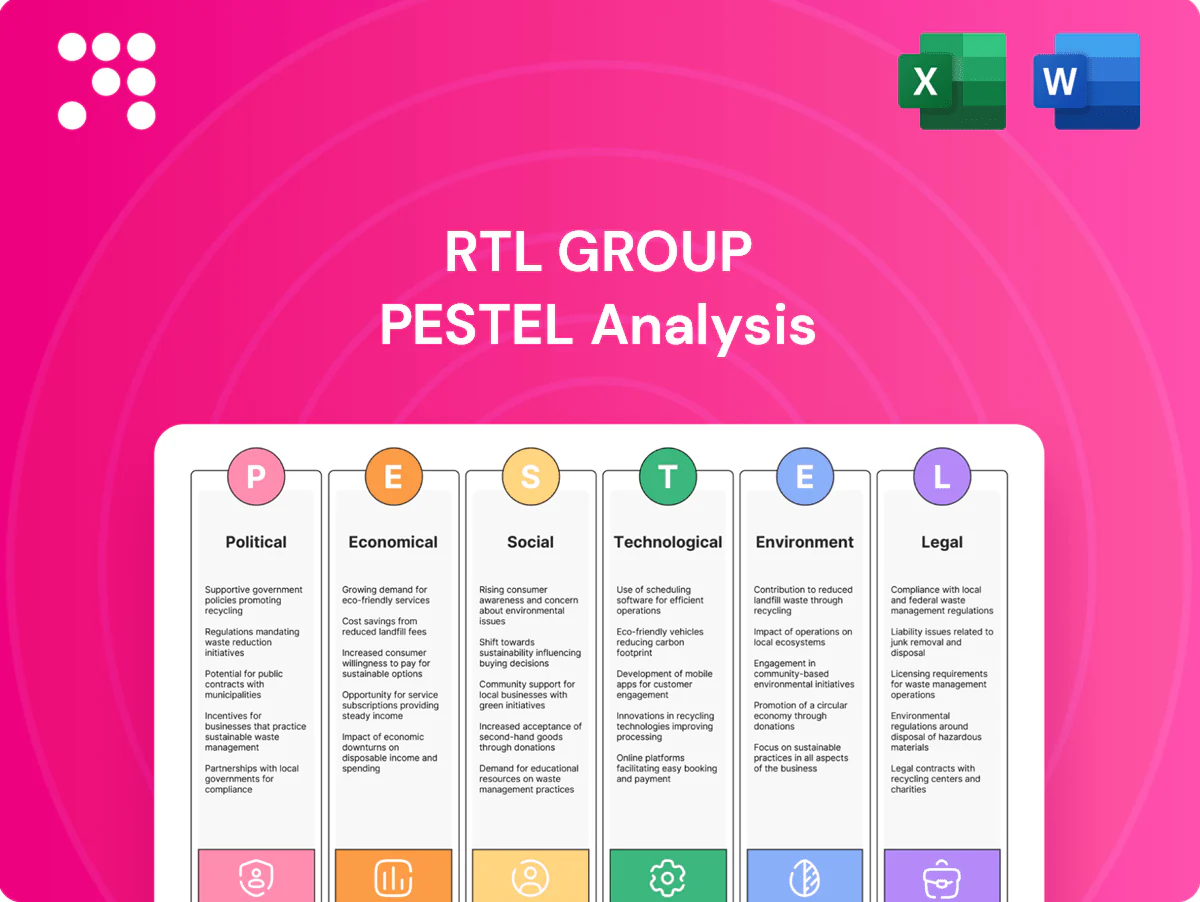
RTL Group PESTLE Analysis

Plan Smarter. Present Sharper. Compete Stronger.
Unlock how political shifts, economic trends, social behaviour, technology advances, legal changes and environmental pressures shape RTL Group's strategy and growth. Our PESTLE distils these forces into clear implications for investors and executives. Purchase the full analysis for the complete, actionable report and ready-to-use insights.
Political factors

EU media and broadcasting policy
EU audiovisual rules, notably the 2018 Audiovisual Media Services Directive, impose measures like a 30% quota for European works on on‑demand services and cross‑Member State safeguards for protection of minors across the 27 EU countries; these directives shape advertising limits, local content obligations and scheduling. Harmonization eases cross‑border scale but requires country‑level compliance tailoring; policy shifts can expand or restrict formats and ad loads, so close regulator engagement is strategic for investment planning.
Public service broadcasters and funding
Strong publicly funded broadcasters—BBC licence fee income ~£3.9bn in 2023/24 and public-service channels averaging about 35% TV market share in key EU markets (EBU estimates)—intensify competition for audiences and premium rights. Shifts to licence fee models or state aid reform can quickly alter that balance and bidding power. RTL must differentiate via local entertainment, faster commissioning and IP creation. Policy debates on funding transparency influence market access and advertiser confidence.

Political stability and election cycles
Election cycles drive volatile advertising demand, heighten regulatory scrutiny and force expanded news programming during campaigns, impacting RTL's ad revenues and scheduling. Political polarization raises reputational risk for RTL News and current affairs, increasing compliance and content-moderation costs. RTL's portfolio diversification across European markets and Fremantle content exports buffers localized volatility. Bertelsmann holds a 75.1% stake in RTL Group, underscoring corporate governance oversight.

Geopolitics and supply chains
Geopolitical tensions since Russia’s 2022 invasion of Ukraine have disrupted European production locations, equipment procurement and talent mobility, while US/EU export controls on advanced semiconductors and media tech (strengthened 2022–2024) constrain sourcing and partnerships. RTL’s production arm maintains multi-country contingencies, insurance and co-production treaties to mitigate risk.
- Diversify shoots across EU/US
- Insurance and location incentives
- Rely on co-production treaties
State support and cultural incentives
- UK Film Tax Relief: up to 25% rebate (2024)
- Creative Europe budget: €2.44bn (2021–2027)
- Eligibility: local spend, quotas, talent use
- Strategy: portfolio flexibility to capture subsidy ROI
EU AVMSD enforces 30% European quota; public licence models and geopolitics reshape ads
EU audiovisual rules (AVMSD) enforce 30% European-works quotas and cross‑border safeguards, requiring country-level compliance and shaping ad limits. Public broadcasters (BBC licence fee ~£3.9bn 2023/24) and licence models intensify competition and bidding power. Geopolitical tensions since 2022 disrupt production/supply chains; Bertelsmann holds 75.1% of RTL.
| Metric | Value |
|---|---|
| European quota | 30% |
| BBC licence fee | £3.9bn (2023/24) |
| Creative Europe | €2.44bn (2021–27) |
| Bertelsmann stake | 75.1% |
What is included in the product
 Detailed Word Document
Explores how macro-environmental factors uniquely affect RTL Group across Political, Economic, Social, Technological, Environmental and Legal dimensions, with data-backed subpoints and forward-looking insights tailored to European media markets. Designed for executives, investors and strategists to identify threats, opportunities and inform proactive scenario planning.

 Customizable Excel Spreadsheet
A concise, visually segmented RTL Group PESTLE summary that removes noise and accelerates decision-making in meetings. Easily shareable and editable for regional or business-line notes, it supports rapid alignment on external risks and market positioning during planning sessions.
Economic factors

Advertising cycle sensitivity
RTL’s core ad revenues track macro cycles: advertising spend fell during the 2020 downturn and historically rebounds with GDP, with RTL Group reporting roughly €6.2bn revenue in 2023 reflecting ad cyclicality. Retail, auto and FMCG account for large quarterly swings, driving volatility. Diversification into subscriptions and production fees has smoothed cash flows. Forward bookings and dynamic pricing mitigate demand shocks.
Streaming monetization and ARPU
SVOD and AVOD need scale to reach sustainable ARPU versus linear TV; global paid streaming subscriptions surpassed 1 billion by 2023, underscoring scale requirements. Bundling, hybrid tiers and targeted ads can raise unit economics, with ad-supported windows commonly lifting ARPU materially. Content amortization must balance against churn risk, and local-language hits drive pricing power in Europe’s fragmented markets.

Content cost inflation
Rising talent fees, amplified by the 2023–2024 WGA and SAG-AFTRA disruptions, higher rights costs and production input inflation are squeezing RTL Group margins. Competitive bidding from global streamers pushes budgets for premium formats higher, prompting more co-productions and format recycling to lower capex. RTL increasingly uses data-led commissioning—platforms report recommendations drive about 80% of viewing—reducing flop rates and improving ROI.

Currency and cross-border exposure
Revenue and costs across the eurozone, UK and other markets expose RTL Group to FX translation and transaction risk; RTL reported group revenue of EUR 6.12bn in 2023, so currency moves materially affect reported top-line and margins.
Hedging policies are used to protect cash flows for production and acquisitions; pricing and contracts often include currency clauses to pass through volatility, and geographic mix drives reported growth swings.
- FX exposure: euro vs GBP, USD
- 2023 revenue: EUR 6.12bn
- Hedges protect production/acquisition cash flows
- Pricing/contracts may include currency clauses
Interest rates and capital allocation
Higher rates raise WACC, pushing discount rates for long-tail content from roughly 6% to about 8–9%, reducing DCF valuations by an estimated 15–25%; tighter spreads (+150–250bp vs pre-2022) constrict M&A, buybacks and tech capex. Prioritizing digital initiatives with ROIC above the new cost of capital is critical. Working capital management tightens as production prepayments and receivables cycles shorten, raising liquidity needs by mid-single-digit percent.
- WACC impact: discount rate +2–3ppt → DCF -15–25%
- Financing spreads: +150–250bp → constrained M&A/buybacks
- Investment focus: prioritize digital projects with ROIC > new WACC
- Working capital: liquidity needs +3–7%
EU AVMSD enforces 30% European quota; public licence models and geopolitics reshape ads
RTL’s ad revenue is cyclical—EUR 6.12bn group revenue in 2023—driven by retail/auto/FMCG; subscriptions/production fees smooth cash flow. Scale needs for SVOD/AVOD remain high (global paid subs >1bn in 2023), while rising talent/rights costs and 2023–24 strikes compress margins. FX (EUR/GBP/USD) and higher WACC (+2–3ppt → DCF -15–25%) increase liquidity and investment scrutiny; hedges and contract clauses mitigate risk.
| Metric | Value |
|---|---|
| 2023 Revenue | EUR 6.12bn |
| Global paid subs | >1.0bn (2023) |
| WACC change | +2–3ppt (DCF -15–25%) |
Preview Before You Purchase
RTL Group PESTLE Analysis
The preview shown here is the exact document you'll receive after purchase—fully formatted and ready to use. This RTL Group PESTLE Analysis provides a comprehensive, professionally structured assessment of political, economic, social, technological, legal, and environmental factors affecting RTL Group. No placeholders or teasers—what you see is the final downloadable file.

Plan Smarter. Present Sharper. Compete Stronger.
Unlock how political shifts, economic trends, social behaviour, technology advances, legal changes and environmental pressures shape RTL Group's strategy and growth. Our PESTLE distils these forces into clear implications for investors and executives. Purchase the full analysis for the complete, actionable report and ready-to-use insights.
Political factors
EU media and broadcasting policy
EU audiovisual rules, notably the 2018 Audiovisual Media Services Directive, impose measures like a 30% quota for European works on on‑demand services and cross‑Member State safeguards for protection of minors across the 27 EU countries; these directives shape advertising limits, local content obligations and scheduling. Harmonization eases cross‑border scale but requires country‑level compliance tailoring; policy shifts can expand or restrict formats and ad loads, so close regulator engagement is strategic for investment planning.
Public service broadcasters and funding
Strong publicly funded broadcasters—BBC licence fee income ~£3.9bn in 2023/24 and public-service channels averaging about 35% TV market share in key EU markets (EBU estimates)—intensify competition for audiences and premium rights. Shifts to licence fee models or state aid reform can quickly alter that balance and bidding power. RTL must differentiate via local entertainment, faster commissioning and IP creation. Policy debates on funding transparency influence market access and advertiser confidence.
Political stability and election cycles
Election cycles drive volatile advertising demand, heighten regulatory scrutiny and force expanded news programming during campaigns, impacting RTL's ad revenues and scheduling. Political polarization raises reputational risk for RTL News and current affairs, increasing compliance and content-moderation costs. RTL's portfolio diversification across European markets and Fremantle content exports buffers localized volatility. Bertelsmann holds a 75.1% stake in RTL Group, underscoring corporate governance oversight.
Geopolitics and supply chains
Geopolitical tensions since Russia’s 2022 invasion of Ukraine have disrupted European production locations, equipment procurement and talent mobility, while US/EU export controls on advanced semiconductors and media tech (strengthened 2022–2024) constrain sourcing and partnerships. RTL’s production arm maintains multi-country contingencies, insurance and co-production treaties to mitigate risk.
- Diversify shoots across EU/US
- Insurance and location incentives
- Rely on co-production treaties
State support and cultural incentives
- UK Film Tax Relief: up to 25% rebate (2024)
- Creative Europe budget: €2.44bn (2021–2027)
- Eligibility: local spend, quotas, talent use
- Strategy: portfolio flexibility to capture subsidy ROI
EU AVMSD enforces 30% European quota; public licence models and geopolitics reshape ads
EU audiovisual rules (AVMSD) enforce 30% European-works quotas and cross‑border safeguards, requiring country-level compliance and shaping ad limits. Public broadcasters (BBC licence fee ~£3.9bn 2023/24) and licence models intensify competition and bidding power. Geopolitical tensions since 2022 disrupt production/supply chains; Bertelsmann holds 75.1% of RTL.
| Metric | Value |
|---|---|
| European quota | 30% |
| BBC licence fee | £3.9bn (2023/24) |
| Creative Europe | €2.44bn (2021–27) |
| Bertelsmann stake | 75.1% |
What is included in the product
Detailed Word Document
Explores how macro-environmental factors uniquely affect RTL Group across Political, Economic, Social, Technological, Environmental and Legal dimensions, with data-backed subpoints and forward-looking insights tailored to European media markets. Designed for executives, investors and strategists to identify threats, opportunities and inform proactive scenario planning.
Customizable Excel Spreadsheet
A concise, visually segmented RTL Group PESTLE summary that removes noise and accelerates decision-making in meetings. Easily shareable and editable for regional or business-line notes, it supports rapid alignment on external risks and market positioning during planning sessions.
Economic factors
Advertising cycle sensitivity
RTL’s core ad revenues track macro cycles: advertising spend fell during the 2020 downturn and historically rebounds with GDP, with RTL Group reporting roughly €6.2bn revenue in 2023 reflecting ad cyclicality. Retail, auto and FMCG account for large quarterly swings, driving volatility. Diversification into subscriptions and production fees has smoothed cash flows. Forward bookings and dynamic pricing mitigate demand shocks.
Streaming monetization and ARPU
SVOD and AVOD need scale to reach sustainable ARPU versus linear TV; global paid streaming subscriptions surpassed 1 billion by 2023, underscoring scale requirements. Bundling, hybrid tiers and targeted ads can raise unit economics, with ad-supported windows commonly lifting ARPU materially. Content amortization must balance against churn risk, and local-language hits drive pricing power in Europe’s fragmented markets.
Content cost inflation
Rising talent fees, amplified by the 2023–2024 WGA and SAG-AFTRA disruptions, higher rights costs and production input inflation are squeezing RTL Group margins. Competitive bidding from global streamers pushes budgets for premium formats higher, prompting more co-productions and format recycling to lower capex. RTL increasingly uses data-led commissioning—platforms report recommendations drive about 80% of viewing—reducing flop rates and improving ROI.
Currency and cross-border exposure
Revenue and costs across the eurozone, UK and other markets expose RTL Group to FX translation and transaction risk; RTL reported group revenue of EUR 6.12bn in 2023, so currency moves materially affect reported top-line and margins.
Hedging policies are used to protect cash flows for production and acquisitions; pricing and contracts often include currency clauses to pass through volatility, and geographic mix drives reported growth swings.
- FX exposure: euro vs GBP, USD
- 2023 revenue: EUR 6.12bn
- Hedges protect production/acquisition cash flows
- Pricing/contracts may include currency clauses
Interest rates and capital allocation
Higher rates raise WACC, pushing discount rates for long-tail content from roughly 6% to about 8–9%, reducing DCF valuations by an estimated 15–25%; tighter spreads (+150–250bp vs pre-2022) constrict M&A, buybacks and tech capex. Prioritizing digital initiatives with ROIC above the new cost of capital is critical. Working capital management tightens as production prepayments and receivables cycles shorten, raising liquidity needs by mid-single-digit percent.
- WACC impact: discount rate +2–3ppt → DCF -15–25%
- Financing spreads: +150–250bp → constrained M&A/buybacks
- Investment focus: prioritize digital projects with ROIC > new WACC
- Working capital: liquidity needs +3–7%
EU AVMSD enforces 30% European quota; public licence models and geopolitics reshape ads
RTL’s ad revenue is cyclical—EUR 6.12bn group revenue in 2023—driven by retail/auto/FMCG; subscriptions/production fees smooth cash flow. Scale needs for SVOD/AVOD remain high (global paid subs >1bn in 2023), while rising talent/rights costs and 2023–24 strikes compress margins. FX (EUR/GBP/USD) and higher WACC (+2–3ppt → DCF -15–25%) increase liquidity and investment scrutiny; hedges and contract clauses mitigate risk.
| Metric | Value |
|---|---|
| 2023 Revenue | EUR 6.12bn |
| Global paid subs | >1.0bn (2023) |
| WACC change | +2–3ppt (DCF -15–25%) |
Preview Before You Purchase
RTL Group PESTLE Analysis
The preview shown here is the exact document you'll receive after purchase—fully formatted and ready to use. This RTL Group PESTLE Analysis provides a comprehensive, professionally structured assessment of political, economic, social, technological, legal, and environmental factors affecting RTL Group. No placeholders or teasers—what you see is the final downloadable file.
Original: $10.00
-65%$10.00
$3.50Description
Plan Smarter. Present Sharper. Compete Stronger.
Unlock how political shifts, economic trends, social behaviour, technology advances, legal changes and environmental pressures shape RTL Group's strategy and growth. Our PESTLE distils these forces into clear implications for investors and executives. Purchase the full analysis for the complete, actionable report and ready-to-use insights.
Political factors
EU media and broadcasting policy
EU audiovisual rules, notably the 2018 Audiovisual Media Services Directive, impose measures like a 30% quota for European works on on‑demand services and cross‑Member State safeguards for protection of minors across the 27 EU countries; these directives shape advertising limits, local content obligations and scheduling. Harmonization eases cross‑border scale but requires country‑level compliance tailoring; policy shifts can expand or restrict formats and ad loads, so close regulator engagement is strategic for investment planning.
Public service broadcasters and funding
Strong publicly funded broadcasters—BBC licence fee income ~£3.9bn in 2023/24 and public-service channels averaging about 35% TV market share in key EU markets (EBU estimates)—intensify competition for audiences and premium rights. Shifts to licence fee models or state aid reform can quickly alter that balance and bidding power. RTL must differentiate via local entertainment, faster commissioning and IP creation. Policy debates on funding transparency influence market access and advertiser confidence.
Political stability and election cycles
Election cycles drive volatile advertising demand, heighten regulatory scrutiny and force expanded news programming during campaigns, impacting RTL's ad revenues and scheduling. Political polarization raises reputational risk for RTL News and current affairs, increasing compliance and content-moderation costs. RTL's portfolio diversification across European markets and Fremantle content exports buffers localized volatility. Bertelsmann holds a 75.1% stake in RTL Group, underscoring corporate governance oversight.
Geopolitics and supply chains
Geopolitical tensions since Russia’s 2022 invasion of Ukraine have disrupted European production locations, equipment procurement and talent mobility, while US/EU export controls on advanced semiconductors and media tech (strengthened 2022–2024) constrain sourcing and partnerships. RTL’s production arm maintains multi-country contingencies, insurance and co-production treaties to mitigate risk.
- Diversify shoots across EU/US
- Insurance and location incentives
- Rely on co-production treaties
State support and cultural incentives
- UK Film Tax Relief: up to 25% rebate (2024)
- Creative Europe budget: €2.44bn (2021–2027)
- Eligibility: local spend, quotas, talent use
- Strategy: portfolio flexibility to capture subsidy ROI
EU AVMSD enforces 30% European quota; public licence models and geopolitics reshape ads
EU audiovisual rules (AVMSD) enforce 30% European-works quotas and cross‑border safeguards, requiring country-level compliance and shaping ad limits. Public broadcasters (BBC licence fee ~£3.9bn 2023/24) and licence models intensify competition and bidding power. Geopolitical tensions since 2022 disrupt production/supply chains; Bertelsmann holds 75.1% of RTL.
| Metric | Value |
|---|---|
| European quota | 30% |
| BBC licence fee | £3.9bn (2023/24) |
| Creative Europe | €2.44bn (2021–27) |
| Bertelsmann stake | 75.1% |
What is included in the product
Detailed Word Document
Explores how macro-environmental factors uniquely affect RTL Group across Political, Economic, Social, Technological, Environmental and Legal dimensions, with data-backed subpoints and forward-looking insights tailored to European media markets. Designed for executives, investors and strategists to identify threats, opportunities and inform proactive scenario planning.
Customizable Excel Spreadsheet
A concise, visually segmented RTL Group PESTLE summary that removes noise and accelerates decision-making in meetings. Easily shareable and editable for regional or business-line notes, it supports rapid alignment on external risks and market positioning during planning sessions.
Economic factors
Advertising cycle sensitivity
RTL’s core ad revenues track macro cycles: advertising spend fell during the 2020 downturn and historically rebounds with GDP, with RTL Group reporting roughly €6.2bn revenue in 2023 reflecting ad cyclicality. Retail, auto and FMCG account for large quarterly swings, driving volatility. Diversification into subscriptions and production fees has smoothed cash flows. Forward bookings and dynamic pricing mitigate demand shocks.
Streaming monetization and ARPU
SVOD and AVOD need scale to reach sustainable ARPU versus linear TV; global paid streaming subscriptions surpassed 1 billion by 2023, underscoring scale requirements. Bundling, hybrid tiers and targeted ads can raise unit economics, with ad-supported windows commonly lifting ARPU materially. Content amortization must balance against churn risk, and local-language hits drive pricing power in Europe’s fragmented markets.
Content cost inflation
Rising talent fees, amplified by the 2023–2024 WGA and SAG-AFTRA disruptions, higher rights costs and production input inflation are squeezing RTL Group margins. Competitive bidding from global streamers pushes budgets for premium formats higher, prompting more co-productions and format recycling to lower capex. RTL increasingly uses data-led commissioning—platforms report recommendations drive about 80% of viewing—reducing flop rates and improving ROI.
Currency and cross-border exposure
Revenue and costs across the eurozone, UK and other markets expose RTL Group to FX translation and transaction risk; RTL reported group revenue of EUR 6.12bn in 2023, so currency moves materially affect reported top-line and margins.
Hedging policies are used to protect cash flows for production and acquisitions; pricing and contracts often include currency clauses to pass through volatility, and geographic mix drives reported growth swings.
- FX exposure: euro vs GBP, USD
- 2023 revenue: EUR 6.12bn
- Hedges protect production/acquisition cash flows
- Pricing/contracts may include currency clauses
Interest rates and capital allocation
Higher rates raise WACC, pushing discount rates for long-tail content from roughly 6% to about 8–9%, reducing DCF valuations by an estimated 15–25%; tighter spreads (+150–250bp vs pre-2022) constrict M&A, buybacks and tech capex. Prioritizing digital initiatives with ROIC above the new cost of capital is critical. Working capital management tightens as production prepayments and receivables cycles shorten, raising liquidity needs by mid-single-digit percent.
- WACC impact: discount rate +2–3ppt → DCF -15–25%
- Financing spreads: +150–250bp → constrained M&A/buybacks
- Investment focus: prioritize digital projects with ROIC > new WACC
- Working capital: liquidity needs +3–7%
EU AVMSD enforces 30% European quota; public licence models and geopolitics reshape ads
RTL’s ad revenue is cyclical—EUR 6.12bn group revenue in 2023—driven by retail/auto/FMCG; subscriptions/production fees smooth cash flow. Scale needs for SVOD/AVOD remain high (global paid subs >1bn in 2023), while rising talent/rights costs and 2023–24 strikes compress margins. FX (EUR/GBP/USD) and higher WACC (+2–3ppt → DCF -15–25%) increase liquidity and investment scrutiny; hedges and contract clauses mitigate risk.
| Metric | Value |
|---|---|
| 2023 Revenue | EUR 6.12bn |
| Global paid subs | >1.0bn (2023) |
| WACC change | +2–3ppt (DCF -15–25%) |
Preview Before You Purchase
RTL Group PESTLE Analysis
The preview shown here is the exact document you'll receive after purchase—fully formatted and ready to use. This RTL Group PESTLE Analysis provides a comprehensive, professionally structured assessment of political, economic, social, technological, legal, and environmental factors affecting RTL Group. No placeholders or teasers—what you see is the final downloadable file.











