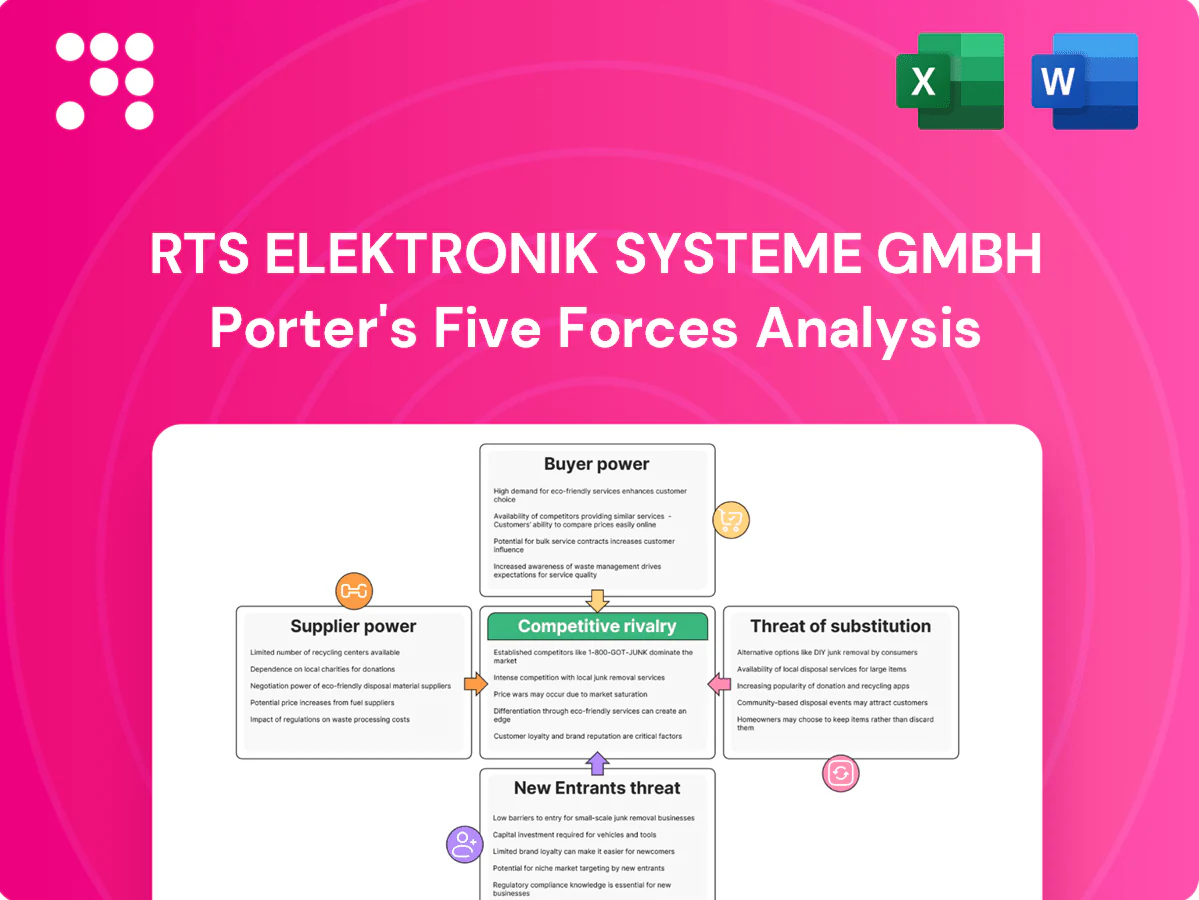
RTS Elektronik Systeme GmbH Porter's Five Forces Analysis

Don't Miss the Bigger Picture
RTS Elektronik Systeme GmbH faces moderate supplier leverage, niche customer demand, and niche-specific barriers that shape its competitive landscape; rivalry centers on technological specialization and service quality. The brief highlights key pressures from buyers, substitutes, and potential entrants but omits force-by-force ratings. Unlock the full Porter's Five Forces Analysis for detailed ratings, visuals, and actionable strategy to inform investment or competitive decisions.
Suppliers Bargaining Power

Specialized component concentration
RTS relies on semiconductor, PCB and passive component makers with few substitutes, giving key suppliers outsized leverage; TSMC held about 56 percent of the global foundry market in 2023, illustrating concentration. Shortages and allocation cycles have historically pushed lead times and forced higher pricing and minimum order quantities. Lead times can exceed several months, constraining RTS’s scheduling flexibility. Strategic multi-sourcing and 3–6 months of buffer stock partially mitigate this risk.
Certification and quality requirements
Automotive IATF 16949, medical ISO 13485 and industrial IEC standards sharply narrow approved vendor lists, concentrating procurement on certified suppliers. As of 2024, changing a qualified vendor mandates audits and revalidation, typically extending qualification timelines by 3–6 months. These steps raise tangible switching costs and time-to-change, increasing operational dependency and strengthening influence of compliant suppliers.

Logistics and geopolitical exposure
Global suppliers expose RTS to freight volatility—container rates saw swings exceeding 50% during 2023–2024 disruptions—and to tariffs and export controls (notably 2023–24 semiconductor export curbs) that raise costs; disruptions shift bargaining power to reliably delivering suppliers. Euro moves of ~5% in 2024 altered component costs in euro terms; regional dual-sourcing and nearshoring lower exposure and supplier leverage.

Technology roadmaps and IP
Advanced MCUs, FPGAs and power modules are tightly coupled to supplier technology roadmaps, with the top 5 suppliers holding >60% of relevant market share in 2024, increasing supplier leverage over RTS Elektronik Systeme GmbH. End-of-life notices — up ~10% in 2024 — force redesigns for RTS and its clients, raising costs and time-to-market. Access to supplier reference designs and FAEs acts as a bargaining lever; preferred partnerships improve allocation and technical support.
- Supplier concentration: top5 >60% (2024)
- EOL notices: +~10% (2024)
- FAE/ref designs: increases integration speed
- Preferred partnerships: better allocations/support
Scale-driven terms
Larger EMS competitors secure better volume pricing and allocations, and in 2024 the global EMS market exceeded $500B with increasing supplier concentration favoring top-tier players. RTS’s negotiating power hinges on aggregate client spend and SKU clustering. Framework agreements and consignment models can rebalance lead-times and margins. Collaborative forecasting with suppliers strengthens RTS’s bargaining position.
- Volume leverage: top EMS get preferential pricing
- Aggregate spend: core to RTS negotiation
- Frameworks/consignment: reduce risk, improve terms
- Forecasting: tightens supplier allocations
Supply concentration >60% and freight swings >50% force 3-6 month buffers
Supplier power is high: top5 component suppliers >60% (2024) and TSMC ~56% foundry share (2023), pushing lead times to several months and EOL notices +10% (2024). Freight swings >50% (2023–24) and EMS market >$500B (2024) favor large buyers; RTS mitigates via multi-sourcing, 3–6 months buffer, framework agreements and preferred partnerships.
| Metric | Value |
|---|---|
| Top5 supplier share | >60% (2024) |
| TSMC foundry | ~56% (2023) |
| EOL notices | +10% (2024) |
| EMS market | >$500B (2024) |
What is included in the product
 Detailed Word Document
Tailored for RTS Elektronik Systeme GmbH, this Porter's Five Forces overview uncovers key drivers of competition, buyer and supplier power, entry barriers, substitutes and disruptive threats affecting its market position and profitability.

 Customizable Excel Spreadsheet
Clear one-sheet summary of RTS Elektronik Systeme GmbH’s five forces—customize pressure levels and view an instant spider chart for fast strategic decisions, with a clean layout ready for pitch decks and seamless Excel integration.
Customers Bargaining Power

OEM concentration and volumes
Large OEMs can demand significant price concessions and higher service levels; in 2024 the global EMS market was about $620 billion, concentrating negotiating power with top OEMs. Their order volumes drive line loading and capacity planning, making utilization sensitive to demand shifts. Losing a major account can cut utilization by 15–30% for specialized suppliers. Diversifying across industries moderates single-customer power.
Customization and engineering influence
RTS increases buyer involvement by offering development and testing services, embedding customer requirements into product engineering and raising switching costs through proprietary know-how and bespoke test fixtures. Co-design creates tacit knowledge that competitors cannot easily replicate, yet detailed customer specifications can be used to benchmark alternative suppliers. Robust IP clauses and clear NRE agreements are essential to protect RTS margins and capture R&D value.

Dual-sourcing and benchmarking
Many OEMs maintain second sources to pressure pricing, with regular RFQs benchmarking RTS against regional EMS peers and market-driven bid cycles. Customers increasingly leverage performance KPIs—OTIF targets around 95% and defect goals often below 1,000 PPM—to negotiate terms. Strong differentiated quality and faster lead times allow RTS to offset price pressure by commanding premium contract terms.

Regulatory requalification
In regulated sectors requalification of a new EMS is costly and slow, with 2024 industry reports citing typical timelines of 6–18 months and costs in the hundreds of thousands, which reduces buyer willingness to switch despite price gaps. Buyers increasingly accept long-term agreements with SLAs; stable supplier relationships enable RTS Elektronik Systeme to pursue value-based pricing and margin protection.
- 6–18 months typical requalification (2024)
- Costs: hundreds of thousands (2024)
- >60% regulated EMS deals are multi-year with SLAs (2024)
Total cost and lifecycle focus
Buyers judge landed cost, yield and warranty risk over unit price; in 2024 EMS benchmarks showed ~95% first-pass yield and 1–2% RMA rates, making yield and RMA critical to total lifecycle cost.
RTS can protect margins through higher FPY and accelerated NPI cycles, reducing scrap and time-to-revenue.
Robust after-sales support, full traceability and selective cost-transparency models build customer stickiness while limiting margin squeeze.
- FPY focus: higher yield protects margin
- After-sales: traceability increases retention
- Transparency: selective cost models build trust
OEM pricing power and requalification cut utilization 15–30%
Large OEMs hold pricing power via volume and RFQs; losing a major account can cut utilization 15–30%. Regulated requalification (6–18 months; costs hundreds of thousands) and >60% multi-year deals (2024) reduce switching. FPY ~95% and RMA 1–2% make yield and warranty key levers for RTS to protect margins.
| Metric | 2024 Value |
|---|---|
| Global EMS market | $620B |
| Requalification time | 6–18 months |
| Requalification cost | Hundreds k |
| Multi-year deals | >60% |
| FPY | ~95% |
| RMA | 1–2% |
| Utilization loss | 15–30% |
Same Document Delivered
RTS Elektronik Systeme GmbH Porter's Five Forces Analysis
This preview shows the exact document you'll receive immediately after purchase—no surprises, no placeholders. It contains a comprehensive Porter's Five Forces analysis of RTS Elektronik Systeme GmbH, covering supplier and buyer power, competitive rivalry, threat of new entrants, and substitute products. The file is fully formatted and ready for download the moment you buy.

Don't Miss the Bigger Picture
RTS Elektronik Systeme GmbH faces moderate supplier leverage, niche customer demand, and niche-specific barriers that shape its competitive landscape; rivalry centers on technological specialization and service quality. The brief highlights key pressures from buyers, substitutes, and potential entrants but omits force-by-force ratings. Unlock the full Porter's Five Forces Analysis for detailed ratings, visuals, and actionable strategy to inform investment or competitive decisions.
Suppliers Bargaining Power
Specialized component concentration
RTS relies on semiconductor, PCB and passive component makers with few substitutes, giving key suppliers outsized leverage; TSMC held about 56 percent of the global foundry market in 2023, illustrating concentration. Shortages and allocation cycles have historically pushed lead times and forced higher pricing and minimum order quantities. Lead times can exceed several months, constraining RTS’s scheduling flexibility. Strategic multi-sourcing and 3–6 months of buffer stock partially mitigate this risk.
Certification and quality requirements
Automotive IATF 16949, medical ISO 13485 and industrial IEC standards sharply narrow approved vendor lists, concentrating procurement on certified suppliers. As of 2024, changing a qualified vendor mandates audits and revalidation, typically extending qualification timelines by 3–6 months. These steps raise tangible switching costs and time-to-change, increasing operational dependency and strengthening influence of compliant suppliers.
Logistics and geopolitical exposure
Global suppliers expose RTS to freight volatility—container rates saw swings exceeding 50% during 2023–2024 disruptions—and to tariffs and export controls (notably 2023–24 semiconductor export curbs) that raise costs; disruptions shift bargaining power to reliably delivering suppliers. Euro moves of ~5% in 2024 altered component costs in euro terms; regional dual-sourcing and nearshoring lower exposure and supplier leverage.
Technology roadmaps and IP
Advanced MCUs, FPGAs and power modules are tightly coupled to supplier technology roadmaps, with the top 5 suppliers holding >60% of relevant market share in 2024, increasing supplier leverage over RTS Elektronik Systeme GmbH. End-of-life notices — up ~10% in 2024 — force redesigns for RTS and its clients, raising costs and time-to-market. Access to supplier reference designs and FAEs acts as a bargaining lever; preferred partnerships improve allocation and technical support.
- Supplier concentration: top5 >60% (2024)
- EOL notices: +~10% (2024)
- FAE/ref designs: increases integration speed
- Preferred partnerships: better allocations/support
Scale-driven terms
Larger EMS competitors secure better volume pricing and allocations, and in 2024 the global EMS market exceeded $500B with increasing supplier concentration favoring top-tier players. RTS’s negotiating power hinges on aggregate client spend and SKU clustering. Framework agreements and consignment models can rebalance lead-times and margins. Collaborative forecasting with suppliers strengthens RTS’s bargaining position.
- Volume leverage: top EMS get preferential pricing
- Aggregate spend: core to RTS negotiation
- Frameworks/consignment: reduce risk, improve terms
- Forecasting: tightens supplier allocations
Supply concentration >60% and freight swings >50% force 3-6 month buffers
Supplier power is high: top5 component suppliers >60% (2024) and TSMC ~56% foundry share (2023), pushing lead times to several months and EOL notices +10% (2024). Freight swings >50% (2023–24) and EMS market >$500B (2024) favor large buyers; RTS mitigates via multi-sourcing, 3–6 months buffer, framework agreements and preferred partnerships.
| Metric | Value |
|---|---|
| Top5 supplier share | >60% (2024) |
| TSMC foundry | ~56% (2023) |
| EOL notices | +10% (2024) |
| EMS market | >$500B (2024) |
What is included in the product
Detailed Word Document
Tailored for RTS Elektronik Systeme GmbH, this Porter's Five Forces overview uncovers key drivers of competition, buyer and supplier power, entry barriers, substitutes and disruptive threats affecting its market position and profitability.
Customizable Excel Spreadsheet
Clear one-sheet summary of RTS Elektronik Systeme GmbH’s five forces—customize pressure levels and view an instant spider chart for fast strategic decisions, with a clean layout ready for pitch decks and seamless Excel integration.
Customers Bargaining Power
OEM concentration and volumes
Large OEMs can demand significant price concessions and higher service levels; in 2024 the global EMS market was about $620 billion, concentrating negotiating power with top OEMs. Their order volumes drive line loading and capacity planning, making utilization sensitive to demand shifts. Losing a major account can cut utilization by 15–30% for specialized suppliers. Diversifying across industries moderates single-customer power.
Customization and engineering influence
RTS increases buyer involvement by offering development and testing services, embedding customer requirements into product engineering and raising switching costs through proprietary know-how and bespoke test fixtures. Co-design creates tacit knowledge that competitors cannot easily replicate, yet detailed customer specifications can be used to benchmark alternative suppliers. Robust IP clauses and clear NRE agreements are essential to protect RTS margins and capture R&D value.
Dual-sourcing and benchmarking
Many OEMs maintain second sources to pressure pricing, with regular RFQs benchmarking RTS against regional EMS peers and market-driven bid cycles. Customers increasingly leverage performance KPIs—OTIF targets around 95% and defect goals often below 1,000 PPM—to negotiate terms. Strong differentiated quality and faster lead times allow RTS to offset price pressure by commanding premium contract terms.
Regulatory requalification
In regulated sectors requalification of a new EMS is costly and slow, with 2024 industry reports citing typical timelines of 6–18 months and costs in the hundreds of thousands, which reduces buyer willingness to switch despite price gaps. Buyers increasingly accept long-term agreements with SLAs; stable supplier relationships enable RTS Elektronik Systeme to pursue value-based pricing and margin protection.
- 6–18 months typical requalification (2024)
- Costs: hundreds of thousands (2024)
- >60% regulated EMS deals are multi-year with SLAs (2024)
Total cost and lifecycle focus
Buyers judge landed cost, yield and warranty risk over unit price; in 2024 EMS benchmarks showed ~95% first-pass yield and 1–2% RMA rates, making yield and RMA critical to total lifecycle cost.
RTS can protect margins through higher FPY and accelerated NPI cycles, reducing scrap and time-to-revenue.
Robust after-sales support, full traceability and selective cost-transparency models build customer stickiness while limiting margin squeeze.
- FPY focus: higher yield protects margin
- After-sales: traceability increases retention
- Transparency: selective cost models build trust
OEM pricing power and requalification cut utilization 15–30%
Large OEMs hold pricing power via volume and RFQs; losing a major account can cut utilization 15–30%. Regulated requalification (6–18 months; costs hundreds of thousands) and >60% multi-year deals (2024) reduce switching. FPY ~95% and RMA 1–2% make yield and warranty key levers for RTS to protect margins.
| Metric | 2024 Value |
|---|---|
| Global EMS market | $620B |
| Requalification time | 6–18 months |
| Requalification cost | Hundreds k |
| Multi-year deals | >60% |
| FPY | ~95% |
| RMA | 1–2% |
| Utilization loss | 15–30% |
Same Document Delivered
RTS Elektronik Systeme GmbH Porter's Five Forces Analysis
This preview shows the exact document you'll receive immediately after purchase—no surprises, no placeholders. It contains a comprehensive Porter's Five Forces analysis of RTS Elektronik Systeme GmbH, covering supplier and buyer power, competitive rivalry, threat of new entrants, and substitute products. The file is fully formatted and ready for download the moment you buy.
Description
Don't Miss the Bigger Picture
RTS Elektronik Systeme GmbH faces moderate supplier leverage, niche customer demand, and niche-specific barriers that shape its competitive landscape; rivalry centers on technological specialization and service quality. The brief highlights key pressures from buyers, substitutes, and potential entrants but omits force-by-force ratings. Unlock the full Porter's Five Forces Analysis for detailed ratings, visuals, and actionable strategy to inform investment or competitive decisions.
Suppliers Bargaining Power
Specialized component concentration
RTS relies on semiconductor, PCB and passive component makers with few substitutes, giving key suppliers outsized leverage; TSMC held about 56 percent of the global foundry market in 2023, illustrating concentration. Shortages and allocation cycles have historically pushed lead times and forced higher pricing and minimum order quantities. Lead times can exceed several months, constraining RTS’s scheduling flexibility. Strategic multi-sourcing and 3–6 months of buffer stock partially mitigate this risk.
Certification and quality requirements
Automotive IATF 16949, medical ISO 13485 and industrial IEC standards sharply narrow approved vendor lists, concentrating procurement on certified suppliers. As of 2024, changing a qualified vendor mandates audits and revalidation, typically extending qualification timelines by 3–6 months. These steps raise tangible switching costs and time-to-change, increasing operational dependency and strengthening influence of compliant suppliers.
Logistics and geopolitical exposure
Global suppliers expose RTS to freight volatility—container rates saw swings exceeding 50% during 2023–2024 disruptions—and to tariffs and export controls (notably 2023–24 semiconductor export curbs) that raise costs; disruptions shift bargaining power to reliably delivering suppliers. Euro moves of ~5% in 2024 altered component costs in euro terms; regional dual-sourcing and nearshoring lower exposure and supplier leverage.
Technology roadmaps and IP
Advanced MCUs, FPGAs and power modules are tightly coupled to supplier technology roadmaps, with the top 5 suppliers holding >60% of relevant market share in 2024, increasing supplier leverage over RTS Elektronik Systeme GmbH. End-of-life notices — up ~10% in 2024 — force redesigns for RTS and its clients, raising costs and time-to-market. Access to supplier reference designs and FAEs acts as a bargaining lever; preferred partnerships improve allocation and technical support.
- Supplier concentration: top5 >60% (2024)
- EOL notices: +~10% (2024)
- FAE/ref designs: increases integration speed
- Preferred partnerships: better allocations/support
Scale-driven terms
Larger EMS competitors secure better volume pricing and allocations, and in 2024 the global EMS market exceeded $500B with increasing supplier concentration favoring top-tier players. RTS’s negotiating power hinges on aggregate client spend and SKU clustering. Framework agreements and consignment models can rebalance lead-times and margins. Collaborative forecasting with suppliers strengthens RTS’s bargaining position.
- Volume leverage: top EMS get preferential pricing
- Aggregate spend: core to RTS negotiation
- Frameworks/consignment: reduce risk, improve terms
- Forecasting: tightens supplier allocations
Supply concentration >60% and freight swings >50% force 3-6 month buffers
Supplier power is high: top5 component suppliers >60% (2024) and TSMC ~56% foundry share (2023), pushing lead times to several months and EOL notices +10% (2024). Freight swings >50% (2023–24) and EMS market >$500B (2024) favor large buyers; RTS mitigates via multi-sourcing, 3–6 months buffer, framework agreements and preferred partnerships.
| Metric | Value |
|---|---|
| Top5 supplier share | >60% (2024) |
| TSMC foundry | ~56% (2023) |
| EOL notices | +10% (2024) |
| EMS market | >$500B (2024) |
What is included in the product
Detailed Word Document
Tailored for RTS Elektronik Systeme GmbH, this Porter's Five Forces overview uncovers key drivers of competition, buyer and supplier power, entry barriers, substitutes and disruptive threats affecting its market position and profitability.
Customizable Excel Spreadsheet
Clear one-sheet summary of RTS Elektronik Systeme GmbH’s five forces—customize pressure levels and view an instant spider chart for fast strategic decisions, with a clean layout ready for pitch decks and seamless Excel integration.
Customers Bargaining Power
OEM concentration and volumes
Large OEMs can demand significant price concessions and higher service levels; in 2024 the global EMS market was about $620 billion, concentrating negotiating power with top OEMs. Their order volumes drive line loading and capacity planning, making utilization sensitive to demand shifts. Losing a major account can cut utilization by 15–30% for specialized suppliers. Diversifying across industries moderates single-customer power.
Customization and engineering influence
RTS increases buyer involvement by offering development and testing services, embedding customer requirements into product engineering and raising switching costs through proprietary know-how and bespoke test fixtures. Co-design creates tacit knowledge that competitors cannot easily replicate, yet detailed customer specifications can be used to benchmark alternative suppliers. Robust IP clauses and clear NRE agreements are essential to protect RTS margins and capture R&D value.
Dual-sourcing and benchmarking
Many OEMs maintain second sources to pressure pricing, with regular RFQs benchmarking RTS against regional EMS peers and market-driven bid cycles. Customers increasingly leverage performance KPIs—OTIF targets around 95% and defect goals often below 1,000 PPM—to negotiate terms. Strong differentiated quality and faster lead times allow RTS to offset price pressure by commanding premium contract terms.
Regulatory requalification
In regulated sectors requalification of a new EMS is costly and slow, with 2024 industry reports citing typical timelines of 6–18 months and costs in the hundreds of thousands, which reduces buyer willingness to switch despite price gaps. Buyers increasingly accept long-term agreements with SLAs; stable supplier relationships enable RTS Elektronik Systeme to pursue value-based pricing and margin protection.
- 6–18 months typical requalification (2024)
- Costs: hundreds of thousands (2024)
- >60% regulated EMS deals are multi-year with SLAs (2024)
Total cost and lifecycle focus
Buyers judge landed cost, yield and warranty risk over unit price; in 2024 EMS benchmarks showed ~95% first-pass yield and 1–2% RMA rates, making yield and RMA critical to total lifecycle cost.
RTS can protect margins through higher FPY and accelerated NPI cycles, reducing scrap and time-to-revenue.
Robust after-sales support, full traceability and selective cost-transparency models build customer stickiness while limiting margin squeeze.
- FPY focus: higher yield protects margin
- After-sales: traceability increases retention
- Transparency: selective cost models build trust
OEM pricing power and requalification cut utilization 15–30%
Large OEMs hold pricing power via volume and RFQs; losing a major account can cut utilization 15–30%. Regulated requalification (6–18 months; costs hundreds of thousands) and >60% multi-year deals (2024) reduce switching. FPY ~95% and RMA 1–2% make yield and warranty key levers for RTS to protect margins.
| Metric | 2024 Value |
|---|---|
| Global EMS market | $620B |
| Requalification time | 6–18 months |
| Requalification cost | Hundreds k |
| Multi-year deals | >60% |
| FPY | ~95% |
| RMA | 1–2% |
| Utilization loss | 15–30% |
Same Document Delivered
RTS Elektronik Systeme GmbH Porter's Five Forces Analysis
This preview shows the exact document you'll receive immediately after purchase—no surprises, no placeholders. It contains a comprehensive Porter's Five Forces analysis of RTS Elektronik Systeme GmbH, covering supplier and buyer power, competitive rivalry, threat of new entrants, and substitute products. The file is fully formatted and ready for download the moment you buy.











