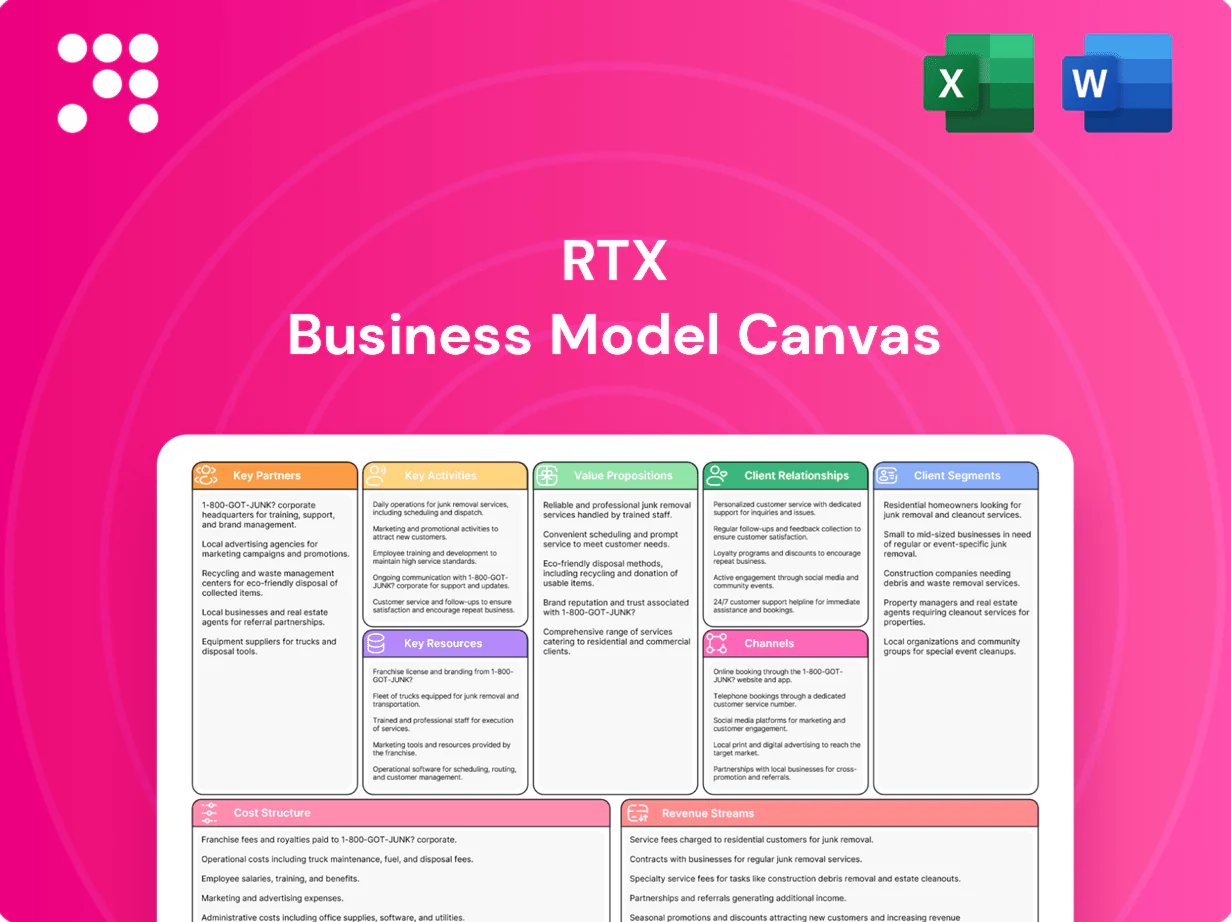
RTX Business Model Canvas

Unlock strategic Business Model Canvas for aerospace and defense leaders - download templates
Unlock the full strategic blueprint behind RTX’s business model with our detailed Business Model Canvas that maps value propositions, key partners, revenue streams, and cost structure. Ideal for investors, consultants, and executives seeking actionable insights. Download the complete Word and Excel files to benchmark, adapt, and scale proven strategies.
Partnerships

Defense and Government Agencies
RTX collaborates with the U.S. Department of Defense, NATO allies and international ministries to co-develop, certify and procure advanced systems, supporting billion-dollar, multi-year programs tied to the 2024 U.S. defense budget of about $858 billion. These partnerships provide budget visibility and mission alignment, while cooperative R&D and test ranges accelerate capability maturation. Security clearances and compliance frameworks for thousands of cleared personnel underpin trust and continuity.
Airframe OEMs and Primes
Collins Aerospace and Pratt & Whitney partner closely with Boeing, Airbus, Lockheed Martin and other primes for platform integration, with Boeing and Airbus accounting for over 90% of large commercial airframe deliveries. Early design-in ensures system compatibility and lifecycle support, reducing certification time and sustainment costs. Joint roadmaps deliver feature evolution, weight reduction and fuel-efficiency gains, while shared aftermarket strategies expand global support coverage.

Supply Chain and Advanced Materials
RTX relies on tier-1/2 suppliers for castings, composites, electronics and specialty alloys, supported by a global supplier base exceeding 10,000 partners and contributing to the companys ~$67 billion 2024 revenue. Long-term agreements stabilize cost and capacity for engine and avionics programs through multi-year contracts. Joint quality and digital traceability initiatives cut defects and shorten lead times, while strategic dual-sourcing mitigates geopolitical and commodity risks.

Technology and Cybersecurity Partners
Alliances with semiconductor, AI, and cyber vendors strengthen RTX sensing, processing, and protection layers, enabling higher-fidelity sensors and edge AI for EW and autonomy. Co-innovation projects accelerate secure communications and autonomy, supported by a growing cybersecurity market estimated at about 205 billion USD in 2024. Secure software pipelines and zero-trust architectures harden products and networks while joint labs validate interoperability and resilience under realistic threats.
- semiconductor+AI partnerships: enhanced sensing/processing
- co-innovation: secure comms, EW, autonomy
- zero-trust & secure pipelines: product/network hardening
- joint labs: interoperability & threat resilience
Maintenance, Repair, and Training Networks
In 2024 RTX leverages global MRO providers, airlines, and depot partners to extend aftermarket reach; licensed shops and pooling arrangements improve turnaround times and asset utilization. Training organizations support pilot, maintainer, and operator readiness, while data-sharing agreements enable predictive maintenance and performance optimization.
- Global MRO partners: extended aftermarket footprint
- Licensed shops & pooling: faster turnaround, higher utilization
- Training orgs: crew and maintainer readiness
- Data-sharing: predictive maintenance, performance gains
Defense prime aligns DoD/NATO, OEMs & 10,000+ suppliers to $67B revenue
RTX partners with DoD, NATO and ministries on multiyear programs tied to the 2024 US defense budget ~$858B. OEMs (Boeing/Airbus >90% large airframe deliveries) and 10,000+ suppliers support platform integration and ~$67B 2024 revenue. Semiconductor, AI and cyber alliances access a ~$205B 2024 cybersecurity market to advance sensors, EW and secure software.
| Partner | Role | 2024 metric |
|---|---|---|
| DoD/NATO | Program funding | $858B |
| OEMs | Platform integration | >90% deliveries |
| Suppliers | Supply base | 10,000+ |
| Company | Revenue | $67B |
What is included in the product
 Detailed Word Document
A comprehensive RTX Business Model Canvas detailing customer segments, channels, value propositions and the 9 BMC blocks with strategic narratives, competitive advantages, SWOT links and polished presentation-ready design for investor or internal use.

 Customizable Excel Spreadsheet
Condenses RTX’s complex aerospace and defense strategy into a single editable canvas, saving hours of structuring and enabling teams to quickly identify core components for decision-making and board-ready presentations.
Activities

R&D and Systems Engineering
RTX designs, prototypes, and tests avionics, engines, sensors, and weapons, supported by roughly 180,000 employees worldwide and $2.9 billion in research and engineering investments (2023). Model-based systems engineering accelerates integration across complex platforms and reduces time-to-certify. Rigorous validation meets FAA, EASA, and military standards. Continuous improvement cycles enable block upgrades and rapid tech insertions.
Manufacturing and Integration
High-precision production of turbines, composites and avionics underpins RTX quality, supported by about 180,000 employees in 2024 and centralized Pratt & Whitney and Collins machining hubs. Final assembly and systems integration validate platform-level performance across civil and defense programs. Increased automation and additive manufacturing reduced cycle times and improved yield, while supply orchestration balanced rate readiness with backlog execution.

Cybersecure Software and Firmware
Secure coding and DevSecOps pipelines deliver resilient mission software, reducing vulnerability exposure while enabling frequent updates that patch flaws and add capabilities; global cybersecurity spending reached about $188B in 2023 and is projected to top $200B in 2024. Digital twins validate performance across edge and cloud environments, and strict ITAR/EAR and federal cybersecurity mandates ensure export-control and compliance adherence.

Aftermarket Services and Sustainment
Aftermarket services and sustainment—global MRO, spares provisioning, and power-by-the-hour contracts—drive lifecycle value for RTX by linking revenue to fleet uptime and mission readiness; field service reps operate in austere environments to keep platforms mission-capable. Performance-based logistics tie uptime to payments while data analytics enable predictive maintenance and cost reduction; RTX had about 180,000 employees in 2024.
- Global MRO scale
- Spares provisioning
- Power-by-the-hour contracts
- Field service reps in austere ops
- Performance-based logistics
- Predictive maintenance via analytics
Program Management and Compliance
Program Management and Compliance enforces milestone control, earned value management and centralized risk governance across RTX’s ~$67.6B 2024 portfolio, with strict certification, ITAR/EAR and security protocols. Supplier quality audits and ESG reporting provide transparency, while proactive customer engagement manages scope, changes and deliverables to protect margins and schedule.
- Milestone control
- Earned value
- Risk governance
- ITAR/EAR compliance
- Supplier audits & ESG
- Customer change management
Model-based systems, digital twins & MRO secure fleet uptime for 180,000 and $67.6B
RTX develops and certifies engines, avionics, sensors and weapons with ~180,000 employees and $2.9B R&E (2023); model-based systems engineering speeds integration and certification. High-precision manufacturing and digital twins enable platform assembly and block upgrades; aftermarket MRO and power-by-the-hour contracts tie revenue to fleet uptime. Program management enforces EVM, ITAR/EAR and supplier audits across a ~$67.6B 2024 portfolio.
| Metric | Value |
|---|---|
| Employees | ~180,000 |
| R&E | $2.9B (2023) |
| Portfolio | $67.6B (2024) |
| Cyber spend | $188B (2023) |
Full Version Awaits
Business Model Canvas
The RTX Business Model Canvas you’re previewing is the actual deliverable, not a mockup—this snapshot comes directly from the final file you’ll receive after purchase. When you complete your order, you’ll get the full, editable document formatted exactly as shown, ready for editing, presenting, or sharing. No surprises, just the same professional Canvas in Word and Excel.

Unlock strategic Business Model Canvas for aerospace and defense leaders - download templates
Unlock the full strategic blueprint behind RTX’s business model with our detailed Business Model Canvas that maps value propositions, key partners, revenue streams, and cost structure. Ideal for investors, consultants, and executives seeking actionable insights. Download the complete Word and Excel files to benchmark, adapt, and scale proven strategies.
Partnerships
Defense and Government Agencies
RTX collaborates with the U.S. Department of Defense, NATO allies and international ministries to co-develop, certify and procure advanced systems, supporting billion-dollar, multi-year programs tied to the 2024 U.S. defense budget of about $858 billion. These partnerships provide budget visibility and mission alignment, while cooperative R&D and test ranges accelerate capability maturation. Security clearances and compliance frameworks for thousands of cleared personnel underpin trust and continuity.
Airframe OEMs and Primes
Collins Aerospace and Pratt & Whitney partner closely with Boeing, Airbus, Lockheed Martin and other primes for platform integration, with Boeing and Airbus accounting for over 90% of large commercial airframe deliveries. Early design-in ensures system compatibility and lifecycle support, reducing certification time and sustainment costs. Joint roadmaps deliver feature evolution, weight reduction and fuel-efficiency gains, while shared aftermarket strategies expand global support coverage.
Supply Chain and Advanced Materials
RTX relies on tier-1/2 suppliers for castings, composites, electronics and specialty alloys, supported by a global supplier base exceeding 10,000 partners and contributing to the companys ~$67 billion 2024 revenue. Long-term agreements stabilize cost and capacity for engine and avionics programs through multi-year contracts. Joint quality and digital traceability initiatives cut defects and shorten lead times, while strategic dual-sourcing mitigates geopolitical and commodity risks.
Technology and Cybersecurity Partners
Alliances with semiconductor, AI, and cyber vendors strengthen RTX sensing, processing, and protection layers, enabling higher-fidelity sensors and edge AI for EW and autonomy. Co-innovation projects accelerate secure communications and autonomy, supported by a growing cybersecurity market estimated at about 205 billion USD in 2024. Secure software pipelines and zero-trust architectures harden products and networks while joint labs validate interoperability and resilience under realistic threats.
- semiconductor+AI partnerships: enhanced sensing/processing
- co-innovation: secure comms, EW, autonomy
- zero-trust & secure pipelines: product/network hardening
- joint labs: interoperability & threat resilience
Maintenance, Repair, and Training Networks
In 2024 RTX leverages global MRO providers, airlines, and depot partners to extend aftermarket reach; licensed shops and pooling arrangements improve turnaround times and asset utilization. Training organizations support pilot, maintainer, and operator readiness, while data-sharing agreements enable predictive maintenance and performance optimization.
- Global MRO partners: extended aftermarket footprint
- Licensed shops & pooling: faster turnaround, higher utilization
- Training orgs: crew and maintainer readiness
- Data-sharing: predictive maintenance, performance gains
Defense prime aligns DoD/NATO, OEMs & 10,000+ suppliers to $67B revenue
RTX partners with DoD, NATO and ministries on multiyear programs tied to the 2024 US defense budget ~$858B. OEMs (Boeing/Airbus >90% large airframe deliveries) and 10,000+ suppliers support platform integration and ~$67B 2024 revenue. Semiconductor, AI and cyber alliances access a ~$205B 2024 cybersecurity market to advance sensors, EW and secure software.
| Partner | Role | 2024 metric |
|---|---|---|
| DoD/NATO | Program funding | $858B |
| OEMs | Platform integration | >90% deliveries |
| Suppliers | Supply base | 10,000+ |
| Company | Revenue | $67B |
What is included in the product
Detailed Word Document
A comprehensive RTX Business Model Canvas detailing customer segments, channels, value propositions and the 9 BMC blocks with strategic narratives, competitive advantages, SWOT links and polished presentation-ready design for investor or internal use.
Customizable Excel Spreadsheet
Condenses RTX’s complex aerospace and defense strategy into a single editable canvas, saving hours of structuring and enabling teams to quickly identify core components for decision-making and board-ready presentations.
Activities
R&D and Systems Engineering
RTX designs, prototypes, and tests avionics, engines, sensors, and weapons, supported by roughly 180,000 employees worldwide and $2.9 billion in research and engineering investments (2023). Model-based systems engineering accelerates integration across complex platforms and reduces time-to-certify. Rigorous validation meets FAA, EASA, and military standards. Continuous improvement cycles enable block upgrades and rapid tech insertions.
Manufacturing and Integration
High-precision production of turbines, composites and avionics underpins RTX quality, supported by about 180,000 employees in 2024 and centralized Pratt & Whitney and Collins machining hubs. Final assembly and systems integration validate platform-level performance across civil and defense programs. Increased automation and additive manufacturing reduced cycle times and improved yield, while supply orchestration balanced rate readiness with backlog execution.
Cybersecure Software and Firmware
Secure coding and DevSecOps pipelines deliver resilient mission software, reducing vulnerability exposure while enabling frequent updates that patch flaws and add capabilities; global cybersecurity spending reached about $188B in 2023 and is projected to top $200B in 2024. Digital twins validate performance across edge and cloud environments, and strict ITAR/EAR and federal cybersecurity mandates ensure export-control and compliance adherence.
Aftermarket Services and Sustainment
Aftermarket services and sustainment—global MRO, spares provisioning, and power-by-the-hour contracts—drive lifecycle value for RTX by linking revenue to fleet uptime and mission readiness; field service reps operate in austere environments to keep platforms mission-capable. Performance-based logistics tie uptime to payments while data analytics enable predictive maintenance and cost reduction; RTX had about 180,000 employees in 2024.
- Global MRO scale
- Spares provisioning
- Power-by-the-hour contracts
- Field service reps in austere ops
- Performance-based logistics
- Predictive maintenance via analytics
Program Management and Compliance
Program Management and Compliance enforces milestone control, earned value management and centralized risk governance across RTX’s ~$67.6B 2024 portfolio, with strict certification, ITAR/EAR and security protocols. Supplier quality audits and ESG reporting provide transparency, while proactive customer engagement manages scope, changes and deliverables to protect margins and schedule.
- Milestone control
- Earned value
- Risk governance
- ITAR/EAR compliance
- Supplier audits & ESG
- Customer change management
Model-based systems, digital twins & MRO secure fleet uptime for 180,000 and $67.6B
RTX develops and certifies engines, avionics, sensors and weapons with ~180,000 employees and $2.9B R&E (2023); model-based systems engineering speeds integration and certification. High-precision manufacturing and digital twins enable platform assembly and block upgrades; aftermarket MRO and power-by-the-hour contracts tie revenue to fleet uptime. Program management enforces EVM, ITAR/EAR and supplier audits across a ~$67.6B 2024 portfolio.
| Metric | Value |
|---|---|
| Employees | ~180,000 |
| R&E | $2.9B (2023) |
| Portfolio | $67.6B (2024) |
| Cyber spend | $188B (2023) |
Full Version Awaits
Business Model Canvas
The RTX Business Model Canvas you’re previewing is the actual deliverable, not a mockup—this snapshot comes directly from the final file you’ll receive after purchase. When you complete your order, you’ll get the full, editable document formatted exactly as shown, ready for editing, presenting, or sharing. No surprises, just the same professional Canvas in Word and Excel.
Original: $10.00
-65%$10.00
$3.50Description
Unlock strategic Business Model Canvas for aerospace and defense leaders - download templates
Unlock the full strategic blueprint behind RTX’s business model with our detailed Business Model Canvas that maps value propositions, key partners, revenue streams, and cost structure. Ideal for investors, consultants, and executives seeking actionable insights. Download the complete Word and Excel files to benchmark, adapt, and scale proven strategies.
Partnerships
Defense and Government Agencies
RTX collaborates with the U.S. Department of Defense, NATO allies and international ministries to co-develop, certify and procure advanced systems, supporting billion-dollar, multi-year programs tied to the 2024 U.S. defense budget of about $858 billion. These partnerships provide budget visibility and mission alignment, while cooperative R&D and test ranges accelerate capability maturation. Security clearances and compliance frameworks for thousands of cleared personnel underpin trust and continuity.
Airframe OEMs and Primes
Collins Aerospace and Pratt & Whitney partner closely with Boeing, Airbus, Lockheed Martin and other primes for platform integration, with Boeing and Airbus accounting for over 90% of large commercial airframe deliveries. Early design-in ensures system compatibility and lifecycle support, reducing certification time and sustainment costs. Joint roadmaps deliver feature evolution, weight reduction and fuel-efficiency gains, while shared aftermarket strategies expand global support coverage.
Supply Chain and Advanced Materials
RTX relies on tier-1/2 suppliers for castings, composites, electronics and specialty alloys, supported by a global supplier base exceeding 10,000 partners and contributing to the companys ~$67 billion 2024 revenue. Long-term agreements stabilize cost and capacity for engine and avionics programs through multi-year contracts. Joint quality and digital traceability initiatives cut defects and shorten lead times, while strategic dual-sourcing mitigates geopolitical and commodity risks.
Technology and Cybersecurity Partners
Alliances with semiconductor, AI, and cyber vendors strengthen RTX sensing, processing, and protection layers, enabling higher-fidelity sensors and edge AI for EW and autonomy. Co-innovation projects accelerate secure communications and autonomy, supported by a growing cybersecurity market estimated at about 205 billion USD in 2024. Secure software pipelines and zero-trust architectures harden products and networks while joint labs validate interoperability and resilience under realistic threats.
- semiconductor+AI partnerships: enhanced sensing/processing
- co-innovation: secure comms, EW, autonomy
- zero-trust & secure pipelines: product/network hardening
- joint labs: interoperability & threat resilience
Maintenance, Repair, and Training Networks
In 2024 RTX leverages global MRO providers, airlines, and depot partners to extend aftermarket reach; licensed shops and pooling arrangements improve turnaround times and asset utilization. Training organizations support pilot, maintainer, and operator readiness, while data-sharing agreements enable predictive maintenance and performance optimization.
- Global MRO partners: extended aftermarket footprint
- Licensed shops & pooling: faster turnaround, higher utilization
- Training orgs: crew and maintainer readiness
- Data-sharing: predictive maintenance, performance gains
Defense prime aligns DoD/NATO, OEMs & 10,000+ suppliers to $67B revenue
RTX partners with DoD, NATO and ministries on multiyear programs tied to the 2024 US defense budget ~$858B. OEMs (Boeing/Airbus >90% large airframe deliveries) and 10,000+ suppliers support platform integration and ~$67B 2024 revenue. Semiconductor, AI and cyber alliances access a ~$205B 2024 cybersecurity market to advance sensors, EW and secure software.
| Partner | Role | 2024 metric |
|---|---|---|
| DoD/NATO | Program funding | $858B |
| OEMs | Platform integration | >90% deliveries |
| Suppliers | Supply base | 10,000+ |
| Company | Revenue | $67B |
What is included in the product
Detailed Word Document
A comprehensive RTX Business Model Canvas detailing customer segments, channels, value propositions and the 9 BMC blocks with strategic narratives, competitive advantages, SWOT links and polished presentation-ready design for investor or internal use.
Customizable Excel Spreadsheet
Condenses RTX’s complex aerospace and defense strategy into a single editable canvas, saving hours of structuring and enabling teams to quickly identify core components for decision-making and board-ready presentations.
Activities
R&D and Systems Engineering
RTX designs, prototypes, and tests avionics, engines, sensors, and weapons, supported by roughly 180,000 employees worldwide and $2.9 billion in research and engineering investments (2023). Model-based systems engineering accelerates integration across complex platforms and reduces time-to-certify. Rigorous validation meets FAA, EASA, and military standards. Continuous improvement cycles enable block upgrades and rapid tech insertions.
Manufacturing and Integration
High-precision production of turbines, composites and avionics underpins RTX quality, supported by about 180,000 employees in 2024 and centralized Pratt & Whitney and Collins machining hubs. Final assembly and systems integration validate platform-level performance across civil and defense programs. Increased automation and additive manufacturing reduced cycle times and improved yield, while supply orchestration balanced rate readiness with backlog execution.
Cybersecure Software and Firmware
Secure coding and DevSecOps pipelines deliver resilient mission software, reducing vulnerability exposure while enabling frequent updates that patch flaws and add capabilities; global cybersecurity spending reached about $188B in 2023 and is projected to top $200B in 2024. Digital twins validate performance across edge and cloud environments, and strict ITAR/EAR and federal cybersecurity mandates ensure export-control and compliance adherence.
Aftermarket Services and Sustainment
Aftermarket services and sustainment—global MRO, spares provisioning, and power-by-the-hour contracts—drive lifecycle value for RTX by linking revenue to fleet uptime and mission readiness; field service reps operate in austere environments to keep platforms mission-capable. Performance-based logistics tie uptime to payments while data analytics enable predictive maintenance and cost reduction; RTX had about 180,000 employees in 2024.
- Global MRO scale
- Spares provisioning
- Power-by-the-hour contracts
- Field service reps in austere ops
- Performance-based logistics
- Predictive maintenance via analytics
Program Management and Compliance
Program Management and Compliance enforces milestone control, earned value management and centralized risk governance across RTX’s ~$67.6B 2024 portfolio, with strict certification, ITAR/EAR and security protocols. Supplier quality audits and ESG reporting provide transparency, while proactive customer engagement manages scope, changes and deliverables to protect margins and schedule.
- Milestone control
- Earned value
- Risk governance
- ITAR/EAR compliance
- Supplier audits & ESG
- Customer change management
Model-based systems, digital twins & MRO secure fleet uptime for 180,000 and $67.6B
RTX develops and certifies engines, avionics, sensors and weapons with ~180,000 employees and $2.9B R&E (2023); model-based systems engineering speeds integration and certification. High-precision manufacturing and digital twins enable platform assembly and block upgrades; aftermarket MRO and power-by-the-hour contracts tie revenue to fleet uptime. Program management enforces EVM, ITAR/EAR and supplier audits across a ~$67.6B 2024 portfolio.
| Metric | Value |
|---|---|
| Employees | ~180,000 |
| R&E | $2.9B (2023) |
| Portfolio | $67.6B (2024) |
| Cyber spend | $188B (2023) |
Full Version Awaits
Business Model Canvas
The RTX Business Model Canvas you’re previewing is the actual deliverable, not a mockup—this snapshot comes directly from the final file you’ll receive after purchase. When you complete your order, you’ll get the full, editable document formatted exactly as shown, ready for editing, presenting, or sharing. No surprises, just the same professional Canvas in Word and Excel.











