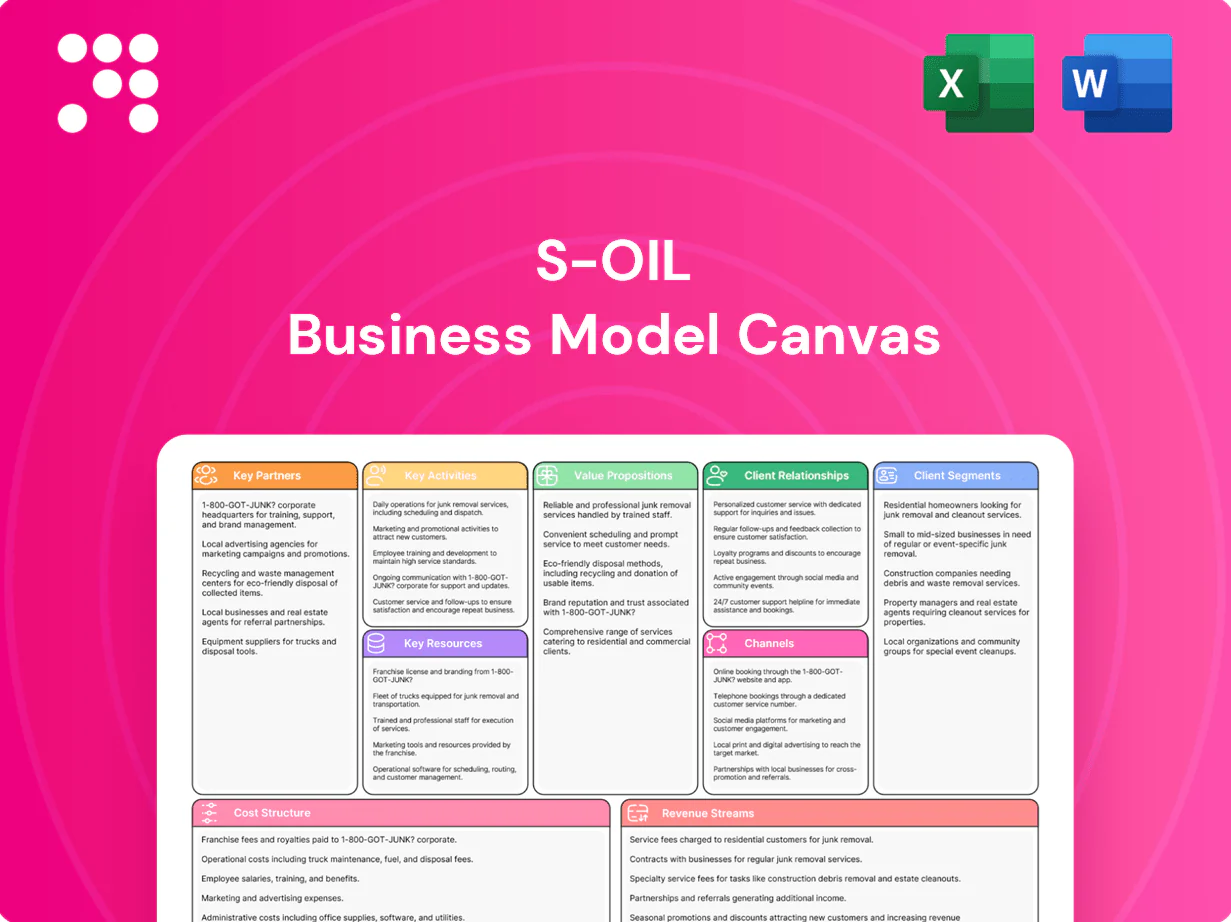
S-Oil Business Model Canvas

Unlock the strategic business model blueprint for refining, petrochemicals, and retail networks
Unlock the full strategic blueprint behind S-Oil’s business model and see exactly how it creates value across refining, petrochemicals, and retail networks. This concise Business Model Canvas maps customer segments, key partners, revenue streams, and competitive advantages to guide investors and strategists. Download the complete Word/Excel canvas for a section-by-section playbook you can use for benchmarking, deal analysis, or strategic planning.
Partnerships

Crude supply agreements
Partnering with global and national oil companies secures diverse crude slates for S-Oil, supporting feedstock for its Onsan refinery capacity of 669,000 barrels per day (2024). Long-term offtake contracts stabilize availability and pricing, cutting volatility in feedstock procurement. These relationships reduce supply risk and enable optimization of refinery yields, while flexible sourcing supports margin management across price cycles.
Technology & catalyst licensors
Collaborate with process licensors such as UOP, Axens and Shell and catalyst suppliers like BASF and Albemarle to optimize S-Oil Onsan refinery (crude distillation capacity 669,000 bpd). Technical alliances enable joint trials and targeted upgrades to improve throughput, energy efficiency and product quality while access to IP accelerates time-to-performance.

Logistics & storage providers
S-Oil partners with tanker operators, terminals, pipelines and rail/truck fleets to secure timely crude intake and product deliveries, crucial for South Korea’s oil import dependence of over 95% in 2024. Integrated logistics and shared storage/blending capacity boost export agility and faster vessel turnaround, cutting demurrage exposure (often >$100,000/day for large tankers) and lowering stockout risk.

Downstream distributors & retailers
Alliances with fuel station operators, lubricant distributors and B2B resellers expand S-Oil’s market reach and shelf space; co-branding and multi-year supply contracts secure offtake and margin stability. Distributors deliver local market intelligence and after-sales service capabilities, while partnership terms—linked to volume, quality and service KPIs—align incentives; S-Oil is 63.4% owned by Saudi Aramco and runs a ~669 kbpd refinery (2024).
- Network access: station & B2B channels
- Contract security: co-branding & supply agreements
- Value alignment: volume/quality/service KPIs
Regulators & industry bodies
Regulators and industry bodies are engaged to align fuel specifications, safety protocols, and environmental standards with S-Oil operations, reducing regulatory risk and reputational exposure. Industry associations facilitate policy dialogue and dissemination of best practices across refining, trading, and logistics. Compliance partnerships streamline permitting and audit processes, accelerating project approvals and operational continuity.
- Engage government agencies on specs, safety, environment
- Use associations for policy dialog and best practices
- Compliance ties streamline permitting and audits
- Alignment lowers regulatory and reputational risk
Onsan refinery: global crude deals, tech alliances boost yield, 669,000 bpd, majority owner 63.4%
Partnerships with global/national oil firms secure diverse crude for S-Oil’s Onsan refinery (669,000 bpd, 2024) and stabilize pricing via long-term offtakes. Tech alliances (UOP, Axens, Shell; BASF, Albemarle) boost yields and efficiency. Logistics ties cut demurrage risk (>100,000 USD/day) and ensure feedstock/product flow. Distribution and regulator links lock market access; Saudi Aramco owns 63.4%.
| Metric | Value (2024) |
|---|---|
| Refinery capacity | 669,000 bpd |
| Aramco ownership | 63.4% |
| Import dependence | >95% |
What is included in the product
 Detailed Word Document
A comprehensive Business Model Canvas tailored to S-Oil’s integrated refining, petrochemicals and fuel retail strategy, mapping customer segments, channels, value propositions and revenue streams across the 9 BMC blocks. Ideal for presentations and investor discussions, it reflects real-world operations, highlights competitive advantages, and links strengths, weaknesses, opportunities and threats to each block.

 Customizable Excel Spreadsheet
High-level view of S-Oil’s business model with editable cells, spotlighting refinery margin, feedstock sourcing, and retail distribution pain points for rapid problem-solving. Perfect for teams to diagnose operational bottlenecks and align strategies in a single, shareable canvas.
Activities

Refining operations
Operate complex refining units at S-Oil's 669,000 barrels-per-day Onsan complex (2024) to convert crude into gasoline, diesel, jet and bunker fuels. Continuously optimize crude selection, cut points and unit severity to maximize product yields and margins. Maintain high utilization (circa 85–92% typical industry range) while scheduling turnarounds to limit downtime. Ensure product quality complies with Korean domestic and major export specifications.
Aromatics & petrochemicals production
In 2024 S-Oil operates aromatics units to produce paraxylene, benzene and related streams from reformate and dedicated aromatics trains. The business balances integrated value between fuels and chemicals by shifting output according to market spreads and refinery economics. Feedstock blending and purity management ensure off-taker specifications and product yield optimization. Stable long-term contracts are supported via consistent specs and reliable supply performance.

Lubricant base oils & finished lubes
S-Oil manufactures high-quality Group II/III base oils and formulates branded lubricants leveraging its Onsan refinery capacity of about 669,000 barrels/day (2024). It secures technical approvals and OEM certifications across major automakers and conducts application testing and performance benchmarking in accredited labs. The company supports channel partners with structured product training, after-sales technical service, and field performance data to drive adoption.

Supply chain, trading & risk management
S-Oil conducts crude and product trading to optimize margins and inventory for its 669 kbpd Onsan refinery, leveraging its Saudi Aramco 63.45% backing; it hedges price, FX and freight exposures, plans logistics, blending and storage to meet demand, and monitors market signals to time exports and imports effectively.
- Refinery capacity: 669 kbpd
- Major shareholder: Saudi Aramco 63.45%
- Hedges: price, FX, freight
- Focus: logistics, blending, timing exports/imports
HSSE, ESG & reliability excellence
S-Oil embeds HSSE and ESG into operations by implementing rigorous health, safety, security and environmental programs, driving energy-efficiency and emissions-reduction projects, and sustaining asset integrity via predictive maintenance; the company reaffirms a net-zero by 2050 commitment and continued 2024 ESG disclosures under TCFD standards.
- HSSE programs
- Energy-efficiency & emissions cuts
- Predictive maintenance
- Transparent 2024 ESG reporting
Operate Onsan 669,000 bpd to maximize fuels, PX/benzene and lube margins
Operate 669,000 bpd Onsan refinery (2024) to maximize fuels yields and margins via crude selection and unit optimization.
Run aromatics and Group II/III base-oil lines, shifting output to capture PX/benzene and lube spreads.
Manage trading, hedges (price/FX/freight) and logistics; major shareholder Saudi Aramco 63.45%.
Maintain HSSE, predictive maintenance and TCFD-aligned ESG reporting; net-zero by 2050.
| Metric | 2024 |
|---|---|
| Refinery capacity | 669 kbpd |
| Aramco stake | 63.45% |
| Utilization | 85–92% range |
Delivered as Displayed
Business Model Canvas
The S-Oil Business Model Canvas shown here is the actual deliverable, not a mockup, and reflects the exact structure and content you’ll receive after purchase. Upon ordering, you’ll get this same professional document ready to edit and present. No surprises—what you preview is what you own.

Unlock the strategic business model blueprint for refining, petrochemicals, and retail networks
Unlock the full strategic blueprint behind S-Oil’s business model and see exactly how it creates value across refining, petrochemicals, and retail networks. This concise Business Model Canvas maps customer segments, key partners, revenue streams, and competitive advantages to guide investors and strategists. Download the complete Word/Excel canvas for a section-by-section playbook you can use for benchmarking, deal analysis, or strategic planning.
Partnerships
Crude supply agreements
Partnering with global and national oil companies secures diverse crude slates for S-Oil, supporting feedstock for its Onsan refinery capacity of 669,000 barrels per day (2024). Long-term offtake contracts stabilize availability and pricing, cutting volatility in feedstock procurement. These relationships reduce supply risk and enable optimization of refinery yields, while flexible sourcing supports margin management across price cycles.
Technology & catalyst licensors
Collaborate with process licensors such as UOP, Axens and Shell and catalyst suppliers like BASF and Albemarle to optimize S-Oil Onsan refinery (crude distillation capacity 669,000 bpd). Technical alliances enable joint trials and targeted upgrades to improve throughput, energy efficiency and product quality while access to IP accelerates time-to-performance.
Logistics & storage providers
S-Oil partners with tanker operators, terminals, pipelines and rail/truck fleets to secure timely crude intake and product deliveries, crucial for South Korea’s oil import dependence of over 95% in 2024. Integrated logistics and shared storage/blending capacity boost export agility and faster vessel turnaround, cutting demurrage exposure (often >$100,000/day for large tankers) and lowering stockout risk.
Downstream distributors & retailers
Alliances with fuel station operators, lubricant distributors and B2B resellers expand S-Oil’s market reach and shelf space; co-branding and multi-year supply contracts secure offtake and margin stability. Distributors deliver local market intelligence and after-sales service capabilities, while partnership terms—linked to volume, quality and service KPIs—align incentives; S-Oil is 63.4% owned by Saudi Aramco and runs a ~669 kbpd refinery (2024).
- Network access: station & B2B channels
- Contract security: co-branding & supply agreements
- Value alignment: volume/quality/service KPIs
Regulators & industry bodies
Regulators and industry bodies are engaged to align fuel specifications, safety protocols, and environmental standards with S-Oil operations, reducing regulatory risk and reputational exposure. Industry associations facilitate policy dialogue and dissemination of best practices across refining, trading, and logistics. Compliance partnerships streamline permitting and audit processes, accelerating project approvals and operational continuity.
- Engage government agencies on specs, safety, environment
- Use associations for policy dialog and best practices
- Compliance ties streamline permitting and audits
- Alignment lowers regulatory and reputational risk
Onsan refinery: global crude deals, tech alliances boost yield, 669,000 bpd, majority owner 63.4%
Partnerships with global/national oil firms secure diverse crude for S-Oil’s Onsan refinery (669,000 bpd, 2024) and stabilize pricing via long-term offtakes. Tech alliances (UOP, Axens, Shell; BASF, Albemarle) boost yields and efficiency. Logistics ties cut demurrage risk (>100,000 USD/day) and ensure feedstock/product flow. Distribution and regulator links lock market access; Saudi Aramco owns 63.4%.
| Metric | Value (2024) |
|---|---|
| Refinery capacity | 669,000 bpd |
| Aramco ownership | 63.4% |
| Import dependence | >95% |
What is included in the product
Detailed Word Document
A comprehensive Business Model Canvas tailored to S-Oil’s integrated refining, petrochemicals and fuel retail strategy, mapping customer segments, channels, value propositions and revenue streams across the 9 BMC blocks. Ideal for presentations and investor discussions, it reflects real-world operations, highlights competitive advantages, and links strengths, weaknesses, opportunities and threats to each block.
Customizable Excel Spreadsheet
High-level view of S-Oil’s business model with editable cells, spotlighting refinery margin, feedstock sourcing, and retail distribution pain points for rapid problem-solving. Perfect for teams to diagnose operational bottlenecks and align strategies in a single, shareable canvas.
Activities
Refining operations
Operate complex refining units at S-Oil's 669,000 barrels-per-day Onsan complex (2024) to convert crude into gasoline, diesel, jet and bunker fuels. Continuously optimize crude selection, cut points and unit severity to maximize product yields and margins. Maintain high utilization (circa 85–92% typical industry range) while scheduling turnarounds to limit downtime. Ensure product quality complies with Korean domestic and major export specifications.
Aromatics & petrochemicals production
In 2024 S-Oil operates aromatics units to produce paraxylene, benzene and related streams from reformate and dedicated aromatics trains. The business balances integrated value between fuels and chemicals by shifting output according to market spreads and refinery economics. Feedstock blending and purity management ensure off-taker specifications and product yield optimization. Stable long-term contracts are supported via consistent specs and reliable supply performance.
Lubricant base oils & finished lubes
S-Oil manufactures high-quality Group II/III base oils and formulates branded lubricants leveraging its Onsan refinery capacity of about 669,000 barrels/day (2024). It secures technical approvals and OEM certifications across major automakers and conducts application testing and performance benchmarking in accredited labs. The company supports channel partners with structured product training, after-sales technical service, and field performance data to drive adoption.
Supply chain, trading & risk management
S-Oil conducts crude and product trading to optimize margins and inventory for its 669 kbpd Onsan refinery, leveraging its Saudi Aramco 63.45% backing; it hedges price, FX and freight exposures, plans logistics, blending and storage to meet demand, and monitors market signals to time exports and imports effectively.
- Refinery capacity: 669 kbpd
- Major shareholder: Saudi Aramco 63.45%
- Hedges: price, FX, freight
- Focus: logistics, blending, timing exports/imports
HSSE, ESG & reliability excellence
S-Oil embeds HSSE and ESG into operations by implementing rigorous health, safety, security and environmental programs, driving energy-efficiency and emissions-reduction projects, and sustaining asset integrity via predictive maintenance; the company reaffirms a net-zero by 2050 commitment and continued 2024 ESG disclosures under TCFD standards.
- HSSE programs
- Energy-efficiency & emissions cuts
- Predictive maintenance
- Transparent 2024 ESG reporting
Operate Onsan 669,000 bpd to maximize fuels, PX/benzene and lube margins
Operate 669,000 bpd Onsan refinery (2024) to maximize fuels yields and margins via crude selection and unit optimization.
Run aromatics and Group II/III base-oil lines, shifting output to capture PX/benzene and lube spreads.
Manage trading, hedges (price/FX/freight) and logistics; major shareholder Saudi Aramco 63.45%.
Maintain HSSE, predictive maintenance and TCFD-aligned ESG reporting; net-zero by 2050.
| Metric | 2024 |
|---|---|
| Refinery capacity | 669 kbpd |
| Aramco stake | 63.45% |
| Utilization | 85–92% range |
Delivered as Displayed
Business Model Canvas
The S-Oil Business Model Canvas shown here is the actual deliverable, not a mockup, and reflects the exact structure and content you’ll receive after purchase. Upon ordering, you’ll get this same professional document ready to edit and present. No surprises—what you preview is what you own.
Original: $10.00
-65%$10.00
$3.50Description
Unlock the strategic business model blueprint for refining, petrochemicals, and retail networks
Unlock the full strategic blueprint behind S-Oil’s business model and see exactly how it creates value across refining, petrochemicals, and retail networks. This concise Business Model Canvas maps customer segments, key partners, revenue streams, and competitive advantages to guide investors and strategists. Download the complete Word/Excel canvas for a section-by-section playbook you can use for benchmarking, deal analysis, or strategic planning.
Partnerships
Crude supply agreements
Partnering with global and national oil companies secures diverse crude slates for S-Oil, supporting feedstock for its Onsan refinery capacity of 669,000 barrels per day (2024). Long-term offtake contracts stabilize availability and pricing, cutting volatility in feedstock procurement. These relationships reduce supply risk and enable optimization of refinery yields, while flexible sourcing supports margin management across price cycles.
Technology & catalyst licensors
Collaborate with process licensors such as UOP, Axens and Shell and catalyst suppliers like BASF and Albemarle to optimize S-Oil Onsan refinery (crude distillation capacity 669,000 bpd). Technical alliances enable joint trials and targeted upgrades to improve throughput, energy efficiency and product quality while access to IP accelerates time-to-performance.
Logistics & storage providers
S-Oil partners with tanker operators, terminals, pipelines and rail/truck fleets to secure timely crude intake and product deliveries, crucial for South Korea’s oil import dependence of over 95% in 2024. Integrated logistics and shared storage/blending capacity boost export agility and faster vessel turnaround, cutting demurrage exposure (often >$100,000/day for large tankers) and lowering stockout risk.
Downstream distributors & retailers
Alliances with fuel station operators, lubricant distributors and B2B resellers expand S-Oil’s market reach and shelf space; co-branding and multi-year supply contracts secure offtake and margin stability. Distributors deliver local market intelligence and after-sales service capabilities, while partnership terms—linked to volume, quality and service KPIs—align incentives; S-Oil is 63.4% owned by Saudi Aramco and runs a ~669 kbpd refinery (2024).
- Network access: station & B2B channels
- Contract security: co-branding & supply agreements
- Value alignment: volume/quality/service KPIs
Regulators & industry bodies
Regulators and industry bodies are engaged to align fuel specifications, safety protocols, and environmental standards with S-Oil operations, reducing regulatory risk and reputational exposure. Industry associations facilitate policy dialogue and dissemination of best practices across refining, trading, and logistics. Compliance partnerships streamline permitting and audit processes, accelerating project approvals and operational continuity.
- Engage government agencies on specs, safety, environment
- Use associations for policy dialog and best practices
- Compliance ties streamline permitting and audits
- Alignment lowers regulatory and reputational risk
Onsan refinery: global crude deals, tech alliances boost yield, 669,000 bpd, majority owner 63.4%
Partnerships with global/national oil firms secure diverse crude for S-Oil’s Onsan refinery (669,000 bpd, 2024) and stabilize pricing via long-term offtakes. Tech alliances (UOP, Axens, Shell; BASF, Albemarle) boost yields and efficiency. Logistics ties cut demurrage risk (>100,000 USD/day) and ensure feedstock/product flow. Distribution and regulator links lock market access; Saudi Aramco owns 63.4%.
| Metric | Value (2024) |
|---|---|
| Refinery capacity | 669,000 bpd |
| Aramco ownership | 63.4% |
| Import dependence | >95% |
What is included in the product
Detailed Word Document
A comprehensive Business Model Canvas tailored to S-Oil’s integrated refining, petrochemicals and fuel retail strategy, mapping customer segments, channels, value propositions and revenue streams across the 9 BMC blocks. Ideal for presentations and investor discussions, it reflects real-world operations, highlights competitive advantages, and links strengths, weaknesses, opportunities and threats to each block.
Customizable Excel Spreadsheet
High-level view of S-Oil’s business model with editable cells, spotlighting refinery margin, feedstock sourcing, and retail distribution pain points for rapid problem-solving. Perfect for teams to diagnose operational bottlenecks and align strategies in a single, shareable canvas.
Activities
Refining operations
Operate complex refining units at S-Oil's 669,000 barrels-per-day Onsan complex (2024) to convert crude into gasoline, diesel, jet and bunker fuels. Continuously optimize crude selection, cut points and unit severity to maximize product yields and margins. Maintain high utilization (circa 85–92% typical industry range) while scheduling turnarounds to limit downtime. Ensure product quality complies with Korean domestic and major export specifications.
Aromatics & petrochemicals production
In 2024 S-Oil operates aromatics units to produce paraxylene, benzene and related streams from reformate and dedicated aromatics trains. The business balances integrated value between fuels and chemicals by shifting output according to market spreads and refinery economics. Feedstock blending and purity management ensure off-taker specifications and product yield optimization. Stable long-term contracts are supported via consistent specs and reliable supply performance.
Lubricant base oils & finished lubes
S-Oil manufactures high-quality Group II/III base oils and formulates branded lubricants leveraging its Onsan refinery capacity of about 669,000 barrels/day (2024). It secures technical approvals and OEM certifications across major automakers and conducts application testing and performance benchmarking in accredited labs. The company supports channel partners with structured product training, after-sales technical service, and field performance data to drive adoption.
Supply chain, trading & risk management
S-Oil conducts crude and product trading to optimize margins and inventory for its 669 kbpd Onsan refinery, leveraging its Saudi Aramco 63.45% backing; it hedges price, FX and freight exposures, plans logistics, blending and storage to meet demand, and monitors market signals to time exports and imports effectively.
- Refinery capacity: 669 kbpd
- Major shareholder: Saudi Aramco 63.45%
- Hedges: price, FX, freight
- Focus: logistics, blending, timing exports/imports
HSSE, ESG & reliability excellence
S-Oil embeds HSSE and ESG into operations by implementing rigorous health, safety, security and environmental programs, driving energy-efficiency and emissions-reduction projects, and sustaining asset integrity via predictive maintenance; the company reaffirms a net-zero by 2050 commitment and continued 2024 ESG disclosures under TCFD standards.
- HSSE programs
- Energy-efficiency & emissions cuts
- Predictive maintenance
- Transparent 2024 ESG reporting
Operate Onsan 669,000 bpd to maximize fuels, PX/benzene and lube margins
Operate 669,000 bpd Onsan refinery (2024) to maximize fuels yields and margins via crude selection and unit optimization.
Run aromatics and Group II/III base-oil lines, shifting output to capture PX/benzene and lube spreads.
Manage trading, hedges (price/FX/freight) and logistics; major shareholder Saudi Aramco 63.45%.
Maintain HSSE, predictive maintenance and TCFD-aligned ESG reporting; net-zero by 2050.
| Metric | 2024 |
|---|---|
| Refinery capacity | 669 kbpd |
| Aramco stake | 63.45% |
| Utilization | 85–92% range |
Delivered as Displayed
Business Model Canvas
The S-Oil Business Model Canvas shown here is the actual deliverable, not a mockup, and reflects the exact structure and content you’ll receive after purchase. Upon ordering, you’ll get this same professional document ready to edit and present. No surprises—what you preview is what you own.











