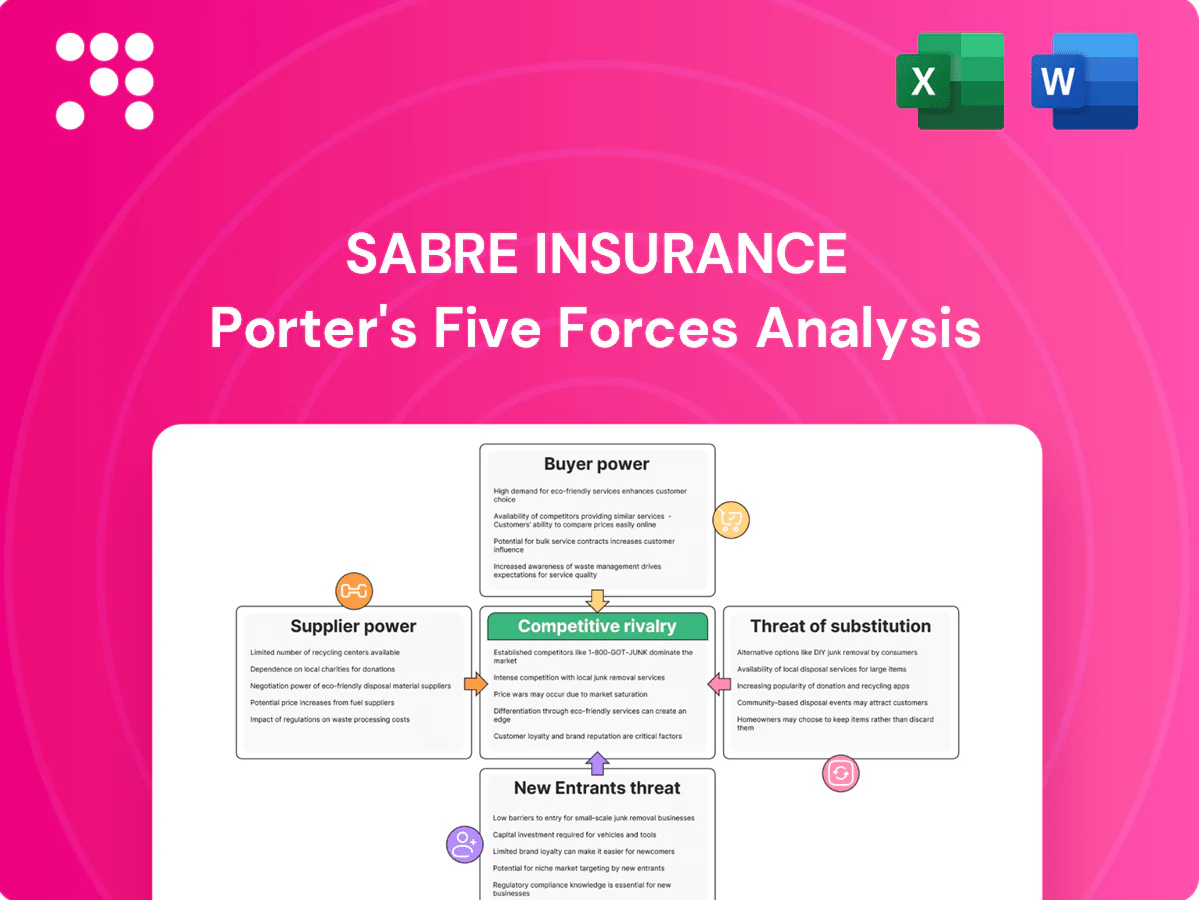
Sabre Insurance Porter's Five Forces Analysis

From Overview to Strategy Blueprint
Sabre Insurance faces moderate buyer power, rising digital substitution threats, and regulatory-driven cost pressures that shape its pricing and distribution strategies. Competitive rivalry is intense among niche insurers, while supplier influence remains limited. This preview is just the beginning—unlock the full Porter's Five Forces Analysis for force-by-force ratings, visuals, and actionable strategy insights.
Suppliers Bargaining Power

Reinsurance dependence
After 2023 catastrophe losses, 2024 reinsurance capacity tightened with pricing uplifts around 10% in UK/European motor markets; concentration of leading reinsurers—controlling roughly half the treaty capacity—can drive higher rates and tighter wordings, pressuring margins. Long-term relationships and Sabre’s historically disciplined underwriting and favourable loss ratios temper that influence, enabling negotiation of more favourable treaty terms and capacity.
Data/telematics vendors
Access to high-quality driver, vehicle and credit data is vital for pricing precision; by 2024 telematics accounted for roughly 10% of UK new motor policies, boosting risk segmentation. A few proprietary datasets and device platforms command premium fees and exclusivity, raising unit data costs. Vendor switching is feasible but costly due to model revalidation and integration overheads; multi-sourcing is used to reduce concentration risk.

Repair networks and parts
Bodyshops, parts suppliers and claims service providers drive indemnity costs and cycle time; UK repair capacity remains tight post‑pandemic with reported cycle times up about 18% in 2024 and OEM parts inflation running near 9% year‑on‑year, increasing supplier leverage. Sabre uses volume‑based agreements and steerage to secure discounts (circa 12%) and SLAs. Broad geographic repair network coverage across roughly 90% of UK postcodes mitigates local bottlenecks.

Core systems and cloud
Policy admin, pricing engines and cloud hosting are sticky for Sabre Insurance in 2024 because integration complexity traps data flows and workflows; vendors leverage license models, upgrade cadences and usage fees to extract rent. Modular architectures and rising in-house analytics reduce lock-in, while strict contracts on performance and portability cap supplier risk.
Capital and ratings
Equity investors and rating expectations drive Sabre’s risk appetite and reinsurance spend, with capital providers tightening terms in hard markets and demanding higher returns. Strong solvency and consistent profitability give Sabre negotiating room with reinsurers and capital markets. Transparent risk selection and underwriting discipline bolster counterparty confidence.
- Equity/rating pressure → higher reinsurance spend
- Hard markets increase capital bargaining power
- Solvency/profitability = negotiating leverage
- Transparent risk selection → stronger counterparty trust
Reinsurance tightens (~10% motor uplift); telematics ~10% adoption; repair costs +18%
2024 reinsurance tightened with ~10% UK/EU motor pricing uplifts and top reinsurers holding ~50% treaty capacity, pressuring margins; Sabre’s underwriting strength and solvency provide negotiation leverage. Telematics reached ~10% of new UK motor policies, improving segmentation but raising data costs; repair cycle times rose ~18% and OEM parts inflation ~9%, increasing supplier leverage; Sabre secures ~12% repair discounts and uses modular IT to limit vendor lock‑in.
| Metric | 2024 Value |
|---|---|
| Reinsurance pricing uplift | ~10% |
| Top reinsurer treaty share | ~50% |
| Telematics new motor share | ~10% |
| Repair cycle time change | +18% |
| OEM parts inflation | ~9% |
| Sabre repair discount | ~12% |
What is included in the product
 Detailed Word Document
Provides a tailored Porter's Five Forces assessment of Sabre Insurance, uncovering competitive intensity, buyer and supplier power, threat of new entrants and substitutes, and regulatory pressures; highlights disruptive threats, pricing leverage, and entry barriers to inform strategic, investor, and internal planning.

 Customizable Excel Spreadsheet
A clear, one-sheet summary of Sabre Insurance's five forces—quickly pinpoint underwriting, distribution, regulatory, supplier, and rivalry pressures to ease strategic decision-making.
Customers Bargaining Power

Price-sensitive motorists
UK motorists are highly price-sensitive: comparison sites dominate distribution, with around 80% of online motor purchases using comparison tools in 2024, so small premium differences drive switching. Low differentiation and the mandatory nature of cover increase price focus, pressuring margins. Sabre’s targeted segments and granular pricing models help retain profitable customers despite churn. Service quality still materially affects renewals.
Aggregators and brokers
Price comparison websites and brokers concentrate demand—industry estimates in 2024 show PCWs account for around 60% of motor insurance leads—allowing intermediaries to set commission norms and squeeze placement terms. Sabre offsets this by blending broker distribution with direct brands and using data-led niche targeting to cut reliance on any single intermediary.

Low switching costs
Simple online quotes and predominantly annual policies make switching easy; with the FCA Consumer Duty enforced through 2024, fair-pricing expectations reduce renewal inertia and empower buyers. Sabre must win each renewal on merit rather than legacy pricing, so transparent renewal communication and a strong claims experience are critical to defend retention.

Demand elasticity
During cost-of-living stress customers commonly trade down cover or raise excesses, increasing price sensitivity and elastic demand; Sabre prioritises risk selection to avoid underpriced policies even if volumes decline, while simple products make value at each price point clearer to buyers.
- price sensitivity rises
- risk-selection over volume
- product simplicity = clearer value
Claims experience leverage
Poor claims handling drives negative reviews and switching: a 2024 industry survey found 62% of UK motorists would consider switching after one bad claim experience, amplifying customers' reputational power via social and aggregator ratings. Fast, fair settlements cut churn and price pressure, while repair network performance directly shapes perceived value and NPS.
- Reputation impact: 62% consider switching (2024)
- Aggregator influence: high visibility of claims reviews
- Settlement speed: reduces price-driven churn
- Repair network: key to perceived value and NPS
PCWs fuel price competition; claims experience has become retention's pivot
UK buyers are highly price-sensitive: ~80% of online motor purchases use PCWs (2024) and PCWs supply ~60% of leads, forcing price competition. Sabre uses granular pricing, niche targeting and strict risk-selection to protect margins; claims service drives retention—62% would switch after one bad claim (2024).
| Metric | 2024 | Implication |
|---|---|---|
| PCW use | ~80% | high price transparency |
| PCW leads | ~60% | distribution dependence |
| Switching after bad claim | 62% | claims = retention |
Same Document Delivered
Sabre Insurance Porter's Five Forces Analysis
This preview shows the exact Sabre Insurance Porter’s Five Forces analysis you’ll receive after purchase—fully formatted and ready for immediate download. It includes the complete competitive evaluation, detailed force-by-force assessment and practical implications. No placeholders or mockups: what you see is the deliverable, available instantly after payment.

From Overview to Strategy Blueprint
Sabre Insurance faces moderate buyer power, rising digital substitution threats, and regulatory-driven cost pressures that shape its pricing and distribution strategies. Competitive rivalry is intense among niche insurers, while supplier influence remains limited. This preview is just the beginning—unlock the full Porter's Five Forces Analysis for force-by-force ratings, visuals, and actionable strategy insights.
Suppliers Bargaining Power
Reinsurance dependence
After 2023 catastrophe losses, 2024 reinsurance capacity tightened with pricing uplifts around 10% in UK/European motor markets; concentration of leading reinsurers—controlling roughly half the treaty capacity—can drive higher rates and tighter wordings, pressuring margins. Long-term relationships and Sabre’s historically disciplined underwriting and favourable loss ratios temper that influence, enabling negotiation of more favourable treaty terms and capacity.
Data/telematics vendors
Access to high-quality driver, vehicle and credit data is vital for pricing precision; by 2024 telematics accounted for roughly 10% of UK new motor policies, boosting risk segmentation. A few proprietary datasets and device platforms command premium fees and exclusivity, raising unit data costs. Vendor switching is feasible but costly due to model revalidation and integration overheads; multi-sourcing is used to reduce concentration risk.
Repair networks and parts
Bodyshops, parts suppliers and claims service providers drive indemnity costs and cycle time; UK repair capacity remains tight post‑pandemic with reported cycle times up about 18% in 2024 and OEM parts inflation running near 9% year‑on‑year, increasing supplier leverage. Sabre uses volume‑based agreements and steerage to secure discounts (circa 12%) and SLAs. Broad geographic repair network coverage across roughly 90% of UK postcodes mitigates local bottlenecks.
Core systems and cloud
Policy admin, pricing engines and cloud hosting are sticky for Sabre Insurance in 2024 because integration complexity traps data flows and workflows; vendors leverage license models, upgrade cadences and usage fees to extract rent. Modular architectures and rising in-house analytics reduce lock-in, while strict contracts on performance and portability cap supplier risk.
Capital and ratings
Equity investors and rating expectations drive Sabre’s risk appetite and reinsurance spend, with capital providers tightening terms in hard markets and demanding higher returns. Strong solvency and consistent profitability give Sabre negotiating room with reinsurers and capital markets. Transparent risk selection and underwriting discipline bolster counterparty confidence.
- Equity/rating pressure → higher reinsurance spend
- Hard markets increase capital bargaining power
- Solvency/profitability = negotiating leverage
- Transparent risk selection → stronger counterparty trust
Reinsurance tightens (~10% motor uplift); telematics ~10% adoption; repair costs +18%
2024 reinsurance tightened with ~10% UK/EU motor pricing uplifts and top reinsurers holding ~50% treaty capacity, pressuring margins; Sabre’s underwriting strength and solvency provide negotiation leverage. Telematics reached ~10% of new UK motor policies, improving segmentation but raising data costs; repair cycle times rose ~18% and OEM parts inflation ~9%, increasing supplier leverage; Sabre secures ~12% repair discounts and uses modular IT to limit vendor lock‑in.
| Metric | 2024 Value |
|---|---|
| Reinsurance pricing uplift | ~10% |
| Top reinsurer treaty share | ~50% |
| Telematics new motor share | ~10% |
| Repair cycle time change | +18% |
| OEM parts inflation | ~9% |
| Sabre repair discount | ~12% |
What is included in the product
Detailed Word Document
Provides a tailored Porter's Five Forces assessment of Sabre Insurance, uncovering competitive intensity, buyer and supplier power, threat of new entrants and substitutes, and regulatory pressures; highlights disruptive threats, pricing leverage, and entry barriers to inform strategic, investor, and internal planning.
Customizable Excel Spreadsheet
A clear, one-sheet summary of Sabre Insurance's five forces—quickly pinpoint underwriting, distribution, regulatory, supplier, and rivalry pressures to ease strategic decision-making.
Customers Bargaining Power
Price-sensitive motorists
UK motorists are highly price-sensitive: comparison sites dominate distribution, with around 80% of online motor purchases using comparison tools in 2024, so small premium differences drive switching. Low differentiation and the mandatory nature of cover increase price focus, pressuring margins. Sabre’s targeted segments and granular pricing models help retain profitable customers despite churn. Service quality still materially affects renewals.
Aggregators and brokers
Price comparison websites and brokers concentrate demand—industry estimates in 2024 show PCWs account for around 60% of motor insurance leads—allowing intermediaries to set commission norms and squeeze placement terms. Sabre offsets this by blending broker distribution with direct brands and using data-led niche targeting to cut reliance on any single intermediary.
Low switching costs
Simple online quotes and predominantly annual policies make switching easy; with the FCA Consumer Duty enforced through 2024, fair-pricing expectations reduce renewal inertia and empower buyers. Sabre must win each renewal on merit rather than legacy pricing, so transparent renewal communication and a strong claims experience are critical to defend retention.
Demand elasticity
During cost-of-living stress customers commonly trade down cover or raise excesses, increasing price sensitivity and elastic demand; Sabre prioritises risk selection to avoid underpriced policies even if volumes decline, while simple products make value at each price point clearer to buyers.
- price sensitivity rises
- risk-selection over volume
- product simplicity = clearer value
Claims experience leverage
Poor claims handling drives negative reviews and switching: a 2024 industry survey found 62% of UK motorists would consider switching after one bad claim experience, amplifying customers' reputational power via social and aggregator ratings. Fast, fair settlements cut churn and price pressure, while repair network performance directly shapes perceived value and NPS.
- Reputation impact: 62% consider switching (2024)
- Aggregator influence: high visibility of claims reviews
- Settlement speed: reduces price-driven churn
- Repair network: key to perceived value and NPS
PCWs fuel price competition; claims experience has become retention's pivot
UK buyers are highly price-sensitive: ~80% of online motor purchases use PCWs (2024) and PCWs supply ~60% of leads, forcing price competition. Sabre uses granular pricing, niche targeting and strict risk-selection to protect margins; claims service drives retention—62% would switch after one bad claim (2024).
| Metric | 2024 | Implication |
|---|---|---|
| PCW use | ~80% | high price transparency |
| PCW leads | ~60% | distribution dependence |
| Switching after bad claim | 62% | claims = retention |
Same Document Delivered
Sabre Insurance Porter's Five Forces Analysis
This preview shows the exact Sabre Insurance Porter’s Five Forces analysis you’ll receive after purchase—fully formatted and ready for immediate download. It includes the complete competitive evaluation, detailed force-by-force assessment and practical implications. No placeholders or mockups: what you see is the deliverable, available instantly after payment.
Original: $10.00
-65%$10.00
$3.50Description
From Overview to Strategy Blueprint
Sabre Insurance faces moderate buyer power, rising digital substitution threats, and regulatory-driven cost pressures that shape its pricing and distribution strategies. Competitive rivalry is intense among niche insurers, while supplier influence remains limited. This preview is just the beginning—unlock the full Porter's Five Forces Analysis for force-by-force ratings, visuals, and actionable strategy insights.
Suppliers Bargaining Power
Reinsurance dependence
After 2023 catastrophe losses, 2024 reinsurance capacity tightened with pricing uplifts around 10% in UK/European motor markets; concentration of leading reinsurers—controlling roughly half the treaty capacity—can drive higher rates and tighter wordings, pressuring margins. Long-term relationships and Sabre’s historically disciplined underwriting and favourable loss ratios temper that influence, enabling negotiation of more favourable treaty terms and capacity.
Data/telematics vendors
Access to high-quality driver, vehicle and credit data is vital for pricing precision; by 2024 telematics accounted for roughly 10% of UK new motor policies, boosting risk segmentation. A few proprietary datasets and device platforms command premium fees and exclusivity, raising unit data costs. Vendor switching is feasible but costly due to model revalidation and integration overheads; multi-sourcing is used to reduce concentration risk.
Repair networks and parts
Bodyshops, parts suppliers and claims service providers drive indemnity costs and cycle time; UK repair capacity remains tight post‑pandemic with reported cycle times up about 18% in 2024 and OEM parts inflation running near 9% year‑on‑year, increasing supplier leverage. Sabre uses volume‑based agreements and steerage to secure discounts (circa 12%) and SLAs. Broad geographic repair network coverage across roughly 90% of UK postcodes mitigates local bottlenecks.
Core systems and cloud
Policy admin, pricing engines and cloud hosting are sticky for Sabre Insurance in 2024 because integration complexity traps data flows and workflows; vendors leverage license models, upgrade cadences and usage fees to extract rent. Modular architectures and rising in-house analytics reduce lock-in, while strict contracts on performance and portability cap supplier risk.
Capital and ratings
Equity investors and rating expectations drive Sabre’s risk appetite and reinsurance spend, with capital providers tightening terms in hard markets and demanding higher returns. Strong solvency and consistent profitability give Sabre negotiating room with reinsurers and capital markets. Transparent risk selection and underwriting discipline bolster counterparty confidence.
- Equity/rating pressure → higher reinsurance spend
- Hard markets increase capital bargaining power
- Solvency/profitability = negotiating leverage
- Transparent risk selection → stronger counterparty trust
Reinsurance tightens (~10% motor uplift); telematics ~10% adoption; repair costs +18%
2024 reinsurance tightened with ~10% UK/EU motor pricing uplifts and top reinsurers holding ~50% treaty capacity, pressuring margins; Sabre’s underwriting strength and solvency provide negotiation leverage. Telematics reached ~10% of new UK motor policies, improving segmentation but raising data costs; repair cycle times rose ~18% and OEM parts inflation ~9%, increasing supplier leverage; Sabre secures ~12% repair discounts and uses modular IT to limit vendor lock‑in.
| Metric | 2024 Value |
|---|---|
| Reinsurance pricing uplift | ~10% |
| Top reinsurer treaty share | ~50% |
| Telematics new motor share | ~10% |
| Repair cycle time change | +18% |
| OEM parts inflation | ~9% |
| Sabre repair discount | ~12% |
What is included in the product
Detailed Word Document
Provides a tailored Porter's Five Forces assessment of Sabre Insurance, uncovering competitive intensity, buyer and supplier power, threat of new entrants and substitutes, and regulatory pressures; highlights disruptive threats, pricing leverage, and entry barriers to inform strategic, investor, and internal planning.
Customizable Excel Spreadsheet
A clear, one-sheet summary of Sabre Insurance's five forces—quickly pinpoint underwriting, distribution, regulatory, supplier, and rivalry pressures to ease strategic decision-making.
Customers Bargaining Power
Price-sensitive motorists
UK motorists are highly price-sensitive: comparison sites dominate distribution, with around 80% of online motor purchases using comparison tools in 2024, so small premium differences drive switching. Low differentiation and the mandatory nature of cover increase price focus, pressuring margins. Sabre’s targeted segments and granular pricing models help retain profitable customers despite churn. Service quality still materially affects renewals.
Aggregators and brokers
Price comparison websites and brokers concentrate demand—industry estimates in 2024 show PCWs account for around 60% of motor insurance leads—allowing intermediaries to set commission norms and squeeze placement terms. Sabre offsets this by blending broker distribution with direct brands and using data-led niche targeting to cut reliance on any single intermediary.
Low switching costs
Simple online quotes and predominantly annual policies make switching easy; with the FCA Consumer Duty enforced through 2024, fair-pricing expectations reduce renewal inertia and empower buyers. Sabre must win each renewal on merit rather than legacy pricing, so transparent renewal communication and a strong claims experience are critical to defend retention.
Demand elasticity
During cost-of-living stress customers commonly trade down cover or raise excesses, increasing price sensitivity and elastic demand; Sabre prioritises risk selection to avoid underpriced policies even if volumes decline, while simple products make value at each price point clearer to buyers.
- price sensitivity rises
- risk-selection over volume
- product simplicity = clearer value
Claims experience leverage
Poor claims handling drives negative reviews and switching: a 2024 industry survey found 62% of UK motorists would consider switching after one bad claim experience, amplifying customers' reputational power via social and aggregator ratings. Fast, fair settlements cut churn and price pressure, while repair network performance directly shapes perceived value and NPS.
- Reputation impact: 62% consider switching (2024)
- Aggregator influence: high visibility of claims reviews
- Settlement speed: reduces price-driven churn
- Repair network: key to perceived value and NPS
PCWs fuel price competition; claims experience has become retention's pivot
UK buyers are highly price-sensitive: ~80% of online motor purchases use PCWs (2024) and PCWs supply ~60% of leads, forcing price competition. Sabre uses granular pricing, niche targeting and strict risk-selection to protect margins; claims service drives retention—62% would switch after one bad claim (2024).
| Metric | 2024 | Implication |
|---|---|---|
| PCW use | ~80% | high price transparency |
| PCW leads | ~60% | distribution dependence |
| Switching after bad claim | 62% | claims = retention |
Same Document Delivered
Sabre Insurance Porter's Five Forces Analysis
This preview shows the exact Sabre Insurance Porter’s Five Forces analysis you’ll receive after purchase—fully formatted and ready for immediate download. It includes the complete competitive evaluation, detailed force-by-force assessment and practical implications. No placeholders or mockups: what you see is the deliverable, available instantly after payment.











