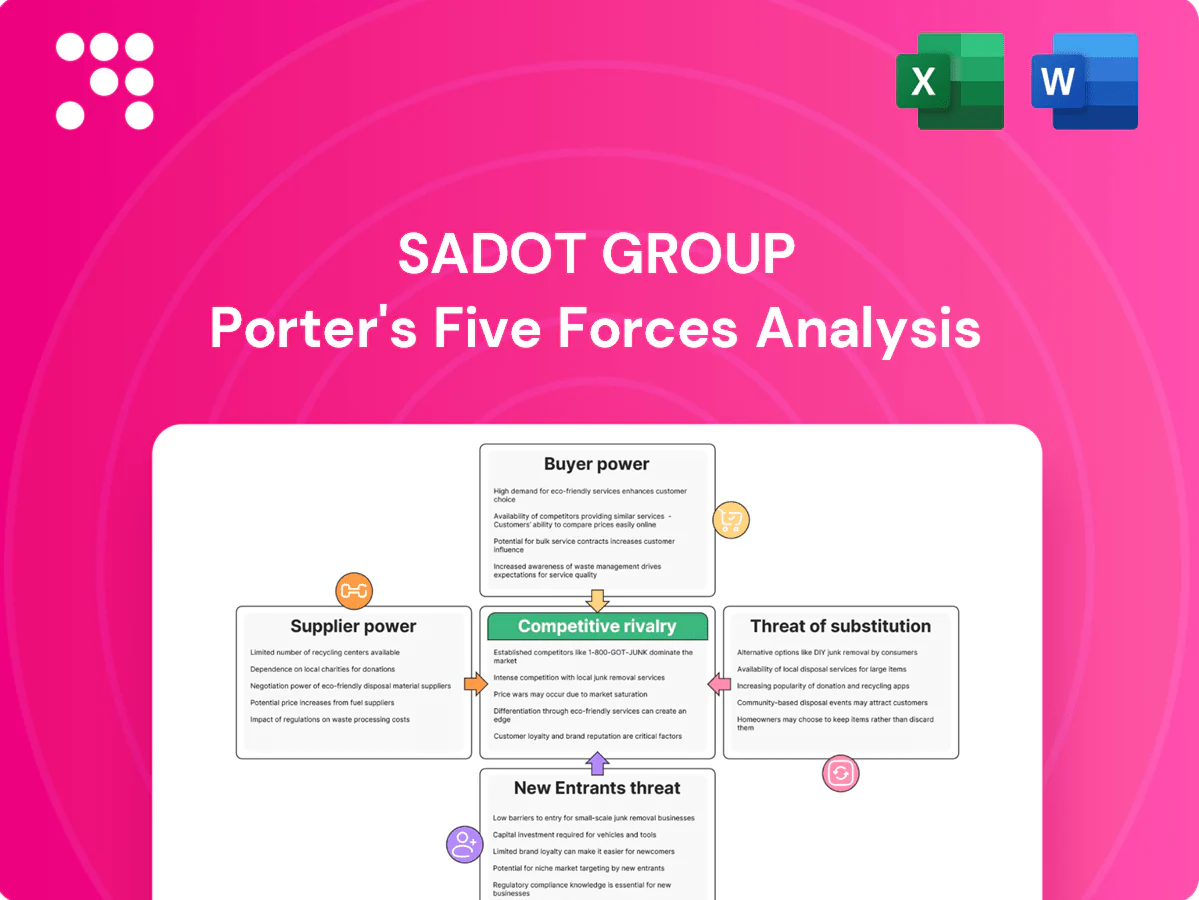
Sadot Group Porter's Five Forces Analysis

Don't Miss the Bigger Picture
Sadot Group’s Porter's Five Forces snapshot highlights moderate supplier leverage, concentrated buyer segments, and rising competitive intensity from regional rivals, while barriers to entry and substitute threats remain mixed. This brief view identifies key pressures shaping profitability and strategic choices. Unlock the full Porter's Five Forces Analysis for force-by-force ratings, visuals, and actionable recommendations tailored to Sadot Group.
Suppliers Bargaining Power

Fragmented farm origins vs. concentrated grain houses
Sadot sources from a mix of smallholders and large agribusiness merchants; concentration matters because the top four global grain traders still control roughly 70% of cross-border trade, increasing their leverage on price and terms. Fragmented farmer bases lower individual supplier power but raise coordination and transaction costs for Sadot. Seasonal cycles and weather shocks can abruptly tilt bargaining power to suppliers, with extreme events cutting yields by as much as 20%.
Logistics and port capacity constraints
In bulk commodities, barge, rail, trucking and terminal slots become choke points that let logistics providers charge premiums and enforce strict allocations; major hubs handle vast volumes (Shanghai handled 45.3 million TEU in 2023) so limited seasonal slotting tightens bargaining power. Congestion and demurrage risks force buyers to accept supplier-driven schedules, and regional infrastructure gaps in many emerging markets amplify that influence.

Country risk and export policy volatility
Export bans, quotas and tariffs—notably India’s May 2023 wheat export curbs and the Feb 2022 Black Sea disruption—can abruptly remove volumes from global markets, strengthening producers and state agencies’ leverage under scarcity. Sanctions and FX controls (eg, restrictions on Russian transactions, local currency limits in Argentina) push negotiation power to licensed traders and those with local networks. Buyers hedge country-policy risk by paying premiums for optionality and by diversifying suppliers, increasing working capital and logistical costs.

Quality, traceability, and sustainability premiums
Suppliers offering certified non-GMO, organic or deforestation-free grains can command premiums often in the 10–30% range in 2024, and strict traceability requirements narrow eligible suppliers, raising their bargaining power. Compliance and audit costs shift upstream to producers, strengthening suppliers who already meet standards and creating switching frictions for buyers due to re-certification timelines and audit burdens.
- Premiums: 10–30% (2024)
- Traceability narrows supplier pool
- Compliance costs favor certified suppliers
- Switching frictions: audits, re-certification
Working capital and pre-finance dependence
Upstream pre-financing and advance payments tie buyers to specific suppliers, increasing supplier leverage; with the global trade finance gap still near $1.5 trillion in 2024, access to funding is a decisive advantage. When credit is tight, suppliers with available capital can dictate pricing and payment terms, and collateral or title structures often favor originators in disputes. Sadot must balance pre-finance to secure volumes without ceding operational control.
- Pre-finance dependence raises supplier leverage
- 2024 trade finance gap ~$1.5 trillion boosts funded suppliers' power
- Collateral/title structures often favor originators
Grain supply concentrated: top traders dominate, premiums 10–30%, logistics & finance risks
Sadot faces moderate-to-high supplier power: top-four traders control ~70% cross-border grain trade, fragmented smallholders lower individual leverage but raise costs, and certified non-GMO/organic premiums ran 10–30% in 2024. Logistics choke points (Shanghai 45.3m TEU in 2023) and a ~$1.5tn 2024 trade finance gap amplify supplier leverage, especially under export curbs or weather shocks.
| Metric | Value |
|---|---|
| Top-4 trader share | ~70% |
| Premiums (certified) | 10–30% (2024) |
| Trade finance gap | $1.5tn (2024) |
| Shanghai throughput | 45.3m TEU (2023) |
What is included in the product
 Detailed Word Document
Comprehensive Porter’s Five Forces analysis tailored exclusively for Sadot Group, uncovering key drivers of competition, supplier and buyer power, substitutes and entry barriers, and identifying disruptive threats to market share and profitability, delivered in fully editable Word format for easy incorporation into investor materials and strategy decks.

 Customizable Excel Spreadsheet
A single-sheet Porter's Five Forces summary for Sadot Group that distills competitive pressures and relieves decision-making overload; customizable force levels and instant radar visuals make updates quick and deck-ready.
Customers Bargaining Power

Concentrated global buyers and state tenders
Concentrated global buyers—large millers, feed producers and state procurement agencies—purchase at scale; global wheat trade in 2023/24 was about 203 million tonnes (USDA), intensifying tender leverage. Tender processes compress margins and extend payment terms, while volume commitments force concessions on specs and tight delivery windows. Failure penalties shift logistics and price risk onto traders.
High price transparency in commodity markets
High price transparency in commodity markets is driven by liquid futures and public benchmarks—ICE Brent open interest ~1.2m contracts in 2024 and CME/NYMEX energy volumes >1m contracts/day—reducing information asymmetry. Buyers shop quotes across traders quickly, compressing basis and trading spreads to tight, often single-digit cents per barrel. Differentiation must come from service, risk management, and reliability rather than price alone.

Switching ease among traders
Commodity fungibility and standardized exchange and OTC contracts reduce switching costs, enabling traders to shift counterparties easily. Incumbency with Sadot Group provides operational familiarity but does not guarantee volumes absent competitive pricing. Strong performance history and flexible credit terms drive retention. Any service lapse can prompt rapid buyer migration in 2024 market conditions.

Quality and delivery specification strictness
- Higher rejection risk: moisture/protein non-compliance
- Upstream QC costs: testing, traceability, blending
- Post-delivery claims: margin erosion
- Trust vs cost: tighter specs raise operational burden
Integrated buyers with origination footprints
Integrated buyers with origination footprints increasingly backward-integrate into farming and elevators, reducing reliance on traders; 2024 market reports note this trend strengthens their internal supply options and benchmarking of internal transfers against external quotes. Traders must therefore provide financing, logistics, or differentiated market access to retain relevance.
- Integrated sourcing reduces trader dependence
- Internal transfers benchmarked to external quotes
- Traders need finance, logistics, market access to compete
Concentrated buyers compress margins; transparency and low switching costs force trader services
Large, concentrated buyers (global wheat trade ~203 Mt in 2023/24) wield strong tender leverage, compressing margins and extending payment terms. High transparency—ICE Brent open interest ~1.2M contracts (2024) and CME energy volumes >1M/day—reduces asymmetry; switching costs are low due to fungibility and standard contracts. Integrated buyers and tighter 2024 specs raise QC costs, forcing traders to offer finance, logistics, or differentiated access.
| Metric | 2024 |
|---|---|
| Global wheat trade | 203 Mt |
| ICE Brent open interest | ~1.2M contracts |
| CME energy volumes/day | >1M contracts |
Same Document Delivered
Sadot Group Porter's Five Forces Analysis
This preview shows the exact Porter’s Five Forces analysis for Sadot Group you'll receive—no placeholders or samples. The full, professionally written document is fully formatted and ready for immediate download upon purchase. It contains actionable insights on competitive rivalry, buyer and supplier power, threats of entry and substitution.

Don't Miss the Bigger Picture
Sadot Group’s Porter's Five Forces snapshot highlights moderate supplier leverage, concentrated buyer segments, and rising competitive intensity from regional rivals, while barriers to entry and substitute threats remain mixed. This brief view identifies key pressures shaping profitability and strategic choices. Unlock the full Porter's Five Forces Analysis for force-by-force ratings, visuals, and actionable recommendations tailored to Sadot Group.
Suppliers Bargaining Power
Fragmented farm origins vs. concentrated grain houses
Sadot sources from a mix of smallholders and large agribusiness merchants; concentration matters because the top four global grain traders still control roughly 70% of cross-border trade, increasing their leverage on price and terms. Fragmented farmer bases lower individual supplier power but raise coordination and transaction costs for Sadot. Seasonal cycles and weather shocks can abruptly tilt bargaining power to suppliers, with extreme events cutting yields by as much as 20%.
Logistics and port capacity constraints
In bulk commodities, barge, rail, trucking and terminal slots become choke points that let logistics providers charge premiums and enforce strict allocations; major hubs handle vast volumes (Shanghai handled 45.3 million TEU in 2023) so limited seasonal slotting tightens bargaining power. Congestion and demurrage risks force buyers to accept supplier-driven schedules, and regional infrastructure gaps in many emerging markets amplify that influence.
Country risk and export policy volatility
Export bans, quotas and tariffs—notably India’s May 2023 wheat export curbs and the Feb 2022 Black Sea disruption—can abruptly remove volumes from global markets, strengthening producers and state agencies’ leverage under scarcity. Sanctions and FX controls (eg, restrictions on Russian transactions, local currency limits in Argentina) push negotiation power to licensed traders and those with local networks. Buyers hedge country-policy risk by paying premiums for optionality and by diversifying suppliers, increasing working capital and logistical costs.
Quality, traceability, and sustainability premiums
Suppliers offering certified non-GMO, organic or deforestation-free grains can command premiums often in the 10–30% range in 2024, and strict traceability requirements narrow eligible suppliers, raising their bargaining power. Compliance and audit costs shift upstream to producers, strengthening suppliers who already meet standards and creating switching frictions for buyers due to re-certification timelines and audit burdens.
- Premiums: 10–30% (2024)
- Traceability narrows supplier pool
- Compliance costs favor certified suppliers
- Switching frictions: audits, re-certification
Working capital and pre-finance dependence
Upstream pre-financing and advance payments tie buyers to specific suppliers, increasing supplier leverage; with the global trade finance gap still near $1.5 trillion in 2024, access to funding is a decisive advantage. When credit is tight, suppliers with available capital can dictate pricing and payment terms, and collateral or title structures often favor originators in disputes. Sadot must balance pre-finance to secure volumes without ceding operational control.
- Pre-finance dependence raises supplier leverage
- 2024 trade finance gap ~$1.5 trillion boosts funded suppliers' power
- Collateral/title structures often favor originators
Grain supply concentrated: top traders dominate, premiums 10–30%, logistics & finance risks
Sadot faces moderate-to-high supplier power: top-four traders control ~70% cross-border grain trade, fragmented smallholders lower individual leverage but raise costs, and certified non-GMO/organic premiums ran 10–30% in 2024. Logistics choke points (Shanghai 45.3m TEU in 2023) and a ~$1.5tn 2024 trade finance gap amplify supplier leverage, especially under export curbs or weather shocks.
| Metric | Value |
|---|---|
| Top-4 trader share | ~70% |
| Premiums (certified) | 10–30% (2024) |
| Trade finance gap | $1.5tn (2024) |
| Shanghai throughput | 45.3m TEU (2023) |
What is included in the product
Detailed Word Document
Comprehensive Porter’s Five Forces analysis tailored exclusively for Sadot Group, uncovering key drivers of competition, supplier and buyer power, substitutes and entry barriers, and identifying disruptive threats to market share and profitability, delivered in fully editable Word format for easy incorporation into investor materials and strategy decks.
Customizable Excel Spreadsheet
A single-sheet Porter's Five Forces summary for Sadot Group that distills competitive pressures and relieves decision-making overload; customizable force levels and instant radar visuals make updates quick and deck-ready.
Customers Bargaining Power
Concentrated global buyers and state tenders
Concentrated global buyers—large millers, feed producers and state procurement agencies—purchase at scale; global wheat trade in 2023/24 was about 203 million tonnes (USDA), intensifying tender leverage. Tender processes compress margins and extend payment terms, while volume commitments force concessions on specs and tight delivery windows. Failure penalties shift logistics and price risk onto traders.
High price transparency in commodity markets
High price transparency in commodity markets is driven by liquid futures and public benchmarks—ICE Brent open interest ~1.2m contracts in 2024 and CME/NYMEX energy volumes >1m contracts/day—reducing information asymmetry. Buyers shop quotes across traders quickly, compressing basis and trading spreads to tight, often single-digit cents per barrel. Differentiation must come from service, risk management, and reliability rather than price alone.
Switching ease among traders
Commodity fungibility and standardized exchange and OTC contracts reduce switching costs, enabling traders to shift counterparties easily. Incumbency with Sadot Group provides operational familiarity but does not guarantee volumes absent competitive pricing. Strong performance history and flexible credit terms drive retention. Any service lapse can prompt rapid buyer migration in 2024 market conditions.
Quality and delivery specification strictness
- Higher rejection risk: moisture/protein non-compliance
- Upstream QC costs: testing, traceability, blending
- Post-delivery claims: margin erosion
- Trust vs cost: tighter specs raise operational burden
Integrated buyers with origination footprints
Integrated buyers with origination footprints increasingly backward-integrate into farming and elevators, reducing reliance on traders; 2024 market reports note this trend strengthens their internal supply options and benchmarking of internal transfers against external quotes. Traders must therefore provide financing, logistics, or differentiated market access to retain relevance.
- Integrated sourcing reduces trader dependence
- Internal transfers benchmarked to external quotes
- Traders need finance, logistics, market access to compete
Concentrated buyers compress margins; transparency and low switching costs force trader services
Large, concentrated buyers (global wheat trade ~203 Mt in 2023/24) wield strong tender leverage, compressing margins and extending payment terms. High transparency—ICE Brent open interest ~1.2M contracts (2024) and CME energy volumes >1M/day—reduces asymmetry; switching costs are low due to fungibility and standard contracts. Integrated buyers and tighter 2024 specs raise QC costs, forcing traders to offer finance, logistics, or differentiated access.
| Metric | 2024 |
|---|---|
| Global wheat trade | 203 Mt |
| ICE Brent open interest | ~1.2M contracts |
| CME energy volumes/day | >1M contracts |
Same Document Delivered
Sadot Group Porter's Five Forces Analysis
This preview shows the exact Porter’s Five Forces analysis for Sadot Group you'll receive—no placeholders or samples. The full, professionally written document is fully formatted and ready for immediate download upon purchase. It contains actionable insights on competitive rivalry, buyer and supplier power, threats of entry and substitution.
Original: $10.00
-65%$10.00
$3.50Description
Don't Miss the Bigger Picture
Sadot Group’s Porter's Five Forces snapshot highlights moderate supplier leverage, concentrated buyer segments, and rising competitive intensity from regional rivals, while barriers to entry and substitute threats remain mixed. This brief view identifies key pressures shaping profitability and strategic choices. Unlock the full Porter's Five Forces Analysis for force-by-force ratings, visuals, and actionable recommendations tailored to Sadot Group.
Suppliers Bargaining Power
Fragmented farm origins vs. concentrated grain houses
Sadot sources from a mix of smallholders and large agribusiness merchants; concentration matters because the top four global grain traders still control roughly 70% of cross-border trade, increasing their leverage on price and terms. Fragmented farmer bases lower individual supplier power but raise coordination and transaction costs for Sadot. Seasonal cycles and weather shocks can abruptly tilt bargaining power to suppliers, with extreme events cutting yields by as much as 20%.
Logistics and port capacity constraints
In bulk commodities, barge, rail, trucking and terminal slots become choke points that let logistics providers charge premiums and enforce strict allocations; major hubs handle vast volumes (Shanghai handled 45.3 million TEU in 2023) so limited seasonal slotting tightens bargaining power. Congestion and demurrage risks force buyers to accept supplier-driven schedules, and regional infrastructure gaps in many emerging markets amplify that influence.
Country risk and export policy volatility
Export bans, quotas and tariffs—notably India’s May 2023 wheat export curbs and the Feb 2022 Black Sea disruption—can abruptly remove volumes from global markets, strengthening producers and state agencies’ leverage under scarcity. Sanctions and FX controls (eg, restrictions on Russian transactions, local currency limits in Argentina) push negotiation power to licensed traders and those with local networks. Buyers hedge country-policy risk by paying premiums for optionality and by diversifying suppliers, increasing working capital and logistical costs.
Quality, traceability, and sustainability premiums
Suppliers offering certified non-GMO, organic or deforestation-free grains can command premiums often in the 10–30% range in 2024, and strict traceability requirements narrow eligible suppliers, raising their bargaining power. Compliance and audit costs shift upstream to producers, strengthening suppliers who already meet standards and creating switching frictions for buyers due to re-certification timelines and audit burdens.
- Premiums: 10–30% (2024)
- Traceability narrows supplier pool
- Compliance costs favor certified suppliers
- Switching frictions: audits, re-certification
Working capital and pre-finance dependence
Upstream pre-financing and advance payments tie buyers to specific suppliers, increasing supplier leverage; with the global trade finance gap still near $1.5 trillion in 2024, access to funding is a decisive advantage. When credit is tight, suppliers with available capital can dictate pricing and payment terms, and collateral or title structures often favor originators in disputes. Sadot must balance pre-finance to secure volumes without ceding operational control.
- Pre-finance dependence raises supplier leverage
- 2024 trade finance gap ~$1.5 trillion boosts funded suppliers' power
- Collateral/title structures often favor originators
Grain supply concentrated: top traders dominate, premiums 10–30%, logistics & finance risks
Sadot faces moderate-to-high supplier power: top-four traders control ~70% cross-border grain trade, fragmented smallholders lower individual leverage but raise costs, and certified non-GMO/organic premiums ran 10–30% in 2024. Logistics choke points (Shanghai 45.3m TEU in 2023) and a ~$1.5tn 2024 trade finance gap amplify supplier leverage, especially under export curbs or weather shocks.
| Metric | Value |
|---|---|
| Top-4 trader share | ~70% |
| Premiums (certified) | 10–30% (2024) |
| Trade finance gap | $1.5tn (2024) |
| Shanghai throughput | 45.3m TEU (2023) |
What is included in the product
Detailed Word Document
Comprehensive Porter’s Five Forces analysis tailored exclusively for Sadot Group, uncovering key drivers of competition, supplier and buyer power, substitutes and entry barriers, and identifying disruptive threats to market share and profitability, delivered in fully editable Word format for easy incorporation into investor materials and strategy decks.
Customizable Excel Spreadsheet
A single-sheet Porter's Five Forces summary for Sadot Group that distills competitive pressures and relieves decision-making overload; customizable force levels and instant radar visuals make updates quick and deck-ready.
Customers Bargaining Power
Concentrated global buyers and state tenders
Concentrated global buyers—large millers, feed producers and state procurement agencies—purchase at scale; global wheat trade in 2023/24 was about 203 million tonnes (USDA), intensifying tender leverage. Tender processes compress margins and extend payment terms, while volume commitments force concessions on specs and tight delivery windows. Failure penalties shift logistics and price risk onto traders.
High price transparency in commodity markets
High price transparency in commodity markets is driven by liquid futures and public benchmarks—ICE Brent open interest ~1.2m contracts in 2024 and CME/NYMEX energy volumes >1m contracts/day—reducing information asymmetry. Buyers shop quotes across traders quickly, compressing basis and trading spreads to tight, often single-digit cents per barrel. Differentiation must come from service, risk management, and reliability rather than price alone.
Switching ease among traders
Commodity fungibility and standardized exchange and OTC contracts reduce switching costs, enabling traders to shift counterparties easily. Incumbency with Sadot Group provides operational familiarity but does not guarantee volumes absent competitive pricing. Strong performance history and flexible credit terms drive retention. Any service lapse can prompt rapid buyer migration in 2024 market conditions.
Quality and delivery specification strictness
- Higher rejection risk: moisture/protein non-compliance
- Upstream QC costs: testing, traceability, blending
- Post-delivery claims: margin erosion
- Trust vs cost: tighter specs raise operational burden
Integrated buyers with origination footprints
Integrated buyers with origination footprints increasingly backward-integrate into farming and elevators, reducing reliance on traders; 2024 market reports note this trend strengthens their internal supply options and benchmarking of internal transfers against external quotes. Traders must therefore provide financing, logistics, or differentiated market access to retain relevance.
- Integrated sourcing reduces trader dependence
- Internal transfers benchmarked to external quotes
- Traders need finance, logistics, market access to compete
Concentrated buyers compress margins; transparency and low switching costs force trader services
Large, concentrated buyers (global wheat trade ~203 Mt in 2023/24) wield strong tender leverage, compressing margins and extending payment terms. High transparency—ICE Brent open interest ~1.2M contracts (2024) and CME energy volumes >1M/day—reduces asymmetry; switching costs are low due to fungibility and standard contracts. Integrated buyers and tighter 2024 specs raise QC costs, forcing traders to offer finance, logistics, or differentiated access.
| Metric | 2024 |
|---|---|
| Global wheat trade | 203 Mt |
| ICE Brent open interest | ~1.2M contracts |
| CME energy volumes/day | >1M contracts |
Same Document Delivered
Sadot Group Porter's Five Forces Analysis
This preview shows the exact Porter’s Five Forces analysis for Sadot Group you'll receive—no placeholders or samples. The full, professionally written document is fully formatted and ready for immediate download upon purchase. It contains actionable insights on competitive rivalry, buyer and supplier power, threats of entry and substitution.











