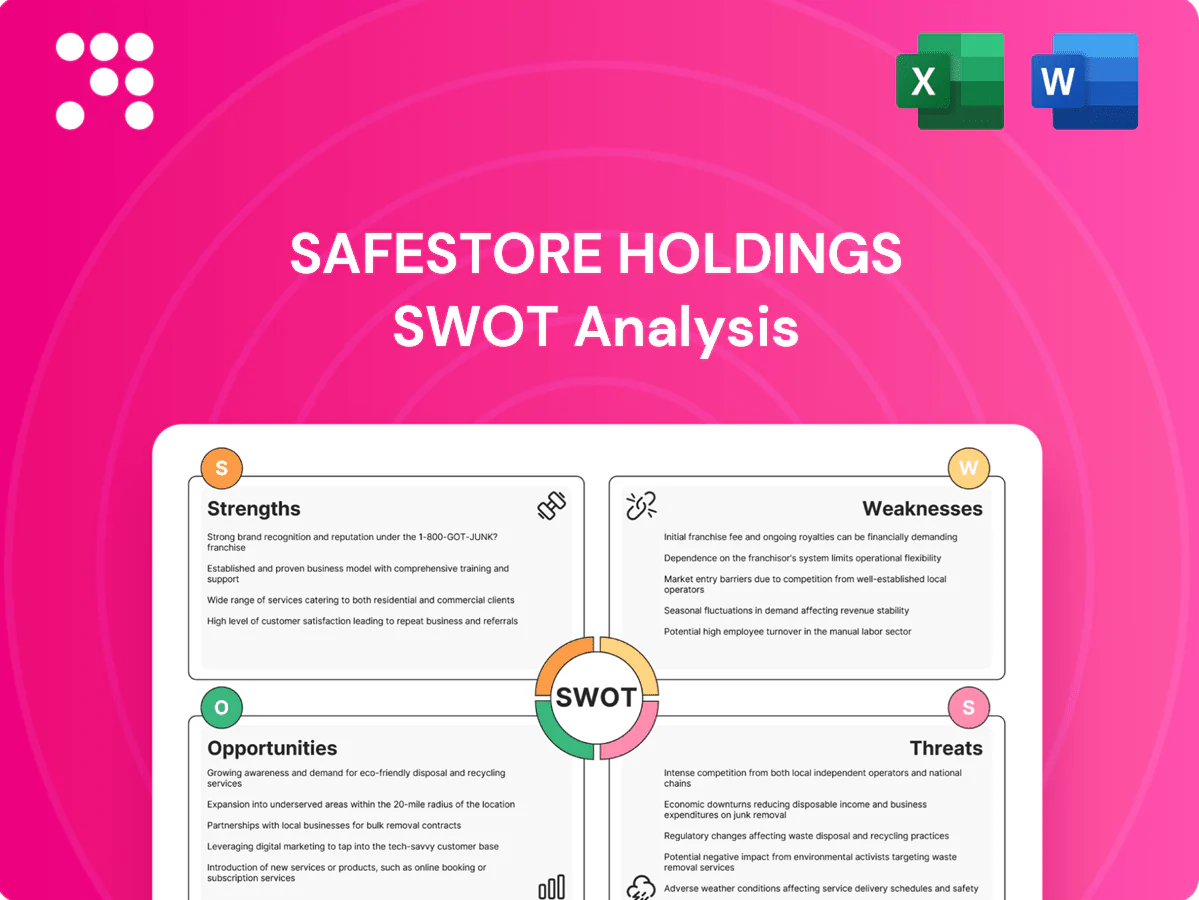
Safestore Holdings SWOT Analysis

Dive Deeper Into the Company’s Strategic Blueprint
Safestore benefits from a leading UK self‑storage portfolio, resilient recurring revenues and growing digital bookings, but it faces high property exposure and capital intensity. Opportunities include urban densification and M&A, while rising rates and competition are key threats. Purchase the full SWOT for a detailed, editable Word+Excel report to inform strategy and investment decisions.
Strengths

Leading UK self‑storage brand
As the leading UK self-storage brand and FTSE 250 constituent, Safestore's scale and brand recognition support pricing power and higher occupancy versus smaller rivals. Its large, visible network (140+ stores across UK and Europe) improves convenience and customer acquisition, lowering acquisition costs and enabling cross‑sell of insurance and packing services. Brand equity also strengthens negotiating leverage with landlords, vendors and insurers.
Diversified customer base
Safestore, listed on the London Stock Exchange under ticker SAFE, serves households, SMEs and students, which smooths demand across cycles and seasons. Mixed use cases—moves, renovations, e‑commerce inventory and document storage—lower customer concentration risk. A wide range of unit sizes allows management to optimise yield per square foot. This broad customer mix helps stabilise revenues and cash flows.

Flexible, recurring revenue model
Short-term contracts and dynamic pricing allow agile yield management, enabling Safestore to adjust rates quickly to market shifts and seasonal demand. Month-to-month billing produces predictable, recurring cash flows and lets the business scale occupancy rapidly. Ancillary sales—packing materials and insurance—boost ARPU and margin contribution. High retention and low bad debt support strong operating margins.

Urban footprint and accessibility
Locations close to dense residential and business hubs raise convenience and drive higher occupancy for Safestore, shortening customer travel time and increasing utilisation. Strong transport links around urban sites reduce last‑mile frictions for customers and business partners, improving retention and delivery services. Urban land scarcity supports rent growth and robust asset valuations, while roadside visibility enhances spontaneous walk‑in demand.
- Proximity to population and business centres
- Good transport connectivity
- Urban scarcity → rent uplift
- Roadside visibility boosts footfall
Operational efficiency and tech
Operational efficiency at Safestore leverages online bookings, CRM and revenue-management tools to lift sales conversion and enable dynamic pricing consistent with company disclosures. Standardised operations tighten cost control and improve service quality across the portfolio. Data-driven unit-mix optimisation and scalable systems increase utilisation and support multi-site expansion with limited overhead growth.
- Online bookings & CRM boost conversion
- Revenue management enables dynamic pricing
- Standardisation reduces costs, raises quality
- Scalable systems support low-overhead expansion
FTSE 250 self-storage leader: 140+ UK & Europe stores, month-to-month recurring cash flow
Safestore is a FTSE 250 self‑storage leader (ticker SAFE) with 140+ stores across the UK and Europe, supporting pricing power and higher occupancy. Diverse customer mix—households, SMEs and students—and month‑to‑month contracts deliver recurring cash flow and demand smoothing. Scalable, standardised operations, online bookings and revenue management enable dynamic pricing and low incremental overhead.
| Metric | Fact |
|---|---|
| Listing | FTSE 250 (SAFE) |
| Estate | 140+ stores (UK & Europe) |
| Contract type | Month‑to‑month |
| Customer mix | Households, SMEs, students |
| Operations | Online bookings, revenue management |
What is included in the product
 Detailed Word Document
Delivers a strategic overview of Safestore Holdings’ internal strengths and weaknesses and external opportunities and threats, mapping competitive position, growth drivers, operational gaps, and market risks to inform strategic decisions.

 Customizable Excel Spreadsheet
Provides a concise SWOT matrix for Safestore Holdings to quickly identify strengths, weaknesses, opportunities and threats for rapid strategic alignment. Editable format enables fast updates to reflect changing market conditions and simplify stakeholder briefing.
Weaknesses

Capital‑intensive portfolio
Site acquisition, construction and fit-out demand significant upfront capital for Safestore, tying up cash until new stores reach mature occupancy and pricing. Returns hinge on hitting target occupancy and ADR over several years, exposing cashflow to demand cycles. High capex needs can constrain rollout during tighter credit conditions. Ongoing maintenance capex is required to sustain service standards and yield.
Sensitivity to interest rates
Sensitivity to interest rates: the Bank of England base rate at 5.25% (July 2025) raises Safestore’s debt costs and can depress property yields, materially hitting earnings and NAV. Rising rates compress development viability and reduce deal flow, while refinancing risk can pressure dividend capacity. Higher interest burden limits balance sheet flexibility in a downturn.

Planning and zoning hurdles
Securing approvals for new Safestore locations is often lengthy and uncertain, with urban sites drawing heightened community and regulatory scrutiny that can prolong timelines.
Protracted decisions increase holding costs and materially erode project IRRs, compressing returns on development capital.
Inconsistent planning practices across UK, French and Spanish jurisdictions make pipeline visibility uneven, complicating rollout sequencing and capital allocation.

Limited product differentiation
Storage units are largely commoditized, pushing Safestore into intensified price competition where service quality and location matter but are hard to defend uniquely; competitors can rapidly replicate ancillary offerings like packing supplies and insurance. Differentiation therefore depends heavily on brand strength, convenience (location and digital booking) and customer experience, which are costly and slow to scale.
- Commoditized market — limited product uniqueness
- Price pressure from peers
- Ancillary services easily replicated
- Reliance on brand, convenience, CX for edge
Occupancy and churn volatility
Short-term, typically month-to-month contracts leave Safestore exposed to seasonality and macro swings; move-in/move-out cycles can whipsaw near-term revenues and occupancy levels. Filling space via discounting can compress yields, while reliance on lumpy segments such as students amplifies volatility in peak months.
- Contract tenor: month-to-month
- Revenue sensitivity: high to move-in/out cycles
- Yield risk: discounting to maintain occupancy
- Demand concentration: seasonal student flows
High capex, 5.25% rates and month-to-month leases compress returns and heighten refinancing risk
High upfront capex and maintenance tie cash until sites reach mature occupancy, exposing returns to demand cycles. Bank of England base rate 5.25% (July 2025) raises borrowing costs and refinancing risk. Planning delays and jurisdictional inconsistency lengthen timelines and compress IRRs. Commoditized offering and month-to-month contracts intensify price sensitivity and revenue volatility.
| Risk | Key data |
|---|---|
| BoE rate | 5.25% (Jul 2025) |
| Contract tenor | Month-to-month |
Full Version Awaits
Safestore Holdings SWOT Analysis
This is the actual SWOT analysis document you’ll receive upon purchase—no surprises, just professional quality. The preview below is taken directly from the full SWOT report you'll get; purchase unlocks the complete, editable version. The file shown is the real, downloadable analysis.

Dive Deeper Into the Company’s Strategic Blueprint
Safestore benefits from a leading UK self‑storage portfolio, resilient recurring revenues and growing digital bookings, but it faces high property exposure and capital intensity. Opportunities include urban densification and M&A, while rising rates and competition are key threats. Purchase the full SWOT for a detailed, editable Word+Excel report to inform strategy and investment decisions.
Strengths
Leading UK self‑storage brand
As the leading UK self-storage brand and FTSE 250 constituent, Safestore's scale and brand recognition support pricing power and higher occupancy versus smaller rivals. Its large, visible network (140+ stores across UK and Europe) improves convenience and customer acquisition, lowering acquisition costs and enabling cross‑sell of insurance and packing services. Brand equity also strengthens negotiating leverage with landlords, vendors and insurers.
Diversified customer base
Safestore, listed on the London Stock Exchange under ticker SAFE, serves households, SMEs and students, which smooths demand across cycles and seasons. Mixed use cases—moves, renovations, e‑commerce inventory and document storage—lower customer concentration risk. A wide range of unit sizes allows management to optimise yield per square foot. This broad customer mix helps stabilise revenues and cash flows.
Flexible, recurring revenue model
Short-term contracts and dynamic pricing allow agile yield management, enabling Safestore to adjust rates quickly to market shifts and seasonal demand. Month-to-month billing produces predictable, recurring cash flows and lets the business scale occupancy rapidly. Ancillary sales—packing materials and insurance—boost ARPU and margin contribution. High retention and low bad debt support strong operating margins.
Urban footprint and accessibility
Locations close to dense residential and business hubs raise convenience and drive higher occupancy for Safestore, shortening customer travel time and increasing utilisation. Strong transport links around urban sites reduce last‑mile frictions for customers and business partners, improving retention and delivery services. Urban land scarcity supports rent growth and robust asset valuations, while roadside visibility enhances spontaneous walk‑in demand.
- Proximity to population and business centres
- Good transport connectivity
- Urban scarcity → rent uplift
- Roadside visibility boosts footfall
Operational efficiency and tech
Operational efficiency at Safestore leverages online bookings, CRM and revenue-management tools to lift sales conversion and enable dynamic pricing consistent with company disclosures. Standardised operations tighten cost control and improve service quality across the portfolio. Data-driven unit-mix optimisation and scalable systems increase utilisation and support multi-site expansion with limited overhead growth.
- Online bookings & CRM boost conversion
- Revenue management enables dynamic pricing
- Standardisation reduces costs, raises quality
- Scalable systems support low-overhead expansion
FTSE 250 self-storage leader: 140+ UK & Europe stores, month-to-month recurring cash flow
Safestore is a FTSE 250 self‑storage leader (ticker SAFE) with 140+ stores across the UK and Europe, supporting pricing power and higher occupancy. Diverse customer mix—households, SMEs and students—and month‑to‑month contracts deliver recurring cash flow and demand smoothing. Scalable, standardised operations, online bookings and revenue management enable dynamic pricing and low incremental overhead.
| Metric | Fact |
|---|---|
| Listing | FTSE 250 (SAFE) |
| Estate | 140+ stores (UK & Europe) |
| Contract type | Month‑to‑month |
| Customer mix | Households, SMEs, students |
| Operations | Online bookings, revenue management |
What is included in the product
Detailed Word Document
Delivers a strategic overview of Safestore Holdings’ internal strengths and weaknesses and external opportunities and threats, mapping competitive position, growth drivers, operational gaps, and market risks to inform strategic decisions.
Customizable Excel Spreadsheet
Provides a concise SWOT matrix for Safestore Holdings to quickly identify strengths, weaknesses, opportunities and threats for rapid strategic alignment. Editable format enables fast updates to reflect changing market conditions and simplify stakeholder briefing.
Weaknesses
Capital‑intensive portfolio
Site acquisition, construction and fit-out demand significant upfront capital for Safestore, tying up cash until new stores reach mature occupancy and pricing. Returns hinge on hitting target occupancy and ADR over several years, exposing cashflow to demand cycles. High capex needs can constrain rollout during tighter credit conditions. Ongoing maintenance capex is required to sustain service standards and yield.
Sensitivity to interest rates
Sensitivity to interest rates: the Bank of England base rate at 5.25% (July 2025) raises Safestore’s debt costs and can depress property yields, materially hitting earnings and NAV. Rising rates compress development viability and reduce deal flow, while refinancing risk can pressure dividend capacity. Higher interest burden limits balance sheet flexibility in a downturn.
Planning and zoning hurdles
Securing approvals for new Safestore locations is often lengthy and uncertain, with urban sites drawing heightened community and regulatory scrutiny that can prolong timelines.
Protracted decisions increase holding costs and materially erode project IRRs, compressing returns on development capital.
Inconsistent planning practices across UK, French and Spanish jurisdictions make pipeline visibility uneven, complicating rollout sequencing and capital allocation.
Limited product differentiation
Storage units are largely commoditized, pushing Safestore into intensified price competition where service quality and location matter but are hard to defend uniquely; competitors can rapidly replicate ancillary offerings like packing supplies and insurance. Differentiation therefore depends heavily on brand strength, convenience (location and digital booking) and customer experience, which are costly and slow to scale.
- Commoditized market — limited product uniqueness
- Price pressure from peers
- Ancillary services easily replicated
- Reliance on brand, convenience, CX for edge
Occupancy and churn volatility
Short-term, typically month-to-month contracts leave Safestore exposed to seasonality and macro swings; move-in/move-out cycles can whipsaw near-term revenues and occupancy levels. Filling space via discounting can compress yields, while reliance on lumpy segments such as students amplifies volatility in peak months.
- Contract tenor: month-to-month
- Revenue sensitivity: high to move-in/out cycles
- Yield risk: discounting to maintain occupancy
- Demand concentration: seasonal student flows
High capex, 5.25% rates and month-to-month leases compress returns and heighten refinancing risk
High upfront capex and maintenance tie cash until sites reach mature occupancy, exposing returns to demand cycles. Bank of England base rate 5.25% (July 2025) raises borrowing costs and refinancing risk. Planning delays and jurisdictional inconsistency lengthen timelines and compress IRRs. Commoditized offering and month-to-month contracts intensify price sensitivity and revenue volatility.
| Risk | Key data |
|---|---|
| BoE rate | 5.25% (Jul 2025) |
| Contract tenor | Month-to-month |
Full Version Awaits
Safestore Holdings SWOT Analysis
This is the actual SWOT analysis document you’ll receive upon purchase—no surprises, just professional quality. The preview below is taken directly from the full SWOT report you'll get; purchase unlocks the complete, editable version. The file shown is the real, downloadable analysis.
Description
Dive Deeper Into the Company’s Strategic Blueprint
Safestore benefits from a leading UK self‑storage portfolio, resilient recurring revenues and growing digital bookings, but it faces high property exposure and capital intensity. Opportunities include urban densification and M&A, while rising rates and competition are key threats. Purchase the full SWOT for a detailed, editable Word+Excel report to inform strategy and investment decisions.
Strengths
Leading UK self‑storage brand
As the leading UK self-storage brand and FTSE 250 constituent, Safestore's scale and brand recognition support pricing power and higher occupancy versus smaller rivals. Its large, visible network (140+ stores across UK and Europe) improves convenience and customer acquisition, lowering acquisition costs and enabling cross‑sell of insurance and packing services. Brand equity also strengthens negotiating leverage with landlords, vendors and insurers.
Diversified customer base
Safestore, listed on the London Stock Exchange under ticker SAFE, serves households, SMEs and students, which smooths demand across cycles and seasons. Mixed use cases—moves, renovations, e‑commerce inventory and document storage—lower customer concentration risk. A wide range of unit sizes allows management to optimise yield per square foot. This broad customer mix helps stabilise revenues and cash flows.
Flexible, recurring revenue model
Short-term contracts and dynamic pricing allow agile yield management, enabling Safestore to adjust rates quickly to market shifts and seasonal demand. Month-to-month billing produces predictable, recurring cash flows and lets the business scale occupancy rapidly. Ancillary sales—packing materials and insurance—boost ARPU and margin contribution. High retention and low bad debt support strong operating margins.
Urban footprint and accessibility
Locations close to dense residential and business hubs raise convenience and drive higher occupancy for Safestore, shortening customer travel time and increasing utilisation. Strong transport links around urban sites reduce last‑mile frictions for customers and business partners, improving retention and delivery services. Urban land scarcity supports rent growth and robust asset valuations, while roadside visibility enhances spontaneous walk‑in demand.
- Proximity to population and business centres
- Good transport connectivity
- Urban scarcity → rent uplift
- Roadside visibility boosts footfall
Operational efficiency and tech
Operational efficiency at Safestore leverages online bookings, CRM and revenue-management tools to lift sales conversion and enable dynamic pricing consistent with company disclosures. Standardised operations tighten cost control and improve service quality across the portfolio. Data-driven unit-mix optimisation and scalable systems increase utilisation and support multi-site expansion with limited overhead growth.
- Online bookings & CRM boost conversion
- Revenue management enables dynamic pricing
- Standardisation reduces costs, raises quality
- Scalable systems support low-overhead expansion
FTSE 250 self-storage leader: 140+ UK & Europe stores, month-to-month recurring cash flow
Safestore is a FTSE 250 self‑storage leader (ticker SAFE) with 140+ stores across the UK and Europe, supporting pricing power and higher occupancy. Diverse customer mix—households, SMEs and students—and month‑to‑month contracts deliver recurring cash flow and demand smoothing. Scalable, standardised operations, online bookings and revenue management enable dynamic pricing and low incremental overhead.
| Metric | Fact |
|---|---|
| Listing | FTSE 250 (SAFE) |
| Estate | 140+ stores (UK & Europe) |
| Contract type | Month‑to‑month |
| Customer mix | Households, SMEs, students |
| Operations | Online bookings, revenue management |
What is included in the product
Detailed Word Document
Delivers a strategic overview of Safestore Holdings’ internal strengths and weaknesses and external opportunities and threats, mapping competitive position, growth drivers, operational gaps, and market risks to inform strategic decisions.
Customizable Excel Spreadsheet
Provides a concise SWOT matrix for Safestore Holdings to quickly identify strengths, weaknesses, opportunities and threats for rapid strategic alignment. Editable format enables fast updates to reflect changing market conditions and simplify stakeholder briefing.
Weaknesses
Capital‑intensive portfolio
Site acquisition, construction and fit-out demand significant upfront capital for Safestore, tying up cash until new stores reach mature occupancy and pricing. Returns hinge on hitting target occupancy and ADR over several years, exposing cashflow to demand cycles. High capex needs can constrain rollout during tighter credit conditions. Ongoing maintenance capex is required to sustain service standards and yield.
Sensitivity to interest rates
Sensitivity to interest rates: the Bank of England base rate at 5.25% (July 2025) raises Safestore’s debt costs and can depress property yields, materially hitting earnings and NAV. Rising rates compress development viability and reduce deal flow, while refinancing risk can pressure dividend capacity. Higher interest burden limits balance sheet flexibility in a downturn.
Planning and zoning hurdles
Securing approvals for new Safestore locations is often lengthy and uncertain, with urban sites drawing heightened community and regulatory scrutiny that can prolong timelines.
Protracted decisions increase holding costs and materially erode project IRRs, compressing returns on development capital.
Inconsistent planning practices across UK, French and Spanish jurisdictions make pipeline visibility uneven, complicating rollout sequencing and capital allocation.
Limited product differentiation
Storage units are largely commoditized, pushing Safestore into intensified price competition where service quality and location matter but are hard to defend uniquely; competitors can rapidly replicate ancillary offerings like packing supplies and insurance. Differentiation therefore depends heavily on brand strength, convenience (location and digital booking) and customer experience, which are costly and slow to scale.
- Commoditized market — limited product uniqueness
- Price pressure from peers
- Ancillary services easily replicated
- Reliance on brand, convenience, CX for edge
Occupancy and churn volatility
Short-term, typically month-to-month contracts leave Safestore exposed to seasonality and macro swings; move-in/move-out cycles can whipsaw near-term revenues and occupancy levels. Filling space via discounting can compress yields, while reliance on lumpy segments such as students amplifies volatility in peak months.
- Contract tenor: month-to-month
- Revenue sensitivity: high to move-in/out cycles
- Yield risk: discounting to maintain occupancy
- Demand concentration: seasonal student flows
High capex, 5.25% rates and month-to-month leases compress returns and heighten refinancing risk
High upfront capex and maintenance tie cash until sites reach mature occupancy, exposing returns to demand cycles. Bank of England base rate 5.25% (July 2025) raises borrowing costs and refinancing risk. Planning delays and jurisdictional inconsistency lengthen timelines and compress IRRs. Commoditized offering and month-to-month contracts intensify price sensitivity and revenue volatility.
| Risk | Key data |
|---|---|
| BoE rate | 5.25% (Jul 2025) |
| Contract tenor | Month-to-month |
Full Version Awaits
Safestore Holdings SWOT Analysis
This is the actual SWOT analysis document you’ll receive upon purchase—no surprises, just professional quality. The preview below is taken directly from the full SWOT report you'll get; purchase unlocks the complete, editable version. The file shown is the real, downloadable analysis.











