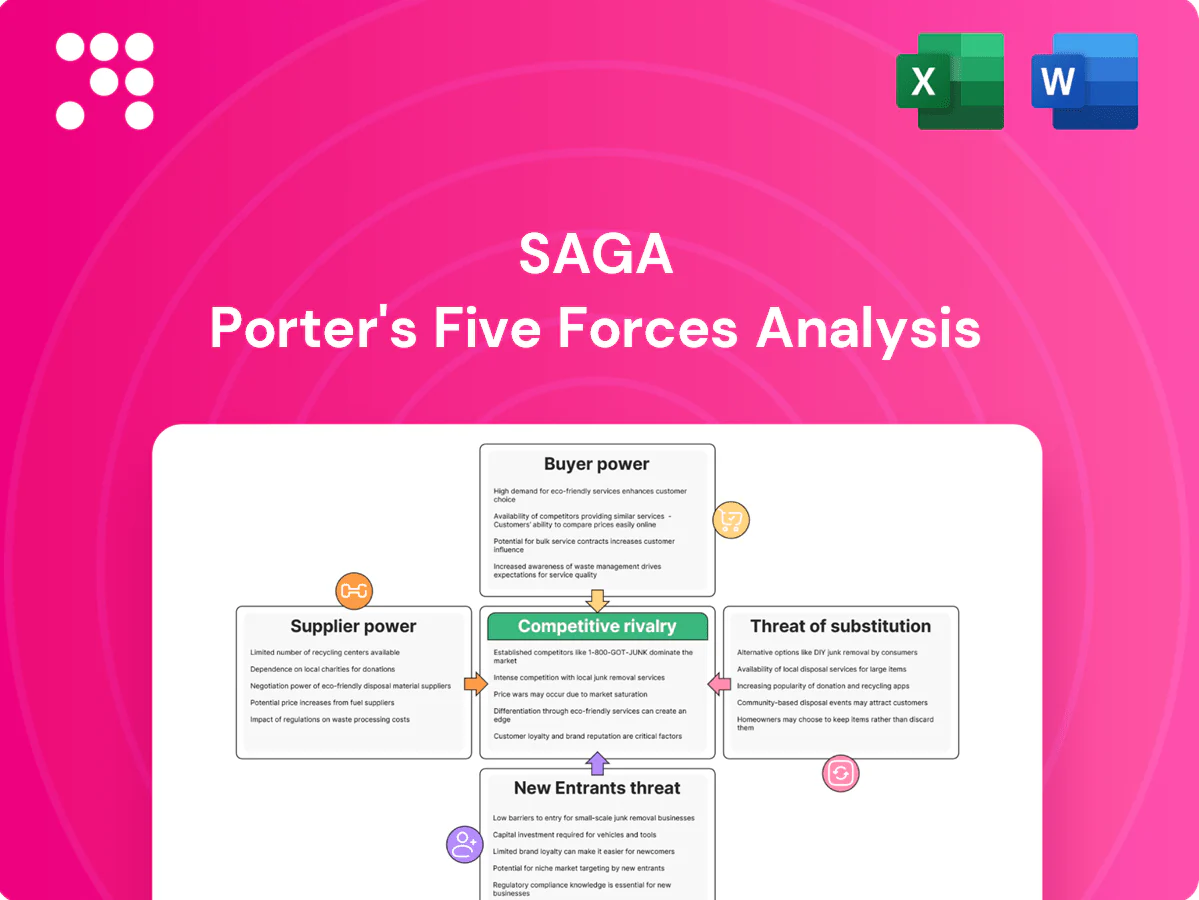
Saga Porter's Five Forces Analysis

From Overview to Strategy Blueprint
This brief snapshot only scratches the surface of Saga’s competitive landscape. Our Porter's Five Forces summarizes buyer/supplier power, substitution risks, and entry barriers to highlight strategic pressure points. Ready for deeper, data-driven insights? Unlock the full Porter's Five Forces Analysis to inform investment and strategy.
Suppliers Bargaining Power

Specialist underwriters & reinsurers
Capacity and risk appetite of specialist reinsurers drive pricing and product design, with 2024 renewals showing ongoing capacity discipline. Concentration among major reinsurers keeps upward pressure on rates and tighter terms. Saga’s over-50 book is commercially attractive but remains sensitive to catastrophe and longevity trends. Long-term partnerships mitigate volatility, yet annual renewal cycles preserve reinsurers’ leverage.
Cruise lines & ship charters
Limited premium cabin inventory and peak-season slots give cruise operators leverage as global cruise embarkations rebounded to 26.7 million in 2023 (CLIA), with the top three operators controlling roughly 70% of capacity. Fuel, crewing and port cost volatility is commonly passed through to charterers. Multi-year ship allotments secure access but cut operational flexibility. Diversifying partners and charter types reduces supplier dependence.

Airlines, hotels, and destination partners
Airport slot constraints—Heathrow’s statutory cap of 480,000 annual movements—tighten supply on key routes, while hotel consolidation (global majors controlling large branded inventory) has firmed rates in popular destinations; Saga’s block-booking leverage partially offsets this by securing group volumes and negotiated rates, yet seasonality—peak summer and winter windows—amplifies supplier power as capacity constraints and rate rigidity concentrate demand.

Technology, data, and claims vendors
- Switching costs: 68% reported vendor lock-in (2024 survey)
- Vendor market scale: >$5bn combined vendor revenue (2024)
- Operational risk: SLAs/cyber needs increase dependency
- Tech trend: modular APIs lower but do not remove power
Distribution affiliates & media
- Commission range: 5–30% (2024)
- 50+ media reach is limited, increasing CPMs
- CAC increased in 2024, favoring distributors
- Direct channels/memberships reduce supplier leverage
Supplier power surges — 68% vendor lock-in, commissions 5-30%, Heathrow cap 480,000
Supplier power is elevated: 68% report vendor lock-in (2024), major platform vendors >$5bn revenue (2024), reinsurer concentration lifts rates, and distribution commissions run 5–30% (2024), while Heathrow cap 480,000 movements and top-3 cruise share ~70% amplify concentration.
| Metric | 2024 Value |
|---|---|
| Vendor lock-in | 68% |
| Vendor revenue | >$5bn |
| Distribution commissions | 5–30% |
| Heathrow cap | 480,000 |
| Cruise top‑3 share | ~70% |
What is included in the product
 Detailed Word Document
Tailored Porter’s Five Forces analysis for Saga that uncovers key competitive drivers, supplier and buyer power, entrant barriers, substitutes and disruptive threats, with strategic commentary to inform pricing, positioning and defensive actions.

 Customizable Excel Spreadsheet
Quickly diagnose competitive pressure with Saga Porter's Five Forces—a single-sheet, customizable view that turns complex industry dynamics into clear strategic actions. Easy to edit, share, and embed into decks for faster, board-ready decisions.
Customers Bargaining Power

Price-sensitive retirees
Price-sensitive retirees, who made up about 18% of the UK population in 2024 (ONS), show high sensitivity to premiums and package prices due to fixed incomes. They routinely compare quotes and expect loyalty discounts as part of value-for-money decisions. Perceived value must clearly justify specialized coverage and service tiers. Transparent pricing and benefit breakdowns are critical to retain trust.
Low switching costs
Low switching costs: insurance renewals enable easy switching via comparison sites, with over 50% of UK consumers using aggregators at renewal in 2024, accelerating churn pressure. Travel buyers can rapidly reprice itineraries as OTA metasearch and dynamic pricing reduce booking friction. Multi-policy holders face some friction from bundling, but not prohibitive; retention hinges on service differentiation and loyalty perks.

Trust and brand expectations
The over-50s, roughly one-third of the UK population (population ~67 million in 2024), prize reliability, fair claims and strong support, so negative experiences spread rapidly through tight communities and social channels. Saga’s brand equity reduces price sensitivity but raises expectations for higher service levels. Assurance features like UK call centres and medical screenings materially influence purchase decisions and retention.

Demand for tailored features
Customers increasingly demand tailored features—pre-existing condition cover, accessible travel options, and concierge help—raising perceived value but prompting side-by-side comparisons of add-ons and exclusions. Buyers push flexible cancellations and transparent exclusions; clear personalization can justify higher premiums while reducing churn.
- pre-existing condition cover
- accessible travel & concierge
- flexible cancellations
- clear exclusions
- personalization defends price
Caregiver and advisor influence
Family members and financial advisors frequently co-decide Saga purchases, scrutinizing contract terms and total cost of ownership; 2024 surveys show a majority (>50%) of elder-care purchases involve at least one caregiver or advisor. Their professional-level bargaining pressure squeezes margins and raises contract churn unless pricing and warranties are transparent.
- Caregiver influence: >50% co-decision (2024)
- Cost scrutiny: drives ≥10% higher price sensitivity
- Retention lever: clear docs + multi-party comms cut churn
Retiree price power 18%, >50% use aggregators, personalization cuts churn
High price sensitivity among retirees (18% of UK pop, ONS 2024) and >50% use of aggregator sites at renewal give customers strong bargaining power. Low switching costs and caregiver co-decision (>50% of elder-care buys) increase churn risk. Personalization and transparent pricing can justify premiums and reduce churn.
| Metric | 2024 |
|---|---|
| Retiree share | 18% |
| Aggregator use at renewal | >50% |
| Caregiver co-decision | >50% |
Full Version Awaits
Saga Porter's Five Forces Analysis
This preview shows the exact Saga Porter Five Forces Analysis you'll receive immediately after purchase—no placeholders or mockups. The document is fully formatted, professionally written, and ready for download and use the moment you buy. You're viewing the final deliverable in its entirety.

From Overview to Strategy Blueprint
This brief snapshot only scratches the surface of Saga’s competitive landscape. Our Porter's Five Forces summarizes buyer/supplier power, substitution risks, and entry barriers to highlight strategic pressure points. Ready for deeper, data-driven insights? Unlock the full Porter's Five Forces Analysis to inform investment and strategy.
Suppliers Bargaining Power
Specialist underwriters & reinsurers
Capacity and risk appetite of specialist reinsurers drive pricing and product design, with 2024 renewals showing ongoing capacity discipline. Concentration among major reinsurers keeps upward pressure on rates and tighter terms. Saga’s over-50 book is commercially attractive but remains sensitive to catastrophe and longevity trends. Long-term partnerships mitigate volatility, yet annual renewal cycles preserve reinsurers’ leverage.
Cruise lines & ship charters
Limited premium cabin inventory and peak-season slots give cruise operators leverage as global cruise embarkations rebounded to 26.7 million in 2023 (CLIA), with the top three operators controlling roughly 70% of capacity. Fuel, crewing and port cost volatility is commonly passed through to charterers. Multi-year ship allotments secure access but cut operational flexibility. Diversifying partners and charter types reduces supplier dependence.
Airlines, hotels, and destination partners
Airport slot constraints—Heathrow’s statutory cap of 480,000 annual movements—tighten supply on key routes, while hotel consolidation (global majors controlling large branded inventory) has firmed rates in popular destinations; Saga’s block-booking leverage partially offsets this by securing group volumes and negotiated rates, yet seasonality—peak summer and winter windows—amplifies supplier power as capacity constraints and rate rigidity concentrate demand.
Technology, data, and claims vendors
- Switching costs: 68% reported vendor lock-in (2024 survey)
- Vendor market scale: >$5bn combined vendor revenue (2024)
- Operational risk: SLAs/cyber needs increase dependency
- Tech trend: modular APIs lower but do not remove power
Distribution affiliates & media
- Commission range: 5–30% (2024)
- 50+ media reach is limited, increasing CPMs
- CAC increased in 2024, favoring distributors
- Direct channels/memberships reduce supplier leverage
Supplier power surges — 68% vendor lock-in, commissions 5-30%, Heathrow cap 480,000
Supplier power is elevated: 68% report vendor lock-in (2024), major platform vendors >$5bn revenue (2024), reinsurer concentration lifts rates, and distribution commissions run 5–30% (2024), while Heathrow cap 480,000 movements and top-3 cruise share ~70% amplify concentration.
| Metric | 2024 Value |
|---|---|
| Vendor lock-in | 68% |
| Vendor revenue | >$5bn |
| Distribution commissions | 5–30% |
| Heathrow cap | 480,000 |
| Cruise top‑3 share | ~70% |
What is included in the product
Detailed Word Document
Tailored Porter’s Five Forces analysis for Saga that uncovers key competitive drivers, supplier and buyer power, entrant barriers, substitutes and disruptive threats, with strategic commentary to inform pricing, positioning and defensive actions.
Customizable Excel Spreadsheet
Quickly diagnose competitive pressure with Saga Porter's Five Forces—a single-sheet, customizable view that turns complex industry dynamics into clear strategic actions. Easy to edit, share, and embed into decks for faster, board-ready decisions.
Customers Bargaining Power
Price-sensitive retirees
Price-sensitive retirees, who made up about 18% of the UK population in 2024 (ONS), show high sensitivity to premiums and package prices due to fixed incomes. They routinely compare quotes and expect loyalty discounts as part of value-for-money decisions. Perceived value must clearly justify specialized coverage and service tiers. Transparent pricing and benefit breakdowns are critical to retain trust.
Low switching costs
Low switching costs: insurance renewals enable easy switching via comparison sites, with over 50% of UK consumers using aggregators at renewal in 2024, accelerating churn pressure. Travel buyers can rapidly reprice itineraries as OTA metasearch and dynamic pricing reduce booking friction. Multi-policy holders face some friction from bundling, but not prohibitive; retention hinges on service differentiation and loyalty perks.
Trust and brand expectations
The over-50s, roughly one-third of the UK population (population ~67 million in 2024), prize reliability, fair claims and strong support, so negative experiences spread rapidly through tight communities and social channels. Saga’s brand equity reduces price sensitivity but raises expectations for higher service levels. Assurance features like UK call centres and medical screenings materially influence purchase decisions and retention.
Demand for tailored features
Customers increasingly demand tailored features—pre-existing condition cover, accessible travel options, and concierge help—raising perceived value but prompting side-by-side comparisons of add-ons and exclusions. Buyers push flexible cancellations and transparent exclusions; clear personalization can justify higher premiums while reducing churn.
- pre-existing condition cover
- accessible travel & concierge
- flexible cancellations
- clear exclusions
- personalization defends price
Caregiver and advisor influence
Family members and financial advisors frequently co-decide Saga purchases, scrutinizing contract terms and total cost of ownership; 2024 surveys show a majority (>50%) of elder-care purchases involve at least one caregiver or advisor. Their professional-level bargaining pressure squeezes margins and raises contract churn unless pricing and warranties are transparent.
- Caregiver influence: >50% co-decision (2024)
- Cost scrutiny: drives ≥10% higher price sensitivity
- Retention lever: clear docs + multi-party comms cut churn
Retiree price power 18%, >50% use aggregators, personalization cuts churn
High price sensitivity among retirees (18% of UK pop, ONS 2024) and >50% use of aggregator sites at renewal give customers strong bargaining power. Low switching costs and caregiver co-decision (>50% of elder-care buys) increase churn risk. Personalization and transparent pricing can justify premiums and reduce churn.
| Metric | 2024 |
|---|---|
| Retiree share | 18% |
| Aggregator use at renewal | >50% |
| Caregiver co-decision | >50% |
Full Version Awaits
Saga Porter's Five Forces Analysis
This preview shows the exact Saga Porter Five Forces Analysis you'll receive immediately after purchase—no placeholders or mockups. The document is fully formatted, professionally written, and ready for download and use the moment you buy. You're viewing the final deliverable in its entirety.
Description
From Overview to Strategy Blueprint
This brief snapshot only scratches the surface of Saga’s competitive landscape. Our Porter's Five Forces summarizes buyer/supplier power, substitution risks, and entry barriers to highlight strategic pressure points. Ready for deeper, data-driven insights? Unlock the full Porter's Five Forces Analysis to inform investment and strategy.
Suppliers Bargaining Power
Specialist underwriters & reinsurers
Capacity and risk appetite of specialist reinsurers drive pricing and product design, with 2024 renewals showing ongoing capacity discipline. Concentration among major reinsurers keeps upward pressure on rates and tighter terms. Saga’s over-50 book is commercially attractive but remains sensitive to catastrophe and longevity trends. Long-term partnerships mitigate volatility, yet annual renewal cycles preserve reinsurers’ leverage.
Cruise lines & ship charters
Limited premium cabin inventory and peak-season slots give cruise operators leverage as global cruise embarkations rebounded to 26.7 million in 2023 (CLIA), with the top three operators controlling roughly 70% of capacity. Fuel, crewing and port cost volatility is commonly passed through to charterers. Multi-year ship allotments secure access but cut operational flexibility. Diversifying partners and charter types reduces supplier dependence.
Airlines, hotels, and destination partners
Airport slot constraints—Heathrow’s statutory cap of 480,000 annual movements—tighten supply on key routes, while hotel consolidation (global majors controlling large branded inventory) has firmed rates in popular destinations; Saga’s block-booking leverage partially offsets this by securing group volumes and negotiated rates, yet seasonality—peak summer and winter windows—amplifies supplier power as capacity constraints and rate rigidity concentrate demand.
Technology, data, and claims vendors
- Switching costs: 68% reported vendor lock-in (2024 survey)
- Vendor market scale: >$5bn combined vendor revenue (2024)
- Operational risk: SLAs/cyber needs increase dependency
- Tech trend: modular APIs lower but do not remove power
Distribution affiliates & media
- Commission range: 5–30% (2024)
- 50+ media reach is limited, increasing CPMs
- CAC increased in 2024, favoring distributors
- Direct channels/memberships reduce supplier leverage
Supplier power surges — 68% vendor lock-in, commissions 5-30%, Heathrow cap 480,000
Supplier power is elevated: 68% report vendor lock-in (2024), major platform vendors >$5bn revenue (2024), reinsurer concentration lifts rates, and distribution commissions run 5–30% (2024), while Heathrow cap 480,000 movements and top-3 cruise share ~70% amplify concentration.
| Metric | 2024 Value |
|---|---|
| Vendor lock-in | 68% |
| Vendor revenue | >$5bn |
| Distribution commissions | 5–30% |
| Heathrow cap | 480,000 |
| Cruise top‑3 share | ~70% |
What is included in the product
Detailed Word Document
Tailored Porter’s Five Forces analysis for Saga that uncovers key competitive drivers, supplier and buyer power, entrant barriers, substitutes and disruptive threats, with strategic commentary to inform pricing, positioning and defensive actions.
Customizable Excel Spreadsheet
Quickly diagnose competitive pressure with Saga Porter's Five Forces—a single-sheet, customizable view that turns complex industry dynamics into clear strategic actions. Easy to edit, share, and embed into decks for faster, board-ready decisions.
Customers Bargaining Power
Price-sensitive retirees
Price-sensitive retirees, who made up about 18% of the UK population in 2024 (ONS), show high sensitivity to premiums and package prices due to fixed incomes. They routinely compare quotes and expect loyalty discounts as part of value-for-money decisions. Perceived value must clearly justify specialized coverage and service tiers. Transparent pricing and benefit breakdowns are critical to retain trust.
Low switching costs
Low switching costs: insurance renewals enable easy switching via comparison sites, with over 50% of UK consumers using aggregators at renewal in 2024, accelerating churn pressure. Travel buyers can rapidly reprice itineraries as OTA metasearch and dynamic pricing reduce booking friction. Multi-policy holders face some friction from bundling, but not prohibitive; retention hinges on service differentiation and loyalty perks.
Trust and brand expectations
The over-50s, roughly one-third of the UK population (population ~67 million in 2024), prize reliability, fair claims and strong support, so negative experiences spread rapidly through tight communities and social channels. Saga’s brand equity reduces price sensitivity but raises expectations for higher service levels. Assurance features like UK call centres and medical screenings materially influence purchase decisions and retention.
Demand for tailored features
Customers increasingly demand tailored features—pre-existing condition cover, accessible travel options, and concierge help—raising perceived value but prompting side-by-side comparisons of add-ons and exclusions. Buyers push flexible cancellations and transparent exclusions; clear personalization can justify higher premiums while reducing churn.
- pre-existing condition cover
- accessible travel & concierge
- flexible cancellations
- clear exclusions
- personalization defends price
Caregiver and advisor influence
Family members and financial advisors frequently co-decide Saga purchases, scrutinizing contract terms and total cost of ownership; 2024 surveys show a majority (>50%) of elder-care purchases involve at least one caregiver or advisor. Their professional-level bargaining pressure squeezes margins and raises contract churn unless pricing and warranties are transparent.
- Caregiver influence: >50% co-decision (2024)
- Cost scrutiny: drives ≥10% higher price sensitivity
- Retention lever: clear docs + multi-party comms cut churn
Retiree price power 18%, >50% use aggregators, personalization cuts churn
High price sensitivity among retirees (18% of UK pop, ONS 2024) and >50% use of aggregator sites at renewal give customers strong bargaining power. Low switching costs and caregiver co-decision (>50% of elder-care buys) increase churn risk. Personalization and transparent pricing can justify premiums and reduce churn.
| Metric | 2024 |
|---|---|
| Retiree share | 18% |
| Aggregator use at renewal | >50% |
| Caregiver co-decision | >50% |
Full Version Awaits
Saga Porter's Five Forces Analysis
This preview shows the exact Saga Porter Five Forces Analysis you'll receive immediately after purchase—no placeholders or mockups. The document is fully formatted, professionally written, and ready for download and use the moment you buy. You're viewing the final deliverable in its entirety.











