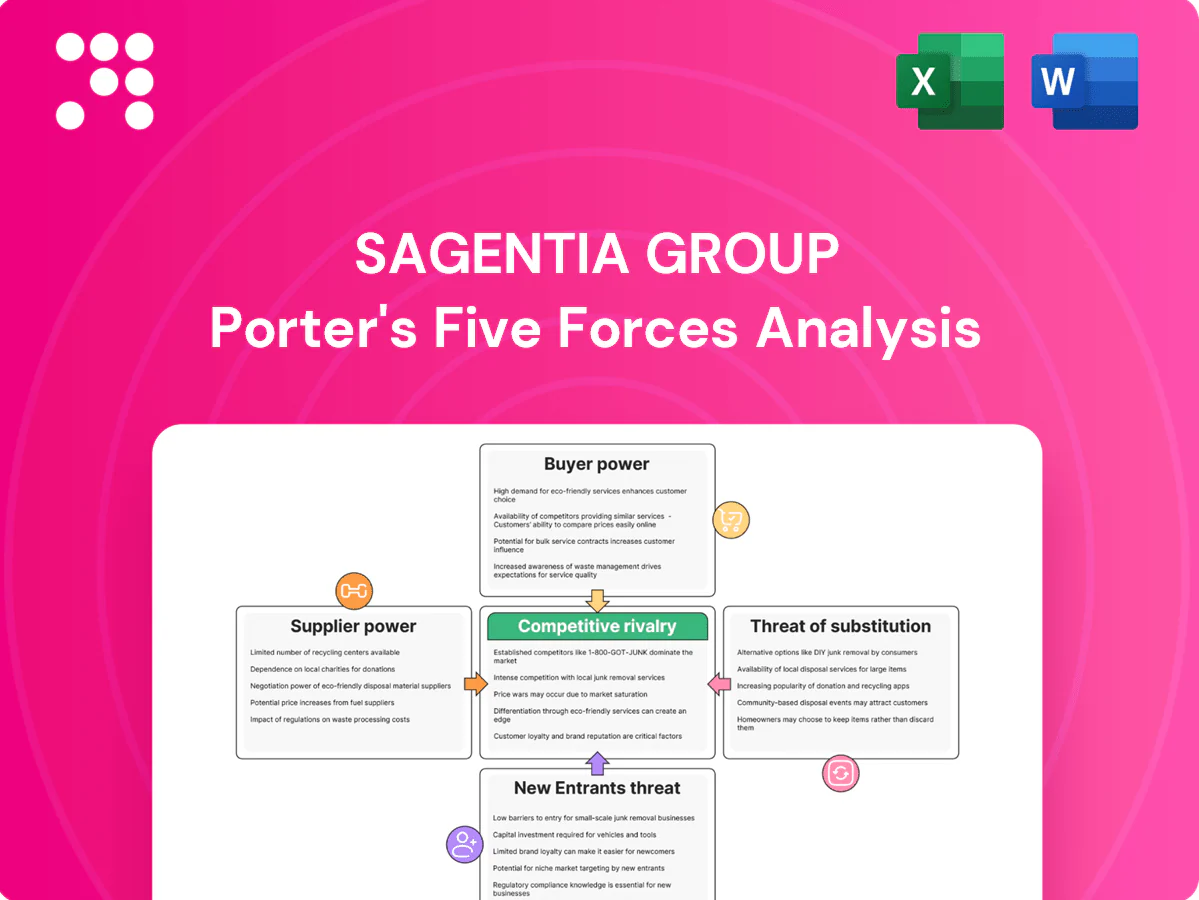
Sagentia Group Porter's Five Forces Analysis

From Overview to Strategy Blueprint
Sagentia Group faces moderate supplier power, niche buyer bargaining, evolving tech-driven substitutes, and guarded entry barriers—resulting in a competitive but opportunity-rich landscape. This snapshot highlights strategic pressure points and growth levers. Unlock the full Porter's Five Forces Analysis to explore detailed force ratings, visuals, and actionable insights.
Suppliers Bargaining Power

Scarce specialist STEM talent
Scarce specialist STEM talent with deep medtech, consumer science and industrial engineering expertise gives niche suppliers moderate bargaining power. In 2024 persistent shortages and salary inflation increased retention-driven delivery costs and stretched timelines. Sagentia offsets this via global recruiting and structured career pathways, but availability bottlenecks and long replacement lead times elevate effective switching costs.
Proprietary tools, software, and IP licensors
Access to specialized simulation, CAD/CAE and algorithm libraries is concentrated among vendors such as ANSYS, Siemens and Dassault, giving licensors leverage via restrictive license terms and price escalators; enterprise bundles often exceed USD 100,000/year. Multi-vendor strategies and open-source options like OpenFOAM reduce exposure but raise integration and validation costs. In regulated sectors, certification and traceability requirements further limit tool switching.

Lab equipment, prototyping, and test suppliers
Precision labs, biocompatibility test houses, and rapid prototyping services can dictate schedules and add 4–12 week lead times for device cycles, increasing supplier leverage over Sagentia Group.
Specialized material and component lead times and low supplier counts concentrate bargaining power; preferred supplier panels and volume bundling have been shown to reduce unit costs by about 10–15%.
Dual-sourcing and targeted in-house prototyping investments lower concentration risk and compress development timelines by several weeks.

Data, trials, and specialist testing partners
Clinical, regulatory, and consumer insights for Sagentia Group rely heavily on external data providers and CROs, creating dependence on a limited supplier pool. Scarcity of credible datasets and accredited labs can elevate prices, with spot premiums reported up to 30% in capacity-constrained specialties. Long approval cycles and trial booking windows of 12–24 months increase supplier lock-in. Strategic alliances and early slot reservations temper supplier power but require upfront financial and contractual commitments.
- Dependence: external CROs, data vendors
- Scarcity: accredited labs, rare datasets
- Timing: booking lead times 12–24 months
- Cost pressure: spot premiums up to 30%
- Mitigation: alliances, early reservations (require upfront commitments)
Subcontractors and niche boutiques
STEM scarcity, concentrated licensors and 60% freelance reliance drive high supplier power
Specialist STEM scarcity, concentrated software licensors and limited labs give suppliers moderate-to-high bargaining power; 60% freelance reliance in 2024 and license bundles often >USD 100,000/yr. Lead times: prototyping 4–12 weeks, trials 12–24 months; spot premiums up to 30%. Mitigations: dual-sourcing, alliances, in-house prototyping.
| Metric | 2024 value | Impact |
|---|---|---|
| Freelance use | 60% | Peak reliance |
| License cost | >USD 100,000/yr | Price leverage |
| Spot premium | Up to 30% | Cost spikes |
What is included in the product
 Detailed Word Document
Tailored Porter's Five Forces analysis for Sagentia Group uncovering key drivers of competition, supplier and buyer power, threat of substitutes and new entrants, and strategic barriers protecting incumbency. Includes industry data, disruptive threats, and actionable insights for investors, strategists, and internal planning—fully editable for reports and decks.

 Customizable Excel Spreadsheet
A concise one-sheet Porter's Five Forces for Sagentia Group—visual radar, customizable pressure levels, ready to drop into pitch decks or reports to quickly relieve strategic uncertainty.
Customers Bargaining Power

Large enterprise clients with procurement leverage
Large medical, consumer and industrial buyers run competitive RFPs and tight MSAs, leveraging volume and brand to pressure margins and demand stringent SLAs (often targeting ≥99% uptime); multi-year contracts commonly span 3–5 years. Sagentia defends pricing through differentiated outcomes, regulated-market credibility and embedded value from long-term programs that shift bargaining power back to the supplier.
Project-based, discretionary spend
Project-based, discretionary spend means innovation budgets flex with market cycles, amplifying price sensitivity as global R&D topped about $2.6 trillion in 2023; consultancies face heightened win-rate pressure. Stop-start funding raises negotiation intensity and deal slippage, with the global management consulting market near $350 billion in 2023, increasing buyer leverage. Outcome- and milestone-based pricing align incentives but shift delivery risk to Sagentia; visible ROI narratives and pilot proofs-of-value are critical to defend pricing.

Insourcing and centers of excellence
Clients increasingly build internal R&D and design centers of excellence, reducing reliance on external partners and raising their bargaining power. Where core IP is strategic, buyers demand knowledge transfer, pressuring suppliers on terms and margins. Sagentia positions as a capability multiplier for peak workloads and niche technical challenges, preserving value beyond routine work. Co-creation models can lower perceived switching costs by embedding Sagentia within client workflows.

Switching costs tied to domain and regulatory knowledge
In regulated sectors, familiarity with standards and client processes raises switching costs as legacy knowledge and working prototypes embed the provider; detailed documentation and modular architectures can be used by buyers as leverage. Sagentia’s track record of repeat engagements helps convert switching friction into retention; Bain notes a 5% retention lift can raise profits 25–95%.
- High regulatory familiarity = higher switch cost
- Documentation/modularity = buyer leverage
- Sagentia repeat work -> retention
Global footprint and integration expectations
Multinational clients demand cross-border delivery, 24/7 cadence and harmonized governance; vendors without global scale concede on price and contract terms while scaled providers command broader scope. The global consulting market was estimated at 343 billion USD in 2024 (Statista), underscoring premium for integrated delivery. Sagentia’s sector breadth aids wins, but buyers often fragment awards to keep competition; a strong PMO limits scope creep.
- Cross-border requirements: premium for scale
- 24/7 delivery: operational capex barrier
- Fragmented awards: 3-4 vendors common
- Strong PMO: reduces scope creep risk
Buyers Demand ≥99% SLAs, 3–5yr Deals and 3–4 Vendor Splits; Outcomes Drive Pricing
Large buyers use RFPs, volume and MSAs to pressure margins and demand ≥99% SLAs; multi-year contracts (3–5 years) and stop-start R&D budgets (global R&D ≈2.6T USD in 2023) amplify price sensitivity. Clients insource capabilities and fragment awards to 3–4 vendors, raising negotiation intensity. Sagentia defends pricing via regulated-market credibility, outcomes and repeat engagements.
| Metric | Value |
|---|---|
| Global R&D | ≈2.6T USD (2023) |
| Consulting market | 343B USD (2024) |
| Contract length | 3–5 yrs |
| Typical vendor split | 3–4 vendors |
Same Document Delivered
Sagentia Group Porter's Five Forces Analysis
This preview displays the Sagentia Group Porter's Five Forces Analysis exactly as delivered—no placeholders or mockups. The document shown is the final, professionally formatted file you’ll receive instantly after purchase. It’s ready for download and immediate use to inform strategy and decision-making.

From Overview to Strategy Blueprint
Sagentia Group faces moderate supplier power, niche buyer bargaining, evolving tech-driven substitutes, and guarded entry barriers—resulting in a competitive but opportunity-rich landscape. This snapshot highlights strategic pressure points and growth levers. Unlock the full Porter's Five Forces Analysis to explore detailed force ratings, visuals, and actionable insights.
Suppliers Bargaining Power
Scarce specialist STEM talent
Scarce specialist STEM talent with deep medtech, consumer science and industrial engineering expertise gives niche suppliers moderate bargaining power. In 2024 persistent shortages and salary inflation increased retention-driven delivery costs and stretched timelines. Sagentia offsets this via global recruiting and structured career pathways, but availability bottlenecks and long replacement lead times elevate effective switching costs.
Proprietary tools, software, and IP licensors
Access to specialized simulation, CAD/CAE and algorithm libraries is concentrated among vendors such as ANSYS, Siemens and Dassault, giving licensors leverage via restrictive license terms and price escalators; enterprise bundles often exceed USD 100,000/year. Multi-vendor strategies and open-source options like OpenFOAM reduce exposure but raise integration and validation costs. In regulated sectors, certification and traceability requirements further limit tool switching.
Lab equipment, prototyping, and test suppliers
Precision labs, biocompatibility test houses, and rapid prototyping services can dictate schedules and add 4–12 week lead times for device cycles, increasing supplier leverage over Sagentia Group.
Specialized material and component lead times and low supplier counts concentrate bargaining power; preferred supplier panels and volume bundling have been shown to reduce unit costs by about 10–15%.
Dual-sourcing and targeted in-house prototyping investments lower concentration risk and compress development timelines by several weeks.
Data, trials, and specialist testing partners
Clinical, regulatory, and consumer insights for Sagentia Group rely heavily on external data providers and CROs, creating dependence on a limited supplier pool. Scarcity of credible datasets and accredited labs can elevate prices, with spot premiums reported up to 30% in capacity-constrained specialties. Long approval cycles and trial booking windows of 12–24 months increase supplier lock-in. Strategic alliances and early slot reservations temper supplier power but require upfront financial and contractual commitments.
- Dependence: external CROs, data vendors
- Scarcity: accredited labs, rare datasets
- Timing: booking lead times 12–24 months
- Cost pressure: spot premiums up to 30%
- Mitigation: alliances, early reservations (require upfront commitments)
Subcontractors and niche boutiques
STEM scarcity, concentrated licensors and 60% freelance reliance drive high supplier power
Specialist STEM scarcity, concentrated software licensors and limited labs give suppliers moderate-to-high bargaining power; 60% freelance reliance in 2024 and license bundles often >USD 100,000/yr. Lead times: prototyping 4–12 weeks, trials 12–24 months; spot premiums up to 30%. Mitigations: dual-sourcing, alliances, in-house prototyping.
| Metric | 2024 value | Impact |
|---|---|---|
| Freelance use | 60% | Peak reliance |
| License cost | >USD 100,000/yr | Price leverage |
| Spot premium | Up to 30% | Cost spikes |
What is included in the product
Detailed Word Document
Tailored Porter's Five Forces analysis for Sagentia Group uncovering key drivers of competition, supplier and buyer power, threat of substitutes and new entrants, and strategic barriers protecting incumbency. Includes industry data, disruptive threats, and actionable insights for investors, strategists, and internal planning—fully editable for reports and decks.
Customizable Excel Spreadsheet
A concise one-sheet Porter's Five Forces for Sagentia Group—visual radar, customizable pressure levels, ready to drop into pitch decks or reports to quickly relieve strategic uncertainty.
Customers Bargaining Power
Large enterprise clients with procurement leverage
Large medical, consumer and industrial buyers run competitive RFPs and tight MSAs, leveraging volume and brand to pressure margins and demand stringent SLAs (often targeting ≥99% uptime); multi-year contracts commonly span 3–5 years. Sagentia defends pricing through differentiated outcomes, regulated-market credibility and embedded value from long-term programs that shift bargaining power back to the supplier.
Project-based, discretionary spend
Project-based, discretionary spend means innovation budgets flex with market cycles, amplifying price sensitivity as global R&D topped about $2.6 trillion in 2023; consultancies face heightened win-rate pressure. Stop-start funding raises negotiation intensity and deal slippage, with the global management consulting market near $350 billion in 2023, increasing buyer leverage. Outcome- and milestone-based pricing align incentives but shift delivery risk to Sagentia; visible ROI narratives and pilot proofs-of-value are critical to defend pricing.
Insourcing and centers of excellence
Clients increasingly build internal R&D and design centers of excellence, reducing reliance on external partners and raising their bargaining power. Where core IP is strategic, buyers demand knowledge transfer, pressuring suppliers on terms and margins. Sagentia positions as a capability multiplier for peak workloads and niche technical challenges, preserving value beyond routine work. Co-creation models can lower perceived switching costs by embedding Sagentia within client workflows.
Switching costs tied to domain and regulatory knowledge
In regulated sectors, familiarity with standards and client processes raises switching costs as legacy knowledge and working prototypes embed the provider; detailed documentation and modular architectures can be used by buyers as leverage. Sagentia’s track record of repeat engagements helps convert switching friction into retention; Bain notes a 5% retention lift can raise profits 25–95%.
- High regulatory familiarity = higher switch cost
- Documentation/modularity = buyer leverage
- Sagentia repeat work -> retention
Global footprint and integration expectations
Multinational clients demand cross-border delivery, 24/7 cadence and harmonized governance; vendors without global scale concede on price and contract terms while scaled providers command broader scope. The global consulting market was estimated at 343 billion USD in 2024 (Statista), underscoring premium for integrated delivery. Sagentia’s sector breadth aids wins, but buyers often fragment awards to keep competition; a strong PMO limits scope creep.
- Cross-border requirements: premium for scale
- 24/7 delivery: operational capex barrier
- Fragmented awards: 3-4 vendors common
- Strong PMO: reduces scope creep risk
Buyers Demand ≥99% SLAs, 3–5yr Deals and 3–4 Vendor Splits; Outcomes Drive Pricing
Large buyers use RFPs, volume and MSAs to pressure margins and demand ≥99% SLAs; multi-year contracts (3–5 years) and stop-start R&D budgets (global R&D ≈2.6T USD in 2023) amplify price sensitivity. Clients insource capabilities and fragment awards to 3–4 vendors, raising negotiation intensity. Sagentia defends pricing via regulated-market credibility, outcomes and repeat engagements.
| Metric | Value |
|---|---|
| Global R&D | ≈2.6T USD (2023) |
| Consulting market | 343B USD (2024) |
| Contract length | 3–5 yrs |
| Typical vendor split | 3–4 vendors |
Same Document Delivered
Sagentia Group Porter's Five Forces Analysis
This preview displays the Sagentia Group Porter's Five Forces Analysis exactly as delivered—no placeholders or mockups. The document shown is the final, professionally formatted file you’ll receive instantly after purchase. It’s ready for download and immediate use to inform strategy and decision-making.
Original: $10.00
-65%$10.00
$3.50Description
From Overview to Strategy Blueprint
Sagentia Group faces moderate supplier power, niche buyer bargaining, evolving tech-driven substitutes, and guarded entry barriers—resulting in a competitive but opportunity-rich landscape. This snapshot highlights strategic pressure points and growth levers. Unlock the full Porter's Five Forces Analysis to explore detailed force ratings, visuals, and actionable insights.
Suppliers Bargaining Power
Scarce specialist STEM talent
Scarce specialist STEM talent with deep medtech, consumer science and industrial engineering expertise gives niche suppliers moderate bargaining power. In 2024 persistent shortages and salary inflation increased retention-driven delivery costs and stretched timelines. Sagentia offsets this via global recruiting and structured career pathways, but availability bottlenecks and long replacement lead times elevate effective switching costs.
Proprietary tools, software, and IP licensors
Access to specialized simulation, CAD/CAE and algorithm libraries is concentrated among vendors such as ANSYS, Siemens and Dassault, giving licensors leverage via restrictive license terms and price escalators; enterprise bundles often exceed USD 100,000/year. Multi-vendor strategies and open-source options like OpenFOAM reduce exposure but raise integration and validation costs. In regulated sectors, certification and traceability requirements further limit tool switching.
Lab equipment, prototyping, and test suppliers
Precision labs, biocompatibility test houses, and rapid prototyping services can dictate schedules and add 4–12 week lead times for device cycles, increasing supplier leverage over Sagentia Group.
Specialized material and component lead times and low supplier counts concentrate bargaining power; preferred supplier panels and volume bundling have been shown to reduce unit costs by about 10–15%.
Dual-sourcing and targeted in-house prototyping investments lower concentration risk and compress development timelines by several weeks.
Data, trials, and specialist testing partners
Clinical, regulatory, and consumer insights for Sagentia Group rely heavily on external data providers and CROs, creating dependence on a limited supplier pool. Scarcity of credible datasets and accredited labs can elevate prices, with spot premiums reported up to 30% in capacity-constrained specialties. Long approval cycles and trial booking windows of 12–24 months increase supplier lock-in. Strategic alliances and early slot reservations temper supplier power but require upfront financial and contractual commitments.
- Dependence: external CROs, data vendors
- Scarcity: accredited labs, rare datasets
- Timing: booking lead times 12–24 months
- Cost pressure: spot premiums up to 30%
- Mitigation: alliances, early reservations (require upfront commitments)
Subcontractors and niche boutiques
STEM scarcity, concentrated licensors and 60% freelance reliance drive high supplier power
Specialist STEM scarcity, concentrated software licensors and limited labs give suppliers moderate-to-high bargaining power; 60% freelance reliance in 2024 and license bundles often >USD 100,000/yr. Lead times: prototyping 4–12 weeks, trials 12–24 months; spot premiums up to 30%. Mitigations: dual-sourcing, alliances, in-house prototyping.
| Metric | 2024 value | Impact |
|---|---|---|
| Freelance use | 60% | Peak reliance |
| License cost | >USD 100,000/yr | Price leverage |
| Spot premium | Up to 30% | Cost spikes |
What is included in the product
Detailed Word Document
Tailored Porter's Five Forces analysis for Sagentia Group uncovering key drivers of competition, supplier and buyer power, threat of substitutes and new entrants, and strategic barriers protecting incumbency. Includes industry data, disruptive threats, and actionable insights for investors, strategists, and internal planning—fully editable for reports and decks.
Customizable Excel Spreadsheet
A concise one-sheet Porter's Five Forces for Sagentia Group—visual radar, customizable pressure levels, ready to drop into pitch decks or reports to quickly relieve strategic uncertainty.
Customers Bargaining Power
Large enterprise clients with procurement leverage
Large medical, consumer and industrial buyers run competitive RFPs and tight MSAs, leveraging volume and brand to pressure margins and demand stringent SLAs (often targeting ≥99% uptime); multi-year contracts commonly span 3–5 years. Sagentia defends pricing through differentiated outcomes, regulated-market credibility and embedded value from long-term programs that shift bargaining power back to the supplier.
Project-based, discretionary spend
Project-based, discretionary spend means innovation budgets flex with market cycles, amplifying price sensitivity as global R&D topped about $2.6 trillion in 2023; consultancies face heightened win-rate pressure. Stop-start funding raises negotiation intensity and deal slippage, with the global management consulting market near $350 billion in 2023, increasing buyer leverage. Outcome- and milestone-based pricing align incentives but shift delivery risk to Sagentia; visible ROI narratives and pilot proofs-of-value are critical to defend pricing.
Insourcing and centers of excellence
Clients increasingly build internal R&D and design centers of excellence, reducing reliance on external partners and raising their bargaining power. Where core IP is strategic, buyers demand knowledge transfer, pressuring suppliers on terms and margins. Sagentia positions as a capability multiplier for peak workloads and niche technical challenges, preserving value beyond routine work. Co-creation models can lower perceived switching costs by embedding Sagentia within client workflows.
Switching costs tied to domain and regulatory knowledge
In regulated sectors, familiarity with standards and client processes raises switching costs as legacy knowledge and working prototypes embed the provider; detailed documentation and modular architectures can be used by buyers as leverage. Sagentia’s track record of repeat engagements helps convert switching friction into retention; Bain notes a 5% retention lift can raise profits 25–95%.
- High regulatory familiarity = higher switch cost
- Documentation/modularity = buyer leverage
- Sagentia repeat work -> retention
Global footprint and integration expectations
Multinational clients demand cross-border delivery, 24/7 cadence and harmonized governance; vendors without global scale concede on price and contract terms while scaled providers command broader scope. The global consulting market was estimated at 343 billion USD in 2024 (Statista), underscoring premium for integrated delivery. Sagentia’s sector breadth aids wins, but buyers often fragment awards to keep competition; a strong PMO limits scope creep.
- Cross-border requirements: premium for scale
- 24/7 delivery: operational capex barrier
- Fragmented awards: 3-4 vendors common
- Strong PMO: reduces scope creep risk
Buyers Demand ≥99% SLAs, 3–5yr Deals and 3–4 Vendor Splits; Outcomes Drive Pricing
Large buyers use RFPs, volume and MSAs to pressure margins and demand ≥99% SLAs; multi-year contracts (3–5 years) and stop-start R&D budgets (global R&D ≈2.6T USD in 2023) amplify price sensitivity. Clients insource capabilities and fragment awards to 3–4 vendors, raising negotiation intensity. Sagentia defends pricing via regulated-market credibility, outcomes and repeat engagements.
| Metric | Value |
|---|---|
| Global R&D | ≈2.6T USD (2023) |
| Consulting market | 343B USD (2024) |
| Contract length | 3–5 yrs |
| Typical vendor split | 3–4 vendors |
Same Document Delivered
Sagentia Group Porter's Five Forces Analysis
This preview displays the Sagentia Group Porter's Five Forces Analysis exactly as delivered—no placeholders or mockups. The document shown is the final, professionally formatted file you’ll receive instantly after purchase. It’s ready for download and immediate use to inform strategy and decision-making.











