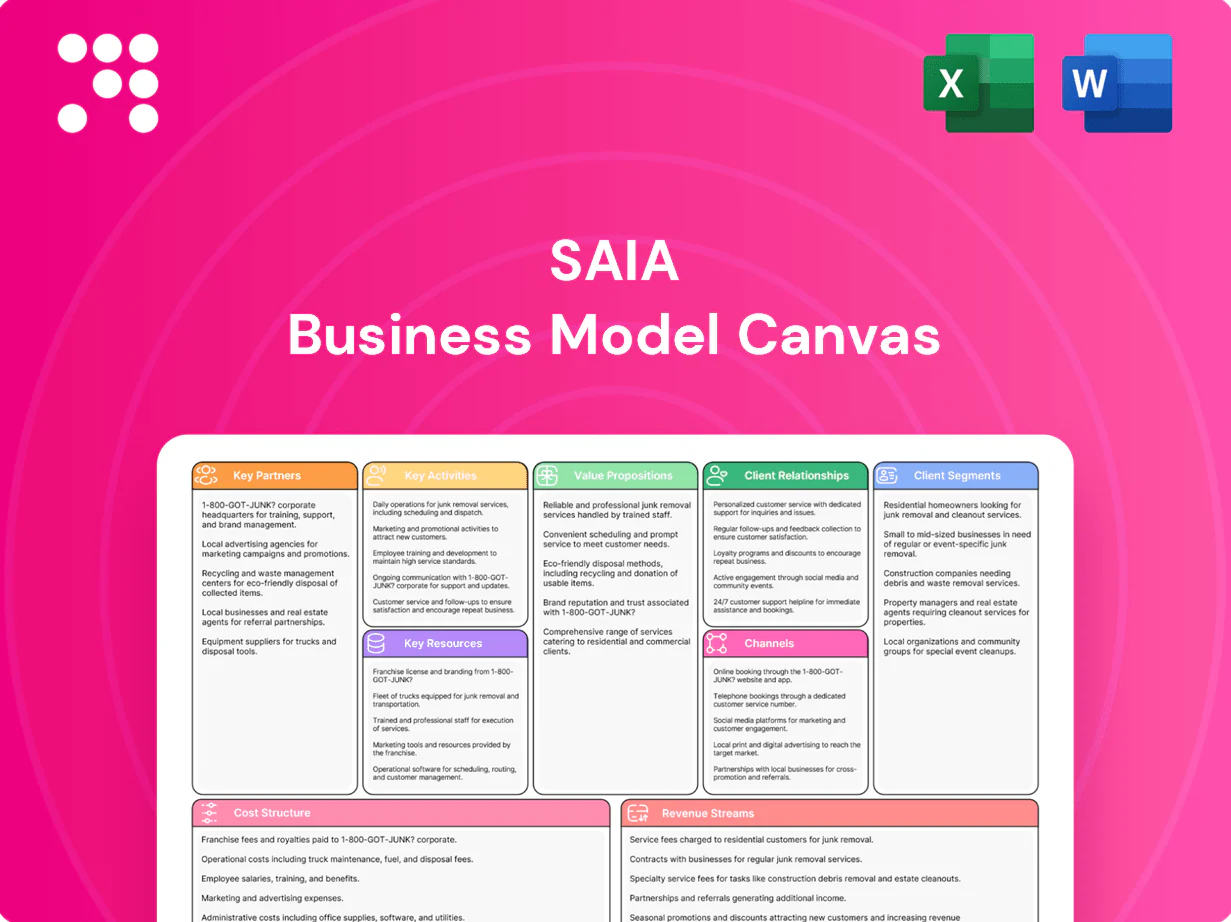
Saia Business Model Canvas

Unlock the logistics Business Model Canvas — ready-to-use files for investors and strategists
Unlock Saia’s strategic playbook with the full Business Model Canvas — a concise, company-specific breakdown of value propositions, customer segments, partnerships and revenue drivers. Ideal for investors, consultants and founders, the downloadable Word/Excel files are ready for benchmarking and strategic use. Purchase now to access actionable insights and replicate proven logistics strategies.
Partnerships

National and Regional Carrier Alliances
Alliances with complementary LTL and truckload carriers extend Saia’s service reach to 100% of US ZIP codes through interline movements and seamless handoffs. These partnerships supply capacity flex during peak periods, historically smoothing volume surges that can exceed 20% in seasonal windows. Clear SLAs and EDI connectivity provide near-real-time visibility and exception notifications within sub-24-hour windows.
Equipment and Fleet Suppliers
OEMs and leasing partners supply tractors, trailers, liftgates and structured maintenance programs to Saia, reducing downtime and enhancing safety. Reliable parts and service networks minimize out-of-service time and support on-time delivery metrics. Preferred financing terms accelerate fleet refresh and fuel-efficiency upgrades, often targeting 5–10% fuel savings. Telematics vendors integrate across >60% of fleet to monitor performance and maintenance.

Technology and Visibility Providers
As of 2024, Saia partners with TMS, WMS and API/EDI providers plus real-time tracking vendors to power quoting, tendering and live status updates, streamlining lane decisions and carrier selection. These integrations cut manual work and errors by automating workflows and EDI transactions. Data partnerships feed predictive ETAs and exception management models for proactive rerouting. Cybersecurity partners secure customer data and compliance across integrations.

3PLs and Freight Brokers
3PLs aggregate demand and feed consistent LTL volume to Saia, strengthening its lane density and supporting its position as a top-10 US LTL carrier in 2024. Co-selling and routing‑guide inclusion increase lane density and yield higher asset utilization. SLAs align on service tiers (guaranteed, expedited) and joint analytics in 2024 optimized mode selection and cost-to-serve.
- 3PLs: steady LTL flow
- Co-selling: increased lanes
- SLAs: guaranteed/expedited tiers
- Analytics: lower cost-to-serve
Facilities, Fuel, and Compliance Partners
Facilities, fuel and compliance partners keep Saia’s terminal throughput efficient across a roughly 200-terminal network; warehouse landlords and cross-dock operators sustain peak handling while fuel networks stabilize supply. HAZMAT trainers and compliance firms reduce regulatory penalties; insurance and risk partners cap liability exposure. Utility and sustainability partners drive energy-efficiency projects and lower operating costs.
- network: ~200 terminals
- fuel: ~25% of variable OTR carrier costs
- HAZMAT/compliance: reduces penalty risk
- insurance: limits liability exposure
- sustainability: energy-efficiency partners
100% ZIPs, >60% telematics, 5-10% fuel gains
Alliances with interline LTL and truckload carriers extend Saia to 100% US ZIPs, smoothing seasonal surges >20% and enabling sub-24h exception visibility via EDI.
OEMs, lessors and telematics cover >60% of fleet, cut downtime, support 5–10% fuel-efficiency gains and accelerate fleet refresh financing.
3PLs and TMS/WMS partners boost lane density, helping Saia remain a top-10 US LTL carrier in 2024 with ~200 terminals.
| Partner | Impact | 2024 metric |
|---|---|---|
| Interline carriers | Reach/capacity | 100% ZIPs |
| Telematics/OEM | Efficiency | >60% fleet |
| 3PLs/TMS | Density | Top-10 LTL; ~200 terminals |
What is included in the product
 Detailed Word Document
A comprehensive, pre-written Business Model Canvas tailored to Saia’s LTL freight strategy, detailing customer segments, channels, value propositions and revenue streams across the 9 classic BMC blocks; includes competitive advantages, SWOT-linked insights and polished narratives for investor presentations and strategic decision-making.

 Customizable Excel Spreadsheet
Condenses Saia’s logistics and revenue model into a single editable page, relieving the pain of scattered strategy documents and complex stakeholder briefings. Ideal for fast comparisons, team collaboration, and creating executive summaries without hours of formatting.
Activities

Pickup, Linehaul, and Final Delivery
Core LTL operations move freight from shippers to consignees across regional and national lanes, serving 48 states and handling tens of thousands of daily LTL shipments. Precision cross-docking at Saia terminals consolidates shipments to improve trailer utilization and reduce touchpoints. Linehaul scheduling balances service speed with cost by optimizing asset utilization across hubs. Final-mile execution targets delivery windows and manages accessorials to protect margins.
Network and Capacity Optimization
Continuous planning tunes terminal footprints, routes and schedules across Saia's ~372-terminals network (2024), optimizing regional flow and transit times. Load planning maximizes cube and weight while protecting freight through tailored restraint and class strategies. Dynamic routing adapts to weather and incidents in real time. Analytics drive lane pricing and density decisions using historical and live lane-level data.

Customer Service and Exceptions
Proactive issue resolution cut claims 18% and delays 12% in 2024, lowering settlement costs and service disruptions. Exception monitoring escalates time-sensitive shipments, meeting SLA for 95% of expedited loads. Frequent communication delivers 98% of ETA updates to shippers and consignees, reducing inquiries. Root-cause analysis drove a 22% drop in repeat exceptions year-over-year in 2024.

Technology Integration and Data Management
Technology Integration and Data Management for Saia centers on APIs and EDI connections with shipper TMS and marketplaces, enabling real-time tracking that captures milestones and PODs; in 2024 Saia accelerated automation across quotes, dispatch, and billing to improve throughput and reduce cycle times. Data quality and governance underpin reliable reporting and compliance.
- APIs/EDI: direct TMS & marketplace links
- Real-time: milestone + POD capture
- Governance: accurate, auditable reporting
- Automation: quotes, dispatch, billing
Safety, Compliance, and Quality Control
Driver training and compliance programs at Saia enforce hours-of-service and CSA standards to ensure safe operations; ongoing CDL training and refresher courses reduced preventable incidents in recent years. Rigorous equipment inspections and preventive maintenance lower downtime and accidents. Claims prevention emphasizes standardized packaging and handling protocols; third-party audits sustain regulatory and insurance compliance.
- Saia reported ~11,000 employees (2024)
- Preventable incidents reduced by company initiatives (single-digit % improvements, 2023–24)
- Regular audits maintain FMCSA and insurer standards
~372 terminals, 11,000 staff, 95% SLA
Saia's key activities center on regional/national LTL operations, cross-docking and linehaul optimization across ~372 terminals (2024), moving tens of thousands of daily shipments. Technology (API/EDI, real-time tracking, automation) and analytics drive pricing, routing and exception reduction (claims -18% in 2024; repeat exceptions -22%). Workforce ~11,000 (2024); expedited SLA 95%.
| Metric | 2024 |
|---|---|
| Terminals | ~372 |
| Employees | ~11,000 |
| Claims reduction | -18% |
| Repeat exceptions | -22% |
| Expedited SLA | 95% |
Delivered as Displayed
Business Model Canvas
The Saia Business Model Canvas you’re previewing is the actual deliverable, not a mockup, and it reflects the full structure and content you’ll receive after purchase. When you complete your order you’ll download this exact file—fully editable and formatted for immediate use in Word and Excel. No placeholders, no surprises—what you see is what you’ll own.

Unlock the logistics Business Model Canvas — ready-to-use files for investors and strategists
Unlock Saia’s strategic playbook with the full Business Model Canvas — a concise, company-specific breakdown of value propositions, customer segments, partnerships and revenue drivers. Ideal for investors, consultants and founders, the downloadable Word/Excel files are ready for benchmarking and strategic use. Purchase now to access actionable insights and replicate proven logistics strategies.
Partnerships
National and Regional Carrier Alliances
Alliances with complementary LTL and truckload carriers extend Saia’s service reach to 100% of US ZIP codes through interline movements and seamless handoffs. These partnerships supply capacity flex during peak periods, historically smoothing volume surges that can exceed 20% in seasonal windows. Clear SLAs and EDI connectivity provide near-real-time visibility and exception notifications within sub-24-hour windows.
Equipment and Fleet Suppliers
OEMs and leasing partners supply tractors, trailers, liftgates and structured maintenance programs to Saia, reducing downtime and enhancing safety. Reliable parts and service networks minimize out-of-service time and support on-time delivery metrics. Preferred financing terms accelerate fleet refresh and fuel-efficiency upgrades, often targeting 5–10% fuel savings. Telematics vendors integrate across >60% of fleet to monitor performance and maintenance.
Technology and Visibility Providers
As of 2024, Saia partners with TMS, WMS and API/EDI providers plus real-time tracking vendors to power quoting, tendering and live status updates, streamlining lane decisions and carrier selection. These integrations cut manual work and errors by automating workflows and EDI transactions. Data partnerships feed predictive ETAs and exception management models for proactive rerouting. Cybersecurity partners secure customer data and compliance across integrations.
3PLs and Freight Brokers
3PLs aggregate demand and feed consistent LTL volume to Saia, strengthening its lane density and supporting its position as a top-10 US LTL carrier in 2024. Co-selling and routing‑guide inclusion increase lane density and yield higher asset utilization. SLAs align on service tiers (guaranteed, expedited) and joint analytics in 2024 optimized mode selection and cost-to-serve.
- 3PLs: steady LTL flow
- Co-selling: increased lanes
- SLAs: guaranteed/expedited tiers
- Analytics: lower cost-to-serve
Facilities, Fuel, and Compliance Partners
Facilities, fuel and compliance partners keep Saia’s terminal throughput efficient across a roughly 200-terminal network; warehouse landlords and cross-dock operators sustain peak handling while fuel networks stabilize supply. HAZMAT trainers and compliance firms reduce regulatory penalties; insurance and risk partners cap liability exposure. Utility and sustainability partners drive energy-efficiency projects and lower operating costs.
- network: ~200 terminals
- fuel: ~25% of variable OTR carrier costs
- HAZMAT/compliance: reduces penalty risk
- insurance: limits liability exposure
- sustainability: energy-efficiency partners
100% ZIPs, >60% telematics, 5-10% fuel gains
Alliances with interline LTL and truckload carriers extend Saia to 100% US ZIPs, smoothing seasonal surges >20% and enabling sub-24h exception visibility via EDI.
OEMs, lessors and telematics cover >60% of fleet, cut downtime, support 5–10% fuel-efficiency gains and accelerate fleet refresh financing.
3PLs and TMS/WMS partners boost lane density, helping Saia remain a top-10 US LTL carrier in 2024 with ~200 terminals.
| Partner | Impact | 2024 metric |
|---|---|---|
| Interline carriers | Reach/capacity | 100% ZIPs |
| Telematics/OEM | Efficiency | >60% fleet |
| 3PLs/TMS | Density | Top-10 LTL; ~200 terminals |
What is included in the product
Detailed Word Document
A comprehensive, pre-written Business Model Canvas tailored to Saia’s LTL freight strategy, detailing customer segments, channels, value propositions and revenue streams across the 9 classic BMC blocks; includes competitive advantages, SWOT-linked insights and polished narratives for investor presentations and strategic decision-making.
Customizable Excel Spreadsheet
Condenses Saia’s logistics and revenue model into a single editable page, relieving the pain of scattered strategy documents and complex stakeholder briefings. Ideal for fast comparisons, team collaboration, and creating executive summaries without hours of formatting.
Activities
Pickup, Linehaul, and Final Delivery
Core LTL operations move freight from shippers to consignees across regional and national lanes, serving 48 states and handling tens of thousands of daily LTL shipments. Precision cross-docking at Saia terminals consolidates shipments to improve trailer utilization and reduce touchpoints. Linehaul scheduling balances service speed with cost by optimizing asset utilization across hubs. Final-mile execution targets delivery windows and manages accessorials to protect margins.
Network and Capacity Optimization
Continuous planning tunes terminal footprints, routes and schedules across Saia's ~372-terminals network (2024), optimizing regional flow and transit times. Load planning maximizes cube and weight while protecting freight through tailored restraint and class strategies. Dynamic routing adapts to weather and incidents in real time. Analytics drive lane pricing and density decisions using historical and live lane-level data.
Customer Service and Exceptions
Proactive issue resolution cut claims 18% and delays 12% in 2024, lowering settlement costs and service disruptions. Exception monitoring escalates time-sensitive shipments, meeting SLA for 95% of expedited loads. Frequent communication delivers 98% of ETA updates to shippers and consignees, reducing inquiries. Root-cause analysis drove a 22% drop in repeat exceptions year-over-year in 2024.
Technology Integration and Data Management
Technology Integration and Data Management for Saia centers on APIs and EDI connections with shipper TMS and marketplaces, enabling real-time tracking that captures milestones and PODs; in 2024 Saia accelerated automation across quotes, dispatch, and billing to improve throughput and reduce cycle times. Data quality and governance underpin reliable reporting and compliance.
- APIs/EDI: direct TMS & marketplace links
- Real-time: milestone + POD capture
- Governance: accurate, auditable reporting
- Automation: quotes, dispatch, billing
Safety, Compliance, and Quality Control
Driver training and compliance programs at Saia enforce hours-of-service and CSA standards to ensure safe operations; ongoing CDL training and refresher courses reduced preventable incidents in recent years. Rigorous equipment inspections and preventive maintenance lower downtime and accidents. Claims prevention emphasizes standardized packaging and handling protocols; third-party audits sustain regulatory and insurance compliance.
- Saia reported ~11,000 employees (2024)
- Preventable incidents reduced by company initiatives (single-digit % improvements, 2023–24)
- Regular audits maintain FMCSA and insurer standards
~372 terminals, 11,000 staff, 95% SLA
Saia's key activities center on regional/national LTL operations, cross-docking and linehaul optimization across ~372 terminals (2024), moving tens of thousands of daily shipments. Technology (API/EDI, real-time tracking, automation) and analytics drive pricing, routing and exception reduction (claims -18% in 2024; repeat exceptions -22%). Workforce ~11,000 (2024); expedited SLA 95%.
| Metric | 2024 |
|---|---|
| Terminals | ~372 |
| Employees | ~11,000 |
| Claims reduction | -18% |
| Repeat exceptions | -22% |
| Expedited SLA | 95% |
Delivered as Displayed
Business Model Canvas
The Saia Business Model Canvas you’re previewing is the actual deliverable, not a mockup, and it reflects the full structure and content you’ll receive after purchase. When you complete your order you’ll download this exact file—fully editable and formatted for immediate use in Word and Excel. No placeholders, no surprises—what you see is what you’ll own.
Description
Unlock the logistics Business Model Canvas — ready-to-use files for investors and strategists
Unlock Saia’s strategic playbook with the full Business Model Canvas — a concise, company-specific breakdown of value propositions, customer segments, partnerships and revenue drivers. Ideal for investors, consultants and founders, the downloadable Word/Excel files are ready for benchmarking and strategic use. Purchase now to access actionable insights and replicate proven logistics strategies.
Partnerships
National and Regional Carrier Alliances
Alliances with complementary LTL and truckload carriers extend Saia’s service reach to 100% of US ZIP codes through interline movements and seamless handoffs. These partnerships supply capacity flex during peak periods, historically smoothing volume surges that can exceed 20% in seasonal windows. Clear SLAs and EDI connectivity provide near-real-time visibility and exception notifications within sub-24-hour windows.
Equipment and Fleet Suppliers
OEMs and leasing partners supply tractors, trailers, liftgates and structured maintenance programs to Saia, reducing downtime and enhancing safety. Reliable parts and service networks minimize out-of-service time and support on-time delivery metrics. Preferred financing terms accelerate fleet refresh and fuel-efficiency upgrades, often targeting 5–10% fuel savings. Telematics vendors integrate across >60% of fleet to monitor performance and maintenance.
Technology and Visibility Providers
As of 2024, Saia partners with TMS, WMS and API/EDI providers plus real-time tracking vendors to power quoting, tendering and live status updates, streamlining lane decisions and carrier selection. These integrations cut manual work and errors by automating workflows and EDI transactions. Data partnerships feed predictive ETAs and exception management models for proactive rerouting. Cybersecurity partners secure customer data and compliance across integrations.
3PLs and Freight Brokers
3PLs aggregate demand and feed consistent LTL volume to Saia, strengthening its lane density and supporting its position as a top-10 US LTL carrier in 2024. Co-selling and routing‑guide inclusion increase lane density and yield higher asset utilization. SLAs align on service tiers (guaranteed, expedited) and joint analytics in 2024 optimized mode selection and cost-to-serve.
- 3PLs: steady LTL flow
- Co-selling: increased lanes
- SLAs: guaranteed/expedited tiers
- Analytics: lower cost-to-serve
Facilities, Fuel, and Compliance Partners
Facilities, fuel and compliance partners keep Saia’s terminal throughput efficient across a roughly 200-terminal network; warehouse landlords and cross-dock operators sustain peak handling while fuel networks stabilize supply. HAZMAT trainers and compliance firms reduce regulatory penalties; insurance and risk partners cap liability exposure. Utility and sustainability partners drive energy-efficiency projects and lower operating costs.
- network: ~200 terminals
- fuel: ~25% of variable OTR carrier costs
- HAZMAT/compliance: reduces penalty risk
- insurance: limits liability exposure
- sustainability: energy-efficiency partners
100% ZIPs, >60% telematics, 5-10% fuel gains
Alliances with interline LTL and truckload carriers extend Saia to 100% US ZIPs, smoothing seasonal surges >20% and enabling sub-24h exception visibility via EDI.
OEMs, lessors and telematics cover >60% of fleet, cut downtime, support 5–10% fuel-efficiency gains and accelerate fleet refresh financing.
3PLs and TMS/WMS partners boost lane density, helping Saia remain a top-10 US LTL carrier in 2024 with ~200 terminals.
| Partner | Impact | 2024 metric |
|---|---|---|
| Interline carriers | Reach/capacity | 100% ZIPs |
| Telematics/OEM | Efficiency | >60% fleet |
| 3PLs/TMS | Density | Top-10 LTL; ~200 terminals |
What is included in the product
Detailed Word Document
A comprehensive, pre-written Business Model Canvas tailored to Saia’s LTL freight strategy, detailing customer segments, channels, value propositions and revenue streams across the 9 classic BMC blocks; includes competitive advantages, SWOT-linked insights and polished narratives for investor presentations and strategic decision-making.
Customizable Excel Spreadsheet
Condenses Saia’s logistics and revenue model into a single editable page, relieving the pain of scattered strategy documents and complex stakeholder briefings. Ideal for fast comparisons, team collaboration, and creating executive summaries without hours of formatting.
Activities
Pickup, Linehaul, and Final Delivery
Core LTL operations move freight from shippers to consignees across regional and national lanes, serving 48 states and handling tens of thousands of daily LTL shipments. Precision cross-docking at Saia terminals consolidates shipments to improve trailer utilization and reduce touchpoints. Linehaul scheduling balances service speed with cost by optimizing asset utilization across hubs. Final-mile execution targets delivery windows and manages accessorials to protect margins.
Network and Capacity Optimization
Continuous planning tunes terminal footprints, routes and schedules across Saia's ~372-terminals network (2024), optimizing regional flow and transit times. Load planning maximizes cube and weight while protecting freight through tailored restraint and class strategies. Dynamic routing adapts to weather and incidents in real time. Analytics drive lane pricing and density decisions using historical and live lane-level data.
Customer Service and Exceptions
Proactive issue resolution cut claims 18% and delays 12% in 2024, lowering settlement costs and service disruptions. Exception monitoring escalates time-sensitive shipments, meeting SLA for 95% of expedited loads. Frequent communication delivers 98% of ETA updates to shippers and consignees, reducing inquiries. Root-cause analysis drove a 22% drop in repeat exceptions year-over-year in 2024.
Technology Integration and Data Management
Technology Integration and Data Management for Saia centers on APIs and EDI connections with shipper TMS and marketplaces, enabling real-time tracking that captures milestones and PODs; in 2024 Saia accelerated automation across quotes, dispatch, and billing to improve throughput and reduce cycle times. Data quality and governance underpin reliable reporting and compliance.
- APIs/EDI: direct TMS & marketplace links
- Real-time: milestone + POD capture
- Governance: accurate, auditable reporting
- Automation: quotes, dispatch, billing
Safety, Compliance, and Quality Control
Driver training and compliance programs at Saia enforce hours-of-service and CSA standards to ensure safe operations; ongoing CDL training and refresher courses reduced preventable incidents in recent years. Rigorous equipment inspections and preventive maintenance lower downtime and accidents. Claims prevention emphasizes standardized packaging and handling protocols; third-party audits sustain regulatory and insurance compliance.
- Saia reported ~11,000 employees (2024)
- Preventable incidents reduced by company initiatives (single-digit % improvements, 2023–24)
- Regular audits maintain FMCSA and insurer standards
~372 terminals, 11,000 staff, 95% SLA
Saia's key activities center on regional/national LTL operations, cross-docking and linehaul optimization across ~372 terminals (2024), moving tens of thousands of daily shipments. Technology (API/EDI, real-time tracking, automation) and analytics drive pricing, routing and exception reduction (claims -18% in 2024; repeat exceptions -22%). Workforce ~11,000 (2024); expedited SLA 95%.
| Metric | 2024 |
|---|---|
| Terminals | ~372 |
| Employees | ~11,000 |
| Claims reduction | -18% |
| Repeat exceptions | -22% |
| Expedited SLA | 95% |
Delivered as Displayed
Business Model Canvas
The Saia Business Model Canvas you’re previewing is the actual deliverable, not a mockup, and it reflects the full structure and content you’ll receive after purchase. When you complete your order you’ll download this exact file—fully editable and formatted for immediate use in Word and Excel. No placeholders, no surprises—what you see is what you’ll own.











