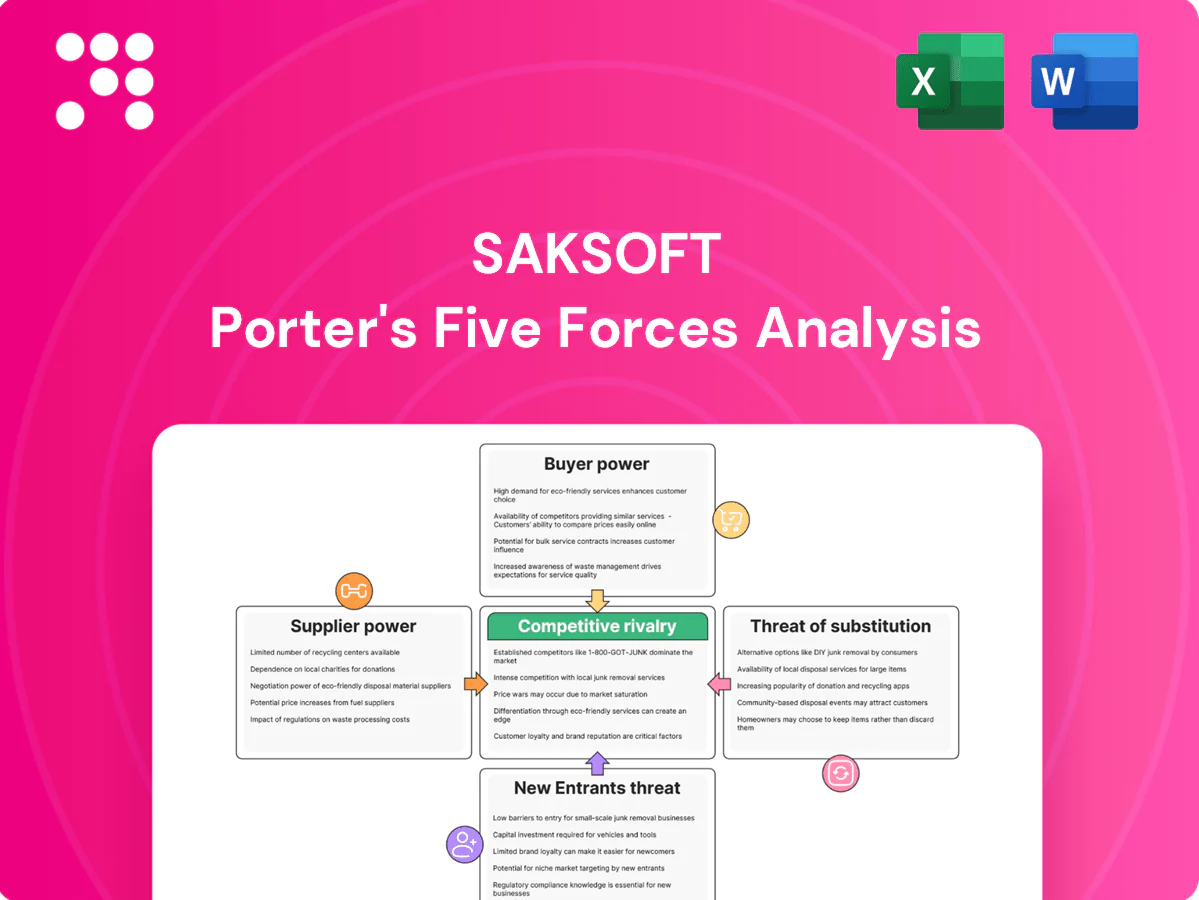
Saksoft Porter's Five Forces Analysis

Go Beyond the Preview—Access the Full Strategic Report
Saksoft's Porter's Five Forces highlights moderate buyer power, fragmented suppliers, and rising substitute threats from digital platforms; competitive rivalry is intense among Indian IT peers while entry barriers remain moderate. This brief snapshot only scratches the surface. Unlock the full Porter's Five Forces Analysis to explore Saksoft’s competitive dynamics, market pressures, and strategic advantages in detail.
Suppliers Bargaining Power

Hyperscaler dependence
Saksoft depends on AWS, Azure and GCP for core infrastructure, creating high switching costs and exposure to price changes; AWS/Azure/GCP held roughly 66% combined market share in 2024 (AWS ~32%, Azure ~23%, GCP ~11%, Synergy Research). Preferred-partner tiers reduce but do not remove dependence; hyperscaler outages and roadmap shifts can delay delivery, while committed spend and multi-cloud diversification boost negotiation leverage.
Specialized talent scarcity
Advanced data engineering, AI/ML and cloud-native skills saw demand surge ~75% YoY in 2024 (LinkedIn), boosting employee/contractor bargaining power; Indian IT attrition hovered around 22% in 2023–24, driving wage inflation of roughly 10–18% and pressuring margins and schedules; Saksoft’s strong employer brand, upskilling pipelines and offshore centers mitigate risk, while visa constraints and expanded remote work further reshape supply availability.

Software and tool vendors
Licensing from analytics, DevOps and security vendors creates architecture lock‑in and recurring costs, with enterprise agreements commonly offering 15–30% discounts that reduce flexibility; Gartner and vendor reports in 2023–24 show enterprise software deals favor bundled contracting. Widespread open‑source adoption (Linux Foundation surveys report >90% enterprise use) can curb supplier power when support risks are manageable, but integration and migration often account for 20–40% of switching costs.

Data partners and APIs
Access to proprietary datasets and third-party APIs is mission-critical for Saksoft client solutions; Postman 2024 State of the API reports 98% of organizations rely on APIs, concentrating upstream risk when terms, rate limits or deprecations change.
- Contractual SLAs mitigate service-risk
- Multi-provider redundancy lowers single-vendor impact
- Internal accelerators reduce API dependence over time
Subcontractors and niche boutiques
In 2024, specialist subcontractors and niche boutiques give Saksoft surge capacity and deep domain expertise but often command premium day rates, raising project cost bases. Quality variance and IP governance issues increase oversight and compliance costs, requiring tighter audits and contract clauses. Frame agreements and preferred-vendor lists standardize commercials, while co-delivery models demand strict PMO controls to prevent margin leakage.
- Surge capacity: premium day rates
- Risk: quality variance and IP governance
- Mitigation: frame agreements, preferred vendors
- Control: tight PMO to prevent margin leakage
Hyperscalers 66%, APIs critical, attrition 22%
Saksoft faces high supplier power from hyperscalers (AWS/Azure/GCP ~66% share in 2024) and API/data providers (98% orgs rely on APIs), driving switching costs and pricing exposure; talent suppliers pressured margins with Indian IT attrition ~22% (2023–24) and wage inflation ~10–18%; software vendors lock‑in offsets by >90% open‑source adoption. Frame agreements, multi‑cloud and SLAs reduce but do not eliminate risk.
| Supplier | Power | Key metric |
|---|---|---|
| Hyperscalers | High | 66% market share (2024) |
| Talent | High | Attrition 22%; wages +10–18% |
| Software/APIs | Medium | APIs critical 98%; OSS >90% |
What is included in the product
 Detailed Word Document
Tailored Porter's Five Forces analysis for Saksoft uncovering competitive drivers, buyer and supplier power, entry barriers, substitutes and disruptive threats, with strategic insights to assess pricing pressure, market positioning and risks to profitability—fully editable for reports and decks.

 Customizable Excel Spreadsheet
One-sheet Saksoft Porter's Five Forces summary that instantly visualizes strategic pressure via a spider chart and lets you customize force levels for evolving market or regulatory scenarios—no macros, copy-ready for decks and seamless Excel/dashboard integration.
Customers Bargaining Power

Enterprise procurement leverage
Large enterprise buyers run competitive RFPs demanding rate cards, volume discounts and outcome-based fees, compressing margins as vendor consolidation after digital programs tightens supplier pools. Multi-year contracts and referenceability temper this bargaining power by creating switching costs and predictable revenue. Differentiated IP and accelerators enable Saksoft to defend value-based pricing and protect margins.
Low switching barriers in services
Low switching barriers mean artifacts and code can be transitioned, making over 60% of enterprise buyers confident in switching vendors; yet mature SLAs and onboarding playbooks create soft lock-in by standardizing handovers. Clear documentation and reusable components cut perceived risk and speed migration. Performance-linked contracts—used by many vendors in 2024—sustain retention without deep discounts.

Outcome and ROI scrutiny
Buyers now tie purchases to measurable ROI, demanding 20–40% improvements in cost, time-to-market or CX and pushing risk-sharing pricing; in 2024 about 60% of enterprise deals required proofs-of-value or pilots before scaling. Transparent KPIs and governance reduce perceived vendor risk and limit pure price pressure, while industry case studies justify premiums and shorten procurement cycles.

Multi-vendor ecosystems
Clients increasingly split work across integrators, product vendors and captive teams, with 2024 surveys showing about 62% of enterprises adopting multi-vendor sourcing, raising comparability and pricing pressure. Benchmarking across vendors heightens negotiation leverage, but strong partnership orchestration and interoperability can position Saksoft as the preferred integrator. Co-sell motions and technical alignment reduce adversarial dynamics and help protect margins.
- Multisourcing prevalence ~62% (2024)
- Benchmarking increases price tension
- Partnership orchestration = differentiation
- Interoperability and co-sell lower conflict
Data security and compliance demands
Stringent InfoSec and regulatory demands raise onboarding costs and liability for Saksoft, with enterprise buyers leveraging standards to extract warranties and penalties; IBM 2024 reports the average global cost of a data breach at $4.45M, underscoring buyer leverage. Robust ISO/SOC certifications and compliant delivery centers reduce procurement friction, while reusable compliance toolkits accelerate due diligence and limit concessions.
- Risk: higher onboarding costs, greater liability
- Buyer leverage: warranties/penalties negotiated
- Mitigation: ISO/SOC reduces friction
- Efficiency: reusable toolkits speed due diligence
Enterprise buyers: ~60% can switch, ~62% multisource; ROI 20–40%, breach $4.45M
Enterprise buyers exert strong price and risk pressure—~60% feel able to switch vendors and ~62% use multisourcing (2024), forcing competitive RFPs and discounts. Demand for measurable ROI (20–40% improvements) and PoVs/pilots (~60% of deals in 2024) shifts billing toward outcome/risk-sharing. InfoSec/regulatory leverage is high—average breach cost $4.45M (2024)—so certifications and compliance toolkits cut concessions.
| Metric | 2024 Value | Implication |
|---|---|---|
| Buyer switch confidence | ~60% | Higher churn risk |
| Multisourcing | ~62% | Price benchmarking |
| ROI demands | 20–40% | Outcome pricing |
| Avg breach cost | $4.45M | Stronger warranty leverage |
What You See Is What You Get
Saksoft Porter's Five Forces Analysis
This Saksoft Porter's Five Forces Analysis preview is the exact, fully formatted document you will receive immediately after purchase—no placeholders or mockups. It delivers comprehensive evaluation of competitive rivalry, supplier and buyer power, threats of new entrants and substitutes, and strategic implications. Ready for download and use the moment you buy.

Go Beyond the Preview—Access the Full Strategic Report
Saksoft's Porter's Five Forces highlights moderate buyer power, fragmented suppliers, and rising substitute threats from digital platforms; competitive rivalry is intense among Indian IT peers while entry barriers remain moderate. This brief snapshot only scratches the surface. Unlock the full Porter's Five Forces Analysis to explore Saksoft’s competitive dynamics, market pressures, and strategic advantages in detail.
Suppliers Bargaining Power
Hyperscaler dependence
Saksoft depends on AWS, Azure and GCP for core infrastructure, creating high switching costs and exposure to price changes; AWS/Azure/GCP held roughly 66% combined market share in 2024 (AWS ~32%, Azure ~23%, GCP ~11%, Synergy Research). Preferred-partner tiers reduce but do not remove dependence; hyperscaler outages and roadmap shifts can delay delivery, while committed spend and multi-cloud diversification boost negotiation leverage.
Specialized talent scarcity
Advanced data engineering, AI/ML and cloud-native skills saw demand surge ~75% YoY in 2024 (LinkedIn), boosting employee/contractor bargaining power; Indian IT attrition hovered around 22% in 2023–24, driving wage inflation of roughly 10–18% and pressuring margins and schedules; Saksoft’s strong employer brand, upskilling pipelines and offshore centers mitigate risk, while visa constraints and expanded remote work further reshape supply availability.
Software and tool vendors
Licensing from analytics, DevOps and security vendors creates architecture lock‑in and recurring costs, with enterprise agreements commonly offering 15–30% discounts that reduce flexibility; Gartner and vendor reports in 2023–24 show enterprise software deals favor bundled contracting. Widespread open‑source adoption (Linux Foundation surveys report >90% enterprise use) can curb supplier power when support risks are manageable, but integration and migration often account for 20–40% of switching costs.
Data partners and APIs
Access to proprietary datasets and third-party APIs is mission-critical for Saksoft client solutions; Postman 2024 State of the API reports 98% of organizations rely on APIs, concentrating upstream risk when terms, rate limits or deprecations change.
- Contractual SLAs mitigate service-risk
- Multi-provider redundancy lowers single-vendor impact
- Internal accelerators reduce API dependence over time
Subcontractors and niche boutiques
In 2024, specialist subcontractors and niche boutiques give Saksoft surge capacity and deep domain expertise but often command premium day rates, raising project cost bases. Quality variance and IP governance issues increase oversight and compliance costs, requiring tighter audits and contract clauses. Frame agreements and preferred-vendor lists standardize commercials, while co-delivery models demand strict PMO controls to prevent margin leakage.
- Surge capacity: premium day rates
- Risk: quality variance and IP governance
- Mitigation: frame agreements, preferred vendors
- Control: tight PMO to prevent margin leakage
Hyperscalers 66%, APIs critical, attrition 22%
Saksoft faces high supplier power from hyperscalers (AWS/Azure/GCP ~66% share in 2024) and API/data providers (98% orgs rely on APIs), driving switching costs and pricing exposure; talent suppliers pressured margins with Indian IT attrition ~22% (2023–24) and wage inflation ~10–18%; software vendors lock‑in offsets by >90% open‑source adoption. Frame agreements, multi‑cloud and SLAs reduce but do not eliminate risk.
| Supplier | Power | Key metric |
|---|---|---|
| Hyperscalers | High | 66% market share (2024) |
| Talent | High | Attrition 22%; wages +10–18% |
| Software/APIs | Medium | APIs critical 98%; OSS >90% |
What is included in the product
Detailed Word Document
Tailored Porter's Five Forces analysis for Saksoft uncovering competitive drivers, buyer and supplier power, entry barriers, substitutes and disruptive threats, with strategic insights to assess pricing pressure, market positioning and risks to profitability—fully editable for reports and decks.
Customizable Excel Spreadsheet
One-sheet Saksoft Porter's Five Forces summary that instantly visualizes strategic pressure via a spider chart and lets you customize force levels for evolving market or regulatory scenarios—no macros, copy-ready for decks and seamless Excel/dashboard integration.
Customers Bargaining Power
Enterprise procurement leverage
Large enterprise buyers run competitive RFPs demanding rate cards, volume discounts and outcome-based fees, compressing margins as vendor consolidation after digital programs tightens supplier pools. Multi-year contracts and referenceability temper this bargaining power by creating switching costs and predictable revenue. Differentiated IP and accelerators enable Saksoft to defend value-based pricing and protect margins.
Low switching barriers in services
Low switching barriers mean artifacts and code can be transitioned, making over 60% of enterprise buyers confident in switching vendors; yet mature SLAs and onboarding playbooks create soft lock-in by standardizing handovers. Clear documentation and reusable components cut perceived risk and speed migration. Performance-linked contracts—used by many vendors in 2024—sustain retention without deep discounts.
Outcome and ROI scrutiny
Buyers now tie purchases to measurable ROI, demanding 20–40% improvements in cost, time-to-market or CX and pushing risk-sharing pricing; in 2024 about 60% of enterprise deals required proofs-of-value or pilots before scaling. Transparent KPIs and governance reduce perceived vendor risk and limit pure price pressure, while industry case studies justify premiums and shorten procurement cycles.
Multi-vendor ecosystems
Clients increasingly split work across integrators, product vendors and captive teams, with 2024 surveys showing about 62% of enterprises adopting multi-vendor sourcing, raising comparability and pricing pressure. Benchmarking across vendors heightens negotiation leverage, but strong partnership orchestration and interoperability can position Saksoft as the preferred integrator. Co-sell motions and technical alignment reduce adversarial dynamics and help protect margins.
- Multisourcing prevalence ~62% (2024)
- Benchmarking increases price tension
- Partnership orchestration = differentiation
- Interoperability and co-sell lower conflict
Data security and compliance demands
Stringent InfoSec and regulatory demands raise onboarding costs and liability for Saksoft, with enterprise buyers leveraging standards to extract warranties and penalties; IBM 2024 reports the average global cost of a data breach at $4.45M, underscoring buyer leverage. Robust ISO/SOC certifications and compliant delivery centers reduce procurement friction, while reusable compliance toolkits accelerate due diligence and limit concessions.
- Risk: higher onboarding costs, greater liability
- Buyer leverage: warranties/penalties negotiated
- Mitigation: ISO/SOC reduces friction
- Efficiency: reusable toolkits speed due diligence
Enterprise buyers: ~60% can switch, ~62% multisource; ROI 20–40%, breach $4.45M
Enterprise buyers exert strong price and risk pressure—~60% feel able to switch vendors and ~62% use multisourcing (2024), forcing competitive RFPs and discounts. Demand for measurable ROI (20–40% improvements) and PoVs/pilots (~60% of deals in 2024) shifts billing toward outcome/risk-sharing. InfoSec/regulatory leverage is high—average breach cost $4.45M (2024)—so certifications and compliance toolkits cut concessions.
| Metric | 2024 Value | Implication |
|---|---|---|
| Buyer switch confidence | ~60% | Higher churn risk |
| Multisourcing | ~62% | Price benchmarking |
| ROI demands | 20–40% | Outcome pricing |
| Avg breach cost | $4.45M | Stronger warranty leverage |
What You See Is What You Get
Saksoft Porter's Five Forces Analysis
This Saksoft Porter's Five Forces Analysis preview is the exact, fully formatted document you will receive immediately after purchase—no placeholders or mockups. It delivers comprehensive evaluation of competitive rivalry, supplier and buyer power, threats of new entrants and substitutes, and strategic implications. Ready for download and use the moment you buy.
Description
Go Beyond the Preview—Access the Full Strategic Report
Saksoft's Porter's Five Forces highlights moderate buyer power, fragmented suppliers, and rising substitute threats from digital platforms; competitive rivalry is intense among Indian IT peers while entry barriers remain moderate. This brief snapshot only scratches the surface. Unlock the full Porter's Five Forces Analysis to explore Saksoft’s competitive dynamics, market pressures, and strategic advantages in detail.
Suppliers Bargaining Power
Hyperscaler dependence
Saksoft depends on AWS, Azure and GCP for core infrastructure, creating high switching costs and exposure to price changes; AWS/Azure/GCP held roughly 66% combined market share in 2024 (AWS ~32%, Azure ~23%, GCP ~11%, Synergy Research). Preferred-partner tiers reduce but do not remove dependence; hyperscaler outages and roadmap shifts can delay delivery, while committed spend and multi-cloud diversification boost negotiation leverage.
Specialized talent scarcity
Advanced data engineering, AI/ML and cloud-native skills saw demand surge ~75% YoY in 2024 (LinkedIn), boosting employee/contractor bargaining power; Indian IT attrition hovered around 22% in 2023–24, driving wage inflation of roughly 10–18% and pressuring margins and schedules; Saksoft’s strong employer brand, upskilling pipelines and offshore centers mitigate risk, while visa constraints and expanded remote work further reshape supply availability.
Software and tool vendors
Licensing from analytics, DevOps and security vendors creates architecture lock‑in and recurring costs, with enterprise agreements commonly offering 15–30% discounts that reduce flexibility; Gartner and vendor reports in 2023–24 show enterprise software deals favor bundled contracting. Widespread open‑source adoption (Linux Foundation surveys report >90% enterprise use) can curb supplier power when support risks are manageable, but integration and migration often account for 20–40% of switching costs.
Data partners and APIs
Access to proprietary datasets and third-party APIs is mission-critical for Saksoft client solutions; Postman 2024 State of the API reports 98% of organizations rely on APIs, concentrating upstream risk when terms, rate limits or deprecations change.
- Contractual SLAs mitigate service-risk
- Multi-provider redundancy lowers single-vendor impact
- Internal accelerators reduce API dependence over time
Subcontractors and niche boutiques
In 2024, specialist subcontractors and niche boutiques give Saksoft surge capacity and deep domain expertise but often command premium day rates, raising project cost bases. Quality variance and IP governance issues increase oversight and compliance costs, requiring tighter audits and contract clauses. Frame agreements and preferred-vendor lists standardize commercials, while co-delivery models demand strict PMO controls to prevent margin leakage.
- Surge capacity: premium day rates
- Risk: quality variance and IP governance
- Mitigation: frame agreements, preferred vendors
- Control: tight PMO to prevent margin leakage
Hyperscalers 66%, APIs critical, attrition 22%
Saksoft faces high supplier power from hyperscalers (AWS/Azure/GCP ~66% share in 2024) and API/data providers (98% orgs rely on APIs), driving switching costs and pricing exposure; talent suppliers pressured margins with Indian IT attrition ~22% (2023–24) and wage inflation ~10–18%; software vendors lock‑in offsets by >90% open‑source adoption. Frame agreements, multi‑cloud and SLAs reduce but do not eliminate risk.
| Supplier | Power | Key metric |
|---|---|---|
| Hyperscalers | High | 66% market share (2024) |
| Talent | High | Attrition 22%; wages +10–18% |
| Software/APIs | Medium | APIs critical 98%; OSS >90% |
What is included in the product
Detailed Word Document
Tailored Porter's Five Forces analysis for Saksoft uncovering competitive drivers, buyer and supplier power, entry barriers, substitutes and disruptive threats, with strategic insights to assess pricing pressure, market positioning and risks to profitability—fully editable for reports and decks.
Customizable Excel Spreadsheet
One-sheet Saksoft Porter's Five Forces summary that instantly visualizes strategic pressure via a spider chart and lets you customize force levels for evolving market or regulatory scenarios—no macros, copy-ready for decks and seamless Excel/dashboard integration.
Customers Bargaining Power
Enterprise procurement leverage
Large enterprise buyers run competitive RFPs demanding rate cards, volume discounts and outcome-based fees, compressing margins as vendor consolidation after digital programs tightens supplier pools. Multi-year contracts and referenceability temper this bargaining power by creating switching costs and predictable revenue. Differentiated IP and accelerators enable Saksoft to defend value-based pricing and protect margins.
Low switching barriers in services
Low switching barriers mean artifacts and code can be transitioned, making over 60% of enterprise buyers confident in switching vendors; yet mature SLAs and onboarding playbooks create soft lock-in by standardizing handovers. Clear documentation and reusable components cut perceived risk and speed migration. Performance-linked contracts—used by many vendors in 2024—sustain retention without deep discounts.
Outcome and ROI scrutiny
Buyers now tie purchases to measurable ROI, demanding 20–40% improvements in cost, time-to-market or CX and pushing risk-sharing pricing; in 2024 about 60% of enterprise deals required proofs-of-value or pilots before scaling. Transparent KPIs and governance reduce perceived vendor risk and limit pure price pressure, while industry case studies justify premiums and shorten procurement cycles.
Multi-vendor ecosystems
Clients increasingly split work across integrators, product vendors and captive teams, with 2024 surveys showing about 62% of enterprises adopting multi-vendor sourcing, raising comparability and pricing pressure. Benchmarking across vendors heightens negotiation leverage, but strong partnership orchestration and interoperability can position Saksoft as the preferred integrator. Co-sell motions and technical alignment reduce adversarial dynamics and help protect margins.
- Multisourcing prevalence ~62% (2024)
- Benchmarking increases price tension
- Partnership orchestration = differentiation
- Interoperability and co-sell lower conflict
Data security and compliance demands
Stringent InfoSec and regulatory demands raise onboarding costs and liability for Saksoft, with enterprise buyers leveraging standards to extract warranties and penalties; IBM 2024 reports the average global cost of a data breach at $4.45M, underscoring buyer leverage. Robust ISO/SOC certifications and compliant delivery centers reduce procurement friction, while reusable compliance toolkits accelerate due diligence and limit concessions.
- Risk: higher onboarding costs, greater liability
- Buyer leverage: warranties/penalties negotiated
- Mitigation: ISO/SOC reduces friction
- Efficiency: reusable toolkits speed due diligence
Enterprise buyers: ~60% can switch, ~62% multisource; ROI 20–40%, breach $4.45M
Enterprise buyers exert strong price and risk pressure—~60% feel able to switch vendors and ~62% use multisourcing (2024), forcing competitive RFPs and discounts. Demand for measurable ROI (20–40% improvements) and PoVs/pilots (~60% of deals in 2024) shifts billing toward outcome/risk-sharing. InfoSec/regulatory leverage is high—average breach cost $4.45M (2024)—so certifications and compliance toolkits cut concessions.
| Metric | 2024 Value | Implication |
|---|---|---|
| Buyer switch confidence | ~60% | Higher churn risk |
| Multisourcing | ~62% | Price benchmarking |
| ROI demands | 20–40% | Outcome pricing |
| Avg breach cost | $4.45M | Stronger warranty leverage |
What You See Is What You Get
Saksoft Porter's Five Forces Analysis
This Saksoft Porter's Five Forces Analysis preview is the exact, fully formatted document you will receive immediately after purchase—no placeholders or mockups. It delivers comprehensive evaluation of competitive rivalry, supplier and buyer power, threats of new entrants and substitutes, and strategic implications. Ready for download and use the moment you buy.











