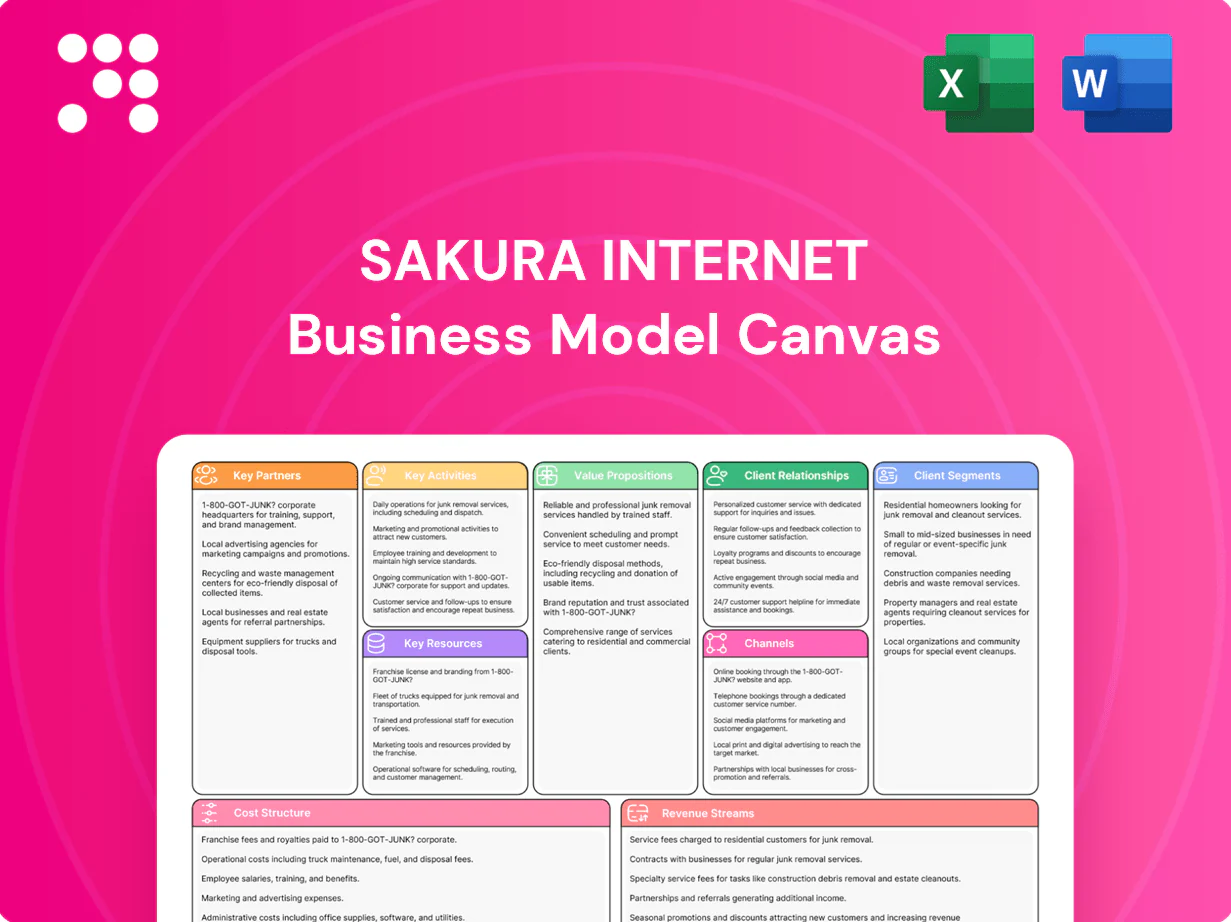
SAKURA Internet Business Model Canvas

Explore a cloud hosting Business Model Canvas: scalable value and recurring revenue insights
Explore SAKURA Internet’s Business Model Canvas to see how its cloud infrastructure, hosting services, and platform diversification create scalable value and recurring revenue. This concise, actionable snapshot highlights customer segments, key partnerships, and monetization levers—perfect for investors and strategists. Download the full, editable canvas to apply these insights to your own planning and due diligence.
Partnerships

Telecom Carriers & ISPs
Peering and carrier partnerships ensure low-latency connectivity across Japan, leveraging a market of about 125.5 million people and ~92% internet penetration in 2024. They provide redundant routes, higher bandwidth and better last-mile reach to strengthen SLAs. Joint planning with carriers improves network resilience and uptime. Co-marketing with ISPs accelerates enterprise adoption and cloud migration.
Hardware & Infrastructure Vendors
Partners supply servers, networking gear, storage and power systems; preferred-vendor status secures pricing, supply priority and lifecycle support, shortening procurement lead times and protecting CAPEX; hardware lifecycles are typically 3–5 years, joint testing with vendors optimizes performance and can materially improve PUE and total cost of ownership, while roadmap alignment reduces obsolescence risk.

Energy Providers & Renewable Programs
Long-term power purchase agreements lock in rates to stabilize operating costs for SAKURA Internet’s data centers, reducing exposure to spot-price volatility that has driven global electricity costs up since 2020 when data centers consumed ~200 TWh (about 1% of global use). Renewable energy initiatives and PPAs support ESG targets and client mandates, while participation in demand-response programs (which can cut peak load by double-digit percentages in some events) enhances resilience during grid stress and transparency builds trust with sustainability-focused customers.

Software, Security, and Platform Providers
Alliances with hypervisor, orchestration, backup and security vendors supply SAKURA with turnkey tooling that accelerates cloud feature breadth and resilience. Integrated stacks cut provisioning complexity and speed deployments, while 2024-standard certifications ISO/IEC 27001 and SOC 2 ensure compatibility and vendor support. Bundled solutions boost customer value and stickiness via simplified procurement and SLAs.
- Tooling: hypervisor, orchestration, backup, security
- Certs: ISO/IEC 27001, SOC 2 (2024)
- Benefit: faster deployment, simplified ops, higher retention
Resellers, MSPs, and Systems Integrators
Channel partners extend SAKURA Internet reach into Japan’s ~3.8 million SMEs (2024), plus industry verticals. They deliver migrations, custom integrations and managed services, improving adoption and time-to-value. Revenue-sharing models align incentives, boosting long-term retention. Local partner expertise raises customer satisfaction and outcomes.
- Channel reach: SMEs & verticals
- Services: migration, customization, managed
- Model: revenue sharing for retention
- Benefit: local expertise → better outcomes
Peering, vendors and PPAs enable low-latency, resilient cloud across Japan for 3.8M SMEs
Peering/carrier alliances deliver low-latency reach across Japan (125.5M pop, ~92% internet penetration in 2024), boosting SLAs and redundancy. Vendor partnerships secure 3–5yr hardware lifecycles, priority supply and lower TCO. PPAs and renewables stabilize power costs; demand-response cuts peak load. Channel and ISV partners drive SME (≈3.8M) migrations and bundled SaaS stickiness.
| Partner | Metric (2024) | Impact |
|---|---|---|
| Carriers | 92% pen., 125.5M | Lower latency, uptime |
| Vendors | 3–5 yr lifecycle | Lower CAPEX/TCO |
| Power | PPAs, grid DR | Cost stability |
| Channels | ≈3.8M SMEs | Faster adoption |
What is included in the product
 Detailed Word Document
A comprehensive Business Model Canvas for SAKURA Internet outlining customer segments, channels, value propositions, key activities, resources, partners, cost structure and revenue streams across the 9 BMC blocks, reflecting real-world operations, competitive advantages and linked SWOT insights—ideal for presentations, investor discussions, and strategic validation.

 Customizable Excel Spreadsheet
High-level view of SAKURA Internet’s business model with editable cells, condensing infrastructure, hosting and cloud services strategy into a shareable one-page snapshot that saves hours on formatting and speeds team decision-making.
Activities

Data Center Operations & Maintenance
Operate facilities to meet industry-standard 99.99% uptime SLAs with strict cooling and power management, plus preventive maintenance and capacity planning to avoid bottlenecks. Implement 24/7 monitoring and rapid incident response teams to minimize downtime. Focus on continuous PUE improvement — global average PUE around 1.6 in 2024 — and efficiency gains to cut OPEX and carbon intensity.
Network Management & Peering
Engineer backbone, transit and IX peering to minimize latency and maximize throughput, monitoring traffic and enforcing QoS while mitigating DDoS with multi-layer defenses; Sakura expanded PoPs to double-digit locations in Japan by 2024 to improve regional reach. Optimize BGP routing and redundancy for 99.99% availability targets and scale backbone capacity in line with rising traffic volumes.

Cloud & Hosting Service Development
Design and enhance IaaS, VPS, bare metal, and storage offerings to meet Japan's growing cloud demand, aligning with a 2024 global IaaS market of roughly USD 135 billion. Build APIs, automation, and self-service portals to cut provisioning times and support projected enterprise cloud adoption increases in 2024. Improve performance, security, and scalability while launching new SKUs driven by customer feedback and usage analytics.

Security, Compliance & Risk Management
SAKURA maintains ISMS (ISO/IEC 27001) and JIPDEC PrivacyMark certifications, enforces role-based access controls and data encryption, runs quarterly patch cycles plus continuous vulnerability scanning, and operates incident handling aligned with Japan regulatory requirements.
Customer Support, Sales & Onboarding
Provide multilingual technical support and SLA management across SAKURA Internet’s Japan data centers; company founded 1996 and listed on TSE. Assist customers with migration, architecture design and cost optimization while running account management and solution consulting to drive adoption. Collect structured feedback to guide the product roadmap and reduce churn.
- Multilingual support (JP/EN)
- SLA & uptime focus
- Migration & cost optimization
- Account mgmt & solutions
- Feedback → roadmap
Japan cloud: 99.99% SLA, 1.6 PUE, multi-PoP scale
Operate Japan data centers to 99.99% SLA with strict cooling, preventive maintenance and global PUE ~1.6 (2024) to cut OPEX and emissions.
Run 24/7 NOC, multi-layer DDoS defenses, BGP redundancy and double-digit PoPs in Japan (2024) to minimize latency and scale backbone capacity.
Develop IaaS, VPS, bare metal, storage, APIs and self-service portals to capture part of the 2024 IaaS market ~USD 135B.
Maintain ISO/IEC 27001 and PrivacyMark, RBAC, encryption, continuous scanning and quarterly patches.
| Metric | 2024 |
|---|---|
| Uptime SLA | 99.99% |
| PUE (avg) | 1.6 |
| PoPs (JP) | >10 |
| IaaS market | USD 135B |
| Founded / Listed | 1996 / TSE |
Full Version Awaits
Business Model Canvas
The document previewed here is the actual SAKURA Internet Business Model Canvas—not a mockup—and reflects the exact structure and content you’ll receive after purchase. Upon checkout you’ll download this same professional, editable file ready for presentation, analysis, and customization. No placeholders, no surprises—what you see is what you’ll own.

Explore a cloud hosting Business Model Canvas: scalable value and recurring revenue insights
Explore SAKURA Internet’s Business Model Canvas to see how its cloud infrastructure, hosting services, and platform diversification create scalable value and recurring revenue. This concise, actionable snapshot highlights customer segments, key partnerships, and monetization levers—perfect for investors and strategists. Download the full, editable canvas to apply these insights to your own planning and due diligence.
Partnerships
Telecom Carriers & ISPs
Peering and carrier partnerships ensure low-latency connectivity across Japan, leveraging a market of about 125.5 million people and ~92% internet penetration in 2024. They provide redundant routes, higher bandwidth and better last-mile reach to strengthen SLAs. Joint planning with carriers improves network resilience and uptime. Co-marketing with ISPs accelerates enterprise adoption and cloud migration.
Hardware & Infrastructure Vendors
Partners supply servers, networking gear, storage and power systems; preferred-vendor status secures pricing, supply priority and lifecycle support, shortening procurement lead times and protecting CAPEX; hardware lifecycles are typically 3–5 years, joint testing with vendors optimizes performance and can materially improve PUE and total cost of ownership, while roadmap alignment reduces obsolescence risk.
Energy Providers & Renewable Programs
Long-term power purchase agreements lock in rates to stabilize operating costs for SAKURA Internet’s data centers, reducing exposure to spot-price volatility that has driven global electricity costs up since 2020 when data centers consumed ~200 TWh (about 1% of global use). Renewable energy initiatives and PPAs support ESG targets and client mandates, while participation in demand-response programs (which can cut peak load by double-digit percentages in some events) enhances resilience during grid stress and transparency builds trust with sustainability-focused customers.
Software, Security, and Platform Providers
Alliances with hypervisor, orchestration, backup and security vendors supply SAKURA with turnkey tooling that accelerates cloud feature breadth and resilience. Integrated stacks cut provisioning complexity and speed deployments, while 2024-standard certifications ISO/IEC 27001 and SOC 2 ensure compatibility and vendor support. Bundled solutions boost customer value and stickiness via simplified procurement and SLAs.
- Tooling: hypervisor, orchestration, backup, security
- Certs: ISO/IEC 27001, SOC 2 (2024)
- Benefit: faster deployment, simplified ops, higher retention
Resellers, MSPs, and Systems Integrators
Channel partners extend SAKURA Internet reach into Japan’s ~3.8 million SMEs (2024), plus industry verticals. They deliver migrations, custom integrations and managed services, improving adoption and time-to-value. Revenue-sharing models align incentives, boosting long-term retention. Local partner expertise raises customer satisfaction and outcomes.
- Channel reach: SMEs & verticals
- Services: migration, customization, managed
- Model: revenue sharing for retention
- Benefit: local expertise → better outcomes
Peering, vendors and PPAs enable low-latency, resilient cloud across Japan for 3.8M SMEs
Peering/carrier alliances deliver low-latency reach across Japan (125.5M pop, ~92% internet penetration in 2024), boosting SLAs and redundancy. Vendor partnerships secure 3–5yr hardware lifecycles, priority supply and lower TCO. PPAs and renewables stabilize power costs; demand-response cuts peak load. Channel and ISV partners drive SME (≈3.8M) migrations and bundled SaaS stickiness.
| Partner | Metric (2024) | Impact |
|---|---|---|
| Carriers | 92% pen., 125.5M | Lower latency, uptime |
| Vendors | 3–5 yr lifecycle | Lower CAPEX/TCO |
| Power | PPAs, grid DR | Cost stability |
| Channels | ≈3.8M SMEs | Faster adoption |
What is included in the product
Detailed Word Document
A comprehensive Business Model Canvas for SAKURA Internet outlining customer segments, channels, value propositions, key activities, resources, partners, cost structure and revenue streams across the 9 BMC blocks, reflecting real-world operations, competitive advantages and linked SWOT insights—ideal for presentations, investor discussions, and strategic validation.
Customizable Excel Spreadsheet
High-level view of SAKURA Internet’s business model with editable cells, condensing infrastructure, hosting and cloud services strategy into a shareable one-page snapshot that saves hours on formatting and speeds team decision-making.
Activities
Data Center Operations & Maintenance
Operate facilities to meet industry-standard 99.99% uptime SLAs with strict cooling and power management, plus preventive maintenance and capacity planning to avoid bottlenecks. Implement 24/7 monitoring and rapid incident response teams to minimize downtime. Focus on continuous PUE improvement — global average PUE around 1.6 in 2024 — and efficiency gains to cut OPEX and carbon intensity.
Network Management & Peering
Engineer backbone, transit and IX peering to minimize latency and maximize throughput, monitoring traffic and enforcing QoS while mitigating DDoS with multi-layer defenses; Sakura expanded PoPs to double-digit locations in Japan by 2024 to improve regional reach. Optimize BGP routing and redundancy for 99.99% availability targets and scale backbone capacity in line with rising traffic volumes.
Cloud & Hosting Service Development
Design and enhance IaaS, VPS, bare metal, and storage offerings to meet Japan's growing cloud demand, aligning with a 2024 global IaaS market of roughly USD 135 billion. Build APIs, automation, and self-service portals to cut provisioning times and support projected enterprise cloud adoption increases in 2024. Improve performance, security, and scalability while launching new SKUs driven by customer feedback and usage analytics.
Security, Compliance & Risk Management
SAKURA maintains ISMS (ISO/IEC 27001) and JIPDEC PrivacyMark certifications, enforces role-based access controls and data encryption, runs quarterly patch cycles plus continuous vulnerability scanning, and operates incident handling aligned with Japan regulatory requirements.
Customer Support, Sales & Onboarding
Provide multilingual technical support and SLA management across SAKURA Internet’s Japan data centers; company founded 1996 and listed on TSE. Assist customers with migration, architecture design and cost optimization while running account management and solution consulting to drive adoption. Collect structured feedback to guide the product roadmap and reduce churn.
- Multilingual support (JP/EN)
- SLA & uptime focus
- Migration & cost optimization
- Account mgmt & solutions
- Feedback → roadmap
Japan cloud: 99.99% SLA, 1.6 PUE, multi-PoP scale
Operate Japan data centers to 99.99% SLA with strict cooling, preventive maintenance and global PUE ~1.6 (2024) to cut OPEX and emissions.
Run 24/7 NOC, multi-layer DDoS defenses, BGP redundancy and double-digit PoPs in Japan (2024) to minimize latency and scale backbone capacity.
Develop IaaS, VPS, bare metal, storage, APIs and self-service portals to capture part of the 2024 IaaS market ~USD 135B.
Maintain ISO/IEC 27001 and PrivacyMark, RBAC, encryption, continuous scanning and quarterly patches.
| Metric | 2024 |
|---|---|
| Uptime SLA | 99.99% |
| PUE (avg) | 1.6 |
| PoPs (JP) | >10 |
| IaaS market | USD 135B |
| Founded / Listed | 1996 / TSE |
Full Version Awaits
Business Model Canvas
The document previewed here is the actual SAKURA Internet Business Model Canvas—not a mockup—and reflects the exact structure and content you’ll receive after purchase. Upon checkout you’ll download this same professional, editable file ready for presentation, analysis, and customization. No placeholders, no surprises—what you see is what you’ll own.
Description
Explore a cloud hosting Business Model Canvas: scalable value and recurring revenue insights
Explore SAKURA Internet’s Business Model Canvas to see how its cloud infrastructure, hosting services, and platform diversification create scalable value and recurring revenue. This concise, actionable snapshot highlights customer segments, key partnerships, and monetization levers—perfect for investors and strategists. Download the full, editable canvas to apply these insights to your own planning and due diligence.
Partnerships
Telecom Carriers & ISPs
Peering and carrier partnerships ensure low-latency connectivity across Japan, leveraging a market of about 125.5 million people and ~92% internet penetration in 2024. They provide redundant routes, higher bandwidth and better last-mile reach to strengthen SLAs. Joint planning with carriers improves network resilience and uptime. Co-marketing with ISPs accelerates enterprise adoption and cloud migration.
Hardware & Infrastructure Vendors
Partners supply servers, networking gear, storage and power systems; preferred-vendor status secures pricing, supply priority and lifecycle support, shortening procurement lead times and protecting CAPEX; hardware lifecycles are typically 3–5 years, joint testing with vendors optimizes performance and can materially improve PUE and total cost of ownership, while roadmap alignment reduces obsolescence risk.
Energy Providers & Renewable Programs
Long-term power purchase agreements lock in rates to stabilize operating costs for SAKURA Internet’s data centers, reducing exposure to spot-price volatility that has driven global electricity costs up since 2020 when data centers consumed ~200 TWh (about 1% of global use). Renewable energy initiatives and PPAs support ESG targets and client mandates, while participation in demand-response programs (which can cut peak load by double-digit percentages in some events) enhances resilience during grid stress and transparency builds trust with sustainability-focused customers.
Software, Security, and Platform Providers
Alliances with hypervisor, orchestration, backup and security vendors supply SAKURA with turnkey tooling that accelerates cloud feature breadth and resilience. Integrated stacks cut provisioning complexity and speed deployments, while 2024-standard certifications ISO/IEC 27001 and SOC 2 ensure compatibility and vendor support. Bundled solutions boost customer value and stickiness via simplified procurement and SLAs.
- Tooling: hypervisor, orchestration, backup, security
- Certs: ISO/IEC 27001, SOC 2 (2024)
- Benefit: faster deployment, simplified ops, higher retention
Resellers, MSPs, and Systems Integrators
Channel partners extend SAKURA Internet reach into Japan’s ~3.8 million SMEs (2024), plus industry verticals. They deliver migrations, custom integrations and managed services, improving adoption and time-to-value. Revenue-sharing models align incentives, boosting long-term retention. Local partner expertise raises customer satisfaction and outcomes.
- Channel reach: SMEs & verticals
- Services: migration, customization, managed
- Model: revenue sharing for retention
- Benefit: local expertise → better outcomes
Peering, vendors and PPAs enable low-latency, resilient cloud across Japan for 3.8M SMEs
Peering/carrier alliances deliver low-latency reach across Japan (125.5M pop, ~92% internet penetration in 2024), boosting SLAs and redundancy. Vendor partnerships secure 3–5yr hardware lifecycles, priority supply and lower TCO. PPAs and renewables stabilize power costs; demand-response cuts peak load. Channel and ISV partners drive SME (≈3.8M) migrations and bundled SaaS stickiness.
| Partner | Metric (2024) | Impact |
|---|---|---|
| Carriers | 92% pen., 125.5M | Lower latency, uptime |
| Vendors | 3–5 yr lifecycle | Lower CAPEX/TCO |
| Power | PPAs, grid DR | Cost stability |
| Channels | ≈3.8M SMEs | Faster adoption |
What is included in the product
Detailed Word Document
A comprehensive Business Model Canvas for SAKURA Internet outlining customer segments, channels, value propositions, key activities, resources, partners, cost structure and revenue streams across the 9 BMC blocks, reflecting real-world operations, competitive advantages and linked SWOT insights—ideal for presentations, investor discussions, and strategic validation.
Customizable Excel Spreadsheet
High-level view of SAKURA Internet’s business model with editable cells, condensing infrastructure, hosting and cloud services strategy into a shareable one-page snapshot that saves hours on formatting and speeds team decision-making.
Activities
Data Center Operations & Maintenance
Operate facilities to meet industry-standard 99.99% uptime SLAs with strict cooling and power management, plus preventive maintenance and capacity planning to avoid bottlenecks. Implement 24/7 monitoring and rapid incident response teams to minimize downtime. Focus on continuous PUE improvement — global average PUE around 1.6 in 2024 — and efficiency gains to cut OPEX and carbon intensity.
Network Management & Peering
Engineer backbone, transit and IX peering to minimize latency and maximize throughput, monitoring traffic and enforcing QoS while mitigating DDoS with multi-layer defenses; Sakura expanded PoPs to double-digit locations in Japan by 2024 to improve regional reach. Optimize BGP routing and redundancy for 99.99% availability targets and scale backbone capacity in line with rising traffic volumes.
Cloud & Hosting Service Development
Design and enhance IaaS, VPS, bare metal, and storage offerings to meet Japan's growing cloud demand, aligning with a 2024 global IaaS market of roughly USD 135 billion. Build APIs, automation, and self-service portals to cut provisioning times and support projected enterprise cloud adoption increases in 2024. Improve performance, security, and scalability while launching new SKUs driven by customer feedback and usage analytics.
Security, Compliance & Risk Management
SAKURA maintains ISMS (ISO/IEC 27001) and JIPDEC PrivacyMark certifications, enforces role-based access controls and data encryption, runs quarterly patch cycles plus continuous vulnerability scanning, and operates incident handling aligned with Japan regulatory requirements.
Customer Support, Sales & Onboarding
Provide multilingual technical support and SLA management across SAKURA Internet’s Japan data centers; company founded 1996 and listed on TSE. Assist customers with migration, architecture design and cost optimization while running account management and solution consulting to drive adoption. Collect structured feedback to guide the product roadmap and reduce churn.
- Multilingual support (JP/EN)
- SLA & uptime focus
- Migration & cost optimization
- Account mgmt & solutions
- Feedback → roadmap
Japan cloud: 99.99% SLA, 1.6 PUE, multi-PoP scale
Operate Japan data centers to 99.99% SLA with strict cooling, preventive maintenance and global PUE ~1.6 (2024) to cut OPEX and emissions.
Run 24/7 NOC, multi-layer DDoS defenses, BGP redundancy and double-digit PoPs in Japan (2024) to minimize latency and scale backbone capacity.
Develop IaaS, VPS, bare metal, storage, APIs and self-service portals to capture part of the 2024 IaaS market ~USD 135B.
Maintain ISO/IEC 27001 and PrivacyMark, RBAC, encryption, continuous scanning and quarterly patches.
| Metric | 2024 |
|---|---|
| Uptime SLA | 99.99% |
| PUE (avg) | 1.6 |
| PoPs (JP) | >10 |
| IaaS market | USD 135B |
| Founded / Listed | 1996 / TSE |
Full Version Awaits
Business Model Canvas
The document previewed here is the actual SAKURA Internet Business Model Canvas—not a mockup—and reflects the exact structure and content you’ll receive after purchase. Upon checkout you’ll download this same professional, editable file ready for presentation, analysis, and customization. No placeholders, no surprises—what you see is what you’ll own.











