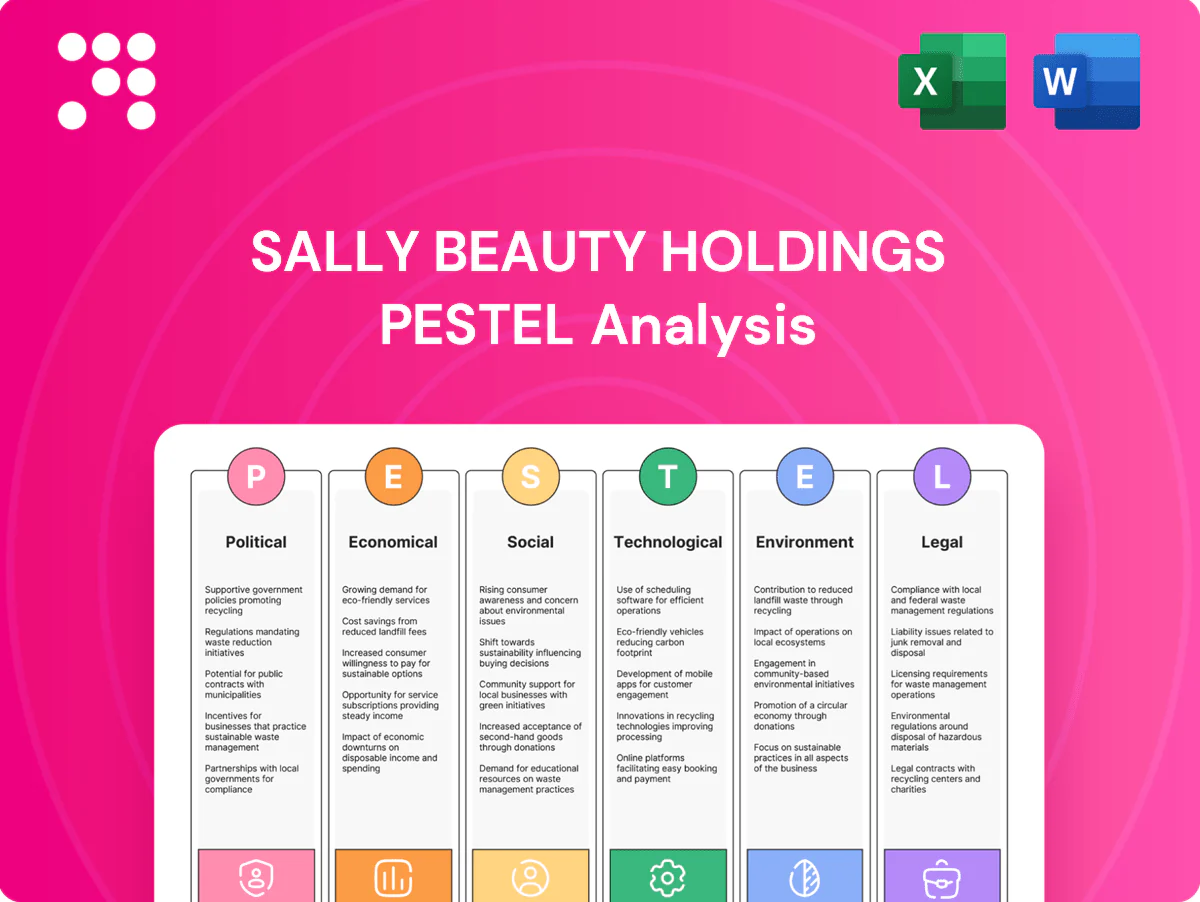
Sally Beauty Holdings PESTLE Analysis

Make Smarter Strategic Decisions with a Complete PESTEL View
Unlock strategic advantage with our PESTLE analysis of Sally Beauty Holdings—concise evaluation of political, economic, social, technological, legal and environmental forces shaping the company’s growth. Ready-made, actionable and fully editable for investors and planners. Purchase the full report for deep-dive insights and downloadable files.
Political factors

Trade policies and tariffs on cosmetics
As a global distributor with FY2024 net sales of about $3.3 billion, Sally Beauty is exposed to import tariffs—US Section 301 duties on many Chinese goods remain up to 25%, raising landed costs and pressuring margins. Shifts in US-China and EU relations can rapidly alter pricing, while preferential agreements like USMCA lower North American tariff burdens. Sanctions (eg Russia 2022–24) disrupted some chemical sourcing, so proactive supplier diversification reduces single-country political risk.
Labor and minimum wage policy shifts
Changes in federal, state, and local wage mandates directly raise store and distribution labor costs—federal minimum remains $7.25/hr while over 20 states and many cities have moved toward $15+/hr targets by 2025, tightening retailer payroll. Political momentum for living-wage laws can compress already-thin retail margins and increase hourly spend. Variability across markets complicates staffing and scheduling, and proactive advocacy plus flexible workforce planning help mitigate volatility.

Government support for small businesses and cosmetology
Grants and tax incentives for small salons boost BSG/CosmoProf demand by lowering startup costs for a professional base that exceeds 600,000 licensed cosmetology professionals in the US, supporting Sally Beauty Holdings’ pro-channel that helps drive company net sales near $3.0B in FY2024.
Policy-funded vocational programs expanding enrollment increase recurring professional purchases, while state budget cuts or licensing rollbacks can compress average ticket sizes and product mix; monitoring state initiatives enables targeted, localized sales strategies.

Public health policy and pandemic readiness
Public health mandates on in-person services can cut salon traffic and wholesale orders, with past lockdowns causing salon bookings to fall by as much as 70% in peak periods.
Health policy dictates in-store operations and PPE sourcing; having a ~3,700-store network raises supply and compliance scale challenges.
Vaccination and reopening policies drive footfall recovery; scenario planning for inventory and cash flow helps buffer against sudden policy swings.
- impact: salon bookings down up to 70%
- scale: ~3,700 stores
- mitigation: inventory & cash-flow scenario planning
Political stability in sourcing and logistics corridors
Instability in key ports and manufacturing hubs threatens Sally Beauty's supply continuity; Red Sea attacks in 2023–24 forced rerouting adding up to 10 days and prompted war-risk premiums rising as much as 30%. Elections and policy transitions in major sourcing countries often slow customs clearance and extend lead times. Geopolitical tensions raise freight insurance and rerouting costs, so building regional redundancies enhances resilience.
- Supply delays: +10 days from rerouting
- Insurance spike: up to +30% in high-risk corridors
- Mitigation: regional redundancies to lower disruption risk
Tariffs, wage hikes and supply shocks squeeze margins; regional sourcing vital
Tariffs (US Section 301 up to 25%) and US-China/EU tensions raise landed costs vs FY2024 net sales $3.3B; wage hikes (federal $7.25, 20+ states ~15+/hr by 2025) pressure labor margins. Public-health rules cut salon bookings up to 70% and PPE/compliance scale across ~3,700 stores; supply shocks added ~+10 day lead times and insurance spikes up to +30%, so regional sourcing and scenario planning are critical.
| Factor | Metric | Impact | Mitigation |
|---|---|---|---|
| Tariffs | Up to 25% | Margin pressure | Diversify sourcing |
| Wages | $7.25 federal; 20+ states $15+ | Higher payroll | Flexible staffing |
What is included in the product
 Detailed Word Document
Explores how external macro-environmental factors uniquely affect Sally Beauty Holdings across six dimensions: Political, Economic, Social, Technological, Environmental, and Legal. Backed by current data and forward-looking insights, it helps executives, investors and advisors identify risks, opportunities and strategic actions tailored to the beauty retail and professional-supplies market.

 Customizable Excel Spreadsheet
A concise, visually segmented PESTLE summary of Sally Beauty that clarifies external risks and opportunities for quick reference during meetings or presentations. Editable and shareable for alignment across teams and client reports.
Economic factors

Consumer spending and discretionary income
Beauty is partly discretionary so Sally Beauty sales track real-wage and employment trends; US unemployment remained near historical lows in 2024–mid‑2025 (around 3.5–4.0%), supporting steady consumer spending. Downturns drive trade‑down and DIY cycles that benefit Sally Beauty retail while pressuring premium pro lines. In expansions salon services and higher‑margin pro brands typically rebound, so Sally uses dynamic pricing and promotional cadence to align with these cycles.
Inflation and input cost pressures
Rising raw material, packaging and freight costs have pressured Sally Beauty’s COGS amid U.S. inflation running about 3.4% in 2024, squeezing gross margins in retail and distribution channels.
Passing through price increases risks demand elasticity and SKU mix shifts as consumers trade down or reduce salon visits, pressuring comparable sales.
Higher private-label penetration supports value perception and typically delivers higher margins, helping offset cost inflation.
Hedging freight and currency exposure combined with multi-sourcing strategies reduce input-price volatility and supply-chain risk.

Currency fluctuations
Currency fluctuations materially affect Sally Beauty by changing reported revenue from international operations and cross-border buying costs; roughly 25% of sales are international, so a strong dollar can both cheapen imports and reduce translated revenue. The company uses hedging policies and local sourcing to limit exposure, while pricing localization helps stabilize margins across markets.

E-commerce growth and channel mix
Online penetration (U.S. e-commerce ~16.4% of retail sales in 2023 per U.S. Census Bureau) reshapes store productivity and raises fulfillment costs as Sally Beauty balances inventory and labor across channels. Optimized click-and-collect and ship-from-store can convert fixed-store assets into lower-cost fulfillment hubs. DTC, marketplaces and pro wholesale have distinct margin structures, requiring differentiated pricing and promotion. Investment prioritization should follow customer lifetime value and basket analytics.
- Online penetration: 16.4% (U.S. 2023, Census)
- Fulfillment: click-and-collect and ship-from-store leverage stores
- Margins: DTC ≠ marketplaces ≠ pro wholesale
- Investment: prioritize LTV and basket data
Credit conditions for salons and consumers
Tighter credit and Fed funds near 5.25–5.50% (2024–25) raise borrowing costs, limiting salon capex on equipment and inventory as commercial loan spreads rose ~200–300 bps since 2021. BNPL and supplier trade-credit expansion (global BNPL >100B in 2023) shape order sizes, while consumer financing drives sales of big-ticket devices; strict credit risk controls protect working capital and DSO.
- Higher rates limit salon capex
- BNPL/trade credit alter order size
- Consumer finance boosts big-ticket sales
- Credit risk management preserves working capital
Tariffs, wage hikes and supply shocks squeeze margins; regional sourcing vital
Consumer spending supported by US unemployment ~3.5–4.0% (2024–mid‑2025) but inflation ~3.4% and Fed funds 5.25–5.50% squeeze margins and salon capex; e‑commerce penetration (US 16.4% 2023) raises fulfillment costs; ~25% international sales make FX and hedging material; private‑label and BNPL help offset cost pressures.
| Metric | Value |
|---|---|
| Unemployment | 3.5–4.0% |
| Inflation (2024) | 3.4% |
| Fed funds | 5.25–5.50% |
| E‑commerce (US) | 16.4% |
| Intl sales | ~25% |
What You See Is What You Get
Sally Beauty Holdings PESTLE Analysis
The preview shown here is the exact Sally Beauty Holdings PESTLE Analysis you’ll receive after purchase—fully formatted, professionally structured, and ready to use. The content, layout, and conclusions are identical to the downloadable file. No placeholders or surprises—this is the final document you’ll own upon checkout.

Make Smarter Strategic Decisions with a Complete PESTEL View
Unlock strategic advantage with our PESTLE analysis of Sally Beauty Holdings—concise evaluation of political, economic, social, technological, legal and environmental forces shaping the company’s growth. Ready-made, actionable and fully editable for investors and planners. Purchase the full report for deep-dive insights and downloadable files.
Political factors
Trade policies and tariffs on cosmetics
As a global distributor with FY2024 net sales of about $3.3 billion, Sally Beauty is exposed to import tariffs—US Section 301 duties on many Chinese goods remain up to 25%, raising landed costs and pressuring margins. Shifts in US-China and EU relations can rapidly alter pricing, while preferential agreements like USMCA lower North American tariff burdens. Sanctions (eg Russia 2022–24) disrupted some chemical sourcing, so proactive supplier diversification reduces single-country political risk.
Labor and minimum wage policy shifts
Changes in federal, state, and local wage mandates directly raise store and distribution labor costs—federal minimum remains $7.25/hr while over 20 states and many cities have moved toward $15+/hr targets by 2025, tightening retailer payroll. Political momentum for living-wage laws can compress already-thin retail margins and increase hourly spend. Variability across markets complicates staffing and scheduling, and proactive advocacy plus flexible workforce planning help mitigate volatility.
Government support for small businesses and cosmetology
Grants and tax incentives for small salons boost BSG/CosmoProf demand by lowering startup costs for a professional base that exceeds 600,000 licensed cosmetology professionals in the US, supporting Sally Beauty Holdings’ pro-channel that helps drive company net sales near $3.0B in FY2024.
Policy-funded vocational programs expanding enrollment increase recurring professional purchases, while state budget cuts or licensing rollbacks can compress average ticket sizes and product mix; monitoring state initiatives enables targeted, localized sales strategies.
Public health policy and pandemic readiness
Public health mandates on in-person services can cut salon traffic and wholesale orders, with past lockdowns causing salon bookings to fall by as much as 70% in peak periods.
Health policy dictates in-store operations and PPE sourcing; having a ~3,700-store network raises supply and compliance scale challenges.
Vaccination and reopening policies drive footfall recovery; scenario planning for inventory and cash flow helps buffer against sudden policy swings.
- impact: salon bookings down up to 70%
- scale: ~3,700 stores
- mitigation: inventory & cash-flow scenario planning
Political stability in sourcing and logistics corridors
Instability in key ports and manufacturing hubs threatens Sally Beauty's supply continuity; Red Sea attacks in 2023–24 forced rerouting adding up to 10 days and prompted war-risk premiums rising as much as 30%. Elections and policy transitions in major sourcing countries often slow customs clearance and extend lead times. Geopolitical tensions raise freight insurance and rerouting costs, so building regional redundancies enhances resilience.
- Supply delays: +10 days from rerouting
- Insurance spike: up to +30% in high-risk corridors
- Mitigation: regional redundancies to lower disruption risk
Tariffs, wage hikes and supply shocks squeeze margins; regional sourcing vital
Tariffs (US Section 301 up to 25%) and US-China/EU tensions raise landed costs vs FY2024 net sales $3.3B; wage hikes (federal $7.25, 20+ states ~15+/hr by 2025) pressure labor margins. Public-health rules cut salon bookings up to 70% and PPE/compliance scale across ~3,700 stores; supply shocks added ~+10 day lead times and insurance spikes up to +30%, so regional sourcing and scenario planning are critical.
| Factor | Metric | Impact | Mitigation |
|---|---|---|---|
| Tariffs | Up to 25% | Margin pressure | Diversify sourcing |
| Wages | $7.25 federal; 20+ states $15+ | Higher payroll | Flexible staffing |
What is included in the product
Detailed Word Document
Explores how external macro-environmental factors uniquely affect Sally Beauty Holdings across six dimensions: Political, Economic, Social, Technological, Environmental, and Legal. Backed by current data and forward-looking insights, it helps executives, investors and advisors identify risks, opportunities and strategic actions tailored to the beauty retail and professional-supplies market.
Customizable Excel Spreadsheet
A concise, visually segmented PESTLE summary of Sally Beauty that clarifies external risks and opportunities for quick reference during meetings or presentations. Editable and shareable for alignment across teams and client reports.
Economic factors
Consumer spending and discretionary income
Beauty is partly discretionary so Sally Beauty sales track real-wage and employment trends; US unemployment remained near historical lows in 2024–mid‑2025 (around 3.5–4.0%), supporting steady consumer spending. Downturns drive trade‑down and DIY cycles that benefit Sally Beauty retail while pressuring premium pro lines. In expansions salon services and higher‑margin pro brands typically rebound, so Sally uses dynamic pricing and promotional cadence to align with these cycles.
Inflation and input cost pressures
Rising raw material, packaging and freight costs have pressured Sally Beauty’s COGS amid U.S. inflation running about 3.4% in 2024, squeezing gross margins in retail and distribution channels.
Passing through price increases risks demand elasticity and SKU mix shifts as consumers trade down or reduce salon visits, pressuring comparable sales.
Higher private-label penetration supports value perception and typically delivers higher margins, helping offset cost inflation.
Hedging freight and currency exposure combined with multi-sourcing strategies reduce input-price volatility and supply-chain risk.
Currency fluctuations
Currency fluctuations materially affect Sally Beauty by changing reported revenue from international operations and cross-border buying costs; roughly 25% of sales are international, so a strong dollar can both cheapen imports and reduce translated revenue. The company uses hedging policies and local sourcing to limit exposure, while pricing localization helps stabilize margins across markets.
E-commerce growth and channel mix
Online penetration (U.S. e-commerce ~16.4% of retail sales in 2023 per U.S. Census Bureau) reshapes store productivity and raises fulfillment costs as Sally Beauty balances inventory and labor across channels. Optimized click-and-collect and ship-from-store can convert fixed-store assets into lower-cost fulfillment hubs. DTC, marketplaces and pro wholesale have distinct margin structures, requiring differentiated pricing and promotion. Investment prioritization should follow customer lifetime value and basket analytics.
- Online penetration: 16.4% (U.S. 2023, Census)
- Fulfillment: click-and-collect and ship-from-store leverage stores
- Margins: DTC ≠ marketplaces ≠ pro wholesale
- Investment: prioritize LTV and basket data
Credit conditions for salons and consumers
Tighter credit and Fed funds near 5.25–5.50% (2024–25) raise borrowing costs, limiting salon capex on equipment and inventory as commercial loan spreads rose ~200–300 bps since 2021. BNPL and supplier trade-credit expansion (global BNPL >100B in 2023) shape order sizes, while consumer financing drives sales of big-ticket devices; strict credit risk controls protect working capital and DSO.
- Higher rates limit salon capex
- BNPL/trade credit alter order size
- Consumer finance boosts big-ticket sales
- Credit risk management preserves working capital
Tariffs, wage hikes and supply shocks squeeze margins; regional sourcing vital
Consumer spending supported by US unemployment ~3.5–4.0% (2024–mid‑2025) but inflation ~3.4% and Fed funds 5.25–5.50% squeeze margins and salon capex; e‑commerce penetration (US 16.4% 2023) raises fulfillment costs; ~25% international sales make FX and hedging material; private‑label and BNPL help offset cost pressures.
| Metric | Value |
|---|---|
| Unemployment | 3.5–4.0% |
| Inflation (2024) | 3.4% |
| Fed funds | 5.25–5.50% |
| E‑commerce (US) | 16.4% |
| Intl sales | ~25% |
What You See Is What You Get
Sally Beauty Holdings PESTLE Analysis
The preview shown here is the exact Sally Beauty Holdings PESTLE Analysis you’ll receive after purchase—fully formatted, professionally structured, and ready to use. The content, layout, and conclusions are identical to the downloadable file. No placeholders or surprises—this is the final document you’ll own upon checkout.
Description
Make Smarter Strategic Decisions with a Complete PESTEL View
Unlock strategic advantage with our PESTLE analysis of Sally Beauty Holdings—concise evaluation of political, economic, social, technological, legal and environmental forces shaping the company’s growth. Ready-made, actionable and fully editable for investors and planners. Purchase the full report for deep-dive insights and downloadable files.
Political factors
Trade policies and tariffs on cosmetics
As a global distributor with FY2024 net sales of about $3.3 billion, Sally Beauty is exposed to import tariffs—US Section 301 duties on many Chinese goods remain up to 25%, raising landed costs and pressuring margins. Shifts in US-China and EU relations can rapidly alter pricing, while preferential agreements like USMCA lower North American tariff burdens. Sanctions (eg Russia 2022–24) disrupted some chemical sourcing, so proactive supplier diversification reduces single-country political risk.
Labor and minimum wage policy shifts
Changes in federal, state, and local wage mandates directly raise store and distribution labor costs—federal minimum remains $7.25/hr while over 20 states and many cities have moved toward $15+/hr targets by 2025, tightening retailer payroll. Political momentum for living-wage laws can compress already-thin retail margins and increase hourly spend. Variability across markets complicates staffing and scheduling, and proactive advocacy plus flexible workforce planning help mitigate volatility.
Government support for small businesses and cosmetology
Grants and tax incentives for small salons boost BSG/CosmoProf demand by lowering startup costs for a professional base that exceeds 600,000 licensed cosmetology professionals in the US, supporting Sally Beauty Holdings’ pro-channel that helps drive company net sales near $3.0B in FY2024.
Policy-funded vocational programs expanding enrollment increase recurring professional purchases, while state budget cuts or licensing rollbacks can compress average ticket sizes and product mix; monitoring state initiatives enables targeted, localized sales strategies.
Public health policy and pandemic readiness
Public health mandates on in-person services can cut salon traffic and wholesale orders, with past lockdowns causing salon bookings to fall by as much as 70% in peak periods.
Health policy dictates in-store operations and PPE sourcing; having a ~3,700-store network raises supply and compliance scale challenges.
Vaccination and reopening policies drive footfall recovery; scenario planning for inventory and cash flow helps buffer against sudden policy swings.
- impact: salon bookings down up to 70%
- scale: ~3,700 stores
- mitigation: inventory & cash-flow scenario planning
Political stability in sourcing and logistics corridors
Instability in key ports and manufacturing hubs threatens Sally Beauty's supply continuity; Red Sea attacks in 2023–24 forced rerouting adding up to 10 days and prompted war-risk premiums rising as much as 30%. Elections and policy transitions in major sourcing countries often slow customs clearance and extend lead times. Geopolitical tensions raise freight insurance and rerouting costs, so building regional redundancies enhances resilience.
- Supply delays: +10 days from rerouting
- Insurance spike: up to +30% in high-risk corridors
- Mitigation: regional redundancies to lower disruption risk
Tariffs, wage hikes and supply shocks squeeze margins; regional sourcing vital
Tariffs (US Section 301 up to 25%) and US-China/EU tensions raise landed costs vs FY2024 net sales $3.3B; wage hikes (federal $7.25, 20+ states ~15+/hr by 2025) pressure labor margins. Public-health rules cut salon bookings up to 70% and PPE/compliance scale across ~3,700 stores; supply shocks added ~+10 day lead times and insurance spikes up to +30%, so regional sourcing and scenario planning are critical.
| Factor | Metric | Impact | Mitigation |
|---|---|---|---|
| Tariffs | Up to 25% | Margin pressure | Diversify sourcing |
| Wages | $7.25 federal; 20+ states $15+ | Higher payroll | Flexible staffing |
What is included in the product
Detailed Word Document
Explores how external macro-environmental factors uniquely affect Sally Beauty Holdings across six dimensions: Political, Economic, Social, Technological, Environmental, and Legal. Backed by current data and forward-looking insights, it helps executives, investors and advisors identify risks, opportunities and strategic actions tailored to the beauty retail and professional-supplies market.
Customizable Excel Spreadsheet
A concise, visually segmented PESTLE summary of Sally Beauty that clarifies external risks and opportunities for quick reference during meetings or presentations. Editable and shareable for alignment across teams and client reports.
Economic factors
Consumer spending and discretionary income
Beauty is partly discretionary so Sally Beauty sales track real-wage and employment trends; US unemployment remained near historical lows in 2024–mid‑2025 (around 3.5–4.0%), supporting steady consumer spending. Downturns drive trade‑down and DIY cycles that benefit Sally Beauty retail while pressuring premium pro lines. In expansions salon services and higher‑margin pro brands typically rebound, so Sally uses dynamic pricing and promotional cadence to align with these cycles.
Inflation and input cost pressures
Rising raw material, packaging and freight costs have pressured Sally Beauty’s COGS amid U.S. inflation running about 3.4% in 2024, squeezing gross margins in retail and distribution channels.
Passing through price increases risks demand elasticity and SKU mix shifts as consumers trade down or reduce salon visits, pressuring comparable sales.
Higher private-label penetration supports value perception and typically delivers higher margins, helping offset cost inflation.
Hedging freight and currency exposure combined with multi-sourcing strategies reduce input-price volatility and supply-chain risk.
Currency fluctuations
Currency fluctuations materially affect Sally Beauty by changing reported revenue from international operations and cross-border buying costs; roughly 25% of sales are international, so a strong dollar can both cheapen imports and reduce translated revenue. The company uses hedging policies and local sourcing to limit exposure, while pricing localization helps stabilize margins across markets.
E-commerce growth and channel mix
Online penetration (U.S. e-commerce ~16.4% of retail sales in 2023 per U.S. Census Bureau) reshapes store productivity and raises fulfillment costs as Sally Beauty balances inventory and labor across channels. Optimized click-and-collect and ship-from-store can convert fixed-store assets into lower-cost fulfillment hubs. DTC, marketplaces and pro wholesale have distinct margin structures, requiring differentiated pricing and promotion. Investment prioritization should follow customer lifetime value and basket analytics.
- Online penetration: 16.4% (U.S. 2023, Census)
- Fulfillment: click-and-collect and ship-from-store leverage stores
- Margins: DTC ≠ marketplaces ≠ pro wholesale
- Investment: prioritize LTV and basket data
Credit conditions for salons and consumers
Tighter credit and Fed funds near 5.25–5.50% (2024–25) raise borrowing costs, limiting salon capex on equipment and inventory as commercial loan spreads rose ~200–300 bps since 2021. BNPL and supplier trade-credit expansion (global BNPL >100B in 2023) shape order sizes, while consumer financing drives sales of big-ticket devices; strict credit risk controls protect working capital and DSO.
- Higher rates limit salon capex
- BNPL/trade credit alter order size
- Consumer finance boosts big-ticket sales
- Credit risk management preserves working capital
Tariffs, wage hikes and supply shocks squeeze margins; regional sourcing vital
Consumer spending supported by US unemployment ~3.5–4.0% (2024–mid‑2025) but inflation ~3.4% and Fed funds 5.25–5.50% squeeze margins and salon capex; e‑commerce penetration (US 16.4% 2023) raises fulfillment costs; ~25% international sales make FX and hedging material; private‑label and BNPL help offset cost pressures.
| Metric | Value |
|---|---|
| Unemployment | 3.5–4.0% |
| Inflation (2024) | 3.4% |
| Fed funds | 5.25–5.50% |
| E‑commerce (US) | 16.4% |
| Intl sales | ~25% |
What You See Is What You Get
Sally Beauty Holdings PESTLE Analysis
The preview shown here is the exact Sally Beauty Holdings PESTLE Analysis you’ll receive after purchase—fully formatted, professionally structured, and ready to use. The content, layout, and conclusions are identical to the downloadable file. No placeholders or surprises—this is the final document you’ll own upon checkout.











