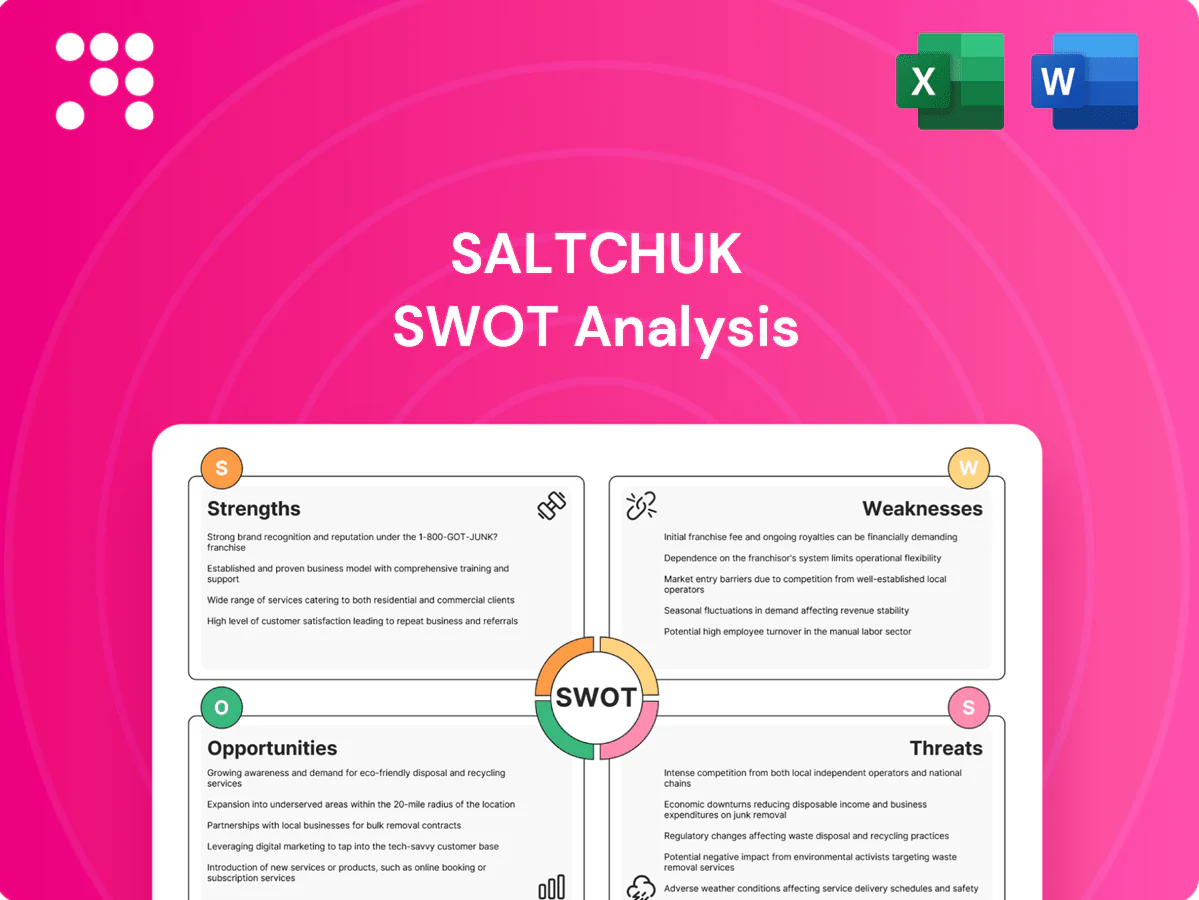
Saltchuk SWOT Analysis

Your Strategic Toolkit Starts Here
Saltchuk's diversified maritime and logistics platform shows resilient cash flows, strong regional reach, and operational depth, but faces regulatory, fuel-cost, and consolidation risks. Our full SWOT unpacks strategic levers, financial context, and competitor positioning. Purchase the complete, editable report to plan, pitch, or invest with confidence.
Strengths

Diverse Transportation & Energy Portfolio
Operating across maritime, aviation, fuel distribution and logistics spreads revenue risk and stabilizes cash flow for Saltchuk, which generates over $2 billion in annual revenue across its family of companies. Cross-modal capabilities enable bundled solutions and stickier customer relationships, increasing lifetime value. Diversification offsets cyclicality in any single segment and enhances bargaining power with suppliers and strategic partners.
Focus on Essential Services
Shipping, fuel and logistics are mission-critical and resilient: U.S. petroleum consumption averaged about 19 million barrels per day in 2023 (EIA), while global seaborne trade totaled 11.3 billion tonnes in 2023 (UNCTAD). Essential-service positioning drives steady demand from industrials, utilities and communities. That underpins long-term contracts and predictable asset utilization. It strengthens confidence in capital allocation and fleet investments.

Integrated North American Footprint
Saltchuk’s integrated North American footprint—spanning Alaska, Hawaii, the continental U.S., Canada and the Caribbean—enables true end-to-end flows within a single family of companies, simplifying handoffs and billing. Proximity to customers reduces transit times and routing complexity, while regional depth drives superior service reliability. Those contiguous networks create strong network effects and measurable operational synergies.

Long-Term, Private Ownership
Private, family ownership gives Saltchuk patient capital and multi-decade investment horizons, enabling disciplined strategy through volatile markets without quarterly earnings pressure. That stance accelerates fleet renewal and infrastructure upgrades while allowing long-term contracts and capital allocation aligned with operational resilience. It also fosters deeper, stable relationships with regulators and local communities.
- Patient capital: supports multi-decade projects
- Operational flexibility: no quarterly market pressure
- Capital deployment: faster fleet/infrastructure renewal
- Stakeholder trust: stronger regulator/community ties
Operational Safety & Compliance Culture
Complex maritime and energy operations demand rigorous safety and regulatory standards; seaborne trade reached 11.2 billion tonnes in 2023 (UNCTAD 2024), increasing operational exposure. A strong safety culture lowers incidents, costs and downtime while consistent compliance builds trust with customers and authorities. This track record supports eligibility for high-spec, long-term energy and maritime contracts.
- Lower incident rates → reduced Opex
- Consistent compliance → preferred vendor status
- Enables high-spec contract eligibility
Private-family maritime and fuel logistics: > $2B revenue, essential-service resilience
Saltchuk’s diversified maritime, aviation, fuel distribution and logistics portfolio generates over $2 billion revenue, stabilizing cash flow and enabling bundled, high-retention solutions. Essential-service exposure (US oil demand ~19 mb/d in 2023; global seaborne trade 11.3 bn tonnes in 2023) supports long-term contracts and high utilization. Private, family ownership supplies patient capital for fleet renewal and regional network expansion across Alaska, Hawaii, US, Canada and the Caribbean.
| Metric | 2023/2024 Value |
|---|---|
| Revenue (family of companies) | > $2.0 bn |
| US petroleum demand (2023) | ~19 mb/d (EIA) |
| Seaborne trade (2023) | 11.3 bn tonnes (UNCTAD) |
What is included in the product
 Detailed Word Document
Provides a concise strategic overview of Saltchuk’s internal capabilities and external market factors, outlining strengths, weaknesses, opportunities, and threats to its diversified maritime, logistics, and transportation businesses.

 Customizable Excel Spreadsheet
Provides a clear, editable SWOT matrix tailored to Saltchuk, enabling rapid alignment across divisions and quick updates to reflect shifting logistics, regulatory changes, and market priorities.
Weaknesses

Capital-Intensive Asset Base
Ships, aircraft, terminals and fuel infrastructure require heavy upfront and ongoing maintenance capex, driving a high capital intensity for Saltchuk.
High fixed costs increase operating leverage, magnifying margin pressure in demand downturns and seasonal slowdowns.
Long payback horizons are sensitive to utilization rates and limit flexibility compared with asset-light competitors that can scale faster.
Exposure to Fuel & Freight Cyclicality
Volumes and margins at Saltchuk fluctuate with industrial activity and trade flows, exposing earnings to cyclical downturns; Brent crude averaged about 83 USD/barrel in 2024 (EIA), driving fuel-cost swings. Fuel price volatility directly raises operating costs and can dampen customer demand, while lags in pass-through mechanisms compress margins. Hedging reduces spot exposure but cannot eliminate basis and timing risks, leaving residual margin volatility.

Complexity Across Multiple Businesses
Managing Saltchuk's portfolio of 30+ operating companies and roughly 6,000 employees across multiple jurisdictions raises regulatory, asset and labor-model complexity, increasing compliance costs and oversight burden. Integration frictions can dilute cross-company synergies and slow decision-making, while fragmented data and systems hinder enterprise-wide visibility. Governance must carefully balance local autonomy with centralized control to mitigate these risks.

Limited Public Market Signaling
As a privately held company (Saltchuk remained private in 2024), lower financial transparency can increase financing costs and extend diligence timelines for large projects. Benchmarking against public peers is harder without market valuations and regular disclosures. Talent attraction suffers without liquid equity incentives, complicating senior hires and retention.
- Reduced transparency — higher lender due diligence
- Financing friction — potential cost premium
- Benchmarking gap — no public comps
- Recruiting handicap — no liquid equity
Geographic Concentration in North America
Saltchuk's concentration in North America limits exposure to faster-growing Asia-Europe and emerging trade lanes, constraining revenue diversification. Regional shocks—seen during COVID-19 supply-chain disruptions and Alaska route interruptions—can disproportionately impact results; the company employs about 6,000 people and has reported annual revenues above 3 billion in recent years. Customer-base overlap within its regional networks raises concentration risk, and meaningful international diversification would require new regulatory, operational and partner competencies.
- Regional focus limits access to other trade-lane growth
- Past regional shocks caused outsized operational impact
- Overlapping customers increase concentration risk
- International expansion demands new competencies and investment
Capital-heavy fleet and complex 30+ company portfolio raise margin sensitivity and cyclicality
High capital intensity and heavy maintenance capex for ships, aircraft and terminals raise fixed costs and margin sensitivity to demand swings. Portfolio complexity—30+ operating companies and ~6,000 employees—elevates compliance and integration friction while limiting transparency as a private firm. Regional concentration (North America) and revenue cyclicality (reported >3.0B annual revenue) constrain diversification.
| Metric | Value |
|---|---|
| Employees | ~6,000 |
| Annual revenue | >3.0B |
| Operating companies | 30+ |
| Brent 2024 avg | ~83 USD/barrel (EIA) |
Same Document Delivered
Saltchuk SWOT Analysis
This is the actual SWOT analysis document you’ll receive upon purchase—no surprises, just professional quality. The preview below is taken directly from the full report; once purchased you’ll get the complete, editable version. You’re viewing a live preview of the real file, and the entire detailed document becomes available immediately after checkout.

Your Strategic Toolkit Starts Here
Saltchuk's diversified maritime and logistics platform shows resilient cash flows, strong regional reach, and operational depth, but faces regulatory, fuel-cost, and consolidation risks. Our full SWOT unpacks strategic levers, financial context, and competitor positioning. Purchase the complete, editable report to plan, pitch, or invest with confidence.
Strengths
Diverse Transportation & Energy Portfolio
Operating across maritime, aviation, fuel distribution and logistics spreads revenue risk and stabilizes cash flow for Saltchuk, which generates over $2 billion in annual revenue across its family of companies. Cross-modal capabilities enable bundled solutions and stickier customer relationships, increasing lifetime value. Diversification offsets cyclicality in any single segment and enhances bargaining power with suppliers and strategic partners.
Focus on Essential Services
Shipping, fuel and logistics are mission-critical and resilient: U.S. petroleum consumption averaged about 19 million barrels per day in 2023 (EIA), while global seaborne trade totaled 11.3 billion tonnes in 2023 (UNCTAD). Essential-service positioning drives steady demand from industrials, utilities and communities. That underpins long-term contracts and predictable asset utilization. It strengthens confidence in capital allocation and fleet investments.
Integrated North American Footprint
Saltchuk’s integrated North American footprint—spanning Alaska, Hawaii, the continental U.S., Canada and the Caribbean—enables true end-to-end flows within a single family of companies, simplifying handoffs and billing. Proximity to customers reduces transit times and routing complexity, while regional depth drives superior service reliability. Those contiguous networks create strong network effects and measurable operational synergies.
Long-Term, Private Ownership
Private, family ownership gives Saltchuk patient capital and multi-decade investment horizons, enabling disciplined strategy through volatile markets without quarterly earnings pressure. That stance accelerates fleet renewal and infrastructure upgrades while allowing long-term contracts and capital allocation aligned with operational resilience. It also fosters deeper, stable relationships with regulators and local communities.
- Patient capital: supports multi-decade projects
- Operational flexibility: no quarterly market pressure
- Capital deployment: faster fleet/infrastructure renewal
- Stakeholder trust: stronger regulator/community ties
Operational Safety & Compliance Culture
Complex maritime and energy operations demand rigorous safety and regulatory standards; seaborne trade reached 11.2 billion tonnes in 2023 (UNCTAD 2024), increasing operational exposure. A strong safety culture lowers incidents, costs and downtime while consistent compliance builds trust with customers and authorities. This track record supports eligibility for high-spec, long-term energy and maritime contracts.
- Lower incident rates → reduced Opex
- Consistent compliance → preferred vendor status
- Enables high-spec contract eligibility
Private-family maritime and fuel logistics: > $2B revenue, essential-service resilience
Saltchuk’s diversified maritime, aviation, fuel distribution and logistics portfolio generates over $2 billion revenue, stabilizing cash flow and enabling bundled, high-retention solutions. Essential-service exposure (US oil demand ~19 mb/d in 2023; global seaborne trade 11.3 bn tonnes in 2023) supports long-term contracts and high utilization. Private, family ownership supplies patient capital for fleet renewal and regional network expansion across Alaska, Hawaii, US, Canada and the Caribbean.
| Metric | 2023/2024 Value |
|---|---|
| Revenue (family of companies) | > $2.0 bn |
| US petroleum demand (2023) | ~19 mb/d (EIA) |
| Seaborne trade (2023) | 11.3 bn tonnes (UNCTAD) |
What is included in the product
Detailed Word Document
Provides a concise strategic overview of Saltchuk’s internal capabilities and external market factors, outlining strengths, weaknesses, opportunities, and threats to its diversified maritime, logistics, and transportation businesses.
Customizable Excel Spreadsheet
Provides a clear, editable SWOT matrix tailored to Saltchuk, enabling rapid alignment across divisions and quick updates to reflect shifting logistics, regulatory changes, and market priorities.
Weaknesses
Capital-Intensive Asset Base
Ships, aircraft, terminals and fuel infrastructure require heavy upfront and ongoing maintenance capex, driving a high capital intensity for Saltchuk.
High fixed costs increase operating leverage, magnifying margin pressure in demand downturns and seasonal slowdowns.
Long payback horizons are sensitive to utilization rates and limit flexibility compared with asset-light competitors that can scale faster.
Exposure to Fuel & Freight Cyclicality
Volumes and margins at Saltchuk fluctuate with industrial activity and trade flows, exposing earnings to cyclical downturns; Brent crude averaged about 83 USD/barrel in 2024 (EIA), driving fuel-cost swings. Fuel price volatility directly raises operating costs and can dampen customer demand, while lags in pass-through mechanisms compress margins. Hedging reduces spot exposure but cannot eliminate basis and timing risks, leaving residual margin volatility.
Complexity Across Multiple Businesses
Managing Saltchuk's portfolio of 30+ operating companies and roughly 6,000 employees across multiple jurisdictions raises regulatory, asset and labor-model complexity, increasing compliance costs and oversight burden. Integration frictions can dilute cross-company synergies and slow decision-making, while fragmented data and systems hinder enterprise-wide visibility. Governance must carefully balance local autonomy with centralized control to mitigate these risks.
Limited Public Market Signaling
As a privately held company (Saltchuk remained private in 2024), lower financial transparency can increase financing costs and extend diligence timelines for large projects. Benchmarking against public peers is harder without market valuations and regular disclosures. Talent attraction suffers without liquid equity incentives, complicating senior hires and retention.
- Reduced transparency — higher lender due diligence
- Financing friction — potential cost premium
- Benchmarking gap — no public comps
- Recruiting handicap — no liquid equity
Geographic Concentration in North America
Saltchuk's concentration in North America limits exposure to faster-growing Asia-Europe and emerging trade lanes, constraining revenue diversification. Regional shocks—seen during COVID-19 supply-chain disruptions and Alaska route interruptions—can disproportionately impact results; the company employs about 6,000 people and has reported annual revenues above 3 billion in recent years. Customer-base overlap within its regional networks raises concentration risk, and meaningful international diversification would require new regulatory, operational and partner competencies.
- Regional focus limits access to other trade-lane growth
- Past regional shocks caused outsized operational impact
- Overlapping customers increase concentration risk
- International expansion demands new competencies and investment
Capital-heavy fleet and complex 30+ company portfolio raise margin sensitivity and cyclicality
High capital intensity and heavy maintenance capex for ships, aircraft and terminals raise fixed costs and margin sensitivity to demand swings. Portfolio complexity—30+ operating companies and ~6,000 employees—elevates compliance and integration friction while limiting transparency as a private firm. Regional concentration (North America) and revenue cyclicality (reported >3.0B annual revenue) constrain diversification.
| Metric | Value |
|---|---|
| Employees | ~6,000 |
| Annual revenue | >3.0B |
| Operating companies | 30+ |
| Brent 2024 avg | ~83 USD/barrel (EIA) |
Same Document Delivered
Saltchuk SWOT Analysis
This is the actual SWOT analysis document you’ll receive upon purchase—no surprises, just professional quality. The preview below is taken directly from the full report; once purchased you’ll get the complete, editable version. You’re viewing a live preview of the real file, and the entire detailed document becomes available immediately after checkout.
Original: $10.00
-65%$10.00
$3.50Description
Your Strategic Toolkit Starts Here
Saltchuk's diversified maritime and logistics platform shows resilient cash flows, strong regional reach, and operational depth, but faces regulatory, fuel-cost, and consolidation risks. Our full SWOT unpacks strategic levers, financial context, and competitor positioning. Purchase the complete, editable report to plan, pitch, or invest with confidence.
Strengths
Diverse Transportation & Energy Portfolio
Operating across maritime, aviation, fuel distribution and logistics spreads revenue risk and stabilizes cash flow for Saltchuk, which generates over $2 billion in annual revenue across its family of companies. Cross-modal capabilities enable bundled solutions and stickier customer relationships, increasing lifetime value. Diversification offsets cyclicality in any single segment and enhances bargaining power with suppliers and strategic partners.
Focus on Essential Services
Shipping, fuel and logistics are mission-critical and resilient: U.S. petroleum consumption averaged about 19 million barrels per day in 2023 (EIA), while global seaborne trade totaled 11.3 billion tonnes in 2023 (UNCTAD). Essential-service positioning drives steady demand from industrials, utilities and communities. That underpins long-term contracts and predictable asset utilization. It strengthens confidence in capital allocation and fleet investments.
Integrated North American Footprint
Saltchuk’s integrated North American footprint—spanning Alaska, Hawaii, the continental U.S., Canada and the Caribbean—enables true end-to-end flows within a single family of companies, simplifying handoffs and billing. Proximity to customers reduces transit times and routing complexity, while regional depth drives superior service reliability. Those contiguous networks create strong network effects and measurable operational synergies.
Long-Term, Private Ownership
Private, family ownership gives Saltchuk patient capital and multi-decade investment horizons, enabling disciplined strategy through volatile markets without quarterly earnings pressure. That stance accelerates fleet renewal and infrastructure upgrades while allowing long-term contracts and capital allocation aligned with operational resilience. It also fosters deeper, stable relationships with regulators and local communities.
- Patient capital: supports multi-decade projects
- Operational flexibility: no quarterly market pressure
- Capital deployment: faster fleet/infrastructure renewal
- Stakeholder trust: stronger regulator/community ties
Operational Safety & Compliance Culture
Complex maritime and energy operations demand rigorous safety and regulatory standards; seaborne trade reached 11.2 billion tonnes in 2023 (UNCTAD 2024), increasing operational exposure. A strong safety culture lowers incidents, costs and downtime while consistent compliance builds trust with customers and authorities. This track record supports eligibility for high-spec, long-term energy and maritime contracts.
- Lower incident rates → reduced Opex
- Consistent compliance → preferred vendor status
- Enables high-spec contract eligibility
Private-family maritime and fuel logistics: > $2B revenue, essential-service resilience
Saltchuk’s diversified maritime, aviation, fuel distribution and logistics portfolio generates over $2 billion revenue, stabilizing cash flow and enabling bundled, high-retention solutions. Essential-service exposure (US oil demand ~19 mb/d in 2023; global seaborne trade 11.3 bn tonnes in 2023) supports long-term contracts and high utilization. Private, family ownership supplies patient capital for fleet renewal and regional network expansion across Alaska, Hawaii, US, Canada and the Caribbean.
| Metric | 2023/2024 Value |
|---|---|
| Revenue (family of companies) | > $2.0 bn |
| US petroleum demand (2023) | ~19 mb/d (EIA) |
| Seaborne trade (2023) | 11.3 bn tonnes (UNCTAD) |
What is included in the product
Detailed Word Document
Provides a concise strategic overview of Saltchuk’s internal capabilities and external market factors, outlining strengths, weaknesses, opportunities, and threats to its diversified maritime, logistics, and transportation businesses.
Customizable Excel Spreadsheet
Provides a clear, editable SWOT matrix tailored to Saltchuk, enabling rapid alignment across divisions and quick updates to reflect shifting logistics, regulatory changes, and market priorities.
Weaknesses
Capital-Intensive Asset Base
Ships, aircraft, terminals and fuel infrastructure require heavy upfront and ongoing maintenance capex, driving a high capital intensity for Saltchuk.
High fixed costs increase operating leverage, magnifying margin pressure in demand downturns and seasonal slowdowns.
Long payback horizons are sensitive to utilization rates and limit flexibility compared with asset-light competitors that can scale faster.
Exposure to Fuel & Freight Cyclicality
Volumes and margins at Saltchuk fluctuate with industrial activity and trade flows, exposing earnings to cyclical downturns; Brent crude averaged about 83 USD/barrel in 2024 (EIA), driving fuel-cost swings. Fuel price volatility directly raises operating costs and can dampen customer demand, while lags in pass-through mechanisms compress margins. Hedging reduces spot exposure but cannot eliminate basis and timing risks, leaving residual margin volatility.
Complexity Across Multiple Businesses
Managing Saltchuk's portfolio of 30+ operating companies and roughly 6,000 employees across multiple jurisdictions raises regulatory, asset and labor-model complexity, increasing compliance costs and oversight burden. Integration frictions can dilute cross-company synergies and slow decision-making, while fragmented data and systems hinder enterprise-wide visibility. Governance must carefully balance local autonomy with centralized control to mitigate these risks.
Limited Public Market Signaling
As a privately held company (Saltchuk remained private in 2024), lower financial transparency can increase financing costs and extend diligence timelines for large projects. Benchmarking against public peers is harder without market valuations and regular disclosures. Talent attraction suffers without liquid equity incentives, complicating senior hires and retention.
- Reduced transparency — higher lender due diligence
- Financing friction — potential cost premium
- Benchmarking gap — no public comps
- Recruiting handicap — no liquid equity
Geographic Concentration in North America
Saltchuk's concentration in North America limits exposure to faster-growing Asia-Europe and emerging trade lanes, constraining revenue diversification. Regional shocks—seen during COVID-19 supply-chain disruptions and Alaska route interruptions—can disproportionately impact results; the company employs about 6,000 people and has reported annual revenues above 3 billion in recent years. Customer-base overlap within its regional networks raises concentration risk, and meaningful international diversification would require new regulatory, operational and partner competencies.
- Regional focus limits access to other trade-lane growth
- Past regional shocks caused outsized operational impact
- Overlapping customers increase concentration risk
- International expansion demands new competencies and investment
Capital-heavy fleet and complex 30+ company portfolio raise margin sensitivity and cyclicality
High capital intensity and heavy maintenance capex for ships, aircraft and terminals raise fixed costs and margin sensitivity to demand swings. Portfolio complexity—30+ operating companies and ~6,000 employees—elevates compliance and integration friction while limiting transparency as a private firm. Regional concentration (North America) and revenue cyclicality (reported >3.0B annual revenue) constrain diversification.
| Metric | Value |
|---|---|
| Employees | ~6,000 |
| Annual revenue | >3.0B |
| Operating companies | 30+ |
| Brent 2024 avg | ~83 USD/barrel (EIA) |
Same Document Delivered
Saltchuk SWOT Analysis
This is the actual SWOT analysis document you’ll receive upon purchase—no surprises, just professional quality. The preview below is taken directly from the full report; once purchased you’ll get the complete, editable version. You’re viewing a live preview of the real file, and the entire detailed document becomes available immediately after checkout.











