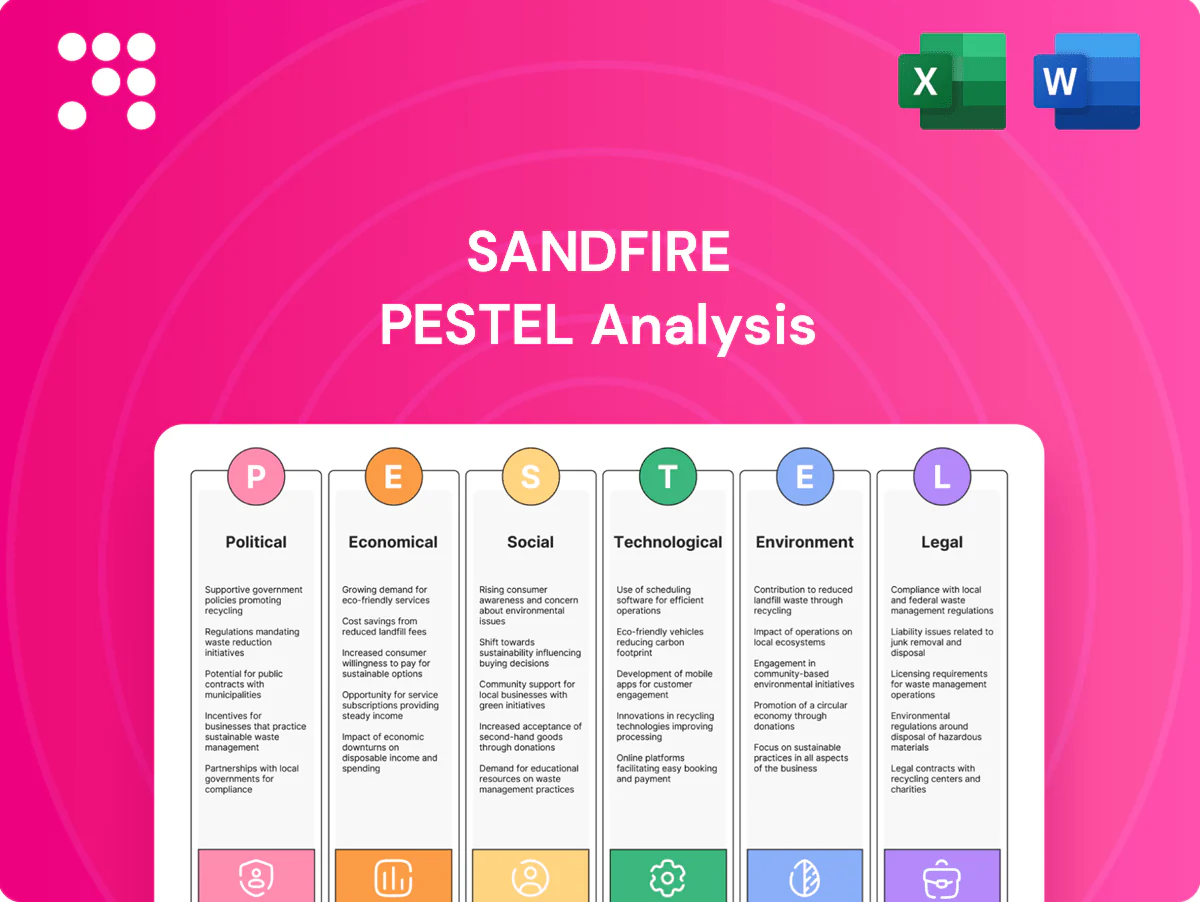
Sandfire PESTLE Analysis

Plan Smarter. Present Sharper. Compete Stronger.
Unlock how political shifts, commodity cycles and technological change shape Sandfire’s prospects with our concise PESTLE snapshot—ideal for investors and strategists seeking fast, actionable context. This briefing highlights key external risks and opportunities; purchase the full PESTLE for the complete, editable deep-dive and execution-ready insights.
Political factors

Botswana stability & policy
Botswana has maintained stable, democratic governance since independence in 1966 and operates an established mining code that underpins predictable permitting and royalty regimes, supporting long-term investment at Motheo. Pro-mining policies and clear licensing procedures reduce sovereign risk for Sandfire, but cabinet or ministerial changes can shift emphasis on local content and beneficiation. Sandfire must sustain active government relations and strict compliance to preserve its operating licence.
Spain/EU governance dynamics
Spain’s regional and national politics shape mining permits, labor rules and energy-transition incentives that directly affect MATSA operations in Andalusia; regional authorities balance industrial jobs with environmental stewardship, influencing permit timelines and conditionalities. EU-level directives and the 2023 Critical Raw Materials list (34 materials) plus NextGenerationEU funds (~€800bn) bolster support for copper projects, while political fragmentation risks lengthening approvals and stakeholder consultations.

Resource nationalism risk
Global moves toward higher royalties, windfall taxes and export constraints remain a sector risk; Botswana and Spain are relatively moderate with headline corporate tax rates of about 22% and 25% respectively. Fiscal terms have historically tightened during high price cycles, raising sovereign take unpredictably. Sandfire should prioritise local value creation, secure stability agreements and maintain transparent fiscal reporting to defend predictability.

Infrastructure & cross-border logistics
Infrastructure investment in roads, ports and reliable power directly shapes Sandfire’s concentrate transport costs and plant uptime; global seaborne trade moves about 80% of merchandise by volume (UNCTAD). Customs, border controls and transit-country diplomacy determine export continuity and delays; proactive engagement secures priority access and contingency routes.
- Roads/ports/power: direct impact on OPEX and uptime
- Customs policies: affect export lead times
- Transit diplomacy: can disrupt shipping lanes
- Engagement: secures priority access, contingency routes
Geopolitics & strategic minerals
Copper’s central role in the energy transition—IEA scenarios show demand rising roughly 30% by 2040—elevates it in national strategic plans, boosting policy tailwinds for producers like Sandfire. Policies prioritizing secure, non-Russian/Chinese supply chains (EU Critical Raw Materials Act 2023, US Inflation Reduction Act incentives) could support Sandfire’s projects, while sanctions and export controls may complicate equipment sourcing and sales. Aligning project development with partner-country priorities can unlock incentives and concessional financing.
- IEA demand +30% by 2040
- EU CRMA 2023: strategic sourcing rules
- US IRA 2022: ~369 billion USD clean energy incentives
- Supply-chain tensions raise equipment and offtake risk
Botswana 22% tax, Spain 25% risk; EU €800bn & US $369bn boost copper +30% by 2040
Botswana’s stable mining code and 22% headline tax support Motheo but ministerial shifts can tighten local-content rules; Spain’s regional politics and 25% tax affect MATSA permitting and labor. EU CRMA (34 materials) and ~€800bn NextGenerationEU fund plus US IRA (~$369bn) provide policy tailwinds; IEA projects copper demand +30% by 2040, raising strategic support and regulatory scrutiny.
| Item | Figure | Relevance |
|---|---|---|
| Botswana tax | 22% | Fiscal predictability |
| Spain tax | 25% | Permitting & labor |
| EU funds | €800bn | Project support |
| US IRA | $369bn | Incentives |
| IEA copper | +30% by 2040 | Strategic priority |
What is included in the product
 Detailed Word Document
Explores how macro-environmental factors uniquely affect Sandfire across Political, Economic, Social, Technological, Environmental and Legal dimensions, with data-backed trends and region-specific regulatory context; designed for executives and investors to identify risks, opportunities and forward-looking scenarios ready for inclusion in plans or pitches.

 Customizable Excel Spreadsheet
A concise, visually segmented Sandfire PESTLE summary that highlights key political, economic, social, technological, legal and environmental risks for quick insertion into decks or meetings, editable for regional or operational notes and easily shareable for fast team alignment.
Economic factors

Copper price cyclicality
Sandfire revenue is highly sensitive to LME copper prices and TC/RCs; LME copper has oscillated from about US$6,500/t in 2020 to peaks above US$10,000/t in 2023 and averaged near US$9,000–9,500/t in 2024–mid‑2025, driving volatile EBITDA. Structural electrification demand supports long‑term price upside, but near‑term swings remain large. Hedging reduces cash‑flow volatility yet limits upside participation. Project timing and capex must align with cycle position to preserve value.
Input costs & inflation
Energy, reagents, steel and labour inflation have squeezed margins across Sandfire operations, with euro-area HICP peaking at 10.6% in Oct 2022 and Spain’s power market remaining volatile post-2022, pressuring MATSA’s cost base. Botswana’s reliance on diesel and specific power arrangements notably drives Motheo operating costs. Supplier diversification and long‑term PPAs are proven levers to mitigate price exposure and stabilize cash flow.

FX exposure
Sandfire incurs costs in Pula, euro and other local currencies while sales are USD-linked; LME copper averaged about $8,900/t in 2024, intensifying FX effects on margins. FX swings can lift unit costs and dent reported AUD earnings when BWP or EUR strengthen versus USD. Natural hedging through USD revenues and active treasury hedges are essential to stabilize cashflows. Monitoring Bank of Botswana and ECB actions remains critical for policy-driven currency moves.

Capital access & cost
Higher interest rates raise project NPVs and refinancing costs, pressuring Sandfire’s capital budgeting and hurdle rates.
Growing green finance and offtake-linked funding channels for copper attract concessional terms, while maintaining investment-grade ESG credentials can lower Sandfire’s cost of capital.
Diligent project execution and clear guidance are critical to preserve market confidence and access to competitive funding.
- Interest-rate sensitivity
- Green finance & offtake options
- ESG lowers capital costs
- Execution sustains access
Global growth & demand
Chinese construction (China GDP ~5.2% in 2024, IMF) and global manufacturing sustain near-term copper demand—world refined copper use ~26 Mt in 2024—while US/ EU/ India energy-transition policies (IRA ~$369bn) add medium-term pull; inventory cycles and macro shocks can whipsaw prices, but Sandfire’s diversified customer base and flexible sales terms mitigate demand risk.
- China growth 5.2% (2024)
- Global copper use ~26 Mt (2024)
- IRA ~$369bn supports demand
- Diversified customers reduce exposure
Botswana 22% tax, Spain 25% risk; EU €800bn & US $369bn boost copper +30% by 2040
Sandfire earnings remain highly copper‑price sensitive (LME ≈ $9,000/t in 2024) while input inflation and FX (BWP/EUR vs USD) squeeze margins; higher rates raise capex/NPV hurdles but green finance/ offtakes (IRA ~$369bn) can lower funding costs. Execution and hedging are key to stabilise cash flow and preserve value.
| Metric | 2024 |
|---|---|
| LME copper | $9,000/t |
| Global refined copper | ~26 Mt |
| China GDP | 5.2% |
What You See Is What You Get
Sandfire PESTLE Analysis
The Sandfire PESTLE Analysis preview shown here is the exact document you’ll receive after purchase—fully formatted and ready to use. The layout, content, and structure visible are exactly what you'll download immediately after buying. No placeholders or teasers—this is the real, finished file.

Plan Smarter. Present Sharper. Compete Stronger.
Unlock how political shifts, commodity cycles and technological change shape Sandfire’s prospects with our concise PESTLE snapshot—ideal for investors and strategists seeking fast, actionable context. This briefing highlights key external risks and opportunities; purchase the full PESTLE for the complete, editable deep-dive and execution-ready insights.
Political factors
Botswana stability & policy
Botswana has maintained stable, democratic governance since independence in 1966 and operates an established mining code that underpins predictable permitting and royalty regimes, supporting long-term investment at Motheo. Pro-mining policies and clear licensing procedures reduce sovereign risk for Sandfire, but cabinet or ministerial changes can shift emphasis on local content and beneficiation. Sandfire must sustain active government relations and strict compliance to preserve its operating licence.
Spain/EU governance dynamics
Spain’s regional and national politics shape mining permits, labor rules and energy-transition incentives that directly affect MATSA operations in Andalusia; regional authorities balance industrial jobs with environmental stewardship, influencing permit timelines and conditionalities. EU-level directives and the 2023 Critical Raw Materials list (34 materials) plus NextGenerationEU funds (~€800bn) bolster support for copper projects, while political fragmentation risks lengthening approvals and stakeholder consultations.
Resource nationalism risk
Global moves toward higher royalties, windfall taxes and export constraints remain a sector risk; Botswana and Spain are relatively moderate with headline corporate tax rates of about 22% and 25% respectively. Fiscal terms have historically tightened during high price cycles, raising sovereign take unpredictably. Sandfire should prioritise local value creation, secure stability agreements and maintain transparent fiscal reporting to defend predictability.
Infrastructure & cross-border logistics
Infrastructure investment in roads, ports and reliable power directly shapes Sandfire’s concentrate transport costs and plant uptime; global seaborne trade moves about 80% of merchandise by volume (UNCTAD). Customs, border controls and transit-country diplomacy determine export continuity and delays; proactive engagement secures priority access and contingency routes.
- Roads/ports/power: direct impact on OPEX and uptime
- Customs policies: affect export lead times
- Transit diplomacy: can disrupt shipping lanes
- Engagement: secures priority access, contingency routes
Geopolitics & strategic minerals
Copper’s central role in the energy transition—IEA scenarios show demand rising roughly 30% by 2040—elevates it in national strategic plans, boosting policy tailwinds for producers like Sandfire. Policies prioritizing secure, non-Russian/Chinese supply chains (EU Critical Raw Materials Act 2023, US Inflation Reduction Act incentives) could support Sandfire’s projects, while sanctions and export controls may complicate equipment sourcing and sales. Aligning project development with partner-country priorities can unlock incentives and concessional financing.
- IEA demand +30% by 2040
- EU CRMA 2023: strategic sourcing rules
- US IRA 2022: ~369 billion USD clean energy incentives
- Supply-chain tensions raise equipment and offtake risk
Botswana 22% tax, Spain 25% risk; EU €800bn & US $369bn boost copper +30% by 2040
Botswana’s stable mining code and 22% headline tax support Motheo but ministerial shifts can tighten local-content rules; Spain’s regional politics and 25% tax affect MATSA permitting and labor. EU CRMA (34 materials) and ~€800bn NextGenerationEU fund plus US IRA (~$369bn) provide policy tailwinds; IEA projects copper demand +30% by 2040, raising strategic support and regulatory scrutiny.
| Item | Figure | Relevance |
|---|---|---|
| Botswana tax | 22% | Fiscal predictability |
| Spain tax | 25% | Permitting & labor |
| EU funds | €800bn | Project support |
| US IRA | $369bn | Incentives |
| IEA copper | +30% by 2040 | Strategic priority |
What is included in the product
Detailed Word Document
Explores how macro-environmental factors uniquely affect Sandfire across Political, Economic, Social, Technological, Environmental and Legal dimensions, with data-backed trends and region-specific regulatory context; designed for executives and investors to identify risks, opportunities and forward-looking scenarios ready for inclusion in plans or pitches.
Customizable Excel Spreadsheet
A concise, visually segmented Sandfire PESTLE summary that highlights key political, economic, social, technological, legal and environmental risks for quick insertion into decks or meetings, editable for regional or operational notes and easily shareable for fast team alignment.
Economic factors
Copper price cyclicality
Sandfire revenue is highly sensitive to LME copper prices and TC/RCs; LME copper has oscillated from about US$6,500/t in 2020 to peaks above US$10,000/t in 2023 and averaged near US$9,000–9,500/t in 2024–mid‑2025, driving volatile EBITDA. Structural electrification demand supports long‑term price upside, but near‑term swings remain large. Hedging reduces cash‑flow volatility yet limits upside participation. Project timing and capex must align with cycle position to preserve value.
Input costs & inflation
Energy, reagents, steel and labour inflation have squeezed margins across Sandfire operations, with euro-area HICP peaking at 10.6% in Oct 2022 and Spain’s power market remaining volatile post-2022, pressuring MATSA’s cost base. Botswana’s reliance on diesel and specific power arrangements notably drives Motheo operating costs. Supplier diversification and long‑term PPAs are proven levers to mitigate price exposure and stabilize cash flow.
FX exposure
Sandfire incurs costs in Pula, euro and other local currencies while sales are USD-linked; LME copper averaged about $8,900/t in 2024, intensifying FX effects on margins. FX swings can lift unit costs and dent reported AUD earnings when BWP or EUR strengthen versus USD. Natural hedging through USD revenues and active treasury hedges are essential to stabilize cashflows. Monitoring Bank of Botswana and ECB actions remains critical for policy-driven currency moves.
Capital access & cost
Higher interest rates raise project NPVs and refinancing costs, pressuring Sandfire’s capital budgeting and hurdle rates.
Growing green finance and offtake-linked funding channels for copper attract concessional terms, while maintaining investment-grade ESG credentials can lower Sandfire’s cost of capital.
Diligent project execution and clear guidance are critical to preserve market confidence and access to competitive funding.
- Interest-rate sensitivity
- Green finance & offtake options
- ESG lowers capital costs
- Execution sustains access
Global growth & demand
Chinese construction (China GDP ~5.2% in 2024, IMF) and global manufacturing sustain near-term copper demand—world refined copper use ~26 Mt in 2024—while US/ EU/ India energy-transition policies (IRA ~$369bn) add medium-term pull; inventory cycles and macro shocks can whipsaw prices, but Sandfire’s diversified customer base and flexible sales terms mitigate demand risk.
- China growth 5.2% (2024)
- Global copper use ~26 Mt (2024)
- IRA ~$369bn supports demand
- Diversified customers reduce exposure
Botswana 22% tax, Spain 25% risk; EU €800bn & US $369bn boost copper +30% by 2040
Sandfire earnings remain highly copper‑price sensitive (LME ≈ $9,000/t in 2024) while input inflation and FX (BWP/EUR vs USD) squeeze margins; higher rates raise capex/NPV hurdles but green finance/ offtakes (IRA ~$369bn) can lower funding costs. Execution and hedging are key to stabilise cash flow and preserve value.
| Metric | 2024 |
|---|---|
| LME copper | $9,000/t |
| Global refined copper | ~26 Mt |
| China GDP | 5.2% |
What You See Is What You Get
Sandfire PESTLE Analysis
The Sandfire PESTLE Analysis preview shown here is the exact document you’ll receive after purchase—fully formatted and ready to use. The layout, content, and structure visible are exactly what you'll download immediately after buying. No placeholders or teasers—this is the real, finished file.
Description
Plan Smarter. Present Sharper. Compete Stronger.
Unlock how political shifts, commodity cycles and technological change shape Sandfire’s prospects with our concise PESTLE snapshot—ideal for investors and strategists seeking fast, actionable context. This briefing highlights key external risks and opportunities; purchase the full PESTLE for the complete, editable deep-dive and execution-ready insights.
Political factors
Botswana stability & policy
Botswana has maintained stable, democratic governance since independence in 1966 and operates an established mining code that underpins predictable permitting and royalty regimes, supporting long-term investment at Motheo. Pro-mining policies and clear licensing procedures reduce sovereign risk for Sandfire, but cabinet or ministerial changes can shift emphasis on local content and beneficiation. Sandfire must sustain active government relations and strict compliance to preserve its operating licence.
Spain/EU governance dynamics
Spain’s regional and national politics shape mining permits, labor rules and energy-transition incentives that directly affect MATSA operations in Andalusia; regional authorities balance industrial jobs with environmental stewardship, influencing permit timelines and conditionalities. EU-level directives and the 2023 Critical Raw Materials list (34 materials) plus NextGenerationEU funds (~€800bn) bolster support for copper projects, while political fragmentation risks lengthening approvals and stakeholder consultations.
Resource nationalism risk
Global moves toward higher royalties, windfall taxes and export constraints remain a sector risk; Botswana and Spain are relatively moderate with headline corporate tax rates of about 22% and 25% respectively. Fiscal terms have historically tightened during high price cycles, raising sovereign take unpredictably. Sandfire should prioritise local value creation, secure stability agreements and maintain transparent fiscal reporting to defend predictability.
Infrastructure & cross-border logistics
Infrastructure investment in roads, ports and reliable power directly shapes Sandfire’s concentrate transport costs and plant uptime; global seaborne trade moves about 80% of merchandise by volume (UNCTAD). Customs, border controls and transit-country diplomacy determine export continuity and delays; proactive engagement secures priority access and contingency routes.
- Roads/ports/power: direct impact on OPEX and uptime
- Customs policies: affect export lead times
- Transit diplomacy: can disrupt shipping lanes
- Engagement: secures priority access, contingency routes
Geopolitics & strategic minerals
Copper’s central role in the energy transition—IEA scenarios show demand rising roughly 30% by 2040—elevates it in national strategic plans, boosting policy tailwinds for producers like Sandfire. Policies prioritizing secure, non-Russian/Chinese supply chains (EU Critical Raw Materials Act 2023, US Inflation Reduction Act incentives) could support Sandfire’s projects, while sanctions and export controls may complicate equipment sourcing and sales. Aligning project development with partner-country priorities can unlock incentives and concessional financing.
- IEA demand +30% by 2040
- EU CRMA 2023: strategic sourcing rules
- US IRA 2022: ~369 billion USD clean energy incentives
- Supply-chain tensions raise equipment and offtake risk
Botswana 22% tax, Spain 25% risk; EU €800bn & US $369bn boost copper +30% by 2040
Botswana’s stable mining code and 22% headline tax support Motheo but ministerial shifts can tighten local-content rules; Spain’s regional politics and 25% tax affect MATSA permitting and labor. EU CRMA (34 materials) and ~€800bn NextGenerationEU fund plus US IRA (~$369bn) provide policy tailwinds; IEA projects copper demand +30% by 2040, raising strategic support and regulatory scrutiny.
| Item | Figure | Relevance |
|---|---|---|
| Botswana tax | 22% | Fiscal predictability |
| Spain tax | 25% | Permitting & labor |
| EU funds | €800bn | Project support |
| US IRA | $369bn | Incentives |
| IEA copper | +30% by 2040 | Strategic priority |
What is included in the product
Detailed Word Document
Explores how macro-environmental factors uniquely affect Sandfire across Political, Economic, Social, Technological, Environmental and Legal dimensions, with data-backed trends and region-specific regulatory context; designed for executives and investors to identify risks, opportunities and forward-looking scenarios ready for inclusion in plans or pitches.
Customizable Excel Spreadsheet
A concise, visually segmented Sandfire PESTLE summary that highlights key political, economic, social, technological, legal and environmental risks for quick insertion into decks or meetings, editable for regional or operational notes and easily shareable for fast team alignment.
Economic factors
Copper price cyclicality
Sandfire revenue is highly sensitive to LME copper prices and TC/RCs; LME copper has oscillated from about US$6,500/t in 2020 to peaks above US$10,000/t in 2023 and averaged near US$9,000–9,500/t in 2024–mid‑2025, driving volatile EBITDA. Structural electrification demand supports long‑term price upside, but near‑term swings remain large. Hedging reduces cash‑flow volatility yet limits upside participation. Project timing and capex must align with cycle position to preserve value.
Input costs & inflation
Energy, reagents, steel and labour inflation have squeezed margins across Sandfire operations, with euro-area HICP peaking at 10.6% in Oct 2022 and Spain’s power market remaining volatile post-2022, pressuring MATSA’s cost base. Botswana’s reliance on diesel and specific power arrangements notably drives Motheo operating costs. Supplier diversification and long‑term PPAs are proven levers to mitigate price exposure and stabilize cash flow.
FX exposure
Sandfire incurs costs in Pula, euro and other local currencies while sales are USD-linked; LME copper averaged about $8,900/t in 2024, intensifying FX effects on margins. FX swings can lift unit costs and dent reported AUD earnings when BWP or EUR strengthen versus USD. Natural hedging through USD revenues and active treasury hedges are essential to stabilize cashflows. Monitoring Bank of Botswana and ECB actions remains critical for policy-driven currency moves.
Capital access & cost
Higher interest rates raise project NPVs and refinancing costs, pressuring Sandfire’s capital budgeting and hurdle rates.
Growing green finance and offtake-linked funding channels for copper attract concessional terms, while maintaining investment-grade ESG credentials can lower Sandfire’s cost of capital.
Diligent project execution and clear guidance are critical to preserve market confidence and access to competitive funding.
- Interest-rate sensitivity
- Green finance & offtake options
- ESG lowers capital costs
- Execution sustains access
Global growth & demand
Chinese construction (China GDP ~5.2% in 2024, IMF) and global manufacturing sustain near-term copper demand—world refined copper use ~26 Mt in 2024—while US/ EU/ India energy-transition policies (IRA ~$369bn) add medium-term pull; inventory cycles and macro shocks can whipsaw prices, but Sandfire’s diversified customer base and flexible sales terms mitigate demand risk.
- China growth 5.2% (2024)
- Global copper use ~26 Mt (2024)
- IRA ~$369bn supports demand
- Diversified customers reduce exposure
Botswana 22% tax, Spain 25% risk; EU €800bn & US $369bn boost copper +30% by 2040
Sandfire earnings remain highly copper‑price sensitive (LME ≈ $9,000/t in 2024) while input inflation and FX (BWP/EUR vs USD) squeeze margins; higher rates raise capex/NPV hurdles but green finance/ offtakes (IRA ~$369bn) can lower funding costs. Execution and hedging are key to stabilise cash flow and preserve value.
| Metric | 2024 |
|---|---|
| LME copper | $9,000/t |
| Global refined copper | ~26 Mt |
| China GDP | 5.2% |
What You See Is What You Get
Sandfire PESTLE Analysis
The Sandfire PESTLE Analysis preview shown here is the exact document you’ll receive after purchase—fully formatted and ready to use. The layout, content, and structure visible are exactly what you'll download immediately after buying. No placeholders or teasers—this is the real, finished file.











