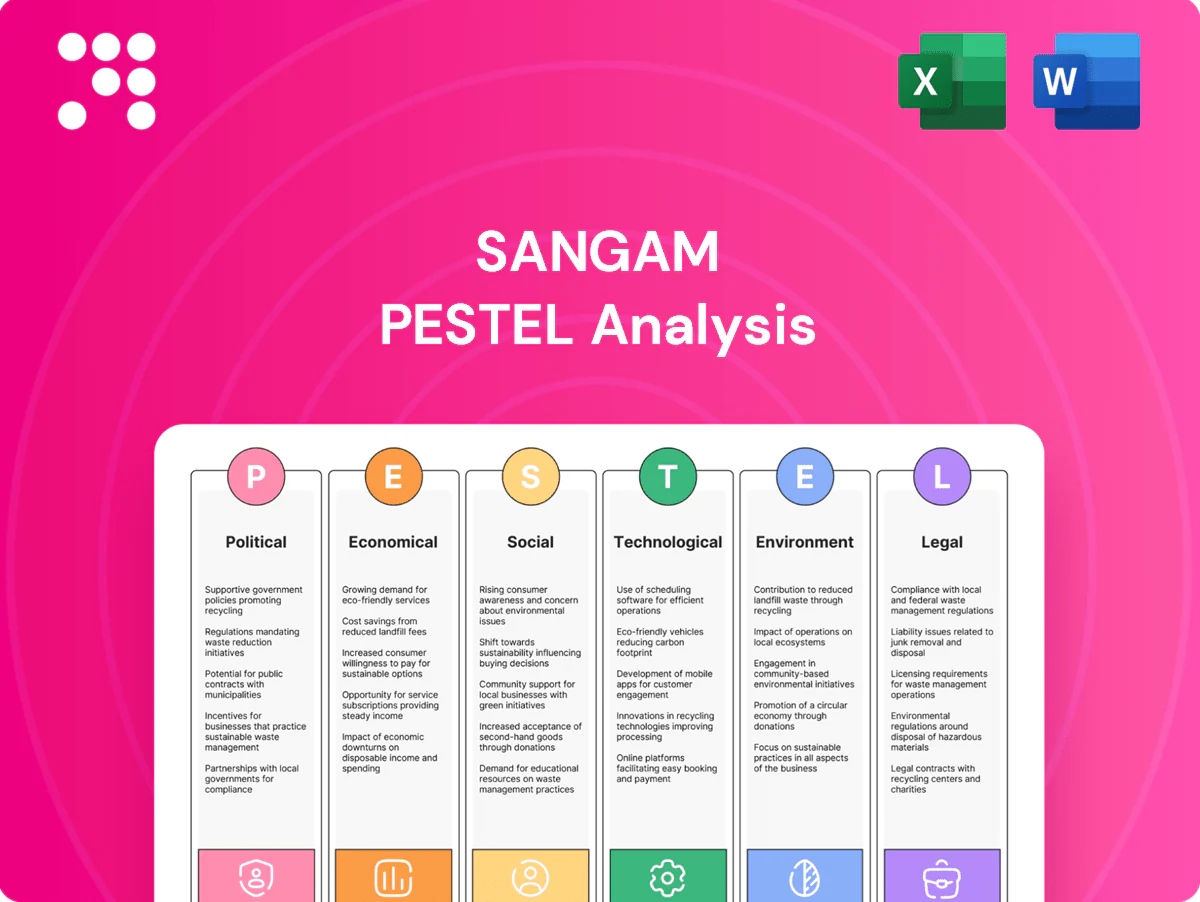
Sangam PESTLE Analysis

Your Competitive Advantage Starts with This Report
Unlock strategic clarity with our Sangam PESTLE Analysis—three-plus sentences of concise insight into political, economic, social, technological, legal, and environmental forces shaping the company. Ideal for investors and strategists, this snapshot highlights risks and opportunities you can act on now. Purchase the full report to access detailed data, scenarios, and ready-to-use recommendations.
Political factors

Trade policy and export incentives
Changes in India's export incentives and RODTEP/ duty-drawback rates directly shift margins for yarns, fabrics and denim—India's textile exports were about $45bn in FY2023-24, so a 1% shift in incentives can change sector EBITDA materially. Exposure to tariffs and non-tariff barriers in the EU, US and Middle East (which together take a large share of exports) raises compliance and price risk, and anti-dumping actions on synthetic fibers can hit volumes and prices. New trade corridors (e.g., India-Middle East shipping links, trans-Caspian routes) offer lower logistics costs and diversification, while manufacturers must align HS classifications, value-add thresholds and product specs to qualify for preferential access under FTAs.
Textile sector schemes and subsidies
PLI for textiles carries a Rs 10,683 crore outlay and, together with seven approved MITRA parks, materially lowers capex per unit and supports vertical integration and scale economies; state capital subsidies (varied by state) further reduce upfront investment needs but shift supplier clustering toward subsidy-rich regions. Eligibility requires meeting investment and incremental turnover thresholds and ongoing compliance/reporting, raising administrative overheads. Timing risks arise from phased policy rollouts and staged fund disbursements that can delay ROI and scale-up.

Political stability and infrastructure push
Policy stability matters for Sangam given long-gestation textile capex; India held national elections in Apr–May 2024 which endorsed continuity of many industrial reforms. The 2024–25 Union Budget raised capital outlay to around ₹10 lakh crore, boosting logistics, ports and power projects that shorten export lead times. State-level textile incentives in Gujarat and Tamil Nadu give location-specific advantages for plant reliability and export competitiveness.

Agricultural policy and cotton ecosystem
MSP and procurement policy shape raw cotton availability and farmgate prices; India produced ~30 million bales in 2023/24 and imports rose to ~1.0 million bales, tightening supply raises textile raw material costs and blending to polyester. Seed and GM regulations affect yields and quality; state interventions (buffer buys, export curbs) during shocks shift blending and inventories. Incentives for quality grading and digital traceability are expanding.
- MSP impact on farmer supply
- Seed/GM → yield & quality
- Interventions → blending/imports
Energy and petrochemical policy
- Brent ~85 USD/bbl (2024)
- Henry Hub ~2.9 USD/MMBtu (2024)
- Coal cess INR 400/ton
- Asian PTA ~900–1,000 USD/ton (2024)
- Incentives for captive/renewables; carbon levies growing
Capex drives textile scale: ₹10L cr, PLI Rs10,683 cr
Political stability after Apr–May 2024 elections preserved industrial reforms; Union Budget 2024–25 raised capital outlay to ~₹10 lakh crore boosting logistics. PLI textiles Rs 10,683 crore and MITRA parks accelerate scale; state incentives (Gujarat, Tamil Nadu) drive location choice. MSP/production: India ~30m bales (2023/24); export incentives/FTAs materially affect margins.
| Factor | Key data |
|---|---|
| Budget capex | ~₹10 lakh crore (2024–25) |
| PLI | Rs 10,683 crore |
| Cotton | ~30m bales (2023/24) |
What is included in the product
 Detailed Word Document
Explores how external macro-environmental factors uniquely affect the Sangam across Political, Economic, Social, Technological, Environmental and Legal dimensions, backed by current data and trends to help executives, consultants and entrepreneurs identify risks, opportunities and forward-looking scenarios ready for plans and pitches.

 Customizable Excel Spreadsheet
A clean, summarized Sangam PESTLE that’s visually segmented by category for rapid interpretation, easily dropped into presentations or shared across teams to align on external risks and market positioning.
Economic factors

Raw material price volatility
Sangam is highly sensitive to cotton cycles and crude-linked synthetics; Cotlook A averaged roughly 96 USc/lb in 2024 while Brent crude averaged about $84/bbl, driving polymer feedstock volatility that widened input cost swings. The company uses futures/options hedges, 2–3 months inventory buffers and blend optimization (cotton/polyester mixes) to protect gross spreads. Basis risk between domestic cotton benchmarks and Cotlook/ICE creates margin leakage on short hedges. Pass-through to fabric and denim customers is partial and lagged, typically 1–3 months.
Global demand and fashion cycles
Global apparel demand — a roughly $1.5 trillion market in 2024 — is concentrated in the US, EU and China (~65%), exposing Sangam to pronounced seasonal swings in discretionary spending and retailer inventory adjustments that drive order cancellations and lower capacity utilization. SKU mix is shifting toward higher-margin finished fabrics and denim from yarn/greige, affecting throughput and working capital. India textile exports totaled about $42.6 billion in FY24, underscoring diversification benefits from balanced domestic and export channels.

Forex and interest rate movements
INR volatility around 83.5 per USD (July 2025) compresses export realizations while inflating costs of imported caustic/chemicals, pressuring gross margins for Sangam's soda ash/chemicals exports and input imports.
Active FX hedging policies, use of natural hedges via export-import netting and dollar-linked pricing clauses mitigate pass-through; hedge coverage typically targets 50-80% of short-term exposures.
Domestic repo at 6.5% (July 2025) raises working-capital and term-debt costs—corporate borrowing rates near 8-9% increase WACC, delaying capex for integrated plants; tighter covenants and 3-6 month liquidity buffers become critical in downcycles.

Logistics and supply chain costs
- Container rates: $1,200–$2,000/40ft
- Port delays: -30% vs 2022
- Inland variance: 7–14 days
- Geopolitical insurance: Red Sea premium spikes
Labor availability and productivity
Regional hubs (Coimbatore, Ahmedabad, Surat) sit within India’s textile sector that employs about 45 million people; wage inflation and labour cost pressure have risen alongside national wage growth, tightening supply of skilled spinners and weavers. Productivity gains from targeted training, optimized shifts and selective automation raise output per worker and cut unit costs, improving delivery reliability; migrant flows and dormitory models materially support retention and attendance.
- Labour pool: 45 million textile workforce
- Productivity levers: training, shift planning, automation
- Retention: migration + dormitories
- Impact: lower unit costs, better on-time delivery
Capex drives textile scale: ₹10L cr, PLI Rs10,683 cr
Sangam faces cotton/crude-driven input swings (Cotlook ~96 USc/lb 2024; Brent ~$84/bbl 2024) and INR ~83.5/USD (Jul 2025) compressing export margins. Repo 6.5% (Jul 2025) raises borrowing to ~8–9%, delaying capex; exports ₹3.6T (~$42.6B FY24) support volumes. Container costs $1,200–$2,000/40ft and 7–14 day inland variance affect logistics and working capital.
| Metric | Value |
|---|---|
| Cotlook (2024) | 96 USc/lb |
| Brent (2024) | $84/bbl |
| INR | 83.5/USD (Jul 2025) |
| Repo | 6.5% (Jul 2025) |
| India textile exports FY24 | $42.6B |
| Container | $1,200–$2,000/40ft |
Same Document Delivered
Sangam PESTLE Analysis
The preview shown here is the exact Sangam PESTLE Analysis you’ll receive after purchase—fully formatted and ready to use. The layout, content, and structure visible are the final file delivered upon payment. No placeholders or teasers—this is the real, professionally structured document.

Your Competitive Advantage Starts with This Report
Unlock strategic clarity with our Sangam PESTLE Analysis—three-plus sentences of concise insight into political, economic, social, technological, legal, and environmental forces shaping the company. Ideal for investors and strategists, this snapshot highlights risks and opportunities you can act on now. Purchase the full report to access detailed data, scenarios, and ready-to-use recommendations.
Political factors
Trade policy and export incentives
Changes in India's export incentives and RODTEP/ duty-drawback rates directly shift margins for yarns, fabrics and denim—India's textile exports were about $45bn in FY2023-24, so a 1% shift in incentives can change sector EBITDA materially. Exposure to tariffs and non-tariff barriers in the EU, US and Middle East (which together take a large share of exports) raises compliance and price risk, and anti-dumping actions on synthetic fibers can hit volumes and prices. New trade corridors (e.g., India-Middle East shipping links, trans-Caspian routes) offer lower logistics costs and diversification, while manufacturers must align HS classifications, value-add thresholds and product specs to qualify for preferential access under FTAs.
Textile sector schemes and subsidies
PLI for textiles carries a Rs 10,683 crore outlay and, together with seven approved MITRA parks, materially lowers capex per unit and supports vertical integration and scale economies; state capital subsidies (varied by state) further reduce upfront investment needs but shift supplier clustering toward subsidy-rich regions. Eligibility requires meeting investment and incremental turnover thresholds and ongoing compliance/reporting, raising administrative overheads. Timing risks arise from phased policy rollouts and staged fund disbursements that can delay ROI and scale-up.
Political stability and infrastructure push
Policy stability matters for Sangam given long-gestation textile capex; India held national elections in Apr–May 2024 which endorsed continuity of many industrial reforms. The 2024–25 Union Budget raised capital outlay to around ₹10 lakh crore, boosting logistics, ports and power projects that shorten export lead times. State-level textile incentives in Gujarat and Tamil Nadu give location-specific advantages for plant reliability and export competitiveness.
Agricultural policy and cotton ecosystem
MSP and procurement policy shape raw cotton availability and farmgate prices; India produced ~30 million bales in 2023/24 and imports rose to ~1.0 million bales, tightening supply raises textile raw material costs and blending to polyester. Seed and GM regulations affect yields and quality; state interventions (buffer buys, export curbs) during shocks shift blending and inventories. Incentives for quality grading and digital traceability are expanding.
- MSP impact on farmer supply
- Seed/GM → yield & quality
- Interventions → blending/imports
Energy and petrochemical policy
- Brent ~85 USD/bbl (2024)
- Henry Hub ~2.9 USD/MMBtu (2024)
- Coal cess INR 400/ton
- Asian PTA ~900–1,000 USD/ton (2024)
- Incentives for captive/renewables; carbon levies growing
Capex drives textile scale: ₹10L cr, PLI Rs10,683 cr
Political stability after Apr–May 2024 elections preserved industrial reforms; Union Budget 2024–25 raised capital outlay to ~₹10 lakh crore boosting logistics. PLI textiles Rs 10,683 crore and MITRA parks accelerate scale; state incentives (Gujarat, Tamil Nadu) drive location choice. MSP/production: India ~30m bales (2023/24); export incentives/FTAs materially affect margins.
| Factor | Key data |
|---|---|
| Budget capex | ~₹10 lakh crore (2024–25) |
| PLI | Rs 10,683 crore |
| Cotton | ~30m bales (2023/24) |
What is included in the product
Detailed Word Document
Explores how external macro-environmental factors uniquely affect the Sangam across Political, Economic, Social, Technological, Environmental and Legal dimensions, backed by current data and trends to help executives, consultants and entrepreneurs identify risks, opportunities and forward-looking scenarios ready for plans and pitches.
Customizable Excel Spreadsheet
A clean, summarized Sangam PESTLE that’s visually segmented by category for rapid interpretation, easily dropped into presentations or shared across teams to align on external risks and market positioning.
Economic factors
Raw material price volatility
Sangam is highly sensitive to cotton cycles and crude-linked synthetics; Cotlook A averaged roughly 96 USc/lb in 2024 while Brent crude averaged about $84/bbl, driving polymer feedstock volatility that widened input cost swings. The company uses futures/options hedges, 2–3 months inventory buffers and blend optimization (cotton/polyester mixes) to protect gross spreads. Basis risk between domestic cotton benchmarks and Cotlook/ICE creates margin leakage on short hedges. Pass-through to fabric and denim customers is partial and lagged, typically 1–3 months.
Global demand and fashion cycles
Global apparel demand — a roughly $1.5 trillion market in 2024 — is concentrated in the US, EU and China (~65%), exposing Sangam to pronounced seasonal swings in discretionary spending and retailer inventory adjustments that drive order cancellations and lower capacity utilization. SKU mix is shifting toward higher-margin finished fabrics and denim from yarn/greige, affecting throughput and working capital. India textile exports totaled about $42.6 billion in FY24, underscoring diversification benefits from balanced domestic and export channels.
Forex and interest rate movements
INR volatility around 83.5 per USD (July 2025) compresses export realizations while inflating costs of imported caustic/chemicals, pressuring gross margins for Sangam's soda ash/chemicals exports and input imports.
Active FX hedging policies, use of natural hedges via export-import netting and dollar-linked pricing clauses mitigate pass-through; hedge coverage typically targets 50-80% of short-term exposures.
Domestic repo at 6.5% (July 2025) raises working-capital and term-debt costs—corporate borrowing rates near 8-9% increase WACC, delaying capex for integrated plants; tighter covenants and 3-6 month liquidity buffers become critical in downcycles.
Logistics and supply chain costs
- Container rates: $1,200–$2,000/40ft
- Port delays: -30% vs 2022
- Inland variance: 7–14 days
- Geopolitical insurance: Red Sea premium spikes
Labor availability and productivity
Regional hubs (Coimbatore, Ahmedabad, Surat) sit within India’s textile sector that employs about 45 million people; wage inflation and labour cost pressure have risen alongside national wage growth, tightening supply of skilled spinners and weavers. Productivity gains from targeted training, optimized shifts and selective automation raise output per worker and cut unit costs, improving delivery reliability; migrant flows and dormitory models materially support retention and attendance.
- Labour pool: 45 million textile workforce
- Productivity levers: training, shift planning, automation
- Retention: migration + dormitories
- Impact: lower unit costs, better on-time delivery
Capex drives textile scale: ₹10L cr, PLI Rs10,683 cr
Sangam faces cotton/crude-driven input swings (Cotlook ~96 USc/lb 2024; Brent ~$84/bbl 2024) and INR ~83.5/USD (Jul 2025) compressing export margins. Repo 6.5% (Jul 2025) raises borrowing to ~8–9%, delaying capex; exports ₹3.6T (~$42.6B FY24) support volumes. Container costs $1,200–$2,000/40ft and 7–14 day inland variance affect logistics and working capital.
| Metric | Value |
|---|---|
| Cotlook (2024) | 96 USc/lb |
| Brent (2024) | $84/bbl |
| INR | 83.5/USD (Jul 2025) |
| Repo | 6.5% (Jul 2025) |
| India textile exports FY24 | $42.6B |
| Container | $1,200–$2,000/40ft |
Same Document Delivered
Sangam PESTLE Analysis
The preview shown here is the exact Sangam PESTLE Analysis you’ll receive after purchase—fully formatted and ready to use. The layout, content, and structure visible are the final file delivered upon payment. No placeholders or teasers—this is the real, professionally structured document.
Original: $10.00
-65%$10.00
$3.50Description
Your Competitive Advantage Starts with This Report
Unlock strategic clarity with our Sangam PESTLE Analysis—three-plus sentences of concise insight into political, economic, social, technological, legal, and environmental forces shaping the company. Ideal for investors and strategists, this snapshot highlights risks and opportunities you can act on now. Purchase the full report to access detailed data, scenarios, and ready-to-use recommendations.
Political factors
Trade policy and export incentives
Changes in India's export incentives and RODTEP/ duty-drawback rates directly shift margins for yarns, fabrics and denim—India's textile exports were about $45bn in FY2023-24, so a 1% shift in incentives can change sector EBITDA materially. Exposure to tariffs and non-tariff barriers in the EU, US and Middle East (which together take a large share of exports) raises compliance and price risk, and anti-dumping actions on synthetic fibers can hit volumes and prices. New trade corridors (e.g., India-Middle East shipping links, trans-Caspian routes) offer lower logistics costs and diversification, while manufacturers must align HS classifications, value-add thresholds and product specs to qualify for preferential access under FTAs.
Textile sector schemes and subsidies
PLI for textiles carries a Rs 10,683 crore outlay and, together with seven approved MITRA parks, materially lowers capex per unit and supports vertical integration and scale economies; state capital subsidies (varied by state) further reduce upfront investment needs but shift supplier clustering toward subsidy-rich regions. Eligibility requires meeting investment and incremental turnover thresholds and ongoing compliance/reporting, raising administrative overheads. Timing risks arise from phased policy rollouts and staged fund disbursements that can delay ROI and scale-up.
Political stability and infrastructure push
Policy stability matters for Sangam given long-gestation textile capex; India held national elections in Apr–May 2024 which endorsed continuity of many industrial reforms. The 2024–25 Union Budget raised capital outlay to around ₹10 lakh crore, boosting logistics, ports and power projects that shorten export lead times. State-level textile incentives in Gujarat and Tamil Nadu give location-specific advantages for plant reliability and export competitiveness.
Agricultural policy and cotton ecosystem
MSP and procurement policy shape raw cotton availability and farmgate prices; India produced ~30 million bales in 2023/24 and imports rose to ~1.0 million bales, tightening supply raises textile raw material costs and blending to polyester. Seed and GM regulations affect yields and quality; state interventions (buffer buys, export curbs) during shocks shift blending and inventories. Incentives for quality grading and digital traceability are expanding.
- MSP impact on farmer supply
- Seed/GM → yield & quality
- Interventions → blending/imports
Energy and petrochemical policy
- Brent ~85 USD/bbl (2024)
- Henry Hub ~2.9 USD/MMBtu (2024)
- Coal cess INR 400/ton
- Asian PTA ~900–1,000 USD/ton (2024)
- Incentives for captive/renewables; carbon levies growing
Capex drives textile scale: ₹10L cr, PLI Rs10,683 cr
Political stability after Apr–May 2024 elections preserved industrial reforms; Union Budget 2024–25 raised capital outlay to ~₹10 lakh crore boosting logistics. PLI textiles Rs 10,683 crore and MITRA parks accelerate scale; state incentives (Gujarat, Tamil Nadu) drive location choice. MSP/production: India ~30m bales (2023/24); export incentives/FTAs materially affect margins.
| Factor | Key data |
|---|---|
| Budget capex | ~₹10 lakh crore (2024–25) |
| PLI | Rs 10,683 crore |
| Cotton | ~30m bales (2023/24) |
What is included in the product
Detailed Word Document
Explores how external macro-environmental factors uniquely affect the Sangam across Political, Economic, Social, Technological, Environmental and Legal dimensions, backed by current data and trends to help executives, consultants and entrepreneurs identify risks, opportunities and forward-looking scenarios ready for plans and pitches.
Customizable Excel Spreadsheet
A clean, summarized Sangam PESTLE that’s visually segmented by category for rapid interpretation, easily dropped into presentations or shared across teams to align on external risks and market positioning.
Economic factors
Raw material price volatility
Sangam is highly sensitive to cotton cycles and crude-linked synthetics; Cotlook A averaged roughly 96 USc/lb in 2024 while Brent crude averaged about $84/bbl, driving polymer feedstock volatility that widened input cost swings. The company uses futures/options hedges, 2–3 months inventory buffers and blend optimization (cotton/polyester mixes) to protect gross spreads. Basis risk between domestic cotton benchmarks and Cotlook/ICE creates margin leakage on short hedges. Pass-through to fabric and denim customers is partial and lagged, typically 1–3 months.
Global demand and fashion cycles
Global apparel demand — a roughly $1.5 trillion market in 2024 — is concentrated in the US, EU and China (~65%), exposing Sangam to pronounced seasonal swings in discretionary spending and retailer inventory adjustments that drive order cancellations and lower capacity utilization. SKU mix is shifting toward higher-margin finished fabrics and denim from yarn/greige, affecting throughput and working capital. India textile exports totaled about $42.6 billion in FY24, underscoring diversification benefits from balanced domestic and export channels.
Forex and interest rate movements
INR volatility around 83.5 per USD (July 2025) compresses export realizations while inflating costs of imported caustic/chemicals, pressuring gross margins for Sangam's soda ash/chemicals exports and input imports.
Active FX hedging policies, use of natural hedges via export-import netting and dollar-linked pricing clauses mitigate pass-through; hedge coverage typically targets 50-80% of short-term exposures.
Domestic repo at 6.5% (July 2025) raises working-capital and term-debt costs—corporate borrowing rates near 8-9% increase WACC, delaying capex for integrated plants; tighter covenants and 3-6 month liquidity buffers become critical in downcycles.
Logistics and supply chain costs
- Container rates: $1,200–$2,000/40ft
- Port delays: -30% vs 2022
- Inland variance: 7–14 days
- Geopolitical insurance: Red Sea premium spikes
Labor availability and productivity
Regional hubs (Coimbatore, Ahmedabad, Surat) sit within India’s textile sector that employs about 45 million people; wage inflation and labour cost pressure have risen alongside national wage growth, tightening supply of skilled spinners and weavers. Productivity gains from targeted training, optimized shifts and selective automation raise output per worker and cut unit costs, improving delivery reliability; migrant flows and dormitory models materially support retention and attendance.
- Labour pool: 45 million textile workforce
- Productivity levers: training, shift planning, automation
- Retention: migration + dormitories
- Impact: lower unit costs, better on-time delivery
Capex drives textile scale: ₹10L cr, PLI Rs10,683 cr
Sangam faces cotton/crude-driven input swings (Cotlook ~96 USc/lb 2024; Brent ~$84/bbl 2024) and INR ~83.5/USD (Jul 2025) compressing export margins. Repo 6.5% (Jul 2025) raises borrowing to ~8–9%, delaying capex; exports ₹3.6T (~$42.6B FY24) support volumes. Container costs $1,200–$2,000/40ft and 7–14 day inland variance affect logistics and working capital.
| Metric | Value |
|---|---|
| Cotlook (2024) | 96 USc/lb |
| Brent (2024) | $84/bbl |
| INR | 83.5/USD (Jul 2025) |
| Repo | 6.5% (Jul 2025) |
| India textile exports FY24 | $42.6B |
| Container | $1,200–$2,000/40ft |
Same Document Delivered
Sangam PESTLE Analysis
The preview shown here is the exact Sangam PESTLE Analysis you’ll receive after purchase—fully formatted and ready to use. The layout, content, and structure visible are the final file delivered upon payment. No placeholders or teasers—this is the real, professionally structured document.











