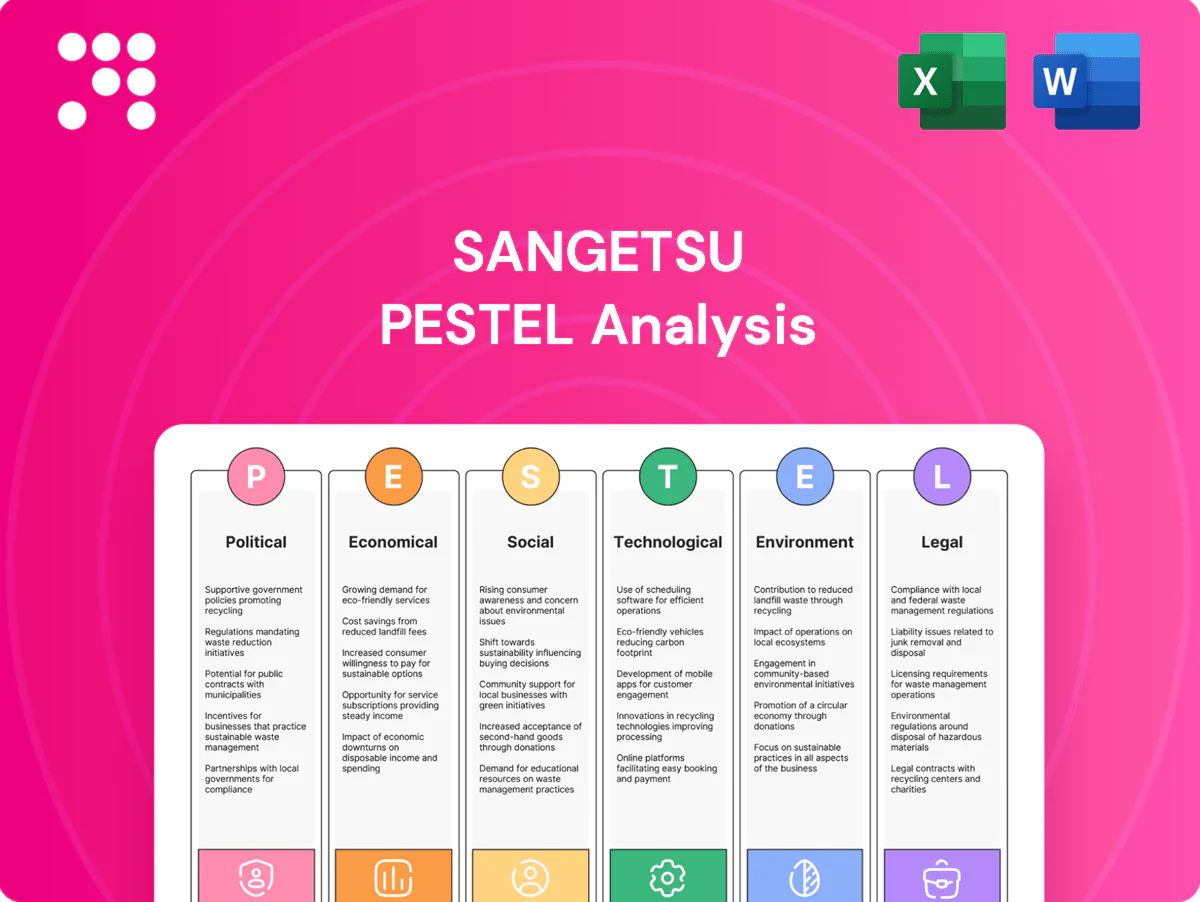
Sangetsu PESTLE Analysis

Your Shortcut to Market Insight Starts Here
Discover how political, economic, social, technological, legal and environmental forces are reshaping Sangetsu’s market position in our concise PESTLE review. Gain actionable insights on risks and growth opportunities tailored for investors and strategists. Ready-to-use and research-backed, it saves you hours of work. Buy the full PESTLE analysis now to access the complete, editable report.
Political factors

Japan infrastructure and housing policies
Government stimulus for renovation, disaster-resilience, and public-facility upgrades is driving interior-material demand; Japan's MLIT budget for FY2024 was about ¥6.6 trillion, while recent retrofit subsidy programs have covered up to 50% of eligible costs, shifting demand toward higher-spec, energy-efficient products; tracking MLIT spend and local procurement pipelines helps forecast orders and detect regional spikes that require agile inventory allocation.
Trade relations and tariffs on petrochemicals
Wallpaper, PVC flooring and backing materials are heavily reliant on imported petrochemicals, so tariff shifts or geopolitical tensions can spike input costs and elongate lead times. Diversifying suppliers across regions and using forward contracts can mitigate price and delivery volatility. Regional trade pacts such as RCEP (15 members, ~2.3 billion people, ~30% of global GDP) and the 11-member CPTPP can lower barriers and open export channels for premium design lines.

Building standards driven by safety policy
Post-disaster safety emphasis since the 2011 Tohoku earthquake has pushed Japan to raise requirements for flame retardancy and seismic performance in building standards, increasing demand for certified interior materials. Public-sector procurement, which OECD estimates at about 12% of GDP, often mandates stricter compliance, favoring certified products. Aligning Sangetsu’s catalog with updated codes secures eligibility for large tenders; non-compliance risks exclusion from major institutional bids.

Local government procurement practices
Prefectural and municipal purchasing rules increasingly favor local suppliers and green-certified materials, and by 2024 many municipalities embedded ESG criteria into vendor registries, materially affecting win rates. Long public bids typically run 6–12 months, requiring pipeline visibility and proactive relationship management. Transparent pricing and lifecycle-cost narratives improve scoring and commercial success.
- Vendor registration: mandatory in many prefectures
- ESG filters: raise qualification thresholds
- Bidding cycle: 6–12 months
- Win strategy: transparent pricing + lifecycle costs
Currency policy and BOJ stance spillovers
Monetary policy drives yen moves: USD/JPY traded around 150 in late 2024, so yen weakness raises import costs for resin and fibers while supporting Sangetsu’s overseas revenue; prolonged weakness can lift raw-material costs by double-digit percent vs a stronger yen.
- Align hedges with BOJ guidance and market FX swaps
- Trigger pricing at FX pass-through thresholds
- Monitor USD/JPY volatility for cost-repricing
MLIT ¥6.6tn stimulus and up to 50% retrofit subsidies boost energy-efficient interior demand
Government renovation stimulus (MLIT FY2024 ≈ ¥6.6tn) and retrofit subsidies (up to 50%) boost demand for certified, energy-efficient interior materials; public procurement (≈12% of GDP) and municipal ESG rules raise win thresholds. Import reliance on petrochemicals and USD/JPY ~150 (late 2024) drive input-cost volatility; regional trade pacts (RCEP, CPTPP) ease export routes.
| Indicator | Value |
|---|---|
| MLIT FY2024 | ¥6.6tn |
| Retrofit subsidy | up to 50% |
| Public procurement | ≈12% GDP |
| USD/JPY (late 2024) | ≈150 |
What is included in the product
 Detailed Word Document
Explores how macro-environmental factors uniquely affect Sangetsu across Political, Economic, Social, Technological, Environmental, and Legal dimensions, with each section supported by current data and trend analysis. Designed for executives, consultants, and entrepreneurs, it highlights threats, opportunities, and forward-looking insights for strategic planning and investor communications.

 Customizable Excel Spreadsheet
A concise, visually segmented Sangetsu PESTLE summary that relieves planning pain points by making external risks and market positioning immediately clear, easily editable for local context, and drop‑in ready for slides or client reports to speed alignment across teams.
Economic factors

Construction cycle across residential and commercial
New builds, office fit-outs, hotels and retail refurbishments remain core volume drivers for Sangetsu, with renovation work often outpacing greenfield starts. Japan inbound tourism reached 31.88 million visitors in 2023, supporting stronger hospitality renovation demand into 2024–25. Office demand is tempered by hybrid work trends; monitoring vacancy rates and corporate capex plans signals segment momentum, while balanced exposure to renovation buffers new-build slowdowns.
Raw material price volatility
PVC, acrylics, nylon and adhesives are highly sensitive to oil and naphtha; Brent crude averaged about 86 USD/barrel in 2024 and naphtha CFR Asia averaged roughly 720 USD/ton in 2024, driving raw-material cost swings. Spikes compress margins unless Sangetsu achieves rapid price pass-through to customers. Strong supplier partnerships and inventory hedges can smooth COGS volatility. Product re-engineering toward bio-based inputs reduces fossil-feedstock exposure and long-term price risk.

Labor and construction productivity constraints
Japan’s tight labor market—unemployment 2.6% in 2024 (OECD)—pushes installation costs and extends schedules, boosting demand for products that shorten install time or cut maintenance. Certified installer training can accelerate adoption and reduce costly callbacks, improving lifetime margins. Strategic prefabrication partnerships position Sangetsu to win large-scale renovation programs and capture scale efficiencies.

Consumer spending and housing wealth effects
Household confidence drives discretionary interior upgrades; with roughly 50% of Japan’s housing stock over 30 years old, renovation demand remains structural and resilient. Mortgage rates and asset-market swings shape renovation budgets, so tiered collections let Sangetsu capture trading-up and down cycles while financing and bundled-project offers unlock latent demand.
- 50% Japan homes older than 30 years (structural renovation need)
- Tiered collections enable trade-up/down capture
- Financing and project bundles convert latent demand
International expansion and currency translation
Overseas sales diversify Sangetsu’s cyclical exposure but introduce FX translation volatility; USD/JPY moved roughly between 130–155 from 2022–2024, amplifying reported results. Localizing SKUs raises sell-through—regional product lines increased order fill in Asia markets in recent quarters. Asia GDP growth ~4.6% in 2024 (IMF) drives contract pipeline variability. Shared services can lift margins via 50–200 bps savings when centralized.
MLIT ¥6.6tn stimulus and up to 50% retrofit subsidies boost energy-efficient interior demand
New builds, fit-outs and hotel/retail refurbishments drive Sangetsu volumes; Japan inbound tourism 31.88m (2023) supports hospitality renovations while renovation > new builds. Brent averaged ~86 USD/bbl and naphtha ~720 USD/ton (2024), pressuring PVC/adhesive costs; USD/JPY swung 130–155 (2022–24) adding FX volatility. Japan unemployment 2.6% (2024) and ~50% homes >30 years sustain structural renovation demand.
| Metric | Value |
|---|---|
| Japan inbound tourism | 31.88m (2023) |
| Brent crude | ~86 USD/bbl (2024) |
| Naphtha CFR Asia | ~720 USD/ton (2024) |
| Unemployment (Japan) | 2.6% (2024) |
| Homes >30 yrs | ~50% |
| USD/JPY | 130–155 (2022–24) |
| Asia GDP | ~4.6% (IMF 2024) |
Preview Before You Purchase
Sangetsu PESTLE Analysis
The preview shown here is the exact Sangetsu PESTLE Analysis document you’ll receive after purchase—fully formatted and ready to use. The layout, content, and structure visible are identical to the downloadable file, with no placeholders or surprises. After checkout you’ll instantly get this final, professionally structured file ready for strategic use.

Your Shortcut to Market Insight Starts Here
Discover how political, economic, social, technological, legal and environmental forces are reshaping Sangetsu’s market position in our concise PESTLE review. Gain actionable insights on risks and growth opportunities tailored for investors and strategists. Ready-to-use and research-backed, it saves you hours of work. Buy the full PESTLE analysis now to access the complete, editable report.
Political factors
Japan infrastructure and housing policies
Government stimulus for renovation, disaster-resilience, and public-facility upgrades is driving interior-material demand; Japan's MLIT budget for FY2024 was about ¥6.6 trillion, while recent retrofit subsidy programs have covered up to 50% of eligible costs, shifting demand toward higher-spec, energy-efficient products; tracking MLIT spend and local procurement pipelines helps forecast orders and detect regional spikes that require agile inventory allocation.
Trade relations and tariffs on petrochemicals
Wallpaper, PVC flooring and backing materials are heavily reliant on imported petrochemicals, so tariff shifts or geopolitical tensions can spike input costs and elongate lead times. Diversifying suppliers across regions and using forward contracts can mitigate price and delivery volatility. Regional trade pacts such as RCEP (15 members, ~2.3 billion people, ~30% of global GDP) and the 11-member CPTPP can lower barriers and open export channels for premium design lines.
Building standards driven by safety policy
Post-disaster safety emphasis since the 2011 Tohoku earthquake has pushed Japan to raise requirements for flame retardancy and seismic performance in building standards, increasing demand for certified interior materials. Public-sector procurement, which OECD estimates at about 12% of GDP, often mandates stricter compliance, favoring certified products. Aligning Sangetsu’s catalog with updated codes secures eligibility for large tenders; non-compliance risks exclusion from major institutional bids.
Local government procurement practices
Prefectural and municipal purchasing rules increasingly favor local suppliers and green-certified materials, and by 2024 many municipalities embedded ESG criteria into vendor registries, materially affecting win rates. Long public bids typically run 6–12 months, requiring pipeline visibility and proactive relationship management. Transparent pricing and lifecycle-cost narratives improve scoring and commercial success.
- Vendor registration: mandatory in many prefectures
- ESG filters: raise qualification thresholds
- Bidding cycle: 6–12 months
- Win strategy: transparent pricing + lifecycle costs
Currency policy and BOJ stance spillovers
Monetary policy drives yen moves: USD/JPY traded around 150 in late 2024, so yen weakness raises import costs for resin and fibers while supporting Sangetsu’s overseas revenue; prolonged weakness can lift raw-material costs by double-digit percent vs a stronger yen.
- Align hedges with BOJ guidance and market FX swaps
- Trigger pricing at FX pass-through thresholds
- Monitor USD/JPY volatility for cost-repricing
MLIT ¥6.6tn stimulus and up to 50% retrofit subsidies boost energy-efficient interior demand
Government renovation stimulus (MLIT FY2024 ≈ ¥6.6tn) and retrofit subsidies (up to 50%) boost demand for certified, energy-efficient interior materials; public procurement (≈12% of GDP) and municipal ESG rules raise win thresholds. Import reliance on petrochemicals and USD/JPY ~150 (late 2024) drive input-cost volatility; regional trade pacts (RCEP, CPTPP) ease export routes.
| Indicator | Value |
|---|---|
| MLIT FY2024 | ¥6.6tn |
| Retrofit subsidy | up to 50% |
| Public procurement | ≈12% GDP |
| USD/JPY (late 2024) | ≈150 |
What is included in the product
Detailed Word Document
Explores how macro-environmental factors uniquely affect Sangetsu across Political, Economic, Social, Technological, Environmental, and Legal dimensions, with each section supported by current data and trend analysis. Designed for executives, consultants, and entrepreneurs, it highlights threats, opportunities, and forward-looking insights for strategic planning and investor communications.
Customizable Excel Spreadsheet
A concise, visually segmented Sangetsu PESTLE summary that relieves planning pain points by making external risks and market positioning immediately clear, easily editable for local context, and drop‑in ready for slides or client reports to speed alignment across teams.
Economic factors
Construction cycle across residential and commercial
New builds, office fit-outs, hotels and retail refurbishments remain core volume drivers for Sangetsu, with renovation work often outpacing greenfield starts. Japan inbound tourism reached 31.88 million visitors in 2023, supporting stronger hospitality renovation demand into 2024–25. Office demand is tempered by hybrid work trends; monitoring vacancy rates and corporate capex plans signals segment momentum, while balanced exposure to renovation buffers new-build slowdowns.
Raw material price volatility
PVC, acrylics, nylon and adhesives are highly sensitive to oil and naphtha; Brent crude averaged about 86 USD/barrel in 2024 and naphtha CFR Asia averaged roughly 720 USD/ton in 2024, driving raw-material cost swings. Spikes compress margins unless Sangetsu achieves rapid price pass-through to customers. Strong supplier partnerships and inventory hedges can smooth COGS volatility. Product re-engineering toward bio-based inputs reduces fossil-feedstock exposure and long-term price risk.
Labor and construction productivity constraints
Japan’s tight labor market—unemployment 2.6% in 2024 (OECD)—pushes installation costs and extends schedules, boosting demand for products that shorten install time or cut maintenance. Certified installer training can accelerate adoption and reduce costly callbacks, improving lifetime margins. Strategic prefabrication partnerships position Sangetsu to win large-scale renovation programs and capture scale efficiencies.
Consumer spending and housing wealth effects
Household confidence drives discretionary interior upgrades; with roughly 50% of Japan’s housing stock over 30 years old, renovation demand remains structural and resilient. Mortgage rates and asset-market swings shape renovation budgets, so tiered collections let Sangetsu capture trading-up and down cycles while financing and bundled-project offers unlock latent demand.
- 50% Japan homes older than 30 years (structural renovation need)
- Tiered collections enable trade-up/down capture
- Financing and project bundles convert latent demand
International expansion and currency translation
Overseas sales diversify Sangetsu’s cyclical exposure but introduce FX translation volatility; USD/JPY moved roughly between 130–155 from 2022–2024, amplifying reported results. Localizing SKUs raises sell-through—regional product lines increased order fill in Asia markets in recent quarters. Asia GDP growth ~4.6% in 2024 (IMF) drives contract pipeline variability. Shared services can lift margins via 50–200 bps savings when centralized.
MLIT ¥6.6tn stimulus and up to 50% retrofit subsidies boost energy-efficient interior demand
New builds, fit-outs and hotel/retail refurbishments drive Sangetsu volumes; Japan inbound tourism 31.88m (2023) supports hospitality renovations while renovation > new builds. Brent averaged ~86 USD/bbl and naphtha ~720 USD/ton (2024), pressuring PVC/adhesive costs; USD/JPY swung 130–155 (2022–24) adding FX volatility. Japan unemployment 2.6% (2024) and ~50% homes >30 years sustain structural renovation demand.
| Metric | Value |
|---|---|
| Japan inbound tourism | 31.88m (2023) |
| Brent crude | ~86 USD/bbl (2024) |
| Naphtha CFR Asia | ~720 USD/ton (2024) |
| Unemployment (Japan) | 2.6% (2024) |
| Homes >30 yrs | ~50% |
| USD/JPY | 130–155 (2022–24) |
| Asia GDP | ~4.6% (IMF 2024) |
Preview Before You Purchase
Sangetsu PESTLE Analysis
The preview shown here is the exact Sangetsu PESTLE Analysis document you’ll receive after purchase—fully formatted and ready to use. The layout, content, and structure visible are identical to the downloadable file, with no placeholders or surprises. After checkout you’ll instantly get this final, professionally structured file ready for strategic use.
Original: $10.00
-65%$10.00
$3.50Description
Your Shortcut to Market Insight Starts Here
Discover how political, economic, social, technological, legal and environmental forces are reshaping Sangetsu’s market position in our concise PESTLE review. Gain actionable insights on risks and growth opportunities tailored for investors and strategists. Ready-to-use and research-backed, it saves you hours of work. Buy the full PESTLE analysis now to access the complete, editable report.
Political factors
Japan infrastructure and housing policies
Government stimulus for renovation, disaster-resilience, and public-facility upgrades is driving interior-material demand; Japan's MLIT budget for FY2024 was about ¥6.6 trillion, while recent retrofit subsidy programs have covered up to 50% of eligible costs, shifting demand toward higher-spec, energy-efficient products; tracking MLIT spend and local procurement pipelines helps forecast orders and detect regional spikes that require agile inventory allocation.
Trade relations and tariffs on petrochemicals
Wallpaper, PVC flooring and backing materials are heavily reliant on imported petrochemicals, so tariff shifts or geopolitical tensions can spike input costs and elongate lead times. Diversifying suppliers across regions and using forward contracts can mitigate price and delivery volatility. Regional trade pacts such as RCEP (15 members, ~2.3 billion people, ~30% of global GDP) and the 11-member CPTPP can lower barriers and open export channels for premium design lines.
Building standards driven by safety policy
Post-disaster safety emphasis since the 2011 Tohoku earthquake has pushed Japan to raise requirements for flame retardancy and seismic performance in building standards, increasing demand for certified interior materials. Public-sector procurement, which OECD estimates at about 12% of GDP, often mandates stricter compliance, favoring certified products. Aligning Sangetsu’s catalog with updated codes secures eligibility for large tenders; non-compliance risks exclusion from major institutional bids.
Local government procurement practices
Prefectural and municipal purchasing rules increasingly favor local suppliers and green-certified materials, and by 2024 many municipalities embedded ESG criteria into vendor registries, materially affecting win rates. Long public bids typically run 6–12 months, requiring pipeline visibility and proactive relationship management. Transparent pricing and lifecycle-cost narratives improve scoring and commercial success.
- Vendor registration: mandatory in many prefectures
- ESG filters: raise qualification thresholds
- Bidding cycle: 6–12 months
- Win strategy: transparent pricing + lifecycle costs
Currency policy and BOJ stance spillovers
Monetary policy drives yen moves: USD/JPY traded around 150 in late 2024, so yen weakness raises import costs for resin and fibers while supporting Sangetsu’s overseas revenue; prolonged weakness can lift raw-material costs by double-digit percent vs a stronger yen.
- Align hedges with BOJ guidance and market FX swaps
- Trigger pricing at FX pass-through thresholds
- Monitor USD/JPY volatility for cost-repricing
MLIT ¥6.6tn stimulus and up to 50% retrofit subsidies boost energy-efficient interior demand
Government renovation stimulus (MLIT FY2024 ≈ ¥6.6tn) and retrofit subsidies (up to 50%) boost demand for certified, energy-efficient interior materials; public procurement (≈12% of GDP) and municipal ESG rules raise win thresholds. Import reliance on petrochemicals and USD/JPY ~150 (late 2024) drive input-cost volatility; regional trade pacts (RCEP, CPTPP) ease export routes.
| Indicator | Value |
|---|---|
| MLIT FY2024 | ¥6.6tn |
| Retrofit subsidy | up to 50% |
| Public procurement | ≈12% GDP |
| USD/JPY (late 2024) | ≈150 |
What is included in the product
Detailed Word Document
Explores how macro-environmental factors uniquely affect Sangetsu across Political, Economic, Social, Technological, Environmental, and Legal dimensions, with each section supported by current data and trend analysis. Designed for executives, consultants, and entrepreneurs, it highlights threats, opportunities, and forward-looking insights for strategic planning and investor communications.
Customizable Excel Spreadsheet
A concise, visually segmented Sangetsu PESTLE summary that relieves planning pain points by making external risks and market positioning immediately clear, easily editable for local context, and drop‑in ready for slides or client reports to speed alignment across teams.
Economic factors
Construction cycle across residential and commercial
New builds, office fit-outs, hotels and retail refurbishments remain core volume drivers for Sangetsu, with renovation work often outpacing greenfield starts. Japan inbound tourism reached 31.88 million visitors in 2023, supporting stronger hospitality renovation demand into 2024–25. Office demand is tempered by hybrid work trends; monitoring vacancy rates and corporate capex plans signals segment momentum, while balanced exposure to renovation buffers new-build slowdowns.
Raw material price volatility
PVC, acrylics, nylon and adhesives are highly sensitive to oil and naphtha; Brent crude averaged about 86 USD/barrel in 2024 and naphtha CFR Asia averaged roughly 720 USD/ton in 2024, driving raw-material cost swings. Spikes compress margins unless Sangetsu achieves rapid price pass-through to customers. Strong supplier partnerships and inventory hedges can smooth COGS volatility. Product re-engineering toward bio-based inputs reduces fossil-feedstock exposure and long-term price risk.
Labor and construction productivity constraints
Japan’s tight labor market—unemployment 2.6% in 2024 (OECD)—pushes installation costs and extends schedules, boosting demand for products that shorten install time or cut maintenance. Certified installer training can accelerate adoption and reduce costly callbacks, improving lifetime margins. Strategic prefabrication partnerships position Sangetsu to win large-scale renovation programs and capture scale efficiencies.
Consumer spending and housing wealth effects
Household confidence drives discretionary interior upgrades; with roughly 50% of Japan’s housing stock over 30 years old, renovation demand remains structural and resilient. Mortgage rates and asset-market swings shape renovation budgets, so tiered collections let Sangetsu capture trading-up and down cycles while financing and bundled-project offers unlock latent demand.
- 50% Japan homes older than 30 years (structural renovation need)
- Tiered collections enable trade-up/down capture
- Financing and project bundles convert latent demand
International expansion and currency translation
Overseas sales diversify Sangetsu’s cyclical exposure but introduce FX translation volatility; USD/JPY moved roughly between 130–155 from 2022–2024, amplifying reported results. Localizing SKUs raises sell-through—regional product lines increased order fill in Asia markets in recent quarters. Asia GDP growth ~4.6% in 2024 (IMF) drives contract pipeline variability. Shared services can lift margins via 50–200 bps savings when centralized.
MLIT ¥6.6tn stimulus and up to 50% retrofit subsidies boost energy-efficient interior demand
New builds, fit-outs and hotel/retail refurbishments drive Sangetsu volumes; Japan inbound tourism 31.88m (2023) supports hospitality renovations while renovation > new builds. Brent averaged ~86 USD/bbl and naphtha ~720 USD/ton (2024), pressuring PVC/adhesive costs; USD/JPY swung 130–155 (2022–24) adding FX volatility. Japan unemployment 2.6% (2024) and ~50% homes >30 years sustain structural renovation demand.
| Metric | Value |
|---|---|
| Japan inbound tourism | 31.88m (2023) |
| Brent crude | ~86 USD/bbl (2024) |
| Naphtha CFR Asia | ~720 USD/ton (2024) |
| Unemployment (Japan) | 2.6% (2024) |
| Homes >30 yrs | ~50% |
| USD/JPY | 130–155 (2022–24) |
| Asia GDP | ~4.6% (IMF 2024) |
Preview Before You Purchase
Sangetsu PESTLE Analysis
The preview shown here is the exact Sangetsu PESTLE Analysis document you’ll receive after purchase—fully formatted and ready to use. The layout, content, and structure visible are identical to the downloadable file, with no placeholders or surprises. After checkout you’ll instantly get this final, professionally structured file ready for strategic use.











