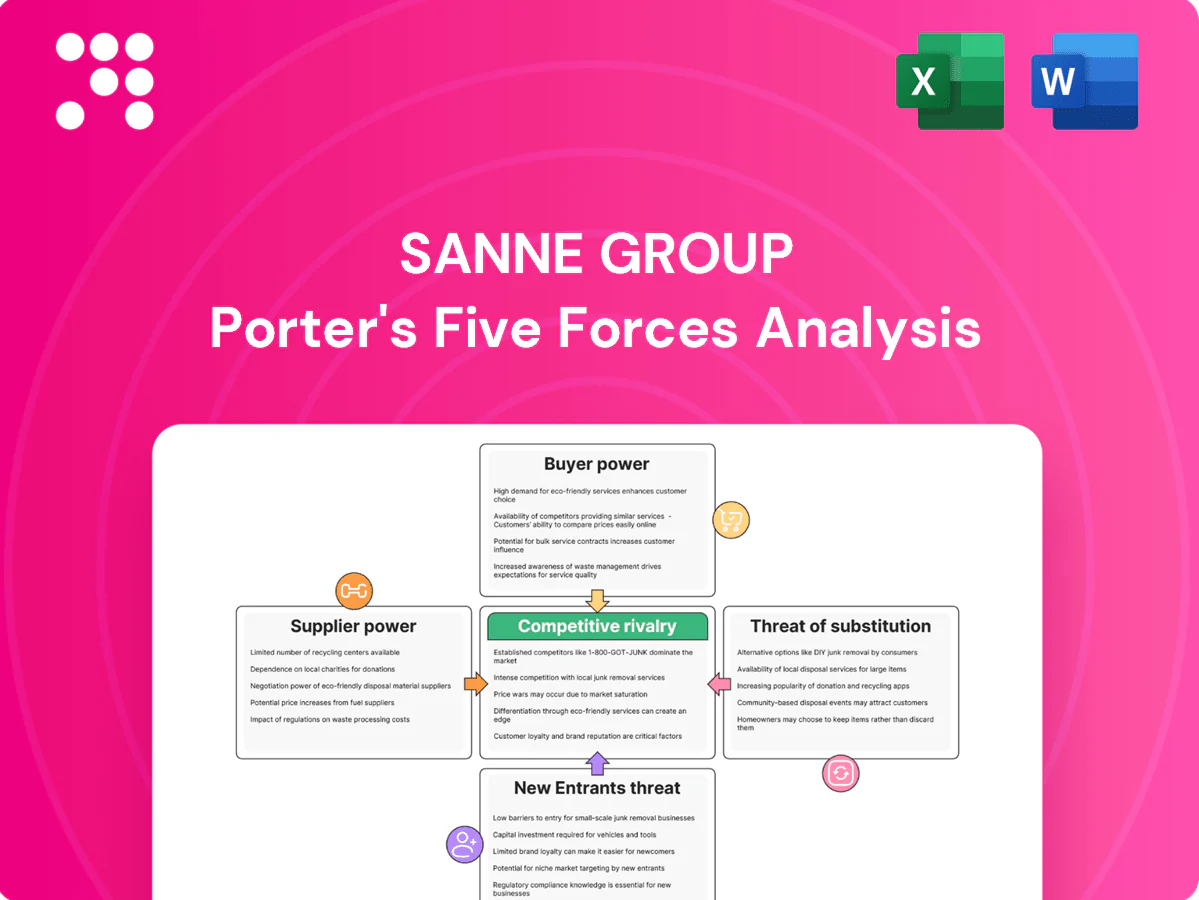
Sanne Group Porter's Five Forces Analysis

Go Beyond the Preview—Access the Full Strategic Report
Sanne Group faces moderate entry barriers and regulatory pressure, with significant buyer power from large institutional clients and low supplier leverage, while threat of substitutes remains limited due to specialized services and trust-based relationships. This brief snapshot only scratches the surface. Unlock the full Porter's Five Forces Analysis to explore Sanne Group’s competitive dynamics, market pressures, and strategic advantages in detail.
Suppliers Bargaining Power

Specialist talent scarcity
Qualified accountants, fund administrators and compliance officers are scarce, with over 50% of fund firms reporting recruitment difficulty in 2024 and premium wages rising accordingly. Credential and jurisdictional requirements raise switching costs for Sanne, increasing onboarding timelines. Wage inflation and retention bonuses have compressed margins by mid-single digits industry-wide in 2024. Apex’s scale mitigates but competition for talent remains intense.
Concentrated tech stack
Core systems for fund administration (fund accounting, transfer agency, compliance, workflow, cloud) are concentrated among a few vendors—SS&C, FIS and leading cloud providers—with AWS/Azure/GCP together holding roughly two-thirds of the cloud market in 2023–24, increasing supplier leverage. Integration and data-migration costs create strong vendor lock-in, raising switching costs materially. Seat-based or per-module price increases directly compress unit economics, while multi-year contracts (common in the sector) dampen short-term volatility but reduce flexibility.

Data and market feeds
Valuation, pricing and regulatory data are concentrated among major vendors—Bloomberg (around 325,000 terminal subscribers in 2023–24) and Refinitiv—making them essential for Sanne Group’s NAV and compliance workflows. Stringent accuracy and sub-second timeliness needs limit negotiation leverage despite high costs; Bloomberg terminal pricing (~2,000 USD/month in 2024) exemplifies this. Bundled data packages and enterprise licenses create minimum-spend commitments often exceeding 100,000 USD annually. Direct exchange feeds or smaller providers are available but add integration and validation overhead.

Jurisdictional infrastructure
Local agents, resident directors and registered office providers are mandatory in many domiciles, and in niche jurisdictions there are often only 1-3 credible providers, increasing dependency; service continuity failures or reputational issues materially elevate their bargaining leverage; multi-sourcing mitigates concentration but raises coordination and compliance complexity.
- 1-3 credible providers in niche domiciles
- Mandatory local agents/directors raise dependency
- Continuity/reputation amplify supplier leverage
- Multi-sourcing reduces risk but increases coordination costs
Compliance and audit partners
External auditors and legal counsel are critical to Sanne’s client reporting and regulatory filings, with Big Four firms auditing roughly 98% of FTSE 100 by market cap in 2024, reinforcing client preference for big-brand assurance. End-client brand preferences constrain switching, so fee uplifts and scope creep can only be partially passed through without risking client friction. Panel arrangements moderate but do not eliminate supplier leverage, leaving residual cost pressure on fees.
- External auditors: Big Four dominance c.98% FTSE 100 (2024)
- Switching cost: high due to brand trust
- Fee pass-through: partial, limited by client pushback
- Panels: reduce but not remove supplier power
High supplier power: talent scarcity, wage inflation and cloud/data vendor lock-in
Supplier power is high: talent scarcity (50%+ of fund firms report recruitment difficulty in 2024) and wage inflation compress margins. Core tech/cloud vendors (AWS/Azure/GCP ~66% cloud share 2023–24) and data providers (Bloomberg ~$2,000/month) create strong lock-in. Local agents, auditors (Big Four c.98% FTSE 100, 2024) and niche service providers retain pricing leverage.
| Supplier | Concentration | Key metric |
|---|---|---|
| Talent | Fragmented scarce | 50%+ recruitment difficulty (2024) |
| Cloud/Data | High | AWS/Azure/GCP ~66% (2023–24); Bloomberg ~$2,000/mo |
| Auditors/Local agents | High | Big Four ~98% FTSE100 (2024); 1–3 providers in niches |
What is included in the product
 Detailed Word Document
Tailored Porter's Five Forces analysis for Sanne Group, assessing competitive rivalry, buyer and supplier power, entry barriers, and substitute threats to reveal strategic vulnerabilities and growth levers.

 Customizable Excel Spreadsheet
One-sheet Porter's Five Forces for Sanne Group—instantly visualize competitive pressures via a spider chart and customize force levels with your data; clean, no-macro layout ready for pitch decks, scenario tabs (pre/post regulation) and seamless integration into Excel dashboards or paired Word reports.
Customers Bargaining Power

Sophisticated alternative managers
Private equity, real estate, hedge and private credit clients run highly competitive RFPs, benchmarking SLAs, error rates and fees across global peers. Their multi-fund footprints and scale—with private markets AUM exceeding $12 trillion in 2024—drive meaningful volume bargaining power and price compression. Referenceability and logo value from top-tier clients further tilt negotiations, forcing providers like Sanne to match service KPIs and fee terms to retain mandates.
Moderate switching costs
Data migration, NAV cutovers and regulatory consents make switching painful but feasible for Sanne clients, creating moderate customer bargaining power. Event triggers such as fund launches or GP restructurings prompt competitive tenders where buyers press for price and service concessions. Buyers leverage these windows to extract better terms, though rivals’ increasingly robust onboarding processes steadily lower frictions over time.

Service commoditization risk
Core fund administration tasks risk being viewed as interchangeable as standardized reporting and investor portals compress differentiation, driving buyers to demand lower fees unless providers bundle value-add analytics or ESG/regulatory insights. Clients increasingly push outcome-based SLAs, intensifying scrutiny on uptime, reconciliation accuracy and turnaround times. Without clear advanced services, pricing power erodes and margin pressure rises.

Multi-jurisdiction demands
Global managers prefer a single provider across domiciles, concentrating scale and increasing buyer leverage in fee negotiations; post-Apex consolidation, bundled services can temper headline discounts by delivering operational and regulatory synergies. Depth of cross-sell across custody, fund administration and compliance is pivotal to rebalance power as clients demand multi-jurisdiction coverage.
- Scale concentration boosts fee bargaining
- Bundled Apex offerings can limit discounting
- Cross-sell depth key to power balance
Regulatory and timeline sensitivity
Late filings and NAV errors carry high penalties—often reaching seven-figure regulatory fines for major breaches—giving buyers strong leverage to demand remediation and performance guarantees.
Clients routinely seek remediation credits and contractual step-in rights; ISO 27001 and SOC 1/2 attestations are now table stakes for institutional mandates.
Continuous improvement programs and demonstrable control KPIs are essential to retain accounts and avoid churn in a 2024 market focused on operational resilience.
- penalties: seven-figure fines common
- controls: ISO 27001, SOC 1/2 required
- client remedies: remediation credits, step-in rights
- retention: continuous improvement KPI focus
Buyers leverage >$12T private AUM - fees squeezed; SOC1/2 ISO27001 risk
Buyers (PE, RE, hedge, private credit) exert strong bargaining power—private markets AUM >12 trillion in 2024 fuels volume-based fee pressure and intense RFP benchmarking. Switching is painful but feasible; event-driven tenders extract concessions and remediation credits. Standardized reporting compresses pricing unless Sanne upsells analytics/ESG; SOC1/2 and ISO27001 are mandatory, seven-figure fines amplify leverage.
| Metric | 2024 |
|---|---|
| Private markets AUM | >$12 trillion |
| Regulatory fines | Seven-figure |
| Certifications | SOC1/2, ISO27001 |
Same Document Delivered
Sanne Group Porter's Five Forces Analysis
This preview shows the exact Porter’s Five Forces analysis of Sanne Group you'll receive immediately after purchase—no placeholders or mockups. The document provides a full assessment of competitive rivalry, supplier and buyer power, threat of substitutes, and barriers to entry, fully formatted and ready to download. Purchase grants instant access to this identical, professional file.

Go Beyond the Preview—Access the Full Strategic Report
Sanne Group faces moderate entry barriers and regulatory pressure, with significant buyer power from large institutional clients and low supplier leverage, while threat of substitutes remains limited due to specialized services and trust-based relationships. This brief snapshot only scratches the surface. Unlock the full Porter's Five Forces Analysis to explore Sanne Group’s competitive dynamics, market pressures, and strategic advantages in detail.
Suppliers Bargaining Power
Specialist talent scarcity
Qualified accountants, fund administrators and compliance officers are scarce, with over 50% of fund firms reporting recruitment difficulty in 2024 and premium wages rising accordingly. Credential and jurisdictional requirements raise switching costs for Sanne, increasing onboarding timelines. Wage inflation and retention bonuses have compressed margins by mid-single digits industry-wide in 2024. Apex’s scale mitigates but competition for talent remains intense.
Concentrated tech stack
Core systems for fund administration (fund accounting, transfer agency, compliance, workflow, cloud) are concentrated among a few vendors—SS&C, FIS and leading cloud providers—with AWS/Azure/GCP together holding roughly two-thirds of the cloud market in 2023–24, increasing supplier leverage. Integration and data-migration costs create strong vendor lock-in, raising switching costs materially. Seat-based or per-module price increases directly compress unit economics, while multi-year contracts (common in the sector) dampen short-term volatility but reduce flexibility.
Data and market feeds
Valuation, pricing and regulatory data are concentrated among major vendors—Bloomberg (around 325,000 terminal subscribers in 2023–24) and Refinitiv—making them essential for Sanne Group’s NAV and compliance workflows. Stringent accuracy and sub-second timeliness needs limit negotiation leverage despite high costs; Bloomberg terminal pricing (~2,000 USD/month in 2024) exemplifies this. Bundled data packages and enterprise licenses create minimum-spend commitments often exceeding 100,000 USD annually. Direct exchange feeds or smaller providers are available but add integration and validation overhead.
Jurisdictional infrastructure
Local agents, resident directors and registered office providers are mandatory in many domiciles, and in niche jurisdictions there are often only 1-3 credible providers, increasing dependency; service continuity failures or reputational issues materially elevate their bargaining leverage; multi-sourcing mitigates concentration but raises coordination and compliance complexity.
- 1-3 credible providers in niche domiciles
- Mandatory local agents/directors raise dependency
- Continuity/reputation amplify supplier leverage
- Multi-sourcing reduces risk but increases coordination costs
Compliance and audit partners
External auditors and legal counsel are critical to Sanne’s client reporting and regulatory filings, with Big Four firms auditing roughly 98% of FTSE 100 by market cap in 2024, reinforcing client preference for big-brand assurance. End-client brand preferences constrain switching, so fee uplifts and scope creep can only be partially passed through without risking client friction. Panel arrangements moderate but do not eliminate supplier leverage, leaving residual cost pressure on fees.
- External auditors: Big Four dominance c.98% FTSE 100 (2024)
- Switching cost: high due to brand trust
- Fee pass-through: partial, limited by client pushback
- Panels: reduce but not remove supplier power
High supplier power: talent scarcity, wage inflation and cloud/data vendor lock-in
Supplier power is high: talent scarcity (50%+ of fund firms report recruitment difficulty in 2024) and wage inflation compress margins. Core tech/cloud vendors (AWS/Azure/GCP ~66% cloud share 2023–24) and data providers (Bloomberg ~$2,000/month) create strong lock-in. Local agents, auditors (Big Four c.98% FTSE 100, 2024) and niche service providers retain pricing leverage.
| Supplier | Concentration | Key metric |
|---|---|---|
| Talent | Fragmented scarce | 50%+ recruitment difficulty (2024) |
| Cloud/Data | High | AWS/Azure/GCP ~66% (2023–24); Bloomberg ~$2,000/mo |
| Auditors/Local agents | High | Big Four ~98% FTSE100 (2024); 1–3 providers in niches |
What is included in the product
Detailed Word Document
Tailored Porter's Five Forces analysis for Sanne Group, assessing competitive rivalry, buyer and supplier power, entry barriers, and substitute threats to reveal strategic vulnerabilities and growth levers.
Customizable Excel Spreadsheet
One-sheet Porter's Five Forces for Sanne Group—instantly visualize competitive pressures via a spider chart and customize force levels with your data; clean, no-macro layout ready for pitch decks, scenario tabs (pre/post regulation) and seamless integration into Excel dashboards or paired Word reports.
Customers Bargaining Power
Sophisticated alternative managers
Private equity, real estate, hedge and private credit clients run highly competitive RFPs, benchmarking SLAs, error rates and fees across global peers. Their multi-fund footprints and scale—with private markets AUM exceeding $12 trillion in 2024—drive meaningful volume bargaining power and price compression. Referenceability and logo value from top-tier clients further tilt negotiations, forcing providers like Sanne to match service KPIs and fee terms to retain mandates.
Moderate switching costs
Data migration, NAV cutovers and regulatory consents make switching painful but feasible for Sanne clients, creating moderate customer bargaining power. Event triggers such as fund launches or GP restructurings prompt competitive tenders where buyers press for price and service concessions. Buyers leverage these windows to extract better terms, though rivals’ increasingly robust onboarding processes steadily lower frictions over time.
Service commoditization risk
Core fund administration tasks risk being viewed as interchangeable as standardized reporting and investor portals compress differentiation, driving buyers to demand lower fees unless providers bundle value-add analytics or ESG/regulatory insights. Clients increasingly push outcome-based SLAs, intensifying scrutiny on uptime, reconciliation accuracy and turnaround times. Without clear advanced services, pricing power erodes and margin pressure rises.
Multi-jurisdiction demands
Global managers prefer a single provider across domiciles, concentrating scale and increasing buyer leverage in fee negotiations; post-Apex consolidation, bundled services can temper headline discounts by delivering operational and regulatory synergies. Depth of cross-sell across custody, fund administration and compliance is pivotal to rebalance power as clients demand multi-jurisdiction coverage.
- Scale concentration boosts fee bargaining
- Bundled Apex offerings can limit discounting
- Cross-sell depth key to power balance
Regulatory and timeline sensitivity
Late filings and NAV errors carry high penalties—often reaching seven-figure regulatory fines for major breaches—giving buyers strong leverage to demand remediation and performance guarantees.
Clients routinely seek remediation credits and contractual step-in rights; ISO 27001 and SOC 1/2 attestations are now table stakes for institutional mandates.
Continuous improvement programs and demonstrable control KPIs are essential to retain accounts and avoid churn in a 2024 market focused on operational resilience.
- penalties: seven-figure fines common
- controls: ISO 27001, SOC 1/2 required
- client remedies: remediation credits, step-in rights
- retention: continuous improvement KPI focus
Buyers leverage >$12T private AUM - fees squeezed; SOC1/2 ISO27001 risk
Buyers (PE, RE, hedge, private credit) exert strong bargaining power—private markets AUM >12 trillion in 2024 fuels volume-based fee pressure and intense RFP benchmarking. Switching is painful but feasible; event-driven tenders extract concessions and remediation credits. Standardized reporting compresses pricing unless Sanne upsells analytics/ESG; SOC1/2 and ISO27001 are mandatory, seven-figure fines amplify leverage.
| Metric | 2024 |
|---|---|
| Private markets AUM | >$12 trillion |
| Regulatory fines | Seven-figure |
| Certifications | SOC1/2, ISO27001 |
Same Document Delivered
Sanne Group Porter's Five Forces Analysis
This preview shows the exact Porter’s Five Forces analysis of Sanne Group you'll receive immediately after purchase—no placeholders or mockups. The document provides a full assessment of competitive rivalry, supplier and buyer power, threat of substitutes, and barriers to entry, fully formatted and ready to download. Purchase grants instant access to this identical, professional file.
Original: $10.00
-65%$10.00
$3.50Description
Go Beyond the Preview—Access the Full Strategic Report
Sanne Group faces moderate entry barriers and regulatory pressure, with significant buyer power from large institutional clients and low supplier leverage, while threat of substitutes remains limited due to specialized services and trust-based relationships. This brief snapshot only scratches the surface. Unlock the full Porter's Five Forces Analysis to explore Sanne Group’s competitive dynamics, market pressures, and strategic advantages in detail.
Suppliers Bargaining Power
Specialist talent scarcity
Qualified accountants, fund administrators and compliance officers are scarce, with over 50% of fund firms reporting recruitment difficulty in 2024 and premium wages rising accordingly. Credential and jurisdictional requirements raise switching costs for Sanne, increasing onboarding timelines. Wage inflation and retention bonuses have compressed margins by mid-single digits industry-wide in 2024. Apex’s scale mitigates but competition for talent remains intense.
Concentrated tech stack
Core systems for fund administration (fund accounting, transfer agency, compliance, workflow, cloud) are concentrated among a few vendors—SS&C, FIS and leading cloud providers—with AWS/Azure/GCP together holding roughly two-thirds of the cloud market in 2023–24, increasing supplier leverage. Integration and data-migration costs create strong vendor lock-in, raising switching costs materially. Seat-based or per-module price increases directly compress unit economics, while multi-year contracts (common in the sector) dampen short-term volatility but reduce flexibility.
Data and market feeds
Valuation, pricing and regulatory data are concentrated among major vendors—Bloomberg (around 325,000 terminal subscribers in 2023–24) and Refinitiv—making them essential for Sanne Group’s NAV and compliance workflows. Stringent accuracy and sub-second timeliness needs limit negotiation leverage despite high costs; Bloomberg terminal pricing (~2,000 USD/month in 2024) exemplifies this. Bundled data packages and enterprise licenses create minimum-spend commitments often exceeding 100,000 USD annually. Direct exchange feeds or smaller providers are available but add integration and validation overhead.
Jurisdictional infrastructure
Local agents, resident directors and registered office providers are mandatory in many domiciles, and in niche jurisdictions there are often only 1-3 credible providers, increasing dependency; service continuity failures or reputational issues materially elevate their bargaining leverage; multi-sourcing mitigates concentration but raises coordination and compliance complexity.
- 1-3 credible providers in niche domiciles
- Mandatory local agents/directors raise dependency
- Continuity/reputation amplify supplier leverage
- Multi-sourcing reduces risk but increases coordination costs
Compliance and audit partners
External auditors and legal counsel are critical to Sanne’s client reporting and regulatory filings, with Big Four firms auditing roughly 98% of FTSE 100 by market cap in 2024, reinforcing client preference for big-brand assurance. End-client brand preferences constrain switching, so fee uplifts and scope creep can only be partially passed through without risking client friction. Panel arrangements moderate but do not eliminate supplier leverage, leaving residual cost pressure on fees.
- External auditors: Big Four dominance c.98% FTSE 100 (2024)
- Switching cost: high due to brand trust
- Fee pass-through: partial, limited by client pushback
- Panels: reduce but not remove supplier power
High supplier power: talent scarcity, wage inflation and cloud/data vendor lock-in
Supplier power is high: talent scarcity (50%+ of fund firms report recruitment difficulty in 2024) and wage inflation compress margins. Core tech/cloud vendors (AWS/Azure/GCP ~66% cloud share 2023–24) and data providers (Bloomberg ~$2,000/month) create strong lock-in. Local agents, auditors (Big Four c.98% FTSE 100, 2024) and niche service providers retain pricing leverage.
| Supplier | Concentration | Key metric |
|---|---|---|
| Talent | Fragmented scarce | 50%+ recruitment difficulty (2024) |
| Cloud/Data | High | AWS/Azure/GCP ~66% (2023–24); Bloomberg ~$2,000/mo |
| Auditors/Local agents | High | Big Four ~98% FTSE100 (2024); 1–3 providers in niches |
What is included in the product
Detailed Word Document
Tailored Porter's Five Forces analysis for Sanne Group, assessing competitive rivalry, buyer and supplier power, entry barriers, and substitute threats to reveal strategic vulnerabilities and growth levers.
Customizable Excel Spreadsheet
One-sheet Porter's Five Forces for Sanne Group—instantly visualize competitive pressures via a spider chart and customize force levels with your data; clean, no-macro layout ready for pitch decks, scenario tabs (pre/post regulation) and seamless integration into Excel dashboards or paired Word reports.
Customers Bargaining Power
Sophisticated alternative managers
Private equity, real estate, hedge and private credit clients run highly competitive RFPs, benchmarking SLAs, error rates and fees across global peers. Their multi-fund footprints and scale—with private markets AUM exceeding $12 trillion in 2024—drive meaningful volume bargaining power and price compression. Referenceability and logo value from top-tier clients further tilt negotiations, forcing providers like Sanne to match service KPIs and fee terms to retain mandates.
Moderate switching costs
Data migration, NAV cutovers and regulatory consents make switching painful but feasible for Sanne clients, creating moderate customer bargaining power. Event triggers such as fund launches or GP restructurings prompt competitive tenders where buyers press for price and service concessions. Buyers leverage these windows to extract better terms, though rivals’ increasingly robust onboarding processes steadily lower frictions over time.
Service commoditization risk
Core fund administration tasks risk being viewed as interchangeable as standardized reporting and investor portals compress differentiation, driving buyers to demand lower fees unless providers bundle value-add analytics or ESG/regulatory insights. Clients increasingly push outcome-based SLAs, intensifying scrutiny on uptime, reconciliation accuracy and turnaround times. Without clear advanced services, pricing power erodes and margin pressure rises.
Multi-jurisdiction demands
Global managers prefer a single provider across domiciles, concentrating scale and increasing buyer leverage in fee negotiations; post-Apex consolidation, bundled services can temper headline discounts by delivering operational and regulatory synergies. Depth of cross-sell across custody, fund administration and compliance is pivotal to rebalance power as clients demand multi-jurisdiction coverage.
- Scale concentration boosts fee bargaining
- Bundled Apex offerings can limit discounting
- Cross-sell depth key to power balance
Regulatory and timeline sensitivity
Late filings and NAV errors carry high penalties—often reaching seven-figure regulatory fines for major breaches—giving buyers strong leverage to demand remediation and performance guarantees.
Clients routinely seek remediation credits and contractual step-in rights; ISO 27001 and SOC 1/2 attestations are now table stakes for institutional mandates.
Continuous improvement programs and demonstrable control KPIs are essential to retain accounts and avoid churn in a 2024 market focused on operational resilience.
- penalties: seven-figure fines common
- controls: ISO 27001, SOC 1/2 required
- client remedies: remediation credits, step-in rights
- retention: continuous improvement KPI focus
Buyers leverage >$12T private AUM - fees squeezed; SOC1/2 ISO27001 risk
Buyers (PE, RE, hedge, private credit) exert strong bargaining power—private markets AUM >12 trillion in 2024 fuels volume-based fee pressure and intense RFP benchmarking. Switching is painful but feasible; event-driven tenders extract concessions and remediation credits. Standardized reporting compresses pricing unless Sanne upsells analytics/ESG; SOC1/2 and ISO27001 are mandatory, seven-figure fines amplify leverage.
| Metric | 2024 |
|---|---|
| Private markets AUM | >$12 trillion |
| Regulatory fines | Seven-figure |
| Certifications | SOC1/2, ISO27001 |
Same Document Delivered
Sanne Group Porter's Five Forces Analysis
This preview shows the exact Porter’s Five Forces analysis of Sanne Group you'll receive immediately after purchase—no placeholders or mockups. The document provides a full assessment of competitive rivalry, supplier and buyer power, threat of substitutes, and barriers to entry, fully formatted and ready to download. Purchase grants instant access to this identical, professional file.











