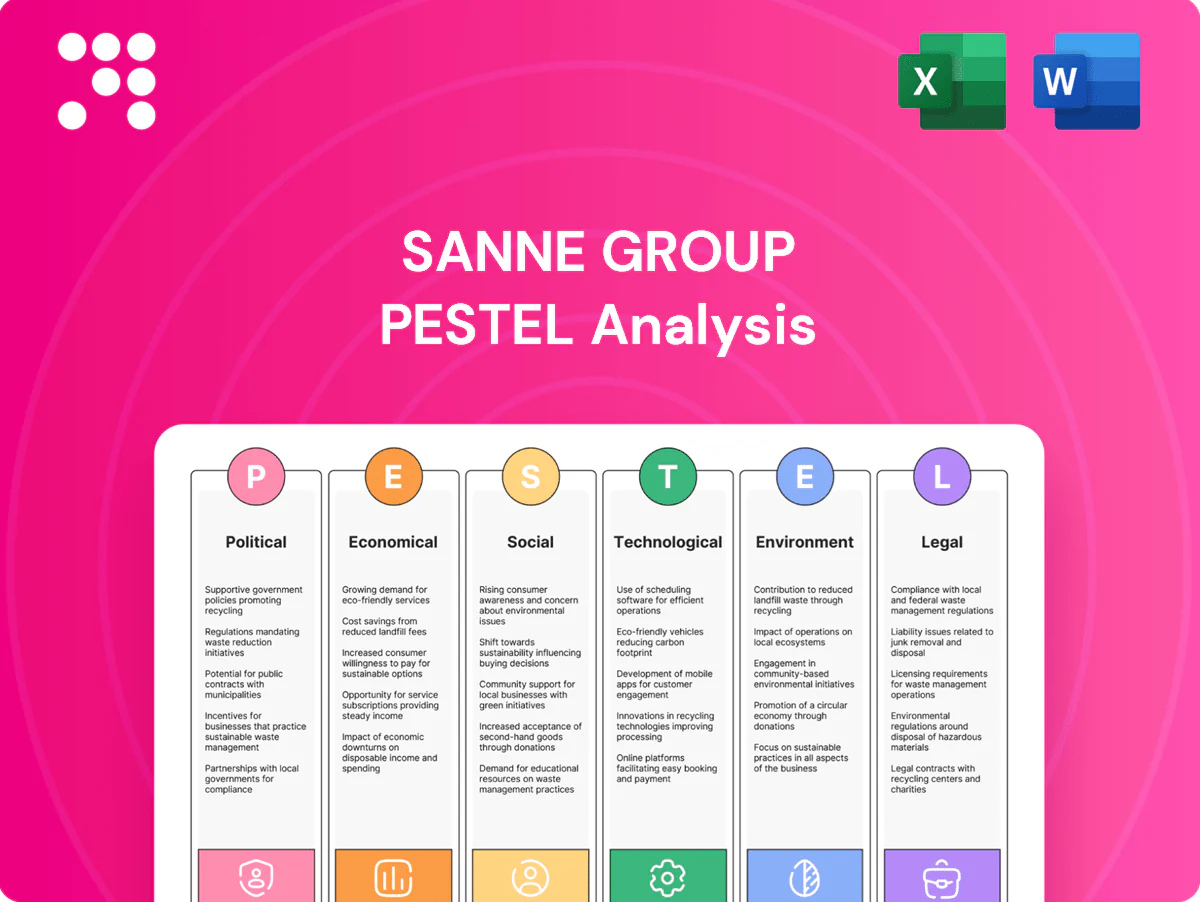
Sanne Group PESTLE Analysis

Make Smarter Strategic Decisions with a Complete PESTEL View
Unlock strategic clarity with our PESTLE analysis of Sanne Group—three to five expert-level insights highlight how political, economic, and regulatory shifts influence growth and risk. This concise briefing reveals tech and environmental trends shaping operations. Purchase the full report to access deep, actionable intelligence ready for investment theses and boardroom strategy.
Political factors

Multi-jurisdiction regulatory regimes
Operating across Jersey, Luxembourg, Ireland and Cayman exposes Sanne to shifting supervisory expectations that affect licensing, reporting cadence and permissible services; Apex agreed a takeover of Sanne in 2022 valued at about £1.1bn, increasing regulatory coordination needs. Integration into Apex magnifies engagement with host regulators and requires harmonizing controls to meet the most stringent standard across jurisdictions.
Brexit and EU-UK fund passport dynamics
Post-Brexit removal of the UK from the EU AIFMD passport (2019) has reshaped distribution, delegation and substance requirements for EU clients, driving many managers to establish EU legal and operational footprints in Ireland and Luxembourg. UK-EU regulatory divergence and equivalence assessments influence compliance costs and structuring choices, making EU contingency domiciles critical for continuity, while ongoing political negotiations can alter cross-border workflows.

Global AML/CFT policy tightening
FATF's 39 members and observers have intensified mutual evaluations, and national AML/CFT reforms are raising KYC and transaction-monitoring burdens across custody and fund services. Heightened political focus on financial crime has driven more audits and higher penalties, pressuring service models to scale automated screening and beneficial ownership transparency. Coordination with Apex's global AML framework enables standardization of controls and reporting across jurisdictions.

Tax policy shifts (OECD BEPS, Pillar Two)
OECD BEPS Pillar Two (15% global minimum tax) and BEPS reforms — now adopted by about 140 jurisdictions — reshape fund and SPV structuring as substance, reporting and minimum tax rules shift client domicile choices and potential tax burdens for MNE-owned vehicles; administrators like Sanne must update compliance, NAV workflows and investor communications to handle wider reporting and top-up tax mechanics.
- Impact: 15% global minimum tax
- Scope: ~140 Inclusive Framework members
- Action: update substance & reporting checks
- Risk: client domicile migration
Sanctions and geopolitics
Evolving sanctions regimes complicate onboarding and asset servicing for Sanne, increasing screening false positives and manual review time and driving higher compliance costs.
Conflicts and great-power tensions raise counterparty risk, requiring rapid sanctions-list updates and political risk mapping to inform client acceptance and ongoing monitoring.
Centralized sanctions governance post-integration reduces fragmentation, enabling consistent escalation, faster decisioning and auditability.
- Sanctions complexity increases compliance workload
- Rapid screening updates required for rising counterparty risk
- Political risk maps should guide client acceptance
- Centralized governance cuts fragmentation
Cross-jurisdiction funds face higher compliance, KYC and 15% BEPS costs
Operating across Jersey, Lux, Ireland and Cayman plus Apex takeover in 2022 (~£1.1bn) raises regulatory coordination and licensing burdens. Post-Brexit UK/EU divergence and AIFMD changes push managers to EU domiciles. FATF (39) AML reforms and sanctions escalation increase KYC costs. OECD BEPS Pillar Two (15%, ~140 jurisdictions) forces substance and reporting updates.
| Impact | Scope | Action | Risk |
|---|---|---|---|
| Higher compliance | 39 FATF; ~140 BEPS | Harmonize controls | Client migration |
What is included in the product
 Detailed Word Document
Explores how macro-environmental factors uniquely affect Sanne Group across Political, Economic, Social, Technological, Environmental and Legal dimensions, each backed by current data and trends to identify threats and opportunities for executives, investors and strategists. Includes forward-looking insights for scenario planning and investor-ready presentation.

 Customizable Excel Spreadsheet
A concise PESTLE summary for Sanne Group highlighting regulatory, economic, and technological risks and opportunities, formatted for quick sharing and presentation-ready so teams can align fast and annotate context-specific actions.
Economic factors

Interest rate and liquidity cycle
Higher policy rates (Fed funds 5.25–5.50% and ECB deposit ~4.00% mid‑2025) have pushed private markets to recalibrate fundraising, valuations and deal activity, with global private capital dry powder around $2.5tn (end‑2024). Cash management, timing of capital calls and credit lines are tightened; administrators must flex headcount between new fund launches and extended closings, and scenario planning should assume slower exits and longer fund lives.
Growth of alternatives AUM
Rising alternatives AUM—with Preqin forecasting ~23tn USD by 2027 and private credit topping ~1.2tn USD in 2023—drives sustained demand for PE, private credit and real assets, while fee compression and scale favor integrated platforms like Apex; broader product sets and multi-jurisdiction coverage become key competitive levers, and operational leverage depends on rigorous process standardization to capture margin upside.

FX volatility across client domiciles
Multi-currency reporting and NAV calculations at Sanne are exposed to FX swings; major pairs saw roughly 8–12% annual moves in 2023–24, amplifying valuation variance. Hedging policy design and disclosure cadence materially affect client satisfaction and redemption risk. Currency mismatches between cost base and revenues compress margins. Robust FX controls and automation reduce processing errors and operational losses.

Consolidation and M&A synergies
The 2023 Apex acquisition of Sanne targets material cross-sell and cost synergies, with management guiding to deliver c.£25m run-rate cost synergies by 2025 while leveraging combined scale to improve margins.
Realising gains requires tight integration discipline to rationalise overlapping systems and teams without service disruption; pricing should be recalibrated to reflect enhanced capability and scale.
- Deal: Apex acquisition of Sanne (2023)
- Target synergies: c.£25m run-rate by 2025
- Focus: systems/team rationalisation, no service disruption
- Pricing: premium to reflect scale and capabilities
Recession risk and LP behavior
Recession risk slows fundraising—global PE fundraising fell about 30% year‑on‑year in 2023 while dry powder remained near $2.5tn in mid‑2024—driving higher secondary market activity and LPs pressing for fee, valuation and liquidity transparency. Administrators face more ad hoc reporting and audits; capacity planning must assume cyclical onboarding surges.
- Fundraising down ~30% (2023)
- Dry powder ~ $2.5tn (mid‑2024)
- LPs demand fee/valuation/liquidity transparency
- Increased ad hoc reporting & audits
- Plan capacity for cyclic onboarding
Cross-jurisdiction funds face higher compliance, KYC and 15% BEPS costs
Higher policy rates (Fed 5.25–5.50% / ECB deposit ~4.0% mid‑2025) and slower fundraising (PE down ~30% in 2023; dry powder ~$2.5tn end‑2024) compress deal activity and extend fund lives. Alternatives AUM set to reach ~$23tn by 2027, boosting admin demand but pressuring fees. FX volatility (8–12% moves 2023–24) and Apex acquisition synergies (c.£25m run‑rate by 2025) drive integration and hedging priorities.
| Metric | Value |
|---|---|
| Fed funds | 5.25–5.50% |
| ECB deposit | ~4.0% |
| Dry powder | $2.5tn (end‑2024) |
| Alt AUM | $23tn (2027 est.) |
| Synergies | c.£25m (2025) |
Full Version Awaits
Sanne Group PESTLE Analysis
The preview shown here is the exact Sanne Group PESTLE Analysis you’ll receive after purchase — fully formatted, professionally structured, and ready to use. It contains the complete political, economic, social, technological, legal and environmental assessment specific to Sanne Group. No placeholders or teasers — this is the final file available for immediate download after checkout.

Make Smarter Strategic Decisions with a Complete PESTEL View
Unlock strategic clarity with our PESTLE analysis of Sanne Group—three to five expert-level insights highlight how political, economic, and regulatory shifts influence growth and risk. This concise briefing reveals tech and environmental trends shaping operations. Purchase the full report to access deep, actionable intelligence ready for investment theses and boardroom strategy.
Political factors
Multi-jurisdiction regulatory regimes
Operating across Jersey, Luxembourg, Ireland and Cayman exposes Sanne to shifting supervisory expectations that affect licensing, reporting cadence and permissible services; Apex agreed a takeover of Sanne in 2022 valued at about £1.1bn, increasing regulatory coordination needs. Integration into Apex magnifies engagement with host regulators and requires harmonizing controls to meet the most stringent standard across jurisdictions.
Brexit and EU-UK fund passport dynamics
Post-Brexit removal of the UK from the EU AIFMD passport (2019) has reshaped distribution, delegation and substance requirements for EU clients, driving many managers to establish EU legal and operational footprints in Ireland and Luxembourg. UK-EU regulatory divergence and equivalence assessments influence compliance costs and structuring choices, making EU contingency domiciles critical for continuity, while ongoing political negotiations can alter cross-border workflows.
Global AML/CFT policy tightening
FATF's 39 members and observers have intensified mutual evaluations, and national AML/CFT reforms are raising KYC and transaction-monitoring burdens across custody and fund services. Heightened political focus on financial crime has driven more audits and higher penalties, pressuring service models to scale automated screening and beneficial ownership transparency. Coordination with Apex's global AML framework enables standardization of controls and reporting across jurisdictions.
Tax policy shifts (OECD BEPS, Pillar Two)
OECD BEPS Pillar Two (15% global minimum tax) and BEPS reforms — now adopted by about 140 jurisdictions — reshape fund and SPV structuring as substance, reporting and minimum tax rules shift client domicile choices and potential tax burdens for MNE-owned vehicles; administrators like Sanne must update compliance, NAV workflows and investor communications to handle wider reporting and top-up tax mechanics.
- Impact: 15% global minimum tax
- Scope: ~140 Inclusive Framework members
- Action: update substance & reporting checks
- Risk: client domicile migration
Sanctions and geopolitics
Evolving sanctions regimes complicate onboarding and asset servicing for Sanne, increasing screening false positives and manual review time and driving higher compliance costs.
Conflicts and great-power tensions raise counterparty risk, requiring rapid sanctions-list updates and political risk mapping to inform client acceptance and ongoing monitoring.
Centralized sanctions governance post-integration reduces fragmentation, enabling consistent escalation, faster decisioning and auditability.
- Sanctions complexity increases compliance workload
- Rapid screening updates required for rising counterparty risk
- Political risk maps should guide client acceptance
- Centralized governance cuts fragmentation
Cross-jurisdiction funds face higher compliance, KYC and 15% BEPS costs
Operating across Jersey, Lux, Ireland and Cayman plus Apex takeover in 2022 (~£1.1bn) raises regulatory coordination and licensing burdens. Post-Brexit UK/EU divergence and AIFMD changes push managers to EU domiciles. FATF (39) AML reforms and sanctions escalation increase KYC costs. OECD BEPS Pillar Two (15%, ~140 jurisdictions) forces substance and reporting updates.
| Impact | Scope | Action | Risk |
|---|---|---|---|
| Higher compliance | 39 FATF; ~140 BEPS | Harmonize controls | Client migration |
What is included in the product
Detailed Word Document
Explores how macro-environmental factors uniquely affect Sanne Group across Political, Economic, Social, Technological, Environmental and Legal dimensions, each backed by current data and trends to identify threats and opportunities for executives, investors and strategists. Includes forward-looking insights for scenario planning and investor-ready presentation.
Customizable Excel Spreadsheet
A concise PESTLE summary for Sanne Group highlighting regulatory, economic, and technological risks and opportunities, formatted for quick sharing and presentation-ready so teams can align fast and annotate context-specific actions.
Economic factors
Interest rate and liquidity cycle
Higher policy rates (Fed funds 5.25–5.50% and ECB deposit ~4.00% mid‑2025) have pushed private markets to recalibrate fundraising, valuations and deal activity, with global private capital dry powder around $2.5tn (end‑2024). Cash management, timing of capital calls and credit lines are tightened; administrators must flex headcount between new fund launches and extended closings, and scenario planning should assume slower exits and longer fund lives.
Growth of alternatives AUM
Rising alternatives AUM—with Preqin forecasting ~23tn USD by 2027 and private credit topping ~1.2tn USD in 2023—drives sustained demand for PE, private credit and real assets, while fee compression and scale favor integrated platforms like Apex; broader product sets and multi-jurisdiction coverage become key competitive levers, and operational leverage depends on rigorous process standardization to capture margin upside.
FX volatility across client domiciles
Multi-currency reporting and NAV calculations at Sanne are exposed to FX swings; major pairs saw roughly 8–12% annual moves in 2023–24, amplifying valuation variance. Hedging policy design and disclosure cadence materially affect client satisfaction and redemption risk. Currency mismatches between cost base and revenues compress margins. Robust FX controls and automation reduce processing errors and operational losses.
Consolidation and M&A synergies
The 2023 Apex acquisition of Sanne targets material cross-sell and cost synergies, with management guiding to deliver c.£25m run-rate cost synergies by 2025 while leveraging combined scale to improve margins.
Realising gains requires tight integration discipline to rationalise overlapping systems and teams without service disruption; pricing should be recalibrated to reflect enhanced capability and scale.
- Deal: Apex acquisition of Sanne (2023)
- Target synergies: c.£25m run-rate by 2025
- Focus: systems/team rationalisation, no service disruption
- Pricing: premium to reflect scale and capabilities
Recession risk and LP behavior
Recession risk slows fundraising—global PE fundraising fell about 30% year‑on‑year in 2023 while dry powder remained near $2.5tn in mid‑2024—driving higher secondary market activity and LPs pressing for fee, valuation and liquidity transparency. Administrators face more ad hoc reporting and audits; capacity planning must assume cyclical onboarding surges.
- Fundraising down ~30% (2023)
- Dry powder ~ $2.5tn (mid‑2024)
- LPs demand fee/valuation/liquidity transparency
- Increased ad hoc reporting & audits
- Plan capacity for cyclic onboarding
Cross-jurisdiction funds face higher compliance, KYC and 15% BEPS costs
Higher policy rates (Fed 5.25–5.50% / ECB deposit ~4.0% mid‑2025) and slower fundraising (PE down ~30% in 2023; dry powder ~$2.5tn end‑2024) compress deal activity and extend fund lives. Alternatives AUM set to reach ~$23tn by 2027, boosting admin demand but pressuring fees. FX volatility (8–12% moves 2023–24) and Apex acquisition synergies (c.£25m run‑rate by 2025) drive integration and hedging priorities.
| Metric | Value |
|---|---|
| Fed funds | 5.25–5.50% |
| ECB deposit | ~4.0% |
| Dry powder | $2.5tn (end‑2024) |
| Alt AUM | $23tn (2027 est.) |
| Synergies | c.£25m (2025) |
Full Version Awaits
Sanne Group PESTLE Analysis
The preview shown here is the exact Sanne Group PESTLE Analysis you’ll receive after purchase — fully formatted, professionally structured, and ready to use. It contains the complete political, economic, social, technological, legal and environmental assessment specific to Sanne Group. No placeholders or teasers — this is the final file available for immediate download after checkout.
Description
Make Smarter Strategic Decisions with a Complete PESTEL View
Unlock strategic clarity with our PESTLE analysis of Sanne Group—three to five expert-level insights highlight how political, economic, and regulatory shifts influence growth and risk. This concise briefing reveals tech and environmental trends shaping operations. Purchase the full report to access deep, actionable intelligence ready for investment theses and boardroom strategy.
Political factors
Multi-jurisdiction regulatory regimes
Operating across Jersey, Luxembourg, Ireland and Cayman exposes Sanne to shifting supervisory expectations that affect licensing, reporting cadence and permissible services; Apex agreed a takeover of Sanne in 2022 valued at about £1.1bn, increasing regulatory coordination needs. Integration into Apex magnifies engagement with host regulators and requires harmonizing controls to meet the most stringent standard across jurisdictions.
Brexit and EU-UK fund passport dynamics
Post-Brexit removal of the UK from the EU AIFMD passport (2019) has reshaped distribution, delegation and substance requirements for EU clients, driving many managers to establish EU legal and operational footprints in Ireland and Luxembourg. UK-EU regulatory divergence and equivalence assessments influence compliance costs and structuring choices, making EU contingency domiciles critical for continuity, while ongoing political negotiations can alter cross-border workflows.
Global AML/CFT policy tightening
FATF's 39 members and observers have intensified mutual evaluations, and national AML/CFT reforms are raising KYC and transaction-monitoring burdens across custody and fund services. Heightened political focus on financial crime has driven more audits and higher penalties, pressuring service models to scale automated screening and beneficial ownership transparency. Coordination with Apex's global AML framework enables standardization of controls and reporting across jurisdictions.
Tax policy shifts (OECD BEPS, Pillar Two)
OECD BEPS Pillar Two (15% global minimum tax) and BEPS reforms — now adopted by about 140 jurisdictions — reshape fund and SPV structuring as substance, reporting and minimum tax rules shift client domicile choices and potential tax burdens for MNE-owned vehicles; administrators like Sanne must update compliance, NAV workflows and investor communications to handle wider reporting and top-up tax mechanics.
- Impact: 15% global minimum tax
- Scope: ~140 Inclusive Framework members
- Action: update substance & reporting checks
- Risk: client domicile migration
Sanctions and geopolitics
Evolving sanctions regimes complicate onboarding and asset servicing for Sanne, increasing screening false positives and manual review time and driving higher compliance costs.
Conflicts and great-power tensions raise counterparty risk, requiring rapid sanctions-list updates and political risk mapping to inform client acceptance and ongoing monitoring.
Centralized sanctions governance post-integration reduces fragmentation, enabling consistent escalation, faster decisioning and auditability.
- Sanctions complexity increases compliance workload
- Rapid screening updates required for rising counterparty risk
- Political risk maps should guide client acceptance
- Centralized governance cuts fragmentation
Cross-jurisdiction funds face higher compliance, KYC and 15% BEPS costs
Operating across Jersey, Lux, Ireland and Cayman plus Apex takeover in 2022 (~£1.1bn) raises regulatory coordination and licensing burdens. Post-Brexit UK/EU divergence and AIFMD changes push managers to EU domiciles. FATF (39) AML reforms and sanctions escalation increase KYC costs. OECD BEPS Pillar Two (15%, ~140 jurisdictions) forces substance and reporting updates.
| Impact | Scope | Action | Risk |
|---|---|---|---|
| Higher compliance | 39 FATF; ~140 BEPS | Harmonize controls | Client migration |
What is included in the product
Detailed Word Document
Explores how macro-environmental factors uniquely affect Sanne Group across Political, Economic, Social, Technological, Environmental and Legal dimensions, each backed by current data and trends to identify threats and opportunities for executives, investors and strategists. Includes forward-looking insights for scenario planning and investor-ready presentation.
Customizable Excel Spreadsheet
A concise PESTLE summary for Sanne Group highlighting regulatory, economic, and technological risks and opportunities, formatted for quick sharing and presentation-ready so teams can align fast and annotate context-specific actions.
Economic factors
Interest rate and liquidity cycle
Higher policy rates (Fed funds 5.25–5.50% and ECB deposit ~4.00% mid‑2025) have pushed private markets to recalibrate fundraising, valuations and deal activity, with global private capital dry powder around $2.5tn (end‑2024). Cash management, timing of capital calls and credit lines are tightened; administrators must flex headcount between new fund launches and extended closings, and scenario planning should assume slower exits and longer fund lives.
Growth of alternatives AUM
Rising alternatives AUM—with Preqin forecasting ~23tn USD by 2027 and private credit topping ~1.2tn USD in 2023—drives sustained demand for PE, private credit and real assets, while fee compression and scale favor integrated platforms like Apex; broader product sets and multi-jurisdiction coverage become key competitive levers, and operational leverage depends on rigorous process standardization to capture margin upside.
FX volatility across client domiciles
Multi-currency reporting and NAV calculations at Sanne are exposed to FX swings; major pairs saw roughly 8–12% annual moves in 2023–24, amplifying valuation variance. Hedging policy design and disclosure cadence materially affect client satisfaction and redemption risk. Currency mismatches between cost base and revenues compress margins. Robust FX controls and automation reduce processing errors and operational losses.
Consolidation and M&A synergies
The 2023 Apex acquisition of Sanne targets material cross-sell and cost synergies, with management guiding to deliver c.£25m run-rate cost synergies by 2025 while leveraging combined scale to improve margins.
Realising gains requires tight integration discipline to rationalise overlapping systems and teams without service disruption; pricing should be recalibrated to reflect enhanced capability and scale.
- Deal: Apex acquisition of Sanne (2023)
- Target synergies: c.£25m run-rate by 2025
- Focus: systems/team rationalisation, no service disruption
- Pricing: premium to reflect scale and capabilities
Recession risk and LP behavior
Recession risk slows fundraising—global PE fundraising fell about 30% year‑on‑year in 2023 while dry powder remained near $2.5tn in mid‑2024—driving higher secondary market activity and LPs pressing for fee, valuation and liquidity transparency. Administrators face more ad hoc reporting and audits; capacity planning must assume cyclical onboarding surges.
- Fundraising down ~30% (2023)
- Dry powder ~ $2.5tn (mid‑2024)
- LPs demand fee/valuation/liquidity transparency
- Increased ad hoc reporting & audits
- Plan capacity for cyclic onboarding
Cross-jurisdiction funds face higher compliance, KYC and 15% BEPS costs
Higher policy rates (Fed 5.25–5.50% / ECB deposit ~4.0% mid‑2025) and slower fundraising (PE down ~30% in 2023; dry powder ~$2.5tn end‑2024) compress deal activity and extend fund lives. Alternatives AUM set to reach ~$23tn by 2027, boosting admin demand but pressuring fees. FX volatility (8–12% moves 2023–24) and Apex acquisition synergies (c.£25m run‑rate by 2025) drive integration and hedging priorities.
| Metric | Value |
|---|---|
| Fed funds | 5.25–5.50% |
| ECB deposit | ~4.0% |
| Dry powder | $2.5tn (end‑2024) |
| Alt AUM | $23tn (2027 est.) |
| Synergies | c.£25m (2025) |
Full Version Awaits
Sanne Group PESTLE Analysis
The preview shown here is the exact Sanne Group PESTLE Analysis you’ll receive after purchase — fully formatted, professionally structured, and ready to use. It contains the complete political, economic, social, technological, legal and environmental assessment specific to Sanne Group. No placeholders or teasers — this is the final file available for immediate download after checkout.











