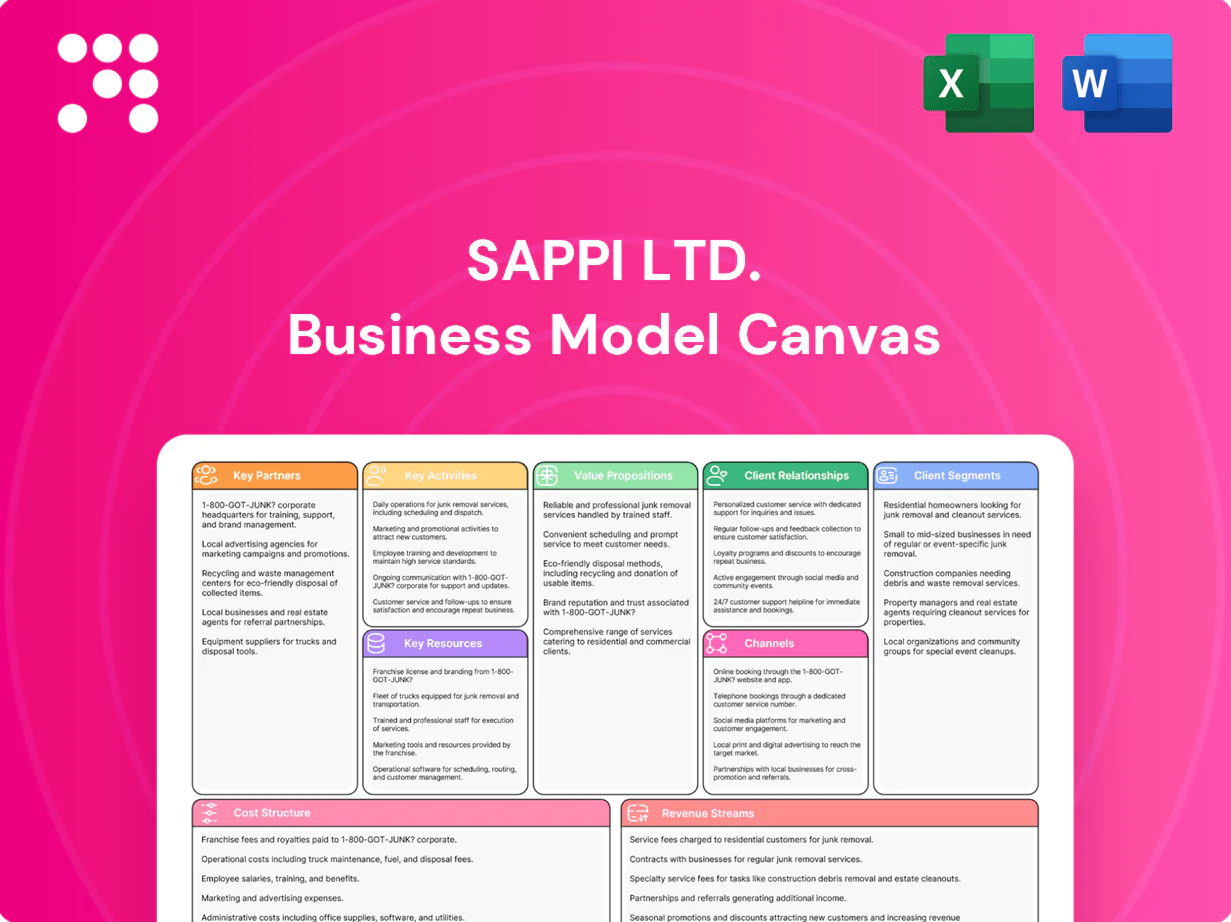
Sappi Ltd. Business Model Canvas

Unlock a pulp and paper Business Model Canvas: value drivers, partners, revenue levers
Unlock Sappi Ltd.’s strategic playbook with our Business Model Canvas — a concise, sector-specific breakdown of value propositions, key partners, revenue engines and cost drivers. Perfect for investors, consultants and founders; purchase the full Word/Excel canvas to analyze tactics, risks and growth levers and apply them to your strategy.
Partnerships

Sustainable forestry and pulpwood suppliers
Secure, certified woodfibre supply underpins Sappi’s mills and product quality, with partners aligned to FSC/PEFC standards as of 2024 to reinforce traceability and sustainability claims. Long-term contracts and grower support programs ensure volume stability and desired species mix across supply regions. Regional sourcing in 2024 reduced transport emissions and mitigated supply risk, supporting consistent mill feedstock and product performance.
Chemicals, enzymes, and specialty additives providers
Strategic suppliers deliver pulping chemicals, bleaching agents, coatings and enzymes that directly impact yield and performance; Sappi, with FY2024 revenue of around US$5.3bn, works with partners to secure these inputs. Joint process optimization projects cut costs and CO2 intensity, while supply-assurance contracts and hedging frameworks mitigate price volatility. Co-development yields tailored formulations for speciality grades, improving margins and product performance.

Equipment OEMs and mill technology partners
In 2024 Sappi deepened OEM and mill-technology partnerships to drive debottlenecking, energy efficiency and reliability across its global mills. Predictive maintenance and upgrade programs extended asset life and improved uptime, supported by service SLAs and performance guarantees. Pilots with tech vendors accelerated bio-based innovations and scale-up pathways in 2024.

Certification bodies and sustainability alliances
Sappi’s engagement with FSC and PEFC certification, SBTi-aligned targets and industry platforms validates responsible sourcing and credible climate pathways, with third-party audits strengthening investor and customer trust. Collaboration with certification bodies and peers helps shape best practices and regulatory readiness while joint projects deliver measurable gains in biodiversity, water stewardship and circularity.
- FSC/PEFC: credible chain-of-custody and responsible sourcing
- SBTi: aligns climate targets with science-based pathways
- Third-party audits: enhance stakeholder trust and compliance
- Joint projects: improve biodiversity, water stewardship, circularity
Logistics, converters, and brand-owner co-innovation
Integrated logistics partners optimize multimodal flows to global customers, lowering transit times and costs and supporting Sappi’s scale in fiber-based packaging; global fiber-packaging demand rose about 6% in 2024 (Smithers 2024), accelerating shipments. Converters and printers supply end-use insights that refine specifications and cut waste, while co-innovation with brand owners speeds market adoption. Collaborative design programs have reduced plastic content and improved recyclability across pilots.
- Logistics: multimodal optimization, reduced lead times
- Converters/printers: end-use feedback to refine specs
- Brand co-innovation: faster adoption; 6% market growth 2024
- Design collaboration: less plastic, better recyclability
Certified woodfibre, long-term contracts and tech partnerships boost fibre-packaging margins
Secure, certified woodfibre (FSC/PEFC) and long-term grower contracts underpin mill feedstock and product quality. Strategic suppliers and co-development reduce costs and improve specialty-grade margins; Sappi reported FY2024 revenue ~US$5.3bn. OEM and tech partnerships raised reliability and energy efficiency; global fibre-packaging demand grew ~6% in 2024 (Smithers).
| Metric | 2024 |
|---|---|
| Revenue | ~US$5.3bn |
| Fibre-packaging demand | +6% (Smithers) |
What is included in the product
 Detailed Word Document
A comprehensive Business Model Canvas for Sappi Ltd., detailing customer segments (paper, packaging, textiles), channels, value propositions (sustainable pulp and specialty papers), key activities, partners, resources, cost/revenue structure and competitive advantages, with linked SWOT insights—designed for presentations, investor discussions and strategic decision-making.

 Customizable Excel Spreadsheet
High-level view of Sappi Ltd.’s business model with editable cells to quickly pinpoint value drivers, cost pressures, and revenue streams. Ideal for teams to condense strategy, compare pulp and specialty-paper segments, and save hours on formatting for boardroom-ready reviews.
Activities

Dissolving wood pulp production and optimization
Operate and continuously improve DP lines for textile and consumer applications, maintaining tight control of purity (>92% alpha-cellulose), viscosity and uniformity; process enhancements target 1–3% yield gains, 5–10% lower energy intensity and chemical recovery >95%; long-term contracts cover the majority of volumes, aligning runs with customer specs and lead times.
Manufacturing of packaging, speciality, and printing papers
Sappi runs integrated paper and paperboard machines across North America, Europe and Southern Africa, supporting a FY2024 group turnover of about USD 5.1 billion. Grade mix management optimises coated, speciality and printing paper volumes to balance demand cycles and margins. Coating, calendaring and finishing processes deliver target gloss, smoothness and basis weight tolerances. Robust quality systems ensure consistent runnability for converters and printers.

R&D and product development in bio-based solutions
In 2024 Sappi intensified R&D to develop new fibre-based materials, barrier technologies and functional papers targeting packaging and specialty grades.
Research expanded into lignin, nanocellulose and biocomposites to address adjacent markets and sustainability-driven demand.
Lab-to-mill scaling programs validate cost and performance metrics prior to capital deployment.
Active IP generation secures differentiation and supports pricing power in premium segments.

Sustainable forestry management and certification compliance
Global sales, technical service, and supply chain orchestration
Manage key accounts and regional distributors to ensure broad market coverage and channel alignment; dedicated sales teams coordinate contract pricing and service levels. Technical service engineers work onsite and remotely to optimize customers’ process integration and end-product quality through trials and formulation support. S&OP synchronizes mill capacity with demand variability while logistics execution delivers just-in-time shipments and advances sustainability goals.
Drive FY24 USD 5.1bn via DP lines and mills: improve yield, energy & chemical recovery
Operate and improve DP lines and integrated mills across NA, EU and S Africa to deliver FY2024 revenue ~USD 5.1bn; focus on yield, energy and chemical recovery targets, coating/finishing quality and lab-to-mill R&D in lignin, nanocellulose and biocomposites; maintain sustainable forestry, CDP/GRI disclosure; run account management, technical service, S&OP and logistics.
| KPI | 2024 |
|---|---|
| Group revenue | USD 5.1bn |
| Alpha-cellulose | >92% |
| Chemical recovery | >95% target |
| Energy intensity target | -5–10% |
Delivered as Displayed
Business Model Canvas
The Sappi Ltd. Business Model Canvas shown here is the actual deliverable, not a mockup—this preview is a direct extract from the final file you’ll receive. Upon purchase you’ll get the same ready-to-edit document (Word and Excel), fully formatted with all sections included and free of surprises.

Unlock a pulp and paper Business Model Canvas: value drivers, partners, revenue levers
Unlock Sappi Ltd.’s strategic playbook with our Business Model Canvas — a concise, sector-specific breakdown of value propositions, key partners, revenue engines and cost drivers. Perfect for investors, consultants and founders; purchase the full Word/Excel canvas to analyze tactics, risks and growth levers and apply them to your strategy.
Partnerships
Sustainable forestry and pulpwood suppliers
Secure, certified woodfibre supply underpins Sappi’s mills and product quality, with partners aligned to FSC/PEFC standards as of 2024 to reinforce traceability and sustainability claims. Long-term contracts and grower support programs ensure volume stability and desired species mix across supply regions. Regional sourcing in 2024 reduced transport emissions and mitigated supply risk, supporting consistent mill feedstock and product performance.
Chemicals, enzymes, and specialty additives providers
Strategic suppliers deliver pulping chemicals, bleaching agents, coatings and enzymes that directly impact yield and performance; Sappi, with FY2024 revenue of around US$5.3bn, works with partners to secure these inputs. Joint process optimization projects cut costs and CO2 intensity, while supply-assurance contracts and hedging frameworks mitigate price volatility. Co-development yields tailored formulations for speciality grades, improving margins and product performance.
Equipment OEMs and mill technology partners
In 2024 Sappi deepened OEM and mill-technology partnerships to drive debottlenecking, energy efficiency and reliability across its global mills. Predictive maintenance and upgrade programs extended asset life and improved uptime, supported by service SLAs and performance guarantees. Pilots with tech vendors accelerated bio-based innovations and scale-up pathways in 2024.
Certification bodies and sustainability alliances
Sappi’s engagement with FSC and PEFC certification, SBTi-aligned targets and industry platforms validates responsible sourcing and credible climate pathways, with third-party audits strengthening investor and customer trust. Collaboration with certification bodies and peers helps shape best practices and regulatory readiness while joint projects deliver measurable gains in biodiversity, water stewardship and circularity.
- FSC/PEFC: credible chain-of-custody and responsible sourcing
- SBTi: aligns climate targets with science-based pathways
- Third-party audits: enhance stakeholder trust and compliance
- Joint projects: improve biodiversity, water stewardship, circularity
Logistics, converters, and brand-owner co-innovation
Integrated logistics partners optimize multimodal flows to global customers, lowering transit times and costs and supporting Sappi’s scale in fiber-based packaging; global fiber-packaging demand rose about 6% in 2024 (Smithers 2024), accelerating shipments. Converters and printers supply end-use insights that refine specifications and cut waste, while co-innovation with brand owners speeds market adoption. Collaborative design programs have reduced plastic content and improved recyclability across pilots.
- Logistics: multimodal optimization, reduced lead times
- Converters/printers: end-use feedback to refine specs
- Brand co-innovation: faster adoption; 6% market growth 2024
- Design collaboration: less plastic, better recyclability
Certified woodfibre, long-term contracts and tech partnerships boost fibre-packaging margins
Secure, certified woodfibre (FSC/PEFC) and long-term grower contracts underpin mill feedstock and product quality. Strategic suppliers and co-development reduce costs and improve specialty-grade margins; Sappi reported FY2024 revenue ~US$5.3bn. OEM and tech partnerships raised reliability and energy efficiency; global fibre-packaging demand grew ~6% in 2024 (Smithers).
| Metric | 2024 |
|---|---|
| Revenue | ~US$5.3bn |
| Fibre-packaging demand | +6% (Smithers) |
What is included in the product
Detailed Word Document
A comprehensive Business Model Canvas for Sappi Ltd., detailing customer segments (paper, packaging, textiles), channels, value propositions (sustainable pulp and specialty papers), key activities, partners, resources, cost/revenue structure and competitive advantages, with linked SWOT insights—designed for presentations, investor discussions and strategic decision-making.
Customizable Excel Spreadsheet
High-level view of Sappi Ltd.’s business model with editable cells to quickly pinpoint value drivers, cost pressures, and revenue streams. Ideal for teams to condense strategy, compare pulp and specialty-paper segments, and save hours on formatting for boardroom-ready reviews.
Activities
Dissolving wood pulp production and optimization
Operate and continuously improve DP lines for textile and consumer applications, maintaining tight control of purity (>92% alpha-cellulose), viscosity and uniformity; process enhancements target 1–3% yield gains, 5–10% lower energy intensity and chemical recovery >95%; long-term contracts cover the majority of volumes, aligning runs with customer specs and lead times.
Manufacturing of packaging, speciality, and printing papers
Sappi runs integrated paper and paperboard machines across North America, Europe and Southern Africa, supporting a FY2024 group turnover of about USD 5.1 billion. Grade mix management optimises coated, speciality and printing paper volumes to balance demand cycles and margins. Coating, calendaring and finishing processes deliver target gloss, smoothness and basis weight tolerances. Robust quality systems ensure consistent runnability for converters and printers.
R&D and product development in bio-based solutions
In 2024 Sappi intensified R&D to develop new fibre-based materials, barrier technologies and functional papers targeting packaging and specialty grades.
Research expanded into lignin, nanocellulose and biocomposites to address adjacent markets and sustainability-driven demand.
Lab-to-mill scaling programs validate cost and performance metrics prior to capital deployment.
Active IP generation secures differentiation and supports pricing power in premium segments.
Sustainable forestry management and certification compliance
Global sales, technical service, and supply chain orchestration
Manage key accounts and regional distributors to ensure broad market coverage and channel alignment; dedicated sales teams coordinate contract pricing and service levels. Technical service engineers work onsite and remotely to optimize customers’ process integration and end-product quality through trials and formulation support. S&OP synchronizes mill capacity with demand variability while logistics execution delivers just-in-time shipments and advances sustainability goals.
Drive FY24 USD 5.1bn via DP lines and mills: improve yield, energy & chemical recovery
Operate and improve DP lines and integrated mills across NA, EU and S Africa to deliver FY2024 revenue ~USD 5.1bn; focus on yield, energy and chemical recovery targets, coating/finishing quality and lab-to-mill R&D in lignin, nanocellulose and biocomposites; maintain sustainable forestry, CDP/GRI disclosure; run account management, technical service, S&OP and logistics.
| KPI | 2024 |
|---|---|
| Group revenue | USD 5.1bn |
| Alpha-cellulose | >92% |
| Chemical recovery | >95% target |
| Energy intensity target | -5–10% |
Delivered as Displayed
Business Model Canvas
The Sappi Ltd. Business Model Canvas shown here is the actual deliverable, not a mockup—this preview is a direct extract from the final file you’ll receive. Upon purchase you’ll get the same ready-to-edit document (Word and Excel), fully formatted with all sections included and free of surprises.
Original: $10.00
-65%$10.00
$3.50Description
Unlock a pulp and paper Business Model Canvas: value drivers, partners, revenue levers
Unlock Sappi Ltd.’s strategic playbook with our Business Model Canvas — a concise, sector-specific breakdown of value propositions, key partners, revenue engines and cost drivers. Perfect for investors, consultants and founders; purchase the full Word/Excel canvas to analyze tactics, risks and growth levers and apply them to your strategy.
Partnerships
Sustainable forestry and pulpwood suppliers
Secure, certified woodfibre supply underpins Sappi’s mills and product quality, with partners aligned to FSC/PEFC standards as of 2024 to reinforce traceability and sustainability claims. Long-term contracts and grower support programs ensure volume stability and desired species mix across supply regions. Regional sourcing in 2024 reduced transport emissions and mitigated supply risk, supporting consistent mill feedstock and product performance.
Chemicals, enzymes, and specialty additives providers
Strategic suppliers deliver pulping chemicals, bleaching agents, coatings and enzymes that directly impact yield and performance; Sappi, with FY2024 revenue of around US$5.3bn, works with partners to secure these inputs. Joint process optimization projects cut costs and CO2 intensity, while supply-assurance contracts and hedging frameworks mitigate price volatility. Co-development yields tailored formulations for speciality grades, improving margins and product performance.
Equipment OEMs and mill technology partners
In 2024 Sappi deepened OEM and mill-technology partnerships to drive debottlenecking, energy efficiency and reliability across its global mills. Predictive maintenance and upgrade programs extended asset life and improved uptime, supported by service SLAs and performance guarantees. Pilots with tech vendors accelerated bio-based innovations and scale-up pathways in 2024.
Certification bodies and sustainability alliances
Sappi’s engagement with FSC and PEFC certification, SBTi-aligned targets and industry platforms validates responsible sourcing and credible climate pathways, with third-party audits strengthening investor and customer trust. Collaboration with certification bodies and peers helps shape best practices and regulatory readiness while joint projects deliver measurable gains in biodiversity, water stewardship and circularity.
- FSC/PEFC: credible chain-of-custody and responsible sourcing
- SBTi: aligns climate targets with science-based pathways
- Third-party audits: enhance stakeholder trust and compliance
- Joint projects: improve biodiversity, water stewardship, circularity
Logistics, converters, and brand-owner co-innovation
Integrated logistics partners optimize multimodal flows to global customers, lowering transit times and costs and supporting Sappi’s scale in fiber-based packaging; global fiber-packaging demand rose about 6% in 2024 (Smithers 2024), accelerating shipments. Converters and printers supply end-use insights that refine specifications and cut waste, while co-innovation with brand owners speeds market adoption. Collaborative design programs have reduced plastic content and improved recyclability across pilots.
- Logistics: multimodal optimization, reduced lead times
- Converters/printers: end-use feedback to refine specs
- Brand co-innovation: faster adoption; 6% market growth 2024
- Design collaboration: less plastic, better recyclability
Certified woodfibre, long-term contracts and tech partnerships boost fibre-packaging margins
Secure, certified woodfibre (FSC/PEFC) and long-term grower contracts underpin mill feedstock and product quality. Strategic suppliers and co-development reduce costs and improve specialty-grade margins; Sappi reported FY2024 revenue ~US$5.3bn. OEM and tech partnerships raised reliability and energy efficiency; global fibre-packaging demand grew ~6% in 2024 (Smithers).
| Metric | 2024 |
|---|---|
| Revenue | ~US$5.3bn |
| Fibre-packaging demand | +6% (Smithers) |
What is included in the product
Detailed Word Document
A comprehensive Business Model Canvas for Sappi Ltd., detailing customer segments (paper, packaging, textiles), channels, value propositions (sustainable pulp and specialty papers), key activities, partners, resources, cost/revenue structure and competitive advantages, with linked SWOT insights—designed for presentations, investor discussions and strategic decision-making.
Customizable Excel Spreadsheet
High-level view of Sappi Ltd.’s business model with editable cells to quickly pinpoint value drivers, cost pressures, and revenue streams. Ideal for teams to condense strategy, compare pulp and specialty-paper segments, and save hours on formatting for boardroom-ready reviews.
Activities
Dissolving wood pulp production and optimization
Operate and continuously improve DP lines for textile and consumer applications, maintaining tight control of purity (>92% alpha-cellulose), viscosity and uniformity; process enhancements target 1–3% yield gains, 5–10% lower energy intensity and chemical recovery >95%; long-term contracts cover the majority of volumes, aligning runs with customer specs and lead times.
Manufacturing of packaging, speciality, and printing papers
Sappi runs integrated paper and paperboard machines across North America, Europe and Southern Africa, supporting a FY2024 group turnover of about USD 5.1 billion. Grade mix management optimises coated, speciality and printing paper volumes to balance demand cycles and margins. Coating, calendaring and finishing processes deliver target gloss, smoothness and basis weight tolerances. Robust quality systems ensure consistent runnability for converters and printers.
R&D and product development in bio-based solutions
In 2024 Sappi intensified R&D to develop new fibre-based materials, barrier technologies and functional papers targeting packaging and specialty grades.
Research expanded into lignin, nanocellulose and biocomposites to address adjacent markets and sustainability-driven demand.
Lab-to-mill scaling programs validate cost and performance metrics prior to capital deployment.
Active IP generation secures differentiation and supports pricing power in premium segments.
Sustainable forestry management and certification compliance
Global sales, technical service, and supply chain orchestration
Manage key accounts and regional distributors to ensure broad market coverage and channel alignment; dedicated sales teams coordinate contract pricing and service levels. Technical service engineers work onsite and remotely to optimize customers’ process integration and end-product quality through trials and formulation support. S&OP synchronizes mill capacity with demand variability while logistics execution delivers just-in-time shipments and advances sustainability goals.
Drive FY24 USD 5.1bn via DP lines and mills: improve yield, energy & chemical recovery
Operate and improve DP lines and integrated mills across NA, EU and S Africa to deliver FY2024 revenue ~USD 5.1bn; focus on yield, energy and chemical recovery targets, coating/finishing quality and lab-to-mill R&D in lignin, nanocellulose and biocomposites; maintain sustainable forestry, CDP/GRI disclosure; run account management, technical service, S&OP and logistics.
| KPI | 2024 |
|---|---|
| Group revenue | USD 5.1bn |
| Alpha-cellulose | >92% |
| Chemical recovery | >95% target |
| Energy intensity target | -5–10% |
Delivered as Displayed
Business Model Canvas
The Sappi Ltd. Business Model Canvas shown here is the actual deliverable, not a mockup—this preview is a direct extract from the final file you’ll receive. Upon purchase you’ll get the same ready-to-edit document (Word and Excel), fully formatted with all sections included and free of surprises.











