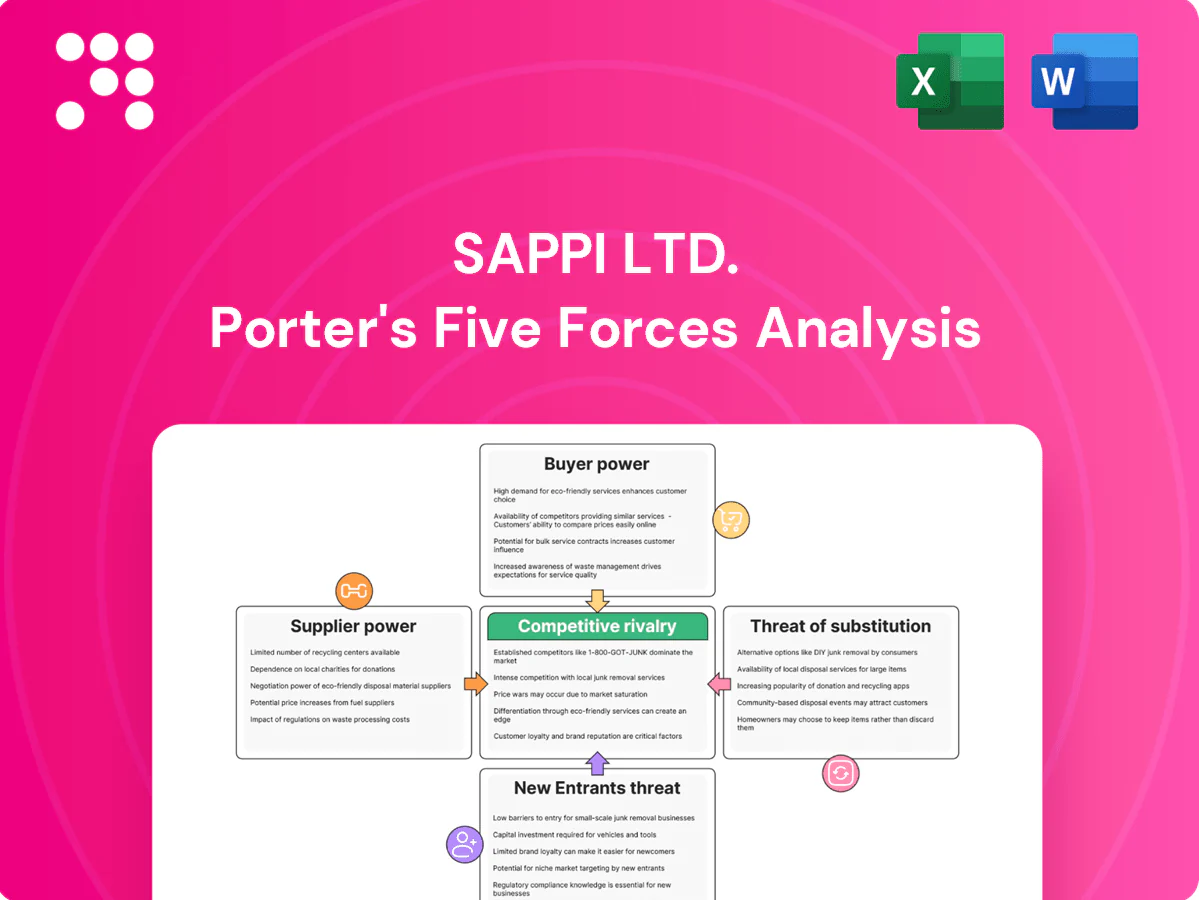
Sappi Ltd. Porter's Five Forces Analysis

Elevate Your Analysis with the Complete Porter's Five Forces Analysis
Sappi Ltd. faces moderate supplier power due to integrated pulp sources and global contracts; demand cyclicality and commodity pricing amplify buyer pressure and margin volatility. Barriers to entry remain high, yet substitutes and digital disruption pose long-term threats. This preview is just the beginning. The full analysis provides a complete strategic snapshot with force-by-force ratings, visuals, and business implications tailored to Sappi Ltd.
Suppliers Bargaining Power

Concentrated timber sources
Sappi relies on sustainably managed, long-rotation timber sourced from concentrated regional suppliers, increasing supplier leverage where concessions or large private growers dominate procurement. Sappi reported in its 2024 annual report that over 90% of its woodfibre came from certified or controlled sources, which narrows qualified suppliers and raises supplier power. Long-term contracts and owned/managed forestry mitigate supply risk but reduce sourcing flexibility.
Specialty chemicals and pulp additives
Dissolving pulp and specialty papers rely on tailored chemicals, enzymes and bleaching agents supplied by a concentrated set of global players such as Kemira, Solvay, Clariant and BASF, giving suppliers pricing leverage during 2024 tightness in key raw materials. Switching costs are material because process requalification and performance guarantees lock buyers in. Sappi mitigates risk through strategic sourcing and dual-supply programs.

Energy and logistics volatility
Sappi's pulp and paper operations are highly exposed to utilities, fuel and shipping suppliers—Brent averaged about $80–90/bbl in 2024 and container freight rates remained elevated versus pre-2019 levels—tightening supplier leverage. Regional power constraints and port congestion cause episodic cost spikes; EU carbon permits averaged near €60/t in 2024, adding pass-through costs. Hedging and on-site energy projects materially reduce but do not eliminate this supplier-driven volatility.

Capital equipment and maintenance
Capital equipment and maintenance for Sappi rely on a concentrated OEM set—Voith, Valmet, ANDRITZ—supplying paper machines, recovery boilers and specialty converters, creating vendor lock-in via proprietary spares and service contracts; switching costs are high and planned shutdowns make supplier response time critical, with downtime losses often in the hundreds of thousands of USD per day (2024 industry data). Framework agreements help cap price volatility but do not remove technical dependence.
- OEM concentration: 3 primary suppliers
- Downtime impact: hundreds of thousands USD/day (2024)
- High switching costs from proprietary spares & contracts
- Frameworks reduce price risk, not technical lock-in
Sustainability certifications
FSC and PEFC-certified fiber and chain-of-custody traceability are mandatory for Sappi’s major brand customers, narrowing the eligible supplier pool and pressuring input costs; global certified forest area was ~220 million hectares in 2024, concentrating supply. Certification lapses or regional fiber scarcity amplify supplier leverage and price volatility, while supplier-development programs improve compliance but require multiple years to scale.
- Mandatory certified fiber: restricts suppliers
- ~220M ha certified (2024): concentrated supply
- Lapses/scarcity increase supplier power
- Collaboration programs: multi-year scale-up
Supplier power: >90% fibre, 3 OEMs, Brent $80-90, €60/t
Sappi faces high supplier power: >90% woodfibre certified (2024) narrows supplier pool; OEM concentration (3) and proprietary spares create high switching costs; chemicals and utilities saw 2024 pressure — Brent $80–90/bbl, EU carbon ~€60/t; strategic sourcing, hedging and on-site energy reduce but do not remove risk.
| Supplier | 2024 metric | Impact |
|---|---|---|
| Woodfibre | >90% certified | Higher leverage |
| OEMs | 3 main | High switching cost |
| Energy/chem | Brent $80–90; €60/t | Cost volatility |
What is included in the product
 Detailed Word Document
Tailored exclusively for Sappi Ltd., analyzes competitive forces, supplier and buyer power, substitutes, entry barriers, and disruptive threats to its market share.

 Customizable Excel Spreadsheet
Clear one-sheet summary of Sappi Ltd.’s Porter's Five Forces with customizable pressure levels and an instant spider chart—quickly pinpoint competitive pain points and copy-ready for pitch decks, dashboards, or boardroom slides.
Customers Bargaining Power

Concentrated industrial buyers
In 2024 Sappi’s dissolving pulp sales are dominated by large viscose staple fiber producers buying in high volumes, giving these industrial customers strong bargaining leverage. Their scale enables tough price negotiations and higher service-level demands, compressing Sappi’s margins despite multi-year contract visibility that stabilizes volumes. Expanding into cellulose derivatives and specialty markets can dilute this buyer concentration and improve pricing flexibility.
Converters and brand owners
Converters and global brand owners exert strong leverage over Sappi in packaging and specialty papers, where 2024 group sales ~USD 4.6bn underscore scale pressures; specifications and benchmarking are tight, so performance differentiation is often modest. Large multi-year tenders and supply programs magnify buyer power, while co-development of unique substrates and tailored coatings has created stickiness that limits pure price-driven switching.

Substitution and specification flexibility
Buyers can switch between grades, suppliers or alternative materials—raising bargaining power in oversupplied markets—despite qualification cycles of typically 6–24 months that prevent instant shifts. Sappi’s global footprint of 13 mills helps it defend margins via specialty grades and service reliability, making lower-cost substitutes less attractive.

Price transparency and indices
Global pulp and paper indices such as FOEX and PIX make market movements visible to Sappi buyers, increasing customer bargaining power by reducing information asymmetry.
Index-linked contracts rapidly pass through market declines, which compresses Sappi margins in downcycles and shortens time to market price adjustments.
To sustain premiums, Sappi must justify them via demonstrable quality, service or sustainability credentials (certifications like FSC/PEFC and recycled-content claims).
- Indices referenced: FOEX, PIX
- Effect: faster pass-through of price declines
- Impact: margin compression in downcycles
- Mitigation: justify premiums with quality, service, sustainability
Sustainability demands
Buyers increasingly demand low-carbon, certified, and recyclable paper and packaging; Sappi's 2024 Sustainability Report emphasizes traceability and credible ESG data as commercial priorities, shifting negotiation leverage toward customers who set standards.
These requirements can raise production costs and marginalize suppliers that cannot verify claims, yet Sappi can command premiums when it outperforms peers on certification, recycled content, and emissions intensity.
- 2024: traceability and ESG data highlighted in Sappi’s sustainability reporting
- Buyers set standards, increasing negotiation leverage
- Premium pricing possible for best-in-class ESG performance
2024: USD 4.6bn, 13 mills — buyer power, index-linked margins, certified premiums
In 2024 Sappi faces strong buyer power from large viscose producers and converters, with group sales ~USD 4.6bn and 13 mills providing some defence via specialty grades. Index transparency (FOEX, PIX) and index-linked contracts accelerate pass-throughs, compressing margins in downturns. Superior certification and traceability (FSC/PEFC, 2024 sustainability emphasis) enable premium pricing.
| Metric | 2024 |
|---|---|
| Group sales | ~USD 4.6bn |
| Mills | 13 |
| Key indices | FOEX, PIX |
Preview the Actual Deliverable
Sappi Ltd. Porter's Five Forces Analysis
This preview shows the exact Porter’s Five Forces analysis of Sappi Ltd. you'll receive immediately after purchase—no placeholders or samples. The document is fully formatted and ready to download for strategic, competitive or investment use. You’ll get instant access to this identical file upon payment.

Elevate Your Analysis with the Complete Porter's Five Forces Analysis
Sappi Ltd. faces moderate supplier power due to integrated pulp sources and global contracts; demand cyclicality and commodity pricing amplify buyer pressure and margin volatility. Barriers to entry remain high, yet substitutes and digital disruption pose long-term threats. This preview is just the beginning. The full analysis provides a complete strategic snapshot with force-by-force ratings, visuals, and business implications tailored to Sappi Ltd.
Suppliers Bargaining Power
Concentrated timber sources
Sappi relies on sustainably managed, long-rotation timber sourced from concentrated regional suppliers, increasing supplier leverage where concessions or large private growers dominate procurement. Sappi reported in its 2024 annual report that over 90% of its woodfibre came from certified or controlled sources, which narrows qualified suppliers and raises supplier power. Long-term contracts and owned/managed forestry mitigate supply risk but reduce sourcing flexibility.
Specialty chemicals and pulp additives
Dissolving pulp and specialty papers rely on tailored chemicals, enzymes and bleaching agents supplied by a concentrated set of global players such as Kemira, Solvay, Clariant and BASF, giving suppliers pricing leverage during 2024 tightness in key raw materials. Switching costs are material because process requalification and performance guarantees lock buyers in. Sappi mitigates risk through strategic sourcing and dual-supply programs.
Energy and logistics volatility
Sappi's pulp and paper operations are highly exposed to utilities, fuel and shipping suppliers—Brent averaged about $80–90/bbl in 2024 and container freight rates remained elevated versus pre-2019 levels—tightening supplier leverage. Regional power constraints and port congestion cause episodic cost spikes; EU carbon permits averaged near €60/t in 2024, adding pass-through costs. Hedging and on-site energy projects materially reduce but do not eliminate this supplier-driven volatility.
Capital equipment and maintenance
Capital equipment and maintenance for Sappi rely on a concentrated OEM set—Voith, Valmet, ANDRITZ—supplying paper machines, recovery boilers and specialty converters, creating vendor lock-in via proprietary spares and service contracts; switching costs are high and planned shutdowns make supplier response time critical, with downtime losses often in the hundreds of thousands of USD per day (2024 industry data). Framework agreements help cap price volatility but do not remove technical dependence.
- OEM concentration: 3 primary suppliers
- Downtime impact: hundreds of thousands USD/day (2024)
- High switching costs from proprietary spares & contracts
- Frameworks reduce price risk, not technical lock-in
Sustainability certifications
FSC and PEFC-certified fiber and chain-of-custody traceability are mandatory for Sappi’s major brand customers, narrowing the eligible supplier pool and pressuring input costs; global certified forest area was ~220 million hectares in 2024, concentrating supply. Certification lapses or regional fiber scarcity amplify supplier leverage and price volatility, while supplier-development programs improve compliance but require multiple years to scale.
- Mandatory certified fiber: restricts suppliers
- ~220M ha certified (2024): concentrated supply
- Lapses/scarcity increase supplier power
- Collaboration programs: multi-year scale-up
Supplier power: >90% fibre, 3 OEMs, Brent $80-90, €60/t
Sappi faces high supplier power: >90% woodfibre certified (2024) narrows supplier pool; OEM concentration (3) and proprietary spares create high switching costs; chemicals and utilities saw 2024 pressure — Brent $80–90/bbl, EU carbon ~€60/t; strategic sourcing, hedging and on-site energy reduce but do not remove risk.
| Supplier | 2024 metric | Impact |
|---|---|---|
| Woodfibre | >90% certified | Higher leverage |
| OEMs | 3 main | High switching cost |
| Energy/chem | Brent $80–90; €60/t | Cost volatility |
What is included in the product
Detailed Word Document
Tailored exclusively for Sappi Ltd., analyzes competitive forces, supplier and buyer power, substitutes, entry barriers, and disruptive threats to its market share.
Customizable Excel Spreadsheet
Clear one-sheet summary of Sappi Ltd.’s Porter's Five Forces with customizable pressure levels and an instant spider chart—quickly pinpoint competitive pain points and copy-ready for pitch decks, dashboards, or boardroom slides.
Customers Bargaining Power
Concentrated industrial buyers
In 2024 Sappi’s dissolving pulp sales are dominated by large viscose staple fiber producers buying in high volumes, giving these industrial customers strong bargaining leverage. Their scale enables tough price negotiations and higher service-level demands, compressing Sappi’s margins despite multi-year contract visibility that stabilizes volumes. Expanding into cellulose derivatives and specialty markets can dilute this buyer concentration and improve pricing flexibility.
Converters and brand owners
Converters and global brand owners exert strong leverage over Sappi in packaging and specialty papers, where 2024 group sales ~USD 4.6bn underscore scale pressures; specifications and benchmarking are tight, so performance differentiation is often modest. Large multi-year tenders and supply programs magnify buyer power, while co-development of unique substrates and tailored coatings has created stickiness that limits pure price-driven switching.
Substitution and specification flexibility
Buyers can switch between grades, suppliers or alternative materials—raising bargaining power in oversupplied markets—despite qualification cycles of typically 6–24 months that prevent instant shifts. Sappi’s global footprint of 13 mills helps it defend margins via specialty grades and service reliability, making lower-cost substitutes less attractive.
Price transparency and indices
Global pulp and paper indices such as FOEX and PIX make market movements visible to Sappi buyers, increasing customer bargaining power by reducing information asymmetry.
Index-linked contracts rapidly pass through market declines, which compresses Sappi margins in downcycles and shortens time to market price adjustments.
To sustain premiums, Sappi must justify them via demonstrable quality, service or sustainability credentials (certifications like FSC/PEFC and recycled-content claims).
- Indices referenced: FOEX, PIX
- Effect: faster pass-through of price declines
- Impact: margin compression in downcycles
- Mitigation: justify premiums with quality, service, sustainability
Sustainability demands
Buyers increasingly demand low-carbon, certified, and recyclable paper and packaging; Sappi's 2024 Sustainability Report emphasizes traceability and credible ESG data as commercial priorities, shifting negotiation leverage toward customers who set standards.
These requirements can raise production costs and marginalize suppliers that cannot verify claims, yet Sappi can command premiums when it outperforms peers on certification, recycled content, and emissions intensity.
- 2024: traceability and ESG data highlighted in Sappi’s sustainability reporting
- Buyers set standards, increasing negotiation leverage
- Premium pricing possible for best-in-class ESG performance
2024: USD 4.6bn, 13 mills — buyer power, index-linked margins, certified premiums
In 2024 Sappi faces strong buyer power from large viscose producers and converters, with group sales ~USD 4.6bn and 13 mills providing some defence via specialty grades. Index transparency (FOEX, PIX) and index-linked contracts accelerate pass-throughs, compressing margins in downturns. Superior certification and traceability (FSC/PEFC, 2024 sustainability emphasis) enable premium pricing.
| Metric | 2024 |
|---|---|
| Group sales | ~USD 4.6bn |
| Mills | 13 |
| Key indices | FOEX, PIX |
Preview the Actual Deliverable
Sappi Ltd. Porter's Five Forces Analysis
This preview shows the exact Porter’s Five Forces analysis of Sappi Ltd. you'll receive immediately after purchase—no placeholders or samples. The document is fully formatted and ready to download for strategic, competitive or investment use. You’ll get instant access to this identical file upon payment.
Original: $10.00
-65%$10.00
$3.50Description
Elevate Your Analysis with the Complete Porter's Five Forces Analysis
Sappi Ltd. faces moderate supplier power due to integrated pulp sources and global contracts; demand cyclicality and commodity pricing amplify buyer pressure and margin volatility. Barriers to entry remain high, yet substitutes and digital disruption pose long-term threats. This preview is just the beginning. The full analysis provides a complete strategic snapshot with force-by-force ratings, visuals, and business implications tailored to Sappi Ltd.
Suppliers Bargaining Power
Concentrated timber sources
Sappi relies on sustainably managed, long-rotation timber sourced from concentrated regional suppliers, increasing supplier leverage where concessions or large private growers dominate procurement. Sappi reported in its 2024 annual report that over 90% of its woodfibre came from certified or controlled sources, which narrows qualified suppliers and raises supplier power. Long-term contracts and owned/managed forestry mitigate supply risk but reduce sourcing flexibility.
Specialty chemicals and pulp additives
Dissolving pulp and specialty papers rely on tailored chemicals, enzymes and bleaching agents supplied by a concentrated set of global players such as Kemira, Solvay, Clariant and BASF, giving suppliers pricing leverage during 2024 tightness in key raw materials. Switching costs are material because process requalification and performance guarantees lock buyers in. Sappi mitigates risk through strategic sourcing and dual-supply programs.
Energy and logistics volatility
Sappi's pulp and paper operations are highly exposed to utilities, fuel and shipping suppliers—Brent averaged about $80–90/bbl in 2024 and container freight rates remained elevated versus pre-2019 levels—tightening supplier leverage. Regional power constraints and port congestion cause episodic cost spikes; EU carbon permits averaged near €60/t in 2024, adding pass-through costs. Hedging and on-site energy projects materially reduce but do not eliminate this supplier-driven volatility.
Capital equipment and maintenance
Capital equipment and maintenance for Sappi rely on a concentrated OEM set—Voith, Valmet, ANDRITZ—supplying paper machines, recovery boilers and specialty converters, creating vendor lock-in via proprietary spares and service contracts; switching costs are high and planned shutdowns make supplier response time critical, with downtime losses often in the hundreds of thousands of USD per day (2024 industry data). Framework agreements help cap price volatility but do not remove technical dependence.
- OEM concentration: 3 primary suppliers
- Downtime impact: hundreds of thousands USD/day (2024)
- High switching costs from proprietary spares & contracts
- Frameworks reduce price risk, not technical lock-in
Sustainability certifications
FSC and PEFC-certified fiber and chain-of-custody traceability are mandatory for Sappi’s major brand customers, narrowing the eligible supplier pool and pressuring input costs; global certified forest area was ~220 million hectares in 2024, concentrating supply. Certification lapses or regional fiber scarcity amplify supplier leverage and price volatility, while supplier-development programs improve compliance but require multiple years to scale.
- Mandatory certified fiber: restricts suppliers
- ~220M ha certified (2024): concentrated supply
- Lapses/scarcity increase supplier power
- Collaboration programs: multi-year scale-up
Supplier power: >90% fibre, 3 OEMs, Brent $80-90, €60/t
Sappi faces high supplier power: >90% woodfibre certified (2024) narrows supplier pool; OEM concentration (3) and proprietary spares create high switching costs; chemicals and utilities saw 2024 pressure — Brent $80–90/bbl, EU carbon ~€60/t; strategic sourcing, hedging and on-site energy reduce but do not remove risk.
| Supplier | 2024 metric | Impact |
|---|---|---|
| Woodfibre | >90% certified | Higher leverage |
| OEMs | 3 main | High switching cost |
| Energy/chem | Brent $80–90; €60/t | Cost volatility |
What is included in the product
Detailed Word Document
Tailored exclusively for Sappi Ltd., analyzes competitive forces, supplier and buyer power, substitutes, entry barriers, and disruptive threats to its market share.
Customizable Excel Spreadsheet
Clear one-sheet summary of Sappi Ltd.’s Porter's Five Forces with customizable pressure levels and an instant spider chart—quickly pinpoint competitive pain points and copy-ready for pitch decks, dashboards, or boardroom slides.
Customers Bargaining Power
Concentrated industrial buyers
In 2024 Sappi’s dissolving pulp sales are dominated by large viscose staple fiber producers buying in high volumes, giving these industrial customers strong bargaining leverage. Their scale enables tough price negotiations and higher service-level demands, compressing Sappi’s margins despite multi-year contract visibility that stabilizes volumes. Expanding into cellulose derivatives and specialty markets can dilute this buyer concentration and improve pricing flexibility.
Converters and brand owners
Converters and global brand owners exert strong leverage over Sappi in packaging and specialty papers, where 2024 group sales ~USD 4.6bn underscore scale pressures; specifications and benchmarking are tight, so performance differentiation is often modest. Large multi-year tenders and supply programs magnify buyer power, while co-development of unique substrates and tailored coatings has created stickiness that limits pure price-driven switching.
Substitution and specification flexibility
Buyers can switch between grades, suppliers or alternative materials—raising bargaining power in oversupplied markets—despite qualification cycles of typically 6–24 months that prevent instant shifts. Sappi’s global footprint of 13 mills helps it defend margins via specialty grades and service reliability, making lower-cost substitutes less attractive.
Price transparency and indices
Global pulp and paper indices such as FOEX and PIX make market movements visible to Sappi buyers, increasing customer bargaining power by reducing information asymmetry.
Index-linked contracts rapidly pass through market declines, which compresses Sappi margins in downcycles and shortens time to market price adjustments.
To sustain premiums, Sappi must justify them via demonstrable quality, service or sustainability credentials (certifications like FSC/PEFC and recycled-content claims).
- Indices referenced: FOEX, PIX
- Effect: faster pass-through of price declines
- Impact: margin compression in downcycles
- Mitigation: justify premiums with quality, service, sustainability
Sustainability demands
Buyers increasingly demand low-carbon, certified, and recyclable paper and packaging; Sappi's 2024 Sustainability Report emphasizes traceability and credible ESG data as commercial priorities, shifting negotiation leverage toward customers who set standards.
These requirements can raise production costs and marginalize suppliers that cannot verify claims, yet Sappi can command premiums when it outperforms peers on certification, recycled content, and emissions intensity.
- 2024: traceability and ESG data highlighted in Sappi’s sustainability reporting
- Buyers set standards, increasing negotiation leverage
- Premium pricing possible for best-in-class ESG performance
2024: USD 4.6bn, 13 mills — buyer power, index-linked margins, certified premiums
In 2024 Sappi faces strong buyer power from large viscose producers and converters, with group sales ~USD 4.6bn and 13 mills providing some defence via specialty grades. Index transparency (FOEX, PIX) and index-linked contracts accelerate pass-throughs, compressing margins in downturns. Superior certification and traceability (FSC/PEFC, 2024 sustainability emphasis) enable premium pricing.
| Metric | 2024 |
|---|---|
| Group sales | ~USD 4.6bn |
| Mills | 13 |
| Key indices | FOEX, PIX |
Preview the Actual Deliverable
Sappi Ltd. Porter's Five Forces Analysis
This preview shows the exact Porter’s Five Forces analysis of Sappi Ltd. you'll receive immediately after purchase—no placeholders or samples. The document is fully formatted and ready to download for strategic, competitive or investment use. You’ll get instant access to this identical file upon payment.











