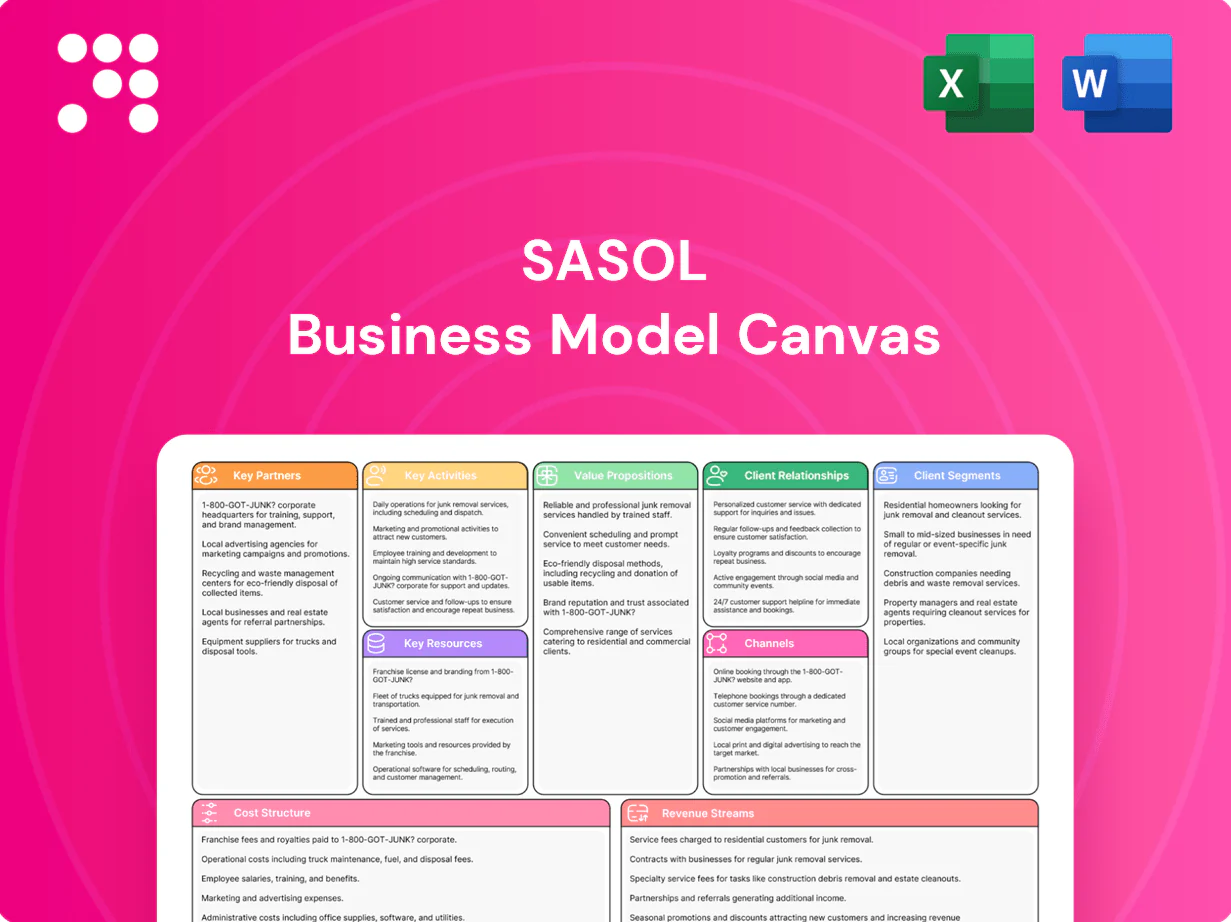
Sasol Business Model Canvas

Unlock the strategic business model blueprint for a leading chemicals and energy firm
Unlock the full strategic blueprint behind Sasol's business model. This in-depth Business Model Canvas reveals how Sasol creates and captures value across chemicals, energy and customer segments. Ideal for investors, consultants and entrepreneurs seeking actionable insights. Purchase the complete Word/Excel canvas to access nine blocks, financial implications and ready-to-use strategic templates.
Partnerships

Feedstock and utilities suppliers
Secure coal, natural gas, biomass, power, water and catalysts from diversified suppliers across regions, with supply networks strengthened in 2024 to reduce concentration risk. Long-term offtake and indexed contracts dampen price volatility and support plant uptime. Collaborative supply planning aligns feedstock quality to process specs, while supplier sustainability programs mitigate ESG and supply-chain disruption risks.
Technology and equipment partners
Collaborate with licensors, OEMs and engineering firms for reactors, compressors and control systems to jointly develop process upgrades and decarbonization projects; Sasol reported c.24,000 employees in 2024 supporting these partnerships. Reliability agreements and spares frameworks cut unplanned downtime and costs, while cyber-physical integration improves safety, asset performance and real-time optimization.

Joint ventures and co-investors
Form 50:50 joint ventures and co-investor structures for upstream resources, GTL/CTL facilities and downstream distribution to share capex and de-risk projects. Shared capital commitments improve market access and leverage partners’ local knowledge while structured governance aligns economic and ESG outcomes. Portfolio partnerships enable scalable entry into new geographies and segments via staged investment and off-take arrangements.

Logistics and distribution networks
Logistics and distribution networks integrate rail, pipeline, marine, road carriers and terminal operators to link Sasol chemical and fuels hubs with domestic and export markets; capacity reservations and scheduling tools secure on-time deliveries while safety and hazmat compliance partners protect people and assets; multi-modal options optimize cost-to-serve and resilience.
- Integration: rail, pipeline, marine, road, terminals
- Scheduling: capacity reservations and planning tools
- Safety: hazmat and compliance partnerships
- Resilience: multi-modal cost-to-serve optimization
Governments and regulators
Governments and regulators are engaged on permits, environmental standards and local‑content commitments to enable Sasol’s transition, leveraging public‑private programs such as South Africa’s Just Energy Transition Partnership (JETP) mobilising about $8.5 billion for transition projects. Transparent reporting and adherence to 2024 regulatory frameworks build social licence and access to incentives and emerging carbon markets. Policy alignment facilitates eligibility for grants, tax relief and carbon credit mechanisms.
- Permits & standards: regulatory approvals for projects
- Public‑private funding: JETP ~$8.5bn support
- Reporting & markets: transparency enables incentives/carbon credits
Diversified feedstock, indexed contracts; 50:50 JVs de-risk, $8.5bn 2024
Secure diversified feedstock via long‑term indexed contracts and collaborative supply planning; 2024 network reduced concentration risk. Licensors/OEMs and c.24,000 employees drive decarbonisation, reliability agreements and cyber‑physical optimisation. 50:50 JVs, logistics alliances and offtake deals share capex, de‑risk projects and support exports; JETP mobilised ~$8.5bn in 2024.
| Metric | 2024 |
|---|---|
| Employees | ~24,000 |
| JETP funding | $8.5bn |
| JV model | 50:50 common |
What is included in the product
 Detailed Word Document
A comprehensive Business Model Canvas for Sasol outlining customer segments, channels, value propositions, key activities, resources, partners, cost and revenue structures across the 9 BMC blocks, with competitive advantages and linked SWOT insights—designed for presentations, investor discussions and strategic validation.

 Customizable Excel Spreadsheet
High-level view of Sasol’s business model with editable cells to quickly identify core components and save hours of formatting—ideal for boardrooms, team collaboration, and fast executive summaries.
Activities

Upstream resource development
Upstream resource development secures coal, gas and biomass feedstocks through exploration, extraction and targeted procurement across Sasol’s asset base. Teams manage reserves, mine planning and gas field operations while optimizing the procurement mix for cost, emissions and reliability. Emphasis is placed on reducing operational risk and meeting ISO 14001 and ISO 45001 environmental and safety standards. Targets and execution are monitored against corporate KPIs and regulatory limits.
Conversion and manufacturing
Operate Fischer–Tropsch and related processes to produce fuels, chemicals and power, including the Secunda CTL complex, the world’s largest single-site coal‑to‑liquids facility (~160,000 b/d in 2024). Run continuous plants with advanced process controls and proactive maintenance. Debottleneck and revamp assets to improve yields and reduce energy intensity. Maintain rigorous quality systems across all product lines.

R&D and technology innovation
R&D and technology innovation at Sasol advances catalysts, reactor design and process integration to boost efficiency and lower carbon intensity, targeting up to 30% lifecycle emission reductions in priority value chains by 2030. The company develops new chemistries and specialty grades and pilots biomass and renewable integration at demonstration scale, with over 2,000 active patents and patent families supporting commercialization. IP is protected and monetized via patents and licensing to capture upstream technology value.

Market development and sales
Market development and sales drive demand across fuels, polymers, solvents, surfactants, waxes and specialties, supported by technical service and application development to secure industrial adoption. Sales teams structure long-term contracts and hedges to stabilise margins while managing pricing, credit and key-account relationships. As of 2024 Sasol remains dual-listed on the JSE and NYSE American.
- Long-term contracts: 3–10+ year off-takes
- Focus: fuels → polymers → specialties
- Key functions: pricing, credit, technical service
Sustainability and risk management
Sasol executes decarbonization roadmaps (net-zero by 2050, 30% Scope 1&2 reduction target by 2030), water stewardship and community programmes while monitoring HSE, process safety and quarterly asset integrity inspections; it manages commodity and currency exposures via rolling hedges up to 12 months and reports ESG metrics aligned with TCFD and GRI.
- Net-zero target: 2050
- 2030 Scope 1&2 reduction: 30% target
- Quarterly asset integrity inspections
- Rolling 12-month hedges for commodity/currency
- ESG reporting aligned to TCFD and GRI
Scale CTL/FT, R&D patents, target 30% cut by 2030
Secure feedstocks (coal, gas, biomass), operate CTL and FT plants (Secunda ~160,000 b/d in 2024), and optimize procurement and asset reliability. Drive R&D (2,000+ patents) to lower carbon intensity and commercialize renewables. Execute sales, long‑term offtakes (3–10+ yrs) and hedging; pursue net‑zero 2050 and 30% Scope 1&2 cut by 2030.
| Metric | 2024 |
|---|---|
| Secunda output | ~160,000 b/d |
| Patents | 2,000+ |
| 2030 Scope 1&2 target | 30% |
What You See Is What You Get
Business Model Canvas
The document you’re previewing is the actual Sasol Business Model Canvas, not a mockup or sample; it’s a direct snapshot of the final file you’ll receive after purchase. When you complete your order you’ll get the same fully structured, editable document—formatted and ready for use. No surprises, just the exact deliverable shown here.

Unlock the strategic business model blueprint for a leading chemicals and energy firm
Unlock the full strategic blueprint behind Sasol's business model. This in-depth Business Model Canvas reveals how Sasol creates and captures value across chemicals, energy and customer segments. Ideal for investors, consultants and entrepreneurs seeking actionable insights. Purchase the complete Word/Excel canvas to access nine blocks, financial implications and ready-to-use strategic templates.
Partnerships
Feedstock and utilities suppliers
Secure coal, natural gas, biomass, power, water and catalysts from diversified suppliers across regions, with supply networks strengthened in 2024 to reduce concentration risk. Long-term offtake and indexed contracts dampen price volatility and support plant uptime. Collaborative supply planning aligns feedstock quality to process specs, while supplier sustainability programs mitigate ESG and supply-chain disruption risks.
Technology and equipment partners
Collaborate with licensors, OEMs and engineering firms for reactors, compressors and control systems to jointly develop process upgrades and decarbonization projects; Sasol reported c.24,000 employees in 2024 supporting these partnerships. Reliability agreements and spares frameworks cut unplanned downtime and costs, while cyber-physical integration improves safety, asset performance and real-time optimization.
Joint ventures and co-investors
Form 50:50 joint ventures and co-investor structures for upstream resources, GTL/CTL facilities and downstream distribution to share capex and de-risk projects. Shared capital commitments improve market access and leverage partners’ local knowledge while structured governance aligns economic and ESG outcomes. Portfolio partnerships enable scalable entry into new geographies and segments via staged investment and off-take arrangements.
Logistics and distribution networks
Logistics and distribution networks integrate rail, pipeline, marine, road carriers and terminal operators to link Sasol chemical and fuels hubs with domestic and export markets; capacity reservations and scheduling tools secure on-time deliveries while safety and hazmat compliance partners protect people and assets; multi-modal options optimize cost-to-serve and resilience.
- Integration: rail, pipeline, marine, road, terminals
- Scheduling: capacity reservations and planning tools
- Safety: hazmat and compliance partnerships
- Resilience: multi-modal cost-to-serve optimization
Governments and regulators
Governments and regulators are engaged on permits, environmental standards and local‑content commitments to enable Sasol’s transition, leveraging public‑private programs such as South Africa’s Just Energy Transition Partnership (JETP) mobilising about $8.5 billion for transition projects. Transparent reporting and adherence to 2024 regulatory frameworks build social licence and access to incentives and emerging carbon markets. Policy alignment facilitates eligibility for grants, tax relief and carbon credit mechanisms.
- Permits & standards: regulatory approvals for projects
- Public‑private funding: JETP ~$8.5bn support
- Reporting & markets: transparency enables incentives/carbon credits
Diversified feedstock, indexed contracts; 50:50 JVs de-risk, $8.5bn 2024
Secure diversified feedstock via long‑term indexed contracts and collaborative supply planning; 2024 network reduced concentration risk. Licensors/OEMs and c.24,000 employees drive decarbonisation, reliability agreements and cyber‑physical optimisation. 50:50 JVs, logistics alliances and offtake deals share capex, de‑risk projects and support exports; JETP mobilised ~$8.5bn in 2024.
| Metric | 2024 |
|---|---|
| Employees | ~24,000 |
| JETP funding | $8.5bn |
| JV model | 50:50 common |
What is included in the product
Detailed Word Document
A comprehensive Business Model Canvas for Sasol outlining customer segments, channels, value propositions, key activities, resources, partners, cost and revenue structures across the 9 BMC blocks, with competitive advantages and linked SWOT insights—designed for presentations, investor discussions and strategic validation.
Customizable Excel Spreadsheet
High-level view of Sasol’s business model with editable cells to quickly identify core components and save hours of formatting—ideal for boardrooms, team collaboration, and fast executive summaries.
Activities
Upstream resource development
Upstream resource development secures coal, gas and biomass feedstocks through exploration, extraction and targeted procurement across Sasol’s asset base. Teams manage reserves, mine planning and gas field operations while optimizing the procurement mix for cost, emissions and reliability. Emphasis is placed on reducing operational risk and meeting ISO 14001 and ISO 45001 environmental and safety standards. Targets and execution are monitored against corporate KPIs and regulatory limits.
Conversion and manufacturing
Operate Fischer–Tropsch and related processes to produce fuels, chemicals and power, including the Secunda CTL complex, the world’s largest single-site coal‑to‑liquids facility (~160,000 b/d in 2024). Run continuous plants with advanced process controls and proactive maintenance. Debottleneck and revamp assets to improve yields and reduce energy intensity. Maintain rigorous quality systems across all product lines.
R&D and technology innovation
R&D and technology innovation at Sasol advances catalysts, reactor design and process integration to boost efficiency and lower carbon intensity, targeting up to 30% lifecycle emission reductions in priority value chains by 2030. The company develops new chemistries and specialty grades and pilots biomass and renewable integration at demonstration scale, with over 2,000 active patents and patent families supporting commercialization. IP is protected and monetized via patents and licensing to capture upstream technology value.
Market development and sales
Market development and sales drive demand across fuels, polymers, solvents, surfactants, waxes and specialties, supported by technical service and application development to secure industrial adoption. Sales teams structure long-term contracts and hedges to stabilise margins while managing pricing, credit and key-account relationships. As of 2024 Sasol remains dual-listed on the JSE and NYSE American.
- Long-term contracts: 3–10+ year off-takes
- Focus: fuels → polymers → specialties
- Key functions: pricing, credit, technical service
Sustainability and risk management
Sasol executes decarbonization roadmaps (net-zero by 2050, 30% Scope 1&2 reduction target by 2030), water stewardship and community programmes while monitoring HSE, process safety and quarterly asset integrity inspections; it manages commodity and currency exposures via rolling hedges up to 12 months and reports ESG metrics aligned with TCFD and GRI.
- Net-zero target: 2050
- 2030 Scope 1&2 reduction: 30% target
- Quarterly asset integrity inspections
- Rolling 12-month hedges for commodity/currency
- ESG reporting aligned to TCFD and GRI
Scale CTL/FT, R&D patents, target 30% cut by 2030
Secure feedstocks (coal, gas, biomass), operate CTL and FT plants (Secunda ~160,000 b/d in 2024), and optimize procurement and asset reliability. Drive R&D (2,000+ patents) to lower carbon intensity and commercialize renewables. Execute sales, long‑term offtakes (3–10+ yrs) and hedging; pursue net‑zero 2050 and 30% Scope 1&2 cut by 2030.
| Metric | 2024 |
|---|---|
| Secunda output | ~160,000 b/d |
| Patents | 2,000+ |
| 2030 Scope 1&2 target | 30% |
What You See Is What You Get
Business Model Canvas
The document you’re previewing is the actual Sasol Business Model Canvas, not a mockup or sample; it’s a direct snapshot of the final file you’ll receive after purchase. When you complete your order you’ll get the same fully structured, editable document—formatted and ready for use. No surprises, just the exact deliverable shown here.
Description
Unlock the strategic business model blueprint for a leading chemicals and energy firm
Unlock the full strategic blueprint behind Sasol's business model. This in-depth Business Model Canvas reveals how Sasol creates and captures value across chemicals, energy and customer segments. Ideal for investors, consultants and entrepreneurs seeking actionable insights. Purchase the complete Word/Excel canvas to access nine blocks, financial implications and ready-to-use strategic templates.
Partnerships
Feedstock and utilities suppliers
Secure coal, natural gas, biomass, power, water and catalysts from diversified suppliers across regions, with supply networks strengthened in 2024 to reduce concentration risk. Long-term offtake and indexed contracts dampen price volatility and support plant uptime. Collaborative supply planning aligns feedstock quality to process specs, while supplier sustainability programs mitigate ESG and supply-chain disruption risks.
Technology and equipment partners
Collaborate with licensors, OEMs and engineering firms for reactors, compressors and control systems to jointly develop process upgrades and decarbonization projects; Sasol reported c.24,000 employees in 2024 supporting these partnerships. Reliability agreements and spares frameworks cut unplanned downtime and costs, while cyber-physical integration improves safety, asset performance and real-time optimization.
Joint ventures and co-investors
Form 50:50 joint ventures and co-investor structures for upstream resources, GTL/CTL facilities and downstream distribution to share capex and de-risk projects. Shared capital commitments improve market access and leverage partners’ local knowledge while structured governance aligns economic and ESG outcomes. Portfolio partnerships enable scalable entry into new geographies and segments via staged investment and off-take arrangements.
Logistics and distribution networks
Logistics and distribution networks integrate rail, pipeline, marine, road carriers and terminal operators to link Sasol chemical and fuels hubs with domestic and export markets; capacity reservations and scheduling tools secure on-time deliveries while safety and hazmat compliance partners protect people and assets; multi-modal options optimize cost-to-serve and resilience.
- Integration: rail, pipeline, marine, road, terminals
- Scheduling: capacity reservations and planning tools
- Safety: hazmat and compliance partnerships
- Resilience: multi-modal cost-to-serve optimization
Governments and regulators
Governments and regulators are engaged on permits, environmental standards and local‑content commitments to enable Sasol’s transition, leveraging public‑private programs such as South Africa’s Just Energy Transition Partnership (JETP) mobilising about $8.5 billion for transition projects. Transparent reporting and adherence to 2024 regulatory frameworks build social licence and access to incentives and emerging carbon markets. Policy alignment facilitates eligibility for grants, tax relief and carbon credit mechanisms.
- Permits & standards: regulatory approvals for projects
- Public‑private funding: JETP ~$8.5bn support
- Reporting & markets: transparency enables incentives/carbon credits
Diversified feedstock, indexed contracts; 50:50 JVs de-risk, $8.5bn 2024
Secure diversified feedstock via long‑term indexed contracts and collaborative supply planning; 2024 network reduced concentration risk. Licensors/OEMs and c.24,000 employees drive decarbonisation, reliability agreements and cyber‑physical optimisation. 50:50 JVs, logistics alliances and offtake deals share capex, de‑risk projects and support exports; JETP mobilised ~$8.5bn in 2024.
| Metric | 2024 |
|---|---|
| Employees | ~24,000 |
| JETP funding | $8.5bn |
| JV model | 50:50 common |
What is included in the product
Detailed Word Document
A comprehensive Business Model Canvas for Sasol outlining customer segments, channels, value propositions, key activities, resources, partners, cost and revenue structures across the 9 BMC blocks, with competitive advantages and linked SWOT insights—designed for presentations, investor discussions and strategic validation.
Customizable Excel Spreadsheet
High-level view of Sasol’s business model with editable cells to quickly identify core components and save hours of formatting—ideal for boardrooms, team collaboration, and fast executive summaries.
Activities
Upstream resource development
Upstream resource development secures coal, gas and biomass feedstocks through exploration, extraction and targeted procurement across Sasol’s asset base. Teams manage reserves, mine planning and gas field operations while optimizing the procurement mix for cost, emissions and reliability. Emphasis is placed on reducing operational risk and meeting ISO 14001 and ISO 45001 environmental and safety standards. Targets and execution are monitored against corporate KPIs and regulatory limits.
Conversion and manufacturing
Operate Fischer–Tropsch and related processes to produce fuels, chemicals and power, including the Secunda CTL complex, the world’s largest single-site coal‑to‑liquids facility (~160,000 b/d in 2024). Run continuous plants with advanced process controls and proactive maintenance. Debottleneck and revamp assets to improve yields and reduce energy intensity. Maintain rigorous quality systems across all product lines.
R&D and technology innovation
R&D and technology innovation at Sasol advances catalysts, reactor design and process integration to boost efficiency and lower carbon intensity, targeting up to 30% lifecycle emission reductions in priority value chains by 2030. The company develops new chemistries and specialty grades and pilots biomass and renewable integration at demonstration scale, with over 2,000 active patents and patent families supporting commercialization. IP is protected and monetized via patents and licensing to capture upstream technology value.
Market development and sales
Market development and sales drive demand across fuels, polymers, solvents, surfactants, waxes and specialties, supported by technical service and application development to secure industrial adoption. Sales teams structure long-term contracts and hedges to stabilise margins while managing pricing, credit and key-account relationships. As of 2024 Sasol remains dual-listed on the JSE and NYSE American.
- Long-term contracts: 3–10+ year off-takes
- Focus: fuels → polymers → specialties
- Key functions: pricing, credit, technical service
Sustainability and risk management
Sasol executes decarbonization roadmaps (net-zero by 2050, 30% Scope 1&2 reduction target by 2030), water stewardship and community programmes while monitoring HSE, process safety and quarterly asset integrity inspections; it manages commodity and currency exposures via rolling hedges up to 12 months and reports ESG metrics aligned with TCFD and GRI.
- Net-zero target: 2050
- 2030 Scope 1&2 reduction: 30% target
- Quarterly asset integrity inspections
- Rolling 12-month hedges for commodity/currency
- ESG reporting aligned to TCFD and GRI
Scale CTL/FT, R&D patents, target 30% cut by 2030
Secure feedstocks (coal, gas, biomass), operate CTL and FT plants (Secunda ~160,000 b/d in 2024), and optimize procurement and asset reliability. Drive R&D (2,000+ patents) to lower carbon intensity and commercialize renewables. Execute sales, long‑term offtakes (3–10+ yrs) and hedging; pursue net‑zero 2050 and 30% Scope 1&2 cut by 2030.
| Metric | 2024 |
|---|---|
| Secunda output | ~160,000 b/d |
| Patents | 2,000+ |
| 2030 Scope 1&2 target | 30% |
What You See Is What You Get
Business Model Canvas
The document you’re previewing is the actual Sasol Business Model Canvas, not a mockup or sample; it’s a direct snapshot of the final file you’ll receive after purchase. When you complete your order you’ll get the same fully structured, editable document—formatted and ready for use. No surprises, just the exact deliverable shown here.











