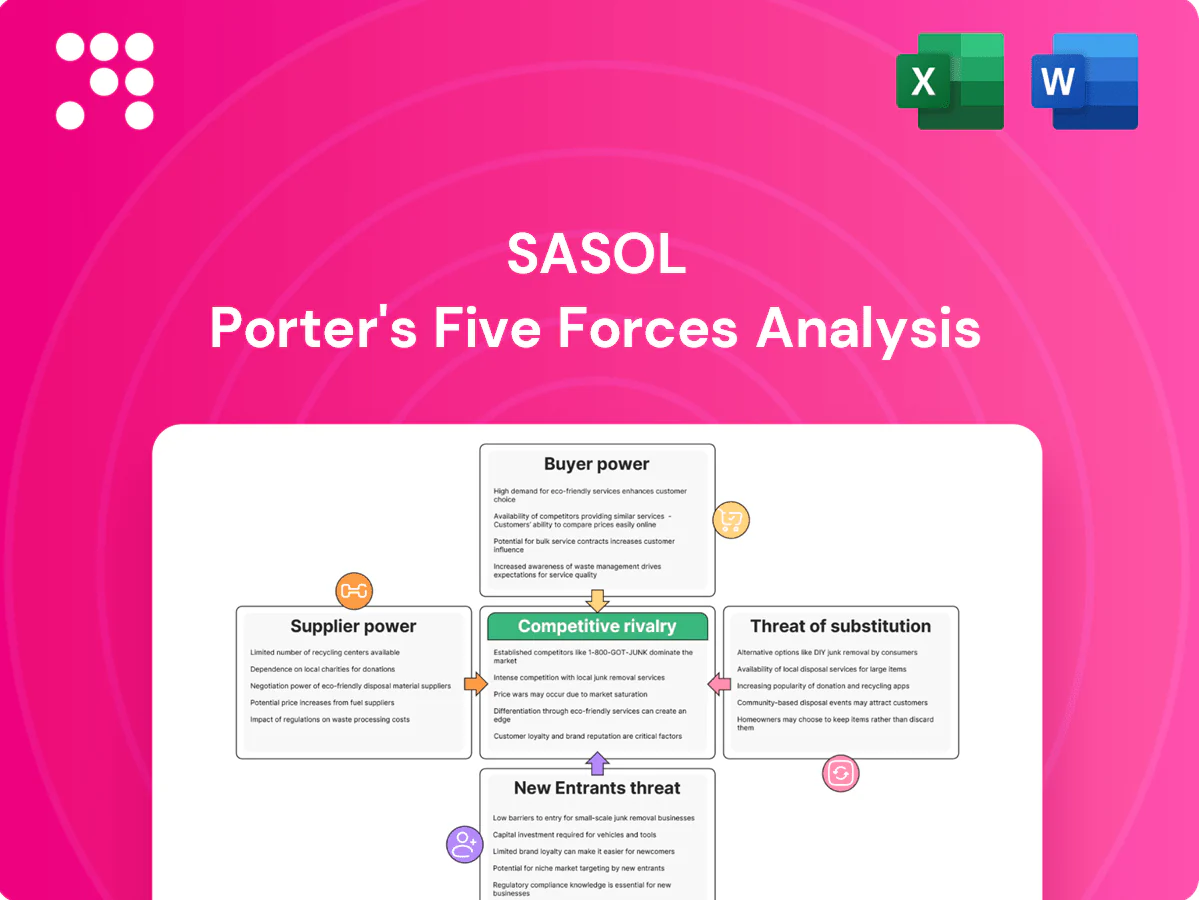
Sasol Porter's Five Forces Analysis

Go Beyond the Preview—Access the Full Strategic Report
Sasol faces strong supplier power from concentrated feedstock sources and capital intensity, while buyer leverage is moderate and substitutes plus regulatory pressures raise risks; rivalry with integrated oil‑and‑chemical firms is high and demand cyclicality compresses margins. This brief snapshot only scratches the surface. Unlock the full Porter's Five Forces Analysis to explore Sasol’s competitive dynamics, market pressures, and strategic advantages in detail.
Suppliers Bargaining Power

Concentrated feedstock sources
Coal and gas feedstock for Sasol are regionally concentrated, with Secunda reliant on South African coal and Mozambican gas (Rovuma basin ~75 trillion cubic feet), giving miners and producers leverage. Long-term take-or-pay contracts reduce volatility but embed fixed costs. 2023–24 security and production tightness raised supply risk and pushed greater use of imported LNG (global trade ~380 million tonnes) and biomass diversification plans.
Logistics and utilities dependency
Sasol depends heavily on rail, pipelines, ports, water and grid power, so bottlenecks in 2024 gave these suppliers clear leverage over input costs and throughput. Infrastructure constraints or tariff hikes raise feedstock and transport costs and can force throughput curtailments. Unreliable power in South Africa in 2024 reduced plant uptime and worsened unit economics. Strategic capex and dual-sourcing logistics partially offset this exposure.

Specialty catalysts and tech inputs
In 2024 Sasol highlighted that Fischer–Tropsch catalysts, specialized solvents and critical spares come from a limited set of global vendors, increasing supplier leverage due to qualification, downtime and performance risks. Switching suppliers requires lengthy requalification and operational risk, strengthening supplier bargaining power. Long-term supply agreements and in-house R&D mitigate some dependence. Strategic inventory buffers reduce short-term disruption exposure.

Skilled labor and contractors
Complex operations at Sasol make specialized engineers and artisans de facto suppliers, with Sasol reporting about 29,000 employees in 2023 and heavy reliance on technical trades; tight South African labor markets and active unions have driven episodic wage pressure and stoppages in recent years. Robust training pipelines and retention programs reduce turnover and skills gaps, while outsourcing peak workloads spreads capacity risk but increases coordination and contract costs.
- Skilled labor = quasi-supplier
- ~29,000 employees (Sasol 2023)
- Union dynamics → wage/stoppage risk
- Training/retention stabilizes costs
- Outsourcing reduces peak risk, raises coordination complexity
ESG and carbon cost pass-through
Environmental compliance and South Africa’s carbon tax (approx R144/tCO2e in 2024) elevate feedstock costs that suppliers can pass through, amplified by limited low-carbon alternatives for hydrogen and naphtha. Supplier screening and joint decarbonization projects can lower lifecycle intensity and blunt supplier leverage. Green premium negotiations hinge on carbon-price trajectories and policy certainty (EU ETS ~€95/t in 2024).
- R144/tCO2e: SA carbon tax 2024
- €95/t: EU ETS 2024 price
- Green H2 cost 2024 ~$2–6/kg
- Supplier decarb projects lower lifecycle intensity
Moderate-high supplier leverage raises cost and disruption risk amid carbon pricing
Suppliers hold moderate-to-high bargaining power for Sasol: regionally concentrated coal/gas, limited catalyst vendors and logistics bottlenecks elevated costs and disruption risk in 2023–24; ~29,000 workforce and unions add labor supply leverage; carbon tax R144/tCO2e and EU ETS ~€95/t raise pass-through risk while long-term contracts, capex and decarbon projects mitigate exposure.
| Metric | 2024 Value |
|---|---|
| Employees | ~29,000 |
| SA carbon tax | R144/tCO2e |
| EU ETS price | €95/t |
| Global LNG trade | ~380 Mt |
What is included in the product
 Detailed Word Document
Concise Porter’s Five Forces analysis tailored for Sasol, assessing competitive rivalry, supplier and buyer power, threat of substitutes, and entry barriers to reveal pricing pressure, margin risks, and strategic defenses across its integrated energy and chemical value chain.

 Customizable Excel Spreadsheet
Clear, one-sheet Porter's Five Forces for Sasol—instantly identify supplier power, regulatory risk, and new-energy entrants pressuring margins for fast, board-ready decisions.
Customers Bargaining Power

Diverse but sizable industrial customers
Sasol sells fuels and chemicals to a broad industrial base, yet large automotive, mining and manufacturing buyers retain negotiating leverage; multi-year contracts and volume commitments reduce churn but keep pricing under pressure. Tailored product specifications in specialty segments raise switching costs, while Sasol’s diversified portfolio and cross-selling across fuels and chemicals dilute concentrated buyer power.
High price transparency in commodities
Fuel and base chemical prices for Sasol closely track global benchmarks such as Brent and naphtha, with 2024 Brent averaging about $86/barrel, empowering buyers to demand parity. Spot market references for products like ethylene and synthetic fuels limit premium capture and compress margins. Hedging and formula pricing reduce volatility for Sasol but cap upside in cyclical rallies. Differentiation shifts toward reliability, logistics and service offerings.

Moderate switching costs by product
Standard fuels sold by Sasol carry low switching costs, giving buyers strong leverage in spot and retail markets, while specialty chemicals demand supplier qualifications and validation, creating higher switching hurdles for industrial clients.

Contract structures and credit terms
Buyers push for favorable payment terms, rebates and logistics clauses, with extended terms stressing suppliers' working capital; Sasol reported net debt of about R68 billion at June 2024, underscoring sensitivity to cashflow pressure. Performance-linked pricing and indexation help align costs and volumes; credit vetting and trade credit insurance reduce counterparty risk.
- Payment terms pressure: extended DSO raises WC needs
- Performance pricing: indexation stabilizes margins
- Risk mitigation: credit vetting and insurance
Cyclical demand sensitivity
Downturns in construction, autos, and mining compress Sasol volumes and intensify buyer price pressure, while expansions and periodic capacity tightness reduce buyer leverage; geographic and product diversification dampens cycle swings and demand forecasting combined with flexible production aligns supply to shifting end-market demand.
- Cyclical sensitivity: sector-linked volumes fall in downturns
- Diversification: smooths revenue volatility
- Capacity cycles: tighten = lower buyer power
- Operational agility: forecasting + flexible output
Buyer leverage caps pricing; specialty contracts curb churn while debt raises exposure
Sasol faces strong buyer leverage in fuels and commoditised chemicals, offset by higher switching costs in specialty segments and multi-year contracts that limit churn. Global benchmark linkage (Brent ~ $86/barrel in 2024) and spot references compress pricing power; hedging and indexation stabilize but cap upside. Net debt (~R68 billion at June 2024) increases sensitivity to extended payment terms.
| Metric | 2024 |
|---|---|
| Brent oil | $86/bbl (avg) |
| Sasol net debt | R68 billion (Jun) |
Full Version Awaits
Sasol Porter's Five Forces Analysis
This Sasol Porter's Five Forces analysis delivers a concise, professionally formatted evaluation of competitive pressures—supplier power, buyer power, rivalry, threat of substitutes, and entry barriers—tailored to Sasol's petroleum and chemical operations. This preview is the exact document you'll receive upon purchase, ready for immediate download and use. No placeholders or samples—what you see is the final deliverable.

Go Beyond the Preview—Access the Full Strategic Report
Sasol faces strong supplier power from concentrated feedstock sources and capital intensity, while buyer leverage is moderate and substitutes plus regulatory pressures raise risks; rivalry with integrated oil‑and‑chemical firms is high and demand cyclicality compresses margins. This brief snapshot only scratches the surface. Unlock the full Porter's Five Forces Analysis to explore Sasol’s competitive dynamics, market pressures, and strategic advantages in detail.
Suppliers Bargaining Power
Concentrated feedstock sources
Coal and gas feedstock for Sasol are regionally concentrated, with Secunda reliant on South African coal and Mozambican gas (Rovuma basin ~75 trillion cubic feet), giving miners and producers leverage. Long-term take-or-pay contracts reduce volatility but embed fixed costs. 2023–24 security and production tightness raised supply risk and pushed greater use of imported LNG (global trade ~380 million tonnes) and biomass diversification plans.
Logistics and utilities dependency
Sasol depends heavily on rail, pipelines, ports, water and grid power, so bottlenecks in 2024 gave these suppliers clear leverage over input costs and throughput. Infrastructure constraints or tariff hikes raise feedstock and transport costs and can force throughput curtailments. Unreliable power in South Africa in 2024 reduced plant uptime and worsened unit economics. Strategic capex and dual-sourcing logistics partially offset this exposure.
Specialty catalysts and tech inputs
In 2024 Sasol highlighted that Fischer–Tropsch catalysts, specialized solvents and critical spares come from a limited set of global vendors, increasing supplier leverage due to qualification, downtime and performance risks. Switching suppliers requires lengthy requalification and operational risk, strengthening supplier bargaining power. Long-term supply agreements and in-house R&D mitigate some dependence. Strategic inventory buffers reduce short-term disruption exposure.
Skilled labor and contractors
Complex operations at Sasol make specialized engineers and artisans de facto suppliers, with Sasol reporting about 29,000 employees in 2023 and heavy reliance on technical trades; tight South African labor markets and active unions have driven episodic wage pressure and stoppages in recent years. Robust training pipelines and retention programs reduce turnover and skills gaps, while outsourcing peak workloads spreads capacity risk but increases coordination and contract costs.
- Skilled labor = quasi-supplier
- ~29,000 employees (Sasol 2023)
- Union dynamics → wage/stoppage risk
- Training/retention stabilizes costs
- Outsourcing reduces peak risk, raises coordination complexity
ESG and carbon cost pass-through
Environmental compliance and South Africa’s carbon tax (approx R144/tCO2e in 2024) elevate feedstock costs that suppliers can pass through, amplified by limited low-carbon alternatives for hydrogen and naphtha. Supplier screening and joint decarbonization projects can lower lifecycle intensity and blunt supplier leverage. Green premium negotiations hinge on carbon-price trajectories and policy certainty (EU ETS ~€95/t in 2024).
- R144/tCO2e: SA carbon tax 2024
- €95/t: EU ETS 2024 price
- Green H2 cost 2024 ~$2–6/kg
- Supplier decarb projects lower lifecycle intensity
Moderate-high supplier leverage raises cost and disruption risk amid carbon pricing
Suppliers hold moderate-to-high bargaining power for Sasol: regionally concentrated coal/gas, limited catalyst vendors and logistics bottlenecks elevated costs and disruption risk in 2023–24; ~29,000 workforce and unions add labor supply leverage; carbon tax R144/tCO2e and EU ETS ~€95/t raise pass-through risk while long-term contracts, capex and decarbon projects mitigate exposure.
| Metric | 2024 Value |
|---|---|
| Employees | ~29,000 |
| SA carbon tax | R144/tCO2e |
| EU ETS price | €95/t |
| Global LNG trade | ~380 Mt |
What is included in the product
Detailed Word Document
Concise Porter’s Five Forces analysis tailored for Sasol, assessing competitive rivalry, supplier and buyer power, threat of substitutes, and entry barriers to reveal pricing pressure, margin risks, and strategic defenses across its integrated energy and chemical value chain.
Customizable Excel Spreadsheet
Clear, one-sheet Porter's Five Forces for Sasol—instantly identify supplier power, regulatory risk, and new-energy entrants pressuring margins for fast, board-ready decisions.
Customers Bargaining Power
Diverse but sizable industrial customers
Sasol sells fuels and chemicals to a broad industrial base, yet large automotive, mining and manufacturing buyers retain negotiating leverage; multi-year contracts and volume commitments reduce churn but keep pricing under pressure. Tailored product specifications in specialty segments raise switching costs, while Sasol’s diversified portfolio and cross-selling across fuels and chemicals dilute concentrated buyer power.
High price transparency in commodities
Fuel and base chemical prices for Sasol closely track global benchmarks such as Brent and naphtha, with 2024 Brent averaging about $86/barrel, empowering buyers to demand parity. Spot market references for products like ethylene and synthetic fuels limit premium capture and compress margins. Hedging and formula pricing reduce volatility for Sasol but cap upside in cyclical rallies. Differentiation shifts toward reliability, logistics and service offerings.
Moderate switching costs by product
Standard fuels sold by Sasol carry low switching costs, giving buyers strong leverage in spot and retail markets, while specialty chemicals demand supplier qualifications and validation, creating higher switching hurdles for industrial clients.
Contract structures and credit terms
Buyers push for favorable payment terms, rebates and logistics clauses, with extended terms stressing suppliers' working capital; Sasol reported net debt of about R68 billion at June 2024, underscoring sensitivity to cashflow pressure. Performance-linked pricing and indexation help align costs and volumes; credit vetting and trade credit insurance reduce counterparty risk.
- Payment terms pressure: extended DSO raises WC needs
- Performance pricing: indexation stabilizes margins
- Risk mitigation: credit vetting and insurance
Cyclical demand sensitivity
Downturns in construction, autos, and mining compress Sasol volumes and intensify buyer price pressure, while expansions and periodic capacity tightness reduce buyer leverage; geographic and product diversification dampens cycle swings and demand forecasting combined with flexible production aligns supply to shifting end-market demand.
- Cyclical sensitivity: sector-linked volumes fall in downturns
- Diversification: smooths revenue volatility
- Capacity cycles: tighten = lower buyer power
- Operational agility: forecasting + flexible output
Buyer leverage caps pricing; specialty contracts curb churn while debt raises exposure
Sasol faces strong buyer leverage in fuels and commoditised chemicals, offset by higher switching costs in specialty segments and multi-year contracts that limit churn. Global benchmark linkage (Brent ~ $86/barrel in 2024) and spot references compress pricing power; hedging and indexation stabilize but cap upside. Net debt (~R68 billion at June 2024) increases sensitivity to extended payment terms.
| Metric | 2024 |
|---|---|
| Brent oil | $86/bbl (avg) |
| Sasol net debt | R68 billion (Jun) |
Full Version Awaits
Sasol Porter's Five Forces Analysis
This Sasol Porter's Five Forces analysis delivers a concise, professionally formatted evaluation of competitive pressures—supplier power, buyer power, rivalry, threat of substitutes, and entry barriers—tailored to Sasol's petroleum and chemical operations. This preview is the exact document you'll receive upon purchase, ready for immediate download and use. No placeholders or samples—what you see is the final deliverable.
Description
Go Beyond the Preview—Access the Full Strategic Report
Sasol faces strong supplier power from concentrated feedstock sources and capital intensity, while buyer leverage is moderate and substitutes plus regulatory pressures raise risks; rivalry with integrated oil‑and‑chemical firms is high and demand cyclicality compresses margins. This brief snapshot only scratches the surface. Unlock the full Porter's Five Forces Analysis to explore Sasol’s competitive dynamics, market pressures, and strategic advantages in detail.
Suppliers Bargaining Power
Concentrated feedstock sources
Coal and gas feedstock for Sasol are regionally concentrated, with Secunda reliant on South African coal and Mozambican gas (Rovuma basin ~75 trillion cubic feet), giving miners and producers leverage. Long-term take-or-pay contracts reduce volatility but embed fixed costs. 2023–24 security and production tightness raised supply risk and pushed greater use of imported LNG (global trade ~380 million tonnes) and biomass diversification plans.
Logistics and utilities dependency
Sasol depends heavily on rail, pipelines, ports, water and grid power, so bottlenecks in 2024 gave these suppliers clear leverage over input costs and throughput. Infrastructure constraints or tariff hikes raise feedstock and transport costs and can force throughput curtailments. Unreliable power in South Africa in 2024 reduced plant uptime and worsened unit economics. Strategic capex and dual-sourcing logistics partially offset this exposure.
Specialty catalysts and tech inputs
In 2024 Sasol highlighted that Fischer–Tropsch catalysts, specialized solvents and critical spares come from a limited set of global vendors, increasing supplier leverage due to qualification, downtime and performance risks. Switching suppliers requires lengthy requalification and operational risk, strengthening supplier bargaining power. Long-term supply agreements and in-house R&D mitigate some dependence. Strategic inventory buffers reduce short-term disruption exposure.
Skilled labor and contractors
Complex operations at Sasol make specialized engineers and artisans de facto suppliers, with Sasol reporting about 29,000 employees in 2023 and heavy reliance on technical trades; tight South African labor markets and active unions have driven episodic wage pressure and stoppages in recent years. Robust training pipelines and retention programs reduce turnover and skills gaps, while outsourcing peak workloads spreads capacity risk but increases coordination and contract costs.
- Skilled labor = quasi-supplier
- ~29,000 employees (Sasol 2023)
- Union dynamics → wage/stoppage risk
- Training/retention stabilizes costs
- Outsourcing reduces peak risk, raises coordination complexity
ESG and carbon cost pass-through
Environmental compliance and South Africa’s carbon tax (approx R144/tCO2e in 2024) elevate feedstock costs that suppliers can pass through, amplified by limited low-carbon alternatives for hydrogen and naphtha. Supplier screening and joint decarbonization projects can lower lifecycle intensity and blunt supplier leverage. Green premium negotiations hinge on carbon-price trajectories and policy certainty (EU ETS ~€95/t in 2024).
- R144/tCO2e: SA carbon tax 2024
- €95/t: EU ETS 2024 price
- Green H2 cost 2024 ~$2–6/kg
- Supplier decarb projects lower lifecycle intensity
Moderate-high supplier leverage raises cost and disruption risk amid carbon pricing
Suppliers hold moderate-to-high bargaining power for Sasol: regionally concentrated coal/gas, limited catalyst vendors and logistics bottlenecks elevated costs and disruption risk in 2023–24; ~29,000 workforce and unions add labor supply leverage; carbon tax R144/tCO2e and EU ETS ~€95/t raise pass-through risk while long-term contracts, capex and decarbon projects mitigate exposure.
| Metric | 2024 Value |
|---|---|
| Employees | ~29,000 |
| SA carbon tax | R144/tCO2e |
| EU ETS price | €95/t |
| Global LNG trade | ~380 Mt |
What is included in the product
Detailed Word Document
Concise Porter’s Five Forces analysis tailored for Sasol, assessing competitive rivalry, supplier and buyer power, threat of substitutes, and entry barriers to reveal pricing pressure, margin risks, and strategic defenses across its integrated energy and chemical value chain.
Customizable Excel Spreadsheet
Clear, one-sheet Porter's Five Forces for Sasol—instantly identify supplier power, regulatory risk, and new-energy entrants pressuring margins for fast, board-ready decisions.
Customers Bargaining Power
Diverse but sizable industrial customers
Sasol sells fuels and chemicals to a broad industrial base, yet large automotive, mining and manufacturing buyers retain negotiating leverage; multi-year contracts and volume commitments reduce churn but keep pricing under pressure. Tailored product specifications in specialty segments raise switching costs, while Sasol’s diversified portfolio and cross-selling across fuels and chemicals dilute concentrated buyer power.
High price transparency in commodities
Fuel and base chemical prices for Sasol closely track global benchmarks such as Brent and naphtha, with 2024 Brent averaging about $86/barrel, empowering buyers to demand parity. Spot market references for products like ethylene and synthetic fuels limit premium capture and compress margins. Hedging and formula pricing reduce volatility for Sasol but cap upside in cyclical rallies. Differentiation shifts toward reliability, logistics and service offerings.
Moderate switching costs by product
Standard fuels sold by Sasol carry low switching costs, giving buyers strong leverage in spot and retail markets, while specialty chemicals demand supplier qualifications and validation, creating higher switching hurdles for industrial clients.
Contract structures and credit terms
Buyers push for favorable payment terms, rebates and logistics clauses, with extended terms stressing suppliers' working capital; Sasol reported net debt of about R68 billion at June 2024, underscoring sensitivity to cashflow pressure. Performance-linked pricing and indexation help align costs and volumes; credit vetting and trade credit insurance reduce counterparty risk.
- Payment terms pressure: extended DSO raises WC needs
- Performance pricing: indexation stabilizes margins
- Risk mitigation: credit vetting and insurance
Cyclical demand sensitivity
Downturns in construction, autos, and mining compress Sasol volumes and intensify buyer price pressure, while expansions and periodic capacity tightness reduce buyer leverage; geographic and product diversification dampens cycle swings and demand forecasting combined with flexible production aligns supply to shifting end-market demand.
- Cyclical sensitivity: sector-linked volumes fall in downturns
- Diversification: smooths revenue volatility
- Capacity cycles: tighten = lower buyer power
- Operational agility: forecasting + flexible output
Buyer leverage caps pricing; specialty contracts curb churn while debt raises exposure
Sasol faces strong buyer leverage in fuels and commoditised chemicals, offset by higher switching costs in specialty segments and multi-year contracts that limit churn. Global benchmark linkage (Brent ~ $86/barrel in 2024) and spot references compress pricing power; hedging and indexation stabilize but cap upside. Net debt (~R68 billion at June 2024) increases sensitivity to extended payment terms.
| Metric | 2024 |
|---|---|
| Brent oil | $86/bbl (avg) |
| Sasol net debt | R68 billion (Jun) |
Full Version Awaits
Sasol Porter's Five Forces Analysis
This Sasol Porter's Five Forces analysis delivers a concise, professionally formatted evaluation of competitive pressures—supplier power, buyer power, rivalry, threat of substitutes, and entry barriers—tailored to Sasol's petroleum and chemical operations. This preview is the exact document you'll receive upon purchase, ready for immediate download and use. No placeholders or samples—what you see is the final deliverable.











