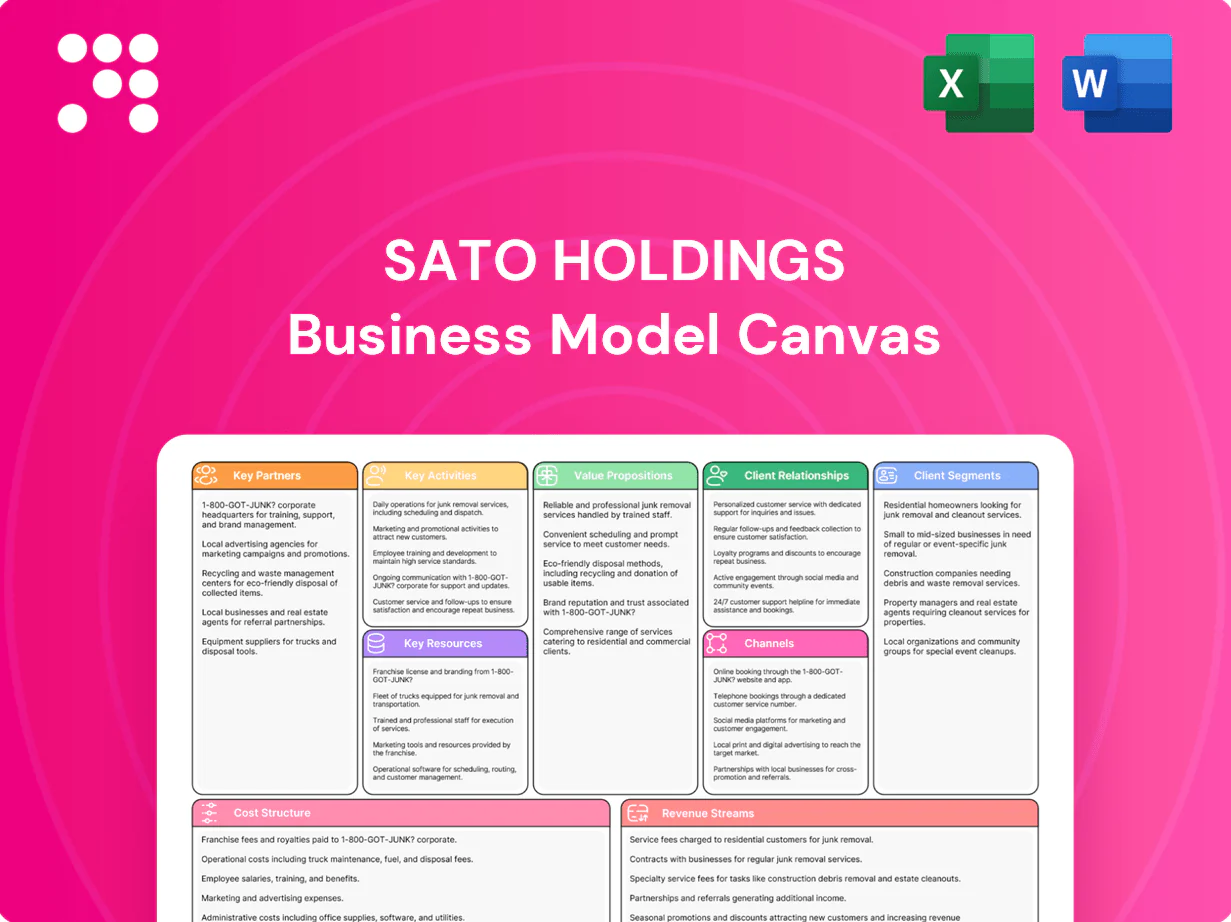
Sato Holdings Business Model Canvas

Concise Business Model Canvas: Strategic blueprint of value, partners, and revenue engines
Discover Sato Holdings' strategic blueprint in a concise Business Model Canvas that maps its value propositions, key partners, and revenue engines across core customer segments. This snapshot reveals competitive levers and growth drivers in practical terms. Purchase the full, editable Canvas to access in-depth analysis, financial implications, and ready-to-use templates for strategy or investment work.
Partnerships

RFID & chip suppliers
Strategic sourcing of RFID inlays, NFC chips and barcode printheads stabilizes device performance and cost amid a global RFID market of about US$18B in 2024, while co-development roadmaps align component specs with next‑gen printers and labels. Vendor‑managed inventory and rigorous quality programs cut defects and shorten lead times, and long‑term contracts secured priority allocation during the 2020–22 semiconductor supply shocks.
Label material makers
Partnerships with paper, film, linerless and eco-resin substrate producers deliver durable, sustainable media that address a global label market valued at about USD 50 billion in 2024. Joint testing with suppliers optimizes adhesion, print contrast and chemical resistance by use case, reducing reprints and raising print yields by double-digit percentages in trials. Co-branding certifies consumables for mission-critical industries, lowering TCO through fewer production stops and higher first-pass accuracy.

ISVs & platform partners
Alliances with WMS, ERP, MES and POS vendors embed SATO device support across enterprise stacks, enabling pre-built drivers, SDKs and APIs that accelerate deployments and reduce integration friction. Marketplace listings and certifications boosted visibility to enterprise buyers; joint go-to-market bundles AIDC solutions—supporting SATO growth in the 2024 AIDC market valued at about $7.2 billion.

Channel & system integrators
Channel and system integrators design, install and maintain Sato end-to-end solutions, tailoring labeling workflows, mobile computing and site-specific networks; as of 2024 they accelerate rollouts and reduce implementation time. Revenue sharing and deal registration protect partner margins and limit channel conflict. Field coverage expands reach into new geographies and verticals.
- Resellers: tailored workflows
- Integrators: site installs & maintenance
- Commercial: revenue share & deal registration
- Market: extends field coverage
Standards & regulators
Engagement with GS1 (serving over 2 million companies in 150+ countries) and RAIN RFID standards, plus healthcare and food-safety bodies, ensures Sato compliance and interoperability; RAIN RFID adoption grew ~18% CAGR through 2024, guiding product design and label formats. Certification programs reduce customer audit remediation costs by up to 30% and advocacy accelerates cross-border supply chain harmonization.
- Standards: GS1 >2M companies, 150+ countries
- RAIN RFID: ~18% CAGR to 2024
- Certs: audit remediation cost ↓ up to 30%
- Advocacy: boosts global interoperability
Supplier contracts secure RFID inlays in US$18B market; media partners boost yields
Strategic supplier contracts secure RFID inlays/chips amid a US$18B RFID market (2024) and cut defect rates; media partners support a US$50B label market, improving first-pass yield by double digits. ISV/ERP integrations accelerate deployments in a US$7.2B AIDC market; channel & SI programs expand field coverage. Standards/GS1 alignment (2M+ companies) and RAIN RFID (~18% CAGR to 2024) lower audit costs ~30%.
| Partnership | Role | 2024 metric |
|---|---|---|
| Components | Supply stability | RFID market US$18B |
| Media | Durable consumables | Label market US$50B |
| Systems | Integrations/APIs | AIDC US$7.2B |
| Standards | Compliance | GS1 2M+; RAIN 18% CAGR |
What is included in the product
 Detailed Word Document
A comprehensive, pre-written Business Model Canvas tailored to Sato Holdings’ strategy, detailing customer segments, channels, value propositions and the nine BMC blocks with narrative and insights. Includes competitive advantages, linked SWOT, and polished design ideal for investor presentations and strategic validation.

 Customizable Excel Spreadsheet
High-level view of Sato Holdings’ business model with editable cells to quickly identify supply-chain bottlenecks, pricing gaps, and efficiency opportunities.
Activities

Hardware R&D
Design of barcode/RFID printers, print engines and scanners focuses on higher speed, accuracy and ruggedness for industrial use. Thermal printing advances cut energy use ~20% and consumables waste ~30% in 2024 pilot programs. Iterative prototyping delivered 99.8% reliability in harsh-condition field tests (2024). Integrated security and fleet manageability reduced TCO ~12% in enterprise rollouts.
Media engineering
Media engineering at Sato Holdings (TYO:6287) develops labels, tags, linerless rolls and ribbons tuned for varied surfaces and environments, supporting the global pressure-sensitive label market valued at about $44.6 billion in 2024. Material science ensures legibility, adhesion and sustainability through recyclable substrates and solvent-free inks. Device qualification cuts jams and wear, while lifecycle testing extends printhead longevity and lowers TCO.

Software & firmware
SATO Holdings (TSE:6287) develops printer OS, device management and labeling software with open APIs to enable ERP/WMS connectors that streamline data capture and print jobs. Remote fleet monitoring in FY2024 supported global deployments, reducing on-site service needs and downtime. Continuous security updates and embedded analytics enhance regulatory compliance and device performance reporting.

Manufacturing & QA
Lean manufacturing aligns hardware and media output to global demand while calibration and burn-in testing ensure consistent performance; supplier quality audits uphold component standards and continuous improvement lowers scrap and lead times.
- Lean production
- Calibration & burn-in
- Supplier audits
- CI to cut scrap/lead time
Solution deployment
Pre-sales design, site surveys and pilot programs tailor Sato solutions to customer workflows, with 2024 pilots reporting deployment time cuts around 30% and SKU capture accuracy near 99%. On-site installation, hands-on training and change-management teams accelerate user adoption and compliance. Robust SLAs and field service maintain uptime targets above 99% while data-driven optimization continually refines labeling and tracking KPIs.
- Pre-sales design: workflow alignment
- Site surveys & pilots: ~30% faster deployment
- Installation & training: faster adoption
- SLAs/field service: 99%+ uptime; data-driven KPI refinement
99.8% reliability; energy -20%, waste -30%; uptime >99%
Design and prototyping delivered 99.8% field reliability; thermal advances cut energy ~20% and consumables waste ~30% in 2024 pilots, lowering TCO ~12%. Media engineering supported the $44.6B label market with recyclable substrates and extended printhead life. Software and remote fleet monitoring raised uptime >99%, cut deployment time ~30% and achieved SKU capture ~99%.
| Activity | 2024 metric | Impact |
|---|---|---|
| Hardware R&D | 99.8% reliability | Lower failures/TCO |
| Thermal pilots | Energy −20%, waste −30% | Cost & eco gains |
| Software & remote | Uptime >99% | Fewer onsite services |
What You See Is What You Get
Business Model Canvas
The Sato Holdings Business Model Canvas shown here is the actual deliverable, not a mockup. When you purchase, you’ll receive this exact document—complete and formatted—for editing and presentation. Files are provided in Word and Excel so you can customize and deploy immediately.

Concise Business Model Canvas: Strategic blueprint of value, partners, and revenue engines
Discover Sato Holdings' strategic blueprint in a concise Business Model Canvas that maps its value propositions, key partners, and revenue engines across core customer segments. This snapshot reveals competitive levers and growth drivers in practical terms. Purchase the full, editable Canvas to access in-depth analysis, financial implications, and ready-to-use templates for strategy or investment work.
Partnerships
RFID & chip suppliers
Strategic sourcing of RFID inlays, NFC chips and barcode printheads stabilizes device performance and cost amid a global RFID market of about US$18B in 2024, while co-development roadmaps align component specs with next‑gen printers and labels. Vendor‑managed inventory and rigorous quality programs cut defects and shorten lead times, and long‑term contracts secured priority allocation during the 2020–22 semiconductor supply shocks.
Label material makers
Partnerships with paper, film, linerless and eco-resin substrate producers deliver durable, sustainable media that address a global label market valued at about USD 50 billion in 2024. Joint testing with suppliers optimizes adhesion, print contrast and chemical resistance by use case, reducing reprints and raising print yields by double-digit percentages in trials. Co-branding certifies consumables for mission-critical industries, lowering TCO through fewer production stops and higher first-pass accuracy.
ISVs & platform partners
Alliances with WMS, ERP, MES and POS vendors embed SATO device support across enterprise stacks, enabling pre-built drivers, SDKs and APIs that accelerate deployments and reduce integration friction. Marketplace listings and certifications boosted visibility to enterprise buyers; joint go-to-market bundles AIDC solutions—supporting SATO growth in the 2024 AIDC market valued at about $7.2 billion.
Channel & system integrators
Channel and system integrators design, install and maintain Sato end-to-end solutions, tailoring labeling workflows, mobile computing and site-specific networks; as of 2024 they accelerate rollouts and reduce implementation time. Revenue sharing and deal registration protect partner margins and limit channel conflict. Field coverage expands reach into new geographies and verticals.
- Resellers: tailored workflows
- Integrators: site installs & maintenance
- Commercial: revenue share & deal registration
- Market: extends field coverage
Standards & regulators
Engagement with GS1 (serving over 2 million companies in 150+ countries) and RAIN RFID standards, plus healthcare and food-safety bodies, ensures Sato compliance and interoperability; RAIN RFID adoption grew ~18% CAGR through 2024, guiding product design and label formats. Certification programs reduce customer audit remediation costs by up to 30% and advocacy accelerates cross-border supply chain harmonization.
- Standards: GS1 >2M companies, 150+ countries
- RAIN RFID: ~18% CAGR to 2024
- Certs: audit remediation cost ↓ up to 30%
- Advocacy: boosts global interoperability
Supplier contracts secure RFID inlays in US$18B market; media partners boost yields
Strategic supplier contracts secure RFID inlays/chips amid a US$18B RFID market (2024) and cut defect rates; media partners support a US$50B label market, improving first-pass yield by double digits. ISV/ERP integrations accelerate deployments in a US$7.2B AIDC market; channel & SI programs expand field coverage. Standards/GS1 alignment (2M+ companies) and RAIN RFID (~18% CAGR to 2024) lower audit costs ~30%.
| Partnership | Role | 2024 metric |
|---|---|---|
| Components | Supply stability | RFID market US$18B |
| Media | Durable consumables | Label market US$50B |
| Systems | Integrations/APIs | AIDC US$7.2B |
| Standards | Compliance | GS1 2M+; RAIN 18% CAGR |
What is included in the product
Detailed Word Document
A comprehensive, pre-written Business Model Canvas tailored to Sato Holdings’ strategy, detailing customer segments, channels, value propositions and the nine BMC blocks with narrative and insights. Includes competitive advantages, linked SWOT, and polished design ideal for investor presentations and strategic validation.
Customizable Excel Spreadsheet
High-level view of Sato Holdings’ business model with editable cells to quickly identify supply-chain bottlenecks, pricing gaps, and efficiency opportunities.
Activities
Hardware R&D
Design of barcode/RFID printers, print engines and scanners focuses on higher speed, accuracy and ruggedness for industrial use. Thermal printing advances cut energy use ~20% and consumables waste ~30% in 2024 pilot programs. Iterative prototyping delivered 99.8% reliability in harsh-condition field tests (2024). Integrated security and fleet manageability reduced TCO ~12% in enterprise rollouts.
Media engineering
Media engineering at Sato Holdings (TYO:6287) develops labels, tags, linerless rolls and ribbons tuned for varied surfaces and environments, supporting the global pressure-sensitive label market valued at about $44.6 billion in 2024. Material science ensures legibility, adhesion and sustainability through recyclable substrates and solvent-free inks. Device qualification cuts jams and wear, while lifecycle testing extends printhead longevity and lowers TCO.
Software & firmware
SATO Holdings (TSE:6287) develops printer OS, device management and labeling software with open APIs to enable ERP/WMS connectors that streamline data capture and print jobs. Remote fleet monitoring in FY2024 supported global deployments, reducing on-site service needs and downtime. Continuous security updates and embedded analytics enhance regulatory compliance and device performance reporting.
Manufacturing & QA
Lean manufacturing aligns hardware and media output to global demand while calibration and burn-in testing ensure consistent performance; supplier quality audits uphold component standards and continuous improvement lowers scrap and lead times.
- Lean production
- Calibration & burn-in
- Supplier audits
- CI to cut scrap/lead time
Solution deployment
Pre-sales design, site surveys and pilot programs tailor Sato solutions to customer workflows, with 2024 pilots reporting deployment time cuts around 30% and SKU capture accuracy near 99%. On-site installation, hands-on training and change-management teams accelerate user adoption and compliance. Robust SLAs and field service maintain uptime targets above 99% while data-driven optimization continually refines labeling and tracking KPIs.
- Pre-sales design: workflow alignment
- Site surveys & pilots: ~30% faster deployment
- Installation & training: faster adoption
- SLAs/field service: 99%+ uptime; data-driven KPI refinement
99.8% reliability; energy -20%, waste -30%; uptime >99%
Design and prototyping delivered 99.8% field reliability; thermal advances cut energy ~20% and consumables waste ~30% in 2024 pilots, lowering TCO ~12%. Media engineering supported the $44.6B label market with recyclable substrates and extended printhead life. Software and remote fleet monitoring raised uptime >99%, cut deployment time ~30% and achieved SKU capture ~99%.
| Activity | 2024 metric | Impact |
|---|---|---|
| Hardware R&D | 99.8% reliability | Lower failures/TCO |
| Thermal pilots | Energy −20%, waste −30% | Cost & eco gains |
| Software & remote | Uptime >99% | Fewer onsite services |
What You See Is What You Get
Business Model Canvas
The Sato Holdings Business Model Canvas shown here is the actual deliverable, not a mockup. When you purchase, you’ll receive this exact document—complete and formatted—for editing and presentation. Files are provided in Word and Excel so you can customize and deploy immediately.
Original: $10.00
-65%$10.00
$3.50Description
Concise Business Model Canvas: Strategic blueprint of value, partners, and revenue engines
Discover Sato Holdings' strategic blueprint in a concise Business Model Canvas that maps its value propositions, key partners, and revenue engines across core customer segments. This snapshot reveals competitive levers and growth drivers in practical terms. Purchase the full, editable Canvas to access in-depth analysis, financial implications, and ready-to-use templates for strategy or investment work.
Partnerships
RFID & chip suppliers
Strategic sourcing of RFID inlays, NFC chips and barcode printheads stabilizes device performance and cost amid a global RFID market of about US$18B in 2024, while co-development roadmaps align component specs with next‑gen printers and labels. Vendor‑managed inventory and rigorous quality programs cut defects and shorten lead times, and long‑term contracts secured priority allocation during the 2020–22 semiconductor supply shocks.
Label material makers
Partnerships with paper, film, linerless and eco-resin substrate producers deliver durable, sustainable media that address a global label market valued at about USD 50 billion in 2024. Joint testing with suppliers optimizes adhesion, print contrast and chemical resistance by use case, reducing reprints and raising print yields by double-digit percentages in trials. Co-branding certifies consumables for mission-critical industries, lowering TCO through fewer production stops and higher first-pass accuracy.
ISVs & platform partners
Alliances with WMS, ERP, MES and POS vendors embed SATO device support across enterprise stacks, enabling pre-built drivers, SDKs and APIs that accelerate deployments and reduce integration friction. Marketplace listings and certifications boosted visibility to enterprise buyers; joint go-to-market bundles AIDC solutions—supporting SATO growth in the 2024 AIDC market valued at about $7.2 billion.
Channel & system integrators
Channel and system integrators design, install and maintain Sato end-to-end solutions, tailoring labeling workflows, mobile computing and site-specific networks; as of 2024 they accelerate rollouts and reduce implementation time. Revenue sharing and deal registration protect partner margins and limit channel conflict. Field coverage expands reach into new geographies and verticals.
- Resellers: tailored workflows
- Integrators: site installs & maintenance
- Commercial: revenue share & deal registration
- Market: extends field coverage
Standards & regulators
Engagement with GS1 (serving over 2 million companies in 150+ countries) and RAIN RFID standards, plus healthcare and food-safety bodies, ensures Sato compliance and interoperability; RAIN RFID adoption grew ~18% CAGR through 2024, guiding product design and label formats. Certification programs reduce customer audit remediation costs by up to 30% and advocacy accelerates cross-border supply chain harmonization.
- Standards: GS1 >2M companies, 150+ countries
- RAIN RFID: ~18% CAGR to 2024
- Certs: audit remediation cost ↓ up to 30%
- Advocacy: boosts global interoperability
Supplier contracts secure RFID inlays in US$18B market; media partners boost yields
Strategic supplier contracts secure RFID inlays/chips amid a US$18B RFID market (2024) and cut defect rates; media partners support a US$50B label market, improving first-pass yield by double digits. ISV/ERP integrations accelerate deployments in a US$7.2B AIDC market; channel & SI programs expand field coverage. Standards/GS1 alignment (2M+ companies) and RAIN RFID (~18% CAGR to 2024) lower audit costs ~30%.
| Partnership | Role | 2024 metric |
|---|---|---|
| Components | Supply stability | RFID market US$18B |
| Media | Durable consumables | Label market US$50B |
| Systems | Integrations/APIs | AIDC US$7.2B |
| Standards | Compliance | GS1 2M+; RAIN 18% CAGR |
What is included in the product
Detailed Word Document
A comprehensive, pre-written Business Model Canvas tailored to Sato Holdings’ strategy, detailing customer segments, channels, value propositions and the nine BMC blocks with narrative and insights. Includes competitive advantages, linked SWOT, and polished design ideal for investor presentations and strategic validation.
Customizable Excel Spreadsheet
High-level view of Sato Holdings’ business model with editable cells to quickly identify supply-chain bottlenecks, pricing gaps, and efficiency opportunities.
Activities
Hardware R&D
Design of barcode/RFID printers, print engines and scanners focuses on higher speed, accuracy and ruggedness for industrial use. Thermal printing advances cut energy use ~20% and consumables waste ~30% in 2024 pilot programs. Iterative prototyping delivered 99.8% reliability in harsh-condition field tests (2024). Integrated security and fleet manageability reduced TCO ~12% in enterprise rollouts.
Media engineering
Media engineering at Sato Holdings (TYO:6287) develops labels, tags, linerless rolls and ribbons tuned for varied surfaces and environments, supporting the global pressure-sensitive label market valued at about $44.6 billion in 2024. Material science ensures legibility, adhesion and sustainability through recyclable substrates and solvent-free inks. Device qualification cuts jams and wear, while lifecycle testing extends printhead longevity and lowers TCO.
Software & firmware
SATO Holdings (TSE:6287) develops printer OS, device management and labeling software with open APIs to enable ERP/WMS connectors that streamline data capture and print jobs. Remote fleet monitoring in FY2024 supported global deployments, reducing on-site service needs and downtime. Continuous security updates and embedded analytics enhance regulatory compliance and device performance reporting.
Manufacturing & QA
Lean manufacturing aligns hardware and media output to global demand while calibration and burn-in testing ensure consistent performance; supplier quality audits uphold component standards and continuous improvement lowers scrap and lead times.
- Lean production
- Calibration & burn-in
- Supplier audits
- CI to cut scrap/lead time
Solution deployment
Pre-sales design, site surveys and pilot programs tailor Sato solutions to customer workflows, with 2024 pilots reporting deployment time cuts around 30% and SKU capture accuracy near 99%. On-site installation, hands-on training and change-management teams accelerate user adoption and compliance. Robust SLAs and field service maintain uptime targets above 99% while data-driven optimization continually refines labeling and tracking KPIs.
- Pre-sales design: workflow alignment
- Site surveys & pilots: ~30% faster deployment
- Installation & training: faster adoption
- SLAs/field service: 99%+ uptime; data-driven KPI refinement
99.8% reliability; energy -20%, waste -30%; uptime >99%
Design and prototyping delivered 99.8% field reliability; thermal advances cut energy ~20% and consumables waste ~30% in 2024 pilots, lowering TCO ~12%. Media engineering supported the $44.6B label market with recyclable substrates and extended printhead life. Software and remote fleet monitoring raised uptime >99%, cut deployment time ~30% and achieved SKU capture ~99%.
| Activity | 2024 metric | Impact |
|---|---|---|
| Hardware R&D | 99.8% reliability | Lower failures/TCO |
| Thermal pilots | Energy −20%, waste −30% | Cost & eco gains |
| Software & remote | Uptime >99% | Fewer onsite services |
What You See Is What You Get
Business Model Canvas
The Sato Holdings Business Model Canvas shown here is the actual deliverable, not a mockup. When you purchase, you’ll receive this exact document—complete and formatted—for editing and presentation. Files are provided in Word and Excel so you can customize and deploy immediately.











