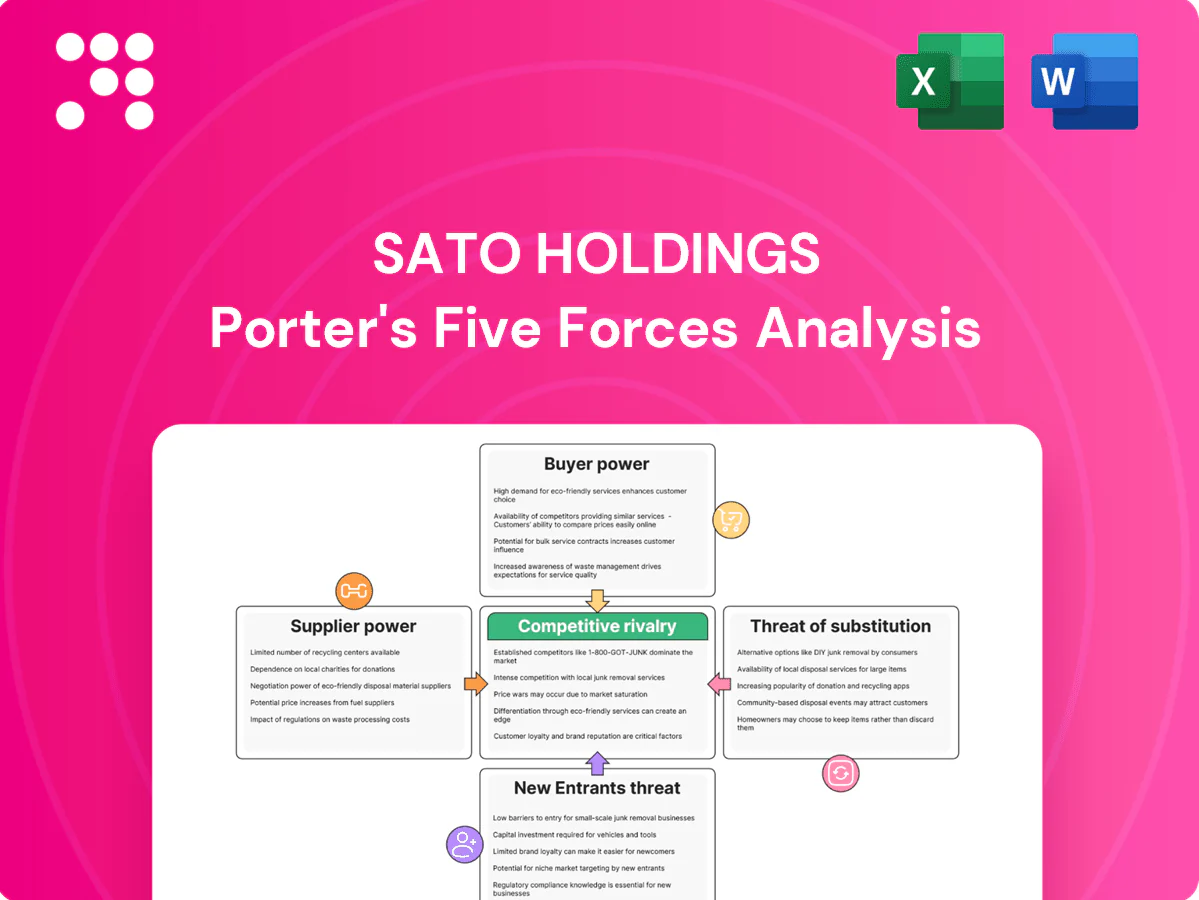
Sato Holdings Porter's Five Forces Analysis

A Must-Have Tool for Decision-Makers
Sato Holdings faces moderate supplier power, rising buyer expectations, and intense rivalry driven by commoditization and innovation in labeling and packaging; barriers to entry remain moderate due to capex and proprietary tech. This brief snapshot only scratches the surface. Unlock the full Porter's Five Forces Analysis to explore Sato Holdings’s competitive dynamics, market pressures, and strategic advantages in detail.
Suppliers Bargaining Power

Specialized printheads
Industrial thermal printheads and RFID modules are sourced from a concentrated group of qualified suppliers, which can push input costs higher and extend lead times to several months during tight cycles; SATO flagged supply constraints in 2023-24 that pressured procurement. Maintaining multi-sourcing and joint development reduces dependency, while long-term supply agreements help secure allocation in constrained markets.
Consumables dependency
Labels, adhesives, ribbons and specialty papers come from chemical and pulp producers with proprietary formulations, creating specification lock-in that can increase supplier power on niche media. SATO reduces this by in-house label conversion and private-label sourcing, preserving margin control and supply flexibility. Proactively qualifying alternate suppliers and media lowers switching risk and shortens replacement lead times.

Semiconductor cycles
MCUs, radios and sensors remain exposed to cyclical semiconductor shortages—MCU lead times averaged 12–18 weeks in 2024 and allocation drove component cost inflation near 10% year-over-year for many IoT SKUs; allocation risk can halt production and raise BOM costs; forecast collaboration with suppliers and 8–12 weeks of buffer inventory is essential; design-for-substitution to qualify alternate die and package options diversifies sourcing.

Quality and compliance
Healthcare and pharma sourcing demands ISO 13485, GMP and UDI compliance; in 2024 these standards remained enforced across major markets, concentrating qualified suppliers and increasing their leverage. SATO’s audited vendor base lowers non-compliance risk and co-certification programs lock-in terms and reduce supply volatility.
- Regulatory base: ISO 13485/GMP/UDI enforced in 2024
- Supplier scarcity: few consistently certified vendors
- SATO mitigation: audited vendors and co-certification
Logistics and geopolitics
Global shipping volatility and trade controls constrain access to key materials, highlighted by the 2021-22 freight spikes that disrupted supply chains; regionalizing suppliers reduces transit risk but narrows supplier pools. SATO benefits from Japan- and Asia-centric networks yet needs dual-sourcing across regions to maintain resilience. Hedging and local inventories cushion shocks.
- Regional focus: Japan/Asia advantage
- Risk: narrower supplier pool
- Mitigation: dual-sourcing
- Buffers: hedging + local inventory
Supplier concentration drives input inflation: MCU lead times 12–18 weeks, costs ≈10% YoY
Supplier concentration raises input leverage: industrial printhead/RFID lead times hit several months and MCU lead times averaged 12–18 weeks in 2024, driving component cost inflation near 10% YoY. Proprietary media and certified healthcare vendors (ISO 13485/GMP enforced in 2024) increase scarcity; SATO mitigates via in-house conversion, co-certification and multi-sourcing.
| Metric | 2024 |
|---|---|
| MCU lead time | 12–18 weeks |
| Component cost inflation | ≈10% YoY |
| Regulatory enforcement | ISO 13485/GMP (2024) |
What is included in the product
 Detailed Word Document
Comprehensive Porter's Five Forces overview for Sato Holdings revealing competitive drivers, buyer/supplier power, entry barriers, substitutes and disruptive threats, with strategic commentary to inform pricing, positioning and risk mitigation.

 Customizable Excel Spreadsheet
Clear one-sheet Porter's Five Forces for Sato Holdings that visualizes competitive pressure with an editable radar chart—customize scores, swap data, and drop directly into pitch decks for instant strategic clarity.
Customers Bargaining Power

Enterprise volume leverage
Large retailers, 3PLs and manufacturers buying at scale exert strong price pressure on Sato, demanding volume discounts and strict SLAs; the global 3PL market reached roughly $1.2 trillion in 2024, concentrating negotiating power and compressing hardware and media margins. Bundled solutions—software, services and consumables—allow Sato to recapture value and improve blended margins despite unit-price erosion.
Standards enable switching
Barcode and RFID printers adhere to common protocols such as EPCglobal Gen2 for RFID and languages like ZPL for thermal labels, enabling broad interoperability. This standards-driven compatibility materially lowers technical switching costs and lets buyers run competitive RFPs frequently, often on annual or biennial cycles. SATO therefore must compete on proven reliability and lower total cost of ownership to maintain margins.

TCO and uptime focus
Customers optimize for total cost of ownership—consumables, maintenance and downtime drive purchasing choices, so predictable pricing and rapid service are nonnegotiable. A broad service network lowers perceived risk and weakens buyer bargaining power by ensuring swift onsite support. Demonstrable uptime through analytics and SLAs boosts retention and allows premium pricing, shifting leverage back to Sato.

Regulated use cases
Regulated use cases in healthcare, food and pharma demand validated workflows and full traceability; EU FMD (in effect since 2019) and US FDA requirements keep buyers from changing certified systems because requalification often exceeds $100,000 and validated system lifecycles typically span 5+ years, reducing buyer bargaining power after deployment, though pre-sale buyers press hard for compliance assurances.
- Validation cost: often >$100,000
- Lifecycle: validated systems commonly 5+ years
- Regulation: EU FMD active since 2019; US FDA compliance enforced
Demand for integration
Clients increasingly demand end-to-end solutions that natively integrate with WMS/ERP and IoT; in 2024 over 54% of logistics buyers prioritized platform integration, shifting bargaining power toward providers offering integrated hardware, media, and software which drive stickiness and higher lifetime value.
3PL market $1.2T, integration 54% boosts stickiness; validation >$100K
Large retailers and 3PLs (global 3PL market ~$1.2T in 2024) exert strong price pressure, while standards (EPCglobal Gen2, ZPL) lower switching costs. Integration demands (54% of logistics buyers prioritized platform integration in 2024) increase stickiness. Regulated sectors (validation >$100,000; 5+ year lifecycles) reduce post-deployment buyer leverage.
| Metric | 2024 |
|---|---|
| 3PL market | $1.2T |
| Integration priority | 54% |
| Validation cost | >$100,000 |
Same Document Delivered
Sato Holdings Porter's Five Forces Analysis
This preview shows the exact Sato Holdings Porter's Five Forces Analysis you'll receive after purchase; it's the full, professionally formatted document with no placeholders. What you see is ready for immediate download and use. No mockups—instant access to the final deliverable.

A Must-Have Tool for Decision-Makers
Sato Holdings faces moderate supplier power, rising buyer expectations, and intense rivalry driven by commoditization and innovation in labeling and packaging; barriers to entry remain moderate due to capex and proprietary tech. This brief snapshot only scratches the surface. Unlock the full Porter's Five Forces Analysis to explore Sato Holdings’s competitive dynamics, market pressures, and strategic advantages in detail.
Suppliers Bargaining Power
Specialized printheads
Industrial thermal printheads and RFID modules are sourced from a concentrated group of qualified suppliers, which can push input costs higher and extend lead times to several months during tight cycles; SATO flagged supply constraints in 2023-24 that pressured procurement. Maintaining multi-sourcing and joint development reduces dependency, while long-term supply agreements help secure allocation in constrained markets.
Consumables dependency
Labels, adhesives, ribbons and specialty papers come from chemical and pulp producers with proprietary formulations, creating specification lock-in that can increase supplier power on niche media. SATO reduces this by in-house label conversion and private-label sourcing, preserving margin control and supply flexibility. Proactively qualifying alternate suppliers and media lowers switching risk and shortens replacement lead times.
Semiconductor cycles
MCUs, radios and sensors remain exposed to cyclical semiconductor shortages—MCU lead times averaged 12–18 weeks in 2024 and allocation drove component cost inflation near 10% year-over-year for many IoT SKUs; allocation risk can halt production and raise BOM costs; forecast collaboration with suppliers and 8–12 weeks of buffer inventory is essential; design-for-substitution to qualify alternate die and package options diversifies sourcing.
Quality and compliance
Healthcare and pharma sourcing demands ISO 13485, GMP and UDI compliance; in 2024 these standards remained enforced across major markets, concentrating qualified suppliers and increasing their leverage. SATO’s audited vendor base lowers non-compliance risk and co-certification programs lock-in terms and reduce supply volatility.
- Regulatory base: ISO 13485/GMP/UDI enforced in 2024
- Supplier scarcity: few consistently certified vendors
- SATO mitigation: audited vendors and co-certification
Logistics and geopolitics
Global shipping volatility and trade controls constrain access to key materials, highlighted by the 2021-22 freight spikes that disrupted supply chains; regionalizing suppliers reduces transit risk but narrows supplier pools. SATO benefits from Japan- and Asia-centric networks yet needs dual-sourcing across regions to maintain resilience. Hedging and local inventories cushion shocks.
- Regional focus: Japan/Asia advantage
- Risk: narrower supplier pool
- Mitigation: dual-sourcing
- Buffers: hedging + local inventory
Supplier concentration drives input inflation: MCU lead times 12–18 weeks, costs ≈10% YoY
Supplier concentration raises input leverage: industrial printhead/RFID lead times hit several months and MCU lead times averaged 12–18 weeks in 2024, driving component cost inflation near 10% YoY. Proprietary media and certified healthcare vendors (ISO 13485/GMP enforced in 2024) increase scarcity; SATO mitigates via in-house conversion, co-certification and multi-sourcing.
| Metric | 2024 |
|---|---|
| MCU lead time | 12–18 weeks |
| Component cost inflation | ≈10% YoY |
| Regulatory enforcement | ISO 13485/GMP (2024) |
What is included in the product
Detailed Word Document
Comprehensive Porter's Five Forces overview for Sato Holdings revealing competitive drivers, buyer/supplier power, entry barriers, substitutes and disruptive threats, with strategic commentary to inform pricing, positioning and risk mitigation.
Customizable Excel Spreadsheet
Clear one-sheet Porter's Five Forces for Sato Holdings that visualizes competitive pressure with an editable radar chart—customize scores, swap data, and drop directly into pitch decks for instant strategic clarity.
Customers Bargaining Power
Enterprise volume leverage
Large retailers, 3PLs and manufacturers buying at scale exert strong price pressure on Sato, demanding volume discounts and strict SLAs; the global 3PL market reached roughly $1.2 trillion in 2024, concentrating negotiating power and compressing hardware and media margins. Bundled solutions—software, services and consumables—allow Sato to recapture value and improve blended margins despite unit-price erosion.
Standards enable switching
Barcode and RFID printers adhere to common protocols such as EPCglobal Gen2 for RFID and languages like ZPL for thermal labels, enabling broad interoperability. This standards-driven compatibility materially lowers technical switching costs and lets buyers run competitive RFPs frequently, often on annual or biennial cycles. SATO therefore must compete on proven reliability and lower total cost of ownership to maintain margins.
TCO and uptime focus
Customers optimize for total cost of ownership—consumables, maintenance and downtime drive purchasing choices, so predictable pricing and rapid service are nonnegotiable. A broad service network lowers perceived risk and weakens buyer bargaining power by ensuring swift onsite support. Demonstrable uptime through analytics and SLAs boosts retention and allows premium pricing, shifting leverage back to Sato.
Regulated use cases
Regulated use cases in healthcare, food and pharma demand validated workflows and full traceability; EU FMD (in effect since 2019) and US FDA requirements keep buyers from changing certified systems because requalification often exceeds $100,000 and validated system lifecycles typically span 5+ years, reducing buyer bargaining power after deployment, though pre-sale buyers press hard for compliance assurances.
- Validation cost: often >$100,000
- Lifecycle: validated systems commonly 5+ years
- Regulation: EU FMD active since 2019; US FDA compliance enforced
Demand for integration
Clients increasingly demand end-to-end solutions that natively integrate with WMS/ERP and IoT; in 2024 over 54% of logistics buyers prioritized platform integration, shifting bargaining power toward providers offering integrated hardware, media, and software which drive stickiness and higher lifetime value.
3PL market $1.2T, integration 54% boosts stickiness; validation >$100K
Large retailers and 3PLs (global 3PL market ~$1.2T in 2024) exert strong price pressure, while standards (EPCglobal Gen2, ZPL) lower switching costs. Integration demands (54% of logistics buyers prioritized platform integration in 2024) increase stickiness. Regulated sectors (validation >$100,000; 5+ year lifecycles) reduce post-deployment buyer leverage.
| Metric | 2024 |
|---|---|
| 3PL market | $1.2T |
| Integration priority | 54% |
| Validation cost | >$100,000 |
Same Document Delivered
Sato Holdings Porter's Five Forces Analysis
This preview shows the exact Sato Holdings Porter's Five Forces Analysis you'll receive after purchase; it's the full, professionally formatted document with no placeholders. What you see is ready for immediate download and use. No mockups—instant access to the final deliverable.
Original: $10.00
-65%$10.00
$3.50Description
A Must-Have Tool for Decision-Makers
Sato Holdings faces moderate supplier power, rising buyer expectations, and intense rivalry driven by commoditization and innovation in labeling and packaging; barriers to entry remain moderate due to capex and proprietary tech. This brief snapshot only scratches the surface. Unlock the full Porter's Five Forces Analysis to explore Sato Holdings’s competitive dynamics, market pressures, and strategic advantages in detail.
Suppliers Bargaining Power
Specialized printheads
Industrial thermal printheads and RFID modules are sourced from a concentrated group of qualified suppliers, which can push input costs higher and extend lead times to several months during tight cycles; SATO flagged supply constraints in 2023-24 that pressured procurement. Maintaining multi-sourcing and joint development reduces dependency, while long-term supply agreements help secure allocation in constrained markets.
Consumables dependency
Labels, adhesives, ribbons and specialty papers come from chemical and pulp producers with proprietary formulations, creating specification lock-in that can increase supplier power on niche media. SATO reduces this by in-house label conversion and private-label sourcing, preserving margin control and supply flexibility. Proactively qualifying alternate suppliers and media lowers switching risk and shortens replacement lead times.
Semiconductor cycles
MCUs, radios and sensors remain exposed to cyclical semiconductor shortages—MCU lead times averaged 12–18 weeks in 2024 and allocation drove component cost inflation near 10% year-over-year for many IoT SKUs; allocation risk can halt production and raise BOM costs; forecast collaboration with suppliers and 8–12 weeks of buffer inventory is essential; design-for-substitution to qualify alternate die and package options diversifies sourcing.
Quality and compliance
Healthcare and pharma sourcing demands ISO 13485, GMP and UDI compliance; in 2024 these standards remained enforced across major markets, concentrating qualified suppliers and increasing their leverage. SATO’s audited vendor base lowers non-compliance risk and co-certification programs lock-in terms and reduce supply volatility.
- Regulatory base: ISO 13485/GMP/UDI enforced in 2024
- Supplier scarcity: few consistently certified vendors
- SATO mitigation: audited vendors and co-certification
Logistics and geopolitics
Global shipping volatility and trade controls constrain access to key materials, highlighted by the 2021-22 freight spikes that disrupted supply chains; regionalizing suppliers reduces transit risk but narrows supplier pools. SATO benefits from Japan- and Asia-centric networks yet needs dual-sourcing across regions to maintain resilience. Hedging and local inventories cushion shocks.
- Regional focus: Japan/Asia advantage
- Risk: narrower supplier pool
- Mitigation: dual-sourcing
- Buffers: hedging + local inventory
Supplier concentration drives input inflation: MCU lead times 12–18 weeks, costs ≈10% YoY
Supplier concentration raises input leverage: industrial printhead/RFID lead times hit several months and MCU lead times averaged 12–18 weeks in 2024, driving component cost inflation near 10% YoY. Proprietary media and certified healthcare vendors (ISO 13485/GMP enforced in 2024) increase scarcity; SATO mitigates via in-house conversion, co-certification and multi-sourcing.
| Metric | 2024 |
|---|---|
| MCU lead time | 12–18 weeks |
| Component cost inflation | ≈10% YoY |
| Regulatory enforcement | ISO 13485/GMP (2024) |
What is included in the product
Detailed Word Document
Comprehensive Porter's Five Forces overview for Sato Holdings revealing competitive drivers, buyer/supplier power, entry barriers, substitutes and disruptive threats, with strategic commentary to inform pricing, positioning and risk mitigation.
Customizable Excel Spreadsheet
Clear one-sheet Porter's Five Forces for Sato Holdings that visualizes competitive pressure with an editable radar chart—customize scores, swap data, and drop directly into pitch decks for instant strategic clarity.
Customers Bargaining Power
Enterprise volume leverage
Large retailers, 3PLs and manufacturers buying at scale exert strong price pressure on Sato, demanding volume discounts and strict SLAs; the global 3PL market reached roughly $1.2 trillion in 2024, concentrating negotiating power and compressing hardware and media margins. Bundled solutions—software, services and consumables—allow Sato to recapture value and improve blended margins despite unit-price erosion.
Standards enable switching
Barcode and RFID printers adhere to common protocols such as EPCglobal Gen2 for RFID and languages like ZPL for thermal labels, enabling broad interoperability. This standards-driven compatibility materially lowers technical switching costs and lets buyers run competitive RFPs frequently, often on annual or biennial cycles. SATO therefore must compete on proven reliability and lower total cost of ownership to maintain margins.
TCO and uptime focus
Customers optimize for total cost of ownership—consumables, maintenance and downtime drive purchasing choices, so predictable pricing and rapid service are nonnegotiable. A broad service network lowers perceived risk and weakens buyer bargaining power by ensuring swift onsite support. Demonstrable uptime through analytics and SLAs boosts retention and allows premium pricing, shifting leverage back to Sato.
Regulated use cases
Regulated use cases in healthcare, food and pharma demand validated workflows and full traceability; EU FMD (in effect since 2019) and US FDA requirements keep buyers from changing certified systems because requalification often exceeds $100,000 and validated system lifecycles typically span 5+ years, reducing buyer bargaining power after deployment, though pre-sale buyers press hard for compliance assurances.
- Validation cost: often >$100,000
- Lifecycle: validated systems commonly 5+ years
- Regulation: EU FMD active since 2019; US FDA compliance enforced
Demand for integration
Clients increasingly demand end-to-end solutions that natively integrate with WMS/ERP and IoT; in 2024 over 54% of logistics buyers prioritized platform integration, shifting bargaining power toward providers offering integrated hardware, media, and software which drive stickiness and higher lifetime value.
3PL market $1.2T, integration 54% boosts stickiness; validation >$100K
Large retailers and 3PLs (global 3PL market ~$1.2T in 2024) exert strong price pressure, while standards (EPCglobal Gen2, ZPL) lower switching costs. Integration demands (54% of logistics buyers prioritized platform integration in 2024) increase stickiness. Regulated sectors (validation >$100,000; 5+ year lifecycles) reduce post-deployment buyer leverage.
| Metric | 2024 |
|---|---|
| 3PL market | $1.2T |
| Integration priority | 54% |
| Validation cost | >$100,000 |
Same Document Delivered
Sato Holdings Porter's Five Forces Analysis
This preview shows the exact Sato Holdings Porter's Five Forces Analysis you'll receive after purchase; it's the full, professionally formatted document with no placeholders. What you see is ready for immediate download and use. No mockups—instant access to the final deliverable.











