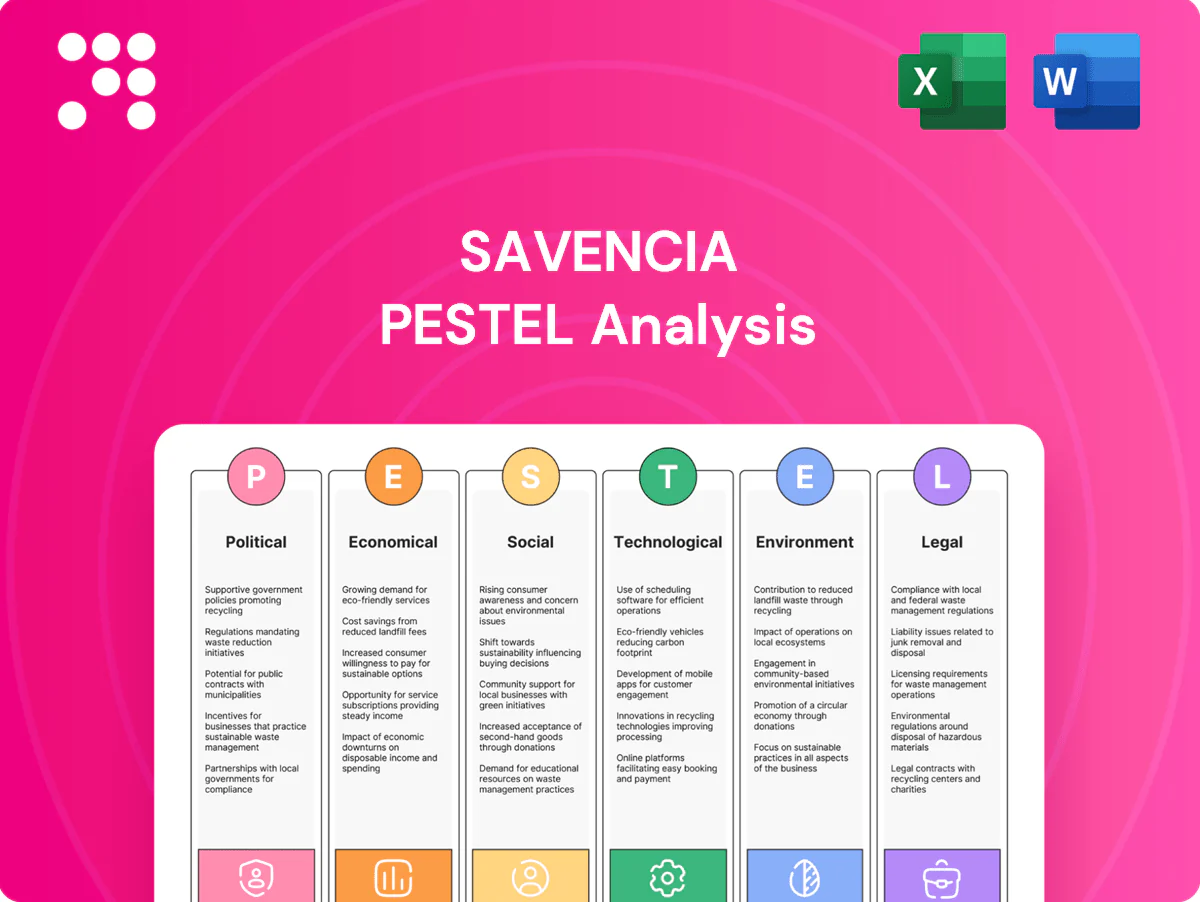
Savencia PESTLE Analysis

Make Smarter Strategic Decisions with a Complete PESTEL View
Unlock strategic clarity with our Savencia PESTLE Analysis. Explore how political, economic, social, technological, legal, and environmental forces shape the company’s outlook. Ideal for investors and strategists seeking actionable intelligence. Buy the full report for the complete, ready-to-use breakdown.
Political factors

Agricultural subsidies and CAP alignment
EU Common Agricultural Policy (CAP) budget for 2023–27 is €387 billion and shapes raw milk economics across an EU milk production base of roughly 144 million tonnes in 2023, directly affecting farmgate returns. Subsidy shifts can change farm viability and input prices for processors, squeezing margins for dairy groups like Savencia. Savencia must monitor CAP revisions, adjust sourcing and pricing strategies, and engage in advocacy and co-op partnerships to help stabilize supply.
Trade policies, tariffs, and non-tariff barriers
Cheese faces applied tariffs up to 40% in some markets and non-tariff sanitary and phytosanitary (SPS) controls that can trigger clearance delays of up to 30 days, raising landed costs and inventory needs.
Any rise in protectionism or SPS tightening can restrict market access and compress margins; Savencia must keep diversified export routes and implement rapid compliance protocols.
Strategic localization of production and packaging in key markets mitigates tariff shocks and trade-risk exposure.

Geopolitical risk and sanctions exposure
Russia's 2014 food import ban and the 2022 wave of sanctions and capital controls show how embargoes and regional conflicts can abruptly curb dairy trade and complicate receivables. Savencia must adopt scenario planning and flexible distribution networks to reroute volumes when markets close. Use insurance, trade credit protection and FX hedges to cushion sudden shocks to cash flow and contracts.

Public health and nutrition guidelines
National salt, fat and additive policies such as WHO salt target <5 g/day and EU voluntary salt reduction pushes compel Savencia to reformulate cheeses; Savencia reported €3.7bn sales in 2024 so recipe changes affect significant volumes. School and public procurement standards drive product mix and portioning; proactive lower-sodium/fat variants can capture premium contracts and margin uplift.
- Policy impact: mandatory/voluntary salt, fat, additive limits
- Procurement: schools/public tenders shift volumes
- Action: reformulate recipes, adjust portion sizes
- Opportunity: differentiation, access to institutional contracts
Rural development and farm consolidation policies
Rural development and farm consolidation policies reshape milk supply stability; EU raw milk production was about 150 million tonnes in 2023 (Eurostat), concentrating supply among larger farms and raising volatility risks for processors like Savencia.
Incentives tied to sustainability, such as CAP eco-schemes, force stricter supplier requirements and create costs and opportunities for traceable, low-carbon milk sourcing.
Savencia can co-invest in farmer programs and long-term contracts to secure quality and volume—Savencia Group reported ~€4.9bn revenue in 2023, underscoring scale to finance upstream partnerships.
- Supply impact: EU milk ~150 Mt (2023)
- Policy shift: CAP eco-schemes raise sustainability standards
- Action: Co-investment in farms to secure volumes
- Resilience: Long-term contracts for stability
CAP, tariffs and milk volatility squeeze margins - hedge, localize and co-invest in farms
CAP €387bn (2023–27) and EU milk ~150Mt (2023) shape farmgate returns and input costs, pressuring Savencia margins. Tariffs up to 40% and SPS delays (~30 days) raise landed costs and inventory needs. Sanitary/salt/fat rules and CAP eco-schemes force reformulation and supplier requirements; Savencia (€3.7bn sales 2024) can hedge, localize production and co-invest in farms.
| Factor | Metric | Impact | Action |
|---|---|---|---|
| CAP | €387bn | Farmgate returns | Advocacy/sourcing |
| Milk supply | ~150Mt (2023) | Volatility | Long-term contracts |
| Trade | Tariffs up to 40% | Landed cost ↑ | Localize production |
What is included in the product
 Detailed Word Document
Explores how external macro-environmental factors uniquely affect Savencia across Political, Economic, Social, Technological, Environmental and Legal dimensions, with data-backed trends and region-specific regulatory context. Designed for executives and investors, it provides detailed sub-points, forward-looking insights and scenario inputs to identify risks, opportunities and inform strategic planning.

 Customizable Excel Spreadsheet
A concise, visually segmented PESTLE summary of Savencia that can be dropped into presentations, edited with region- or product-specific notes, and easily shared to align teams and support external risk discussions during planning sessions.
Economic factors

Milk price volatility and margin pressure
Global supply-demand cycles drove raw milk swings, with global milk output rising about 1.7% year-on-year in 2024 per USDA estimates and skimmed milk powder (SMP) spot prices varying roughly 30% between 2022–24, squeezing industrial margins when increases cannot be passed through. Savencia must deploy dynamic pricing and hedging to protect processing margins, while deepening long-term supplier contracts to smooth procurement variability.
Inflation and consumer trading behavior
High food and energy inflation pushed consumers toward value tiers; FAO Food Price Index declined ~15% from its 2022 peak but households still traded down in 2024, with private-label penetration near 40% in Western Europe (Kantar 2024).
Savencia may see premium cheese slow while private labels grow, so it should balance premium brands with affordable lines and use pack-size engineering to hit lower price points and protect volumes.

FX fluctuations across multi-market footprint
Savencia records revenues across 120+ markets and conducts production and purchases in multiple currencies, so FX moves affect competitiveness and earnings translation. Natural hedges from local production and sales plus active use of forward currency derivatives mitigate volatility under its hedging policy. Diversified sourcing and sales reduce single-currency concentration risk, limiting translation swings on its ~€4.7bn annual turnover.

Energy and logistics cost cycles
Dairy processing is energy‑intensive with refrigeration often representing 30–40% of plant energy use; EU industrial electricity averaged about €0.18–0.24/kWh in 2024 and diesel roughly €1.60–1.80/L, so fuel and electricity spikes materially raise unit costs. Savencia can mitigate via efficiency projects and corporate PPAs and by network optimization to cut freight miles and logistics spend.
- Refrigeration 30–40% of energy
- EU industrial power €0.18–0.24/kWh (2024)
- Diesel ~€1.60–1.80/L (2024)
- PPAs and route optimization reduce unit cost
Retailer consolidation and bargaining power
Savencia faces strong pricing pressure from large retailers and foodservice chains; Walmart’s FY2023 revenue of $611 billion highlights retailer scale and leverage. Slotting fees and promotional spend increasingly strain margins. Demonstrating category value and using data-driven revenue management enhances negotiation outcomes.
- Retailer leverage: large chains dominate shelf access
- Margin pressure: slotting/promotions increase COGS
- Mitigation: category value + data-driven pricing
CAP, tariffs and milk volatility squeeze margins - hedge, localize and co-invest in farms
Global milk output +1.7% y/y (USDA 2024) and SMP price swings ~30% (2022–24) squeeze margins; FAO Food Price Index down ~15% from 2022 peak with private label ~40% in Western Europe (Kantar 2024). Savencia: €4.7bn turnover, must hedge FX and commodities, balance premium vs value, cut energy (refrig 30–40%) and logistics costs.
| Metric | 2024/2025 |
|---|---|
| Milk output | +1.7% y/y (USDA 2024) |
| SMP volatility | ~30% (2022–24) |
| FAO FPI | -15% from 2022 peak |
| Private label WE | ~40% (Kantar 2024) |
| Turnover | ~€4.7bn |
| EU power | €0.18–0.24/kWh (2024) |
| Diesel | €1.60–1.80/L (2024) |
What You See Is What You Get
Savencia PESTLE Analysis
The preview shown here is the exact Savencia PESTLE Analysis you’ll receive after purchase—fully formatted and ready to use. The layout, content, and structure visible are identical to the downloadable file. No placeholders or surprises; this is the final, professional document.

Make Smarter Strategic Decisions with a Complete PESTEL View
Unlock strategic clarity with our Savencia PESTLE Analysis. Explore how political, economic, social, technological, legal, and environmental forces shape the company’s outlook. Ideal for investors and strategists seeking actionable intelligence. Buy the full report for the complete, ready-to-use breakdown.
Political factors
Agricultural subsidies and CAP alignment
EU Common Agricultural Policy (CAP) budget for 2023–27 is €387 billion and shapes raw milk economics across an EU milk production base of roughly 144 million tonnes in 2023, directly affecting farmgate returns. Subsidy shifts can change farm viability and input prices for processors, squeezing margins for dairy groups like Savencia. Savencia must monitor CAP revisions, adjust sourcing and pricing strategies, and engage in advocacy and co-op partnerships to help stabilize supply.
Trade policies, tariffs, and non-tariff barriers
Cheese faces applied tariffs up to 40% in some markets and non-tariff sanitary and phytosanitary (SPS) controls that can trigger clearance delays of up to 30 days, raising landed costs and inventory needs.
Any rise in protectionism or SPS tightening can restrict market access and compress margins; Savencia must keep diversified export routes and implement rapid compliance protocols.
Strategic localization of production and packaging in key markets mitigates tariff shocks and trade-risk exposure.
Geopolitical risk and sanctions exposure
Russia's 2014 food import ban and the 2022 wave of sanctions and capital controls show how embargoes and regional conflicts can abruptly curb dairy trade and complicate receivables. Savencia must adopt scenario planning and flexible distribution networks to reroute volumes when markets close. Use insurance, trade credit protection and FX hedges to cushion sudden shocks to cash flow and contracts.
Public health and nutrition guidelines
National salt, fat and additive policies such as WHO salt target <5 g/day and EU voluntary salt reduction pushes compel Savencia to reformulate cheeses; Savencia reported €3.7bn sales in 2024 so recipe changes affect significant volumes. School and public procurement standards drive product mix and portioning; proactive lower-sodium/fat variants can capture premium contracts and margin uplift.
- Policy impact: mandatory/voluntary salt, fat, additive limits
- Procurement: schools/public tenders shift volumes
- Action: reformulate recipes, adjust portion sizes
- Opportunity: differentiation, access to institutional contracts
Rural development and farm consolidation policies
Rural development and farm consolidation policies reshape milk supply stability; EU raw milk production was about 150 million tonnes in 2023 (Eurostat), concentrating supply among larger farms and raising volatility risks for processors like Savencia.
Incentives tied to sustainability, such as CAP eco-schemes, force stricter supplier requirements and create costs and opportunities for traceable, low-carbon milk sourcing.
Savencia can co-invest in farmer programs and long-term contracts to secure quality and volume—Savencia Group reported ~€4.9bn revenue in 2023, underscoring scale to finance upstream partnerships.
- Supply impact: EU milk ~150 Mt (2023)
- Policy shift: CAP eco-schemes raise sustainability standards
- Action: Co-investment in farms to secure volumes
- Resilience: Long-term contracts for stability
CAP, tariffs and milk volatility squeeze margins - hedge, localize and co-invest in farms
CAP €387bn (2023–27) and EU milk ~150Mt (2023) shape farmgate returns and input costs, pressuring Savencia margins. Tariffs up to 40% and SPS delays (~30 days) raise landed costs and inventory needs. Sanitary/salt/fat rules and CAP eco-schemes force reformulation and supplier requirements; Savencia (€3.7bn sales 2024) can hedge, localize production and co-invest in farms.
| Factor | Metric | Impact | Action |
|---|---|---|---|
| CAP | €387bn | Farmgate returns | Advocacy/sourcing |
| Milk supply | ~150Mt (2023) | Volatility | Long-term contracts |
| Trade | Tariffs up to 40% | Landed cost ↑ | Localize production |
What is included in the product
Detailed Word Document
Explores how external macro-environmental factors uniquely affect Savencia across Political, Economic, Social, Technological, Environmental and Legal dimensions, with data-backed trends and region-specific regulatory context. Designed for executives and investors, it provides detailed sub-points, forward-looking insights and scenario inputs to identify risks, opportunities and inform strategic planning.
Customizable Excel Spreadsheet
A concise, visually segmented PESTLE summary of Savencia that can be dropped into presentations, edited with region- or product-specific notes, and easily shared to align teams and support external risk discussions during planning sessions.
Economic factors
Milk price volatility and margin pressure
Global supply-demand cycles drove raw milk swings, with global milk output rising about 1.7% year-on-year in 2024 per USDA estimates and skimmed milk powder (SMP) spot prices varying roughly 30% between 2022–24, squeezing industrial margins when increases cannot be passed through. Savencia must deploy dynamic pricing and hedging to protect processing margins, while deepening long-term supplier contracts to smooth procurement variability.
Inflation and consumer trading behavior
High food and energy inflation pushed consumers toward value tiers; FAO Food Price Index declined ~15% from its 2022 peak but households still traded down in 2024, with private-label penetration near 40% in Western Europe (Kantar 2024).
Savencia may see premium cheese slow while private labels grow, so it should balance premium brands with affordable lines and use pack-size engineering to hit lower price points and protect volumes.
FX fluctuations across multi-market footprint
Savencia records revenues across 120+ markets and conducts production and purchases in multiple currencies, so FX moves affect competitiveness and earnings translation. Natural hedges from local production and sales plus active use of forward currency derivatives mitigate volatility under its hedging policy. Diversified sourcing and sales reduce single-currency concentration risk, limiting translation swings on its ~€4.7bn annual turnover.
Energy and logistics cost cycles
Dairy processing is energy‑intensive with refrigeration often representing 30–40% of plant energy use; EU industrial electricity averaged about €0.18–0.24/kWh in 2024 and diesel roughly €1.60–1.80/L, so fuel and electricity spikes materially raise unit costs. Savencia can mitigate via efficiency projects and corporate PPAs and by network optimization to cut freight miles and logistics spend.
- Refrigeration 30–40% of energy
- EU industrial power €0.18–0.24/kWh (2024)
- Diesel ~€1.60–1.80/L (2024)
- PPAs and route optimization reduce unit cost
Retailer consolidation and bargaining power
Savencia faces strong pricing pressure from large retailers and foodservice chains; Walmart’s FY2023 revenue of $611 billion highlights retailer scale and leverage. Slotting fees and promotional spend increasingly strain margins. Demonstrating category value and using data-driven revenue management enhances negotiation outcomes.
- Retailer leverage: large chains dominate shelf access
- Margin pressure: slotting/promotions increase COGS
- Mitigation: category value + data-driven pricing
CAP, tariffs and milk volatility squeeze margins - hedge, localize and co-invest in farms
Global milk output +1.7% y/y (USDA 2024) and SMP price swings ~30% (2022–24) squeeze margins; FAO Food Price Index down ~15% from 2022 peak with private label ~40% in Western Europe (Kantar 2024). Savencia: €4.7bn turnover, must hedge FX and commodities, balance premium vs value, cut energy (refrig 30–40%) and logistics costs.
| Metric | 2024/2025 |
|---|---|
| Milk output | +1.7% y/y (USDA 2024) |
| SMP volatility | ~30% (2022–24) |
| FAO FPI | -15% from 2022 peak |
| Private label WE | ~40% (Kantar 2024) |
| Turnover | ~€4.7bn |
| EU power | €0.18–0.24/kWh (2024) |
| Diesel | €1.60–1.80/L (2024) |
What You See Is What You Get
Savencia PESTLE Analysis
The preview shown here is the exact Savencia PESTLE Analysis you’ll receive after purchase—fully formatted and ready to use. The layout, content, and structure visible are identical to the downloadable file. No placeholders or surprises; this is the final, professional document.
Description
Make Smarter Strategic Decisions with a Complete PESTEL View
Unlock strategic clarity with our Savencia PESTLE Analysis. Explore how political, economic, social, technological, legal, and environmental forces shape the company’s outlook. Ideal for investors and strategists seeking actionable intelligence. Buy the full report for the complete, ready-to-use breakdown.
Political factors
Agricultural subsidies and CAP alignment
EU Common Agricultural Policy (CAP) budget for 2023–27 is €387 billion and shapes raw milk economics across an EU milk production base of roughly 144 million tonnes in 2023, directly affecting farmgate returns. Subsidy shifts can change farm viability and input prices for processors, squeezing margins for dairy groups like Savencia. Savencia must monitor CAP revisions, adjust sourcing and pricing strategies, and engage in advocacy and co-op partnerships to help stabilize supply.
Trade policies, tariffs, and non-tariff barriers
Cheese faces applied tariffs up to 40% in some markets and non-tariff sanitary and phytosanitary (SPS) controls that can trigger clearance delays of up to 30 days, raising landed costs and inventory needs.
Any rise in protectionism or SPS tightening can restrict market access and compress margins; Savencia must keep diversified export routes and implement rapid compliance protocols.
Strategic localization of production and packaging in key markets mitigates tariff shocks and trade-risk exposure.
Geopolitical risk and sanctions exposure
Russia's 2014 food import ban and the 2022 wave of sanctions and capital controls show how embargoes and regional conflicts can abruptly curb dairy trade and complicate receivables. Savencia must adopt scenario planning and flexible distribution networks to reroute volumes when markets close. Use insurance, trade credit protection and FX hedges to cushion sudden shocks to cash flow and contracts.
Public health and nutrition guidelines
National salt, fat and additive policies such as WHO salt target <5 g/day and EU voluntary salt reduction pushes compel Savencia to reformulate cheeses; Savencia reported €3.7bn sales in 2024 so recipe changes affect significant volumes. School and public procurement standards drive product mix and portioning; proactive lower-sodium/fat variants can capture premium contracts and margin uplift.
- Policy impact: mandatory/voluntary salt, fat, additive limits
- Procurement: schools/public tenders shift volumes
- Action: reformulate recipes, adjust portion sizes
- Opportunity: differentiation, access to institutional contracts
Rural development and farm consolidation policies
Rural development and farm consolidation policies reshape milk supply stability; EU raw milk production was about 150 million tonnes in 2023 (Eurostat), concentrating supply among larger farms and raising volatility risks for processors like Savencia.
Incentives tied to sustainability, such as CAP eco-schemes, force stricter supplier requirements and create costs and opportunities for traceable, low-carbon milk sourcing.
Savencia can co-invest in farmer programs and long-term contracts to secure quality and volume—Savencia Group reported ~€4.9bn revenue in 2023, underscoring scale to finance upstream partnerships.
- Supply impact: EU milk ~150 Mt (2023)
- Policy shift: CAP eco-schemes raise sustainability standards
- Action: Co-investment in farms to secure volumes
- Resilience: Long-term contracts for stability
CAP, tariffs and milk volatility squeeze margins - hedge, localize and co-invest in farms
CAP €387bn (2023–27) and EU milk ~150Mt (2023) shape farmgate returns and input costs, pressuring Savencia margins. Tariffs up to 40% and SPS delays (~30 days) raise landed costs and inventory needs. Sanitary/salt/fat rules and CAP eco-schemes force reformulation and supplier requirements; Savencia (€3.7bn sales 2024) can hedge, localize production and co-invest in farms.
| Factor | Metric | Impact | Action |
|---|---|---|---|
| CAP | €387bn | Farmgate returns | Advocacy/sourcing |
| Milk supply | ~150Mt (2023) | Volatility | Long-term contracts |
| Trade | Tariffs up to 40% | Landed cost ↑ | Localize production |
What is included in the product
Detailed Word Document
Explores how external macro-environmental factors uniquely affect Savencia across Political, Economic, Social, Technological, Environmental and Legal dimensions, with data-backed trends and region-specific regulatory context. Designed for executives and investors, it provides detailed sub-points, forward-looking insights and scenario inputs to identify risks, opportunities and inform strategic planning.
Customizable Excel Spreadsheet
A concise, visually segmented PESTLE summary of Savencia that can be dropped into presentations, edited with region- or product-specific notes, and easily shared to align teams and support external risk discussions during planning sessions.
Economic factors
Milk price volatility and margin pressure
Global supply-demand cycles drove raw milk swings, with global milk output rising about 1.7% year-on-year in 2024 per USDA estimates and skimmed milk powder (SMP) spot prices varying roughly 30% between 2022–24, squeezing industrial margins when increases cannot be passed through. Savencia must deploy dynamic pricing and hedging to protect processing margins, while deepening long-term supplier contracts to smooth procurement variability.
Inflation and consumer trading behavior
High food and energy inflation pushed consumers toward value tiers; FAO Food Price Index declined ~15% from its 2022 peak but households still traded down in 2024, with private-label penetration near 40% in Western Europe (Kantar 2024).
Savencia may see premium cheese slow while private labels grow, so it should balance premium brands with affordable lines and use pack-size engineering to hit lower price points and protect volumes.
FX fluctuations across multi-market footprint
Savencia records revenues across 120+ markets and conducts production and purchases in multiple currencies, so FX moves affect competitiveness and earnings translation. Natural hedges from local production and sales plus active use of forward currency derivatives mitigate volatility under its hedging policy. Diversified sourcing and sales reduce single-currency concentration risk, limiting translation swings on its ~€4.7bn annual turnover.
Energy and logistics cost cycles
Dairy processing is energy‑intensive with refrigeration often representing 30–40% of plant energy use; EU industrial electricity averaged about €0.18–0.24/kWh in 2024 and diesel roughly €1.60–1.80/L, so fuel and electricity spikes materially raise unit costs. Savencia can mitigate via efficiency projects and corporate PPAs and by network optimization to cut freight miles and logistics spend.
- Refrigeration 30–40% of energy
- EU industrial power €0.18–0.24/kWh (2024)
- Diesel ~€1.60–1.80/L (2024)
- PPAs and route optimization reduce unit cost
Retailer consolidation and bargaining power
Savencia faces strong pricing pressure from large retailers and foodservice chains; Walmart’s FY2023 revenue of $611 billion highlights retailer scale and leverage. Slotting fees and promotional spend increasingly strain margins. Demonstrating category value and using data-driven revenue management enhances negotiation outcomes.
- Retailer leverage: large chains dominate shelf access
- Margin pressure: slotting/promotions increase COGS
- Mitigation: category value + data-driven pricing
CAP, tariffs and milk volatility squeeze margins - hedge, localize and co-invest in farms
Global milk output +1.7% y/y (USDA 2024) and SMP price swings ~30% (2022–24) squeeze margins; FAO Food Price Index down ~15% from 2022 peak with private label ~40% in Western Europe (Kantar 2024). Savencia: €4.7bn turnover, must hedge FX and commodities, balance premium vs value, cut energy (refrig 30–40%) and logistics costs.
| Metric | 2024/2025 |
|---|---|
| Milk output | +1.7% y/y (USDA 2024) |
| SMP volatility | ~30% (2022–24) |
| FAO FPI | -15% from 2022 peak |
| Private label WE | ~40% (Kantar 2024) |
| Turnover | ~€4.7bn |
| EU power | €0.18–0.24/kWh (2024) |
| Diesel | €1.60–1.80/L (2024) |
What You See Is What You Get
Savencia PESTLE Analysis
The preview shown here is the exact Savencia PESTLE Analysis you’ll receive after purchase—fully formatted and ready to use. The layout, content, and structure visible are identical to the downloadable file. No placeholders or surprises; this is the final, professional document.











