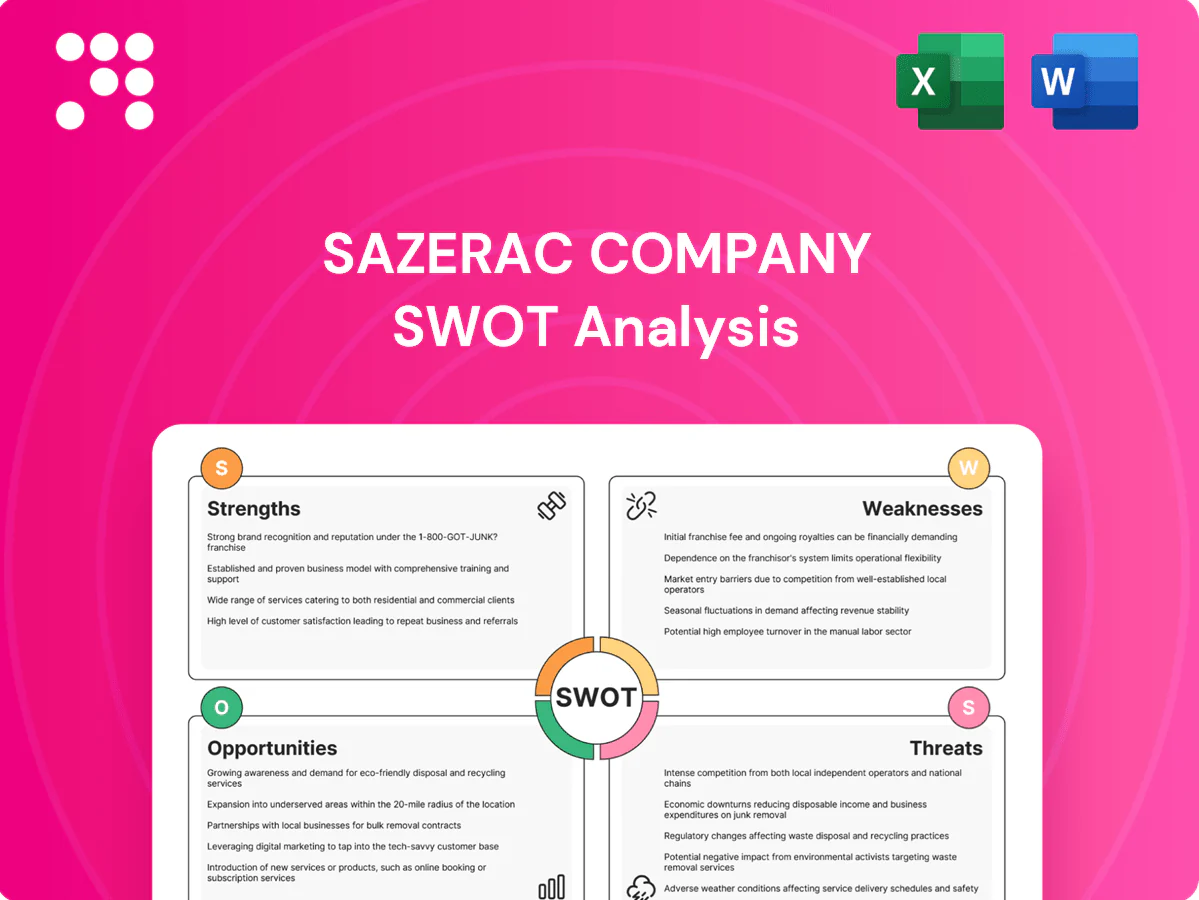
Sazerac Company SWOT Analysis

Elevate Your Analysis with the Complete SWOT Report
Sazerac’s strong brand portfolio, private-label flexibility, and strategic acquisitions underpin durable margins, while competition, regulatory shifts, and commodity cost volatility pose tangible risks. Emerging markets and premiumization offer clear growth levers. Purchase the full SWOT analysis for a detailed, editable report and Excel tools to plan, pitch, and invest with confidence.
Strengths

Diversified spirits portfolio
Sazerac maintains a diversified spirits portfolio spanning bourbons, whiskeys, vodkas, rums, tequilas and liqueurs, with ownership of dozens of brands across those categories. This breadth creates cross-category revenue streams and reduces reliance on any single segment. The company can reallocate marketing and supply toward outperforming categories, enhancing resilience against category-specific downturns.
Owned distilleries and bottling
Owned distilleries and bottling give Sazerac vertical integration that tightens cost control, quality assurance and capacity planning, supporting an estimated company revenue of about $1.5 billion (2023 estimate). In-house production yields better margins than contract manufacturing, enabling faster commercialization and small-batch innovation. It also enhances traceability and secures supply chains amid global disruptions.

Global distribution footprint
Sazerac, a privately held New Orleans-based spirits company and owner of Buffalo Trace, maintains a global distribution footprint across on-premise, off-premise and travel-retail channels, leveraging scale advantages in logistics and route-to-market execution. This reach enables rapid international brand seeding and local assortment tailoring while diversifying currency and macroeconomic exposure.

Strength in American whiskey
- Flagship brands: Buffalo Trace, Pappy Van Winkle
- Heritage: distilling lineage since 1775
- Pricing support: long-age expressions and collectors
- Demand drivers: premiumization + cocktail culture
Brand building and innovation
Sazerac leverages a pipeline of line extensions, limited releases and flavor variants across its portfolio of over 200 brands to drive premium trade-up and seasonal demand. Data-driven marketing and experiential activations—tasting events and on-premise partnerships—boost premiumization and awareness. The company shows agility testing small sizes and gift packs and routinely refreshes legacy brands to appeal to new consumer cohorts.
- line-extensions
- limited-releases
- flavor-variants
- data-driven-marketing
- experiential-activations
- small-sizes-gift-packs
- legacy-refresh
Vertically integrated spirits group: 200+ brands, aging inventory and premium pricing power
Sazerac owns 200+ brands and vertically integrated distilleries, enabling margin control, fast innovation and resilience across bourbons, whiskeys, vodkas, rums and liqueurs. Flagships Buffalo Trace and Pappy Van Winkle drive premiumization and collector demand; company revenue ~ $1.5B (2023 est.) with broad global distribution and aging inventory supporting pricing power.
| Metric | Value |
|---|---|
| Brands | 200+ |
| Revenue (est.) | $1.5B (2023) |
| Flagships | Buffalo Trace, Pappy Van Winkle |
What is included in the product
 Detailed Word Document
Provides a concise strategic overview of Sazerac Company's internal strengths and weaknesses and external opportunities and threats, highlighting its diversified spirits portfolio, strong distribution and family ownership agility, alongside regulatory and competitive risks and growth avenues in premiumization and international expansion.

 Customizable Excel Spreadsheet
Provides a concise, Sazerac-specific SWOT matrix for fast strategic alignment across brands and markets, relieving analysis bottlenecks; editable format lets teams quickly update positions to reflect market shifts and inform stakeholder decisions.
Weaknesses

Private company opacity
As a privately held company, Sazerac discloses far less financial detail than public peers, reducing investor and partner visibility and complicating comparisons with companies like Constellation Brands (FY2024 net sales ≈ $9.6B). Limited disclosure can constrain direct access to public capital markets and raise financing costs. External benchmarking of KPIs is therefore harder, and opacity can create perception risk during M&A talks.
Long aging cycles
Barrel aging (often 2–12+ years for Sazerac brands such as Buffalo Trace) ties up substantial inventory and working capital, limiting cash flow. Long cycles reduce flexibility when demand spikes for older expressions, increase forecasting risk if consumer tastes shift mid-cycle, and create allocation tensions with distributors and retailers.

Portfolio complexity
SKU proliferation across Sazerac s 200+ brand portfolio and 1,000+ SKUs drives higher operational and marketing costs, while complex compliance, labeling and supply‑planning across multiple markets raises overhead and lead‑time risks. Overlapping variants increase cannibalization and shelf congestion, pressuring distributor facings and ROI per SKU. Managing investment priorities becomes difficult amid many low‑volume brands.

Regulatory fragmentation
Regulatory fragmentation exposes Sazerac to 51 distinct U.S. jurisdictions plus varying international rules, with the three-tier system and state-by-state licensing creating heavy compliance costs and slower speed-to-market for new SKUs. Many states still restrict direct-to-consumer spirits shipments, limiting e-commerce growth, and advertising/placement rules for distilled spirits are more constrained than for nonalcoholic or some beverage alcohol categories.
- Dependence on 51 U.S. jurisdictions and varied international laws
- Three-tier system increases licensing/compliance burden
- Direct-to-consumer spirits shipments restricted in many states
- Stricter marketing limits vs other beverage categories
Exposure to commodity inputs
Exposure to commodity inputs leaves Sazerac sensitive to swings in grain, agave, sugar, glass and oak barrel costs, with corn futures near $6.50/bu and global sugar ~420 $/MT in mid-2024 reflecting input pressure. Freight and energy volatility (SCFI swings and oil price moves) compress margins, while aged inventory cannot be repriced quickly and sourcing concentration for barrels and specialty agave raises supply risk.
- input-sensitivity
- freight-energy-volatility
- aged-inventory-pricing-lag
- sourcing-concentration
Private spirits firm: limited disclosure, long aging (2–12+ yrs), 1,000+ SKUs, 51 jurisdictions
Limited disclosure as a private firm reduces market visibility vs peers (Constellation FY2024 net sales ≈ $9.6B), raising perceived financing and M&A risk. Long barrel-aging cycles (2–12+ years) tie up cash and limit supply flexibility. SKU proliferation (1,000+ SKUs) and 51-jurisdiction regulation increase compliance, distribution and marketing costs, while input cost swings (corn ≈ $6.50/bu, sugar ≈ $420/MT mid-2024) pressure margins.
| Metric | Value |
|---|---|
| Public peer FY2024 sales | $9.6B |
| Typical aging | 2–12+ yrs |
| SKUs | 1,000+ |
| Jurisdictions | 51 US + int'l |
| Corn / Sugar (mid‑2024) | $6.50/bu / $420/MT |
What You See Is What You Get
Sazerac Company SWOT Analysis
This preview is an actual excerpt from the Sazerac Company SWOT analysis you'll receive upon purchase—no samples or placeholders. The full, editable document contains the complete strengths, weaknesses, opportunities, and threats analysis with professional formatting and actionable insights. Buy now to unlock the entire report and download the ready-to-use file immediately.

Elevate Your Analysis with the Complete SWOT Report
Sazerac’s strong brand portfolio, private-label flexibility, and strategic acquisitions underpin durable margins, while competition, regulatory shifts, and commodity cost volatility pose tangible risks. Emerging markets and premiumization offer clear growth levers. Purchase the full SWOT analysis for a detailed, editable report and Excel tools to plan, pitch, and invest with confidence.
Strengths
Diversified spirits portfolio
Sazerac maintains a diversified spirits portfolio spanning bourbons, whiskeys, vodkas, rums, tequilas and liqueurs, with ownership of dozens of brands across those categories. This breadth creates cross-category revenue streams and reduces reliance on any single segment. The company can reallocate marketing and supply toward outperforming categories, enhancing resilience against category-specific downturns.
Owned distilleries and bottling
Owned distilleries and bottling give Sazerac vertical integration that tightens cost control, quality assurance and capacity planning, supporting an estimated company revenue of about $1.5 billion (2023 estimate). In-house production yields better margins than contract manufacturing, enabling faster commercialization and small-batch innovation. It also enhances traceability and secures supply chains amid global disruptions.
Global distribution footprint
Sazerac, a privately held New Orleans-based spirits company and owner of Buffalo Trace, maintains a global distribution footprint across on-premise, off-premise and travel-retail channels, leveraging scale advantages in logistics and route-to-market execution. This reach enables rapid international brand seeding and local assortment tailoring while diversifying currency and macroeconomic exposure.
Strength in American whiskey
- Flagship brands: Buffalo Trace, Pappy Van Winkle
- Heritage: distilling lineage since 1775
- Pricing support: long-age expressions and collectors
- Demand drivers: premiumization + cocktail culture
Brand building and innovation
Sazerac leverages a pipeline of line extensions, limited releases and flavor variants across its portfolio of over 200 brands to drive premium trade-up and seasonal demand. Data-driven marketing and experiential activations—tasting events and on-premise partnerships—boost premiumization and awareness. The company shows agility testing small sizes and gift packs and routinely refreshes legacy brands to appeal to new consumer cohorts.
- line-extensions
- limited-releases
- flavor-variants
- data-driven-marketing
- experiential-activations
- small-sizes-gift-packs
- legacy-refresh
Vertically integrated spirits group: 200+ brands, aging inventory and premium pricing power
Sazerac owns 200+ brands and vertically integrated distilleries, enabling margin control, fast innovation and resilience across bourbons, whiskeys, vodkas, rums and liqueurs. Flagships Buffalo Trace and Pappy Van Winkle drive premiumization and collector demand; company revenue ~ $1.5B (2023 est.) with broad global distribution and aging inventory supporting pricing power.
| Metric | Value |
|---|---|
| Brands | 200+ |
| Revenue (est.) | $1.5B (2023) |
| Flagships | Buffalo Trace, Pappy Van Winkle |
What is included in the product
Detailed Word Document
Provides a concise strategic overview of Sazerac Company's internal strengths and weaknesses and external opportunities and threats, highlighting its diversified spirits portfolio, strong distribution and family ownership agility, alongside regulatory and competitive risks and growth avenues in premiumization and international expansion.
Customizable Excel Spreadsheet
Provides a concise, Sazerac-specific SWOT matrix for fast strategic alignment across brands and markets, relieving analysis bottlenecks; editable format lets teams quickly update positions to reflect market shifts and inform stakeholder decisions.
Weaknesses
Private company opacity
As a privately held company, Sazerac discloses far less financial detail than public peers, reducing investor and partner visibility and complicating comparisons with companies like Constellation Brands (FY2024 net sales ≈ $9.6B). Limited disclosure can constrain direct access to public capital markets and raise financing costs. External benchmarking of KPIs is therefore harder, and opacity can create perception risk during M&A talks.
Long aging cycles
Barrel aging (often 2–12+ years for Sazerac brands such as Buffalo Trace) ties up substantial inventory and working capital, limiting cash flow. Long cycles reduce flexibility when demand spikes for older expressions, increase forecasting risk if consumer tastes shift mid-cycle, and create allocation tensions with distributors and retailers.
Portfolio complexity
SKU proliferation across Sazerac s 200+ brand portfolio and 1,000+ SKUs drives higher operational and marketing costs, while complex compliance, labeling and supply‑planning across multiple markets raises overhead and lead‑time risks. Overlapping variants increase cannibalization and shelf congestion, pressuring distributor facings and ROI per SKU. Managing investment priorities becomes difficult amid many low‑volume brands.
Regulatory fragmentation
Regulatory fragmentation exposes Sazerac to 51 distinct U.S. jurisdictions plus varying international rules, with the three-tier system and state-by-state licensing creating heavy compliance costs and slower speed-to-market for new SKUs. Many states still restrict direct-to-consumer spirits shipments, limiting e-commerce growth, and advertising/placement rules for distilled spirits are more constrained than for nonalcoholic or some beverage alcohol categories.
- Dependence on 51 U.S. jurisdictions and varied international laws
- Three-tier system increases licensing/compliance burden
- Direct-to-consumer spirits shipments restricted in many states
- Stricter marketing limits vs other beverage categories
Exposure to commodity inputs
Exposure to commodity inputs leaves Sazerac sensitive to swings in grain, agave, sugar, glass and oak barrel costs, with corn futures near $6.50/bu and global sugar ~420 $/MT in mid-2024 reflecting input pressure. Freight and energy volatility (SCFI swings and oil price moves) compress margins, while aged inventory cannot be repriced quickly and sourcing concentration for barrels and specialty agave raises supply risk.
- input-sensitivity
- freight-energy-volatility
- aged-inventory-pricing-lag
- sourcing-concentration
Private spirits firm: limited disclosure, long aging (2–12+ yrs), 1,000+ SKUs, 51 jurisdictions
Limited disclosure as a private firm reduces market visibility vs peers (Constellation FY2024 net sales ≈ $9.6B), raising perceived financing and M&A risk. Long barrel-aging cycles (2–12+ years) tie up cash and limit supply flexibility. SKU proliferation (1,000+ SKUs) and 51-jurisdiction regulation increase compliance, distribution and marketing costs, while input cost swings (corn ≈ $6.50/bu, sugar ≈ $420/MT mid-2024) pressure margins.
| Metric | Value |
|---|---|
| Public peer FY2024 sales | $9.6B |
| Typical aging | 2–12+ yrs |
| SKUs | 1,000+ |
| Jurisdictions | 51 US + int'l |
| Corn / Sugar (mid‑2024) | $6.50/bu / $420/MT |
What You See Is What You Get
Sazerac Company SWOT Analysis
This preview is an actual excerpt from the Sazerac Company SWOT analysis you'll receive upon purchase—no samples or placeholders. The full, editable document contains the complete strengths, weaknesses, opportunities, and threats analysis with professional formatting and actionable insights. Buy now to unlock the entire report and download the ready-to-use file immediately.
Original: $10.00
-65%$10.00
$3.50Description
Elevate Your Analysis with the Complete SWOT Report
Sazerac’s strong brand portfolio, private-label flexibility, and strategic acquisitions underpin durable margins, while competition, regulatory shifts, and commodity cost volatility pose tangible risks. Emerging markets and premiumization offer clear growth levers. Purchase the full SWOT analysis for a detailed, editable report and Excel tools to plan, pitch, and invest with confidence.
Strengths
Diversified spirits portfolio
Sazerac maintains a diversified spirits portfolio spanning bourbons, whiskeys, vodkas, rums, tequilas and liqueurs, with ownership of dozens of brands across those categories. This breadth creates cross-category revenue streams and reduces reliance on any single segment. The company can reallocate marketing and supply toward outperforming categories, enhancing resilience against category-specific downturns.
Owned distilleries and bottling
Owned distilleries and bottling give Sazerac vertical integration that tightens cost control, quality assurance and capacity planning, supporting an estimated company revenue of about $1.5 billion (2023 estimate). In-house production yields better margins than contract manufacturing, enabling faster commercialization and small-batch innovation. It also enhances traceability and secures supply chains amid global disruptions.
Global distribution footprint
Sazerac, a privately held New Orleans-based spirits company and owner of Buffalo Trace, maintains a global distribution footprint across on-premise, off-premise and travel-retail channels, leveraging scale advantages in logistics and route-to-market execution. This reach enables rapid international brand seeding and local assortment tailoring while diversifying currency and macroeconomic exposure.
Strength in American whiskey
- Flagship brands: Buffalo Trace, Pappy Van Winkle
- Heritage: distilling lineage since 1775
- Pricing support: long-age expressions and collectors
- Demand drivers: premiumization + cocktail culture
Brand building and innovation
Sazerac leverages a pipeline of line extensions, limited releases and flavor variants across its portfolio of over 200 brands to drive premium trade-up and seasonal demand. Data-driven marketing and experiential activations—tasting events and on-premise partnerships—boost premiumization and awareness. The company shows agility testing small sizes and gift packs and routinely refreshes legacy brands to appeal to new consumer cohorts.
- line-extensions
- limited-releases
- flavor-variants
- data-driven-marketing
- experiential-activations
- small-sizes-gift-packs
- legacy-refresh
Vertically integrated spirits group: 200+ brands, aging inventory and premium pricing power
Sazerac owns 200+ brands and vertically integrated distilleries, enabling margin control, fast innovation and resilience across bourbons, whiskeys, vodkas, rums and liqueurs. Flagships Buffalo Trace and Pappy Van Winkle drive premiumization and collector demand; company revenue ~ $1.5B (2023 est.) with broad global distribution and aging inventory supporting pricing power.
| Metric | Value |
|---|---|
| Brands | 200+ |
| Revenue (est.) | $1.5B (2023) |
| Flagships | Buffalo Trace, Pappy Van Winkle |
What is included in the product
Detailed Word Document
Provides a concise strategic overview of Sazerac Company's internal strengths and weaknesses and external opportunities and threats, highlighting its diversified spirits portfolio, strong distribution and family ownership agility, alongside regulatory and competitive risks and growth avenues in premiumization and international expansion.
Customizable Excel Spreadsheet
Provides a concise, Sazerac-specific SWOT matrix for fast strategic alignment across brands and markets, relieving analysis bottlenecks; editable format lets teams quickly update positions to reflect market shifts and inform stakeholder decisions.
Weaknesses
Private company opacity
As a privately held company, Sazerac discloses far less financial detail than public peers, reducing investor and partner visibility and complicating comparisons with companies like Constellation Brands (FY2024 net sales ≈ $9.6B). Limited disclosure can constrain direct access to public capital markets and raise financing costs. External benchmarking of KPIs is therefore harder, and opacity can create perception risk during M&A talks.
Long aging cycles
Barrel aging (often 2–12+ years for Sazerac brands such as Buffalo Trace) ties up substantial inventory and working capital, limiting cash flow. Long cycles reduce flexibility when demand spikes for older expressions, increase forecasting risk if consumer tastes shift mid-cycle, and create allocation tensions with distributors and retailers.
Portfolio complexity
SKU proliferation across Sazerac s 200+ brand portfolio and 1,000+ SKUs drives higher operational and marketing costs, while complex compliance, labeling and supply‑planning across multiple markets raises overhead and lead‑time risks. Overlapping variants increase cannibalization and shelf congestion, pressuring distributor facings and ROI per SKU. Managing investment priorities becomes difficult amid many low‑volume brands.
Regulatory fragmentation
Regulatory fragmentation exposes Sazerac to 51 distinct U.S. jurisdictions plus varying international rules, with the three-tier system and state-by-state licensing creating heavy compliance costs and slower speed-to-market for new SKUs. Many states still restrict direct-to-consumer spirits shipments, limiting e-commerce growth, and advertising/placement rules for distilled spirits are more constrained than for nonalcoholic or some beverage alcohol categories.
- Dependence on 51 U.S. jurisdictions and varied international laws
- Three-tier system increases licensing/compliance burden
- Direct-to-consumer spirits shipments restricted in many states
- Stricter marketing limits vs other beverage categories
Exposure to commodity inputs
Exposure to commodity inputs leaves Sazerac sensitive to swings in grain, agave, sugar, glass and oak barrel costs, with corn futures near $6.50/bu and global sugar ~420 $/MT in mid-2024 reflecting input pressure. Freight and energy volatility (SCFI swings and oil price moves) compress margins, while aged inventory cannot be repriced quickly and sourcing concentration for barrels and specialty agave raises supply risk.
- input-sensitivity
- freight-energy-volatility
- aged-inventory-pricing-lag
- sourcing-concentration
Private spirits firm: limited disclosure, long aging (2–12+ yrs), 1,000+ SKUs, 51 jurisdictions
Limited disclosure as a private firm reduces market visibility vs peers (Constellation FY2024 net sales ≈ $9.6B), raising perceived financing and M&A risk. Long barrel-aging cycles (2–12+ years) tie up cash and limit supply flexibility. SKU proliferation (1,000+ SKUs) and 51-jurisdiction regulation increase compliance, distribution and marketing costs, while input cost swings (corn ≈ $6.50/bu, sugar ≈ $420/MT mid-2024) pressure margins.
| Metric | Value |
|---|---|
| Public peer FY2024 sales | $9.6B |
| Typical aging | 2–12+ yrs |
| SKUs | 1,000+ |
| Jurisdictions | 51 US + int'l |
| Corn / Sugar (mid‑2024) | $6.50/bu / $420/MT |
What You See Is What You Get
Sazerac Company SWOT Analysis
This preview is an actual excerpt from the Sazerac Company SWOT analysis you'll receive upon purchase—no samples or placeholders. The full, editable document contains the complete strengths, weaknesses, opportunities, and threats analysis with professional formatting and actionable insights. Buy now to unlock the entire report and download the ready-to-use file immediately.











