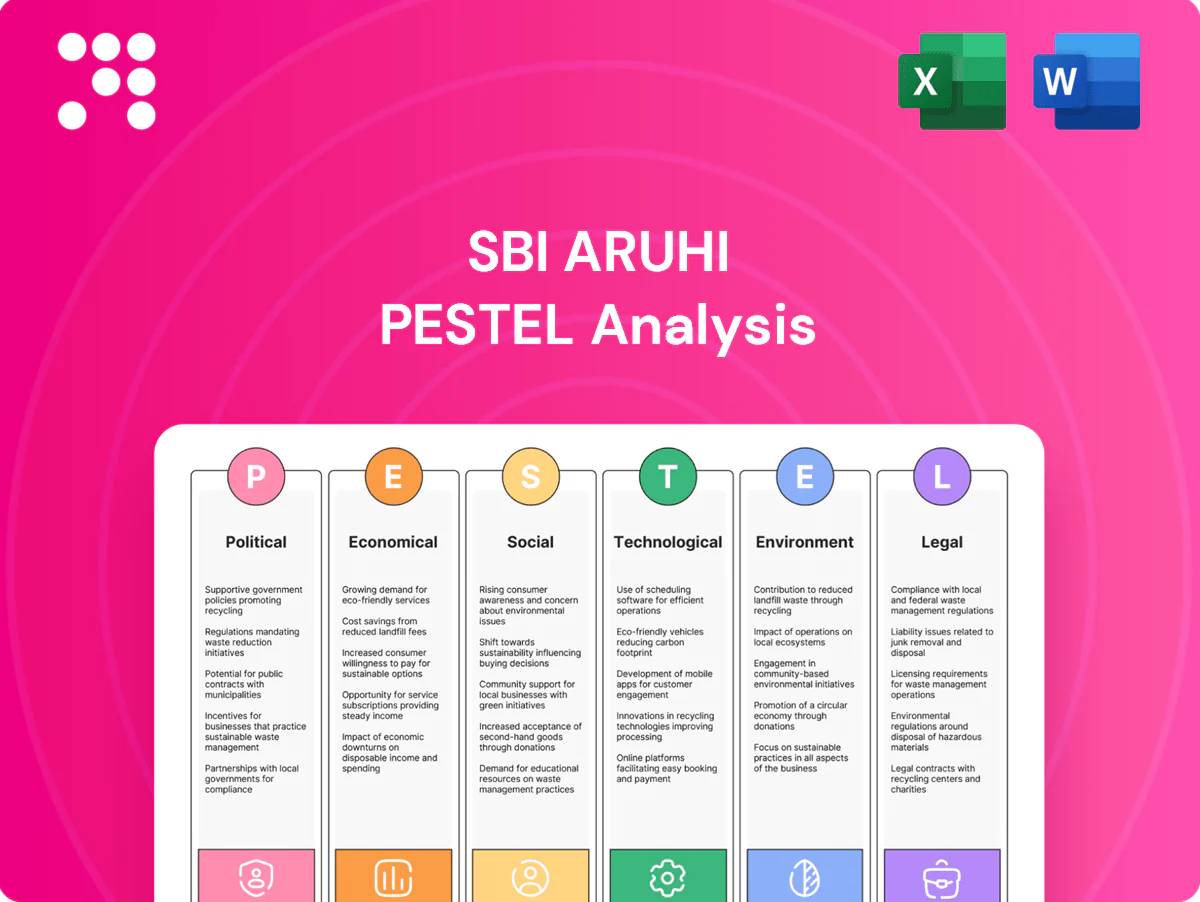
SBI ARUHI PESTLE Analysis

Skip the Research. Get the Strategy.
Unlock critical insights into the external forces shaping SBI ARUHI's strategic landscape. Our PESTEL analysis delves into the political, economic, social, technological, environmental, and legal factors impacting the company's operations and future growth. Gain a competitive advantage by understanding these vital trends.
Don't get left behind in a rapidly evolving market. Our SBI ARUHI PESTEL analysis provides a clear, actionable roadmap to navigate external challenges and capitalize on emerging opportunities. Invest in informed decision-making.
Equip yourself with the knowledge to anticipate market shifts and refine your strategy. Our comprehensive PESTEL analysis of SBI ARUHI is meticulously researched and ready for immediate use. Download the full version now to gain a decisive edge.
Political factors

Government Housing Policy Support
The Japanese government's commitment to supporting housing ownership is a significant tailwind for SBI ARUHI. Programs like Flat 35, a flagship offering for the company, directly benefit from this policy. These initiatives aim to boost the housing market by making homeownership more attainable for a wider population.
Recent policy adjustments in 2024 and projected for 2025 are focusing on enhancing the accessibility of fixed-rate mortgages, especially for homes that meet higher environmental and safety standards. This includes incentives for energy-efficient and earthquake-resistant constructions, which aligns perfectly with the types of properties SBI ARUHI's core business supports, potentially driving increased demand for their specialized loan products.
Bank of Japan Monetary Policy Shifts
The Bank of Japan's move away from ultra-loose monetary policy, marked by interest rate hikes in March 2024 and a subsequent increase in January 2025, directly impacts mortgage costs for Japanese consumers. These policy adjustments are crucial for understanding the evolving financial landscape.
While variable mortgage rates are likely to climb due to these policy shifts, the increased stability offered by fixed-rate products, such as SBI ARUHI's popular Flat 35 loans, becomes a significant draw. Consumers are increasingly prioritizing predictable monthly payments in this changing environment.

Financial Services Agency (FSA) Oversight
The Financial Services Agency (FSA) is the primary regulator for Japan's financial sector, focusing on maintaining stability and integrity. SBI ARUHI, as a financial services provider, operates under strict FSA supervision. This oversight ensures adherence to regulations concerning financial soundness, market stability, and robust consumer protection measures.
FSA regulations are dynamic, constantly evolving to address the increasing complexities of the financial markets. For instance, in 2024, the FSA continued its focus on digital transformation in finance, issuing updated guidelines for fintech companies and cybersecurity standards. SBI ARUHI's compliance with these evolving rules is critical for its continued operation and reputation.

Consumer Protection Legislation
Ongoing amendments to consumer protection laws, including the Four Product Safety Laws, are scheduled to be implemented by December 2025. These changes will significantly influence how financial institutions like SBI ARUHI engage with their customers. For instance, the revised laws aim to bolster consumer rights and mandate clearer disclosure of product terms and conditions.
While Japan does not have a single overarching consumer protection statute, these specific legislative updates necessitate SBI ARUHI to uphold a high degree of transparency and fairness. This applies particularly to its mortgage products and associated services, ensuring borrowers fully understand the risks and benefits involved. The focus is on preventing predatory lending practices and promoting informed decision-making.
- Increased Transparency Requirements: Financial institutions must provide clearer, more accessible information regarding loan terms, fees, and potential risks.
- Enhanced Disclosure Obligations: Specific details about mortgage products, including interest rate calculations and repayment schedules, will require more comprehensive disclosure.
- Focus on Fairness in Contracts: Amendments are expected to scrutinize contract clauses that may be deemed unfair or disadvantageous to consumers.
Government Initiatives for Digital Transformation
The Japanese government, through initiatives driven by the Ministry of Economy, Trade and Industry (METI), is actively promoting digital transformation to avert what's termed the '2025 digital cliff.' This strategic focus aims to upgrade legacy systems and enhance digital capabilities across various sectors.
Financial institutions, including mortgage providers like SBI ARUHI, are strongly encouraged to embrace digitization. This includes streamlining customer-facing processes such as mortgage applications, thereby boosting operational efficiency and maintaining a competitive edge in the evolving market landscape.
- METI's Digital Transformation Strategy: Aims to address the potential economic stagnation caused by outdated IT systems by 2025, encouraging businesses to invest in modernization.
- Incentives for Digitization: The government offers subsidies and tax breaks to companies undertaking digital transformation projects, making it more attractive for firms to upgrade.
- Impact on Financial Services: This push is particularly relevant for the financial sector, pushing for enhanced online services, improved data management, and more efficient customer onboarding.
Policy, Rates, and Digital Transformation Drive Housing Finance
Government support for housing, particularly through programs like Flat 35, remains a key political factor benefiting SBI ARUHI. Policy shifts in 2024 and 2025 are increasingly incentivizing energy-efficient and earthquake-resistant homes, directly aligning with SBI ARUHI's product offerings and potentially boosting demand.
The Bank of Japan's monetary policy adjustments, including rate hikes in March 2024 and January 2025, influence mortgage costs, making fixed-rate products like SBI ARUHI's Flat 35 more attractive due to their predictable payments.
Regulatory oversight from the Financial Services Agency (FSA) is crucial, with ongoing updates in 2024 focusing on fintech and cybersecurity. Furthermore, upcoming amendments to consumer protection laws by December 2025 will necessitate enhanced transparency and fairness in SBI ARUHI's product disclosures and contract terms.
The government's push for digital transformation, aiming to avert the '2025 digital cliff,' encourages financial institutions like SBI ARUHI to streamline processes through digitization, enhancing efficiency and competitiveness.
What is included in the product
 Detailed Word Document
This PESTLE analysis examines the external macro-environmental factors influencing SBI ARUHI, covering Political, Economic, Social, Technological, Environmental, and Legal dimensions.

 Customizable Excel Spreadsheet
Provides a concise version that can be dropped into PowerPoints or used in group planning sessions, simplifying complex external factors for SBI ARUHI's strategic discussions.
Economic factors

Bank of Japan Interest Rate Environment
The Bank of Japan's shift away from negative interest rates, with a policy rate increase to 0.50% by January 2025 from its previous negative stance, marks a significant economic turning point. This policy normalization directly impacts the cost of borrowing for financial institutions.
This change in the Bank of Japan's policy rate directly influences mortgage rates. Lenders face higher funding costs, which are then passed on to consumers through increased fixed and variable mortgage rates. This could dampen demand for new home loans.
Housing Loan Market Growth and Property Prices
Japan's housing loan market is anticipated to expand, with total outstanding housing loans expected to rise in 2024. This growth trajectory offers a favorable backdrop for entities like SBI ARUHI operating within this sector.
Residential property prices, especially within the bustling Tokyo Metropolitan Area, have experienced robust appreciation. While national price growth has seen some stabilization, the continued strength in key urban centers signals sustained demand.
However, this dynamic environment is tempered by weakening construction activity. For mortgage providers such as SBI ARUHI, this presents a dual scenario of potential loan growth alongside considerations regarding the supply and valuation of new properties.

Inflationary Pressures and Disposable Income
Japan's recent shift from prolonged deflation to a period of rising inflation directly impacts the purchasing power of potential homebuyers. As prices for goods and services increase, the real value of disposable income diminishes, making it harder for individuals to save for down payments or manage mortgage payments.
While wage growth, which saw a notable increase in early 2024, is a positive factor, its ability to fully offset persistent inflation remains a key concern. For instance, if inflation outpaces wage hikes, the actual amount of money available for housing loan commitments could shrink, potentially dampening demand.
This inflationary environment is likely to encourage more consumers to explore fixed-rate mortgages. The predictability of fixed payments offers a shield against further interest rate hikes that often accompany inflationary periods, providing greater financial security for homebuyers in the medium to long term.

Economic Growth and Stability
Japan's economy is demonstrating a notable resilience, with projections indicating continued growth and stability. This economic environment is particularly attractive to international investors, drawn by the nation's well-established government policies and predictable market conditions. For instance, the IMF projected Japan's GDP growth at 0.9% for 2024, a figure that underscores this stability.
A stable economic outlook directly bolsters consumer confidence, a crucial factor for businesses like SBI ARUHI that rely on long-term financial commitments such as mortgages. When consumers feel secure about their financial future, they are more likely to engage in significant purchases, positively impacting the housing and lending sectors. This confidence is reflected in consumer spending trends, which remained relatively steady through early 2024.
- Economic Resilience: Japan's economy is showing signs of recovery, supported by stable government policies.
- Investor Attraction: The country's predictable economic landscape is drawing global investment.
- Consumer Confidence Boost: Economic stability encourages long-term financial decisions, benefiting mortgage providers.
- GDP Growth: Projections for 2024, such as the IMF's 0.9% forecast, indicate a steady economic trajectory.
Vacant Property Trends and Construction Activity
Japan is experiencing a significant increase in vacant properties, with the number of akiya, or empty homes, reaching an all-time high. This trend is particularly pronounced in rural areas, creating an oversupply that could influence property values and mortgage demand.
Concurrently, residential construction activity nationwide is weakening. This slowdown in new builds, coupled with the existing surplus of vacant homes, may redirect buyer interest towards the resale market, impacting the types of financial products SBI ARUHI offers.
- Record Vacancy Rates: As of 2023, the number of vacant homes in Japan surpassed 9 million, a figure that continues to grow, especially in non-metropolitan regions.
- Declining Construction: New housing starts in Japan have seen a downward trend, with projections for 2024 indicating a further contraction in residential construction compared to previous years.
- Shift in Demand: The oversupply of vacant properties and reduced new construction are likely to boost demand for existing homes, potentially altering property valuation models and mortgage product development for companies like SBI ARUHI.
Japan's Housing Market: Rates Rise, Growth Projected, Challenges Emerge
Japan's economic landscape is shifting with the Bank of Japan's move away from negative interest rates, impacting borrowing costs and potentially mortgage rates. Despite this, the housing loan market is projected for growth in 2024, supported by appreciating property values in key urban areas like Tokyo.
Inflationary pressures are rising, which could erode purchasing power, although wage growth offers some counterbalance. This environment might steer consumers towards fixed-rate mortgages for greater payment predictability.
The nation's economy exhibits resilience, attracting international investors due to stable policies and predictable markets, as evidenced by IMF projections of 0.9% GDP growth for 2024. This stability fosters consumer confidence, crucial for long-term financial commitments like mortgages.
However, a significant increase in vacant properties (akiya) and weakening residential construction activity present challenges, potentially influencing property values and shifting demand towards the resale market.
| Economic Factor | Data Point | Implication for SBI ARUHI |
|---|---|---|
| Bank of Japan Policy Rate | Increased to 0.50% by Jan 2025 | Higher funding costs for lenders, potential for increased mortgage rates. |
| Housing Loan Market Growth | Projected expansion in 2024 | Favorable outlook for mortgage providers. |
| Tokyo Property Appreciation | Robust appreciation | Sustained demand in key urban centers. |
| Inflation Rate | Rising | Impacts purchasing power, may drive demand for fixed-rate mortgages. |
| Wage Growth | Notable increase in early 2024 | Partially offsets inflation, but full offset is a concern. |
| GDP Growth Projection (IMF) | 0.9% for 2024 | Indicates economic stability and investor attraction. |
| Vacant Properties (Akiya) | Record high, growing | Potential oversupply impacting property values and mortgage demand. |
| Residential Construction Activity | Weakening nationwide | Shift in buyer interest towards the resale market. |
Full Version Awaits
SBI ARUHI PESTLE Analysis
The preview shown here is the exact SBI ARUHI PESTLE Analysis you’ll receive after purchase—fully formatted and ready to use. This comprehensive document delves into the Political, Economic, Social, Technological, Regulatory, and Environmental factors impacting SBI ARUHI, providing actionable insights for strategic planning.

Skip the Research. Get the Strategy.
Unlock critical insights into the external forces shaping SBI ARUHI's strategic landscape. Our PESTEL analysis delves into the political, economic, social, technological, environmental, and legal factors impacting the company's operations and future growth. Gain a competitive advantage by understanding these vital trends.
Don't get left behind in a rapidly evolving market. Our SBI ARUHI PESTEL analysis provides a clear, actionable roadmap to navigate external challenges and capitalize on emerging opportunities. Invest in informed decision-making.
Equip yourself with the knowledge to anticipate market shifts and refine your strategy. Our comprehensive PESTEL analysis of SBI ARUHI is meticulously researched and ready for immediate use. Download the full version now to gain a decisive edge.
Political factors
Government Housing Policy Support
The Japanese government's commitment to supporting housing ownership is a significant tailwind for SBI ARUHI. Programs like Flat 35, a flagship offering for the company, directly benefit from this policy. These initiatives aim to boost the housing market by making homeownership more attainable for a wider population.
Recent policy adjustments in 2024 and projected for 2025 are focusing on enhancing the accessibility of fixed-rate mortgages, especially for homes that meet higher environmental and safety standards. This includes incentives for energy-efficient and earthquake-resistant constructions, which aligns perfectly with the types of properties SBI ARUHI's core business supports, potentially driving increased demand for their specialized loan products.
Bank of Japan Monetary Policy Shifts
The Bank of Japan's move away from ultra-loose monetary policy, marked by interest rate hikes in March 2024 and a subsequent increase in January 2025, directly impacts mortgage costs for Japanese consumers. These policy adjustments are crucial for understanding the evolving financial landscape.
While variable mortgage rates are likely to climb due to these policy shifts, the increased stability offered by fixed-rate products, such as SBI ARUHI's popular Flat 35 loans, becomes a significant draw. Consumers are increasingly prioritizing predictable monthly payments in this changing environment.
Financial Services Agency (FSA) Oversight
The Financial Services Agency (FSA) is the primary regulator for Japan's financial sector, focusing on maintaining stability and integrity. SBI ARUHI, as a financial services provider, operates under strict FSA supervision. This oversight ensures adherence to regulations concerning financial soundness, market stability, and robust consumer protection measures.
FSA regulations are dynamic, constantly evolving to address the increasing complexities of the financial markets. For instance, in 2024, the FSA continued its focus on digital transformation in finance, issuing updated guidelines for fintech companies and cybersecurity standards. SBI ARUHI's compliance with these evolving rules is critical for its continued operation and reputation.
Consumer Protection Legislation
Ongoing amendments to consumer protection laws, including the Four Product Safety Laws, are scheduled to be implemented by December 2025. These changes will significantly influence how financial institutions like SBI ARUHI engage with their customers. For instance, the revised laws aim to bolster consumer rights and mandate clearer disclosure of product terms and conditions.
While Japan does not have a single overarching consumer protection statute, these specific legislative updates necessitate SBI ARUHI to uphold a high degree of transparency and fairness. This applies particularly to its mortgage products and associated services, ensuring borrowers fully understand the risks and benefits involved. The focus is on preventing predatory lending practices and promoting informed decision-making.
- Increased Transparency Requirements: Financial institutions must provide clearer, more accessible information regarding loan terms, fees, and potential risks.
- Enhanced Disclosure Obligations: Specific details about mortgage products, including interest rate calculations and repayment schedules, will require more comprehensive disclosure.
- Focus on Fairness in Contracts: Amendments are expected to scrutinize contract clauses that may be deemed unfair or disadvantageous to consumers.
Government Initiatives for Digital Transformation
The Japanese government, through initiatives driven by the Ministry of Economy, Trade and Industry (METI), is actively promoting digital transformation to avert what's termed the '2025 digital cliff.' This strategic focus aims to upgrade legacy systems and enhance digital capabilities across various sectors.
Financial institutions, including mortgage providers like SBI ARUHI, are strongly encouraged to embrace digitization. This includes streamlining customer-facing processes such as mortgage applications, thereby boosting operational efficiency and maintaining a competitive edge in the evolving market landscape.
- METI's Digital Transformation Strategy: Aims to address the potential economic stagnation caused by outdated IT systems by 2025, encouraging businesses to invest in modernization.
- Incentives for Digitization: The government offers subsidies and tax breaks to companies undertaking digital transformation projects, making it more attractive for firms to upgrade.
- Impact on Financial Services: This push is particularly relevant for the financial sector, pushing for enhanced online services, improved data management, and more efficient customer onboarding.
Policy, Rates, and Digital Transformation Drive Housing Finance
Government support for housing, particularly through programs like Flat 35, remains a key political factor benefiting SBI ARUHI. Policy shifts in 2024 and 2025 are increasingly incentivizing energy-efficient and earthquake-resistant homes, directly aligning with SBI ARUHI's product offerings and potentially boosting demand.
The Bank of Japan's monetary policy adjustments, including rate hikes in March 2024 and January 2025, influence mortgage costs, making fixed-rate products like SBI ARUHI's Flat 35 more attractive due to their predictable payments.
Regulatory oversight from the Financial Services Agency (FSA) is crucial, with ongoing updates in 2024 focusing on fintech and cybersecurity. Furthermore, upcoming amendments to consumer protection laws by December 2025 will necessitate enhanced transparency and fairness in SBI ARUHI's product disclosures and contract terms.
The government's push for digital transformation, aiming to avert the '2025 digital cliff,' encourages financial institutions like SBI ARUHI to streamline processes through digitization, enhancing efficiency and competitiveness.
What is included in the product
Detailed Word Document
This PESTLE analysis examines the external macro-environmental factors influencing SBI ARUHI, covering Political, Economic, Social, Technological, Environmental, and Legal dimensions.
Customizable Excel Spreadsheet
Provides a concise version that can be dropped into PowerPoints or used in group planning sessions, simplifying complex external factors for SBI ARUHI's strategic discussions.
Economic factors
Bank of Japan Interest Rate Environment
The Bank of Japan's shift away from negative interest rates, with a policy rate increase to 0.50% by January 2025 from its previous negative stance, marks a significant economic turning point. This policy normalization directly impacts the cost of borrowing for financial institutions.
This change in the Bank of Japan's policy rate directly influences mortgage rates. Lenders face higher funding costs, which are then passed on to consumers through increased fixed and variable mortgage rates. This could dampen demand for new home loans.
Housing Loan Market Growth and Property Prices
Japan's housing loan market is anticipated to expand, with total outstanding housing loans expected to rise in 2024. This growth trajectory offers a favorable backdrop for entities like SBI ARUHI operating within this sector.
Residential property prices, especially within the bustling Tokyo Metropolitan Area, have experienced robust appreciation. While national price growth has seen some stabilization, the continued strength in key urban centers signals sustained demand.
However, this dynamic environment is tempered by weakening construction activity. For mortgage providers such as SBI ARUHI, this presents a dual scenario of potential loan growth alongside considerations regarding the supply and valuation of new properties.
Inflationary Pressures and Disposable Income
Japan's recent shift from prolonged deflation to a period of rising inflation directly impacts the purchasing power of potential homebuyers. As prices for goods and services increase, the real value of disposable income diminishes, making it harder for individuals to save for down payments or manage mortgage payments.
While wage growth, which saw a notable increase in early 2024, is a positive factor, its ability to fully offset persistent inflation remains a key concern. For instance, if inflation outpaces wage hikes, the actual amount of money available for housing loan commitments could shrink, potentially dampening demand.
This inflationary environment is likely to encourage more consumers to explore fixed-rate mortgages. The predictability of fixed payments offers a shield against further interest rate hikes that often accompany inflationary periods, providing greater financial security for homebuyers in the medium to long term.
Economic Growth and Stability
Japan's economy is demonstrating a notable resilience, with projections indicating continued growth and stability. This economic environment is particularly attractive to international investors, drawn by the nation's well-established government policies and predictable market conditions. For instance, the IMF projected Japan's GDP growth at 0.9% for 2024, a figure that underscores this stability.
A stable economic outlook directly bolsters consumer confidence, a crucial factor for businesses like SBI ARUHI that rely on long-term financial commitments such as mortgages. When consumers feel secure about their financial future, they are more likely to engage in significant purchases, positively impacting the housing and lending sectors. This confidence is reflected in consumer spending trends, which remained relatively steady through early 2024.
- Economic Resilience: Japan's economy is showing signs of recovery, supported by stable government policies.
- Investor Attraction: The country's predictable economic landscape is drawing global investment.
- Consumer Confidence Boost: Economic stability encourages long-term financial decisions, benefiting mortgage providers.
- GDP Growth: Projections for 2024, such as the IMF's 0.9% forecast, indicate a steady economic trajectory.
Vacant Property Trends and Construction Activity
Japan is experiencing a significant increase in vacant properties, with the number of akiya, or empty homes, reaching an all-time high. This trend is particularly pronounced in rural areas, creating an oversupply that could influence property values and mortgage demand.
Concurrently, residential construction activity nationwide is weakening. This slowdown in new builds, coupled with the existing surplus of vacant homes, may redirect buyer interest towards the resale market, impacting the types of financial products SBI ARUHI offers.
- Record Vacancy Rates: As of 2023, the number of vacant homes in Japan surpassed 9 million, a figure that continues to grow, especially in non-metropolitan regions.
- Declining Construction: New housing starts in Japan have seen a downward trend, with projections for 2024 indicating a further contraction in residential construction compared to previous years.
- Shift in Demand: The oversupply of vacant properties and reduced new construction are likely to boost demand for existing homes, potentially altering property valuation models and mortgage product development for companies like SBI ARUHI.
Japan's Housing Market: Rates Rise, Growth Projected, Challenges Emerge
Japan's economic landscape is shifting with the Bank of Japan's move away from negative interest rates, impacting borrowing costs and potentially mortgage rates. Despite this, the housing loan market is projected for growth in 2024, supported by appreciating property values in key urban areas like Tokyo.
Inflationary pressures are rising, which could erode purchasing power, although wage growth offers some counterbalance. This environment might steer consumers towards fixed-rate mortgages for greater payment predictability.
The nation's economy exhibits resilience, attracting international investors due to stable policies and predictable markets, as evidenced by IMF projections of 0.9% GDP growth for 2024. This stability fosters consumer confidence, crucial for long-term financial commitments like mortgages.
However, a significant increase in vacant properties (akiya) and weakening residential construction activity present challenges, potentially influencing property values and shifting demand towards the resale market.
| Economic Factor | Data Point | Implication for SBI ARUHI |
|---|---|---|
| Bank of Japan Policy Rate | Increased to 0.50% by Jan 2025 | Higher funding costs for lenders, potential for increased mortgage rates. |
| Housing Loan Market Growth | Projected expansion in 2024 | Favorable outlook for mortgage providers. |
| Tokyo Property Appreciation | Robust appreciation | Sustained demand in key urban centers. |
| Inflation Rate | Rising | Impacts purchasing power, may drive demand for fixed-rate mortgages. |
| Wage Growth | Notable increase in early 2024 | Partially offsets inflation, but full offset is a concern. |
| GDP Growth Projection (IMF) | 0.9% for 2024 | Indicates economic stability and investor attraction. |
| Vacant Properties (Akiya) | Record high, growing | Potential oversupply impacting property values and mortgage demand. |
| Residential Construction Activity | Weakening nationwide | Shift in buyer interest towards the resale market. |
Full Version Awaits
SBI ARUHI PESTLE Analysis
The preview shown here is the exact SBI ARUHI PESTLE Analysis you’ll receive after purchase—fully formatted and ready to use. This comprehensive document delves into the Political, Economic, Social, Technological, Regulatory, and Environmental factors impacting SBI ARUHI, providing actionable insights for strategic planning.
Original: $10.00
-65%$10.00
$3.50Description
Skip the Research. Get the Strategy.
Unlock critical insights into the external forces shaping SBI ARUHI's strategic landscape. Our PESTEL analysis delves into the political, economic, social, technological, environmental, and legal factors impacting the company's operations and future growth. Gain a competitive advantage by understanding these vital trends.
Don't get left behind in a rapidly evolving market. Our SBI ARUHI PESTEL analysis provides a clear, actionable roadmap to navigate external challenges and capitalize on emerging opportunities. Invest in informed decision-making.
Equip yourself with the knowledge to anticipate market shifts and refine your strategy. Our comprehensive PESTEL analysis of SBI ARUHI is meticulously researched and ready for immediate use. Download the full version now to gain a decisive edge.
Political factors
Government Housing Policy Support
The Japanese government's commitment to supporting housing ownership is a significant tailwind for SBI ARUHI. Programs like Flat 35, a flagship offering for the company, directly benefit from this policy. These initiatives aim to boost the housing market by making homeownership more attainable for a wider population.
Recent policy adjustments in 2024 and projected for 2025 are focusing on enhancing the accessibility of fixed-rate mortgages, especially for homes that meet higher environmental and safety standards. This includes incentives for energy-efficient and earthquake-resistant constructions, which aligns perfectly with the types of properties SBI ARUHI's core business supports, potentially driving increased demand for their specialized loan products.
Bank of Japan Monetary Policy Shifts
The Bank of Japan's move away from ultra-loose monetary policy, marked by interest rate hikes in March 2024 and a subsequent increase in January 2025, directly impacts mortgage costs for Japanese consumers. These policy adjustments are crucial for understanding the evolving financial landscape.
While variable mortgage rates are likely to climb due to these policy shifts, the increased stability offered by fixed-rate products, such as SBI ARUHI's popular Flat 35 loans, becomes a significant draw. Consumers are increasingly prioritizing predictable monthly payments in this changing environment.
Financial Services Agency (FSA) Oversight
The Financial Services Agency (FSA) is the primary regulator for Japan's financial sector, focusing on maintaining stability and integrity. SBI ARUHI, as a financial services provider, operates under strict FSA supervision. This oversight ensures adherence to regulations concerning financial soundness, market stability, and robust consumer protection measures.
FSA regulations are dynamic, constantly evolving to address the increasing complexities of the financial markets. For instance, in 2024, the FSA continued its focus on digital transformation in finance, issuing updated guidelines for fintech companies and cybersecurity standards. SBI ARUHI's compliance with these evolving rules is critical for its continued operation and reputation.
Consumer Protection Legislation
Ongoing amendments to consumer protection laws, including the Four Product Safety Laws, are scheduled to be implemented by December 2025. These changes will significantly influence how financial institutions like SBI ARUHI engage with their customers. For instance, the revised laws aim to bolster consumer rights and mandate clearer disclosure of product terms and conditions.
While Japan does not have a single overarching consumer protection statute, these specific legislative updates necessitate SBI ARUHI to uphold a high degree of transparency and fairness. This applies particularly to its mortgage products and associated services, ensuring borrowers fully understand the risks and benefits involved. The focus is on preventing predatory lending practices and promoting informed decision-making.
- Increased Transparency Requirements: Financial institutions must provide clearer, more accessible information regarding loan terms, fees, and potential risks.
- Enhanced Disclosure Obligations: Specific details about mortgage products, including interest rate calculations and repayment schedules, will require more comprehensive disclosure.
- Focus on Fairness in Contracts: Amendments are expected to scrutinize contract clauses that may be deemed unfair or disadvantageous to consumers.
Government Initiatives for Digital Transformation
The Japanese government, through initiatives driven by the Ministry of Economy, Trade and Industry (METI), is actively promoting digital transformation to avert what's termed the '2025 digital cliff.' This strategic focus aims to upgrade legacy systems and enhance digital capabilities across various sectors.
Financial institutions, including mortgage providers like SBI ARUHI, are strongly encouraged to embrace digitization. This includes streamlining customer-facing processes such as mortgage applications, thereby boosting operational efficiency and maintaining a competitive edge in the evolving market landscape.
- METI's Digital Transformation Strategy: Aims to address the potential economic stagnation caused by outdated IT systems by 2025, encouraging businesses to invest in modernization.
- Incentives for Digitization: The government offers subsidies and tax breaks to companies undertaking digital transformation projects, making it more attractive for firms to upgrade.
- Impact on Financial Services: This push is particularly relevant for the financial sector, pushing for enhanced online services, improved data management, and more efficient customer onboarding.
Policy, Rates, and Digital Transformation Drive Housing Finance
Government support for housing, particularly through programs like Flat 35, remains a key political factor benefiting SBI ARUHI. Policy shifts in 2024 and 2025 are increasingly incentivizing energy-efficient and earthquake-resistant homes, directly aligning with SBI ARUHI's product offerings and potentially boosting demand.
The Bank of Japan's monetary policy adjustments, including rate hikes in March 2024 and January 2025, influence mortgage costs, making fixed-rate products like SBI ARUHI's Flat 35 more attractive due to their predictable payments.
Regulatory oversight from the Financial Services Agency (FSA) is crucial, with ongoing updates in 2024 focusing on fintech and cybersecurity. Furthermore, upcoming amendments to consumer protection laws by December 2025 will necessitate enhanced transparency and fairness in SBI ARUHI's product disclosures and contract terms.
The government's push for digital transformation, aiming to avert the '2025 digital cliff,' encourages financial institutions like SBI ARUHI to streamline processes through digitization, enhancing efficiency and competitiveness.
What is included in the product
Detailed Word Document
This PESTLE analysis examines the external macro-environmental factors influencing SBI ARUHI, covering Political, Economic, Social, Technological, Environmental, and Legal dimensions.
Customizable Excel Spreadsheet
Provides a concise version that can be dropped into PowerPoints or used in group planning sessions, simplifying complex external factors for SBI ARUHI's strategic discussions.
Economic factors
Bank of Japan Interest Rate Environment
The Bank of Japan's shift away from negative interest rates, with a policy rate increase to 0.50% by January 2025 from its previous negative stance, marks a significant economic turning point. This policy normalization directly impacts the cost of borrowing for financial institutions.
This change in the Bank of Japan's policy rate directly influences mortgage rates. Lenders face higher funding costs, which are then passed on to consumers through increased fixed and variable mortgage rates. This could dampen demand for new home loans.
Housing Loan Market Growth and Property Prices
Japan's housing loan market is anticipated to expand, with total outstanding housing loans expected to rise in 2024. This growth trajectory offers a favorable backdrop for entities like SBI ARUHI operating within this sector.
Residential property prices, especially within the bustling Tokyo Metropolitan Area, have experienced robust appreciation. While national price growth has seen some stabilization, the continued strength in key urban centers signals sustained demand.
However, this dynamic environment is tempered by weakening construction activity. For mortgage providers such as SBI ARUHI, this presents a dual scenario of potential loan growth alongside considerations regarding the supply and valuation of new properties.
Inflationary Pressures and Disposable Income
Japan's recent shift from prolonged deflation to a period of rising inflation directly impacts the purchasing power of potential homebuyers. As prices for goods and services increase, the real value of disposable income diminishes, making it harder for individuals to save for down payments or manage mortgage payments.
While wage growth, which saw a notable increase in early 2024, is a positive factor, its ability to fully offset persistent inflation remains a key concern. For instance, if inflation outpaces wage hikes, the actual amount of money available for housing loan commitments could shrink, potentially dampening demand.
This inflationary environment is likely to encourage more consumers to explore fixed-rate mortgages. The predictability of fixed payments offers a shield against further interest rate hikes that often accompany inflationary periods, providing greater financial security for homebuyers in the medium to long term.
Economic Growth and Stability
Japan's economy is demonstrating a notable resilience, with projections indicating continued growth and stability. This economic environment is particularly attractive to international investors, drawn by the nation's well-established government policies and predictable market conditions. For instance, the IMF projected Japan's GDP growth at 0.9% for 2024, a figure that underscores this stability.
A stable economic outlook directly bolsters consumer confidence, a crucial factor for businesses like SBI ARUHI that rely on long-term financial commitments such as mortgages. When consumers feel secure about their financial future, they are more likely to engage in significant purchases, positively impacting the housing and lending sectors. This confidence is reflected in consumer spending trends, which remained relatively steady through early 2024.
- Economic Resilience: Japan's economy is showing signs of recovery, supported by stable government policies.
- Investor Attraction: The country's predictable economic landscape is drawing global investment.
- Consumer Confidence Boost: Economic stability encourages long-term financial decisions, benefiting mortgage providers.
- GDP Growth: Projections for 2024, such as the IMF's 0.9% forecast, indicate a steady economic trajectory.
Vacant Property Trends and Construction Activity
Japan is experiencing a significant increase in vacant properties, with the number of akiya, or empty homes, reaching an all-time high. This trend is particularly pronounced in rural areas, creating an oversupply that could influence property values and mortgage demand.
Concurrently, residential construction activity nationwide is weakening. This slowdown in new builds, coupled with the existing surplus of vacant homes, may redirect buyer interest towards the resale market, impacting the types of financial products SBI ARUHI offers.
- Record Vacancy Rates: As of 2023, the number of vacant homes in Japan surpassed 9 million, a figure that continues to grow, especially in non-metropolitan regions.
- Declining Construction: New housing starts in Japan have seen a downward trend, with projections for 2024 indicating a further contraction in residential construction compared to previous years.
- Shift in Demand: The oversupply of vacant properties and reduced new construction are likely to boost demand for existing homes, potentially altering property valuation models and mortgage product development for companies like SBI ARUHI.
Japan's Housing Market: Rates Rise, Growth Projected, Challenges Emerge
Japan's economic landscape is shifting with the Bank of Japan's move away from negative interest rates, impacting borrowing costs and potentially mortgage rates. Despite this, the housing loan market is projected for growth in 2024, supported by appreciating property values in key urban areas like Tokyo.
Inflationary pressures are rising, which could erode purchasing power, although wage growth offers some counterbalance. This environment might steer consumers towards fixed-rate mortgages for greater payment predictability.
The nation's economy exhibits resilience, attracting international investors due to stable policies and predictable markets, as evidenced by IMF projections of 0.9% GDP growth for 2024. This stability fosters consumer confidence, crucial for long-term financial commitments like mortgages.
However, a significant increase in vacant properties (akiya) and weakening residential construction activity present challenges, potentially influencing property values and shifting demand towards the resale market.
| Economic Factor | Data Point | Implication for SBI ARUHI |
|---|---|---|
| Bank of Japan Policy Rate | Increased to 0.50% by Jan 2025 | Higher funding costs for lenders, potential for increased mortgage rates. |
| Housing Loan Market Growth | Projected expansion in 2024 | Favorable outlook for mortgage providers. |
| Tokyo Property Appreciation | Robust appreciation | Sustained demand in key urban centers. |
| Inflation Rate | Rising | Impacts purchasing power, may drive demand for fixed-rate mortgages. |
| Wage Growth | Notable increase in early 2024 | Partially offsets inflation, but full offset is a concern. |
| GDP Growth Projection (IMF) | 0.9% for 2024 | Indicates economic stability and investor attraction. |
| Vacant Properties (Akiya) | Record high, growing | Potential oversupply impacting property values and mortgage demand. |
| Residential Construction Activity | Weakening nationwide | Shift in buyer interest towards the resale market. |
Full Version Awaits
SBI ARUHI PESTLE Analysis
The preview shown here is the exact SBI ARUHI PESTLE Analysis you’ll receive after purchase—fully formatted and ready to use. This comprehensive document delves into the Political, Economic, Social, Technological, Regulatory, and Environmental factors impacting SBI ARUHI, providing actionable insights for strategic planning.











