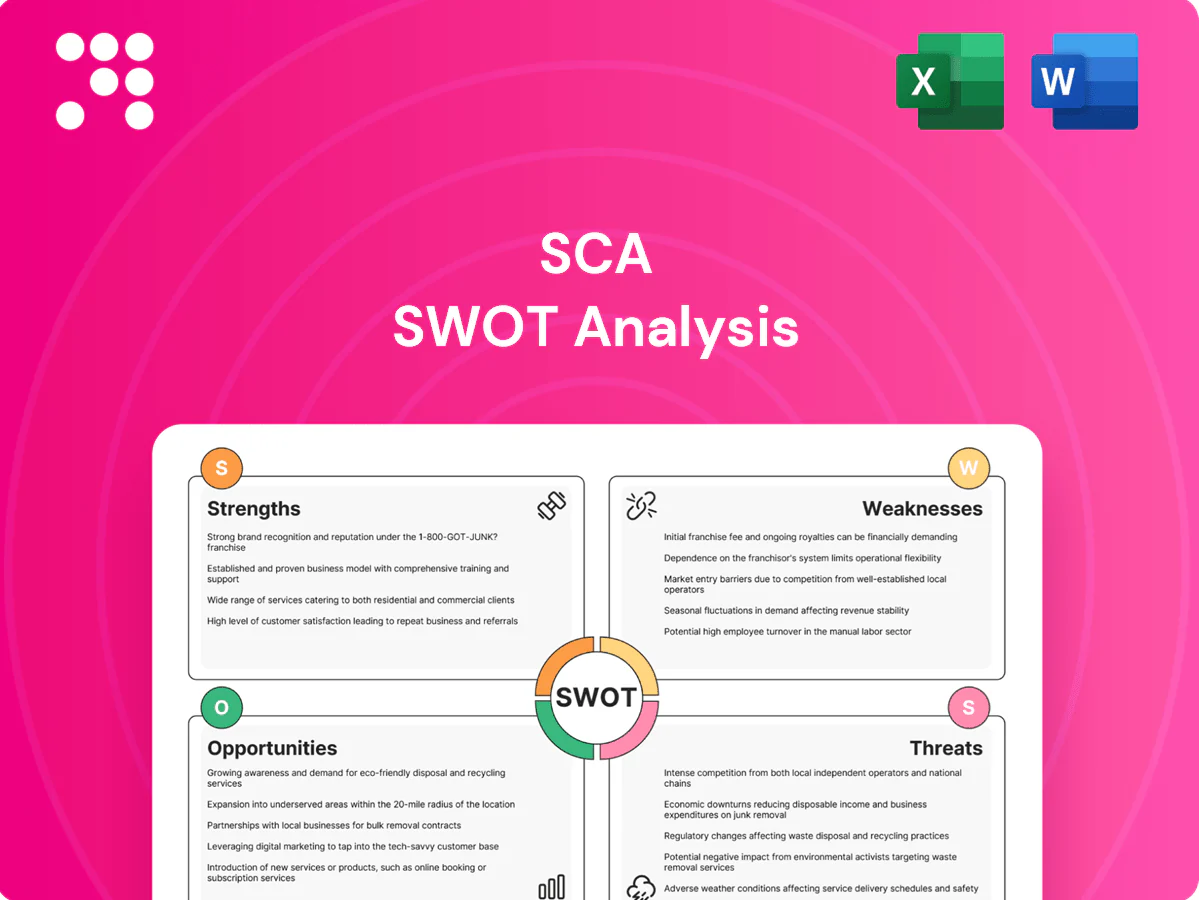
SCA SWOT Analysis

Make Insightful Decisions Backed by Expert Research
Unlock strategic clarity with our SCA SWOT Analysis: concise, research-backed insights into strengths, weaknesses, opportunities and threats that shape competitive advantage. Ideal for investors, advisors and managers, it highlights actionable risks and growth levers. Purchase the full report for a professionally formatted, editable SWOT plus financial context to power confident decisions.
Strengths

Extensive certified forest asset base
SCA’s c.2.6 million hectares of sustainably managed forest in northern Sweden represent a defensible, renewable raw‑material base supporting its pulp, paper and wood operations. The entire estate is certified under FSC and PEFC, underpinning traceability and enabling premium pricing in certified markets. Long‑term, secured fiber supply stabilizes input costs and mill utilization. The carbon‑rich forest portfolio strengthens sequestration credentials and sustainability brand trust.
Integrated forest-to-product value chain
Integrated forest-to-product operations across SCA's 2.6 million hectares coordinate upstream forest management, sawmills, pulp and kraftliner to optimize yield and log assortments, boosting recovery rates and lowering per-unit costs. By-product synergies—chips and bark—feed pulp mills and bioenergy boilers, improving energy integration and margin resilience through internal fiber and heat flows. This reduces external wood purchases, cutting input volatility and strengthening supply reliability for customers.

Renewable energy and circular utilization
SCA leverages its ~2.6 million hectare forest estate to convert residues into self-generated bioenergy, lowering energy costs and cutting process emissions by substituting fossil fuels; on-site heat, power and emerging biofuels strengthen energy security and resilience. Circular valorization of side-streams reduces waste and creates revenue streams, giving SCA a measurable edge in decarbonizing value chains.

Strong market positions in wood, pulp, kraftliner
SCA combines scale and product breadth across solid wood, market pulp and containerboard kraftliner, backed by ownership of about 2.6 million hectares of forest; it is known for high-quality, reliable supply across European markets. Diversified end-markets—construction, packaging and tissue—help smooth cyclicality, supported by long-term contracts and recurring industrial demand.
Sustainability-led brand and customer relationships
SCA’s sustainability credentials strengthen access to premium customer segments and institutional buyers with ESG mandates, driving higher-margin contracts and loyalty through verified low-carbon products.
Collaborative innovation with clients on recyclable and bio-based materials shortens development cycles and reduces scope 3 emissions, supported by transparent sourcing and lifecycle disclosures that inform procurement decisions.
Clear sustainability reporting improves access to green financing and broadens stakeholder support from ESG investors, lenders and corporate partners.
- ESG-aligned premium demand
- Client co-innovation on low-carbon materials
- Transparent sourcing and lifecycle data
- Enhanced green financing and investor support
Certified forest network fuels integrated low-carbon products, ESG premiums and green finance
SCA’s c.2.6 million hectares of FSC/PEFC‑certified forest secures long‑term, renewable fiber and carbon sequestration credentials. Integrated forest‑to‑product operations (solid wood, pulp, kraftliner) optimize yields and by‑product synergies, reducing external wood purchases and energy needs. Strong ESG profile and transparent sourcing support premium contracts, green finance and client co‑innovation on low‑carbon materials.
| Metric | Value |
|---|---|
| Forest area | ≈2.6M ha |
| Certifications | FSC, PEFC |
| Product mix | Solid wood, pulp, kraftliner |
| Strengths | Secured fiber, bioenergy synergies, ESG premium access |
What is included in the product
 Detailed Word Document
Provides a concise SWOT analysis of SCA, outlining internal strengths and weaknesses alongside external opportunities and threats to assess its strategic position and future risks.

 Customizable Excel Spreadsheet
Delivers a focused SCA SWOT matrix to quickly pinpoint competitive pain points and prioritize strategic fixes for rapid execution.
Weaknesses

Exposure to cyclical commodity pricing
Earnings volatility is high as pulp, sawn timber and kraftliner prices swung roughly 40% from 2021–23 and rebounded ~20% in 2024, driving quarter-to-quarter EBITDA swings. Sensitivity to global supply–demand imbalances and inventory cycles amplifies cashflow variability. Despite vertical integration, margins compressed in downturns; forecasting and hedging across multiple asynchronous product cycles remains difficult.
High capital intensity and long paybacks
SCA requires multi-year, billion-SEK capex for mills, bioenergy facilities and sustainable forestry assets, tying up capital in long lead-time projects. Construction and ramp-up often span several years, delaying returns and exposing projects to price swings. Ongoing maintenance and upgrades to meet efficiency and regulatory standards drive continuous spend. During industry troughs this high capital intensity strains the balance sheet and liquidity.

Geographic concentration risk
SCA's forest and customer base is heavily Nordic/European, with roughly 2.6 million hectares of forestland in northern Sweden and about 80% of sales directed to European markets, increasing regional exposure. This concentration raises vulnerability to localized weather extremes and pest outbreaks that hit timber yields and fiber supply. Logistics disruptions or EU policy shifts on biofuels, forestry regulation or trade could sharply affect operations. Currency and demand concentration in EUR/SEK amplify revenue and price risks.

Biological asset and inventory valuation swings
Fair-value adjustments on standing timber can cause large swings in SCA’s reported earnings as changes in discount rates, growth assumptions and timber market prices revalue biological assets, amplifying P&L volatility.
Inventory revaluations of finished wood products further distort short-term profitability, raising investor perception risk when accounting-driven gains or losses mask underlying cash performance.
- Exposure to discount-rate shifts
- Sensitivity to growth/price assumptions
- Inventory revaluation volatility
- Investor perception risk from accounting swings
Input and logistics dependencies
Earnings volatile: ~40% pulp swings, multi‑bn SEK capex, 80% Europe exposure
Earnings volatility driven by ~40% pulp/wood price swings 2021–23 and ~20% rebound 2024 causes quarter-to-quarter EBITDA swings. Multi-year capex needs of several billion SEK tie capital and delay returns. Concentration: 2.6m ha forests, ~80% sales Europe increase regional and policy risk. Fair-value timber and inventory revaluations amplify P&L volatility.
| Metric | Value |
|---|---|
| Forest area | 2.6m ha |
| Sales to Europe | ~80% |
| Pulp/wood price swing | ~40% (21–23), +20% (2024) |
| Freight volatility | >20% y/y |
| Capex | several bn SEK (multi‑year) |
Full Version Awaits
SCA SWOT Analysis
This is the actual SCA SWOT analysis you'll receive upon purchase—no surprises, just professional quality. The preview below is taken directly from the full report and reflects the complete document structure and findings. Purchase unlocks the full, editable version for immediate download.

Make Insightful Decisions Backed by Expert Research
Unlock strategic clarity with our SCA SWOT Analysis: concise, research-backed insights into strengths, weaknesses, opportunities and threats that shape competitive advantage. Ideal for investors, advisors and managers, it highlights actionable risks and growth levers. Purchase the full report for a professionally formatted, editable SWOT plus financial context to power confident decisions.
Strengths
Extensive certified forest asset base
SCA’s c.2.6 million hectares of sustainably managed forest in northern Sweden represent a defensible, renewable raw‑material base supporting its pulp, paper and wood operations. The entire estate is certified under FSC and PEFC, underpinning traceability and enabling premium pricing in certified markets. Long‑term, secured fiber supply stabilizes input costs and mill utilization. The carbon‑rich forest portfolio strengthens sequestration credentials and sustainability brand trust.
Integrated forest-to-product value chain
Integrated forest-to-product operations across SCA's 2.6 million hectares coordinate upstream forest management, sawmills, pulp and kraftliner to optimize yield and log assortments, boosting recovery rates and lowering per-unit costs. By-product synergies—chips and bark—feed pulp mills and bioenergy boilers, improving energy integration and margin resilience through internal fiber and heat flows. This reduces external wood purchases, cutting input volatility and strengthening supply reliability for customers.
Renewable energy and circular utilization
SCA leverages its ~2.6 million hectare forest estate to convert residues into self-generated bioenergy, lowering energy costs and cutting process emissions by substituting fossil fuels; on-site heat, power and emerging biofuels strengthen energy security and resilience. Circular valorization of side-streams reduces waste and creates revenue streams, giving SCA a measurable edge in decarbonizing value chains.
Strong market positions in wood, pulp, kraftliner
SCA combines scale and product breadth across solid wood, market pulp and containerboard kraftliner, backed by ownership of about 2.6 million hectares of forest; it is known for high-quality, reliable supply across European markets. Diversified end-markets—construction, packaging and tissue—help smooth cyclicality, supported by long-term contracts and recurring industrial demand.
Sustainability-led brand and customer relationships
SCA’s sustainability credentials strengthen access to premium customer segments and institutional buyers with ESG mandates, driving higher-margin contracts and loyalty through verified low-carbon products.
Collaborative innovation with clients on recyclable and bio-based materials shortens development cycles and reduces scope 3 emissions, supported by transparent sourcing and lifecycle disclosures that inform procurement decisions.
Clear sustainability reporting improves access to green financing and broadens stakeholder support from ESG investors, lenders and corporate partners.
- ESG-aligned premium demand
- Client co-innovation on low-carbon materials
- Transparent sourcing and lifecycle data
- Enhanced green financing and investor support
Certified forest network fuels integrated low-carbon products, ESG premiums and green finance
SCA’s c.2.6 million hectares of FSC/PEFC‑certified forest secures long‑term, renewable fiber and carbon sequestration credentials. Integrated forest‑to‑product operations (solid wood, pulp, kraftliner) optimize yields and by‑product synergies, reducing external wood purchases and energy needs. Strong ESG profile and transparent sourcing support premium contracts, green finance and client co‑innovation on low‑carbon materials.
| Metric | Value |
|---|---|
| Forest area | ≈2.6M ha |
| Certifications | FSC, PEFC |
| Product mix | Solid wood, pulp, kraftliner |
| Strengths | Secured fiber, bioenergy synergies, ESG premium access |
What is included in the product
Detailed Word Document
Provides a concise SWOT analysis of SCA, outlining internal strengths and weaknesses alongside external opportunities and threats to assess its strategic position and future risks.
Customizable Excel Spreadsheet
Delivers a focused SCA SWOT matrix to quickly pinpoint competitive pain points and prioritize strategic fixes for rapid execution.
Weaknesses
Exposure to cyclical commodity pricing
Earnings volatility is high as pulp, sawn timber and kraftliner prices swung roughly 40% from 2021–23 and rebounded ~20% in 2024, driving quarter-to-quarter EBITDA swings. Sensitivity to global supply–demand imbalances and inventory cycles amplifies cashflow variability. Despite vertical integration, margins compressed in downturns; forecasting and hedging across multiple asynchronous product cycles remains difficult.
High capital intensity and long paybacks
SCA requires multi-year, billion-SEK capex for mills, bioenergy facilities and sustainable forestry assets, tying up capital in long lead-time projects. Construction and ramp-up often span several years, delaying returns and exposing projects to price swings. Ongoing maintenance and upgrades to meet efficiency and regulatory standards drive continuous spend. During industry troughs this high capital intensity strains the balance sheet and liquidity.
Geographic concentration risk
SCA's forest and customer base is heavily Nordic/European, with roughly 2.6 million hectares of forestland in northern Sweden and about 80% of sales directed to European markets, increasing regional exposure. This concentration raises vulnerability to localized weather extremes and pest outbreaks that hit timber yields and fiber supply. Logistics disruptions or EU policy shifts on biofuels, forestry regulation or trade could sharply affect operations. Currency and demand concentration in EUR/SEK amplify revenue and price risks.
Biological asset and inventory valuation swings
Fair-value adjustments on standing timber can cause large swings in SCA’s reported earnings as changes in discount rates, growth assumptions and timber market prices revalue biological assets, amplifying P&L volatility.
Inventory revaluations of finished wood products further distort short-term profitability, raising investor perception risk when accounting-driven gains or losses mask underlying cash performance.
- Exposure to discount-rate shifts
- Sensitivity to growth/price assumptions
- Inventory revaluation volatility
- Investor perception risk from accounting swings
Input and logistics dependencies
Earnings volatile: ~40% pulp swings, multi‑bn SEK capex, 80% Europe exposure
Earnings volatility driven by ~40% pulp/wood price swings 2021–23 and ~20% rebound 2024 causes quarter-to-quarter EBITDA swings. Multi-year capex needs of several billion SEK tie capital and delay returns. Concentration: 2.6m ha forests, ~80% sales Europe increase regional and policy risk. Fair-value timber and inventory revaluations amplify P&L volatility.
| Metric | Value |
|---|---|
| Forest area | 2.6m ha |
| Sales to Europe | ~80% |
| Pulp/wood price swing | ~40% (21–23), +20% (2024) |
| Freight volatility | >20% y/y |
| Capex | several bn SEK (multi‑year) |
Full Version Awaits
SCA SWOT Analysis
This is the actual SCA SWOT analysis you'll receive upon purchase—no surprises, just professional quality. The preview below is taken directly from the full report and reflects the complete document structure and findings. Purchase unlocks the full, editable version for immediate download.
Original: $10.00
-65%$10.00
$3.50Description
Make Insightful Decisions Backed by Expert Research
Unlock strategic clarity with our SCA SWOT Analysis: concise, research-backed insights into strengths, weaknesses, opportunities and threats that shape competitive advantage. Ideal for investors, advisors and managers, it highlights actionable risks and growth levers. Purchase the full report for a professionally formatted, editable SWOT plus financial context to power confident decisions.
Strengths
Extensive certified forest asset base
SCA’s c.2.6 million hectares of sustainably managed forest in northern Sweden represent a defensible, renewable raw‑material base supporting its pulp, paper and wood operations. The entire estate is certified under FSC and PEFC, underpinning traceability and enabling premium pricing in certified markets. Long‑term, secured fiber supply stabilizes input costs and mill utilization. The carbon‑rich forest portfolio strengthens sequestration credentials and sustainability brand trust.
Integrated forest-to-product value chain
Integrated forest-to-product operations across SCA's 2.6 million hectares coordinate upstream forest management, sawmills, pulp and kraftliner to optimize yield and log assortments, boosting recovery rates and lowering per-unit costs. By-product synergies—chips and bark—feed pulp mills and bioenergy boilers, improving energy integration and margin resilience through internal fiber and heat flows. This reduces external wood purchases, cutting input volatility and strengthening supply reliability for customers.
Renewable energy and circular utilization
SCA leverages its ~2.6 million hectare forest estate to convert residues into self-generated bioenergy, lowering energy costs and cutting process emissions by substituting fossil fuels; on-site heat, power and emerging biofuels strengthen energy security and resilience. Circular valorization of side-streams reduces waste and creates revenue streams, giving SCA a measurable edge in decarbonizing value chains.
Strong market positions in wood, pulp, kraftliner
SCA combines scale and product breadth across solid wood, market pulp and containerboard kraftliner, backed by ownership of about 2.6 million hectares of forest; it is known for high-quality, reliable supply across European markets. Diversified end-markets—construction, packaging and tissue—help smooth cyclicality, supported by long-term contracts and recurring industrial demand.
Sustainability-led brand and customer relationships
SCA’s sustainability credentials strengthen access to premium customer segments and institutional buyers with ESG mandates, driving higher-margin contracts and loyalty through verified low-carbon products.
Collaborative innovation with clients on recyclable and bio-based materials shortens development cycles and reduces scope 3 emissions, supported by transparent sourcing and lifecycle disclosures that inform procurement decisions.
Clear sustainability reporting improves access to green financing and broadens stakeholder support from ESG investors, lenders and corporate partners.
- ESG-aligned premium demand
- Client co-innovation on low-carbon materials
- Transparent sourcing and lifecycle data
- Enhanced green financing and investor support
Certified forest network fuels integrated low-carbon products, ESG premiums and green finance
SCA’s c.2.6 million hectares of FSC/PEFC‑certified forest secures long‑term, renewable fiber and carbon sequestration credentials. Integrated forest‑to‑product operations (solid wood, pulp, kraftliner) optimize yields and by‑product synergies, reducing external wood purchases and energy needs. Strong ESG profile and transparent sourcing support premium contracts, green finance and client co‑innovation on low‑carbon materials.
| Metric | Value |
|---|---|
| Forest area | ≈2.6M ha |
| Certifications | FSC, PEFC |
| Product mix | Solid wood, pulp, kraftliner |
| Strengths | Secured fiber, bioenergy synergies, ESG premium access |
What is included in the product
Detailed Word Document
Provides a concise SWOT analysis of SCA, outlining internal strengths and weaknesses alongside external opportunities and threats to assess its strategic position and future risks.
Customizable Excel Spreadsheet
Delivers a focused SCA SWOT matrix to quickly pinpoint competitive pain points and prioritize strategic fixes for rapid execution.
Weaknesses
Exposure to cyclical commodity pricing
Earnings volatility is high as pulp, sawn timber and kraftliner prices swung roughly 40% from 2021–23 and rebounded ~20% in 2024, driving quarter-to-quarter EBITDA swings. Sensitivity to global supply–demand imbalances and inventory cycles amplifies cashflow variability. Despite vertical integration, margins compressed in downturns; forecasting and hedging across multiple asynchronous product cycles remains difficult.
High capital intensity and long paybacks
SCA requires multi-year, billion-SEK capex for mills, bioenergy facilities and sustainable forestry assets, tying up capital in long lead-time projects. Construction and ramp-up often span several years, delaying returns and exposing projects to price swings. Ongoing maintenance and upgrades to meet efficiency and regulatory standards drive continuous spend. During industry troughs this high capital intensity strains the balance sheet and liquidity.
Geographic concentration risk
SCA's forest and customer base is heavily Nordic/European, with roughly 2.6 million hectares of forestland in northern Sweden and about 80% of sales directed to European markets, increasing regional exposure. This concentration raises vulnerability to localized weather extremes and pest outbreaks that hit timber yields and fiber supply. Logistics disruptions or EU policy shifts on biofuels, forestry regulation or trade could sharply affect operations. Currency and demand concentration in EUR/SEK amplify revenue and price risks.
Biological asset and inventory valuation swings
Fair-value adjustments on standing timber can cause large swings in SCA’s reported earnings as changes in discount rates, growth assumptions and timber market prices revalue biological assets, amplifying P&L volatility.
Inventory revaluations of finished wood products further distort short-term profitability, raising investor perception risk when accounting-driven gains or losses mask underlying cash performance.
- Exposure to discount-rate shifts
- Sensitivity to growth/price assumptions
- Inventory revaluation volatility
- Investor perception risk from accounting swings
Input and logistics dependencies
Earnings volatile: ~40% pulp swings, multi‑bn SEK capex, 80% Europe exposure
Earnings volatility driven by ~40% pulp/wood price swings 2021–23 and ~20% rebound 2024 causes quarter-to-quarter EBITDA swings. Multi-year capex needs of several billion SEK tie capital and delay returns. Concentration: 2.6m ha forests, ~80% sales Europe increase regional and policy risk. Fair-value timber and inventory revaluations amplify P&L volatility.
| Metric | Value |
|---|---|
| Forest area | 2.6m ha |
| Sales to Europe | ~80% |
| Pulp/wood price swing | ~40% (21–23), +20% (2024) |
| Freight volatility | >20% y/y |
| Capex | several bn SEK (multi‑year) |
Full Version Awaits
SCA SWOT Analysis
This is the actual SCA SWOT analysis you'll receive upon purchase—no surprises, just professional quality. The preview below is taken directly from the full report and reflects the complete document structure and findings. Purchase unlocks the full, editable version for immediate download.











