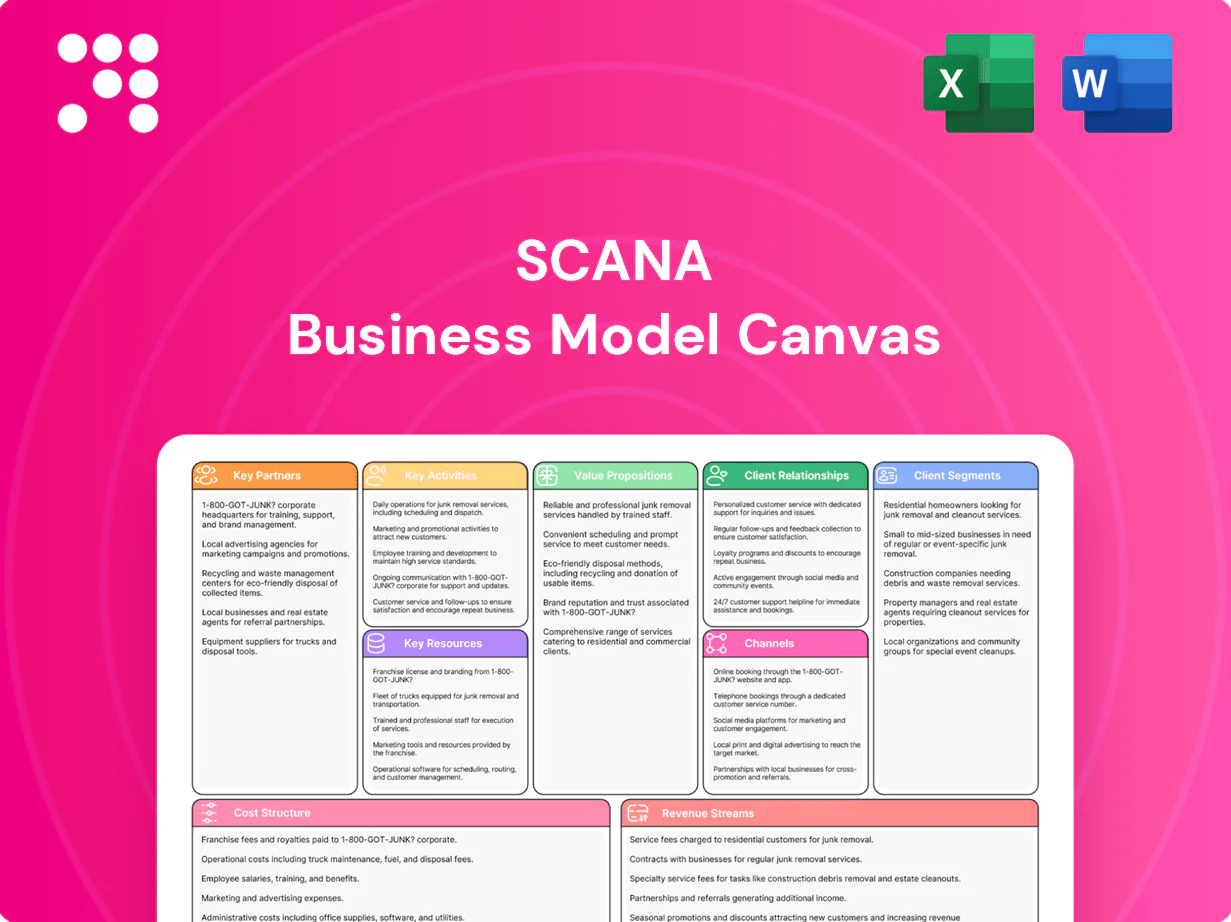
Scana Business Model Canvas

Unlock the strategic blueprint: Business Model Canvas for energy firms
Unlock the full strategic blueprint behind Scana’s business model with our detailed Business Model Canvas. This concise, section-by-section analysis reveals value propositions, revenue streams, key partners and growth levers to inform investment or strategy decisions. Download the editable Word & Excel files to benchmark, adapt, and act on proven insights.
Partnerships

EPC and shipyard alliances
Strategic alliances with EPC firms and shipyards secure capacity for subsea, offshore wind, and maritime builds, crucial as global offshore wind capacity surpassed 70 GW by 2024. These partners enable turnkey delivery, installation, and lifecycle services, lowering capital tie-up for Scana. Co-bidding improves win rates and price competitiveness while joint planning reduces execution risk and schedule slippage.
Technology and OEM partners
Collaboration with OEMs for power, propulsion, control and subsea systems accelerates Scana’s portfolio differentiation and integrates certified components that can cut qualification timelines by ~50%, while joint roadmaps align product innovation with customer needs; licensing deals—often yielding 3–7% royalty rates—expand addressable markets with limited incremental capex and scalable revenue potential.

Universities and research institutes
R&D partnerships with universities and institutes accelerate materials, digital-twin and autonomy advances for ocean applications by leveraging academic labs and shared testbeds. Horizon Europe funding (€95.5bn, 2021–2027) and national grants de-risk early-stage tech through prototyping and sea trials. Shared IP frameworks and graduate pipelines bolster commercialization and engineering depth across subsidiaries.

Financial institutions and co-investors
In 2024 banks, export credit agencies and co-investors supply leverage and growth capital for Scana, with syndications enabling projects and acquisitions typically above 100m EUR. Structured financing can lower WACC by 100–200bps and improve returns, while risk-sharing mechanisms stabilize cash flows in cyclical markets.
- Banks & ECAs: leverage & export support
- Syndication: funds >100m EUR
- Structured finance: −100–200bps WACC
- Risk-sharing: steadier cash flows
Regulators and classification societies
Engagement with maritime authorities and class bodies ensures compliance and certification, with early involvement shortening approvals for offshore assets and reducing schedule risk. Participation in standards committees helps shape future requirements, while a strong compliance record improves customer confidence and strengthens bid scores.
- Regulatory engagement
- Early approvals
- Standards influence
- Compliance = competitive edge
Alliances with EPCs, shipyards and OEMs secure capacity, cut capex and lower WACC
Alliances with EPCs/shipyards and OEMs secure capacity for subsea, offshore wind and maritime builds (global offshore wind >70 GW by 2024), enabling turnkey delivery, lower capex and higher win rates. R&D and university partners leverage Horizon Europe funding (€95.5bn) to cut tech risk; banks/ECAs/syndications fund >100m EUR projects, trimming WACC ~100–200bps.
| Partner | Impact | Metric |
|---|---|---|
| EPCs/Shipyards | Capacity | >70 GW (2024) |
| OEMs | Faster cert | −50% qual time |
| Financiers | Leverage | >100m EUR, −100–200bps |
What is included in the product
 Detailed Word Document
A concise, pre-built Business Model Canvas for Scana covering all nine BMC blocks with detailed customer segments, channels, value propositions, revenue streams and cost structure, plus linked SWOT, competitive advantages and investor-ready narrative for presentations and strategic decisions.

 Customizable Excel Spreadsheet
High-level Scana Business Model Canvas with editable cells that saves hours of setup, condenses strategy into a one-page snapshot for quick review, and is perfect for team collaboration, boardrooms, or comparing multiple company models side-by-side.
Activities

Active ownership and value creation
Hands-on governance, focused board work and KPI steering drive operational improvements, with KPI programs typically cutting OPEX 3–7% in comparable industrials. Lean programs, pricing optimization and supply initiatives lift margins often by 5–15%. Targeted talent upgrades strengthen leadership benches and reduce execution risk. Strategy refreshes reposition assets toward higher-growth segments and premium returns.
Capital allocation and M&A
Scana directs disciplined capital into subsea, offshore wind and aquaculture platforms, prioritizing projects with clear IRR targets and scalable unit economics. Bolt-on acquisitions expand capability and geographic reach, speeding market entry and adding complementary technology. Portfolio pruning recycles capital from non-core assets to fund growth; post-merger integration targets rapid synergies and cost savings. FAO notes aquaculture now supplies over 50% of fish for human consumption.

Business development and bidding
Coordinated key-account management targets developers, operators and shipyards with dedicated teams driving 3–5 year account plans and cross-selling of modules and service agreements in 2024.
Competitive tenders and framework agreements secure multi-year pipelines, with framework contracts covering a large share of supplier orderbooks and stabilizing revenue visibility.
Solution selling bundles products and services to lift average contract value, while win-loss analytics in 2024 refined bid strategy and pricing to improve competitiveness and margin capture.

Technology and product development
Scana's technology roadmaps prioritize reliability, sustainability and digitalization, targeting equipment MTBF >100,000 hours and compliance with IEC/UL/CE standards. Prototyping and field trials validate performance in harsh conditions (−40°C to +85°C, salt-fog and vibration). Modular designs speed integrations and cut assembly lead time, while certification and type approvals unlock regulated markets.
- MTBF >100,000 hours
- Environmental tests −40°C to +85°C
- Certifications: IEC, UL, CE
- Modular designs: faster integration
ESG integration and risk management
Embedded ESG metrics align Scana with energy transition goals, tracking emissions and capital allocation consistent with 2024 global clean-energy investment of about $1.7 trillion. Robust HSE programs reduce offshore incidents and protect personnel and assets. Proactive supply-chain and project risk mitigation, plus cyber and data governance, safeguard mission-critical operations and continuity.
- ESG metrics: alignment with 2024 investments
- HSE: offshore incident reduction focus
- Supply-chain: active risk mitigation
- Cyber: data governance for uptime
Governance cuts OPEX 3-7%, margins up 5-15%; aquaculture >50%
Hands-on governance and KPI steering cut OPEX 3–7% while lean, pricing and supply programs lift margins 5–15%. Capital focuses on subsea, offshore wind and aquaculture; aquaculture now supplies >50% of fish for human consumption. Tech roadmaps target MTBF >100,000 hrs and IEC/UL/CE certification; 2024 clean-energy investment ~$1.7T.
| Metric | 2024 Value |
|---|---|
| OPEX reduction | 3–7% |
| Margin lift | 5–15% |
| Aquaculture share | >50% |
| Clean-energy invest. | $1.7T |
| MTBF | >100,000 hrs |
Full Document Unlocks After Purchase
Business Model Canvas
The Scana Business Model Canvas previewed here is the exact deliverable you’ll receive—no mockups or samples. When you purchase, you’ll get the full, editable file formatted and structured exactly as shown. It’s ready to use for presentations, planning, or customization with all sections included.

Unlock the strategic blueprint: Business Model Canvas for energy firms
Unlock the full strategic blueprint behind Scana’s business model with our detailed Business Model Canvas. This concise, section-by-section analysis reveals value propositions, revenue streams, key partners and growth levers to inform investment or strategy decisions. Download the editable Word & Excel files to benchmark, adapt, and act on proven insights.
Partnerships
EPC and shipyard alliances
Strategic alliances with EPC firms and shipyards secure capacity for subsea, offshore wind, and maritime builds, crucial as global offshore wind capacity surpassed 70 GW by 2024. These partners enable turnkey delivery, installation, and lifecycle services, lowering capital tie-up for Scana. Co-bidding improves win rates and price competitiveness while joint planning reduces execution risk and schedule slippage.
Technology and OEM partners
Collaboration with OEMs for power, propulsion, control and subsea systems accelerates Scana’s portfolio differentiation and integrates certified components that can cut qualification timelines by ~50%, while joint roadmaps align product innovation with customer needs; licensing deals—often yielding 3–7% royalty rates—expand addressable markets with limited incremental capex and scalable revenue potential.
Universities and research institutes
R&D partnerships with universities and institutes accelerate materials, digital-twin and autonomy advances for ocean applications by leveraging academic labs and shared testbeds. Horizon Europe funding (€95.5bn, 2021–2027) and national grants de-risk early-stage tech through prototyping and sea trials. Shared IP frameworks and graduate pipelines bolster commercialization and engineering depth across subsidiaries.
Financial institutions and co-investors
In 2024 banks, export credit agencies and co-investors supply leverage and growth capital for Scana, with syndications enabling projects and acquisitions typically above 100m EUR. Structured financing can lower WACC by 100–200bps and improve returns, while risk-sharing mechanisms stabilize cash flows in cyclical markets.
- Banks & ECAs: leverage & export support
- Syndication: funds >100m EUR
- Structured finance: −100–200bps WACC
- Risk-sharing: steadier cash flows
Regulators and classification societies
Engagement with maritime authorities and class bodies ensures compliance and certification, with early involvement shortening approvals for offshore assets and reducing schedule risk. Participation in standards committees helps shape future requirements, while a strong compliance record improves customer confidence and strengthens bid scores.
- Regulatory engagement
- Early approvals
- Standards influence
- Compliance = competitive edge
Alliances with EPCs, shipyards and OEMs secure capacity, cut capex and lower WACC
Alliances with EPCs/shipyards and OEMs secure capacity for subsea, offshore wind and maritime builds (global offshore wind >70 GW by 2024), enabling turnkey delivery, lower capex and higher win rates. R&D and university partners leverage Horizon Europe funding (€95.5bn) to cut tech risk; banks/ECAs/syndications fund >100m EUR projects, trimming WACC ~100–200bps.
| Partner | Impact | Metric |
|---|---|---|
| EPCs/Shipyards | Capacity | >70 GW (2024) |
| OEMs | Faster cert | −50% qual time |
| Financiers | Leverage | >100m EUR, −100–200bps |
What is included in the product
Detailed Word Document
A concise, pre-built Business Model Canvas for Scana covering all nine BMC blocks with detailed customer segments, channels, value propositions, revenue streams and cost structure, plus linked SWOT, competitive advantages and investor-ready narrative for presentations and strategic decisions.
Customizable Excel Spreadsheet
High-level Scana Business Model Canvas with editable cells that saves hours of setup, condenses strategy into a one-page snapshot for quick review, and is perfect for team collaboration, boardrooms, or comparing multiple company models side-by-side.
Activities
Active ownership and value creation
Hands-on governance, focused board work and KPI steering drive operational improvements, with KPI programs typically cutting OPEX 3–7% in comparable industrials. Lean programs, pricing optimization and supply initiatives lift margins often by 5–15%. Targeted talent upgrades strengthen leadership benches and reduce execution risk. Strategy refreshes reposition assets toward higher-growth segments and premium returns.
Capital allocation and M&A
Scana directs disciplined capital into subsea, offshore wind and aquaculture platforms, prioritizing projects with clear IRR targets and scalable unit economics. Bolt-on acquisitions expand capability and geographic reach, speeding market entry and adding complementary technology. Portfolio pruning recycles capital from non-core assets to fund growth; post-merger integration targets rapid synergies and cost savings. FAO notes aquaculture now supplies over 50% of fish for human consumption.
Business development and bidding
Coordinated key-account management targets developers, operators and shipyards with dedicated teams driving 3–5 year account plans and cross-selling of modules and service agreements in 2024.
Competitive tenders and framework agreements secure multi-year pipelines, with framework contracts covering a large share of supplier orderbooks and stabilizing revenue visibility.
Solution selling bundles products and services to lift average contract value, while win-loss analytics in 2024 refined bid strategy and pricing to improve competitiveness and margin capture.
Technology and product development
Scana's technology roadmaps prioritize reliability, sustainability and digitalization, targeting equipment MTBF >100,000 hours and compliance with IEC/UL/CE standards. Prototyping and field trials validate performance in harsh conditions (−40°C to +85°C, salt-fog and vibration). Modular designs speed integrations and cut assembly lead time, while certification and type approvals unlock regulated markets.
- MTBF >100,000 hours
- Environmental tests −40°C to +85°C
- Certifications: IEC, UL, CE
- Modular designs: faster integration
ESG integration and risk management
Embedded ESG metrics align Scana with energy transition goals, tracking emissions and capital allocation consistent with 2024 global clean-energy investment of about $1.7 trillion. Robust HSE programs reduce offshore incidents and protect personnel and assets. Proactive supply-chain and project risk mitigation, plus cyber and data governance, safeguard mission-critical operations and continuity.
- ESG metrics: alignment with 2024 investments
- HSE: offshore incident reduction focus
- Supply-chain: active risk mitigation
- Cyber: data governance for uptime
Governance cuts OPEX 3-7%, margins up 5-15%; aquaculture >50%
Hands-on governance and KPI steering cut OPEX 3–7% while lean, pricing and supply programs lift margins 5–15%. Capital focuses on subsea, offshore wind and aquaculture; aquaculture now supplies >50% of fish for human consumption. Tech roadmaps target MTBF >100,000 hrs and IEC/UL/CE certification; 2024 clean-energy investment ~$1.7T.
| Metric | 2024 Value |
|---|---|
| OPEX reduction | 3–7% |
| Margin lift | 5–15% |
| Aquaculture share | >50% |
| Clean-energy invest. | $1.7T |
| MTBF | >100,000 hrs |
Full Document Unlocks After Purchase
Business Model Canvas
The Scana Business Model Canvas previewed here is the exact deliverable you’ll receive—no mockups or samples. When you purchase, you’ll get the full, editable file formatted and structured exactly as shown. It’s ready to use for presentations, planning, or customization with all sections included.
Original: $10.00
-65%$10.00
$3.50Description
Unlock the strategic blueprint: Business Model Canvas for energy firms
Unlock the full strategic blueprint behind Scana’s business model with our detailed Business Model Canvas. This concise, section-by-section analysis reveals value propositions, revenue streams, key partners and growth levers to inform investment or strategy decisions. Download the editable Word & Excel files to benchmark, adapt, and act on proven insights.
Partnerships
EPC and shipyard alliances
Strategic alliances with EPC firms and shipyards secure capacity for subsea, offshore wind, and maritime builds, crucial as global offshore wind capacity surpassed 70 GW by 2024. These partners enable turnkey delivery, installation, and lifecycle services, lowering capital tie-up for Scana. Co-bidding improves win rates and price competitiveness while joint planning reduces execution risk and schedule slippage.
Technology and OEM partners
Collaboration with OEMs for power, propulsion, control and subsea systems accelerates Scana’s portfolio differentiation and integrates certified components that can cut qualification timelines by ~50%, while joint roadmaps align product innovation with customer needs; licensing deals—often yielding 3–7% royalty rates—expand addressable markets with limited incremental capex and scalable revenue potential.
Universities and research institutes
R&D partnerships with universities and institutes accelerate materials, digital-twin and autonomy advances for ocean applications by leveraging academic labs and shared testbeds. Horizon Europe funding (€95.5bn, 2021–2027) and national grants de-risk early-stage tech through prototyping and sea trials. Shared IP frameworks and graduate pipelines bolster commercialization and engineering depth across subsidiaries.
Financial institutions and co-investors
In 2024 banks, export credit agencies and co-investors supply leverage and growth capital for Scana, with syndications enabling projects and acquisitions typically above 100m EUR. Structured financing can lower WACC by 100–200bps and improve returns, while risk-sharing mechanisms stabilize cash flows in cyclical markets.
- Banks & ECAs: leverage & export support
- Syndication: funds >100m EUR
- Structured finance: −100–200bps WACC
- Risk-sharing: steadier cash flows
Regulators and classification societies
Engagement with maritime authorities and class bodies ensures compliance and certification, with early involvement shortening approvals for offshore assets and reducing schedule risk. Participation in standards committees helps shape future requirements, while a strong compliance record improves customer confidence and strengthens bid scores.
- Regulatory engagement
- Early approvals
- Standards influence
- Compliance = competitive edge
Alliances with EPCs, shipyards and OEMs secure capacity, cut capex and lower WACC
Alliances with EPCs/shipyards and OEMs secure capacity for subsea, offshore wind and maritime builds (global offshore wind >70 GW by 2024), enabling turnkey delivery, lower capex and higher win rates. R&D and university partners leverage Horizon Europe funding (€95.5bn) to cut tech risk; banks/ECAs/syndications fund >100m EUR projects, trimming WACC ~100–200bps.
| Partner | Impact | Metric |
|---|---|---|
| EPCs/Shipyards | Capacity | >70 GW (2024) |
| OEMs | Faster cert | −50% qual time |
| Financiers | Leverage | >100m EUR, −100–200bps |
What is included in the product
Detailed Word Document
A concise, pre-built Business Model Canvas for Scana covering all nine BMC blocks with detailed customer segments, channels, value propositions, revenue streams and cost structure, plus linked SWOT, competitive advantages and investor-ready narrative for presentations and strategic decisions.
Customizable Excel Spreadsheet
High-level Scana Business Model Canvas with editable cells that saves hours of setup, condenses strategy into a one-page snapshot for quick review, and is perfect for team collaboration, boardrooms, or comparing multiple company models side-by-side.
Activities
Active ownership and value creation
Hands-on governance, focused board work and KPI steering drive operational improvements, with KPI programs typically cutting OPEX 3–7% in comparable industrials. Lean programs, pricing optimization and supply initiatives lift margins often by 5–15%. Targeted talent upgrades strengthen leadership benches and reduce execution risk. Strategy refreshes reposition assets toward higher-growth segments and premium returns.
Capital allocation and M&A
Scana directs disciplined capital into subsea, offshore wind and aquaculture platforms, prioritizing projects with clear IRR targets and scalable unit economics. Bolt-on acquisitions expand capability and geographic reach, speeding market entry and adding complementary technology. Portfolio pruning recycles capital from non-core assets to fund growth; post-merger integration targets rapid synergies and cost savings. FAO notes aquaculture now supplies over 50% of fish for human consumption.
Business development and bidding
Coordinated key-account management targets developers, operators and shipyards with dedicated teams driving 3–5 year account plans and cross-selling of modules and service agreements in 2024.
Competitive tenders and framework agreements secure multi-year pipelines, with framework contracts covering a large share of supplier orderbooks and stabilizing revenue visibility.
Solution selling bundles products and services to lift average contract value, while win-loss analytics in 2024 refined bid strategy and pricing to improve competitiveness and margin capture.
Technology and product development
Scana's technology roadmaps prioritize reliability, sustainability and digitalization, targeting equipment MTBF >100,000 hours and compliance with IEC/UL/CE standards. Prototyping and field trials validate performance in harsh conditions (−40°C to +85°C, salt-fog and vibration). Modular designs speed integrations and cut assembly lead time, while certification and type approvals unlock regulated markets.
- MTBF >100,000 hours
- Environmental tests −40°C to +85°C
- Certifications: IEC, UL, CE
- Modular designs: faster integration
ESG integration and risk management
Embedded ESG metrics align Scana with energy transition goals, tracking emissions and capital allocation consistent with 2024 global clean-energy investment of about $1.7 trillion. Robust HSE programs reduce offshore incidents and protect personnel and assets. Proactive supply-chain and project risk mitigation, plus cyber and data governance, safeguard mission-critical operations and continuity.
- ESG metrics: alignment with 2024 investments
- HSE: offshore incident reduction focus
- Supply-chain: active risk mitigation
- Cyber: data governance for uptime
Governance cuts OPEX 3-7%, margins up 5-15%; aquaculture >50%
Hands-on governance and KPI steering cut OPEX 3–7% while lean, pricing and supply programs lift margins 5–15%. Capital focuses on subsea, offshore wind and aquaculture; aquaculture now supplies >50% of fish for human consumption. Tech roadmaps target MTBF >100,000 hrs and IEC/UL/CE certification; 2024 clean-energy investment ~$1.7T.
| Metric | 2024 Value |
|---|---|
| OPEX reduction | 3–7% |
| Margin lift | 5–15% |
| Aquaculture share | >50% |
| Clean-energy invest. | $1.7T |
| MTBF | >100,000 hrs |
Full Document Unlocks After Purchase
Business Model Canvas
The Scana Business Model Canvas previewed here is the exact deliverable you’ll receive—no mockups or samples. When you purchase, you’ll get the full, editable file formatted and structured exactly as shown. It’s ready to use for presentations, planning, or customization with all sections included.











