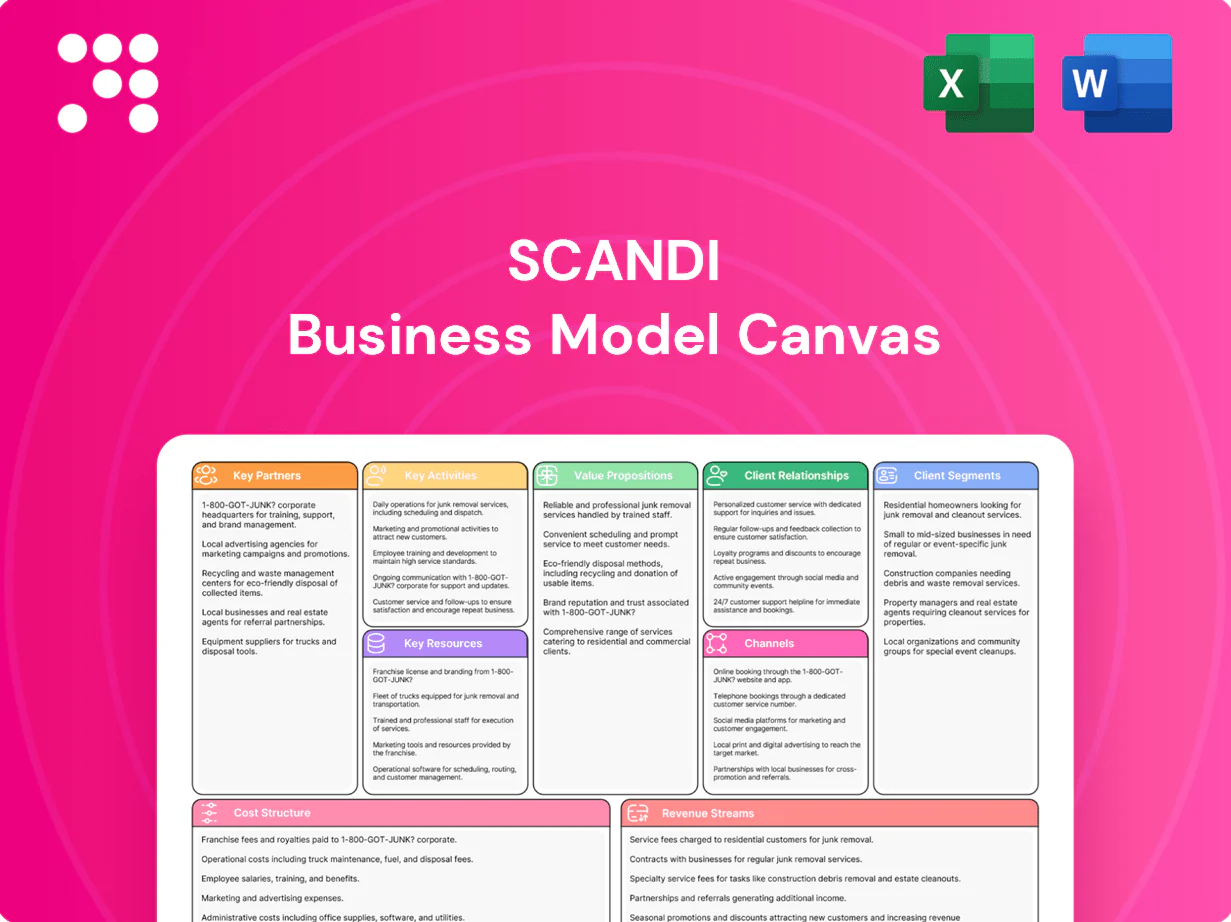
Scandi Business Model Canvas

Unlock the full Business Model Canvas to scale value, operations, and market share
Unlock Scandi’s full strategic blueprint with our Business Model Canvas—three key pages that reveal how the company creates value, scales operations, and captures market share. Ideal for entrepreneurs, investors, and consultants seeking actionable insights. Download the editable Word/Excel canvas to benchmark and accelerate your strategy.
Partnerships

Contract farmers and integrators
Long-term contracts with growers—covering over 80% of broiler supply in several EU markets (Eurostat 2023–24)—secure consistent bird volumes and enforce welfare protocols. Joint planning synchronises flock cycles with plant capacity and retailer promotions, cutting supply mismatches. Shared performance data improves FCR and health monitoring, while incentive schemes tie bonuses to biosecurity and quality metrics.
Feed, hatchery, and genetics suppliers
Partnerships with reputable feed mills and genetics providers optimize growth, welfare and product quality; feed comprises ~60–70% of broiler production costs (2024 industry average). Coordinated supply agreements can cut feed-price volatility ~10–15% and genetics improvements lower FCR by ~5–8%, while technical support reduces mortality ~0.5–1 pp and joint R&D targets 3–5% yield gains for Nordic/Irish markets.

Cold-chain logistics and distribution partners
Specialist cold-chain carriers ensure strict temperature control from plant to customer, enabling product integrity and compliance with EU cold-chain standards. Route optimization and cross-docking shorten transit and reduce on-route waste, supporting freshness and cost efficiency. Contingency capacity preserves service levels during peak seasons. Collaboration enables next-day delivery across Sweden, Denmark, Norway, Ireland, Lithuania and Finland, serving ~35 million consumers (2024).

Retail, foodservice, and QSR alliances
Long-term supply agreements with leading grocers, distributors and QSR chains stabilize volumes—Scandi secures ~120m units/year and reduces SKU churn. Joint category management has driven 2–4ppt shelf share gains and higher menu attach rates for QSR partners. Data sharing improved demand-forecast accuracy to ~85% in 2024 while private-label partnerships now represent ~18% of revenue, boosting customer stickiness.
- Supply stability: ~120m units/year
- Shelf lift: +2–4ppt
- Forecast accuracy: ~85% (2024)
- Private-label: ~18% revenue
Regulatory, certification, and sustainability bodies
Engagement with authorities and auditors ensures compliance with EU and national standards, aligning Scandi operations with the EU Green Deal target of a 55% greenhouse gas reduction by 2030 and the Farm to Fork goal of a 50% pesticide reduction by 2030.
- Certifications: animal welfare, BRC/IFS, ISO boost market access and buyer trust
- Sustainability: joint frameworks advance emissions, water, waste targets
- Transparency: full farm-to-fork traceability supports regulatory reporting
Secure ~80% broiler supply; FCR -5–8%; 120m units/yr
Long-term grower contracts secure ~80% broiler supply in key EU markets, syncing cycles to plant capacity and reducing waste. Feed/genetics partners lower FCR 5–8% and stabilize feed cost volatility ~10–15%. Retail/QSR deals supply ~120m units/year, private-label = 18% revenue; cold-chain carriers enable next-day delivery across 7 markets.
| Metric | Value |
|---|---|
| Supply coverage | ~80% |
| Units/year | 120m |
| Private-label | 18% |
| FCR improvement | 5–8% |
What is included in the product
 Detailed Word Document
A comprehensive Scandi Business Model Canvas tailored to Nordic strategy and operations, detailing customer segments, channels, value propositions, revenue streams and cost structure with competitive analysis and SWOT-linked insights for investor presentations and strategic decisions.

 Customizable Excel Spreadsheet
Clean, concise Scandi Business Model Canvas that relieves pain by providing a one-page, editable snapshot to save hours formatting, enable fast team collaboration and adaptation, and compare multiple companies or models side-by-side.
Activities

End-to-end poultry processing
Manage slaughtering, cutting, deboning and further processing at scale with capacity ~150,000 birds/day (2024), integrated lines and 8–10 t/h throughput. All plants operate HACCP-certified systems; microbiological targets <2 CFU/cm2 and recalls fell ~35% in 2024. Automation and lean reduced yield loss by 3.5% and labour costs by 22% (2024), while welfare/quality standards keep carcass rejection near 0.8%.
Product development and innovation
Develop fresh, frozen, marinated and ready-to-eat chicken ranges aligned to retailer planograms and foodservice formats across the five Nordic countries (Denmark, Sweden, Norway, Finland, Iceland) and Ireland (pop. ~5.1M in 2024). Test recipes for local tastes in each market and iterate using sensory panels and rolling 12-week sales data to refine SKUs and shelf placements.

Demand planning and category management
We forecast jointly with retailers and distributors to synchronize supply and promotions, targeting the Nordic apparel e‑commerce share of 23% in 2024 to capture online demand. Assortments are shaped by occasion, cut and price tier, using scans and menu velocities to refine mix. S&OP minimizes stock‑outs and markdowns through aligned replenishment and promo planning.

Quality, safety, and animal welfare assurance
Operate robust QA systems across farms, transport and plants with batch-level traceability from hatchery to shelf, targeting broiler mortality of 2–3% and strict control of pathogen loads. Track KPIs including mortality, antibiotic use and pathogen counts, and note EU rules have banned antibiotic growth promoters since 2006. Conduct independent audits and continuous staff training; maintain digital trace logs for recall readiness.
- QA systems: farms, transport, plants
- KPI tags: mortality 2–3%, antibiotic use, pathogens
- Actions: audits, continuous training
- Traceability: hatchery to shelf, batch-level
Sustainability and by-product valorization
Scandi cuts emissions, energy and water intensity across sites aligned with EU climate goals to help reach at least 55% net GHG reduction by 2030 and the Farm to Fork target to halve food waste by 2030; by 2024 many processors report double‑digit efficiency gains year‑on‑year. By‑products are routed into pet food, rendered fats and feather meal to close nutrient loops, reduce landfill and create revenue streams, with progress reported regularly to customers and stakeholders.
- Reduce CO2e, energy, water use — align with EU 55% 2030 goal
- Convert by‑products to pet food, rendered fats, feather meal
- Cut food waste via secondary markets and donations — supports Farm to Fork 50% waste cut
- Quarterly reporting to customers and stakeholders
Poultry plant: 150,000/day; recalls -35%, labour -22%
Operate integrated slaughter, processing and QA at ~150,000 birds/day (2024) with HACCP, recalls down ~35% and labour costs cut 22% (2024). Develop market‑tailored fresh/frozen/RTE ranges across five Nordics + Ireland (pop. 5.1M, 2024) using S&OP and joint forecasts. Batch traceability, mortality 2–3%, carcass rejection ~0.8%; circular by‑product streams and targets aligned to EU 55% GHG cut by 2030.
| Metric | 2024 |
|---|---|
| Throughput | 150,000 birds/day |
| Recalls | -35% |
| Labour cost | -22% |
| Mortality | 2–3% |
Full Version Awaits
Business Model Canvas
The Scandi Business Model Canvas preview shown here is the actual deliverable, not a mockup or sample. When you purchase, you’ll receive this exact document—fully formatted and complete—ready to edit, present, and share. Files are delivered instantly in Word and Excel formats.

Unlock the full Business Model Canvas to scale value, operations, and market share
Unlock Scandi’s full strategic blueprint with our Business Model Canvas—three key pages that reveal how the company creates value, scales operations, and captures market share. Ideal for entrepreneurs, investors, and consultants seeking actionable insights. Download the editable Word/Excel canvas to benchmark and accelerate your strategy.
Partnerships
Contract farmers and integrators
Long-term contracts with growers—covering over 80% of broiler supply in several EU markets (Eurostat 2023–24)—secure consistent bird volumes and enforce welfare protocols. Joint planning synchronises flock cycles with plant capacity and retailer promotions, cutting supply mismatches. Shared performance data improves FCR and health monitoring, while incentive schemes tie bonuses to biosecurity and quality metrics.
Feed, hatchery, and genetics suppliers
Partnerships with reputable feed mills and genetics providers optimize growth, welfare and product quality; feed comprises ~60–70% of broiler production costs (2024 industry average). Coordinated supply agreements can cut feed-price volatility ~10–15% and genetics improvements lower FCR by ~5–8%, while technical support reduces mortality ~0.5–1 pp and joint R&D targets 3–5% yield gains for Nordic/Irish markets.
Cold-chain logistics and distribution partners
Specialist cold-chain carriers ensure strict temperature control from plant to customer, enabling product integrity and compliance with EU cold-chain standards. Route optimization and cross-docking shorten transit and reduce on-route waste, supporting freshness and cost efficiency. Contingency capacity preserves service levels during peak seasons. Collaboration enables next-day delivery across Sweden, Denmark, Norway, Ireland, Lithuania and Finland, serving ~35 million consumers (2024).
Retail, foodservice, and QSR alliances
Long-term supply agreements with leading grocers, distributors and QSR chains stabilize volumes—Scandi secures ~120m units/year and reduces SKU churn. Joint category management has driven 2–4ppt shelf share gains and higher menu attach rates for QSR partners. Data sharing improved demand-forecast accuracy to ~85% in 2024 while private-label partnerships now represent ~18% of revenue, boosting customer stickiness.
- Supply stability: ~120m units/year
- Shelf lift: +2–4ppt
- Forecast accuracy: ~85% (2024)
- Private-label: ~18% revenue
Regulatory, certification, and sustainability bodies
Engagement with authorities and auditors ensures compliance with EU and national standards, aligning Scandi operations with the EU Green Deal target of a 55% greenhouse gas reduction by 2030 and the Farm to Fork goal of a 50% pesticide reduction by 2030.
- Certifications: animal welfare, BRC/IFS, ISO boost market access and buyer trust
- Sustainability: joint frameworks advance emissions, water, waste targets
- Transparency: full farm-to-fork traceability supports regulatory reporting
Secure ~80% broiler supply; FCR -5–8%; 120m units/yr
Long-term grower contracts secure ~80% broiler supply in key EU markets, syncing cycles to plant capacity and reducing waste. Feed/genetics partners lower FCR 5–8% and stabilize feed cost volatility ~10–15%. Retail/QSR deals supply ~120m units/year, private-label = 18% revenue; cold-chain carriers enable next-day delivery across 7 markets.
| Metric | Value |
|---|---|
| Supply coverage | ~80% |
| Units/year | 120m |
| Private-label | 18% |
| FCR improvement | 5–8% |
What is included in the product
Detailed Word Document
A comprehensive Scandi Business Model Canvas tailored to Nordic strategy and operations, detailing customer segments, channels, value propositions, revenue streams and cost structure with competitive analysis and SWOT-linked insights for investor presentations and strategic decisions.
Customizable Excel Spreadsheet
Clean, concise Scandi Business Model Canvas that relieves pain by providing a one-page, editable snapshot to save hours formatting, enable fast team collaboration and adaptation, and compare multiple companies or models side-by-side.
Activities
End-to-end poultry processing
Manage slaughtering, cutting, deboning and further processing at scale with capacity ~150,000 birds/day (2024), integrated lines and 8–10 t/h throughput. All plants operate HACCP-certified systems; microbiological targets <2 CFU/cm2 and recalls fell ~35% in 2024. Automation and lean reduced yield loss by 3.5% and labour costs by 22% (2024), while welfare/quality standards keep carcass rejection near 0.8%.
Product development and innovation
Develop fresh, frozen, marinated and ready-to-eat chicken ranges aligned to retailer planograms and foodservice formats across the five Nordic countries (Denmark, Sweden, Norway, Finland, Iceland) and Ireland (pop. ~5.1M in 2024). Test recipes for local tastes in each market and iterate using sensory panels and rolling 12-week sales data to refine SKUs and shelf placements.
Demand planning and category management
We forecast jointly with retailers and distributors to synchronize supply and promotions, targeting the Nordic apparel e‑commerce share of 23% in 2024 to capture online demand. Assortments are shaped by occasion, cut and price tier, using scans and menu velocities to refine mix. S&OP minimizes stock‑outs and markdowns through aligned replenishment and promo planning.
Quality, safety, and animal welfare assurance
Operate robust QA systems across farms, transport and plants with batch-level traceability from hatchery to shelf, targeting broiler mortality of 2–3% and strict control of pathogen loads. Track KPIs including mortality, antibiotic use and pathogen counts, and note EU rules have banned antibiotic growth promoters since 2006. Conduct independent audits and continuous staff training; maintain digital trace logs for recall readiness.
- QA systems: farms, transport, plants
- KPI tags: mortality 2–3%, antibiotic use, pathogens
- Actions: audits, continuous training
- Traceability: hatchery to shelf, batch-level
Sustainability and by-product valorization
Scandi cuts emissions, energy and water intensity across sites aligned with EU climate goals to help reach at least 55% net GHG reduction by 2030 and the Farm to Fork target to halve food waste by 2030; by 2024 many processors report double‑digit efficiency gains year‑on‑year. By‑products are routed into pet food, rendered fats and feather meal to close nutrient loops, reduce landfill and create revenue streams, with progress reported regularly to customers and stakeholders.
- Reduce CO2e, energy, water use — align with EU 55% 2030 goal
- Convert by‑products to pet food, rendered fats, feather meal
- Cut food waste via secondary markets and donations — supports Farm to Fork 50% waste cut
- Quarterly reporting to customers and stakeholders
Poultry plant: 150,000/day; recalls -35%, labour -22%
Operate integrated slaughter, processing and QA at ~150,000 birds/day (2024) with HACCP, recalls down ~35% and labour costs cut 22% (2024). Develop market‑tailored fresh/frozen/RTE ranges across five Nordics + Ireland (pop. 5.1M, 2024) using S&OP and joint forecasts. Batch traceability, mortality 2–3%, carcass rejection ~0.8%; circular by‑product streams and targets aligned to EU 55% GHG cut by 2030.
| Metric | 2024 |
|---|---|
| Throughput | 150,000 birds/day |
| Recalls | -35% |
| Labour cost | -22% |
| Mortality | 2–3% |
Full Version Awaits
Business Model Canvas
The Scandi Business Model Canvas preview shown here is the actual deliverable, not a mockup or sample. When you purchase, you’ll receive this exact document—fully formatted and complete—ready to edit, present, and share. Files are delivered instantly in Word and Excel formats.
Original: $10.00
-65%$10.00
$3.50Description
Unlock the full Business Model Canvas to scale value, operations, and market share
Unlock Scandi’s full strategic blueprint with our Business Model Canvas—three key pages that reveal how the company creates value, scales operations, and captures market share. Ideal for entrepreneurs, investors, and consultants seeking actionable insights. Download the editable Word/Excel canvas to benchmark and accelerate your strategy.
Partnerships
Contract farmers and integrators
Long-term contracts with growers—covering over 80% of broiler supply in several EU markets (Eurostat 2023–24)—secure consistent bird volumes and enforce welfare protocols. Joint planning synchronises flock cycles with plant capacity and retailer promotions, cutting supply mismatches. Shared performance data improves FCR and health monitoring, while incentive schemes tie bonuses to biosecurity and quality metrics.
Feed, hatchery, and genetics suppliers
Partnerships with reputable feed mills and genetics providers optimize growth, welfare and product quality; feed comprises ~60–70% of broiler production costs (2024 industry average). Coordinated supply agreements can cut feed-price volatility ~10–15% and genetics improvements lower FCR by ~5–8%, while technical support reduces mortality ~0.5–1 pp and joint R&D targets 3–5% yield gains for Nordic/Irish markets.
Cold-chain logistics and distribution partners
Specialist cold-chain carriers ensure strict temperature control from plant to customer, enabling product integrity and compliance with EU cold-chain standards. Route optimization and cross-docking shorten transit and reduce on-route waste, supporting freshness and cost efficiency. Contingency capacity preserves service levels during peak seasons. Collaboration enables next-day delivery across Sweden, Denmark, Norway, Ireland, Lithuania and Finland, serving ~35 million consumers (2024).
Retail, foodservice, and QSR alliances
Long-term supply agreements with leading grocers, distributors and QSR chains stabilize volumes—Scandi secures ~120m units/year and reduces SKU churn. Joint category management has driven 2–4ppt shelf share gains and higher menu attach rates for QSR partners. Data sharing improved demand-forecast accuracy to ~85% in 2024 while private-label partnerships now represent ~18% of revenue, boosting customer stickiness.
- Supply stability: ~120m units/year
- Shelf lift: +2–4ppt
- Forecast accuracy: ~85% (2024)
- Private-label: ~18% revenue
Regulatory, certification, and sustainability bodies
Engagement with authorities and auditors ensures compliance with EU and national standards, aligning Scandi operations with the EU Green Deal target of a 55% greenhouse gas reduction by 2030 and the Farm to Fork goal of a 50% pesticide reduction by 2030.
- Certifications: animal welfare, BRC/IFS, ISO boost market access and buyer trust
- Sustainability: joint frameworks advance emissions, water, waste targets
- Transparency: full farm-to-fork traceability supports regulatory reporting
Secure ~80% broiler supply; FCR -5–8%; 120m units/yr
Long-term grower contracts secure ~80% broiler supply in key EU markets, syncing cycles to plant capacity and reducing waste. Feed/genetics partners lower FCR 5–8% and stabilize feed cost volatility ~10–15%. Retail/QSR deals supply ~120m units/year, private-label = 18% revenue; cold-chain carriers enable next-day delivery across 7 markets.
| Metric | Value |
|---|---|
| Supply coverage | ~80% |
| Units/year | 120m |
| Private-label | 18% |
| FCR improvement | 5–8% |
What is included in the product
Detailed Word Document
A comprehensive Scandi Business Model Canvas tailored to Nordic strategy and operations, detailing customer segments, channels, value propositions, revenue streams and cost structure with competitive analysis and SWOT-linked insights for investor presentations and strategic decisions.
Customizable Excel Spreadsheet
Clean, concise Scandi Business Model Canvas that relieves pain by providing a one-page, editable snapshot to save hours formatting, enable fast team collaboration and adaptation, and compare multiple companies or models side-by-side.
Activities
End-to-end poultry processing
Manage slaughtering, cutting, deboning and further processing at scale with capacity ~150,000 birds/day (2024), integrated lines and 8–10 t/h throughput. All plants operate HACCP-certified systems; microbiological targets <2 CFU/cm2 and recalls fell ~35% in 2024. Automation and lean reduced yield loss by 3.5% and labour costs by 22% (2024), while welfare/quality standards keep carcass rejection near 0.8%.
Product development and innovation
Develop fresh, frozen, marinated and ready-to-eat chicken ranges aligned to retailer planograms and foodservice formats across the five Nordic countries (Denmark, Sweden, Norway, Finland, Iceland) and Ireland (pop. ~5.1M in 2024). Test recipes for local tastes in each market and iterate using sensory panels and rolling 12-week sales data to refine SKUs and shelf placements.
Demand planning and category management
We forecast jointly with retailers and distributors to synchronize supply and promotions, targeting the Nordic apparel e‑commerce share of 23% in 2024 to capture online demand. Assortments are shaped by occasion, cut and price tier, using scans and menu velocities to refine mix. S&OP minimizes stock‑outs and markdowns through aligned replenishment and promo planning.
Quality, safety, and animal welfare assurance
Operate robust QA systems across farms, transport and plants with batch-level traceability from hatchery to shelf, targeting broiler mortality of 2–3% and strict control of pathogen loads. Track KPIs including mortality, antibiotic use and pathogen counts, and note EU rules have banned antibiotic growth promoters since 2006. Conduct independent audits and continuous staff training; maintain digital trace logs for recall readiness.
- QA systems: farms, transport, plants
- KPI tags: mortality 2–3%, antibiotic use, pathogens
- Actions: audits, continuous training
- Traceability: hatchery to shelf, batch-level
Sustainability and by-product valorization
Scandi cuts emissions, energy and water intensity across sites aligned with EU climate goals to help reach at least 55% net GHG reduction by 2030 and the Farm to Fork target to halve food waste by 2030; by 2024 many processors report double‑digit efficiency gains year‑on‑year. By‑products are routed into pet food, rendered fats and feather meal to close nutrient loops, reduce landfill and create revenue streams, with progress reported regularly to customers and stakeholders.
- Reduce CO2e, energy, water use — align with EU 55% 2030 goal
- Convert by‑products to pet food, rendered fats, feather meal
- Cut food waste via secondary markets and donations — supports Farm to Fork 50% waste cut
- Quarterly reporting to customers and stakeholders
Poultry plant: 150,000/day; recalls -35%, labour -22%
Operate integrated slaughter, processing and QA at ~150,000 birds/day (2024) with HACCP, recalls down ~35% and labour costs cut 22% (2024). Develop market‑tailored fresh/frozen/RTE ranges across five Nordics + Ireland (pop. 5.1M, 2024) using S&OP and joint forecasts. Batch traceability, mortality 2–3%, carcass rejection ~0.8%; circular by‑product streams and targets aligned to EU 55% GHG cut by 2030.
| Metric | 2024 |
|---|---|
| Throughput | 150,000 birds/day |
| Recalls | -35% |
| Labour cost | -22% |
| Mortality | 2–3% |
Full Version Awaits
Business Model Canvas
The Scandi Business Model Canvas preview shown here is the actual deliverable, not a mockup or sample. When you purchase, you’ll receive this exact document—fully formatted and complete—ready to edit, present, and share. Files are delivered instantly in Word and Excel formats.











