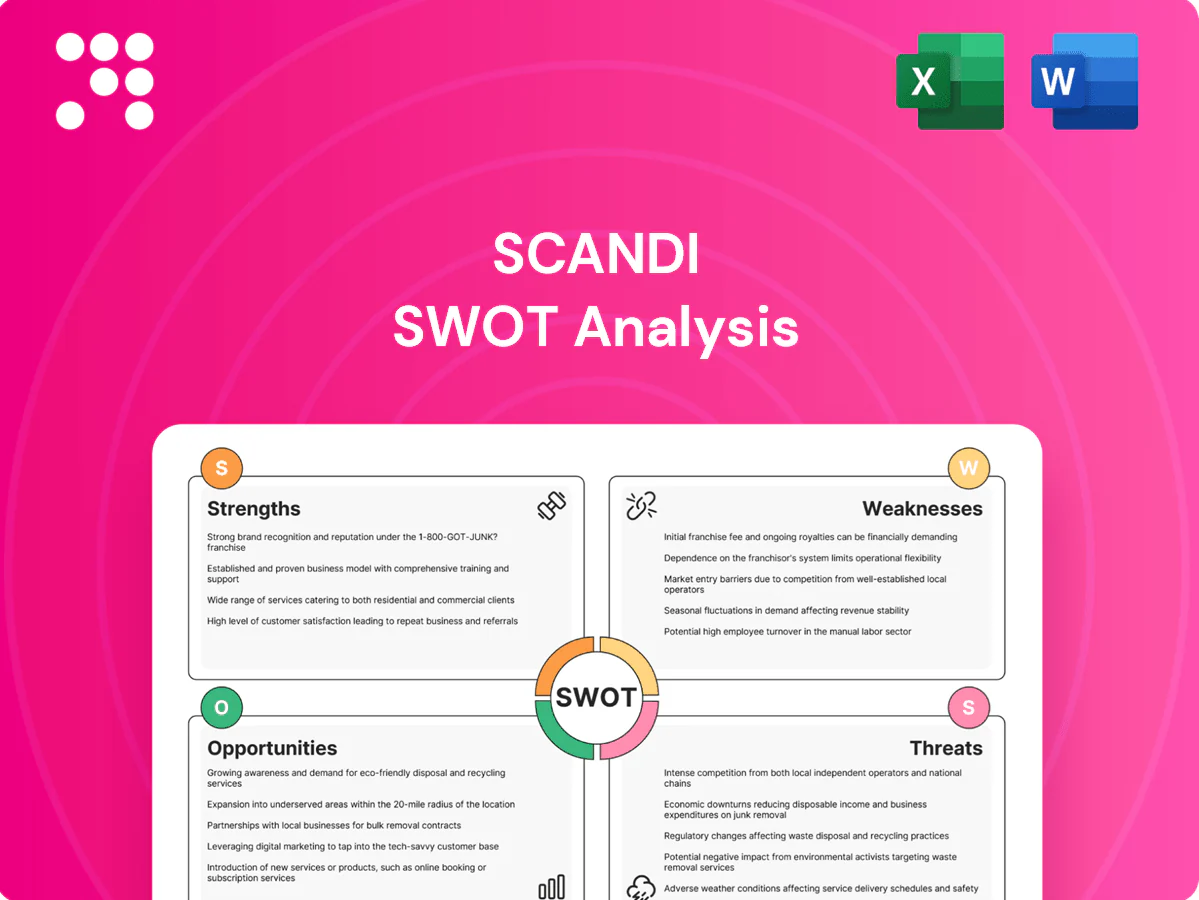
Scandi SWOT Analysis

Elevate Your Analysis with the Complete SWOT Report
The Scandi SWOT Analysis highlights regional strengths, competitive risks, and emerging green-tech opportunities across Nordic markets, plus concise financial context and strategic implications. Ready-to-use insights help investors and managers prioritize moves. Want the full picture? Purchase the complete SWOT for a Word report and editable Excel matrix to act with confidence.
Strengths

Integrated farm-to-fork control
Full vertical integration across breeding, slaughtering, processing and distribution gives Scandi consistent quality, traceability and cost control, supporting its operations across Sweden, Norway, Denmark and the UK as of 2024. This structure enables rapid response to safety or supply issues and faster targeted recalls. Integration strengthens biosecurity and animal welfare compliance through unified protocols. It underpins consistent brand standards across markets.
Leading Nordic and Irish market positions
Scandi commands strong shares in Sweden, Denmark, Norway and Ireland, reinforcing pricing power and prominent shelf presence across key channels. Its scale across countries with a combined population of about 27.1 million (Sweden 10.5m, Denmark 5.9m, Norway 5.5m, Ireland 5.2m) drives lower unit costs versus smaller rivals. Local market leadership strengthens retailer negotiations and builds resilience through diversified country demand.

Portfolio of trusted local brands
Well-known national brands drive higher loyalty and repeat purchases, with Nordic private-label penetration averaging ~20% in 2024, limiting substitution in sensitive categories. Strong brand equity lets Scandi span premium and value tiers, supporting margin mix optimization. Recognized labels also accelerate innovation rollouts in ready-to-cook and ready-to-eat, where Nordic category growth exceeded single-digit rates in 2024.

Multi-channel customer reach
Balanced exposure to retail, foodservice and industrial customers smooths volume swings and improved planning; the global foodservice market reached about $3.6 trillion in 2024, where higher-margin value-added formats boost profitability for partners. Industrial channels convert by-products into ingredients and bioenergy, lifting asset utilization and reducing waste.
- Retail—stable volumes
- Foodservice—higher margins, $3.6T market (2024)
- Industrial—by-product valorization
- Outcome—better utilization & planning
Operational scale and processing expertise
Large, modern plants across the Nordics and Ireland drive operational efficiency and high yields, while proprietary processing know-how ensures consistent product quality and traceability. Scale enables continuous improvement and targeted automation investments, reducing unit costs and supporting export readiness. Facilities adhere to EU food safety and SPS regulations, simplifying cross-border compliance and market access.
- Modern plants: improved yield and throughput
- Proprietary know-how: consistent quality
- Scale: funds automation and CI
- EU compliance: streamlined exports
Nordic vertical integration: traceable quality, lower costs and stronger retailer leverage
Scandi's vertical integration and modern plants ensure traceable quality, fast recalls and lower unit costs across Sweden, Norway, Denmark and Ireland (combined pop 27.1m, 2024). Strong national brands and ~20% Nordic private-label penetration protect pricing and enable premium/value mix. Scale and market leadership improve retailer leverage; diversified channels (retail, foodservice $3.6T, industrial) boost margins and utilization.
| Metric | 2024 | Note |
|---|---|---|
| Combined population | 27.1m | SE, DK, NO, IE |
| Private-label | ~20% | Nordic avg |
| Foodservice market | $3.6T | Global 2024 |
| Market footprint | 4 countries | Top regional shares |
What is included in the product
 Detailed Word Document
Provides a concise SWOT analysis of Scandi, outlining internal strengths and weaknesses alongside external opportunities and threats to assess its competitive position and strategic risks.

 Customizable Excel Spreadsheet
Provides a region-tailored SWOT matrix that clarifies Nordic market risks and opportunities, speeding strategy alignment and stakeholder buy-in.
Weaknesses

High feed and energy cost exposure
Scandi faces high exposure to volatile grain, soy and power markets that can compress margins; European TTF gas prices fell roughly 70% from 2022 peaks to 2024 but remain prone to spikes. Hedging programs only partially offset sudden input shocks, leaving residual cost risk. Retail price pass-through often lags, squeezing near-term margins. Energy-intensive chilling and processing amplify sensitivity to electricity and fuel swings.
Narrow protein concentration
Dependence on chicken concentrates Scandi’s revenue and volumes into a single protein category, leaving it more exposed to category shocks that can trigger disproportionate volume declines vs multi-protein peers; this focus limits cross-selling into pork/seafood channels and constrains portfolio rebalancing in downturns, reducing flexibility to offset shortfalls from price or demand swings.

Biosecurity and disease sensitivity
Avian influenza outbreaks (H5Nx) continued into 2024, causing thousands of wild and domestic bird outbreaks globally and forcing region-specific flock culls that trigger trade restrictions and sharp revenue hits for poultry exporters. Heightened biosecurity measures implemented across Scandinavia raised operating costs—farm-level spending reports showed double-digit increases in PPE, disinfection and testing budgets in recent seasons. Supply continuity suffers as outbreaks cause abrupt production shocks and planning uncertainty, while intense media coverage depresses consumer confidence and short-term demand.

Capital-intensive operations
Capital-intensive operations in processing plants, hatcheries and logistics demand sustained capex, squeezing cashflows in Scandi’s low-margin segments. Long payback horizons amplify exposure when margins compress, and downtime or underutilization rapidly erodes returns. Tightening financing cycles during macro stress can curtail refinancing options and raise cost of capital.
- Sustained capex needs
- Long payback in low margins
- Downtime reduces ROI
- Financing risk in downturns
Geographic concentration in Northern Europe
Revenue remains heavily concentrated in the Nordics and Ireland, limiting exposure to faster-growing markets and making top-line growth dependent on regional conditions. Demand shocks or regulatory changes in these jurisdictions produce outsized impacts on margins and operations. Currency volatility across SEK, DKK, NOK and EUR complicates hedging and reporting, while mature local markets constrain organic expansion.
- Regional revenue concentration
- High sensitivity to Nordic/Ireland shocks
- SEK/DKK/NOK/EUR FX risk
- Market saturation limits organic growth
Margins squeezed by volatile grain/energy; 70%+ Nordic revenue risk
High exposure to volatile grain, soy and power markets (TTF gas fell ~70% 2022–24) compresses margins; hedges only partly protect against spikes.
Revenue concentrated >70% in Nordics/Ireland limits growth and raises regional shock sensitivity; FX (SEK/DKK/NOK/EUR) adds volatility.
Avian influenza and sustained capex (processing/logistics) raise costs and shorten cashflow resilience.
| Metric | 2024 |
|---|---|
| TTF change | -70% |
| Regional rev share | >70% |
| Avian outbreaks | thousands (2024) |
Preview the Actual Deliverable
Scandi SWOT Analysis
This is the actual Scandi SWOT analysis document you’ll receive upon purchase—no surprises, just professional quality. The preview below is taken directly from the full report, showing the same structured strengths, weaknesses, opportunities, and threats you’ll get. Purchase unlocks the complete, editable version immediately after checkout.

Elevate Your Analysis with the Complete SWOT Report
The Scandi SWOT Analysis highlights regional strengths, competitive risks, and emerging green-tech opportunities across Nordic markets, plus concise financial context and strategic implications. Ready-to-use insights help investors and managers prioritize moves. Want the full picture? Purchase the complete SWOT for a Word report and editable Excel matrix to act with confidence.
Strengths
Integrated farm-to-fork control
Full vertical integration across breeding, slaughtering, processing and distribution gives Scandi consistent quality, traceability and cost control, supporting its operations across Sweden, Norway, Denmark and the UK as of 2024. This structure enables rapid response to safety or supply issues and faster targeted recalls. Integration strengthens biosecurity and animal welfare compliance through unified protocols. It underpins consistent brand standards across markets.
Leading Nordic and Irish market positions
Scandi commands strong shares in Sweden, Denmark, Norway and Ireland, reinforcing pricing power and prominent shelf presence across key channels. Its scale across countries with a combined population of about 27.1 million (Sweden 10.5m, Denmark 5.9m, Norway 5.5m, Ireland 5.2m) drives lower unit costs versus smaller rivals. Local market leadership strengthens retailer negotiations and builds resilience through diversified country demand.
Portfolio of trusted local brands
Well-known national brands drive higher loyalty and repeat purchases, with Nordic private-label penetration averaging ~20% in 2024, limiting substitution in sensitive categories. Strong brand equity lets Scandi span premium and value tiers, supporting margin mix optimization. Recognized labels also accelerate innovation rollouts in ready-to-cook and ready-to-eat, where Nordic category growth exceeded single-digit rates in 2024.
Multi-channel customer reach
Balanced exposure to retail, foodservice and industrial customers smooths volume swings and improved planning; the global foodservice market reached about $3.6 trillion in 2024, where higher-margin value-added formats boost profitability for partners. Industrial channels convert by-products into ingredients and bioenergy, lifting asset utilization and reducing waste.
- Retail—stable volumes
- Foodservice—higher margins, $3.6T market (2024)
- Industrial—by-product valorization
- Outcome—better utilization & planning
Operational scale and processing expertise
Large, modern plants across the Nordics and Ireland drive operational efficiency and high yields, while proprietary processing know-how ensures consistent product quality and traceability. Scale enables continuous improvement and targeted automation investments, reducing unit costs and supporting export readiness. Facilities adhere to EU food safety and SPS regulations, simplifying cross-border compliance and market access.
- Modern plants: improved yield and throughput
- Proprietary know-how: consistent quality
- Scale: funds automation and CI
- EU compliance: streamlined exports
Nordic vertical integration: traceable quality, lower costs and stronger retailer leverage
Scandi's vertical integration and modern plants ensure traceable quality, fast recalls and lower unit costs across Sweden, Norway, Denmark and Ireland (combined pop 27.1m, 2024). Strong national brands and ~20% Nordic private-label penetration protect pricing and enable premium/value mix. Scale and market leadership improve retailer leverage; diversified channels (retail, foodservice $3.6T, industrial) boost margins and utilization.
| Metric | 2024 | Note |
|---|---|---|
| Combined population | 27.1m | SE, DK, NO, IE |
| Private-label | ~20% | Nordic avg |
| Foodservice market | $3.6T | Global 2024 |
| Market footprint | 4 countries | Top regional shares |
What is included in the product
Detailed Word Document
Provides a concise SWOT analysis of Scandi, outlining internal strengths and weaknesses alongside external opportunities and threats to assess its competitive position and strategic risks.
Customizable Excel Spreadsheet
Provides a region-tailored SWOT matrix that clarifies Nordic market risks and opportunities, speeding strategy alignment and stakeholder buy-in.
Weaknesses
High feed and energy cost exposure
Scandi faces high exposure to volatile grain, soy and power markets that can compress margins; European TTF gas prices fell roughly 70% from 2022 peaks to 2024 but remain prone to spikes. Hedging programs only partially offset sudden input shocks, leaving residual cost risk. Retail price pass-through often lags, squeezing near-term margins. Energy-intensive chilling and processing amplify sensitivity to electricity and fuel swings.
Narrow protein concentration
Dependence on chicken concentrates Scandi’s revenue and volumes into a single protein category, leaving it more exposed to category shocks that can trigger disproportionate volume declines vs multi-protein peers; this focus limits cross-selling into pork/seafood channels and constrains portfolio rebalancing in downturns, reducing flexibility to offset shortfalls from price or demand swings.
Biosecurity and disease sensitivity
Avian influenza outbreaks (H5Nx) continued into 2024, causing thousands of wild and domestic bird outbreaks globally and forcing region-specific flock culls that trigger trade restrictions and sharp revenue hits for poultry exporters. Heightened biosecurity measures implemented across Scandinavia raised operating costs—farm-level spending reports showed double-digit increases in PPE, disinfection and testing budgets in recent seasons. Supply continuity suffers as outbreaks cause abrupt production shocks and planning uncertainty, while intense media coverage depresses consumer confidence and short-term demand.
Capital-intensive operations
Capital-intensive operations in processing plants, hatcheries and logistics demand sustained capex, squeezing cashflows in Scandi’s low-margin segments. Long payback horizons amplify exposure when margins compress, and downtime or underutilization rapidly erodes returns. Tightening financing cycles during macro stress can curtail refinancing options and raise cost of capital.
- Sustained capex needs
- Long payback in low margins
- Downtime reduces ROI
- Financing risk in downturns
Geographic concentration in Northern Europe
Revenue remains heavily concentrated in the Nordics and Ireland, limiting exposure to faster-growing markets and making top-line growth dependent on regional conditions. Demand shocks or regulatory changes in these jurisdictions produce outsized impacts on margins and operations. Currency volatility across SEK, DKK, NOK and EUR complicates hedging and reporting, while mature local markets constrain organic expansion.
- Regional revenue concentration
- High sensitivity to Nordic/Ireland shocks
- SEK/DKK/NOK/EUR FX risk
- Market saturation limits organic growth
Margins squeezed by volatile grain/energy; 70%+ Nordic revenue risk
High exposure to volatile grain, soy and power markets (TTF gas fell ~70% 2022–24) compresses margins; hedges only partly protect against spikes.
Revenue concentrated >70% in Nordics/Ireland limits growth and raises regional shock sensitivity; FX (SEK/DKK/NOK/EUR) adds volatility.
Avian influenza and sustained capex (processing/logistics) raise costs and shorten cashflow resilience.
| Metric | 2024 |
|---|---|
| TTF change | -70% |
| Regional rev share | >70% |
| Avian outbreaks | thousands (2024) |
Preview the Actual Deliverable
Scandi SWOT Analysis
This is the actual Scandi SWOT analysis document you’ll receive upon purchase—no surprises, just professional quality. The preview below is taken directly from the full report, showing the same structured strengths, weaknesses, opportunities, and threats you’ll get. Purchase unlocks the complete, editable version immediately after checkout.
Original: $10.00
-65%$10.00
$3.50Description
Elevate Your Analysis with the Complete SWOT Report
The Scandi SWOT Analysis highlights regional strengths, competitive risks, and emerging green-tech opportunities across Nordic markets, plus concise financial context and strategic implications. Ready-to-use insights help investors and managers prioritize moves. Want the full picture? Purchase the complete SWOT for a Word report and editable Excel matrix to act with confidence.
Strengths
Integrated farm-to-fork control
Full vertical integration across breeding, slaughtering, processing and distribution gives Scandi consistent quality, traceability and cost control, supporting its operations across Sweden, Norway, Denmark and the UK as of 2024. This structure enables rapid response to safety or supply issues and faster targeted recalls. Integration strengthens biosecurity and animal welfare compliance through unified protocols. It underpins consistent brand standards across markets.
Leading Nordic and Irish market positions
Scandi commands strong shares in Sweden, Denmark, Norway and Ireland, reinforcing pricing power and prominent shelf presence across key channels. Its scale across countries with a combined population of about 27.1 million (Sweden 10.5m, Denmark 5.9m, Norway 5.5m, Ireland 5.2m) drives lower unit costs versus smaller rivals. Local market leadership strengthens retailer negotiations and builds resilience through diversified country demand.
Portfolio of trusted local brands
Well-known national brands drive higher loyalty and repeat purchases, with Nordic private-label penetration averaging ~20% in 2024, limiting substitution in sensitive categories. Strong brand equity lets Scandi span premium and value tiers, supporting margin mix optimization. Recognized labels also accelerate innovation rollouts in ready-to-cook and ready-to-eat, where Nordic category growth exceeded single-digit rates in 2024.
Multi-channel customer reach
Balanced exposure to retail, foodservice and industrial customers smooths volume swings and improved planning; the global foodservice market reached about $3.6 trillion in 2024, where higher-margin value-added formats boost profitability for partners. Industrial channels convert by-products into ingredients and bioenergy, lifting asset utilization and reducing waste.
- Retail—stable volumes
- Foodservice—higher margins, $3.6T market (2024)
- Industrial—by-product valorization
- Outcome—better utilization & planning
Operational scale and processing expertise
Large, modern plants across the Nordics and Ireland drive operational efficiency and high yields, while proprietary processing know-how ensures consistent product quality and traceability. Scale enables continuous improvement and targeted automation investments, reducing unit costs and supporting export readiness. Facilities adhere to EU food safety and SPS regulations, simplifying cross-border compliance and market access.
- Modern plants: improved yield and throughput
- Proprietary know-how: consistent quality
- Scale: funds automation and CI
- EU compliance: streamlined exports
Nordic vertical integration: traceable quality, lower costs and stronger retailer leverage
Scandi's vertical integration and modern plants ensure traceable quality, fast recalls and lower unit costs across Sweden, Norway, Denmark and Ireland (combined pop 27.1m, 2024). Strong national brands and ~20% Nordic private-label penetration protect pricing and enable premium/value mix. Scale and market leadership improve retailer leverage; diversified channels (retail, foodservice $3.6T, industrial) boost margins and utilization.
| Metric | 2024 | Note |
|---|---|---|
| Combined population | 27.1m | SE, DK, NO, IE |
| Private-label | ~20% | Nordic avg |
| Foodservice market | $3.6T | Global 2024 |
| Market footprint | 4 countries | Top regional shares |
What is included in the product
Detailed Word Document
Provides a concise SWOT analysis of Scandi, outlining internal strengths and weaknesses alongside external opportunities and threats to assess its competitive position and strategic risks.
Customizable Excel Spreadsheet
Provides a region-tailored SWOT matrix that clarifies Nordic market risks and opportunities, speeding strategy alignment and stakeholder buy-in.
Weaknesses
High feed and energy cost exposure
Scandi faces high exposure to volatile grain, soy and power markets that can compress margins; European TTF gas prices fell roughly 70% from 2022 peaks to 2024 but remain prone to spikes. Hedging programs only partially offset sudden input shocks, leaving residual cost risk. Retail price pass-through often lags, squeezing near-term margins. Energy-intensive chilling and processing amplify sensitivity to electricity and fuel swings.
Narrow protein concentration
Dependence on chicken concentrates Scandi’s revenue and volumes into a single protein category, leaving it more exposed to category shocks that can trigger disproportionate volume declines vs multi-protein peers; this focus limits cross-selling into pork/seafood channels and constrains portfolio rebalancing in downturns, reducing flexibility to offset shortfalls from price or demand swings.
Biosecurity and disease sensitivity
Avian influenza outbreaks (H5Nx) continued into 2024, causing thousands of wild and domestic bird outbreaks globally and forcing region-specific flock culls that trigger trade restrictions and sharp revenue hits for poultry exporters. Heightened biosecurity measures implemented across Scandinavia raised operating costs—farm-level spending reports showed double-digit increases in PPE, disinfection and testing budgets in recent seasons. Supply continuity suffers as outbreaks cause abrupt production shocks and planning uncertainty, while intense media coverage depresses consumer confidence and short-term demand.
Capital-intensive operations
Capital-intensive operations in processing plants, hatcheries and logistics demand sustained capex, squeezing cashflows in Scandi’s low-margin segments. Long payback horizons amplify exposure when margins compress, and downtime or underutilization rapidly erodes returns. Tightening financing cycles during macro stress can curtail refinancing options and raise cost of capital.
- Sustained capex needs
- Long payback in low margins
- Downtime reduces ROI
- Financing risk in downturns
Geographic concentration in Northern Europe
Revenue remains heavily concentrated in the Nordics and Ireland, limiting exposure to faster-growing markets and making top-line growth dependent on regional conditions. Demand shocks or regulatory changes in these jurisdictions produce outsized impacts on margins and operations. Currency volatility across SEK, DKK, NOK and EUR complicates hedging and reporting, while mature local markets constrain organic expansion.
- Regional revenue concentration
- High sensitivity to Nordic/Ireland shocks
- SEK/DKK/NOK/EUR FX risk
- Market saturation limits organic growth
Margins squeezed by volatile grain/energy; 70%+ Nordic revenue risk
High exposure to volatile grain, soy and power markets (TTF gas fell ~70% 2022–24) compresses margins; hedges only partly protect against spikes.
Revenue concentrated >70% in Nordics/Ireland limits growth and raises regional shock sensitivity; FX (SEK/DKK/NOK/EUR) adds volatility.
Avian influenza and sustained capex (processing/logistics) raise costs and shorten cashflow resilience.
| Metric | 2024 |
|---|---|
| TTF change | -70% |
| Regional rev share | >70% |
| Avian outbreaks | thousands (2024) |
Preview the Actual Deliverable
Scandi SWOT Analysis
This is the actual Scandi SWOT analysis document you’ll receive upon purchase—no surprises, just professional quality. The preview below is taken directly from the full report, showing the same structured strengths, weaknesses, opportunities, and threats you’ll get. Purchase unlocks the complete, editable version immediately after checkout.











