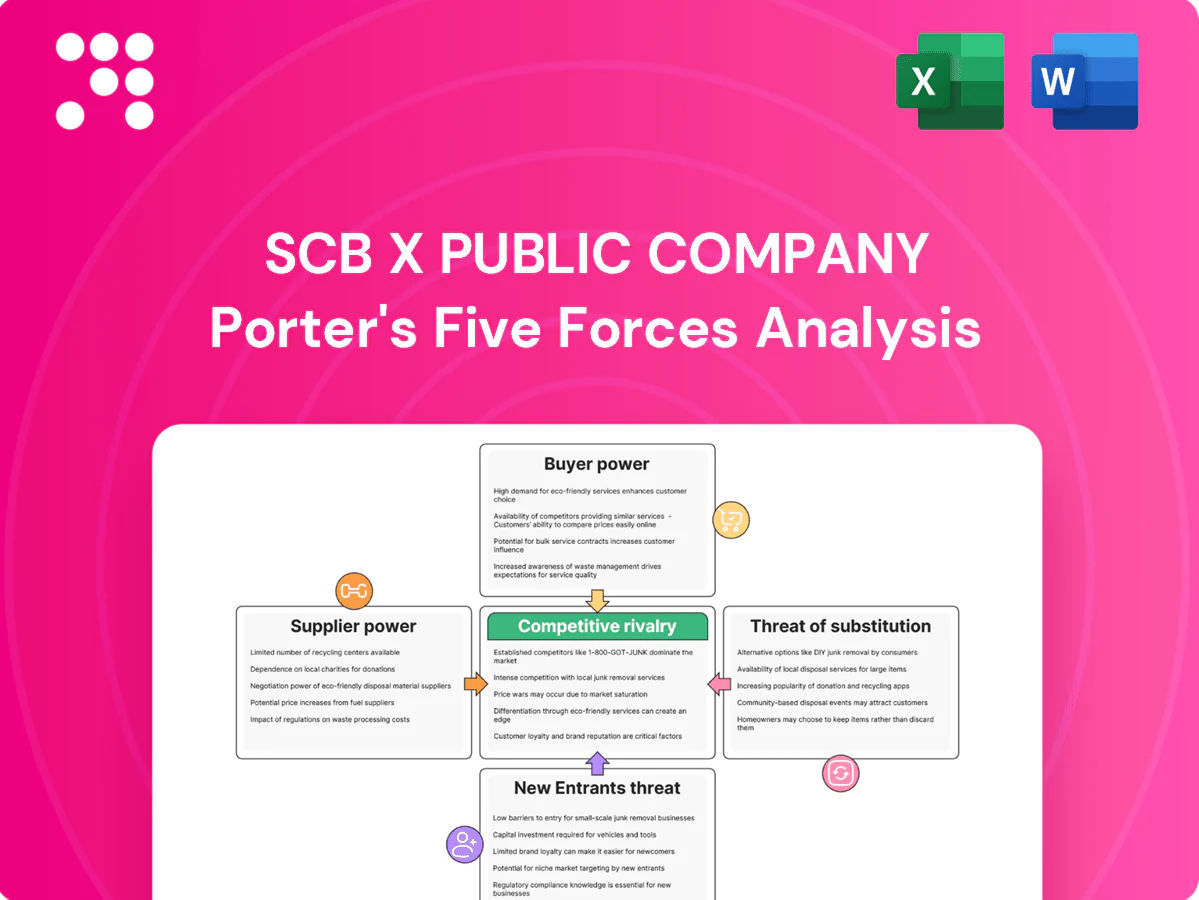
SCB X Public Company Porter's Five Forces Analysis

From Overview to Strategy Blueprint
SCB X Public Company faces intense competitive rivalry, evolving buyer preferences, and moderate supplier leverage while threats from fintech entrants and substitutes reshape margins. This snapshot highlights key pressure points but omits force-by-force ratings and scenario analysis. Unlock the full Porter's Five Forces report for visuals, data-driven implications, and actionable strategy recommendations to inform investment or strategic planning.
Suppliers Bargaining Power

Critical tech stack concentration
SCB X depends on cloud hyperscalers (AWS ~32%, Azure ~23%, GCP ~11% in 2024) and dominant payment rails (Visa+Mastercard ~80% of global card volumes), concentrating supplier power and raising switching costs. Vendor lock-in via APIs, data lakes and security tooling amplifies dependence; multi-year contracts often embed cost escalators. Co-development deals can rebalance leverage but require scale and credibility.
Data and analytics dependencies
Access to credit bureaus, alternative data, and AI models is pivotal for SCB X’s digital underwriting and personalization, with regulatory regimes like Thailand’s PDPA (effective 2022) and EU GDPR tightening 2024 data-sharing rules. Proprietary datasets give defensive advantage, yet third-party feeds and model marketplaces can impose unfavorable licensing and fee structures. Regulatory constraints reduce substitutability, so multi-source strategies are used to limit single-supplier dominance.

Talent as a strategic supplier
Senior engineers, data scientists, cybersecurity experts and product managers are scarce and mobile, raising bargaining power as compensation inflation and poaching from tech firms intensify; ISC2 cites a ~3.4 million global cybersecurity workforce gap. Internal academies and equity incentives with typical 3–4 year vesting help dampen turnover risk. Outsourcing and captive centers diversify supply but add coordination and compliance complexity.

Capital and liquidity providers
Depositors, wholesale funders and investors strongly affect SCB X funding costs and terms, particularly during tightening cycles; price-sensitive retail segments reprice quickly in rate competition. Diversified funding mix and investment-grade backing improve negotiating leverage, and regulatory liquidity buffers such as a 100% LCR mitigate supplier power and short-term funding stress.
- Depositors: fragmented, price-sensitive
- Wholesale: impacts cost in tightening
- Ratings/funding mix: strengthens position
- Liquidity buffer: 100% LCR reduces exposure
Regulatory and network infrastructure
- Non-negotiable access
- Fee/rule risk
- Trust and scale benefits
- Reduced flexibility
- Coalitions shape standards
Cloud & card-rail concentration (AWS 32%, Azure 23%; Visa+MC ~80%) heightens switching risk
SCB X faces concentrated supplier power from cloud hyperscalers (AWS 32%, Azure 23%, GCP 11% in 2024) and payment rails (Visa+Mastercard ~80% global volumes), raising switching costs and contract escalation risk. Data, AI models and credit bureaus are critical yet regulated (PDPA/GDPR 2024), limiting substitutability. Talent scarcity (cyber workforce gap ~3.4M) and mandatory rails (SEA real-time >60%) further strengthen suppliers.
| Supplier | 2024 metric |
|---|---|
| Cloud | AWS 32% / Azure 23% / GCP 11% |
| Card rails | Visa+MC ~80% |
| Cyber talent | Workforce gap ~3.4M |
| Liquidity | LCR 100% |
What is included in the product
 Detailed Word Document
Comprehensive Porter's Five Forces analysis tailored to SCB X Public Company, uncovering competitive drivers, buyer and supplier power, substitutes, and entry barriers; highlights disruptive threats and strategic opportunities for investor materials, strategy decks, or academic use.

 Customizable Excel Spreadsheet
A single-sheet Porter's Five Forces for SCB X—clear radar scoring and concise commentary to quickly identify strategic pressures and relief actions; ready to customize with your own data and drop straight into pitch decks or boardroom slides.
Customers Bargaining Power

High price transparency
High price transparency: digital channels make fees, rates and rewards easy to compare across banks and fintechs, and with over 80% of Thai adults using mobile banking by 2024 (Bank of Thailand), customers can rapidly shop offers. Low-friction switching for deposits, cards and unsecured loans compresses margins in commoditized products. Differentiation via UX, ecosystem perks and advice mitigates pure price sensitivity and preserves premium spreads.
Multi-banking behavior
Consumers and SMEs often maintain 2+ bank accounts and wallets, diluting loyalty and increasing bargaining power; portability of payment credentials and open APIs in 2024 make piecemeal switching easier. Cross-sell success hinges on seamless integration and clear value stacking across accounts. Loyalty programs and embedded finance (e.g., partnerships embedding credit/payments) raise effective switching costs.

Corporate client negotiating clout
Larger corporates and platforms demand bespoke pricing, SLAs, and API integration, with the top 20% of clients often accounting for roughly 80% of transaction volumes, giving them strong negotiating clout. Their scale can secure discounts of up to 25% in transaction banking and lending, while relationship breadth lets banks recoup margins via ancillary fees and cash management. Complex onboarding and compliance still tether clients, with KYC and integration cycles frequently taking 3–6 months.

Digital experience expectations
Customers now benchmark digital banking UX against big-tech: sub-second latency and 99.9% uptime expectations make outages and poor personalization immediate churn triggers, so continuous feature delivery and platform reliability are table stakes; proactive support and data-driven insights materially elevate perceived value.
Sensitivity to trust and security
Breach incidents or fraud spikes rapidly erode customer confidence, giving buyers stronger leverage to demand remediation, fee waivers, or exit options; strong security posture and transparent incident response materially reduce that bargaining pressure. Insurance, guarantees, and visible remediation metrics reassure users, while SCB X’s reputation capital and customer trust remain a key counterweight that preserves pricing power.
- Higher buyer leverage after breaches
- Security posture + transparent IR mitigates churn
- Insurance/guarantees boost user confidence
- Reputation capital sustains pricing power
80% mobile adoption and price transparency squeeze fees; top 20% hold 80% volume
High price transparency and 80% mobile banking adoption in 2024 (Bank of Thailand) raise customer leverage; low-friction switching and 2+ accounts per customer compress commodity margins. Large corporates concentrate volume (top 20% ≈ 80% of transactions) and can secure up to 25% fee discounts. UX, 99.9% uptime expectations and strong security reduce churn; KYC/integration cycles remain 3–6 months.
| Metric | Value (2024) |
|---|---|
| Mobile banking adoption | 80% (Bank of Thailand) |
| Avg accounts/customer | 2+ |
| Top client concentration | Top 20% ≈ 80% volume |
| Contract discounts | Up to 25% |
| KYC/integration | 3–6 months |
| Reliability expectation | 99.9% uptime |
Preview the Actual Deliverable
SCB X Public Company Porter's Five Forces Analysis
This preview shows the exact SCB X Public Company Porter's Five Forces analysis you'll receive immediately after purchase—no placeholders or mockups. The file is fully formatted, professionally written, and ready for download and use the moment you buy. What you see here is precisely the deliverable you'll get, with no additional setup required.

From Overview to Strategy Blueprint
SCB X Public Company faces intense competitive rivalry, evolving buyer preferences, and moderate supplier leverage while threats from fintech entrants and substitutes reshape margins. This snapshot highlights key pressure points but omits force-by-force ratings and scenario analysis. Unlock the full Porter's Five Forces report for visuals, data-driven implications, and actionable strategy recommendations to inform investment or strategic planning.
Suppliers Bargaining Power
Critical tech stack concentration
SCB X depends on cloud hyperscalers (AWS ~32%, Azure ~23%, GCP ~11% in 2024) and dominant payment rails (Visa+Mastercard ~80% of global card volumes), concentrating supplier power and raising switching costs. Vendor lock-in via APIs, data lakes and security tooling amplifies dependence; multi-year contracts often embed cost escalators. Co-development deals can rebalance leverage but require scale and credibility.
Data and analytics dependencies
Access to credit bureaus, alternative data, and AI models is pivotal for SCB X’s digital underwriting and personalization, with regulatory regimes like Thailand’s PDPA (effective 2022) and EU GDPR tightening 2024 data-sharing rules. Proprietary datasets give defensive advantage, yet third-party feeds and model marketplaces can impose unfavorable licensing and fee structures. Regulatory constraints reduce substitutability, so multi-source strategies are used to limit single-supplier dominance.
Talent as a strategic supplier
Senior engineers, data scientists, cybersecurity experts and product managers are scarce and mobile, raising bargaining power as compensation inflation and poaching from tech firms intensify; ISC2 cites a ~3.4 million global cybersecurity workforce gap. Internal academies and equity incentives with typical 3–4 year vesting help dampen turnover risk. Outsourcing and captive centers diversify supply but add coordination and compliance complexity.
Capital and liquidity providers
Depositors, wholesale funders and investors strongly affect SCB X funding costs and terms, particularly during tightening cycles; price-sensitive retail segments reprice quickly in rate competition. Diversified funding mix and investment-grade backing improve negotiating leverage, and regulatory liquidity buffers such as a 100% LCR mitigate supplier power and short-term funding stress.
- Depositors: fragmented, price-sensitive
- Wholesale: impacts cost in tightening
- Ratings/funding mix: strengthens position
- Liquidity buffer: 100% LCR reduces exposure
Regulatory and network infrastructure
- Non-negotiable access
- Fee/rule risk
- Trust and scale benefits
- Reduced flexibility
- Coalitions shape standards
Cloud & card-rail concentration (AWS 32%, Azure 23%; Visa+MC ~80%) heightens switching risk
SCB X faces concentrated supplier power from cloud hyperscalers (AWS 32%, Azure 23%, GCP 11% in 2024) and payment rails (Visa+Mastercard ~80% global volumes), raising switching costs and contract escalation risk. Data, AI models and credit bureaus are critical yet regulated (PDPA/GDPR 2024), limiting substitutability. Talent scarcity (cyber workforce gap ~3.4M) and mandatory rails (SEA real-time >60%) further strengthen suppliers.
| Supplier | 2024 metric |
|---|---|
| Cloud | AWS 32% / Azure 23% / GCP 11% |
| Card rails | Visa+MC ~80% |
| Cyber talent | Workforce gap ~3.4M |
| Liquidity | LCR 100% |
What is included in the product
Detailed Word Document
Comprehensive Porter's Five Forces analysis tailored to SCB X Public Company, uncovering competitive drivers, buyer and supplier power, substitutes, and entry barriers; highlights disruptive threats and strategic opportunities for investor materials, strategy decks, or academic use.
Customizable Excel Spreadsheet
A single-sheet Porter's Five Forces for SCB X—clear radar scoring and concise commentary to quickly identify strategic pressures and relief actions; ready to customize with your own data and drop straight into pitch decks or boardroom slides.
Customers Bargaining Power
High price transparency
High price transparency: digital channels make fees, rates and rewards easy to compare across banks and fintechs, and with over 80% of Thai adults using mobile banking by 2024 (Bank of Thailand), customers can rapidly shop offers. Low-friction switching for deposits, cards and unsecured loans compresses margins in commoditized products. Differentiation via UX, ecosystem perks and advice mitigates pure price sensitivity and preserves premium spreads.
Multi-banking behavior
Consumers and SMEs often maintain 2+ bank accounts and wallets, diluting loyalty and increasing bargaining power; portability of payment credentials and open APIs in 2024 make piecemeal switching easier. Cross-sell success hinges on seamless integration and clear value stacking across accounts. Loyalty programs and embedded finance (e.g., partnerships embedding credit/payments) raise effective switching costs.
Corporate client negotiating clout
Larger corporates and platforms demand bespoke pricing, SLAs, and API integration, with the top 20% of clients often accounting for roughly 80% of transaction volumes, giving them strong negotiating clout. Their scale can secure discounts of up to 25% in transaction banking and lending, while relationship breadth lets banks recoup margins via ancillary fees and cash management. Complex onboarding and compliance still tether clients, with KYC and integration cycles frequently taking 3–6 months.
Digital experience expectations
Customers now benchmark digital banking UX against big-tech: sub-second latency and 99.9% uptime expectations make outages and poor personalization immediate churn triggers, so continuous feature delivery and platform reliability are table stakes; proactive support and data-driven insights materially elevate perceived value.
Sensitivity to trust and security
Breach incidents or fraud spikes rapidly erode customer confidence, giving buyers stronger leverage to demand remediation, fee waivers, or exit options; strong security posture and transparent incident response materially reduce that bargaining pressure. Insurance, guarantees, and visible remediation metrics reassure users, while SCB X’s reputation capital and customer trust remain a key counterweight that preserves pricing power.
- Higher buyer leverage after breaches
- Security posture + transparent IR mitigates churn
- Insurance/guarantees boost user confidence
- Reputation capital sustains pricing power
80% mobile adoption and price transparency squeeze fees; top 20% hold 80% volume
High price transparency and 80% mobile banking adoption in 2024 (Bank of Thailand) raise customer leverage; low-friction switching and 2+ accounts per customer compress commodity margins. Large corporates concentrate volume (top 20% ≈ 80% of transactions) and can secure up to 25% fee discounts. UX, 99.9% uptime expectations and strong security reduce churn; KYC/integration cycles remain 3–6 months.
| Metric | Value (2024) |
|---|---|
| Mobile banking adoption | 80% (Bank of Thailand) |
| Avg accounts/customer | 2+ |
| Top client concentration | Top 20% ≈ 80% volume |
| Contract discounts | Up to 25% |
| KYC/integration | 3–6 months |
| Reliability expectation | 99.9% uptime |
Preview the Actual Deliverable
SCB X Public Company Porter's Five Forces Analysis
This preview shows the exact SCB X Public Company Porter's Five Forces analysis you'll receive immediately after purchase—no placeholders or mockups. The file is fully formatted, professionally written, and ready for download and use the moment you buy. What you see here is precisely the deliverable you'll get, with no additional setup required.
Original: $10.00
-65%$10.00
$3.50Description
From Overview to Strategy Blueprint
SCB X Public Company faces intense competitive rivalry, evolving buyer preferences, and moderate supplier leverage while threats from fintech entrants and substitutes reshape margins. This snapshot highlights key pressure points but omits force-by-force ratings and scenario analysis. Unlock the full Porter's Five Forces report for visuals, data-driven implications, and actionable strategy recommendations to inform investment or strategic planning.
Suppliers Bargaining Power
Critical tech stack concentration
SCB X depends on cloud hyperscalers (AWS ~32%, Azure ~23%, GCP ~11% in 2024) and dominant payment rails (Visa+Mastercard ~80% of global card volumes), concentrating supplier power and raising switching costs. Vendor lock-in via APIs, data lakes and security tooling amplifies dependence; multi-year contracts often embed cost escalators. Co-development deals can rebalance leverage but require scale and credibility.
Data and analytics dependencies
Access to credit bureaus, alternative data, and AI models is pivotal for SCB X’s digital underwriting and personalization, with regulatory regimes like Thailand’s PDPA (effective 2022) and EU GDPR tightening 2024 data-sharing rules. Proprietary datasets give defensive advantage, yet third-party feeds and model marketplaces can impose unfavorable licensing and fee structures. Regulatory constraints reduce substitutability, so multi-source strategies are used to limit single-supplier dominance.
Talent as a strategic supplier
Senior engineers, data scientists, cybersecurity experts and product managers are scarce and mobile, raising bargaining power as compensation inflation and poaching from tech firms intensify; ISC2 cites a ~3.4 million global cybersecurity workforce gap. Internal academies and equity incentives with typical 3–4 year vesting help dampen turnover risk. Outsourcing and captive centers diversify supply but add coordination and compliance complexity.
Capital and liquidity providers
Depositors, wholesale funders and investors strongly affect SCB X funding costs and terms, particularly during tightening cycles; price-sensitive retail segments reprice quickly in rate competition. Diversified funding mix and investment-grade backing improve negotiating leverage, and regulatory liquidity buffers such as a 100% LCR mitigate supplier power and short-term funding stress.
- Depositors: fragmented, price-sensitive
- Wholesale: impacts cost in tightening
- Ratings/funding mix: strengthens position
- Liquidity buffer: 100% LCR reduces exposure
Regulatory and network infrastructure
- Non-negotiable access
- Fee/rule risk
- Trust and scale benefits
- Reduced flexibility
- Coalitions shape standards
Cloud & card-rail concentration (AWS 32%, Azure 23%; Visa+MC ~80%) heightens switching risk
SCB X faces concentrated supplier power from cloud hyperscalers (AWS 32%, Azure 23%, GCP 11% in 2024) and payment rails (Visa+Mastercard ~80% global volumes), raising switching costs and contract escalation risk. Data, AI models and credit bureaus are critical yet regulated (PDPA/GDPR 2024), limiting substitutability. Talent scarcity (cyber workforce gap ~3.4M) and mandatory rails (SEA real-time >60%) further strengthen suppliers.
| Supplier | 2024 metric |
|---|---|
| Cloud | AWS 32% / Azure 23% / GCP 11% |
| Card rails | Visa+MC ~80% |
| Cyber talent | Workforce gap ~3.4M |
| Liquidity | LCR 100% |
What is included in the product
Detailed Word Document
Comprehensive Porter's Five Forces analysis tailored to SCB X Public Company, uncovering competitive drivers, buyer and supplier power, substitutes, and entry barriers; highlights disruptive threats and strategic opportunities for investor materials, strategy decks, or academic use.
Customizable Excel Spreadsheet
A single-sheet Porter's Five Forces for SCB X—clear radar scoring and concise commentary to quickly identify strategic pressures and relief actions; ready to customize with your own data and drop straight into pitch decks or boardroom slides.
Customers Bargaining Power
High price transparency
High price transparency: digital channels make fees, rates and rewards easy to compare across banks and fintechs, and with over 80% of Thai adults using mobile banking by 2024 (Bank of Thailand), customers can rapidly shop offers. Low-friction switching for deposits, cards and unsecured loans compresses margins in commoditized products. Differentiation via UX, ecosystem perks and advice mitigates pure price sensitivity and preserves premium spreads.
Multi-banking behavior
Consumers and SMEs often maintain 2+ bank accounts and wallets, diluting loyalty and increasing bargaining power; portability of payment credentials and open APIs in 2024 make piecemeal switching easier. Cross-sell success hinges on seamless integration and clear value stacking across accounts. Loyalty programs and embedded finance (e.g., partnerships embedding credit/payments) raise effective switching costs.
Corporate client negotiating clout
Larger corporates and platforms demand bespoke pricing, SLAs, and API integration, with the top 20% of clients often accounting for roughly 80% of transaction volumes, giving them strong negotiating clout. Their scale can secure discounts of up to 25% in transaction banking and lending, while relationship breadth lets banks recoup margins via ancillary fees and cash management. Complex onboarding and compliance still tether clients, with KYC and integration cycles frequently taking 3–6 months.
Digital experience expectations
Customers now benchmark digital banking UX against big-tech: sub-second latency and 99.9% uptime expectations make outages and poor personalization immediate churn triggers, so continuous feature delivery and platform reliability are table stakes; proactive support and data-driven insights materially elevate perceived value.
Sensitivity to trust and security
Breach incidents or fraud spikes rapidly erode customer confidence, giving buyers stronger leverage to demand remediation, fee waivers, or exit options; strong security posture and transparent incident response materially reduce that bargaining pressure. Insurance, guarantees, and visible remediation metrics reassure users, while SCB X’s reputation capital and customer trust remain a key counterweight that preserves pricing power.
- Higher buyer leverage after breaches
- Security posture + transparent IR mitigates churn
- Insurance/guarantees boost user confidence
- Reputation capital sustains pricing power
80% mobile adoption and price transparency squeeze fees; top 20% hold 80% volume
High price transparency and 80% mobile banking adoption in 2024 (Bank of Thailand) raise customer leverage; low-friction switching and 2+ accounts per customer compress commodity margins. Large corporates concentrate volume (top 20% ≈ 80% of transactions) and can secure up to 25% fee discounts. UX, 99.9% uptime expectations and strong security reduce churn; KYC/integration cycles remain 3–6 months.
| Metric | Value (2024) |
|---|---|
| Mobile banking adoption | 80% (Bank of Thailand) |
| Avg accounts/customer | 2+ |
| Top client concentration | Top 20% ≈ 80% volume |
| Contract discounts | Up to 25% |
| KYC/integration | 3–6 months |
| Reliability expectation | 99.9% uptime |
Preview the Actual Deliverable
SCB X Public Company Porter's Five Forces Analysis
This preview shows the exact SCB X Public Company Porter's Five Forces analysis you'll receive immediately after purchase—no placeholders or mockups. The file is fully formatted, professionally written, and ready for download and use the moment you buy. What you see here is precisely the deliverable you'll get, with no additional setup required.











