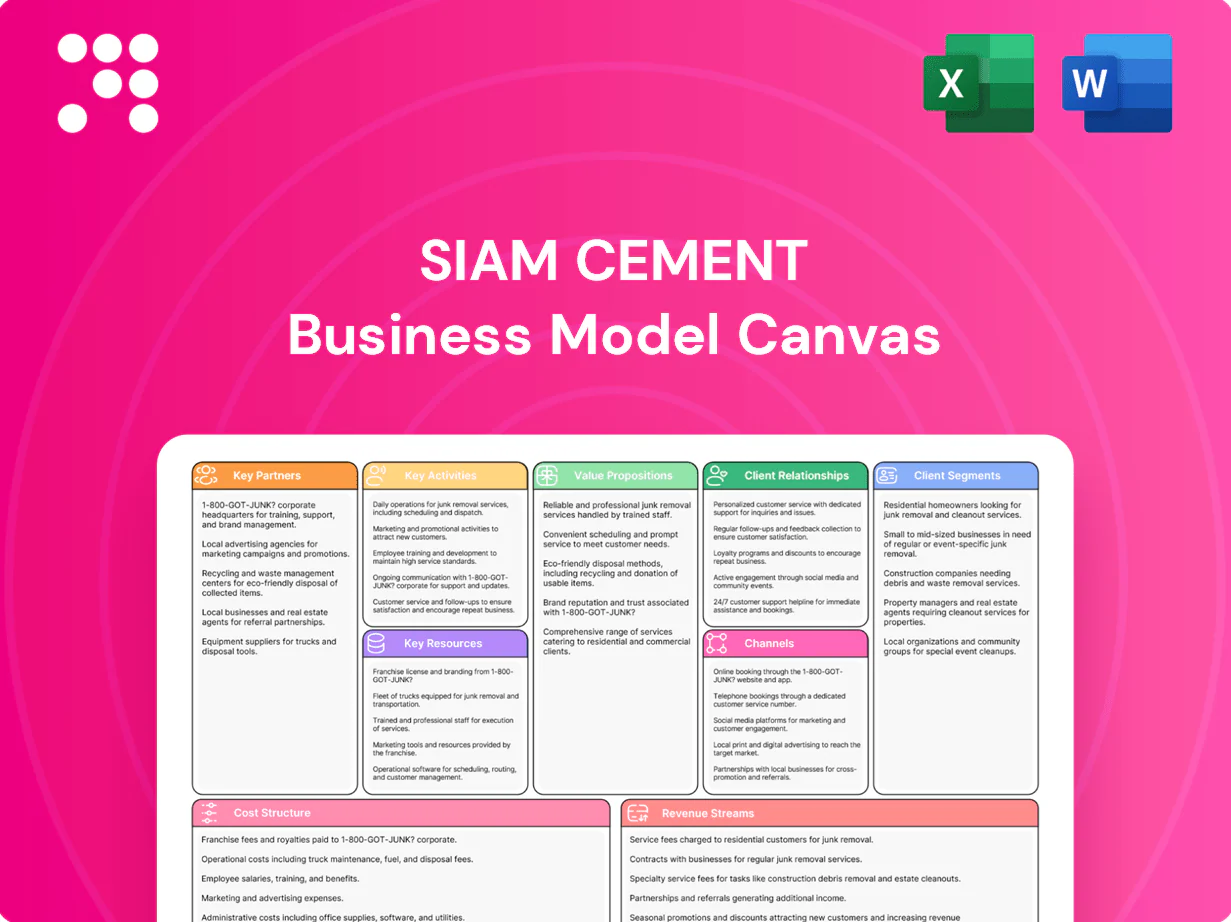
Siam Cement Business Model Canvas

Unlock the strategic Business Model Canvas for a leading industrial materials conglomerate
Unlock the full strategic blueprint behind Siam Cement with our concise Business Model Canvas—three to five sentences won't do it justice. This downloadable file breaks down nine building blocks, revealing value creation, revenue levers, and scalable advantages. Ideal for investors, consultants, and entrepreneurs seeking actionable, ready-to-use insights—purchase the full canvas to dive deep.
Partnerships

Raw material and energy suppliers
SCG secures over 70% of limestone, clinker and petrochemical feedstock through long-term contracts to stabilize costs and quality, underpinning 2024 operations.
Strategic energy partners deliver electricity, natural gas and alternative fuels (biomass/RDF supplies ~1.2 million tonnes/year in 2024) to cut volatility.
These partnerships enable hedging, ensure continuity during market swings and support SCG’s sustainability targets via expanded biomass and RDF sourcing.
Distributors, dealers, and modern trade networks
Regional dealer networks and wholesalers extend SCG’s reach into fragmented construction and retail markets, supporting operations across 15 ASEAN countries and thousands of retail touchpoints. Preferred distributors receive training, co-marketing, and inventory support to maintain service levels and reduce stockouts. Modern trade partners standardize merchandising for packaged products, accelerating penetration into secondary cities across ASEAN.

Construction firms, developers, and EPC contractors
Partnerships with top contractors and developers secure steady demand for SCG cement, ready-mix and building solutions, supporting SCG’s 2024 construction-materials growth. Early engagement during design phases allows specification of SCG materials, reducing rework and change orders. Joint planning cuts site risks and delivery delays, while framework agreements improve forecasting and logistics efficiency.

R&D institutions and technology providers
SCG partners with universities and tech firms to co-develop low-carbon cements, advanced polymers and smart packaging, accelerating commercialization through licensing and joint labs while sharing technical and financial risk. Digital partners supply predictive maintenance and data platforms that—industry-wide—can cut downtime by up to 30%. These alliances support SCG’s net-zero-by-2050 transition and keep it at the innovation front in a sector responsible for ~7% of global CO2.
- Co-development: universities + tech firms
- Commercialization: licensing & joint labs
- Digital: predictive maintenance, data platforms
- Sustainability: net-zero by 2050; cement ~7% global CO2
Logistics, recycling, and circular-economy partners
Logistics partners—transport firms, ports and 3PLs—streamline inbound secondary feedstocks and outbound cement and packaging deliveries, while waste collectors and recyclers supply OCC, plastics and alternative fuels for circular packaging and kiln fuel, cutting raw-material spend and landfill waste. Municipal alliances enable take-back programs and meet EPR mandates, jointly reducing emissions and operational costs.
- Inbound/outbound optimization
- OCC/plastics/AFR supply
- Municipal EPR/take-back
- Lower emissions & input costs
>70% feedstock, ~1.2M t/y biomass, 15-market ASEAN reach
SCG secures >70% limestone/clinker/feedstock via long-term contracts to stabilize costs in 2024.
Energy partners deliver electricity, gas and ~1.2M t/y biomass/RDF (2024), supporting net-zero-by-2050 targets.
Dealer, contractor and logistics alliances extend reach across 15 ASEAN markets and enable predictive maintenance reducing downtime up to 30%.
| Partnership | 2024 metric | Impact |
|---|---|---|
| Feedstock | >70% secured | Cost/quality stability |
| Energy | ~1.2M t RDF/biomass | Lower emissions |
| Market | 15 ASEAN | Distribution reach |
What is included in the product
 Detailed Word Document
A comprehensive Business Model Canvas for Siam Cement (SCG) outlining customer segments, channels, value propositions, key resources, partners, activities, cost structure and revenue streams, reflecting real-world industrial operations and strategic plans. Ideal for presentations, investor discussions and SWOT-linked analysis to support decision-making and validation.

 Customizable Excel Spreadsheet
High-level, editable Business Model Canvas for Siam Cement that condenses complex industrial strategy into a one-page snapshot, saving hours on formatting and enabling fast, shareable alignment across teams and boardrooms.
Activities

Integrated manufacturing and process optimization
SCG runs integrated cement kilns, petrochemical crackers and packaging plants with combined manufacturing capacity of about 26 million tonnes per year; continuous improvement and lean programs cut yield losses and improved energy intensity. Predictive maintenance reduced unplanned downtime and extended asset life across plants. Integrated planning balances product mix between cement, chemicals and packaging to optimize margins.
Product development and sustainability innovation
R&D prioritizes low-clinker cement (cutting CO2 up to 40%), recyclable/biodegradable packaging and high-performance polymers to boost circularity and durability. Life cycle assessments drive design decisions, routinely identifying 20–40% lifecycle emission or waste reductions versus conventional products. Pilot lines (6–12 month trials) validate scalable solutions before rollout. Certifications such as LEED, BREEAM and Thai sustainability labels underpin green building and eco-label claims.

Supply chain and logistics orchestration
Network planning aligns SCG quarries, terminals and distribution hubs to demand centers, shortening lead times and lowering haul distances; multimodal transport cuts cost-to-serve by up to 30% and emissions by up to 40%. Inventory visibility and S&OP lift service levels and reduce stockouts significantly, while vendor-managed inventory for large projects lowers customer working capital needs by around 15%.

Market development, sales, and key account management
Segmented sales teams target contractors, industrial clients, and brand owners, aligning account managers with project pipelines and procurement cycles; SCG sustained this structure through 2024 to protect large public and private contracts.
Solution selling bundles materials, technical services, and financing, shortening adoption lead times and raising average contract value in long-cycle projects during 2024.
Long-cycle bidding and framework agreements secure volumes while marketing builds brand preference across retail and professional channels; initiatives in 2024 emphasized trade programs and digital engagement.
- Segmented teams: contractors / industrial / brand owners
- Solution selling: materials + tech services + financing
- Contracts: long-cycle bids & framework agreements
- Marketing: retail + professional brand preference (2024)
Circular economy and waste valorization operations
SCG sources post-consumer and industrial waste for packaging and kiln co-processing, using sorting, cleaning and compounding to produce high-quality recycled inputs; in 2024 the group expanded municipality and client programs to close material loops, lowering environmental impact and reducing input dependency.
- post-consumer + industrial feedstock sourcing
- sorting, cleaning, compounding for recycled quality
- municipality & client circular programs (2024 expansion)
- reduced environmental footprint & input reliance
Integrated plants, predictive maintenance, low-clinker CO2 cut up to 40%
SCG operates integrated cement, petrochemical and packaging plants (≈26 Mtpa total) with lean and predictive maintenance programs that cut downtime and energy intensity.
R&D focuses on low-clinker cement (up to 40% CO2 reduction), recyclable packaging and LCA-driven designs validated via 6–12 month pilots.
Network, S&OP and VMI shorten lead times, cut cost-to-serve up to 30% and reduce customer working capital ~15% (2024).
| Metric | 2024 |
|---|---|
| Capacity | ≈26 Mtpa |
| CO2 cut (low-clinker) | up to 40% |
| Cost-to-serve ↓ | up to 30% |
| Customer WC ↓ | ~15% |
Full Document Unlocks After Purchase
Business Model Canvas
The Siam Cement Business Model Canvas shown here is the actual deliverable, not a mockup, and reflects the same content and layout you’ll receive after purchase. When you complete your order, you’ll get this exact document ready to edit and present in Word and Excel formats. No hidden pages or placeholders—what you see is what you’ll own.

Unlock the strategic Business Model Canvas for a leading industrial materials conglomerate
Unlock the full strategic blueprint behind Siam Cement with our concise Business Model Canvas—three to five sentences won't do it justice. This downloadable file breaks down nine building blocks, revealing value creation, revenue levers, and scalable advantages. Ideal for investors, consultants, and entrepreneurs seeking actionable, ready-to-use insights—purchase the full canvas to dive deep.
Partnerships
Raw material and energy suppliers
SCG secures over 70% of limestone, clinker and petrochemical feedstock through long-term contracts to stabilize costs and quality, underpinning 2024 operations.
Strategic energy partners deliver electricity, natural gas and alternative fuels (biomass/RDF supplies ~1.2 million tonnes/year in 2024) to cut volatility.
These partnerships enable hedging, ensure continuity during market swings and support SCG’s sustainability targets via expanded biomass and RDF sourcing.
Distributors, dealers, and modern trade networks
Regional dealer networks and wholesalers extend SCG’s reach into fragmented construction and retail markets, supporting operations across 15 ASEAN countries and thousands of retail touchpoints. Preferred distributors receive training, co-marketing, and inventory support to maintain service levels and reduce stockouts. Modern trade partners standardize merchandising for packaged products, accelerating penetration into secondary cities across ASEAN.
Construction firms, developers, and EPC contractors
Partnerships with top contractors and developers secure steady demand for SCG cement, ready-mix and building solutions, supporting SCG’s 2024 construction-materials growth. Early engagement during design phases allows specification of SCG materials, reducing rework and change orders. Joint planning cuts site risks and delivery delays, while framework agreements improve forecasting and logistics efficiency.
R&D institutions and technology providers
SCG partners with universities and tech firms to co-develop low-carbon cements, advanced polymers and smart packaging, accelerating commercialization through licensing and joint labs while sharing technical and financial risk. Digital partners supply predictive maintenance and data platforms that—industry-wide—can cut downtime by up to 30%. These alliances support SCG’s net-zero-by-2050 transition and keep it at the innovation front in a sector responsible for ~7% of global CO2.
- Co-development: universities + tech firms
- Commercialization: licensing & joint labs
- Digital: predictive maintenance, data platforms
- Sustainability: net-zero by 2050; cement ~7% global CO2
Logistics, recycling, and circular-economy partners
Logistics partners—transport firms, ports and 3PLs—streamline inbound secondary feedstocks and outbound cement and packaging deliveries, while waste collectors and recyclers supply OCC, plastics and alternative fuels for circular packaging and kiln fuel, cutting raw-material spend and landfill waste. Municipal alliances enable take-back programs and meet EPR mandates, jointly reducing emissions and operational costs.
- Inbound/outbound optimization
- OCC/plastics/AFR supply
- Municipal EPR/take-back
- Lower emissions & input costs
>70% feedstock, ~1.2M t/y biomass, 15-market ASEAN reach
SCG secures >70% limestone/clinker/feedstock via long-term contracts to stabilize costs in 2024.
Energy partners deliver electricity, gas and ~1.2M t/y biomass/RDF (2024), supporting net-zero-by-2050 targets.
Dealer, contractor and logistics alliances extend reach across 15 ASEAN markets and enable predictive maintenance reducing downtime up to 30%.
| Partnership | 2024 metric | Impact |
|---|---|---|
| Feedstock | >70% secured | Cost/quality stability |
| Energy | ~1.2M t RDF/biomass | Lower emissions |
| Market | 15 ASEAN | Distribution reach |
What is included in the product
Detailed Word Document
A comprehensive Business Model Canvas for Siam Cement (SCG) outlining customer segments, channels, value propositions, key resources, partners, activities, cost structure and revenue streams, reflecting real-world industrial operations and strategic plans. Ideal for presentations, investor discussions and SWOT-linked analysis to support decision-making and validation.
Customizable Excel Spreadsheet
High-level, editable Business Model Canvas for Siam Cement that condenses complex industrial strategy into a one-page snapshot, saving hours on formatting and enabling fast, shareable alignment across teams and boardrooms.
Activities
Integrated manufacturing and process optimization
SCG runs integrated cement kilns, petrochemical crackers and packaging plants with combined manufacturing capacity of about 26 million tonnes per year; continuous improvement and lean programs cut yield losses and improved energy intensity. Predictive maintenance reduced unplanned downtime and extended asset life across plants. Integrated planning balances product mix between cement, chemicals and packaging to optimize margins.
Product development and sustainability innovation
R&D prioritizes low-clinker cement (cutting CO2 up to 40%), recyclable/biodegradable packaging and high-performance polymers to boost circularity and durability. Life cycle assessments drive design decisions, routinely identifying 20–40% lifecycle emission or waste reductions versus conventional products. Pilot lines (6–12 month trials) validate scalable solutions before rollout. Certifications such as LEED, BREEAM and Thai sustainability labels underpin green building and eco-label claims.
Supply chain and logistics orchestration
Network planning aligns SCG quarries, terminals and distribution hubs to demand centers, shortening lead times and lowering haul distances; multimodal transport cuts cost-to-serve by up to 30% and emissions by up to 40%. Inventory visibility and S&OP lift service levels and reduce stockouts significantly, while vendor-managed inventory for large projects lowers customer working capital needs by around 15%.
Market development, sales, and key account management
Segmented sales teams target contractors, industrial clients, and brand owners, aligning account managers with project pipelines and procurement cycles; SCG sustained this structure through 2024 to protect large public and private contracts.
Solution selling bundles materials, technical services, and financing, shortening adoption lead times and raising average contract value in long-cycle projects during 2024.
Long-cycle bidding and framework agreements secure volumes while marketing builds brand preference across retail and professional channels; initiatives in 2024 emphasized trade programs and digital engagement.
- Segmented teams: contractors / industrial / brand owners
- Solution selling: materials + tech services + financing
- Contracts: long-cycle bids & framework agreements
- Marketing: retail + professional brand preference (2024)
Circular economy and waste valorization operations
SCG sources post-consumer and industrial waste for packaging and kiln co-processing, using sorting, cleaning and compounding to produce high-quality recycled inputs; in 2024 the group expanded municipality and client programs to close material loops, lowering environmental impact and reducing input dependency.
- post-consumer + industrial feedstock sourcing
- sorting, cleaning, compounding for recycled quality
- municipality & client circular programs (2024 expansion)
- reduced environmental footprint & input reliance
Integrated plants, predictive maintenance, low-clinker CO2 cut up to 40%
SCG operates integrated cement, petrochemical and packaging plants (≈26 Mtpa total) with lean and predictive maintenance programs that cut downtime and energy intensity.
R&D focuses on low-clinker cement (up to 40% CO2 reduction), recyclable packaging and LCA-driven designs validated via 6–12 month pilots.
Network, S&OP and VMI shorten lead times, cut cost-to-serve up to 30% and reduce customer working capital ~15% (2024).
| Metric | 2024 |
|---|---|
| Capacity | ≈26 Mtpa |
| CO2 cut (low-clinker) | up to 40% |
| Cost-to-serve ↓ | up to 30% |
| Customer WC ↓ | ~15% |
Full Document Unlocks After Purchase
Business Model Canvas
The Siam Cement Business Model Canvas shown here is the actual deliverable, not a mockup, and reflects the same content and layout you’ll receive after purchase. When you complete your order, you’ll get this exact document ready to edit and present in Word and Excel formats. No hidden pages or placeholders—what you see is what you’ll own.
Description
Unlock the strategic Business Model Canvas for a leading industrial materials conglomerate
Unlock the full strategic blueprint behind Siam Cement with our concise Business Model Canvas—three to five sentences won't do it justice. This downloadable file breaks down nine building blocks, revealing value creation, revenue levers, and scalable advantages. Ideal for investors, consultants, and entrepreneurs seeking actionable, ready-to-use insights—purchase the full canvas to dive deep.
Partnerships
Raw material and energy suppliers
SCG secures over 70% of limestone, clinker and petrochemical feedstock through long-term contracts to stabilize costs and quality, underpinning 2024 operations.
Strategic energy partners deliver electricity, natural gas and alternative fuels (biomass/RDF supplies ~1.2 million tonnes/year in 2024) to cut volatility.
These partnerships enable hedging, ensure continuity during market swings and support SCG’s sustainability targets via expanded biomass and RDF sourcing.
Distributors, dealers, and modern trade networks
Regional dealer networks and wholesalers extend SCG’s reach into fragmented construction and retail markets, supporting operations across 15 ASEAN countries and thousands of retail touchpoints. Preferred distributors receive training, co-marketing, and inventory support to maintain service levels and reduce stockouts. Modern trade partners standardize merchandising for packaged products, accelerating penetration into secondary cities across ASEAN.
Construction firms, developers, and EPC contractors
Partnerships with top contractors and developers secure steady demand for SCG cement, ready-mix and building solutions, supporting SCG’s 2024 construction-materials growth. Early engagement during design phases allows specification of SCG materials, reducing rework and change orders. Joint planning cuts site risks and delivery delays, while framework agreements improve forecasting and logistics efficiency.
R&D institutions and technology providers
SCG partners with universities and tech firms to co-develop low-carbon cements, advanced polymers and smart packaging, accelerating commercialization through licensing and joint labs while sharing technical and financial risk. Digital partners supply predictive maintenance and data platforms that—industry-wide—can cut downtime by up to 30%. These alliances support SCG’s net-zero-by-2050 transition and keep it at the innovation front in a sector responsible for ~7% of global CO2.
- Co-development: universities + tech firms
- Commercialization: licensing & joint labs
- Digital: predictive maintenance, data platforms
- Sustainability: net-zero by 2050; cement ~7% global CO2
Logistics, recycling, and circular-economy partners
Logistics partners—transport firms, ports and 3PLs—streamline inbound secondary feedstocks and outbound cement and packaging deliveries, while waste collectors and recyclers supply OCC, plastics and alternative fuels for circular packaging and kiln fuel, cutting raw-material spend and landfill waste. Municipal alliances enable take-back programs and meet EPR mandates, jointly reducing emissions and operational costs.
- Inbound/outbound optimization
- OCC/plastics/AFR supply
- Municipal EPR/take-back
- Lower emissions & input costs
>70% feedstock, ~1.2M t/y biomass, 15-market ASEAN reach
SCG secures >70% limestone/clinker/feedstock via long-term contracts to stabilize costs in 2024.
Energy partners deliver electricity, gas and ~1.2M t/y biomass/RDF (2024), supporting net-zero-by-2050 targets.
Dealer, contractor and logistics alliances extend reach across 15 ASEAN markets and enable predictive maintenance reducing downtime up to 30%.
| Partnership | 2024 metric | Impact |
|---|---|---|
| Feedstock | >70% secured | Cost/quality stability |
| Energy | ~1.2M t RDF/biomass | Lower emissions |
| Market | 15 ASEAN | Distribution reach |
What is included in the product
Detailed Word Document
A comprehensive Business Model Canvas for Siam Cement (SCG) outlining customer segments, channels, value propositions, key resources, partners, activities, cost structure and revenue streams, reflecting real-world industrial operations and strategic plans. Ideal for presentations, investor discussions and SWOT-linked analysis to support decision-making and validation.
Customizable Excel Spreadsheet
High-level, editable Business Model Canvas for Siam Cement that condenses complex industrial strategy into a one-page snapshot, saving hours on formatting and enabling fast, shareable alignment across teams and boardrooms.
Activities
Integrated manufacturing and process optimization
SCG runs integrated cement kilns, petrochemical crackers and packaging plants with combined manufacturing capacity of about 26 million tonnes per year; continuous improvement and lean programs cut yield losses and improved energy intensity. Predictive maintenance reduced unplanned downtime and extended asset life across plants. Integrated planning balances product mix between cement, chemicals and packaging to optimize margins.
Product development and sustainability innovation
R&D prioritizes low-clinker cement (cutting CO2 up to 40%), recyclable/biodegradable packaging and high-performance polymers to boost circularity and durability. Life cycle assessments drive design decisions, routinely identifying 20–40% lifecycle emission or waste reductions versus conventional products. Pilot lines (6–12 month trials) validate scalable solutions before rollout. Certifications such as LEED, BREEAM and Thai sustainability labels underpin green building and eco-label claims.
Supply chain and logistics orchestration
Network planning aligns SCG quarries, terminals and distribution hubs to demand centers, shortening lead times and lowering haul distances; multimodal transport cuts cost-to-serve by up to 30% and emissions by up to 40%. Inventory visibility and S&OP lift service levels and reduce stockouts significantly, while vendor-managed inventory for large projects lowers customer working capital needs by around 15%.
Market development, sales, and key account management
Segmented sales teams target contractors, industrial clients, and brand owners, aligning account managers with project pipelines and procurement cycles; SCG sustained this structure through 2024 to protect large public and private contracts.
Solution selling bundles materials, technical services, and financing, shortening adoption lead times and raising average contract value in long-cycle projects during 2024.
Long-cycle bidding and framework agreements secure volumes while marketing builds brand preference across retail and professional channels; initiatives in 2024 emphasized trade programs and digital engagement.
- Segmented teams: contractors / industrial / brand owners
- Solution selling: materials + tech services + financing
- Contracts: long-cycle bids & framework agreements
- Marketing: retail + professional brand preference (2024)
Circular economy and waste valorization operations
SCG sources post-consumer and industrial waste for packaging and kiln co-processing, using sorting, cleaning and compounding to produce high-quality recycled inputs; in 2024 the group expanded municipality and client programs to close material loops, lowering environmental impact and reducing input dependency.
- post-consumer + industrial feedstock sourcing
- sorting, cleaning, compounding for recycled quality
- municipality & client circular programs (2024 expansion)
- reduced environmental footprint & input reliance
Integrated plants, predictive maintenance, low-clinker CO2 cut up to 40%
SCG operates integrated cement, petrochemical and packaging plants (≈26 Mtpa total) with lean and predictive maintenance programs that cut downtime and energy intensity.
R&D focuses on low-clinker cement (up to 40% CO2 reduction), recyclable packaging and LCA-driven designs validated via 6–12 month pilots.
Network, S&OP and VMI shorten lead times, cut cost-to-serve up to 30% and reduce customer working capital ~15% (2024).
| Metric | 2024 |
|---|---|
| Capacity | ≈26 Mtpa |
| CO2 cut (low-clinker) | up to 40% |
| Cost-to-serve ↓ | up to 30% |
| Customer WC ↓ | ~15% |
Full Document Unlocks After Purchase
Business Model Canvas
The Siam Cement Business Model Canvas shown here is the actual deliverable, not a mockup, and reflects the same content and layout you’ll receive after purchase. When you complete your order, you’ll get this exact document ready to edit and present in Word and Excel formats. No hidden pages or placeholders—what you see is what you’ll own.











