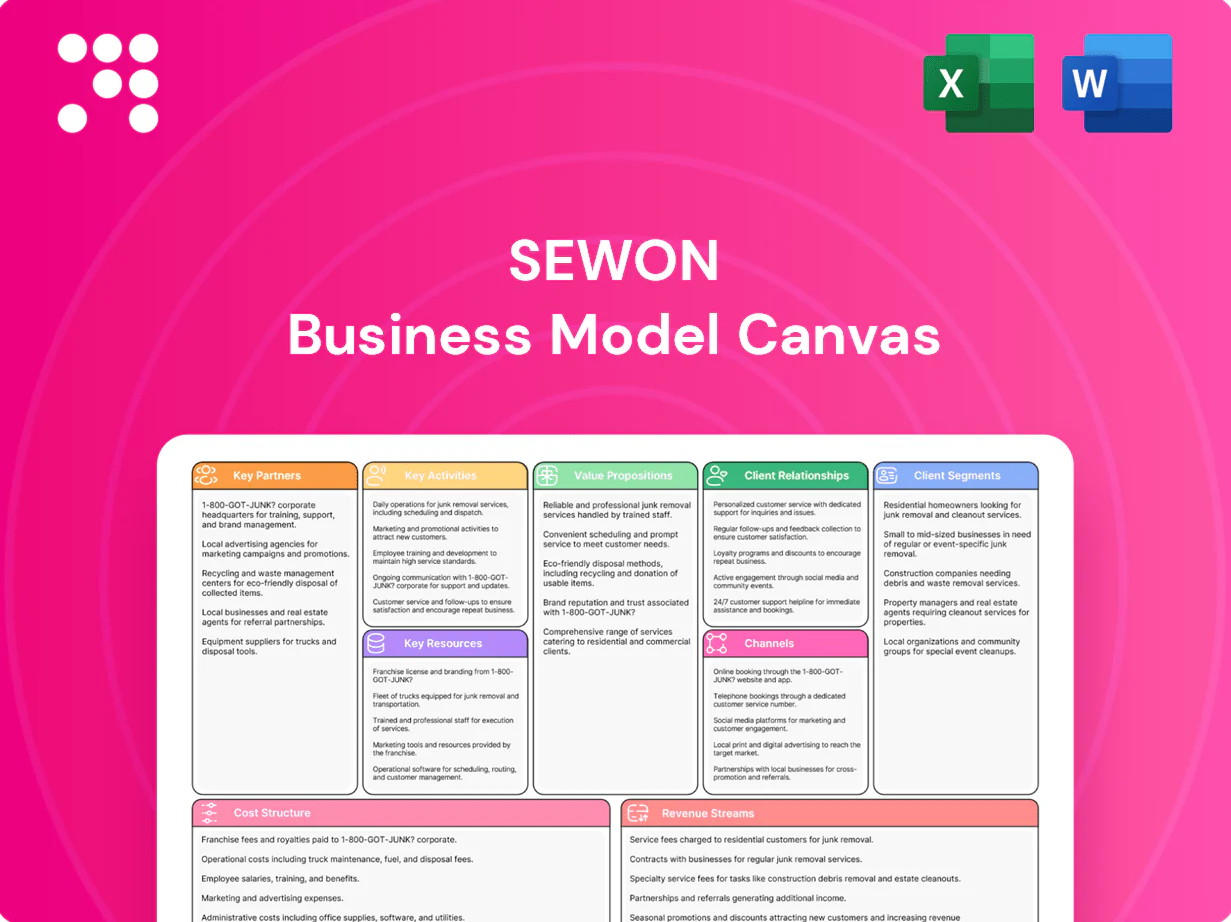
Sewon Business Model Canvas

Download the complete Business Model Canvas to map value, partners, revenue and cost levers
Unlock Sewon’s strategic playbook with the full Business Model Canvas—three to five sentences won’t cover it all. This concise, downloadable canvas maps value propositions, key partners, revenue drivers and cost levers so you can benchmark, adapt, and invest with confidence. Ideal for founders, analysts, and investors seeking actionable insights—get the complete Word and Excel files to start applying Sewon’s proven tactics today.
Partnerships

Global automotive OEMs
Core partnerships with global automotive OEMs secure multi-year program commitments across typical 3–7 year platform lifecycles and annual volumes commonly ranging from 50,000 to 500,000 units, giving Sewon revenue visibility and scale. Early involvement in OEM platform timelines enables capacity planning and tooling investment aligned to launch dates. Rigorous performance scorecards drive continuous improvement toward preferred-supplier status while joint cost-down targets (typically 3–5% p.a.) align incentives across programs.
Tier-1 module integrators
Collaboration with Tier-1 module integrators ensures body and chassis module interfaces fit and assembly sequence alignment, critical as global light-vehicle production reached about 80 million units in 2024. Shared PPAP and APQP workflows cut rework and launch risk, supported by industry data showing faster ramp rates with standardized controls. Forecast sharing improves production levelling and can boost inventory turns materially, while joint value engineering has delivered double-digit cost or weight reductions in recent programs.

Steel, aluminum, and advanced materials suppliers
Strategic sourcing of AHSS, aluminum and coated steels secures strength, corrosion resistance and formability while mill collaboration locks coil specifications, lead times and price stability; Sewon targets >98% on-time coil delivery. Early trials on new grades de-risk manufacturability and cut launch scrap by up to 20%. Consignment/VMI arrangements can reduce inventory 20–30% and support JIT reliability.

Tooling, robotics, and automation vendors
Tooling, robotics, and automation vendors supply high-tonnage presses (up to 3,000 tons), welding robots, vision systems, and dies; co-developing dies and jigs cuts launch time ~25% and raises first-pass yield ~8%. Preventive maintenance programs cut downtime ~35% and scrap rates materially; upgrades enable lights-out or near-lights-out runs with up to 70% unmanned hours.
- Presses: up to 3,000t
- Launch time: -25%
- Yield: +8%
- Downtime: -35%
- Unmanned hours: up to 70%
Logistics and warehousing providers
Inbound coil and outbound sequenced delivery depend on dependable transport and cross-docks to meet production rhythm; milk-run and JIS services synchronize with OEM takt times to cut lead times and buffer stock. Customs and trade partners streamline global shipments and paperwork, while real-time tracking integrated with customer EDI provides end-to-end visibility and exception alerts.
- Dependable transport + cross-docks for sequencing
- Milk-run / JIS aligned to OEM takt
- Customs/trade partners for global flow
- Real-time tracking integrated with customer EDI
OEM programs: multi-yr revenue, 3–5% cost-downs, 98%+ OTD
Core OEM programs (50k–500k units; global LV production ~80M in 2024) give multi-year revenue visibility; joint cost-downs ~3–5% p.a. Tier-1 integrators and standardized APQP/PPAP cut launch risk and improve ramp rates. Material and tooling partners secure >98% on-time coils, presses to 3,000t and VMI cuts inventory 20–30%.
| Partner | Role | 2024 KPI |
|---|---|---|
| OEMs | Program commitments | 50k–500k units; 3–7yr life |
| Tier‑1 | Module integration | Faster ramp, lower rework |
| Materials | Coil supply | >98% OTD |
| Tooling | Automation | 3,000t presses |
What is included in the product
 Detailed Word Document
A comprehensive, pre-written Business Model Canvas tailored to Sewon’s strategy, covering all nine BMC blocks with detailed customer segments, channels, value propositions and real-world operational plans; ideal for presentations and funding discussions, it includes competitive-advantage analysis, linked SWOT insights and practical validation to help entrepreneurs, analysts and investors make informed decisions.

 Customizable Excel Spreadsheet
Condenses Sewon’s strategy into a clean, one-page Business Model Canvas that relieves planning friction, saves hours of formatting, and is shareable and editable for fast team alignment and decision-making.
Activities

Precision stamping and forming
High-tonnage presses up to 2,000 tons form complex body and chassis parts to tolerances as tight as ±0.2 mm, supporting 2024 automotive quality standards.
Progressive dies and transfer lines deliver high throughput and repeatability, routinely cycling thousands of parts per shift.
In-line sensing implemented in 2024 reduced detectable defects by about 30%, while tool change optimization has improved OEE by roughly 6–8 percentage points.
Robotic welding and joining
Spot, MIG and laser welding deliver the structural integrity and crash performance required by OEMs, supported by a 2024 IFR automotive robot density of ~1,300 robots/10,000 workers. Automated welding cells with precision jigging limit distortion and hold dimensional accuracy to sub-millimeter tolerances, cutting cycle times and boosting throughput. Weld traceability provides 100% audit-ready records for OEM compliance. Continuous process monitoring preserves nugget quality and penetration, lowering rework by ~25%.

Product and process co-development
DFM/DFMEA with customers reduces mass and complexity—2024 supplier benchmarks report average part-count cuts of 18% and mass reductions near 10% on co-developed modules. Simulation and rapid prototyping validate feasibility before tooling lock-in, shortening validation cycles by ~25%. PPAP/APQP gates control launch quality (used in 74% of OEM launches in 2024), while VA/VE cycles capture ongoing cost-downs across program life.

Quality assurance and compliance
Quality assurance centers on metrology and CMMs with gauge R&R targets under 10% to underpin tolerance control; SPC tools (control charts, Cp/Cpk) stabilize production and reduce variation. IATF 16949 certification ensures global automotive compliance; Rapid 8D processes and containment actions target response within 48 hours to protect customer lines.
- Metrology: CMM, gauge R&R <10%
- SPC: control charts, Cp/Cpk
- Cert: IATF 16949
- Escalation: Rapid 8D, containment ≤48h
Supply chain and JIT execution
Forecasting, MRP, and EDI synchronize Sewon production flows, enabling near-real-time order visibility and throughput planning; top-tier suppliers reached roughly 95% OTIF in 2024. Kanban and heijunka are used to level demand spikes and cut cycle variability, while sequenced deliveries align with OEM assembly windows to minimize line stoppages. Safety stock targets and dual-sourcing policies limit disruption exposure and preserve service levels.
- Forecasting + MRP + EDI: synchronized production
- Kanban / heijunka: level spikes, reduce variability
- Sequenced deliveries: meet OEM windows
- Safety stock + dual-sourcing: mitigate disruptions
Sub-mm forming ±0.2 mm & automation cuts defects ~30%
High-tonnage forming (≤2,000 t) and progressive dies deliver sub-mm precision (±0.2 mm) and high throughput; in-line sensing cut detectable defects ~30% in 2024 while tool-change optimization lifted OEE ~6–8 pp. Automated welding cells and weld traceability (robot density ~1,300/10,000 workers) ensure OEM crash performance and 100% audit readiness. MRP/EDI and kanban yield ~95% OTIF from top suppliers in 2024.
| Activity | 2024 Metric |
|---|---|
| Forming tol. | ±0.2 mm |
| Defect reduction | ~30% |
| OEE gain | +6–8 pp |
| Robot density | ~1,300/10,000 |
| Top supplier OTIF | ~95% |
What You See Is What You Get
Business Model Canvas
The Sewon Business Model Canvas you see here is the actual deliverable, not a mockup or sample. When you purchase, you’ll receive this exact document—fully structured and complete. Files are provided ready-to-edit in Word and Excel formats. No surprises, just the same professional canvas shown in this preview.

Download the complete Business Model Canvas to map value, partners, revenue and cost levers
Unlock Sewon’s strategic playbook with the full Business Model Canvas—three to five sentences won’t cover it all. This concise, downloadable canvas maps value propositions, key partners, revenue drivers and cost levers so you can benchmark, adapt, and invest with confidence. Ideal for founders, analysts, and investors seeking actionable insights—get the complete Word and Excel files to start applying Sewon’s proven tactics today.
Partnerships
Global automotive OEMs
Core partnerships with global automotive OEMs secure multi-year program commitments across typical 3–7 year platform lifecycles and annual volumes commonly ranging from 50,000 to 500,000 units, giving Sewon revenue visibility and scale. Early involvement in OEM platform timelines enables capacity planning and tooling investment aligned to launch dates. Rigorous performance scorecards drive continuous improvement toward preferred-supplier status while joint cost-down targets (typically 3–5% p.a.) align incentives across programs.
Tier-1 module integrators
Collaboration with Tier-1 module integrators ensures body and chassis module interfaces fit and assembly sequence alignment, critical as global light-vehicle production reached about 80 million units in 2024. Shared PPAP and APQP workflows cut rework and launch risk, supported by industry data showing faster ramp rates with standardized controls. Forecast sharing improves production levelling and can boost inventory turns materially, while joint value engineering has delivered double-digit cost or weight reductions in recent programs.
Steel, aluminum, and advanced materials suppliers
Strategic sourcing of AHSS, aluminum and coated steels secures strength, corrosion resistance and formability while mill collaboration locks coil specifications, lead times and price stability; Sewon targets >98% on-time coil delivery. Early trials on new grades de-risk manufacturability and cut launch scrap by up to 20%. Consignment/VMI arrangements can reduce inventory 20–30% and support JIT reliability.
Tooling, robotics, and automation vendors
Tooling, robotics, and automation vendors supply high-tonnage presses (up to 3,000 tons), welding robots, vision systems, and dies; co-developing dies and jigs cuts launch time ~25% and raises first-pass yield ~8%. Preventive maintenance programs cut downtime ~35% and scrap rates materially; upgrades enable lights-out or near-lights-out runs with up to 70% unmanned hours.
- Presses: up to 3,000t
- Launch time: -25%
- Yield: +8%
- Downtime: -35%
- Unmanned hours: up to 70%
Logistics and warehousing providers
Inbound coil and outbound sequenced delivery depend on dependable transport and cross-docks to meet production rhythm; milk-run and JIS services synchronize with OEM takt times to cut lead times and buffer stock. Customs and trade partners streamline global shipments and paperwork, while real-time tracking integrated with customer EDI provides end-to-end visibility and exception alerts.
- Dependable transport + cross-docks for sequencing
- Milk-run / JIS aligned to OEM takt
- Customs/trade partners for global flow
- Real-time tracking integrated with customer EDI
OEM programs: multi-yr revenue, 3–5% cost-downs, 98%+ OTD
Core OEM programs (50k–500k units; global LV production ~80M in 2024) give multi-year revenue visibility; joint cost-downs ~3–5% p.a. Tier-1 integrators and standardized APQP/PPAP cut launch risk and improve ramp rates. Material and tooling partners secure >98% on-time coils, presses to 3,000t and VMI cuts inventory 20–30%.
| Partner | Role | 2024 KPI |
|---|---|---|
| OEMs | Program commitments | 50k–500k units; 3–7yr life |
| Tier‑1 | Module integration | Faster ramp, lower rework |
| Materials | Coil supply | >98% OTD |
| Tooling | Automation | 3,000t presses |
What is included in the product
Detailed Word Document
A comprehensive, pre-written Business Model Canvas tailored to Sewon’s strategy, covering all nine BMC blocks with detailed customer segments, channels, value propositions and real-world operational plans; ideal for presentations and funding discussions, it includes competitive-advantage analysis, linked SWOT insights and practical validation to help entrepreneurs, analysts and investors make informed decisions.
Customizable Excel Spreadsheet
Condenses Sewon’s strategy into a clean, one-page Business Model Canvas that relieves planning friction, saves hours of formatting, and is shareable and editable for fast team alignment and decision-making.
Activities
Precision stamping and forming
High-tonnage presses up to 2,000 tons form complex body and chassis parts to tolerances as tight as ±0.2 mm, supporting 2024 automotive quality standards.
Progressive dies and transfer lines deliver high throughput and repeatability, routinely cycling thousands of parts per shift.
In-line sensing implemented in 2024 reduced detectable defects by about 30%, while tool change optimization has improved OEE by roughly 6–8 percentage points.
Robotic welding and joining
Spot, MIG and laser welding deliver the structural integrity and crash performance required by OEMs, supported by a 2024 IFR automotive robot density of ~1,300 robots/10,000 workers. Automated welding cells with precision jigging limit distortion and hold dimensional accuracy to sub-millimeter tolerances, cutting cycle times and boosting throughput. Weld traceability provides 100% audit-ready records for OEM compliance. Continuous process monitoring preserves nugget quality and penetration, lowering rework by ~25%.
Product and process co-development
DFM/DFMEA with customers reduces mass and complexity—2024 supplier benchmarks report average part-count cuts of 18% and mass reductions near 10% on co-developed modules. Simulation and rapid prototyping validate feasibility before tooling lock-in, shortening validation cycles by ~25%. PPAP/APQP gates control launch quality (used in 74% of OEM launches in 2024), while VA/VE cycles capture ongoing cost-downs across program life.
Quality assurance and compliance
Quality assurance centers on metrology and CMMs with gauge R&R targets under 10% to underpin tolerance control; SPC tools (control charts, Cp/Cpk) stabilize production and reduce variation. IATF 16949 certification ensures global automotive compliance; Rapid 8D processes and containment actions target response within 48 hours to protect customer lines.
- Metrology: CMM, gauge R&R <10%
- SPC: control charts, Cp/Cpk
- Cert: IATF 16949
- Escalation: Rapid 8D, containment ≤48h
Supply chain and JIT execution
Forecasting, MRP, and EDI synchronize Sewon production flows, enabling near-real-time order visibility and throughput planning; top-tier suppliers reached roughly 95% OTIF in 2024. Kanban and heijunka are used to level demand spikes and cut cycle variability, while sequenced deliveries align with OEM assembly windows to minimize line stoppages. Safety stock targets and dual-sourcing policies limit disruption exposure and preserve service levels.
- Forecasting + MRP + EDI: synchronized production
- Kanban / heijunka: level spikes, reduce variability
- Sequenced deliveries: meet OEM windows
- Safety stock + dual-sourcing: mitigate disruptions
Sub-mm forming ±0.2 mm & automation cuts defects ~30%
High-tonnage forming (≤2,000 t) and progressive dies deliver sub-mm precision (±0.2 mm) and high throughput; in-line sensing cut detectable defects ~30% in 2024 while tool-change optimization lifted OEE ~6–8 pp. Automated welding cells and weld traceability (robot density ~1,300/10,000 workers) ensure OEM crash performance and 100% audit readiness. MRP/EDI and kanban yield ~95% OTIF from top suppliers in 2024.
| Activity | 2024 Metric |
|---|---|
| Forming tol. | ±0.2 mm |
| Defect reduction | ~30% |
| OEE gain | +6–8 pp |
| Robot density | ~1,300/10,000 |
| Top supplier OTIF | ~95% |
What You See Is What You Get
Business Model Canvas
The Sewon Business Model Canvas you see here is the actual deliverable, not a mockup or sample. When you purchase, you’ll receive this exact document—fully structured and complete. Files are provided ready-to-edit in Word and Excel formats. No surprises, just the same professional canvas shown in this preview.
Description
Download the complete Business Model Canvas to map value, partners, revenue and cost levers
Unlock Sewon’s strategic playbook with the full Business Model Canvas—three to five sentences won’t cover it all. This concise, downloadable canvas maps value propositions, key partners, revenue drivers and cost levers so you can benchmark, adapt, and invest with confidence. Ideal for founders, analysts, and investors seeking actionable insights—get the complete Word and Excel files to start applying Sewon’s proven tactics today.
Partnerships
Global automotive OEMs
Core partnerships with global automotive OEMs secure multi-year program commitments across typical 3–7 year platform lifecycles and annual volumes commonly ranging from 50,000 to 500,000 units, giving Sewon revenue visibility and scale. Early involvement in OEM platform timelines enables capacity planning and tooling investment aligned to launch dates. Rigorous performance scorecards drive continuous improvement toward preferred-supplier status while joint cost-down targets (typically 3–5% p.a.) align incentives across programs.
Tier-1 module integrators
Collaboration with Tier-1 module integrators ensures body and chassis module interfaces fit and assembly sequence alignment, critical as global light-vehicle production reached about 80 million units in 2024. Shared PPAP and APQP workflows cut rework and launch risk, supported by industry data showing faster ramp rates with standardized controls. Forecast sharing improves production levelling and can boost inventory turns materially, while joint value engineering has delivered double-digit cost or weight reductions in recent programs.
Steel, aluminum, and advanced materials suppliers
Strategic sourcing of AHSS, aluminum and coated steels secures strength, corrosion resistance and formability while mill collaboration locks coil specifications, lead times and price stability; Sewon targets >98% on-time coil delivery. Early trials on new grades de-risk manufacturability and cut launch scrap by up to 20%. Consignment/VMI arrangements can reduce inventory 20–30% and support JIT reliability.
Tooling, robotics, and automation vendors
Tooling, robotics, and automation vendors supply high-tonnage presses (up to 3,000 tons), welding robots, vision systems, and dies; co-developing dies and jigs cuts launch time ~25% and raises first-pass yield ~8%. Preventive maintenance programs cut downtime ~35% and scrap rates materially; upgrades enable lights-out or near-lights-out runs with up to 70% unmanned hours.
- Presses: up to 3,000t
- Launch time: -25%
- Yield: +8%
- Downtime: -35%
- Unmanned hours: up to 70%
Logistics and warehousing providers
Inbound coil and outbound sequenced delivery depend on dependable transport and cross-docks to meet production rhythm; milk-run and JIS services synchronize with OEM takt times to cut lead times and buffer stock. Customs and trade partners streamline global shipments and paperwork, while real-time tracking integrated with customer EDI provides end-to-end visibility and exception alerts.
- Dependable transport + cross-docks for sequencing
- Milk-run / JIS aligned to OEM takt
- Customs/trade partners for global flow
- Real-time tracking integrated with customer EDI
OEM programs: multi-yr revenue, 3–5% cost-downs, 98%+ OTD
Core OEM programs (50k–500k units; global LV production ~80M in 2024) give multi-year revenue visibility; joint cost-downs ~3–5% p.a. Tier-1 integrators and standardized APQP/PPAP cut launch risk and improve ramp rates. Material and tooling partners secure >98% on-time coils, presses to 3,000t and VMI cuts inventory 20–30%.
| Partner | Role | 2024 KPI |
|---|---|---|
| OEMs | Program commitments | 50k–500k units; 3–7yr life |
| Tier‑1 | Module integration | Faster ramp, lower rework |
| Materials | Coil supply | >98% OTD |
| Tooling | Automation | 3,000t presses |
What is included in the product
Detailed Word Document
A comprehensive, pre-written Business Model Canvas tailored to Sewon’s strategy, covering all nine BMC blocks with detailed customer segments, channels, value propositions and real-world operational plans; ideal for presentations and funding discussions, it includes competitive-advantage analysis, linked SWOT insights and practical validation to help entrepreneurs, analysts and investors make informed decisions.
Customizable Excel Spreadsheet
Condenses Sewon’s strategy into a clean, one-page Business Model Canvas that relieves planning friction, saves hours of formatting, and is shareable and editable for fast team alignment and decision-making.
Activities
Precision stamping and forming
High-tonnage presses up to 2,000 tons form complex body and chassis parts to tolerances as tight as ±0.2 mm, supporting 2024 automotive quality standards.
Progressive dies and transfer lines deliver high throughput and repeatability, routinely cycling thousands of parts per shift.
In-line sensing implemented in 2024 reduced detectable defects by about 30%, while tool change optimization has improved OEE by roughly 6–8 percentage points.
Robotic welding and joining
Spot, MIG and laser welding deliver the structural integrity and crash performance required by OEMs, supported by a 2024 IFR automotive robot density of ~1,300 robots/10,000 workers. Automated welding cells with precision jigging limit distortion and hold dimensional accuracy to sub-millimeter tolerances, cutting cycle times and boosting throughput. Weld traceability provides 100% audit-ready records for OEM compliance. Continuous process monitoring preserves nugget quality and penetration, lowering rework by ~25%.
Product and process co-development
DFM/DFMEA with customers reduces mass and complexity—2024 supplier benchmarks report average part-count cuts of 18% and mass reductions near 10% on co-developed modules. Simulation and rapid prototyping validate feasibility before tooling lock-in, shortening validation cycles by ~25%. PPAP/APQP gates control launch quality (used in 74% of OEM launches in 2024), while VA/VE cycles capture ongoing cost-downs across program life.
Quality assurance and compliance
Quality assurance centers on metrology and CMMs with gauge R&R targets under 10% to underpin tolerance control; SPC tools (control charts, Cp/Cpk) stabilize production and reduce variation. IATF 16949 certification ensures global automotive compliance; Rapid 8D processes and containment actions target response within 48 hours to protect customer lines.
- Metrology: CMM, gauge R&R <10%
- SPC: control charts, Cp/Cpk
- Cert: IATF 16949
- Escalation: Rapid 8D, containment ≤48h
Supply chain and JIT execution
Forecasting, MRP, and EDI synchronize Sewon production flows, enabling near-real-time order visibility and throughput planning; top-tier suppliers reached roughly 95% OTIF in 2024. Kanban and heijunka are used to level demand spikes and cut cycle variability, while sequenced deliveries align with OEM assembly windows to minimize line stoppages. Safety stock targets and dual-sourcing policies limit disruption exposure and preserve service levels.
- Forecasting + MRP + EDI: synchronized production
- Kanban / heijunka: level spikes, reduce variability
- Sequenced deliveries: meet OEM windows
- Safety stock + dual-sourcing: mitigate disruptions
Sub-mm forming ±0.2 mm & automation cuts defects ~30%
High-tonnage forming (≤2,000 t) and progressive dies deliver sub-mm precision (±0.2 mm) and high throughput; in-line sensing cut detectable defects ~30% in 2024 while tool-change optimization lifted OEE ~6–8 pp. Automated welding cells and weld traceability (robot density ~1,300/10,000 workers) ensure OEM crash performance and 100% audit readiness. MRP/EDI and kanban yield ~95% OTIF from top suppliers in 2024.
| Activity | 2024 Metric |
|---|---|
| Forming tol. | ±0.2 mm |
| Defect reduction | ~30% |
| OEE gain | +6–8 pp |
| Robot density | ~1,300/10,000 |
| Top supplier OTIF | ~95% |
What You See Is What You Get
Business Model Canvas
The Sewon Business Model Canvas you see here is the actual deliverable, not a mockup or sample. When you purchase, you’ll receive this exact document—fully structured and complete. Files are provided ready-to-edit in Word and Excel formats. No surprises, just the same professional canvas shown in this preview.











