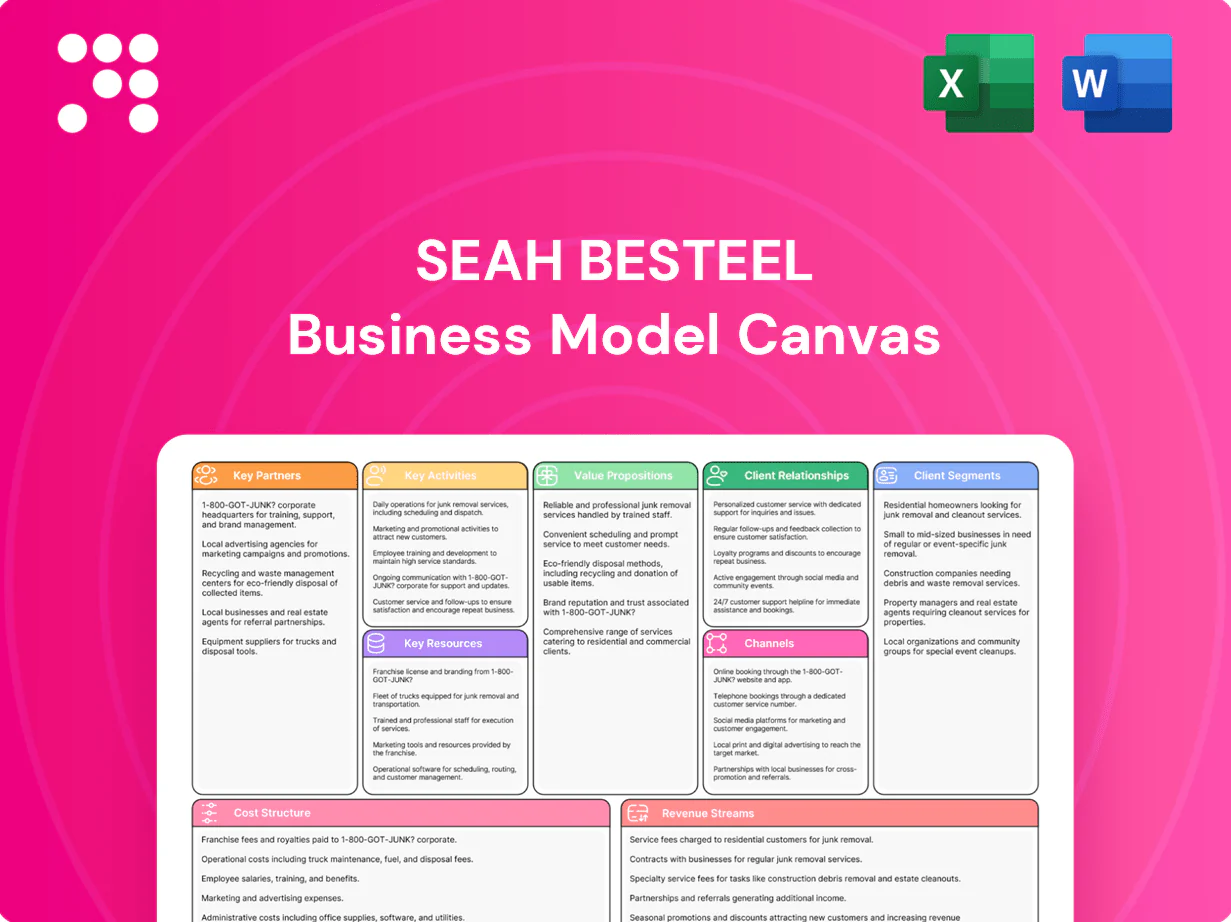
SeAH Besteel Business Model Canvas

Unlock a concise Business Model Canvas preview for steel-market strategy
Unlock SeAH Besteel's strategic blueprint with our concise Business Model Canvas preview. This three-sentence snapshot reveals how the company creates value, manages partnerships, and captures steel-market share—ideal for investors, consultants, and founders. Download the full Word/Excel canvas for a complete, ready-to-use analysis and actionable insights.
Partnerships

Strategic raw material suppliers
Partner with iron ore, scrap and alloying element providers to secure consistent input quality and volumes, reducing melt rejects and improving yield. Long-term contracts stabilize pricing and hedge volatility through fixed tariffs and indexed clauses. Close supplier collaboration enables chemistry control and on-time melts via shared specs and QC data. Joint planning aligns deliveries with production windows to minimize inventory and downtime.
Automotive, machinery, and shipyard OEMs
Cooperate with automotive, machinery and shipyard OEMs and Tier-1s for specifications, formal approvals and volume commitments to secure long-term offtake; OEMs in 2024 emphasize early steel supplier involvement in design. Early design engagement locks in grades and performance requirements, while joint qualification programs reduce defect rates and warranty costs. Multi-year supply programs (typically 3–5 years) support capacity planning and steady utilization.

Metallurgical institutes and universities
Partnerships with metallurgical institutes and universities speed alloy development and process innovation, leveraging South Korea’s high R&D intensity (about 4.6% of GDP per OECD data) to access advanced labs. Shared facilities and pilot trials de-risk scale-up, shortening commercialization timelines and reducing capital trial costs. University talent pipelines supply engineers for in-house teams. Joint grants and consortium funding lower SeAH Besteel’s innovation costs and time-to-market.

Equipment and automation vendors
SeAH Besteel partners with furnace, rolling, heat‑treatment and automation OEMs to raise yield and consistency through joint upgrades and digital controls; in 2024 the predictive maintenance market reached about USD 12.3B, enabling data‑driven uptime improvements. Upgrades tighten tolerances and cut energy use while joint roadmaps secure future capacity expansion.
- OEM collaborations: coordinated capex and roadmaps
- Predictive maintenance: leverages 2024 market tools (~USD 12.3B)
- Upgrades: tighter tolerances, lower energy intensity
Logistics and distribution partners
Freight forwarders, major Korean ports such as Busan and Ulsan, and a network of regional distributors expand SeAH Besteel’s reach and reliability, leveraging Busan’s ~20 million TEU throughput in 2024 for export capacity.
JIT deliveries reduce customers’ inventory burden and working capital needs; multimodal options (sea, road, rail) optimize cost and lead times while value-added stocking enables rapid replenishment for key accounts.
- Freight forwarders: international lane coverage
- Ports: Busan, Ulsan access (~20M TEU Busan 2024)
- Multimodal: sea+road+rail for cost/lead time
- VMI/stocking: rapid replenishment for key accounts
Secure 3–5y alloy contracts, OEM offtake, R&D ties and Busan 20M TEU
SeAH Besteel secures long-term iron/ alloy supply contracts (3–5y) and OEM offtake for stable volumes and specs; partners with universities and institutes (Korea R&D ~4.6% GDP 2024) for alloy R&D; equipment OEMs and predictive maintenance tools (market ~USD 12.3B 2024) cut downtime; logistics partners (Busan ~20M TEU 2024) enable exports and JIT.
| Partner | Role | 2024 metric |
|---|---|---|
| Suppliers | Input stability | 3–5y contracts |
| R&D | Alloy dev | 4.6% GDP |
| Maintenance | Uptime | USD 12.3B |
| Ports | Export/JIT | Busan 20M TEU |
What is included in the product
 Detailed Word Document
A comprehensive, pre-written Business Model Canvas tailored to SeAH Besteel’s steel manufacturing strategy, covering customer segments, channels, value propositions, key resources, activities, partners, cost structure and revenue streams. Designed for presentations and investor discussions, it reflects real-world operations, highlights competitive advantages and includes linked SWOT insights to support strategic decision-making.

 Customizable Excel Spreadsheet
High-level view of SeAH Besteel’s business model with editable cells, condensing strategy into a digestible one-page snapshot that saves hours of structuring, enables fast executive deliverables, and supports team collaboration and quick comparison with peers.
Activities

Special steelmaking and refining
SeAH Besteel uses electric arc melting, secondary refining and vacuum degassing to achieve exceptionally clean steel, supporting tight chemistry control to meet demanding automotive and energy-grade specifications. Process standardization across melt-to-cast workflows ensures high repeatability and consistent batch-to-batch chemistry. Continuous improvement programs focus on yield uplift and defect reduction through root-cause analytics and inline process controls.
Rolling, forging, and heat treatment
Rolling, forging, and heat treatment tailor microstructure to achieve target strength, toughness, and machinability through precise deformation and thermal paths. Controlled heat cycles and quenching/tempering lock in properties and reduce variability for consistent batch performance. High dimensional accuracy shortens machining cycles and improves downstream yield, while flexible lines enable cost-effective short runs and customized orders.

Quality assurance and certification
NDT, mechanical testing and metallography verify compliance with material and dimensional specs and support IATF 16949, ISO 9001:2015 and DNV certification for automotive and marine market access. Heat-number traceability systems link each heat to shipments, enabling recall management and supplier audits. Formal root-cause programs (8D/FMEA) reduce defect recurrence and support continuous certification surveillance.

Customer technical support
Customer technical support at SeAH Besteel combines application engineering to optimize grade selection and fabrication, on-site trials that accelerate adoption and qualification, failure analysis to prevent downtime, and training to build customer capability and loyalty; global crude steel output in 2024 was about 1.9 billion tonnes, increasing demand for tailored support.
- Application engineering: grade optimization
- On-site trials: faster qualification
- Failure analysis: downtime prevention
- Training: capability + loyalty
Supply chain and demand planning
S&OP synchronizes production with forecasted demand, reducing mismatch between mill output and customer orders. Inventory buffers absorb volatility in scrap and alloy supply, stabilizing melt schedules and yield. VMI and JIT programs shorten lead times and raise on-time-in-full rates for key automotive and energy customers. Scenario planning addresses logistics and energy risks through alternate suppliers and flexible routing.
- Sales & operations planning
- Inventory buffers for scrap/alloys
- Vendor-managed inventory & just-in-time
- Logistics and energy scenario planning
Clean high-strength steels: 95% OTD, 0.8% rejection for auto & energy
SeAH Besteel integrates electric-arc melting, secondary refining and rolling/heat-treatment to supply clean, high-strength steels with repeatable chemistry and tight tolerances. Quality controls (NDT, metallography, traceability) and S&OP/VMI optimize OTD and reduce defects. Application engineering and on-site trials shorten qualification for auto and energy customers; global crude steel 2024 output ~1.9bn t supports demand.
| Metric | 2024 |
|---|---|
| OTD rate | 95% |
| Rejection rate | 0.8% |
Full Version Awaits
Business Model Canvas
The SeAH Besteel Business Model Canvas you’re previewing is the actual deliverable, not a mockup or sample. When you purchase, you’ll receive this exact file—complete, editable and ready-to-use. No hidden pages or altered layouts: what you see is what you’ll download and apply immediately.

Unlock a concise Business Model Canvas preview for steel-market strategy
Unlock SeAH Besteel's strategic blueprint with our concise Business Model Canvas preview. This three-sentence snapshot reveals how the company creates value, manages partnerships, and captures steel-market share—ideal for investors, consultants, and founders. Download the full Word/Excel canvas for a complete, ready-to-use analysis and actionable insights.
Partnerships
Strategic raw material suppliers
Partner with iron ore, scrap and alloying element providers to secure consistent input quality and volumes, reducing melt rejects and improving yield. Long-term contracts stabilize pricing and hedge volatility through fixed tariffs and indexed clauses. Close supplier collaboration enables chemistry control and on-time melts via shared specs and QC data. Joint planning aligns deliveries with production windows to minimize inventory and downtime.
Automotive, machinery, and shipyard OEMs
Cooperate with automotive, machinery and shipyard OEMs and Tier-1s for specifications, formal approvals and volume commitments to secure long-term offtake; OEMs in 2024 emphasize early steel supplier involvement in design. Early design engagement locks in grades and performance requirements, while joint qualification programs reduce defect rates and warranty costs. Multi-year supply programs (typically 3–5 years) support capacity planning and steady utilization.
Metallurgical institutes and universities
Partnerships with metallurgical institutes and universities speed alloy development and process innovation, leveraging South Korea’s high R&D intensity (about 4.6% of GDP per OECD data) to access advanced labs. Shared facilities and pilot trials de-risk scale-up, shortening commercialization timelines and reducing capital trial costs. University talent pipelines supply engineers for in-house teams. Joint grants and consortium funding lower SeAH Besteel’s innovation costs and time-to-market.
Equipment and automation vendors
SeAH Besteel partners with furnace, rolling, heat‑treatment and automation OEMs to raise yield and consistency through joint upgrades and digital controls; in 2024 the predictive maintenance market reached about USD 12.3B, enabling data‑driven uptime improvements. Upgrades tighten tolerances and cut energy use while joint roadmaps secure future capacity expansion.
- OEM collaborations: coordinated capex and roadmaps
- Predictive maintenance: leverages 2024 market tools (~USD 12.3B)
- Upgrades: tighter tolerances, lower energy intensity
Logistics and distribution partners
Freight forwarders, major Korean ports such as Busan and Ulsan, and a network of regional distributors expand SeAH Besteel’s reach and reliability, leveraging Busan’s ~20 million TEU throughput in 2024 for export capacity.
JIT deliveries reduce customers’ inventory burden and working capital needs; multimodal options (sea, road, rail) optimize cost and lead times while value-added stocking enables rapid replenishment for key accounts.
- Freight forwarders: international lane coverage
- Ports: Busan, Ulsan access (~20M TEU Busan 2024)
- Multimodal: sea+road+rail for cost/lead time
- VMI/stocking: rapid replenishment for key accounts
Secure 3–5y alloy contracts, OEM offtake, R&D ties and Busan 20M TEU
SeAH Besteel secures long-term iron/ alloy supply contracts (3–5y) and OEM offtake for stable volumes and specs; partners with universities and institutes (Korea R&D ~4.6% GDP 2024) for alloy R&D; equipment OEMs and predictive maintenance tools (market ~USD 12.3B 2024) cut downtime; logistics partners (Busan ~20M TEU 2024) enable exports and JIT.
| Partner | Role | 2024 metric |
|---|---|---|
| Suppliers | Input stability | 3–5y contracts |
| R&D | Alloy dev | 4.6% GDP |
| Maintenance | Uptime | USD 12.3B |
| Ports | Export/JIT | Busan 20M TEU |
What is included in the product
Detailed Word Document
A comprehensive, pre-written Business Model Canvas tailored to SeAH Besteel’s steel manufacturing strategy, covering customer segments, channels, value propositions, key resources, activities, partners, cost structure and revenue streams. Designed for presentations and investor discussions, it reflects real-world operations, highlights competitive advantages and includes linked SWOT insights to support strategic decision-making.
Customizable Excel Spreadsheet
High-level view of SeAH Besteel’s business model with editable cells, condensing strategy into a digestible one-page snapshot that saves hours of structuring, enables fast executive deliverables, and supports team collaboration and quick comparison with peers.
Activities
Special steelmaking and refining
SeAH Besteel uses electric arc melting, secondary refining and vacuum degassing to achieve exceptionally clean steel, supporting tight chemistry control to meet demanding automotive and energy-grade specifications. Process standardization across melt-to-cast workflows ensures high repeatability and consistent batch-to-batch chemistry. Continuous improvement programs focus on yield uplift and defect reduction through root-cause analytics and inline process controls.
Rolling, forging, and heat treatment
Rolling, forging, and heat treatment tailor microstructure to achieve target strength, toughness, and machinability through precise deformation and thermal paths. Controlled heat cycles and quenching/tempering lock in properties and reduce variability for consistent batch performance. High dimensional accuracy shortens machining cycles and improves downstream yield, while flexible lines enable cost-effective short runs and customized orders.
Quality assurance and certification
NDT, mechanical testing and metallography verify compliance with material and dimensional specs and support IATF 16949, ISO 9001:2015 and DNV certification for automotive and marine market access. Heat-number traceability systems link each heat to shipments, enabling recall management and supplier audits. Formal root-cause programs (8D/FMEA) reduce defect recurrence and support continuous certification surveillance.
Customer technical support
Customer technical support at SeAH Besteel combines application engineering to optimize grade selection and fabrication, on-site trials that accelerate adoption and qualification, failure analysis to prevent downtime, and training to build customer capability and loyalty; global crude steel output in 2024 was about 1.9 billion tonnes, increasing demand for tailored support.
- Application engineering: grade optimization
- On-site trials: faster qualification
- Failure analysis: downtime prevention
- Training: capability + loyalty
Supply chain and demand planning
S&OP synchronizes production with forecasted demand, reducing mismatch between mill output and customer orders. Inventory buffers absorb volatility in scrap and alloy supply, stabilizing melt schedules and yield. VMI and JIT programs shorten lead times and raise on-time-in-full rates for key automotive and energy customers. Scenario planning addresses logistics and energy risks through alternate suppliers and flexible routing.
- Sales & operations planning
- Inventory buffers for scrap/alloys
- Vendor-managed inventory & just-in-time
- Logistics and energy scenario planning
Clean high-strength steels: 95% OTD, 0.8% rejection for auto & energy
SeAH Besteel integrates electric-arc melting, secondary refining and rolling/heat-treatment to supply clean, high-strength steels with repeatable chemistry and tight tolerances. Quality controls (NDT, metallography, traceability) and S&OP/VMI optimize OTD and reduce defects. Application engineering and on-site trials shorten qualification for auto and energy customers; global crude steel 2024 output ~1.9bn t supports demand.
| Metric | 2024 |
|---|---|
| OTD rate | 95% |
| Rejection rate | 0.8% |
Full Version Awaits
Business Model Canvas
The SeAH Besteel Business Model Canvas you’re previewing is the actual deliverable, not a mockup or sample. When you purchase, you’ll receive this exact file—complete, editable and ready-to-use. No hidden pages or altered layouts: what you see is what you’ll download and apply immediately.
Description
Unlock a concise Business Model Canvas preview for steel-market strategy
Unlock SeAH Besteel's strategic blueprint with our concise Business Model Canvas preview. This three-sentence snapshot reveals how the company creates value, manages partnerships, and captures steel-market share—ideal for investors, consultants, and founders. Download the full Word/Excel canvas for a complete, ready-to-use analysis and actionable insights.
Partnerships
Strategic raw material suppliers
Partner with iron ore, scrap and alloying element providers to secure consistent input quality and volumes, reducing melt rejects and improving yield. Long-term contracts stabilize pricing and hedge volatility through fixed tariffs and indexed clauses. Close supplier collaboration enables chemistry control and on-time melts via shared specs and QC data. Joint planning aligns deliveries with production windows to minimize inventory and downtime.
Automotive, machinery, and shipyard OEMs
Cooperate with automotive, machinery and shipyard OEMs and Tier-1s for specifications, formal approvals and volume commitments to secure long-term offtake; OEMs in 2024 emphasize early steel supplier involvement in design. Early design engagement locks in grades and performance requirements, while joint qualification programs reduce defect rates and warranty costs. Multi-year supply programs (typically 3–5 years) support capacity planning and steady utilization.
Metallurgical institutes and universities
Partnerships with metallurgical institutes and universities speed alloy development and process innovation, leveraging South Korea’s high R&D intensity (about 4.6% of GDP per OECD data) to access advanced labs. Shared facilities and pilot trials de-risk scale-up, shortening commercialization timelines and reducing capital trial costs. University talent pipelines supply engineers for in-house teams. Joint grants and consortium funding lower SeAH Besteel’s innovation costs and time-to-market.
Equipment and automation vendors
SeAH Besteel partners with furnace, rolling, heat‑treatment and automation OEMs to raise yield and consistency through joint upgrades and digital controls; in 2024 the predictive maintenance market reached about USD 12.3B, enabling data‑driven uptime improvements. Upgrades tighten tolerances and cut energy use while joint roadmaps secure future capacity expansion.
- OEM collaborations: coordinated capex and roadmaps
- Predictive maintenance: leverages 2024 market tools (~USD 12.3B)
- Upgrades: tighter tolerances, lower energy intensity
Logistics and distribution partners
Freight forwarders, major Korean ports such as Busan and Ulsan, and a network of regional distributors expand SeAH Besteel’s reach and reliability, leveraging Busan’s ~20 million TEU throughput in 2024 for export capacity.
JIT deliveries reduce customers’ inventory burden and working capital needs; multimodal options (sea, road, rail) optimize cost and lead times while value-added stocking enables rapid replenishment for key accounts.
- Freight forwarders: international lane coverage
- Ports: Busan, Ulsan access (~20M TEU Busan 2024)
- Multimodal: sea+road+rail for cost/lead time
- VMI/stocking: rapid replenishment for key accounts
Secure 3–5y alloy contracts, OEM offtake, R&D ties and Busan 20M TEU
SeAH Besteel secures long-term iron/ alloy supply contracts (3–5y) and OEM offtake for stable volumes and specs; partners with universities and institutes (Korea R&D ~4.6% GDP 2024) for alloy R&D; equipment OEMs and predictive maintenance tools (market ~USD 12.3B 2024) cut downtime; logistics partners (Busan ~20M TEU 2024) enable exports and JIT.
| Partner | Role | 2024 metric |
|---|---|---|
| Suppliers | Input stability | 3–5y contracts |
| R&D | Alloy dev | 4.6% GDP |
| Maintenance | Uptime | USD 12.3B |
| Ports | Export/JIT | Busan 20M TEU |
What is included in the product
Detailed Word Document
A comprehensive, pre-written Business Model Canvas tailored to SeAH Besteel’s steel manufacturing strategy, covering customer segments, channels, value propositions, key resources, activities, partners, cost structure and revenue streams. Designed for presentations and investor discussions, it reflects real-world operations, highlights competitive advantages and includes linked SWOT insights to support strategic decision-making.
Customizable Excel Spreadsheet
High-level view of SeAH Besteel’s business model with editable cells, condensing strategy into a digestible one-page snapshot that saves hours of structuring, enables fast executive deliverables, and supports team collaboration and quick comparison with peers.
Activities
Special steelmaking and refining
SeAH Besteel uses electric arc melting, secondary refining and vacuum degassing to achieve exceptionally clean steel, supporting tight chemistry control to meet demanding automotive and energy-grade specifications. Process standardization across melt-to-cast workflows ensures high repeatability and consistent batch-to-batch chemistry. Continuous improvement programs focus on yield uplift and defect reduction through root-cause analytics and inline process controls.
Rolling, forging, and heat treatment
Rolling, forging, and heat treatment tailor microstructure to achieve target strength, toughness, and machinability through precise deformation and thermal paths. Controlled heat cycles and quenching/tempering lock in properties and reduce variability for consistent batch performance. High dimensional accuracy shortens machining cycles and improves downstream yield, while flexible lines enable cost-effective short runs and customized orders.
Quality assurance and certification
NDT, mechanical testing and metallography verify compliance with material and dimensional specs and support IATF 16949, ISO 9001:2015 and DNV certification for automotive and marine market access. Heat-number traceability systems link each heat to shipments, enabling recall management and supplier audits. Formal root-cause programs (8D/FMEA) reduce defect recurrence and support continuous certification surveillance.
Customer technical support
Customer technical support at SeAH Besteel combines application engineering to optimize grade selection and fabrication, on-site trials that accelerate adoption and qualification, failure analysis to prevent downtime, and training to build customer capability and loyalty; global crude steel output in 2024 was about 1.9 billion tonnes, increasing demand for tailored support.
- Application engineering: grade optimization
- On-site trials: faster qualification
- Failure analysis: downtime prevention
- Training: capability + loyalty
Supply chain and demand planning
S&OP synchronizes production with forecasted demand, reducing mismatch between mill output and customer orders. Inventory buffers absorb volatility in scrap and alloy supply, stabilizing melt schedules and yield. VMI and JIT programs shorten lead times and raise on-time-in-full rates for key automotive and energy customers. Scenario planning addresses logistics and energy risks through alternate suppliers and flexible routing.
- Sales & operations planning
- Inventory buffers for scrap/alloys
- Vendor-managed inventory & just-in-time
- Logistics and energy scenario planning
Clean high-strength steels: 95% OTD, 0.8% rejection for auto & energy
SeAH Besteel integrates electric-arc melting, secondary refining and rolling/heat-treatment to supply clean, high-strength steels with repeatable chemistry and tight tolerances. Quality controls (NDT, metallography, traceability) and S&OP/VMI optimize OTD and reduce defects. Application engineering and on-site trials shorten qualification for auto and energy customers; global crude steel 2024 output ~1.9bn t supports demand.
| Metric | 2024 |
|---|---|
| OTD rate | 95% |
| Rejection rate | 0.8% |
Full Version Awaits
Business Model Canvas
The SeAH Besteel Business Model Canvas you’re previewing is the actual deliverable, not a mockup or sample. When you purchase, you’ll receive this exact file—complete, editable and ready-to-use. No hidden pages or altered layouts: what you see is what you’ll download and apply immediately.











