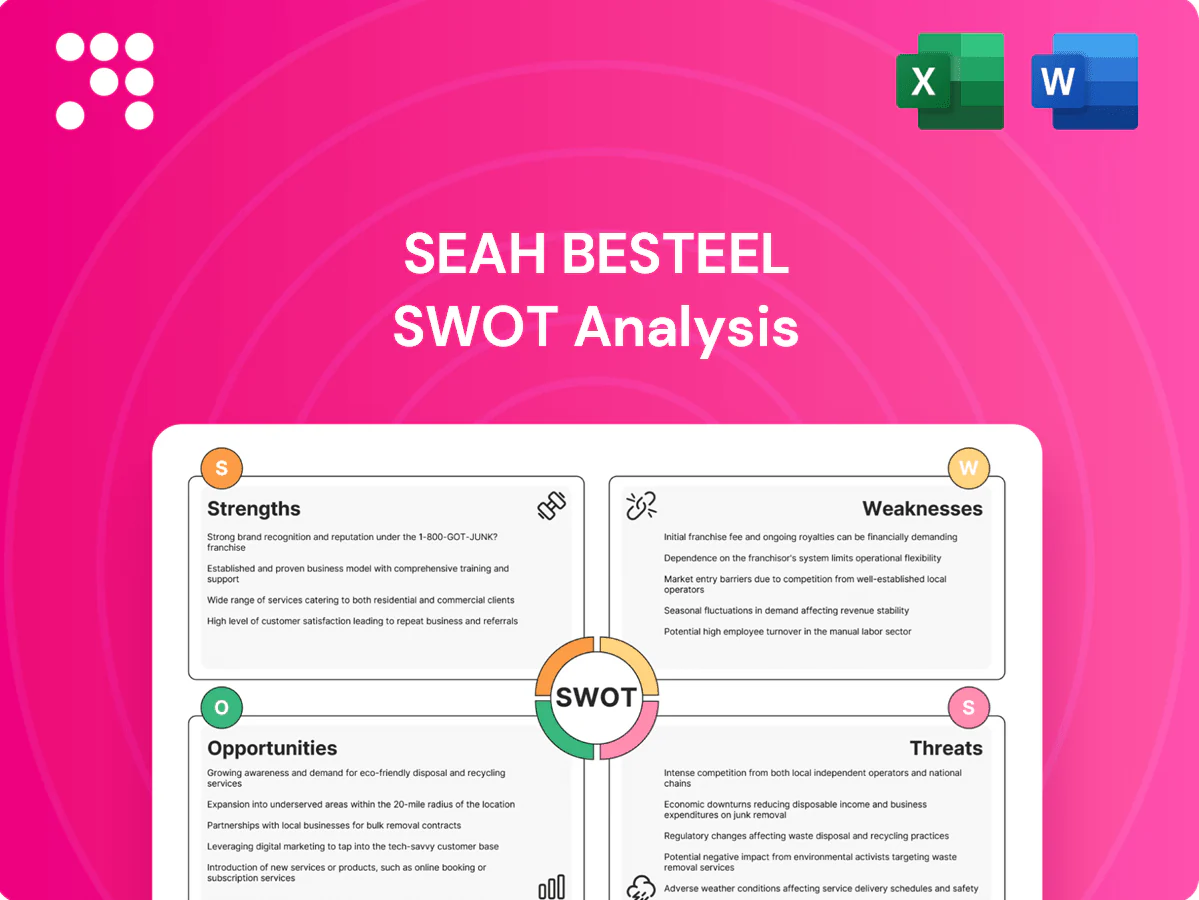
SeAH Besteel SWOT Analysis

Go Beyond the Preview—Access the Full Strategic Report
SeAH Besteel's SWOT highlights resilient domestic steel demand, vertical integration strengths, and exposure to commodity volatility and cyclicality. Purchase the full SWOT analysis for a research-backed, editable Word and Excel package with strategic takeaways. Use it to plan, pitch, and invest with confidence.
Strengths

Leader in special steel
SeAH Besteel commands a strong share in high-grade alloy and carbon steel, with FY2023 revenue of about KRW 3.1 trillion underscoring scale in premium segments. Specialization enables premium pricing and sticky OEM contracts, notably with automotive and machinery makers. Deep metallurgical know-how supports stringent specs and higher margins, buffering the firm from commoditized price wars and cyclical steel spot volatility.
Diverse end-market exposure
Supplying automotive, machinery, shipbuilding and industrial clients spreads demand risk across sectors, so downturns in one are often offset by stability in others. This mix lets SeAH Besteel allocate capacity to higher-margin orders and optimise pricing. Cross-learning of application requirements improves product fit and reduces development time.

Advanced quality and process tech
Focus on clean steel, advanced heat treatment and precision finishing improves product reliability and dimensional consistency, aligning with IATF 16949 and ISO 9001 process controls that meet global OEM standards. These certified processes underpin long-term OEM supply agreements and stabilize revenue streams. Tight process control reduces rework and warranty exposure, lowering operational variability and customer returns.

Global supply chain reach
Established export channels place SeAH Besteel in key regions, while proximity to Korea’s advanced manufacturing base enables quick-turn delivery and tight integration with OEMs. A recognized brand smooths qualification with new customers, and scale in niche grades improves availability and shortens lead times.
- Export reach across Asia, Europe, Americas
- Near Korea manufacturing hubs — fast lead times
- Strong brand aids customer qualification
- Scale in niche grades improves availability
Strategic parent and ecosystem
Affiliation with SeAH Group gives SeAH Besteel procurement leverage and expanded market access, while shared R&D and customer networks accelerate product innovation and commercialization. Financial and operational synergies lower cost per ton through centralized purchasing and optimized logistics, and group credibility strengthens bids for large infrastructure and shipbuilding contracts.
- Group procurement and market access
- Shared R&D and customer network
- Lowered cost per ton via synergies
- Enhanced credibility for large bids
Market-leading high-grade alloy & carbon steel maker posts KRW 3.1 trillion FY2023 revenue
SeAH Besteel holds KRW 3.1 trillion FY2023 revenue with market leadership in high-grade alloy and carbon steel, securing premium pricing and sticky OEM contracts across automotive, machinery, shipbuilding and industrial sectors. Certified processes (IATF 16949, ISO 9001) and advanced metallurgical capabilities raise margins and reduce warranty exposure. SeAH Group affiliation delivers procurement synergies, shared R&D and enhanced bidding credibility.
| Metric | Value |
|---|---|
| FY2023 Revenue | KRW 3.1 trillion |
| Key Certifications | IATF 16949, ISO 9001 |
| Core End Markets | Automotive, Machinery, Shipbuilding, Industrial |
What is included in the product
 Detailed Word Document
Delivers a strategic overview of SeAH Besteel’s internal and external factors, outlining strengths, weaknesses, opportunities and threats to its steel manufacturing, overseas expansion, and value‑chain resilience. Highlights competitive advantages, operational gaps, market growth drivers, and risks shaping its strategic direction.

 Customizable Excel Spreadsheet
Provides a concise SWOT matrix highlighting SeAH Besteel's operational strengths, supply-chain vulnerabilities, market opportunities and competitive threats—ideal for fast strategy alignment and clear stakeholder briefings.
Weaknesses

Automotive demand sensitivity
High exposure to ICE powertrain and chassis grades ties a large portion of SeAH Besteel’s revenues to auto cycles; global light-vehicle production volatility amplifies revenue swings. The shift toward EVs (global EV new-car share ~17% in 2024) alters grade mix and reduces volumes for ICE-focused steels. Qualification cycles of 12–24 months delay pivoting to new EV materials, while customer consolidation (top 10 OEMs account for over 60% of global volume) increases pricing pressure.
Energy- and emission-intensive operations
Steelmaking and heat treatment emit roughly 1.8–2.2 tCO2 per tonne of crude steel, making operations highly energy- and emission-intensive; rising carbon prices (EU ETS ~€100/tCO2 in 2024–25) and compliance costs can meaningfully erode margins. Decarbonization requires substantial capex, often several hundred million dollars for plant retrofit or H2 pilots, while access to competitively priced green electricity and hydrogen remains constrained.

Raw material price volatility
Alloying elements such as nickel, molybdenum and chromium exhibit high price volatility (nickel swung more than 30% across 2022–24), compressing SeAH Besteel margins when pass-through clauses lag market moves. Lagged pass-throughs and contractual caps have not fully protected gross margin, contributing to quarterly margin volatility. Inventory valuation swings under FIFO/LCM can swing reported earnings by several percentage points. Supplier concentration remains a disruption risk for feedstock continuity.

Capital intensity and fixed costs
SeAH Besteel faces high capital intensity and a large fixed-cost base, meaning plants must run near full capacity to sustain profitability; downturns in steel demand quickly compress margins and operating leverage amplifies losses.
Continuous modernization and heavy maintenance spending are required to meet tubular steel quality and environmental standards, constraining free cash flow flexibility.
Scaling production down is costly—flexing capacity without incurring significant per-unit cost penalties is difficult, increasing vulnerability to cyclical swings.
- High fixed costs → strong utilization required
- Downturns rapidly compress margins
- Ongoing capex for modernization reduces cash flow
- Low flexibility to cut costs when demand falls
Product concentration in niche grades
SeAH Besteel s heavy reliance on special-grade steels narrows its addressable market compared with broad flat-steel producers, making volume growth sensitive to niche demand swings; qualification for adjacent applications typically takes 12–18 months, delaying revenue capture. Customer-specific specs reduce interchangeability and raise switching costs, while downstream component diversification remains limited.
- concentration: niche-dependent
- qualification: 12–18 months
- interchangeability: low
- downstream diversification: limited
Auto suppliers squeezed by ICE exposure, carbon prices, alloy swings and 12–24m qualification
Concentrated ICE-grade exposure, high fixed costs and capex needs, carbon-price and alloy volatility pressure margins; long (12–24m) qualification cycles and low product interchangeability limit agility.
| Metric | Value (2024–25) |
|---|---|
| Global EV share | ~17% |
| EU ETS price | ~€100/tCO2 |
| Nickel price swing | >30% (2022–24) |
| Qualification time | 12–24 months |
| Top-10 OEM volume | >60% |
Preview the Actual Deliverable
SeAH Besteel SWOT Analysis
This is the actual SeAH Besteel SWOT analysis document you’ll receive upon purchase—no surprises, just professional quality. The preview below is taken directly from the full report and reflects the real, structured analysis. Buy now to unlock the complete, editable version immediately after checkout.

Go Beyond the Preview—Access the Full Strategic Report
SeAH Besteel's SWOT highlights resilient domestic steel demand, vertical integration strengths, and exposure to commodity volatility and cyclicality. Purchase the full SWOT analysis for a research-backed, editable Word and Excel package with strategic takeaways. Use it to plan, pitch, and invest with confidence.
Strengths
Leader in special steel
SeAH Besteel commands a strong share in high-grade alloy and carbon steel, with FY2023 revenue of about KRW 3.1 trillion underscoring scale in premium segments. Specialization enables premium pricing and sticky OEM contracts, notably with automotive and machinery makers. Deep metallurgical know-how supports stringent specs and higher margins, buffering the firm from commoditized price wars and cyclical steel spot volatility.
Diverse end-market exposure
Supplying automotive, machinery, shipbuilding and industrial clients spreads demand risk across sectors, so downturns in one are often offset by stability in others. This mix lets SeAH Besteel allocate capacity to higher-margin orders and optimise pricing. Cross-learning of application requirements improves product fit and reduces development time.
Advanced quality and process tech
Focus on clean steel, advanced heat treatment and precision finishing improves product reliability and dimensional consistency, aligning with IATF 16949 and ISO 9001 process controls that meet global OEM standards. These certified processes underpin long-term OEM supply agreements and stabilize revenue streams. Tight process control reduces rework and warranty exposure, lowering operational variability and customer returns.
Global supply chain reach
Established export channels place SeAH Besteel in key regions, while proximity to Korea’s advanced manufacturing base enables quick-turn delivery and tight integration with OEMs. A recognized brand smooths qualification with new customers, and scale in niche grades improves availability and shortens lead times.
- Export reach across Asia, Europe, Americas
- Near Korea manufacturing hubs — fast lead times
- Strong brand aids customer qualification
- Scale in niche grades improves availability
Strategic parent and ecosystem
Affiliation with SeAH Group gives SeAH Besteel procurement leverage and expanded market access, while shared R&D and customer networks accelerate product innovation and commercialization. Financial and operational synergies lower cost per ton through centralized purchasing and optimized logistics, and group credibility strengthens bids for large infrastructure and shipbuilding contracts.
- Group procurement and market access
- Shared R&D and customer network
- Lowered cost per ton via synergies
- Enhanced credibility for large bids
Market-leading high-grade alloy & carbon steel maker posts KRW 3.1 trillion FY2023 revenue
SeAH Besteel holds KRW 3.1 trillion FY2023 revenue with market leadership in high-grade alloy and carbon steel, securing premium pricing and sticky OEM contracts across automotive, machinery, shipbuilding and industrial sectors. Certified processes (IATF 16949, ISO 9001) and advanced metallurgical capabilities raise margins and reduce warranty exposure. SeAH Group affiliation delivers procurement synergies, shared R&D and enhanced bidding credibility.
| Metric | Value |
|---|---|
| FY2023 Revenue | KRW 3.1 trillion |
| Key Certifications | IATF 16949, ISO 9001 |
| Core End Markets | Automotive, Machinery, Shipbuilding, Industrial |
What is included in the product
Detailed Word Document
Delivers a strategic overview of SeAH Besteel’s internal and external factors, outlining strengths, weaknesses, opportunities and threats to its steel manufacturing, overseas expansion, and value‑chain resilience. Highlights competitive advantages, operational gaps, market growth drivers, and risks shaping its strategic direction.
Customizable Excel Spreadsheet
Provides a concise SWOT matrix highlighting SeAH Besteel's operational strengths, supply-chain vulnerabilities, market opportunities and competitive threats—ideal for fast strategy alignment and clear stakeholder briefings.
Weaknesses
Automotive demand sensitivity
High exposure to ICE powertrain and chassis grades ties a large portion of SeAH Besteel’s revenues to auto cycles; global light-vehicle production volatility amplifies revenue swings. The shift toward EVs (global EV new-car share ~17% in 2024) alters grade mix and reduces volumes for ICE-focused steels. Qualification cycles of 12–24 months delay pivoting to new EV materials, while customer consolidation (top 10 OEMs account for over 60% of global volume) increases pricing pressure.
Energy- and emission-intensive operations
Steelmaking and heat treatment emit roughly 1.8–2.2 tCO2 per tonne of crude steel, making operations highly energy- and emission-intensive; rising carbon prices (EU ETS ~€100/tCO2 in 2024–25) and compliance costs can meaningfully erode margins. Decarbonization requires substantial capex, often several hundred million dollars for plant retrofit or H2 pilots, while access to competitively priced green electricity and hydrogen remains constrained.
Raw material price volatility
Alloying elements such as nickel, molybdenum and chromium exhibit high price volatility (nickel swung more than 30% across 2022–24), compressing SeAH Besteel margins when pass-through clauses lag market moves. Lagged pass-throughs and contractual caps have not fully protected gross margin, contributing to quarterly margin volatility. Inventory valuation swings under FIFO/LCM can swing reported earnings by several percentage points. Supplier concentration remains a disruption risk for feedstock continuity.
Capital intensity and fixed costs
SeAH Besteel faces high capital intensity and a large fixed-cost base, meaning plants must run near full capacity to sustain profitability; downturns in steel demand quickly compress margins and operating leverage amplifies losses.
Continuous modernization and heavy maintenance spending are required to meet tubular steel quality and environmental standards, constraining free cash flow flexibility.
Scaling production down is costly—flexing capacity without incurring significant per-unit cost penalties is difficult, increasing vulnerability to cyclical swings.
- High fixed costs → strong utilization required
- Downturns rapidly compress margins
- Ongoing capex for modernization reduces cash flow
- Low flexibility to cut costs when demand falls
Product concentration in niche grades
SeAH Besteel s heavy reliance on special-grade steels narrows its addressable market compared with broad flat-steel producers, making volume growth sensitive to niche demand swings; qualification for adjacent applications typically takes 12–18 months, delaying revenue capture. Customer-specific specs reduce interchangeability and raise switching costs, while downstream component diversification remains limited.
- concentration: niche-dependent
- qualification: 12–18 months
- interchangeability: low
- downstream diversification: limited
Auto suppliers squeezed by ICE exposure, carbon prices, alloy swings and 12–24m qualification
Concentrated ICE-grade exposure, high fixed costs and capex needs, carbon-price and alloy volatility pressure margins; long (12–24m) qualification cycles and low product interchangeability limit agility.
| Metric | Value (2024–25) |
|---|---|
| Global EV share | ~17% |
| EU ETS price | ~€100/tCO2 |
| Nickel price swing | >30% (2022–24) |
| Qualification time | 12–24 months |
| Top-10 OEM volume | >60% |
Preview the Actual Deliverable
SeAH Besteel SWOT Analysis
This is the actual SeAH Besteel SWOT analysis document you’ll receive upon purchase—no surprises, just professional quality. The preview below is taken directly from the full report and reflects the real, structured analysis. Buy now to unlock the complete, editable version immediately after checkout.
Original: $10.00
-65%$10.00
$3.50Description
Go Beyond the Preview—Access the Full Strategic Report
SeAH Besteel's SWOT highlights resilient domestic steel demand, vertical integration strengths, and exposure to commodity volatility and cyclicality. Purchase the full SWOT analysis for a research-backed, editable Word and Excel package with strategic takeaways. Use it to plan, pitch, and invest with confidence.
Strengths
Leader in special steel
SeAH Besteel commands a strong share in high-grade alloy and carbon steel, with FY2023 revenue of about KRW 3.1 trillion underscoring scale in premium segments. Specialization enables premium pricing and sticky OEM contracts, notably with automotive and machinery makers. Deep metallurgical know-how supports stringent specs and higher margins, buffering the firm from commoditized price wars and cyclical steel spot volatility.
Diverse end-market exposure
Supplying automotive, machinery, shipbuilding and industrial clients spreads demand risk across sectors, so downturns in one are often offset by stability in others. This mix lets SeAH Besteel allocate capacity to higher-margin orders and optimise pricing. Cross-learning of application requirements improves product fit and reduces development time.
Advanced quality and process tech
Focus on clean steel, advanced heat treatment and precision finishing improves product reliability and dimensional consistency, aligning with IATF 16949 and ISO 9001 process controls that meet global OEM standards. These certified processes underpin long-term OEM supply agreements and stabilize revenue streams. Tight process control reduces rework and warranty exposure, lowering operational variability and customer returns.
Global supply chain reach
Established export channels place SeAH Besteel in key regions, while proximity to Korea’s advanced manufacturing base enables quick-turn delivery and tight integration with OEMs. A recognized brand smooths qualification with new customers, and scale in niche grades improves availability and shortens lead times.
- Export reach across Asia, Europe, Americas
- Near Korea manufacturing hubs — fast lead times
- Strong brand aids customer qualification
- Scale in niche grades improves availability
Strategic parent and ecosystem
Affiliation with SeAH Group gives SeAH Besteel procurement leverage and expanded market access, while shared R&D and customer networks accelerate product innovation and commercialization. Financial and operational synergies lower cost per ton through centralized purchasing and optimized logistics, and group credibility strengthens bids for large infrastructure and shipbuilding contracts.
- Group procurement and market access
- Shared R&D and customer network
- Lowered cost per ton via synergies
- Enhanced credibility for large bids
Market-leading high-grade alloy & carbon steel maker posts KRW 3.1 trillion FY2023 revenue
SeAH Besteel holds KRW 3.1 trillion FY2023 revenue with market leadership in high-grade alloy and carbon steel, securing premium pricing and sticky OEM contracts across automotive, machinery, shipbuilding and industrial sectors. Certified processes (IATF 16949, ISO 9001) and advanced metallurgical capabilities raise margins and reduce warranty exposure. SeAH Group affiliation delivers procurement synergies, shared R&D and enhanced bidding credibility.
| Metric | Value |
|---|---|
| FY2023 Revenue | KRW 3.1 trillion |
| Key Certifications | IATF 16949, ISO 9001 |
| Core End Markets | Automotive, Machinery, Shipbuilding, Industrial |
What is included in the product
Detailed Word Document
Delivers a strategic overview of SeAH Besteel’s internal and external factors, outlining strengths, weaknesses, opportunities and threats to its steel manufacturing, overseas expansion, and value‑chain resilience. Highlights competitive advantages, operational gaps, market growth drivers, and risks shaping its strategic direction.
Customizable Excel Spreadsheet
Provides a concise SWOT matrix highlighting SeAH Besteel's operational strengths, supply-chain vulnerabilities, market opportunities and competitive threats—ideal for fast strategy alignment and clear stakeholder briefings.
Weaknesses
Automotive demand sensitivity
High exposure to ICE powertrain and chassis grades ties a large portion of SeAH Besteel’s revenues to auto cycles; global light-vehicle production volatility amplifies revenue swings. The shift toward EVs (global EV new-car share ~17% in 2024) alters grade mix and reduces volumes for ICE-focused steels. Qualification cycles of 12–24 months delay pivoting to new EV materials, while customer consolidation (top 10 OEMs account for over 60% of global volume) increases pricing pressure.
Energy- and emission-intensive operations
Steelmaking and heat treatment emit roughly 1.8–2.2 tCO2 per tonne of crude steel, making operations highly energy- and emission-intensive; rising carbon prices (EU ETS ~€100/tCO2 in 2024–25) and compliance costs can meaningfully erode margins. Decarbonization requires substantial capex, often several hundred million dollars for plant retrofit or H2 pilots, while access to competitively priced green electricity and hydrogen remains constrained.
Raw material price volatility
Alloying elements such as nickel, molybdenum and chromium exhibit high price volatility (nickel swung more than 30% across 2022–24), compressing SeAH Besteel margins when pass-through clauses lag market moves. Lagged pass-throughs and contractual caps have not fully protected gross margin, contributing to quarterly margin volatility. Inventory valuation swings under FIFO/LCM can swing reported earnings by several percentage points. Supplier concentration remains a disruption risk for feedstock continuity.
Capital intensity and fixed costs
SeAH Besteel faces high capital intensity and a large fixed-cost base, meaning plants must run near full capacity to sustain profitability; downturns in steel demand quickly compress margins and operating leverage amplifies losses.
Continuous modernization and heavy maintenance spending are required to meet tubular steel quality and environmental standards, constraining free cash flow flexibility.
Scaling production down is costly—flexing capacity without incurring significant per-unit cost penalties is difficult, increasing vulnerability to cyclical swings.
- High fixed costs → strong utilization required
- Downturns rapidly compress margins
- Ongoing capex for modernization reduces cash flow
- Low flexibility to cut costs when demand falls
Product concentration in niche grades
SeAH Besteel s heavy reliance on special-grade steels narrows its addressable market compared with broad flat-steel producers, making volume growth sensitive to niche demand swings; qualification for adjacent applications typically takes 12–18 months, delaying revenue capture. Customer-specific specs reduce interchangeability and raise switching costs, while downstream component diversification remains limited.
- concentration: niche-dependent
- qualification: 12–18 months
- interchangeability: low
- downstream diversification: limited
Auto suppliers squeezed by ICE exposure, carbon prices, alloy swings and 12–24m qualification
Concentrated ICE-grade exposure, high fixed costs and capex needs, carbon-price and alloy volatility pressure margins; long (12–24m) qualification cycles and low product interchangeability limit agility.
| Metric | Value (2024–25) |
|---|---|
| Global EV share | ~17% |
| EU ETS price | ~€100/tCO2 |
| Nickel price swing | >30% (2022–24) |
| Qualification time | 12–24 months |
| Top-10 OEM volume | >60% |
Preview the Actual Deliverable
SeAH Besteel SWOT Analysis
This is the actual SeAH Besteel SWOT analysis document you’ll receive upon purchase—no surprises, just professional quality. The preview below is taken directly from the full report and reflects the real, structured analysis. Buy now to unlock the complete, editable version immediately after checkout.











