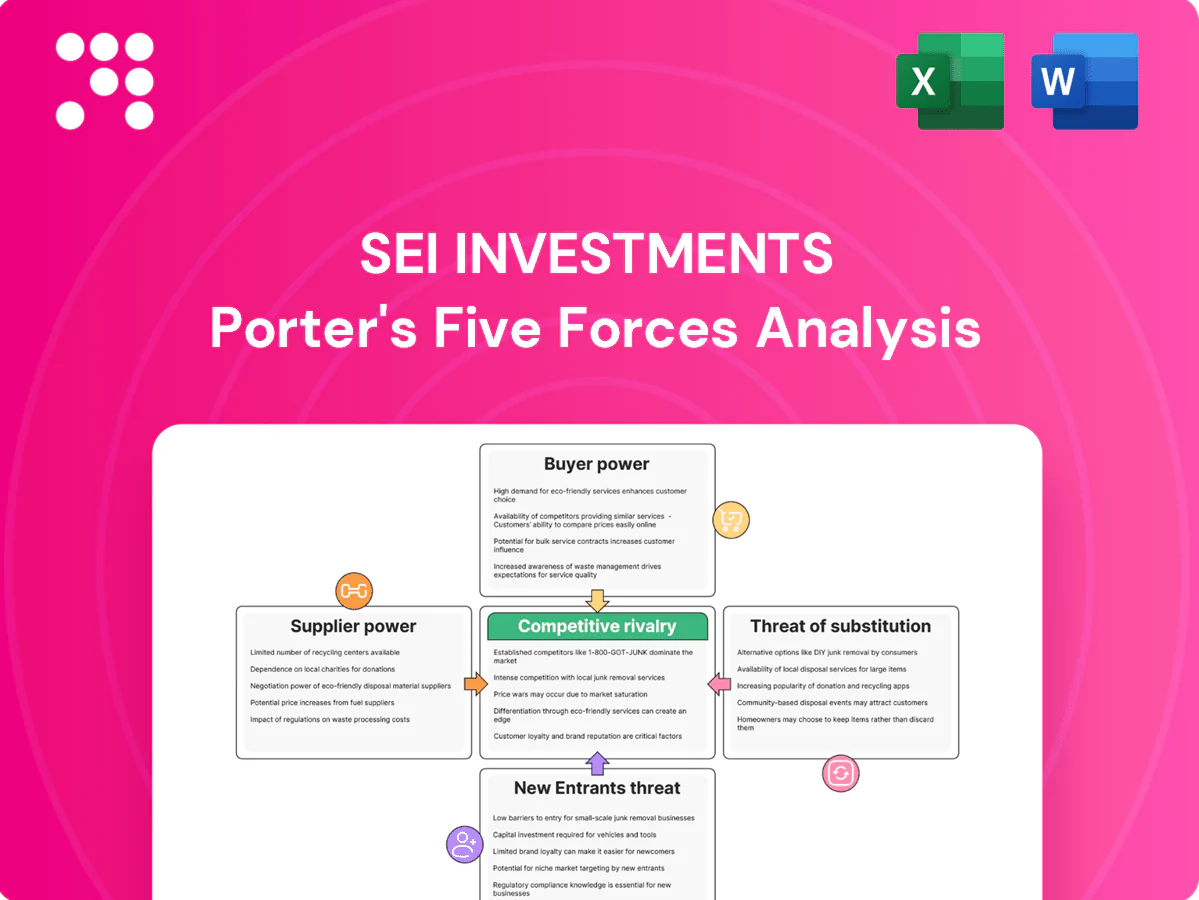
SEI Investments Porter's Five Forces Analysis

A Must-Have Tool for Decision-Makers
SEI Investments faces moderate buyer power, persistent regulatory and technological pressures, and competitive rivalry shaped by scale and product differentiation. This snapshot highlights key threats from fee compression and fintech incumbents while noting SEI’s distribution advantages and service moat. This brief snapshot only scratches the surface—unlock the full Porter's Five Forces Analysis to explore SEI Investments’s competitive dynamics, market pressures, and strategic advantages in detail.
Suppliers Bargaining Power

Concentrated tech/data vendors
SEI depends on a small set of critical suppliers for cloud infrastructure, market data and cybersecurity. Hyperscalers hold strong pricing power (AWS ~32%, Microsoft Azure ~23%, Google Cloud ~11% in 2024), limiting alternatives. Market-data concentration—Bloomberg with roughly 325,000 terminals and large Refinitiv/S&P footprints—plus deep integrations raise switching costs. SEI mitigates through multi-vendor architectures and long-term agreements.
Specialized talent dependency
Highly skilled engineers, quants and compliance experts form a supplier market that drives wage pressure and retention costs, particularly as SEI managed roughly $1.2 trillion in client assets in 2024 and relies on platform expertise; tight talent markets have elevated compensation demands. Knowledge concentration in legacy platforms amplifies bargaining power of key staff, while SEI mitigates risk via training pipelines and automation investments.

Sub-advisers and product partners
SEI relies on hundreds of third-party sub-advisers and product partners for certain strategies, and high-performing niche managers can command fee premiums often ranging from 10 to 150 basis points, shifting economics in their favor. Performance cycles and capacity constraints periodically increase managers’ bargaining power, pressuring SEI’s fee negotiation. Diversifying mandates across multiple partners reduces single-partner dependence and concentration risk.

Financial market utilities
Software/IP licensors
Core components such as databases, analytics and risk models are frequently licensed third-party IP, and price escalators plus audit clauses in contracts strengthen suppliers’ negotiating leverage; replacing embedded IP is costly and operationally risky. As of 2024 SEI continues to invest in proprietary platforms and open standards to reduce dependency and limit margin exposure.
- Supplier leverage: licensed core IP
- Contract pressure: escalators and audits
- Switch cost: high integration and migration risk
- Mitigants: SEI proprietary IP and open-standards adoption (2024)
Hyperscaler and data vendor power raises costs; multi-vendor builds and contracts reduce risk
Suppliers exert medium-high power: hyperscalers, market-data vendors and talent concentration raise costs and switching barriers; financial utilities and licensed IP add non-negotiable fees and audit risk. SEI softens pressure via multi-vendor architectures, long-term contracts, proprietary build and redundancy investments in 2024.
| Metric | 2024 |
|---|---|
| AWS/Azure/GCP share | 32%/23%/11% |
| Bloomberg terminals | 325,000 |
| SEI AUM | $1.2T |
| Global custodians AUC | $100T |
| Manager fee premium | 10–150 bps |
What is included in the product
 Detailed Word Document
Uncovers key drivers of competition, customer influence, and market entry risks tailored to SEI Investments, providing detailed analysis of each competitive force, identification of disruptive threats and substitutes, and evaluation of supplier and buyer power to inform strategic positioning and investor materials.

 Customizable Excel Spreadsheet
A concise, one-sheet Porter’s Five Forces for SEI Investments that visualizes competitive pressure, lets you tweak force levels for scenario planning, and produces deck-ready charts—ideal for quick strategic decisions without complex tools.
Customers Bargaining Power

Large institutional clients
Large institutional clients—banks, insurers and asset managers—buy at scale and run fiercely competitive RFPs; in 2024 institutions controlled trillions (SEI reported roughly $1.0 trillion AUA), enabling steep pricing concessions and bespoke service asks. Consolidation among buyers concentrates power, with top-tier institutions negotiating volume discounts and roadmap influence. SEI must justify value via demonstrable outcomes, binding SLAs and product roadmap sway.
High switching costs, still negotiated
High switching costs make platform migrations costly and risky for clients, helping preserve SEI's position given its ~$1.2 trillion in client assets under administration in 2024. Buyers still exploit renewal windows to renegotiate fees, pressuring margins. Improved data portability and APIs are making vendor offerings more comparable. SEI counters with client stickiness, dedicated migration support and multi-year contracts to lock in revenue.

Outcome and compliance focus
Clients prioritize risk reduction, uptime, and regulatory compliance, driving negotiations toward penalty-backed SLAs that shift operational risk and justify higher pricing. Demonstrable audit readiness and mature control frameworks materially sway contract terms and renewal decisions. SEI’s documented controls and certifications enable conversion of compliance strength into premium positioning and fee differentiation.

Modular buying behavior
Advisors and institutions increasingly cherry-pick modules (trading, reporting, ops), driving unbundling that raises price transparency and buyer leverage; integration ease becomes a decisive bargaining chip as firms compare total-cost-of-ownership across vendors. SEI’s open-architecture must demonstrate measurable total-cost advantages and seamless integration to retain and grow client relationships.
Budget cycles and fee pressure
Market downturns drive clients to cut costs and consolidate vendors, with buyers in 2024 increasingly demanding usage- or outcome-based pricing and multi-year discounts that trade margin for retention; SEI, with roughly $1.1 trillion in assets serviced in 2024, offsets pressure by pairing rate cards with analytics and automation savings to protect net margins.
- Vendor consolidation: higher
- Outcome-pricing demand: rising
- Multi-year discounts: margin trade-off
- SEI 2024 AUA/AUM: ~$1.1T
Institutions leverage platforms; $1.1T AUM drives outcome pricing
Institutional buyers exert strong leverage—SEI reported ~$1.1T assets serviced in 2024—pushing discounts, bespoke SLAs and module-level unbundling; switching costs and compliance strength limit churn but renewals remain high-pressure negotiations. Outcome-based and multi-year pricing are rising, forcing SEI to prove TCO and uptime advantages.
| Metric | 2024 | Impact |
|---|---|---|
| SEI AUA/AUM | $1.1T | High buyer leverage |
| Unbundling | Rising | Price transparency |
| Outcome pricing | Increasing | Margin pressure |
Preview Before You Purchase
SEI Investments Porter's Five Forces Analysis
This preview shows the exact SEI Investments Porter's Five Forces analysis you'll receive immediately after purchase—no surprises or placeholders. The document displayed here is the complete, professionally formatted file, ready for download and use the moment you buy. You're looking at the final deliverable available instantly after payment.

A Must-Have Tool for Decision-Makers
SEI Investments faces moderate buyer power, persistent regulatory and technological pressures, and competitive rivalry shaped by scale and product differentiation. This snapshot highlights key threats from fee compression and fintech incumbents while noting SEI’s distribution advantages and service moat. This brief snapshot only scratches the surface—unlock the full Porter's Five Forces Analysis to explore SEI Investments’s competitive dynamics, market pressures, and strategic advantages in detail.
Suppliers Bargaining Power
Concentrated tech/data vendors
SEI depends on a small set of critical suppliers for cloud infrastructure, market data and cybersecurity. Hyperscalers hold strong pricing power (AWS ~32%, Microsoft Azure ~23%, Google Cloud ~11% in 2024), limiting alternatives. Market-data concentration—Bloomberg with roughly 325,000 terminals and large Refinitiv/S&P footprints—plus deep integrations raise switching costs. SEI mitigates through multi-vendor architectures and long-term agreements.
Specialized talent dependency
Highly skilled engineers, quants and compliance experts form a supplier market that drives wage pressure and retention costs, particularly as SEI managed roughly $1.2 trillion in client assets in 2024 and relies on platform expertise; tight talent markets have elevated compensation demands. Knowledge concentration in legacy platforms amplifies bargaining power of key staff, while SEI mitigates risk via training pipelines and automation investments.
Sub-advisers and product partners
SEI relies on hundreds of third-party sub-advisers and product partners for certain strategies, and high-performing niche managers can command fee premiums often ranging from 10 to 150 basis points, shifting economics in their favor. Performance cycles and capacity constraints periodically increase managers’ bargaining power, pressuring SEI’s fee negotiation. Diversifying mandates across multiple partners reduces single-partner dependence and concentration risk.
Financial market utilities
Software/IP licensors
Core components such as databases, analytics and risk models are frequently licensed third-party IP, and price escalators plus audit clauses in contracts strengthen suppliers’ negotiating leverage; replacing embedded IP is costly and operationally risky. As of 2024 SEI continues to invest in proprietary platforms and open standards to reduce dependency and limit margin exposure.
- Supplier leverage: licensed core IP
- Contract pressure: escalators and audits
- Switch cost: high integration and migration risk
- Mitigants: SEI proprietary IP and open-standards adoption (2024)
Hyperscaler and data vendor power raises costs; multi-vendor builds and contracts reduce risk
Suppliers exert medium-high power: hyperscalers, market-data vendors and talent concentration raise costs and switching barriers; financial utilities and licensed IP add non-negotiable fees and audit risk. SEI softens pressure via multi-vendor architectures, long-term contracts, proprietary build and redundancy investments in 2024.
| Metric | 2024 |
|---|---|
| AWS/Azure/GCP share | 32%/23%/11% |
| Bloomberg terminals | 325,000 |
| SEI AUM | $1.2T |
| Global custodians AUC | $100T |
| Manager fee premium | 10–150 bps |
What is included in the product
Detailed Word Document
Uncovers key drivers of competition, customer influence, and market entry risks tailored to SEI Investments, providing detailed analysis of each competitive force, identification of disruptive threats and substitutes, and evaluation of supplier and buyer power to inform strategic positioning and investor materials.
Customizable Excel Spreadsheet
A concise, one-sheet Porter’s Five Forces for SEI Investments that visualizes competitive pressure, lets you tweak force levels for scenario planning, and produces deck-ready charts—ideal for quick strategic decisions without complex tools.
Customers Bargaining Power
Large institutional clients
Large institutional clients—banks, insurers and asset managers—buy at scale and run fiercely competitive RFPs; in 2024 institutions controlled trillions (SEI reported roughly $1.0 trillion AUA), enabling steep pricing concessions and bespoke service asks. Consolidation among buyers concentrates power, with top-tier institutions negotiating volume discounts and roadmap influence. SEI must justify value via demonstrable outcomes, binding SLAs and product roadmap sway.
High switching costs, still negotiated
High switching costs make platform migrations costly and risky for clients, helping preserve SEI's position given its ~$1.2 trillion in client assets under administration in 2024. Buyers still exploit renewal windows to renegotiate fees, pressuring margins. Improved data portability and APIs are making vendor offerings more comparable. SEI counters with client stickiness, dedicated migration support and multi-year contracts to lock in revenue.
Outcome and compliance focus
Clients prioritize risk reduction, uptime, and regulatory compliance, driving negotiations toward penalty-backed SLAs that shift operational risk and justify higher pricing. Demonstrable audit readiness and mature control frameworks materially sway contract terms and renewal decisions. SEI’s documented controls and certifications enable conversion of compliance strength into premium positioning and fee differentiation.
Modular buying behavior
Advisors and institutions increasingly cherry-pick modules (trading, reporting, ops), driving unbundling that raises price transparency and buyer leverage; integration ease becomes a decisive bargaining chip as firms compare total-cost-of-ownership across vendors. SEI’s open-architecture must demonstrate measurable total-cost advantages and seamless integration to retain and grow client relationships.
Budget cycles and fee pressure
Market downturns drive clients to cut costs and consolidate vendors, with buyers in 2024 increasingly demanding usage- or outcome-based pricing and multi-year discounts that trade margin for retention; SEI, with roughly $1.1 trillion in assets serviced in 2024, offsets pressure by pairing rate cards with analytics and automation savings to protect net margins.
- Vendor consolidation: higher
- Outcome-pricing demand: rising
- Multi-year discounts: margin trade-off
- SEI 2024 AUA/AUM: ~$1.1T
Institutions leverage platforms; $1.1T AUM drives outcome pricing
Institutional buyers exert strong leverage—SEI reported ~$1.1T assets serviced in 2024—pushing discounts, bespoke SLAs and module-level unbundling; switching costs and compliance strength limit churn but renewals remain high-pressure negotiations. Outcome-based and multi-year pricing are rising, forcing SEI to prove TCO and uptime advantages.
| Metric | 2024 | Impact |
|---|---|---|
| SEI AUA/AUM | $1.1T | High buyer leverage |
| Unbundling | Rising | Price transparency |
| Outcome pricing | Increasing | Margin pressure |
Preview Before You Purchase
SEI Investments Porter's Five Forces Analysis
This preview shows the exact SEI Investments Porter's Five Forces analysis you'll receive immediately after purchase—no surprises or placeholders. The document displayed here is the complete, professionally formatted file, ready for download and use the moment you buy. You're looking at the final deliverable available instantly after payment.
Description
A Must-Have Tool for Decision-Makers
SEI Investments faces moderate buyer power, persistent regulatory and technological pressures, and competitive rivalry shaped by scale and product differentiation. This snapshot highlights key threats from fee compression and fintech incumbents while noting SEI’s distribution advantages and service moat. This brief snapshot only scratches the surface—unlock the full Porter's Five Forces Analysis to explore SEI Investments’s competitive dynamics, market pressures, and strategic advantages in detail.
Suppliers Bargaining Power
Concentrated tech/data vendors
SEI depends on a small set of critical suppliers for cloud infrastructure, market data and cybersecurity. Hyperscalers hold strong pricing power (AWS ~32%, Microsoft Azure ~23%, Google Cloud ~11% in 2024), limiting alternatives. Market-data concentration—Bloomberg with roughly 325,000 terminals and large Refinitiv/S&P footprints—plus deep integrations raise switching costs. SEI mitigates through multi-vendor architectures and long-term agreements.
Specialized talent dependency
Highly skilled engineers, quants and compliance experts form a supplier market that drives wage pressure and retention costs, particularly as SEI managed roughly $1.2 trillion in client assets in 2024 and relies on platform expertise; tight talent markets have elevated compensation demands. Knowledge concentration in legacy platforms amplifies bargaining power of key staff, while SEI mitigates risk via training pipelines and automation investments.
Sub-advisers and product partners
SEI relies on hundreds of third-party sub-advisers and product partners for certain strategies, and high-performing niche managers can command fee premiums often ranging from 10 to 150 basis points, shifting economics in their favor. Performance cycles and capacity constraints periodically increase managers’ bargaining power, pressuring SEI’s fee negotiation. Diversifying mandates across multiple partners reduces single-partner dependence and concentration risk.
Financial market utilities
Software/IP licensors
Core components such as databases, analytics and risk models are frequently licensed third-party IP, and price escalators plus audit clauses in contracts strengthen suppliers’ negotiating leverage; replacing embedded IP is costly and operationally risky. As of 2024 SEI continues to invest in proprietary platforms and open standards to reduce dependency and limit margin exposure.
- Supplier leverage: licensed core IP
- Contract pressure: escalators and audits
- Switch cost: high integration and migration risk
- Mitigants: SEI proprietary IP and open-standards adoption (2024)
Hyperscaler and data vendor power raises costs; multi-vendor builds and contracts reduce risk
Suppliers exert medium-high power: hyperscalers, market-data vendors and talent concentration raise costs and switching barriers; financial utilities and licensed IP add non-negotiable fees and audit risk. SEI softens pressure via multi-vendor architectures, long-term contracts, proprietary build and redundancy investments in 2024.
| Metric | 2024 |
|---|---|
| AWS/Azure/GCP share | 32%/23%/11% |
| Bloomberg terminals | 325,000 |
| SEI AUM | $1.2T |
| Global custodians AUC | $100T |
| Manager fee premium | 10–150 bps |
What is included in the product
Detailed Word Document
Uncovers key drivers of competition, customer influence, and market entry risks tailored to SEI Investments, providing detailed analysis of each competitive force, identification of disruptive threats and substitutes, and evaluation of supplier and buyer power to inform strategic positioning and investor materials.
Customizable Excel Spreadsheet
A concise, one-sheet Porter’s Five Forces for SEI Investments that visualizes competitive pressure, lets you tweak force levels for scenario planning, and produces deck-ready charts—ideal for quick strategic decisions without complex tools.
Customers Bargaining Power
Large institutional clients
Large institutional clients—banks, insurers and asset managers—buy at scale and run fiercely competitive RFPs; in 2024 institutions controlled trillions (SEI reported roughly $1.0 trillion AUA), enabling steep pricing concessions and bespoke service asks. Consolidation among buyers concentrates power, with top-tier institutions negotiating volume discounts and roadmap influence. SEI must justify value via demonstrable outcomes, binding SLAs and product roadmap sway.
High switching costs, still negotiated
High switching costs make platform migrations costly and risky for clients, helping preserve SEI's position given its ~$1.2 trillion in client assets under administration in 2024. Buyers still exploit renewal windows to renegotiate fees, pressuring margins. Improved data portability and APIs are making vendor offerings more comparable. SEI counters with client stickiness, dedicated migration support and multi-year contracts to lock in revenue.
Outcome and compliance focus
Clients prioritize risk reduction, uptime, and regulatory compliance, driving negotiations toward penalty-backed SLAs that shift operational risk and justify higher pricing. Demonstrable audit readiness and mature control frameworks materially sway contract terms and renewal decisions. SEI’s documented controls and certifications enable conversion of compliance strength into premium positioning and fee differentiation.
Modular buying behavior
Advisors and institutions increasingly cherry-pick modules (trading, reporting, ops), driving unbundling that raises price transparency and buyer leverage; integration ease becomes a decisive bargaining chip as firms compare total-cost-of-ownership across vendors. SEI’s open-architecture must demonstrate measurable total-cost advantages and seamless integration to retain and grow client relationships.
Budget cycles and fee pressure
Market downturns drive clients to cut costs and consolidate vendors, with buyers in 2024 increasingly demanding usage- or outcome-based pricing and multi-year discounts that trade margin for retention; SEI, with roughly $1.1 trillion in assets serviced in 2024, offsets pressure by pairing rate cards with analytics and automation savings to protect net margins.
- Vendor consolidation: higher
- Outcome-pricing demand: rising
- Multi-year discounts: margin trade-off
- SEI 2024 AUA/AUM: ~$1.1T
Institutions leverage platforms; $1.1T AUM drives outcome pricing
Institutional buyers exert strong leverage—SEI reported ~$1.1T assets serviced in 2024—pushing discounts, bespoke SLAs and module-level unbundling; switching costs and compliance strength limit churn but renewals remain high-pressure negotiations. Outcome-based and multi-year pricing are rising, forcing SEI to prove TCO and uptime advantages.
| Metric | 2024 | Impact |
|---|---|---|
| SEI AUA/AUM | $1.1T | High buyer leverage |
| Unbundling | Rising | Price transparency |
| Outcome pricing | Increasing | Margin pressure |
Preview Before You Purchase
SEI Investments Porter's Five Forces Analysis
This preview shows the exact SEI Investments Porter's Five Forces analysis you'll receive immediately after purchase—no surprises or placeholders. The document displayed here is the complete, professionally formatted file, ready for download and use the moment you buy. You're looking at the final deliverable available instantly after payment.











