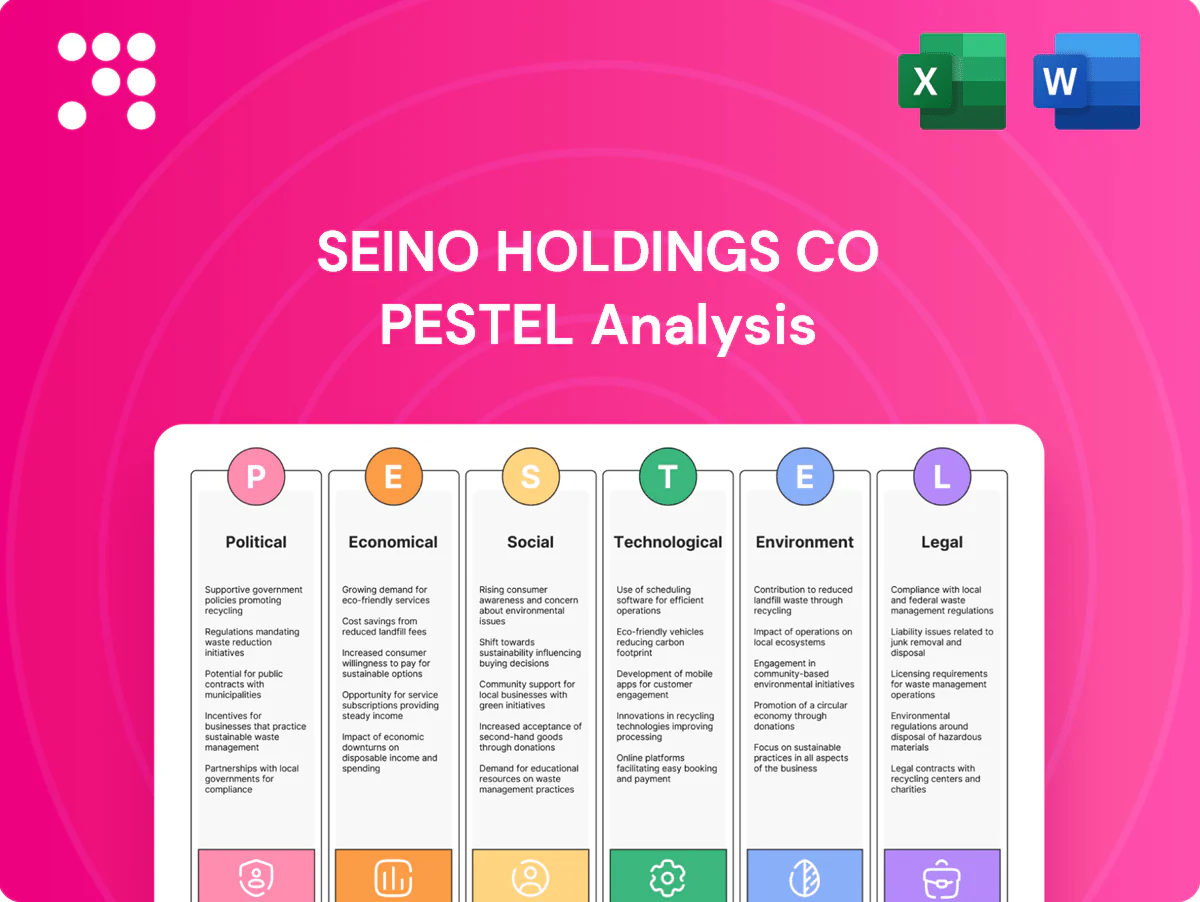
Seino Holdings Co PESTLE Analysis

Your Shortcut to Market Insight Starts Here
Discover how political shifts, economic cycles, and technological change are reshaping Seino Holdings Co in our concise PESTLE Analysis. Gain actionable risk and opportunity insights to sharpen strategy and investment decisions. Purchase the full report for the complete, ready-to-use breakdown now.
Political factors

Japan transport policy direction
MLIT national logistics strategies in 2024 increasingly steer trucking capacity, safety standards and modal-shift incentives, affecting fleet utilization and corridor prioritization. Policy pushes for consolidation of Japan's roughly 47,000 small carriers could reshape competition and compress pricing power for mid-size operators. Seino must align network planning with designated logistics hubs and last-mile guidelines to retain market share. Public–private pilots continue unlocking subsidies for digital and green upgrades.
Infrastructure and toll road decisions
Highway toll levels and maintenance schedules directly affect route economics and delivery times, especially across Japan's national expressway network of over 9,500 km. Government investments in port and airport upgrades shape international forwarding efficiency and modal connections. Construction disruptions force detours and higher costs, while Seino Holdings (TYO: 9063) gains from early visibility into corridor prioritization to adjust routing and capacity.

Geopolitical trade stance
Japan's trade pacts such as CPTPP and the Japan-EU EPA streamline customs rules that affect lane viability, while sanctions regimes alter clearance times and costs; China and the US together account for roughly 42% of Japan's exports, making reroutes from bilateral tensions material for Seino. Recent export control tightening on semiconductors and dual-use goods (2023–24) has raised compliance scrutiny and handling complexity. Seino needs agile brokerage, enhanced compliance tech, and rapid rerouting to protect throughput and margins.

Local government regulations
Disaster preparedness policy
National resilience plans in Japan prioritize logistics continuity for earthquakes, floods and the 3–4 typhoons that make landfall annually, elevating carriers to critical infrastructure status. Government stockpiling and emergency contracts—backed by ¥1 trillion+ recent disaster allocations—create surge demand that can boost freight volumes. Compliance with mandated drills and designated routes is required; Seino’s role as a lifeline operator strengthens bargaining power for stable public–private partnerships.
- 3–4 typhoons/year
- ¥1T+ recent disaster allocations
- Mandatory drills & designated routes
- Surge demand via emergency contracts
- Seino positioned as lifeline partner
MLIT 2024: ~47,000 carriers consolidated; capacity and low-carbon demand rise
MLIT 2024 logistics policy, consolidation of ~47,000 small carriers and designated hubs shift capacity and pricing; Seino (TYO:9063) must adapt routing and fleet mix. Toll levels, 9,500 km expressways and port investments affect costs; CPTPP/Japan‑EU and China+US (~42% of exports) make trade tensions material. Green Growth 46% GHG cut by 2030 and ¥1T+ disaster funds raise demand for low‑carbon, resilient operators.
| Metric | Value |
|---|---|
| Small carriers | ~47,000 |
| Expressways | 9,500 km |
| China+US share | ~42% of exports |
| GHG target | 46% by 2030 |
| Disaster funds | ¥1T+ |
What is included in the product
 Detailed Word Document
Explores how macro-environmental forces uniquely affect Seino Holdings Co across Political, Economic, Social, Technological, Environmental, and Legal dimensions, with data-backed trends and industry-specific examples. Designed to help executives and investors spot risks, opportunities, and actionable scenarios for strategy and funding.

 Customizable Excel Spreadsheet
A concise, visually segmented PESTLE summary of Seino Holdings Co that’s easily droppable into presentations and shareable across teams, enabling quick alignment on external risks, regulatory shifts, and market positioning during planning sessions.
Economic factors

Fuel and energy price volatility
Diesel and electricity costs for Seino track global oil — Brent averaged about $86/barrel in 2024 — and domestic energy policy, causing retail diesel swings that pass to customers with fuel surcharges often lagging 30–60 days and compressing margins. Electrification shifts total cost of ownership across fleet life cycles as electric drivetrains can reduce energy cost per km by roughly 30–50%. Active hedging and long‑term energy contracting are therefore critical risk mitigants.
Currency and trade cycles
Yen volatility (USD/JPY ranged roughly 140–155 through 2024) raises import costs for vehicles, tires and parts and complicates pricing of international freight contracts. Global demand cycles—WTO projected merchandise trade volume growth of about 1.7% in 2024—drive industrial and retail cargo variability. A weaker yen supports exports and outbound loads, so Seino must aggressively balance lanes and optimize backhauls to avoid empty miles.

Labor costs and productivity
Wage pressures for Seino intensify amid a national truck driver shortage of about 100,000 drivers and regulatory driving-hour caps (roughly 720–960 hours overtime limits), pushing market pay up ~4% year-on-year. Investments in automation and route-optimization have cut unit labor costs by an estimated 6% since 2021. Robust training and retention programs preserve service quality, while contracts need explicit escalation clauses to pass rising labor costs to clients.

Capex and interest rates
Rate movements reshape Seino Holdings financing: rising corporate lending (≈5% avg in 2024) increases cost of funding trucks, warehouses and IT, while higher capex for low-emission fleets—battery truck capex premiums near 30% (IEA 2024)—necessitates longer-payback planning and fleet renewal phasing. Asset-light partnerships and leasing can smooth capital intensity, and disciplined ROIC tracking (targeting returns above weighted cost of capital) guides allocation.
- Higher lending rates ≈5% (2024) raise financing costs
- Low-emission truck capex premium ≈30% extends payback
- Asset-light partnerships reduce upfront capex
- ROIC monitoring directs capital allocation
Industrial mix and e-commerce growth
- Manufacturing: specialized handling↑
- E-commerce: ¥22T 2024, ~8% YoY
- Omnichannel: micro-fulfillment & returns↑
- Seino: tailored vertical solutions = yield stability
MLIT 2024: ~47,000 carriers consolidated; capacity and low-carbon demand rise
Fuel and power costs tied to Brent ~$86/bbl (2024) and electrification (EV fleet energy cost −30–50%) shift OPEX and capex. Yen 140–155 (2024) and WTO trade +1.7% influence import costs and lane balance. Driver shortage ~100,000 and wage inflation ~4% push labor costs; lending ~5% and EV capex +30% raise financing needs.
| Metric | 2024 |
|---|---|
| Brent | $86/bbl |
| USD/JPY | 140–155 |
| Japan e‑commerce | ¥22T (↑8%) |
| Driver gap | ~100,000 |
| Lending rate | ≈5% |
| EV capex premium | ≈+30% |
Full Version Awaits
Seino Holdings Co PESTLE Analysis
This preview of the Seino Holdings Co PESTLE Analysis is the exact document you’ll receive after purchase—fully formatted, professionally structured, and ready to use. The content, layout, and conclusions shown here are final; no placeholders or edits are necessary. You’ll get this same file as an instant download upon payment.

Your Shortcut to Market Insight Starts Here
Discover how political shifts, economic cycles, and technological change are reshaping Seino Holdings Co in our concise PESTLE Analysis. Gain actionable risk and opportunity insights to sharpen strategy and investment decisions. Purchase the full report for the complete, ready-to-use breakdown now.
Political factors
Japan transport policy direction
MLIT national logistics strategies in 2024 increasingly steer trucking capacity, safety standards and modal-shift incentives, affecting fleet utilization and corridor prioritization. Policy pushes for consolidation of Japan's roughly 47,000 small carriers could reshape competition and compress pricing power for mid-size operators. Seino must align network planning with designated logistics hubs and last-mile guidelines to retain market share. Public–private pilots continue unlocking subsidies for digital and green upgrades.
Infrastructure and toll road decisions
Highway toll levels and maintenance schedules directly affect route economics and delivery times, especially across Japan's national expressway network of over 9,500 km. Government investments in port and airport upgrades shape international forwarding efficiency and modal connections. Construction disruptions force detours and higher costs, while Seino Holdings (TYO: 9063) gains from early visibility into corridor prioritization to adjust routing and capacity.
Geopolitical trade stance
Japan's trade pacts such as CPTPP and the Japan-EU EPA streamline customs rules that affect lane viability, while sanctions regimes alter clearance times and costs; China and the US together account for roughly 42% of Japan's exports, making reroutes from bilateral tensions material for Seino. Recent export control tightening on semiconductors and dual-use goods (2023–24) has raised compliance scrutiny and handling complexity. Seino needs agile brokerage, enhanced compliance tech, and rapid rerouting to protect throughput and margins.
Local government regulations
Disaster preparedness policy
National resilience plans in Japan prioritize logistics continuity for earthquakes, floods and the 3–4 typhoons that make landfall annually, elevating carriers to critical infrastructure status. Government stockpiling and emergency contracts—backed by ¥1 trillion+ recent disaster allocations—create surge demand that can boost freight volumes. Compliance with mandated drills and designated routes is required; Seino’s role as a lifeline operator strengthens bargaining power for stable public–private partnerships.
- 3–4 typhoons/year
- ¥1T+ recent disaster allocations
- Mandatory drills & designated routes
- Surge demand via emergency contracts
- Seino positioned as lifeline partner
MLIT 2024: ~47,000 carriers consolidated; capacity and low-carbon demand rise
MLIT 2024 logistics policy, consolidation of ~47,000 small carriers and designated hubs shift capacity and pricing; Seino (TYO:9063) must adapt routing and fleet mix. Toll levels, 9,500 km expressways and port investments affect costs; CPTPP/Japan‑EU and China+US (~42% of exports) make trade tensions material. Green Growth 46% GHG cut by 2030 and ¥1T+ disaster funds raise demand for low‑carbon, resilient operators.
| Metric | Value |
|---|---|
| Small carriers | ~47,000 |
| Expressways | 9,500 km |
| China+US share | ~42% of exports |
| GHG target | 46% by 2030 |
| Disaster funds | ¥1T+ |
What is included in the product
Detailed Word Document
Explores how macro-environmental forces uniquely affect Seino Holdings Co across Political, Economic, Social, Technological, Environmental, and Legal dimensions, with data-backed trends and industry-specific examples. Designed to help executives and investors spot risks, opportunities, and actionable scenarios for strategy and funding.
Customizable Excel Spreadsheet
A concise, visually segmented PESTLE summary of Seino Holdings Co that’s easily droppable into presentations and shareable across teams, enabling quick alignment on external risks, regulatory shifts, and market positioning during planning sessions.
Economic factors
Fuel and energy price volatility
Diesel and electricity costs for Seino track global oil — Brent averaged about $86/barrel in 2024 — and domestic energy policy, causing retail diesel swings that pass to customers with fuel surcharges often lagging 30–60 days and compressing margins. Electrification shifts total cost of ownership across fleet life cycles as electric drivetrains can reduce energy cost per km by roughly 30–50%. Active hedging and long‑term energy contracting are therefore critical risk mitigants.
Currency and trade cycles
Yen volatility (USD/JPY ranged roughly 140–155 through 2024) raises import costs for vehicles, tires and parts and complicates pricing of international freight contracts. Global demand cycles—WTO projected merchandise trade volume growth of about 1.7% in 2024—drive industrial and retail cargo variability. A weaker yen supports exports and outbound loads, so Seino must aggressively balance lanes and optimize backhauls to avoid empty miles.
Labor costs and productivity
Wage pressures for Seino intensify amid a national truck driver shortage of about 100,000 drivers and regulatory driving-hour caps (roughly 720–960 hours overtime limits), pushing market pay up ~4% year-on-year. Investments in automation and route-optimization have cut unit labor costs by an estimated 6% since 2021. Robust training and retention programs preserve service quality, while contracts need explicit escalation clauses to pass rising labor costs to clients.
Capex and interest rates
Rate movements reshape Seino Holdings financing: rising corporate lending (≈5% avg in 2024) increases cost of funding trucks, warehouses and IT, while higher capex for low-emission fleets—battery truck capex premiums near 30% (IEA 2024)—necessitates longer-payback planning and fleet renewal phasing. Asset-light partnerships and leasing can smooth capital intensity, and disciplined ROIC tracking (targeting returns above weighted cost of capital) guides allocation.
- Higher lending rates ≈5% (2024) raise financing costs
- Low-emission truck capex premium ≈30% extends payback
- Asset-light partnerships reduce upfront capex
- ROIC monitoring directs capital allocation
Industrial mix and e-commerce growth
- Manufacturing: specialized handling↑
- E-commerce: ¥22T 2024, ~8% YoY
- Omnichannel: micro-fulfillment & returns↑
- Seino: tailored vertical solutions = yield stability
MLIT 2024: ~47,000 carriers consolidated; capacity and low-carbon demand rise
Fuel and power costs tied to Brent ~$86/bbl (2024) and electrification (EV fleet energy cost −30–50%) shift OPEX and capex. Yen 140–155 (2024) and WTO trade +1.7% influence import costs and lane balance. Driver shortage ~100,000 and wage inflation ~4% push labor costs; lending ~5% and EV capex +30% raise financing needs.
| Metric | 2024 |
|---|---|
| Brent | $86/bbl |
| USD/JPY | 140–155 |
| Japan e‑commerce | ¥22T (↑8%) |
| Driver gap | ~100,000 |
| Lending rate | ≈5% |
| EV capex premium | ≈+30% |
Full Version Awaits
Seino Holdings Co PESTLE Analysis
This preview of the Seino Holdings Co PESTLE Analysis is the exact document you’ll receive after purchase—fully formatted, professionally structured, and ready to use. The content, layout, and conclusions shown here are final; no placeholders or edits are necessary. You’ll get this same file as an instant download upon payment.
Original: $10.00
-65%$10.00
$3.50Description
Your Shortcut to Market Insight Starts Here
Discover how political shifts, economic cycles, and technological change are reshaping Seino Holdings Co in our concise PESTLE Analysis. Gain actionable risk and opportunity insights to sharpen strategy and investment decisions. Purchase the full report for the complete, ready-to-use breakdown now.
Political factors
Japan transport policy direction
MLIT national logistics strategies in 2024 increasingly steer trucking capacity, safety standards and modal-shift incentives, affecting fleet utilization and corridor prioritization. Policy pushes for consolidation of Japan's roughly 47,000 small carriers could reshape competition and compress pricing power for mid-size operators. Seino must align network planning with designated logistics hubs and last-mile guidelines to retain market share. Public–private pilots continue unlocking subsidies for digital and green upgrades.
Infrastructure and toll road decisions
Highway toll levels and maintenance schedules directly affect route economics and delivery times, especially across Japan's national expressway network of over 9,500 km. Government investments in port and airport upgrades shape international forwarding efficiency and modal connections. Construction disruptions force detours and higher costs, while Seino Holdings (TYO: 9063) gains from early visibility into corridor prioritization to adjust routing and capacity.
Geopolitical trade stance
Japan's trade pacts such as CPTPP and the Japan-EU EPA streamline customs rules that affect lane viability, while sanctions regimes alter clearance times and costs; China and the US together account for roughly 42% of Japan's exports, making reroutes from bilateral tensions material for Seino. Recent export control tightening on semiconductors and dual-use goods (2023–24) has raised compliance scrutiny and handling complexity. Seino needs agile brokerage, enhanced compliance tech, and rapid rerouting to protect throughput and margins.
Local government regulations
Disaster preparedness policy
National resilience plans in Japan prioritize logistics continuity for earthquakes, floods and the 3–4 typhoons that make landfall annually, elevating carriers to critical infrastructure status. Government stockpiling and emergency contracts—backed by ¥1 trillion+ recent disaster allocations—create surge demand that can boost freight volumes. Compliance with mandated drills and designated routes is required; Seino’s role as a lifeline operator strengthens bargaining power for stable public–private partnerships.
- 3–4 typhoons/year
- ¥1T+ recent disaster allocations
- Mandatory drills & designated routes
- Surge demand via emergency contracts
- Seino positioned as lifeline partner
MLIT 2024: ~47,000 carriers consolidated; capacity and low-carbon demand rise
MLIT 2024 logistics policy, consolidation of ~47,000 small carriers and designated hubs shift capacity and pricing; Seino (TYO:9063) must adapt routing and fleet mix. Toll levels, 9,500 km expressways and port investments affect costs; CPTPP/Japan‑EU and China+US (~42% of exports) make trade tensions material. Green Growth 46% GHG cut by 2030 and ¥1T+ disaster funds raise demand for low‑carbon, resilient operators.
| Metric | Value |
|---|---|
| Small carriers | ~47,000 |
| Expressways | 9,500 km |
| China+US share | ~42% of exports |
| GHG target | 46% by 2030 |
| Disaster funds | ¥1T+ |
What is included in the product
Detailed Word Document
Explores how macro-environmental forces uniquely affect Seino Holdings Co across Political, Economic, Social, Technological, Environmental, and Legal dimensions, with data-backed trends and industry-specific examples. Designed to help executives and investors spot risks, opportunities, and actionable scenarios for strategy and funding.
Customizable Excel Spreadsheet
A concise, visually segmented PESTLE summary of Seino Holdings Co that’s easily droppable into presentations and shareable across teams, enabling quick alignment on external risks, regulatory shifts, and market positioning during planning sessions.
Economic factors
Fuel and energy price volatility
Diesel and electricity costs for Seino track global oil — Brent averaged about $86/barrel in 2024 — and domestic energy policy, causing retail diesel swings that pass to customers with fuel surcharges often lagging 30–60 days and compressing margins. Electrification shifts total cost of ownership across fleet life cycles as electric drivetrains can reduce energy cost per km by roughly 30–50%. Active hedging and long‑term energy contracting are therefore critical risk mitigants.
Currency and trade cycles
Yen volatility (USD/JPY ranged roughly 140–155 through 2024) raises import costs for vehicles, tires and parts and complicates pricing of international freight contracts. Global demand cycles—WTO projected merchandise trade volume growth of about 1.7% in 2024—drive industrial and retail cargo variability. A weaker yen supports exports and outbound loads, so Seino must aggressively balance lanes and optimize backhauls to avoid empty miles.
Labor costs and productivity
Wage pressures for Seino intensify amid a national truck driver shortage of about 100,000 drivers and regulatory driving-hour caps (roughly 720–960 hours overtime limits), pushing market pay up ~4% year-on-year. Investments in automation and route-optimization have cut unit labor costs by an estimated 6% since 2021. Robust training and retention programs preserve service quality, while contracts need explicit escalation clauses to pass rising labor costs to clients.
Capex and interest rates
Rate movements reshape Seino Holdings financing: rising corporate lending (≈5% avg in 2024) increases cost of funding trucks, warehouses and IT, while higher capex for low-emission fleets—battery truck capex premiums near 30% (IEA 2024)—necessitates longer-payback planning and fleet renewal phasing. Asset-light partnerships and leasing can smooth capital intensity, and disciplined ROIC tracking (targeting returns above weighted cost of capital) guides allocation.
- Higher lending rates ≈5% (2024) raise financing costs
- Low-emission truck capex premium ≈30% extends payback
- Asset-light partnerships reduce upfront capex
- ROIC monitoring directs capital allocation
Industrial mix and e-commerce growth
- Manufacturing: specialized handling↑
- E-commerce: ¥22T 2024, ~8% YoY
- Omnichannel: micro-fulfillment & returns↑
- Seino: tailored vertical solutions = yield stability
MLIT 2024: ~47,000 carriers consolidated; capacity and low-carbon demand rise
Fuel and power costs tied to Brent ~$86/bbl (2024) and electrification (EV fleet energy cost −30–50%) shift OPEX and capex. Yen 140–155 (2024) and WTO trade +1.7% influence import costs and lane balance. Driver shortage ~100,000 and wage inflation ~4% push labor costs; lending ~5% and EV capex +30% raise financing needs.
| Metric | 2024 |
|---|---|
| Brent | $86/bbl |
| USD/JPY | 140–155 |
| Japan e‑commerce | ¥22T (↑8%) |
| Driver gap | ~100,000 |
| Lending rate | ≈5% |
| EV capex premium | ≈+30% |
Full Version Awaits
Seino Holdings Co PESTLE Analysis
This preview of the Seino Holdings Co PESTLE Analysis is the exact document you’ll receive after purchase—fully formatted, professionally structured, and ready to use. The content, layout, and conclusions shown here are final; no placeholders or edits are necessary. You’ll get this same file as an instant download upon payment.











