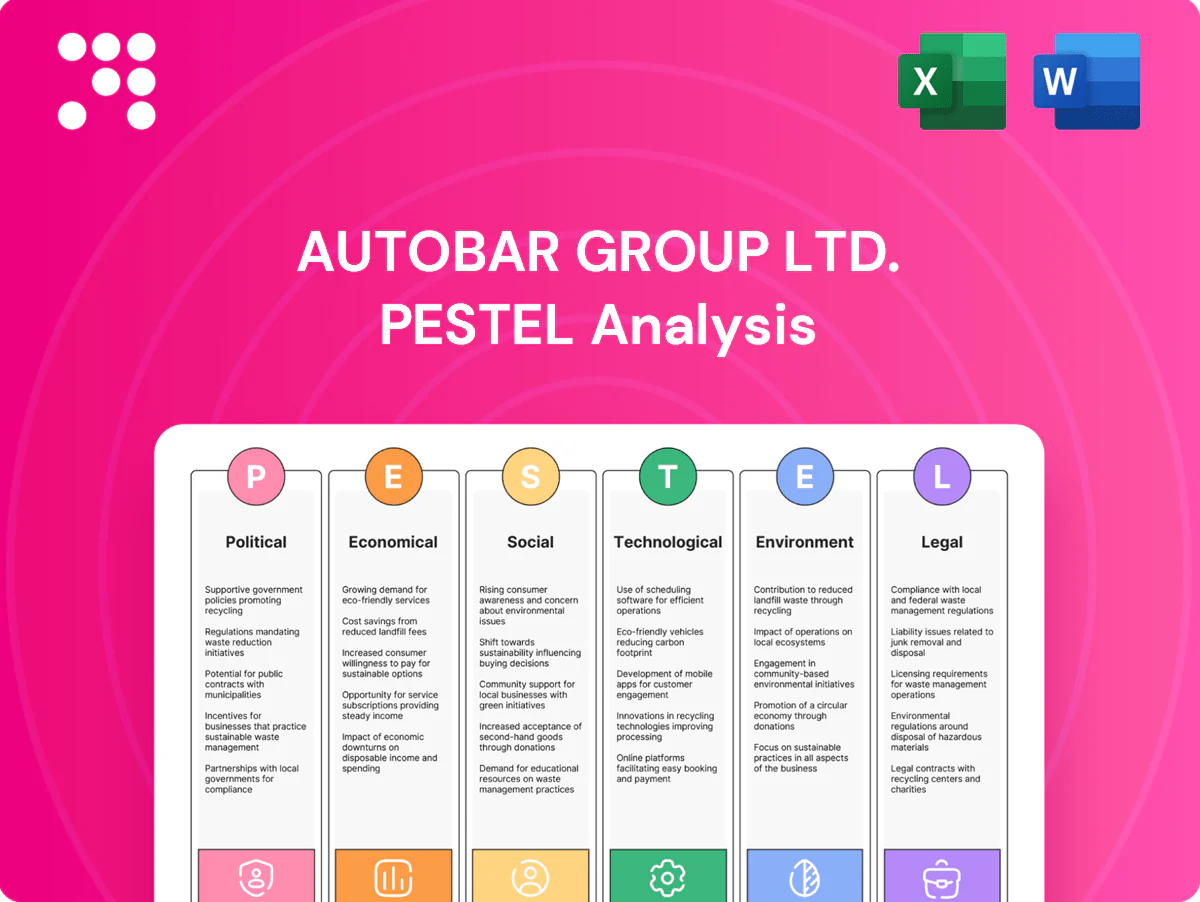
Autobar Group Ltd. PESTLE Analysis

Make Smarter Strategic Decisions with a Complete PESTEL View
Gain strategic clarity with our PESTLE Analysis of Autobar Group Ltd.—three to five concise insights into political, economic, social, technological, legal and environmental forces shaping its prospects. Use this analysis to anticipate risks, identify growth levers and sharpen investor or board decisions. Purchase the full report for the complete, actionable breakdown and ready-to-use charts.
Political factors

UK and EU regulatory alignment
Post-Brexit regulatory divergence can change product standards, labeling and machine compliance as UKCA (introduced 1 January 2021) operates alongside the EU CE regime. Autobar must track both UKCA and CE requirements for devices and consumables to avoid non-compliance. ONS data showed UK goods exports to the EU fell about 15% in 2021, underlining frictions that raise certification costs and time-to-market. Close supplier coordination across borders mitigates disruption.
Public sector procurement policies
Government hospitals, schools and transport hubs procure via formal tenders—UK public procurement was ~£300bn in 2023—where social value, local sourcing, health outcomes and sustainability increasingly influence award decisions. Selecta must build bid capabilities tied to social-value metrics and green sourcing; typical contract lengths of 3–7 years create lumpy revenue and reduced short-term visibility.

Health and nutrition policy priorities
Policies pushing reduced sugar and healthier choices (WHO: free sugars <10% kcal, conditional <5%) shift Autobar Group Ltd toward reformulated SKUs and smaller portions; UK data show a 44% sugar cut in soft drinks by 2019 after levies. School/hospital vending faces stricter rules (US Smart Snacks since 2014; NHS guidance from 2018), so clear nutrition labeling supports compliance and brand trust.

Infrastructure and transport policy
Infrastructure and transport policy shifts—backed by the EU Recovery and Resilience Facility mobilising about €723 billion—are expanding rail, office and public-venue investment, creating new vending locations; conversely hybrid and remote-work trends have cut city-centre footfall by up to ~30% versus pre‑pandemic in some metros, forcing Selecta to rebalance toward transit hubs and high-traffic nodes and deepen partnerships with facilities operators.
- Reallocate footprint to rail/transit hubs
- Prioritise venues funded by public infrastructure schemes
- Form strategic partnerships with facility operators
Trade and customs frictions
Customs checks on coffee, ingredients and parts can delay replenishment, sometimes extending lead times beyond planned 4–12 weeks for global suppliers; tariff shifts in 2024 have moved input costs and forced price reviews across foodservice suppliers. Buffer inventory and nearshore sourcing reduce exposure, while digital customs documentation (e-CUS) shortens clearance and improves predictability.
Post-Brexit regs and higher input costs reshape foodservice: public contracts, transit hubs win
Post-Brexit dual UKCA/CE rules raise certification costs and time-to-market; 2024 customs/tariff changes pushed input costs ~3–6% for foodservice suppliers. Public procurement (~£300bn in 2023) and health/school nutrition rules favor compliant, low-sugar SKUs. Hybrid work cuts city footfall ~25–30%, shifting focus to transit hubs and long-term 3–7y contracts.
| Metric | 2023–24 |
|---|---|
| UK public procurement | £300bn (2023) |
| City footfall drop | 25–30% |
| Input cost rise | 3–6% (2024) |
What is included in the product
 Detailed Word Document
Explores how macro-environmental factors uniquely affect Autobar Group Ltd across Political, Economic, Social, Technological, Environmental and Legal dimensions, with data-backed trends and forward-looking insights tailored to its industry and region to help executives, investors and strategists identify risks, opportunities and actionable scenarios.

 Customizable Excel Spreadsheet
A concise, visually segmented PESTLE summary of Autobar Group Ltd that eases stakeholder alignment, supports external risk and market positioning discussions, and can be dropped into presentations or exported for quick sharing across teams.
Economic factors

Consumer spending cycles
Snack and beverage demand closely tracks disposable income and workplace occupancy — office footfall recovered to around 60% in 2024, supporting corporate catering volumes. In downturns trading down and 10–15% lower volumes squeeze margins, while premium coffee often remains resilient in captive locations with 10–20% higher spend per visit. Dynamic pricing and targeted product mix help stabilize revenue.
Inflation and input costs
Volatility in coffee beans, sugar, packaging and energy has driven input cost swings, with Brent crude averaging about $85/barrel in 2024 and ICE arabica futures up notably vs 2023, pressuring margins. Pricing pass-through must balance contractual terms and client satisfaction to avoid churn while protecting margin. Route optimization and digital scheduling have cut fuel and labor costs by up to 10% in comparable operators. Hedging key commodities can materially reduce earnings volatility.

Labor availability and wages
Field technician and replenishment labor make up a large share of Autobar Group Ltds service costs, with service-occupation wages rising about 4% in 2024 and frontline payroll driving margin pressure. Tight labor markets (US unemployment ~3.7% in 2024) lift wage levels and attrition risk, increasing recruiting/overtime spend. Targeted training and telemetric route planning have raised productivity per route by ~18%, while remote monitoring and automation have cut site visits and overtime roughly 25%.

FX exposure across Europe
- FX risk: euro–sterling volatility
- Impact: procurement vs revenue translation
- Mitigants: natural hedges, forward contracts
- Control: centralized treasury for visibility
Client mix diversification
Autobar Group Ltd serves offices, healthcare, education and retail, spreading exposure across sectors that account for roughly 80% of UK GDP in services-led activity (ONS, 2024).
Sector-specific shocks—hospital demand spikes, school closures or retail downturns—can shift utilization and revenue abruptly; diversified portfolios historically smooth cash flow volatility.
Tailored service-level agreements by segment improve retention and protect utilization rates during sector swings; benchmark retention gains of 3-7% post-SLA rollout are typical in facilities services studies (2023–24).
- Coverage: offices, healthcare, education, retail
- Risk: sector shocks can abruptly shift demand
- Benefit: diversified mix smooths cash flows
- Mitigation: segment-specific SLAs protect retention
Post-Brexit regs and higher input costs reshape foodservice: public contracts, transit hubs win
Demand tracks disposable income and office footfall (≈60% in 2024), so downturns cause 10–15% volume declines and margin pressure while captive premium spend rises 10–20%. Input cost volatility (Brent ≈ $85/bbl; ICE arabica up vs 2023) and rising service wages (+4% in 2024) squeeze margins; hedging, route optimization and telematics cut costs ~10–25%. EUR/GBP ≈0.87 in 2024 creates procurement/translation risks managed by centralized treasury.
| Metric | 2024 | Impact |
|---|---|---|
| Office footfall | ~60% | Drives corporate catering |
| Brent crude | $85/bbl | Fuel & energy cost pressure |
| Wage growth | +4% | Higher service costs |
| EUR/GBP | 0.87 | Procurement FX risk |
What You See Is What You Get
Autobar Group Ltd. PESTLE Analysis
This PESTLE analysis of Autobar Group Ltd examines political, economic, social, technological, legal and environmental factors shaping the company’s strategic position, risks and opportunities. It includes concise insights and actionable implications for investors and managers. The preview shown here is the exact document you’ll receive after purchase—fully formatted and ready to use.

Make Smarter Strategic Decisions with a Complete PESTEL View
Gain strategic clarity with our PESTLE Analysis of Autobar Group Ltd.—three to five concise insights into political, economic, social, technological, legal and environmental forces shaping its prospects. Use this analysis to anticipate risks, identify growth levers and sharpen investor or board decisions. Purchase the full report for the complete, actionable breakdown and ready-to-use charts.
Political factors
UK and EU regulatory alignment
Post-Brexit regulatory divergence can change product standards, labeling and machine compliance as UKCA (introduced 1 January 2021) operates alongside the EU CE regime. Autobar must track both UKCA and CE requirements for devices and consumables to avoid non-compliance. ONS data showed UK goods exports to the EU fell about 15% in 2021, underlining frictions that raise certification costs and time-to-market. Close supplier coordination across borders mitigates disruption.
Public sector procurement policies
Government hospitals, schools and transport hubs procure via formal tenders—UK public procurement was ~£300bn in 2023—where social value, local sourcing, health outcomes and sustainability increasingly influence award decisions. Selecta must build bid capabilities tied to social-value metrics and green sourcing; typical contract lengths of 3–7 years create lumpy revenue and reduced short-term visibility.
Health and nutrition policy priorities
Policies pushing reduced sugar and healthier choices (WHO: free sugars <10% kcal, conditional <5%) shift Autobar Group Ltd toward reformulated SKUs and smaller portions; UK data show a 44% sugar cut in soft drinks by 2019 after levies. School/hospital vending faces stricter rules (US Smart Snacks since 2014; NHS guidance from 2018), so clear nutrition labeling supports compliance and brand trust.
Infrastructure and transport policy
Infrastructure and transport policy shifts—backed by the EU Recovery and Resilience Facility mobilising about €723 billion—are expanding rail, office and public-venue investment, creating new vending locations; conversely hybrid and remote-work trends have cut city-centre footfall by up to ~30% versus pre‑pandemic in some metros, forcing Selecta to rebalance toward transit hubs and high-traffic nodes and deepen partnerships with facilities operators.
- Reallocate footprint to rail/transit hubs
- Prioritise venues funded by public infrastructure schemes
- Form strategic partnerships with facility operators
Trade and customs frictions
Customs checks on coffee, ingredients and parts can delay replenishment, sometimes extending lead times beyond planned 4–12 weeks for global suppliers; tariff shifts in 2024 have moved input costs and forced price reviews across foodservice suppliers. Buffer inventory and nearshore sourcing reduce exposure, while digital customs documentation (e-CUS) shortens clearance and improves predictability.
Post-Brexit regs and higher input costs reshape foodservice: public contracts, transit hubs win
Post-Brexit dual UKCA/CE rules raise certification costs and time-to-market; 2024 customs/tariff changes pushed input costs ~3–6% for foodservice suppliers. Public procurement (~£300bn in 2023) and health/school nutrition rules favor compliant, low-sugar SKUs. Hybrid work cuts city footfall ~25–30%, shifting focus to transit hubs and long-term 3–7y contracts.
| Metric | 2023–24 |
|---|---|
| UK public procurement | £300bn (2023) |
| City footfall drop | 25–30% |
| Input cost rise | 3–6% (2024) |
What is included in the product
Detailed Word Document
Explores how macro-environmental factors uniquely affect Autobar Group Ltd across Political, Economic, Social, Technological, Environmental and Legal dimensions, with data-backed trends and forward-looking insights tailored to its industry and region to help executives, investors and strategists identify risks, opportunities and actionable scenarios.
Customizable Excel Spreadsheet
A concise, visually segmented PESTLE summary of Autobar Group Ltd that eases stakeholder alignment, supports external risk and market positioning discussions, and can be dropped into presentations or exported for quick sharing across teams.
Economic factors
Consumer spending cycles
Snack and beverage demand closely tracks disposable income and workplace occupancy — office footfall recovered to around 60% in 2024, supporting corporate catering volumes. In downturns trading down and 10–15% lower volumes squeeze margins, while premium coffee often remains resilient in captive locations with 10–20% higher spend per visit. Dynamic pricing and targeted product mix help stabilize revenue.
Inflation and input costs
Volatility in coffee beans, sugar, packaging and energy has driven input cost swings, with Brent crude averaging about $85/barrel in 2024 and ICE arabica futures up notably vs 2023, pressuring margins. Pricing pass-through must balance contractual terms and client satisfaction to avoid churn while protecting margin. Route optimization and digital scheduling have cut fuel and labor costs by up to 10% in comparable operators. Hedging key commodities can materially reduce earnings volatility.
Labor availability and wages
Field technician and replenishment labor make up a large share of Autobar Group Ltds service costs, with service-occupation wages rising about 4% in 2024 and frontline payroll driving margin pressure. Tight labor markets (US unemployment ~3.7% in 2024) lift wage levels and attrition risk, increasing recruiting/overtime spend. Targeted training and telemetric route planning have raised productivity per route by ~18%, while remote monitoring and automation have cut site visits and overtime roughly 25%.
FX exposure across Europe
- FX risk: euro–sterling volatility
- Impact: procurement vs revenue translation
- Mitigants: natural hedges, forward contracts
- Control: centralized treasury for visibility
Client mix diversification
Autobar Group Ltd serves offices, healthcare, education and retail, spreading exposure across sectors that account for roughly 80% of UK GDP in services-led activity (ONS, 2024).
Sector-specific shocks—hospital demand spikes, school closures or retail downturns—can shift utilization and revenue abruptly; diversified portfolios historically smooth cash flow volatility.
Tailored service-level agreements by segment improve retention and protect utilization rates during sector swings; benchmark retention gains of 3-7% post-SLA rollout are typical in facilities services studies (2023–24).
- Coverage: offices, healthcare, education, retail
- Risk: sector shocks can abruptly shift demand
- Benefit: diversified mix smooths cash flows
- Mitigation: segment-specific SLAs protect retention
Post-Brexit regs and higher input costs reshape foodservice: public contracts, transit hubs win
Demand tracks disposable income and office footfall (≈60% in 2024), so downturns cause 10–15% volume declines and margin pressure while captive premium spend rises 10–20%. Input cost volatility (Brent ≈ $85/bbl; ICE arabica up vs 2023) and rising service wages (+4% in 2024) squeeze margins; hedging, route optimization and telematics cut costs ~10–25%. EUR/GBP ≈0.87 in 2024 creates procurement/translation risks managed by centralized treasury.
| Metric | 2024 | Impact |
|---|---|---|
| Office footfall | ~60% | Drives corporate catering |
| Brent crude | $85/bbl | Fuel & energy cost pressure |
| Wage growth | +4% | Higher service costs |
| EUR/GBP | 0.87 | Procurement FX risk |
What You See Is What You Get
Autobar Group Ltd. PESTLE Analysis
This PESTLE analysis of Autobar Group Ltd examines political, economic, social, technological, legal and environmental factors shaping the company’s strategic position, risks and opportunities. It includes concise insights and actionable implications for investors and managers. The preview shown here is the exact document you’ll receive after purchase—fully formatted and ready to use.
Description
Make Smarter Strategic Decisions with a Complete PESTEL View
Gain strategic clarity with our PESTLE Analysis of Autobar Group Ltd.—three to five concise insights into political, economic, social, technological, legal and environmental forces shaping its prospects. Use this analysis to anticipate risks, identify growth levers and sharpen investor or board decisions. Purchase the full report for the complete, actionable breakdown and ready-to-use charts.
Political factors
UK and EU regulatory alignment
Post-Brexit regulatory divergence can change product standards, labeling and machine compliance as UKCA (introduced 1 January 2021) operates alongside the EU CE regime. Autobar must track both UKCA and CE requirements for devices and consumables to avoid non-compliance. ONS data showed UK goods exports to the EU fell about 15% in 2021, underlining frictions that raise certification costs and time-to-market. Close supplier coordination across borders mitigates disruption.
Public sector procurement policies
Government hospitals, schools and transport hubs procure via formal tenders—UK public procurement was ~£300bn in 2023—where social value, local sourcing, health outcomes and sustainability increasingly influence award decisions. Selecta must build bid capabilities tied to social-value metrics and green sourcing; typical contract lengths of 3–7 years create lumpy revenue and reduced short-term visibility.
Health and nutrition policy priorities
Policies pushing reduced sugar and healthier choices (WHO: free sugars <10% kcal, conditional <5%) shift Autobar Group Ltd toward reformulated SKUs and smaller portions; UK data show a 44% sugar cut in soft drinks by 2019 after levies. School/hospital vending faces stricter rules (US Smart Snacks since 2014; NHS guidance from 2018), so clear nutrition labeling supports compliance and brand trust.
Infrastructure and transport policy
Infrastructure and transport policy shifts—backed by the EU Recovery and Resilience Facility mobilising about €723 billion—are expanding rail, office and public-venue investment, creating new vending locations; conversely hybrid and remote-work trends have cut city-centre footfall by up to ~30% versus pre‑pandemic in some metros, forcing Selecta to rebalance toward transit hubs and high-traffic nodes and deepen partnerships with facilities operators.
- Reallocate footprint to rail/transit hubs
- Prioritise venues funded by public infrastructure schemes
- Form strategic partnerships with facility operators
Trade and customs frictions
Customs checks on coffee, ingredients and parts can delay replenishment, sometimes extending lead times beyond planned 4–12 weeks for global suppliers; tariff shifts in 2024 have moved input costs and forced price reviews across foodservice suppliers. Buffer inventory and nearshore sourcing reduce exposure, while digital customs documentation (e-CUS) shortens clearance and improves predictability.
Post-Brexit regs and higher input costs reshape foodservice: public contracts, transit hubs win
Post-Brexit dual UKCA/CE rules raise certification costs and time-to-market; 2024 customs/tariff changes pushed input costs ~3–6% for foodservice suppliers. Public procurement (~£300bn in 2023) and health/school nutrition rules favor compliant, low-sugar SKUs. Hybrid work cuts city footfall ~25–30%, shifting focus to transit hubs and long-term 3–7y contracts.
| Metric | 2023–24 |
|---|---|
| UK public procurement | £300bn (2023) |
| City footfall drop | 25–30% |
| Input cost rise | 3–6% (2024) |
What is included in the product
Detailed Word Document
Explores how macro-environmental factors uniquely affect Autobar Group Ltd across Political, Economic, Social, Technological, Environmental and Legal dimensions, with data-backed trends and forward-looking insights tailored to its industry and region to help executives, investors and strategists identify risks, opportunities and actionable scenarios.
Customizable Excel Spreadsheet
A concise, visually segmented PESTLE summary of Autobar Group Ltd that eases stakeholder alignment, supports external risk and market positioning discussions, and can be dropped into presentations or exported for quick sharing across teams.
Economic factors
Consumer spending cycles
Snack and beverage demand closely tracks disposable income and workplace occupancy — office footfall recovered to around 60% in 2024, supporting corporate catering volumes. In downturns trading down and 10–15% lower volumes squeeze margins, while premium coffee often remains resilient in captive locations with 10–20% higher spend per visit. Dynamic pricing and targeted product mix help stabilize revenue.
Inflation and input costs
Volatility in coffee beans, sugar, packaging and energy has driven input cost swings, with Brent crude averaging about $85/barrel in 2024 and ICE arabica futures up notably vs 2023, pressuring margins. Pricing pass-through must balance contractual terms and client satisfaction to avoid churn while protecting margin. Route optimization and digital scheduling have cut fuel and labor costs by up to 10% in comparable operators. Hedging key commodities can materially reduce earnings volatility.
Labor availability and wages
Field technician and replenishment labor make up a large share of Autobar Group Ltds service costs, with service-occupation wages rising about 4% in 2024 and frontline payroll driving margin pressure. Tight labor markets (US unemployment ~3.7% in 2024) lift wage levels and attrition risk, increasing recruiting/overtime spend. Targeted training and telemetric route planning have raised productivity per route by ~18%, while remote monitoring and automation have cut site visits and overtime roughly 25%.
FX exposure across Europe
- FX risk: euro–sterling volatility
- Impact: procurement vs revenue translation
- Mitigants: natural hedges, forward contracts
- Control: centralized treasury for visibility
Client mix diversification
Autobar Group Ltd serves offices, healthcare, education and retail, spreading exposure across sectors that account for roughly 80% of UK GDP in services-led activity (ONS, 2024).
Sector-specific shocks—hospital demand spikes, school closures or retail downturns—can shift utilization and revenue abruptly; diversified portfolios historically smooth cash flow volatility.
Tailored service-level agreements by segment improve retention and protect utilization rates during sector swings; benchmark retention gains of 3-7% post-SLA rollout are typical in facilities services studies (2023–24).
- Coverage: offices, healthcare, education, retail
- Risk: sector shocks can abruptly shift demand
- Benefit: diversified mix smooths cash flows
- Mitigation: segment-specific SLAs protect retention
Post-Brexit regs and higher input costs reshape foodservice: public contracts, transit hubs win
Demand tracks disposable income and office footfall (≈60% in 2024), so downturns cause 10–15% volume declines and margin pressure while captive premium spend rises 10–20%. Input cost volatility (Brent ≈ $85/bbl; ICE arabica up vs 2023) and rising service wages (+4% in 2024) squeeze margins; hedging, route optimization and telematics cut costs ~10–25%. EUR/GBP ≈0.87 in 2024 creates procurement/translation risks managed by centralized treasury.
| Metric | 2024 | Impact |
|---|---|---|
| Office footfall | ~60% | Drives corporate catering |
| Brent crude | $85/bbl | Fuel & energy cost pressure |
| Wage growth | +4% | Higher service costs |
| EUR/GBP | 0.87 | Procurement FX risk |
What You See Is What You Get
Autobar Group Ltd. PESTLE Analysis
This PESTLE analysis of Autobar Group Ltd examines political, economic, social, technological, legal and environmental factors shaping the company’s strategic position, risks and opportunities. It includes concise insights and actionable implications for investors and managers. The preview shown here is the exact document you’ll receive after purchase—fully formatted and ready to use.











