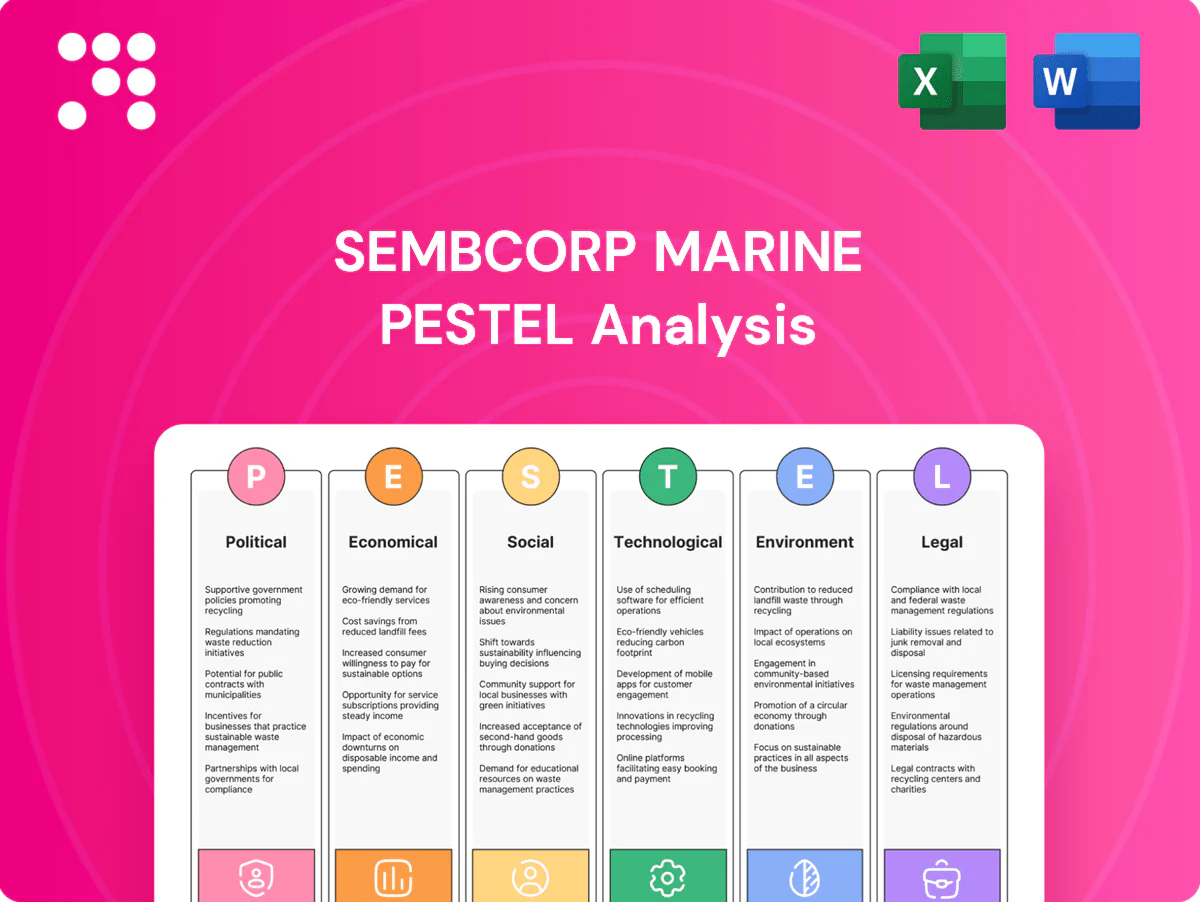
Sembcorp Marine PESTLE Analysis

Plan Smarter. Present Sharper. Compete Stronger.
Gain strategic clarity on Sembcorp Marine with our concise PESTLE analysis—examining political, economic, social, technological, legal and environmental forces shaping its prospects. Ideal for investors and strategists seeking actionable intelligence. Purchase the full report to access in-depth findings and ready-to-use insights.
Political factors

Geopolitical stability in key shipyard hubs
Seatrium is headquartered in politically stable Singapore, supporting core operations and strong maritime governance, while project delivery spans three key jurisdictions — Brazil, the Middle East and the North Sea — exposing contracts to sanctions, regime change and supply‑chain disruption; diversifying locations and formal diplomatic risk mapping are therefore critical to mitigate approval and logistics interruptions.
Energy transition policy and subsidies
Government support for offshore wind—US target 30 GW by 2030, UK 50 GW by 2030 and EU ~60 GW by 2030—directly shapes Seatrium’s order book, with IRA tax credits/ITC up to ~30% and EU/UK auction pipelines driving demand for substations, foundations and cable‑lay vessels. Auction delays or policy reversals have stalled projects and cash flows in 2023–24; continuous engagement with policymakers improves pipeline predictability.

Local content and industrial policy
Many host countries impose local content requirements for offshore projects, commonly ranging from 40–70%, forcing Sembcorp Marine to adjust yard selection, staffing and supplier choices which raises costs and can extend schedules. Partnerships and JV structures enable meeting thresholds while preserving technical quality. Strategic localization plans—local training, supplier development and manufacturing hubs—can convert regulatory constraints into a competitive advantage.

Trade policies and tariff regimes
Tariffs on steel and specialty alloys in key markets (eg US Section 232 at 25%) and equipment duties compress Sembcorp Marine project margins; export controls on advanced and dual-use components increasingly slow integration and add compliance costs. Singapore's streamlined customs (World Bank LPI rank 1 in 2023) mitigates some delays, but cross-border module movement still raises logistics complexity. Early procurement and multi-source strategies reduce exposure and price volatility.
- Tariffs: up to 25% in major markets
- Export controls: longer lead times for tech components
- Singapore LPI: rank 1 (2023)
- Mitigation: early procurement, multi-sourcing
Government-backed financing and export credit
Large offshore projects frequently rely on ECA and multilateral financing; favorable political support can unlock longer tenors (commonly up to 20 years) and lower costs, expanding client affordability. Recent ECA emphasis on green projects has shifted capital toward renewables, benefiting Seatrium’s offshore wind and CCS opportunities. Building bankable ESG credentials is essential to access these pools.
- Dependence: ECA/multilateral finance key for mega offshore projects
- Tenors: commonly up to 20 years, lowering project IRRs
- Green tilt: ECAs shifting priority to renewables, aiding Seatrium
- Action: strengthen ESG to secure concessional ECA terms
Offshore wind bolstered by US/UK/EU targets and ~30% IRA credits, but tariffs and regional risks
Seatrium benefits from Singapore's stable governance and LPI rank 1 (2023) but operations across Brazil, Mideast and North Sea face sanction, local‑content and regime risks. Policy support drives demand—US 30 GW/2030, UK 50 GW/2030, EU ~60 GW/2030—and US IRA/ITC offers ~30% credits; auction delays have hit 2023–24 cashflows. Tariffs (eg US Section 232 up to 25%) and export controls raise costs; ECAs now favor green projects with tenors up to 20 years.
| Factor | Key datum |
|---|---|
| Singapore LPI | Rank 1 (2023) |
| Offshore targets | US 30GW, UK 50GW, EU ~60GW by 2030 |
| IRA/ITC | ~30% tax support |
| Tariffs | Up to 25% (US Sec232) |
| ECA tenors | Up to 20 years |
What is included in the product
 Detailed Word Document
Explores how Political, Economic, Social, Technological, Environmental and Legal forces uniquely affect Sembcorp Marine, with data-backed trends and regional industry context to identify risks and opportunities. Designed for executives and investors, it offers detailed sub-points and forward-looking insights for strategy and scenario planning.

 Customizable Excel Spreadsheet
A concise, visually segmented PESTLE summary of Sembcorp Marine for quick reference in meetings or presentations, enabling easy sharing and alignment across teams. It’s editable for adding region- or business-specific notes, making it a practical tool for risk discussions and client-facing reports.
Economic factors

Global oil and gas capex cycles
Global upstream capex, estimated at about $420bn in 2024 (Rystad Energy) and with Brent averaging near $85/bbl in 2024, directly drives demand for floaters, FPSOs and platforms, lifting maintenance, conversion and newbuild orders; price volatility can defer FIDs and strain yard utilisation; Sembcorp Marine’s balanced mix of O&G and renewables helps smooth cyclical revenue swings.
Offshore wind economics and auction dynamics
Turbine scale-up to 12–15MW and supply-chain inflation (capex up to 15–20% vs 2019) compressed project IRRs and forced bid renegotiations. Improved auction indexation (inflation/steel-linked clauses) and more realistic designs have restored viability, unlocking substation and foundation work. Seatrium’s EPC capabilities align with these higher-value segments, but vigilance on cost pass-through terms is critical.

Input cost inflation and supply chain constraints
Volatile input costs—steel plate swings of about ±25% since 2020 and LME copper near US$10,000/tonne in mid‑2025—plus long lead times for specialized components create margin and scheduling risks for Sembcorp Marine. Tight labor markets (Singapore median wage growth ~5–6% in 2024) lift direct wages and subcontractor rates. Long‑dated contracts require explicit escalation clauses to preserve margins. Strategic inventory buffers and close supplier partnerships improve resilience and delivery certainty.

Currency fluctuations and hedging
Contracts for Sembcorp Marine span USD, EUR, GBP and local currencies, so FX volatility can sharply erode margins if unhedged. Multi-currency cost structures provide natural hedges but leave residual exposure. Robust treasury policies and active derivatives usage are essential to protect profitability.
- Primary currencies: USD, EUR, GBP, local
- Natural hedge reduces but does not eliminate risk
- Treasury policies + derivatives required
Interest rates and project financing costs
Higher global rates (US 10-year near 4% in mid-2024) lift WACC for clients, delaying FIDs and compressing order intake for Sembcorp Marine/Seatrium; a sustained easing in rates would likely reignite project pipelines. Seatrium’s improved cash-conversion and milestone billing reduce working-capital strain, while strong credit counterparties lower counterparty default risk.
- WACC↑ delays FIDs
- Rate easing → pipeline rebound
- Cash-conversion & milestone billing → lower working-capital pressure
- Strong credit counterparties → reduced default risk
Offshore wind bolstered by US/UK/EU targets and ~30% IRA credits, but tariffs and regional risks
Global upstream capex ~$420bn (2024) and Brent ~$85/bbl boost floater/FPSO demand but price volatility and US 10y ~4% (mid‑2024) can delay FIDs; steel ±25% since 2020 and LME copper ~US$10,000/t (mid‑2025) squeeze margins; Singapore wage growth ~5–6% (2024) raises labour costs; multi‑currency contracts (USD, EUR, GBP, local) require active hedging.
| Metric | Value |
|---|---|
| Upstream capex 2024 | $420bn |
| Brent 2024 | $85/bbl |
| Steel volatility | ±25% |
| Copper mid‑2025 | $10,000/t |
Preview the Actual Deliverable
Sembcorp Marine PESTLE Analysis
The preview shown here is the exact Sembcorp Marine PESTLE Analysis document you’ll receive after purchase—fully formatted and ready to use. The layout, content, and structure visible here are exactly what you’ll download immediately after buying. No placeholders, no surprises.

Plan Smarter. Present Sharper. Compete Stronger.
Gain strategic clarity on Sembcorp Marine with our concise PESTLE analysis—examining political, economic, social, technological, legal and environmental forces shaping its prospects. Ideal for investors and strategists seeking actionable intelligence. Purchase the full report to access in-depth findings and ready-to-use insights.
Political factors
Geopolitical stability in key shipyard hubs
Seatrium is headquartered in politically stable Singapore, supporting core operations and strong maritime governance, while project delivery spans three key jurisdictions — Brazil, the Middle East and the North Sea — exposing contracts to sanctions, regime change and supply‑chain disruption; diversifying locations and formal diplomatic risk mapping are therefore critical to mitigate approval and logistics interruptions.
Energy transition policy and subsidies
Government support for offshore wind—US target 30 GW by 2030, UK 50 GW by 2030 and EU ~60 GW by 2030—directly shapes Seatrium’s order book, with IRA tax credits/ITC up to ~30% and EU/UK auction pipelines driving demand for substations, foundations and cable‑lay vessels. Auction delays or policy reversals have stalled projects and cash flows in 2023–24; continuous engagement with policymakers improves pipeline predictability.
Local content and industrial policy
Many host countries impose local content requirements for offshore projects, commonly ranging from 40–70%, forcing Sembcorp Marine to adjust yard selection, staffing and supplier choices which raises costs and can extend schedules. Partnerships and JV structures enable meeting thresholds while preserving technical quality. Strategic localization plans—local training, supplier development and manufacturing hubs—can convert regulatory constraints into a competitive advantage.
Trade policies and tariff regimes
Tariffs on steel and specialty alloys in key markets (eg US Section 232 at 25%) and equipment duties compress Sembcorp Marine project margins; export controls on advanced and dual-use components increasingly slow integration and add compliance costs. Singapore's streamlined customs (World Bank LPI rank 1 in 2023) mitigates some delays, but cross-border module movement still raises logistics complexity. Early procurement and multi-source strategies reduce exposure and price volatility.
- Tariffs: up to 25% in major markets
- Export controls: longer lead times for tech components
- Singapore LPI: rank 1 (2023)
- Mitigation: early procurement, multi-sourcing
Government-backed financing and export credit
Large offshore projects frequently rely on ECA and multilateral financing; favorable political support can unlock longer tenors (commonly up to 20 years) and lower costs, expanding client affordability. Recent ECA emphasis on green projects has shifted capital toward renewables, benefiting Seatrium’s offshore wind and CCS opportunities. Building bankable ESG credentials is essential to access these pools.
- Dependence: ECA/multilateral finance key for mega offshore projects
- Tenors: commonly up to 20 years, lowering project IRRs
- Green tilt: ECAs shifting priority to renewables, aiding Seatrium
- Action: strengthen ESG to secure concessional ECA terms
Offshore wind bolstered by US/UK/EU targets and ~30% IRA credits, but tariffs and regional risks
Seatrium benefits from Singapore's stable governance and LPI rank 1 (2023) but operations across Brazil, Mideast and North Sea face sanction, local‑content and regime risks. Policy support drives demand—US 30 GW/2030, UK 50 GW/2030, EU ~60 GW/2030—and US IRA/ITC offers ~30% credits; auction delays have hit 2023–24 cashflows. Tariffs (eg US Section 232 up to 25%) and export controls raise costs; ECAs now favor green projects with tenors up to 20 years.
| Factor | Key datum |
|---|---|
| Singapore LPI | Rank 1 (2023) |
| Offshore targets | US 30GW, UK 50GW, EU ~60GW by 2030 |
| IRA/ITC | ~30% tax support |
| Tariffs | Up to 25% (US Sec232) |
| ECA tenors | Up to 20 years |
What is included in the product
Detailed Word Document
Explores how Political, Economic, Social, Technological, Environmental and Legal forces uniquely affect Sembcorp Marine, with data-backed trends and regional industry context to identify risks and opportunities. Designed for executives and investors, it offers detailed sub-points and forward-looking insights for strategy and scenario planning.
Customizable Excel Spreadsheet
A concise, visually segmented PESTLE summary of Sembcorp Marine for quick reference in meetings or presentations, enabling easy sharing and alignment across teams. It’s editable for adding region- or business-specific notes, making it a practical tool for risk discussions and client-facing reports.
Economic factors
Global oil and gas capex cycles
Global upstream capex, estimated at about $420bn in 2024 (Rystad Energy) and with Brent averaging near $85/bbl in 2024, directly drives demand for floaters, FPSOs and platforms, lifting maintenance, conversion and newbuild orders; price volatility can defer FIDs and strain yard utilisation; Sembcorp Marine’s balanced mix of O&G and renewables helps smooth cyclical revenue swings.
Offshore wind economics and auction dynamics
Turbine scale-up to 12–15MW and supply-chain inflation (capex up to 15–20% vs 2019) compressed project IRRs and forced bid renegotiations. Improved auction indexation (inflation/steel-linked clauses) and more realistic designs have restored viability, unlocking substation and foundation work. Seatrium’s EPC capabilities align with these higher-value segments, but vigilance on cost pass-through terms is critical.
Input cost inflation and supply chain constraints
Volatile input costs—steel plate swings of about ±25% since 2020 and LME copper near US$10,000/tonne in mid‑2025—plus long lead times for specialized components create margin and scheduling risks for Sembcorp Marine. Tight labor markets (Singapore median wage growth ~5–6% in 2024) lift direct wages and subcontractor rates. Long‑dated contracts require explicit escalation clauses to preserve margins. Strategic inventory buffers and close supplier partnerships improve resilience and delivery certainty.
Currency fluctuations and hedging
Contracts for Sembcorp Marine span USD, EUR, GBP and local currencies, so FX volatility can sharply erode margins if unhedged. Multi-currency cost structures provide natural hedges but leave residual exposure. Robust treasury policies and active derivatives usage are essential to protect profitability.
- Primary currencies: USD, EUR, GBP, local
- Natural hedge reduces but does not eliminate risk
- Treasury policies + derivatives required
Interest rates and project financing costs
Higher global rates (US 10-year near 4% in mid-2024) lift WACC for clients, delaying FIDs and compressing order intake for Sembcorp Marine/Seatrium; a sustained easing in rates would likely reignite project pipelines. Seatrium’s improved cash-conversion and milestone billing reduce working-capital strain, while strong credit counterparties lower counterparty default risk.
- WACC↑ delays FIDs
- Rate easing → pipeline rebound
- Cash-conversion & milestone billing → lower working-capital pressure
- Strong credit counterparties → reduced default risk
Offshore wind bolstered by US/UK/EU targets and ~30% IRA credits, but tariffs and regional risks
Global upstream capex ~$420bn (2024) and Brent ~$85/bbl boost floater/FPSO demand but price volatility and US 10y ~4% (mid‑2024) can delay FIDs; steel ±25% since 2020 and LME copper ~US$10,000/t (mid‑2025) squeeze margins; Singapore wage growth ~5–6% (2024) raises labour costs; multi‑currency contracts (USD, EUR, GBP, local) require active hedging.
| Metric | Value |
|---|---|
| Upstream capex 2024 | $420bn |
| Brent 2024 | $85/bbl |
| Steel volatility | ±25% |
| Copper mid‑2025 | $10,000/t |
Preview the Actual Deliverable
Sembcorp Marine PESTLE Analysis
The preview shown here is the exact Sembcorp Marine PESTLE Analysis document you’ll receive after purchase—fully formatted and ready to use. The layout, content, and structure visible here are exactly what you’ll download immediately after buying. No placeholders, no surprises.
Original: $10.00
-65%$10.00
$3.50Description
Plan Smarter. Present Sharper. Compete Stronger.
Gain strategic clarity on Sembcorp Marine with our concise PESTLE analysis—examining political, economic, social, technological, legal and environmental forces shaping its prospects. Ideal for investors and strategists seeking actionable intelligence. Purchase the full report to access in-depth findings and ready-to-use insights.
Political factors
Geopolitical stability in key shipyard hubs
Seatrium is headquartered in politically stable Singapore, supporting core operations and strong maritime governance, while project delivery spans three key jurisdictions — Brazil, the Middle East and the North Sea — exposing contracts to sanctions, regime change and supply‑chain disruption; diversifying locations and formal diplomatic risk mapping are therefore critical to mitigate approval and logistics interruptions.
Energy transition policy and subsidies
Government support for offshore wind—US target 30 GW by 2030, UK 50 GW by 2030 and EU ~60 GW by 2030—directly shapes Seatrium’s order book, with IRA tax credits/ITC up to ~30% and EU/UK auction pipelines driving demand for substations, foundations and cable‑lay vessels. Auction delays or policy reversals have stalled projects and cash flows in 2023–24; continuous engagement with policymakers improves pipeline predictability.
Local content and industrial policy
Many host countries impose local content requirements for offshore projects, commonly ranging from 40–70%, forcing Sembcorp Marine to adjust yard selection, staffing and supplier choices which raises costs and can extend schedules. Partnerships and JV structures enable meeting thresholds while preserving technical quality. Strategic localization plans—local training, supplier development and manufacturing hubs—can convert regulatory constraints into a competitive advantage.
Trade policies and tariff regimes
Tariffs on steel and specialty alloys in key markets (eg US Section 232 at 25%) and equipment duties compress Sembcorp Marine project margins; export controls on advanced and dual-use components increasingly slow integration and add compliance costs. Singapore's streamlined customs (World Bank LPI rank 1 in 2023) mitigates some delays, but cross-border module movement still raises logistics complexity. Early procurement and multi-source strategies reduce exposure and price volatility.
- Tariffs: up to 25% in major markets
- Export controls: longer lead times for tech components
- Singapore LPI: rank 1 (2023)
- Mitigation: early procurement, multi-sourcing
Government-backed financing and export credit
Large offshore projects frequently rely on ECA and multilateral financing; favorable political support can unlock longer tenors (commonly up to 20 years) and lower costs, expanding client affordability. Recent ECA emphasis on green projects has shifted capital toward renewables, benefiting Seatrium’s offshore wind and CCS opportunities. Building bankable ESG credentials is essential to access these pools.
- Dependence: ECA/multilateral finance key for mega offshore projects
- Tenors: commonly up to 20 years, lowering project IRRs
- Green tilt: ECAs shifting priority to renewables, aiding Seatrium
- Action: strengthen ESG to secure concessional ECA terms
Offshore wind bolstered by US/UK/EU targets and ~30% IRA credits, but tariffs and regional risks
Seatrium benefits from Singapore's stable governance and LPI rank 1 (2023) but operations across Brazil, Mideast and North Sea face sanction, local‑content and regime risks. Policy support drives demand—US 30 GW/2030, UK 50 GW/2030, EU ~60 GW/2030—and US IRA/ITC offers ~30% credits; auction delays have hit 2023–24 cashflows. Tariffs (eg US Section 232 up to 25%) and export controls raise costs; ECAs now favor green projects with tenors up to 20 years.
| Factor | Key datum |
|---|---|
| Singapore LPI | Rank 1 (2023) |
| Offshore targets | US 30GW, UK 50GW, EU ~60GW by 2030 |
| IRA/ITC | ~30% tax support |
| Tariffs | Up to 25% (US Sec232) |
| ECA tenors | Up to 20 years |
What is included in the product
Detailed Word Document
Explores how Political, Economic, Social, Technological, Environmental and Legal forces uniquely affect Sembcorp Marine, with data-backed trends and regional industry context to identify risks and opportunities. Designed for executives and investors, it offers detailed sub-points and forward-looking insights for strategy and scenario planning.
Customizable Excel Spreadsheet
A concise, visually segmented PESTLE summary of Sembcorp Marine for quick reference in meetings or presentations, enabling easy sharing and alignment across teams. It’s editable for adding region- or business-specific notes, making it a practical tool for risk discussions and client-facing reports.
Economic factors
Global oil and gas capex cycles
Global upstream capex, estimated at about $420bn in 2024 (Rystad Energy) and with Brent averaging near $85/bbl in 2024, directly drives demand for floaters, FPSOs and platforms, lifting maintenance, conversion and newbuild orders; price volatility can defer FIDs and strain yard utilisation; Sembcorp Marine’s balanced mix of O&G and renewables helps smooth cyclical revenue swings.
Offshore wind economics and auction dynamics
Turbine scale-up to 12–15MW and supply-chain inflation (capex up to 15–20% vs 2019) compressed project IRRs and forced bid renegotiations. Improved auction indexation (inflation/steel-linked clauses) and more realistic designs have restored viability, unlocking substation and foundation work. Seatrium’s EPC capabilities align with these higher-value segments, but vigilance on cost pass-through terms is critical.
Input cost inflation and supply chain constraints
Volatile input costs—steel plate swings of about ±25% since 2020 and LME copper near US$10,000/tonne in mid‑2025—plus long lead times for specialized components create margin and scheduling risks for Sembcorp Marine. Tight labor markets (Singapore median wage growth ~5–6% in 2024) lift direct wages and subcontractor rates. Long‑dated contracts require explicit escalation clauses to preserve margins. Strategic inventory buffers and close supplier partnerships improve resilience and delivery certainty.
Currency fluctuations and hedging
Contracts for Sembcorp Marine span USD, EUR, GBP and local currencies, so FX volatility can sharply erode margins if unhedged. Multi-currency cost structures provide natural hedges but leave residual exposure. Robust treasury policies and active derivatives usage are essential to protect profitability.
- Primary currencies: USD, EUR, GBP, local
- Natural hedge reduces but does not eliminate risk
- Treasury policies + derivatives required
Interest rates and project financing costs
Higher global rates (US 10-year near 4% in mid-2024) lift WACC for clients, delaying FIDs and compressing order intake for Sembcorp Marine/Seatrium; a sustained easing in rates would likely reignite project pipelines. Seatrium’s improved cash-conversion and milestone billing reduce working-capital strain, while strong credit counterparties lower counterparty default risk.
- WACC↑ delays FIDs
- Rate easing → pipeline rebound
- Cash-conversion & milestone billing → lower working-capital pressure
- Strong credit counterparties → reduced default risk
Offshore wind bolstered by US/UK/EU targets and ~30% IRA credits, but tariffs and regional risks
Global upstream capex ~$420bn (2024) and Brent ~$85/bbl boost floater/FPSO demand but price volatility and US 10y ~4% (mid‑2024) can delay FIDs; steel ±25% since 2020 and LME copper ~US$10,000/t (mid‑2025) squeeze margins; Singapore wage growth ~5–6% (2024) raises labour costs; multi‑currency contracts (USD, EUR, GBP, local) require active hedging.
| Metric | Value |
|---|---|
| Upstream capex 2024 | $420bn |
| Brent 2024 | $85/bbl |
| Steel volatility | ±25% |
| Copper mid‑2025 | $10,000/t |
Preview the Actual Deliverable
Sembcorp Marine PESTLE Analysis
The preview shown here is the exact Sembcorp Marine PESTLE Analysis document you’ll receive after purchase—fully formatted and ready to use. The layout, content, and structure visible here are exactly what you’ll download immediately after buying. No placeholders, no surprises.











