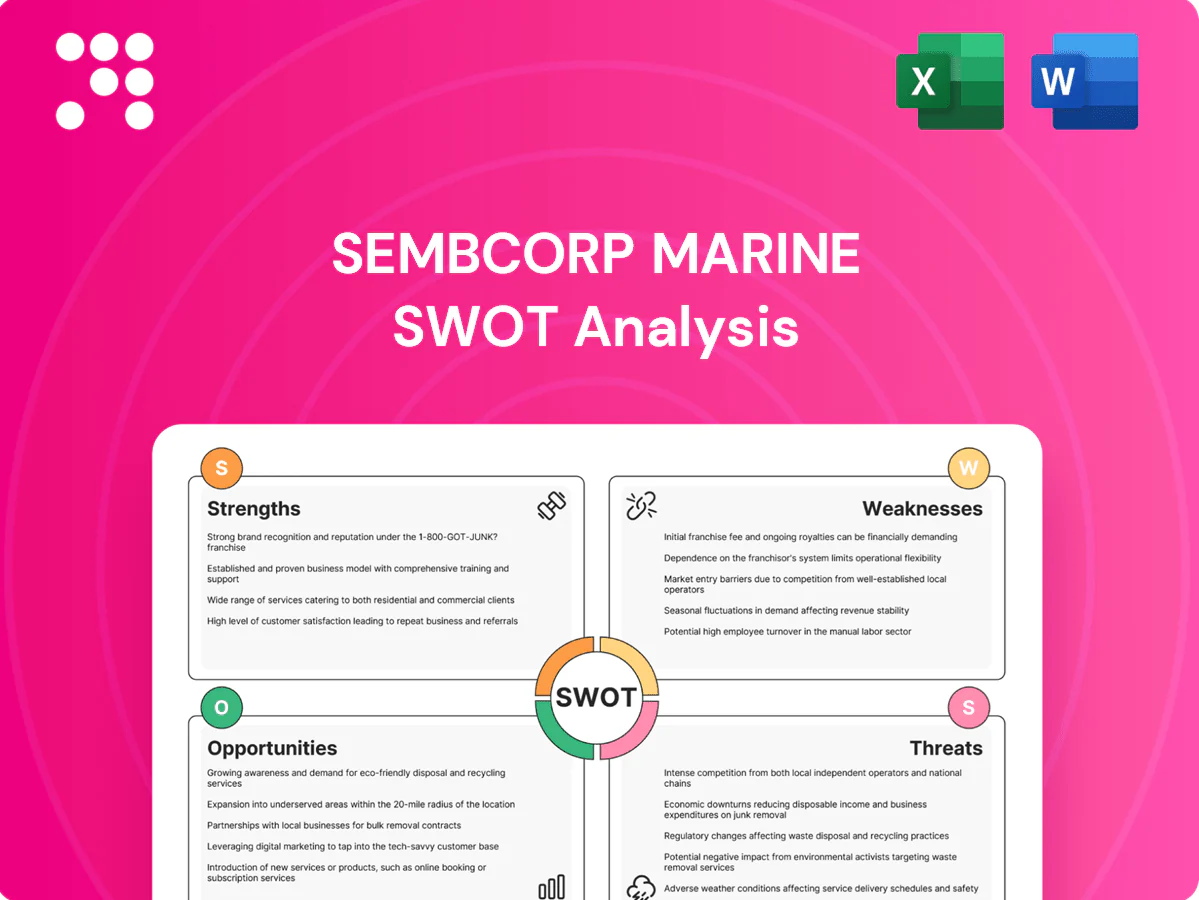
Sembcorp Marine SWOT Analysis

Go Beyond the Preview—Access the Full Strategic Report
Sembcorp Marine combines large-scale fabrication capacity and engineering know-how with growing focus on offshore renewables, but it remains exposed to cyclical oil & gas demand and project execution risks. Rising green-energy contracts present clear upside while global competition and margin pressure are key threats. Want the full strategic picture? Purchase the complete SWOT for a research-backed, editable Word and Excel pack to plan or invest with confidence.
Strengths

Integrated offshore engineering breadth
End-to-end capabilities across design, newbuild, repair and conversion allow Sembcorp Marine to capture cross-selling and lifecycle revenues across three core asset classes: floaters, platforms and specialized vessels. This breadth reduces dependency on any single segment and supports complex EPC scopes, improving win rates on multi-scope packages. It provides flexibility through market cycles and enhances bid competitiveness.
Global yard network and scale
Large, well-equipped yards across Singapore, Brazil, China, Indonesia and Vietnam enable execution of mega-projects and parallel workstreams. Scale drives cost efficiencies, schedule resilience and HSE governance required by tier-one clients. Geographic spread diversifies regulatory and labor risks and improves access to local content requirements in key markets.

Track record with top-tier clients
With 62 years of shipyard and offshore engineering experience (founded 1963), Sembcorp Marine’s delivery record for oil majors, national oil companies and leading contractors enhances its credibility. Proven execution on floaters and offshore platforms underpins prequalification for complex tenders. Established supply‑chain relationships shorten lead times and lower perceived execution risk.

Growing renewables capability
Integrated capabilities in substations, foundations and support vessels align Sembcorp Marine with the Asia‑Pacific offshore wind pipeline of about 300 GW by 2030, letting engineering expertise in harsh marine environments transfer directly to renewable assets and capture policy‑driven growth while diversifying revenue away from hydrocarbons.
- Integrated offshore wind solutions
- Harsh‑environment engineering
- Access to 300 GW Asia‑Pacific pipeline
- Revenue diversification from hydrocarbons
Conversion and repair specialization
Strong competencies in FPSO/FSO conversions and vessel repairs give Sembcorp Marine counter-cyclical cash flows, as conversions leverage existing hulls for faster delivery and client cost savings, while recurring repair and maintenance smooth revenue volatility and extend lifetime customer engagement.
- Conversion-led faster delivery
- Cost advantages for clients
- Recurring MRO revenue
- Deeper post-delivery ties
Integrated shipyards for mega-projects, aligned with ~300 GW Asia-Pacific offshore wind
End-to-end design, newbuild, repair and conversion capabilities across floaters, platforms and specialized vessels support lifecycle revenues and bid competitiveness. Large yards in Singapore, Brazil, China, Indonesia and Vietnam enable mega-project execution. Founded 1963 (62 years) and aligned with a c.300 GW Asia‑Pacific offshore wind pipeline to diversify from hydrocarbons.
| Metric | Value |
|---|---|
| Founded | 1963 |
| Experience | 62 years |
| Asia‑Pac wind pipeline | ~300 GW by 2030 |
| Yard footprint | SG, BR, CN, ID, VN |
What is included in the product
 Detailed Word Document
Delivers a strategic overview of Sembcorp Marine’s internal strengths and weaknesses and external opportunities and threats, highlighting competitive position, operational capabilities, market challenges, and key risks shaping its future growth and resilience.

 Customizable Excel Spreadsheet
Provides a concise SWOT matrix for Sembcorp Marine to quickly relieve strategic uncertainty, aligning stakeholders on strengths (engineering scale, technology) and threats (cyclical offshore demand) for faster, actionable decisions. Ideal for executives needing a clear, at-a-glance view to prioritize initiatives and mitigate risks.
Weaknesses

Exposure to project execution risk
Large EPC and conversion jobs expose Sembcorp Marine to delays, rework and liquidated damages that can erode profitability.
Fixed-price contracts leave margins vulnerable if scope creeps or supply‑chain inflation raises input costs.
Complex integration of topsides and hulls increases technical and schedule risk, and any slippage can strain cash flow and working capital.
Cyclicality tied to energy capex
Backlog for Sembcorp Marine is highly dependent on offshore capex cycles and oil prices; when Brent dropped in 2014–16 and orders plunged, utilization and revenue were strained. Downturns cut orders for floaters and platforms sharply, pressuring shop utilization and fixed costs. Volatile tender pipelines complicate capacity planning, squeezing pricing power and compressing margins.

Legacy profitability challenges
Legacy profitability challenges — past significant losses and asset write-downs in the offshore and shipbuilding sector have weighed on investor confidence in Sembcorp Marine. Recovery hinges on consistent contract delivery, strict margin discipline and risk-managed bidding to rebuild credibility. Any new project overruns or disputes could extend the turnaround timeline. Higher financing costs may reflect persistent perceived risk among lenders and bondholders.

High fixed-cost base
Large yards and a skilled workforce give Sembcorp Marine high operating leverage, so underutilisation in weak offshore markets quickly erodes margins; shrinking project volumes in 2023–24 exposed this sensitivity. Flexing capacity without losing specialist skills is difficult, constraining responsiveness to sudden demand shocks and lengthening recovery time.
- High operating leverage
- Underutilisation hurts margins
- Hard to downscale without skill loss
- Limits speed of demand response
Concentration in complex assets
Concentration on high-spec offshore assets narrows Sembcorp Marine's customer pool, making tender wins lumpy and driving pronounced revenue volatility across quarters. Stringent qualification requirements restrict the addressable market outside its core EPC and rig-conversion strengths. Meaningful diversification into renewables or shiprepair will require substantial capex and multi-year execution.
- High-spec focus limits buyers
- Tender-driven revenue swings
- Qualification barriers reduce market reach
- Diversification needs time and investment
Fixed-price EPCs and specialist yards raise margin risk, slow downscaling and weaken visibility
Large fixed‑price EPC and conversion contracts expose Sembcorp Marine to schedule slippages, rework and LDs that compress margins. Backlog and utilisation remain cyclical and tender‑driven, weakening revenue visibility in 2024–25. High operating leverage and specialist yards make downscaling costly and slow, constraining diversification.
| Metric | 2024–25 note |
|---|---|
| Backlog | Highly cyclical, tender‑dependent |
| Utilisation | Pressure in weak offshore markets |
Preview the Actual Deliverable
Sembcorp Marine SWOT Analysis
This is the actual Sembcorp Marine SWOT analysis document you’ll receive upon purchase—no surprises, just professional quality. The preview below is taken directly from the full report; purchase unlocks the entire in-depth, editable version. You’re viewing a live excerpt of the final file, ready for download after checkout.

Go Beyond the Preview—Access the Full Strategic Report
Sembcorp Marine combines large-scale fabrication capacity and engineering know-how with growing focus on offshore renewables, but it remains exposed to cyclical oil & gas demand and project execution risks. Rising green-energy contracts present clear upside while global competition and margin pressure are key threats. Want the full strategic picture? Purchase the complete SWOT for a research-backed, editable Word and Excel pack to plan or invest with confidence.
Strengths
Integrated offshore engineering breadth
End-to-end capabilities across design, newbuild, repair and conversion allow Sembcorp Marine to capture cross-selling and lifecycle revenues across three core asset classes: floaters, platforms and specialized vessels. This breadth reduces dependency on any single segment and supports complex EPC scopes, improving win rates on multi-scope packages. It provides flexibility through market cycles and enhances bid competitiveness.
Global yard network and scale
Large, well-equipped yards across Singapore, Brazil, China, Indonesia and Vietnam enable execution of mega-projects and parallel workstreams. Scale drives cost efficiencies, schedule resilience and HSE governance required by tier-one clients. Geographic spread diversifies regulatory and labor risks and improves access to local content requirements in key markets.
Track record with top-tier clients
With 62 years of shipyard and offshore engineering experience (founded 1963), Sembcorp Marine’s delivery record for oil majors, national oil companies and leading contractors enhances its credibility. Proven execution on floaters and offshore platforms underpins prequalification for complex tenders. Established supply‑chain relationships shorten lead times and lower perceived execution risk.
Growing renewables capability
Integrated capabilities in substations, foundations and support vessels align Sembcorp Marine with the Asia‑Pacific offshore wind pipeline of about 300 GW by 2030, letting engineering expertise in harsh marine environments transfer directly to renewable assets and capture policy‑driven growth while diversifying revenue away from hydrocarbons.
- Integrated offshore wind solutions
- Harsh‑environment engineering
- Access to 300 GW Asia‑Pacific pipeline
- Revenue diversification from hydrocarbons
Conversion and repair specialization
Strong competencies in FPSO/FSO conversions and vessel repairs give Sembcorp Marine counter-cyclical cash flows, as conversions leverage existing hulls for faster delivery and client cost savings, while recurring repair and maintenance smooth revenue volatility and extend lifetime customer engagement.
- Conversion-led faster delivery
- Cost advantages for clients
- Recurring MRO revenue
- Deeper post-delivery ties
Integrated shipyards for mega-projects, aligned with ~300 GW Asia-Pacific offshore wind
End-to-end design, newbuild, repair and conversion capabilities across floaters, platforms and specialized vessels support lifecycle revenues and bid competitiveness. Large yards in Singapore, Brazil, China, Indonesia and Vietnam enable mega-project execution. Founded 1963 (62 years) and aligned with a c.300 GW Asia‑Pacific offshore wind pipeline to diversify from hydrocarbons.
| Metric | Value |
|---|---|
| Founded | 1963 |
| Experience | 62 years |
| Asia‑Pac wind pipeline | ~300 GW by 2030 |
| Yard footprint | SG, BR, CN, ID, VN |
What is included in the product
Detailed Word Document
Delivers a strategic overview of Sembcorp Marine’s internal strengths and weaknesses and external opportunities and threats, highlighting competitive position, operational capabilities, market challenges, and key risks shaping its future growth and resilience.
Customizable Excel Spreadsheet
Provides a concise SWOT matrix for Sembcorp Marine to quickly relieve strategic uncertainty, aligning stakeholders on strengths (engineering scale, technology) and threats (cyclical offshore demand) for faster, actionable decisions. Ideal for executives needing a clear, at-a-glance view to prioritize initiatives and mitigate risks.
Weaknesses
Exposure to project execution risk
Large EPC and conversion jobs expose Sembcorp Marine to delays, rework and liquidated damages that can erode profitability.
Fixed-price contracts leave margins vulnerable if scope creeps or supply‑chain inflation raises input costs.
Complex integration of topsides and hulls increases technical and schedule risk, and any slippage can strain cash flow and working capital.
Cyclicality tied to energy capex
Backlog for Sembcorp Marine is highly dependent on offshore capex cycles and oil prices; when Brent dropped in 2014–16 and orders plunged, utilization and revenue were strained. Downturns cut orders for floaters and platforms sharply, pressuring shop utilization and fixed costs. Volatile tender pipelines complicate capacity planning, squeezing pricing power and compressing margins.
Legacy profitability challenges
Legacy profitability challenges — past significant losses and asset write-downs in the offshore and shipbuilding sector have weighed on investor confidence in Sembcorp Marine. Recovery hinges on consistent contract delivery, strict margin discipline and risk-managed bidding to rebuild credibility. Any new project overruns or disputes could extend the turnaround timeline. Higher financing costs may reflect persistent perceived risk among lenders and bondholders.
High fixed-cost base
Large yards and a skilled workforce give Sembcorp Marine high operating leverage, so underutilisation in weak offshore markets quickly erodes margins; shrinking project volumes in 2023–24 exposed this sensitivity. Flexing capacity without losing specialist skills is difficult, constraining responsiveness to sudden demand shocks and lengthening recovery time.
- High operating leverage
- Underutilisation hurts margins
- Hard to downscale without skill loss
- Limits speed of demand response
Concentration in complex assets
Concentration on high-spec offshore assets narrows Sembcorp Marine's customer pool, making tender wins lumpy and driving pronounced revenue volatility across quarters. Stringent qualification requirements restrict the addressable market outside its core EPC and rig-conversion strengths. Meaningful diversification into renewables or shiprepair will require substantial capex and multi-year execution.
- High-spec focus limits buyers
- Tender-driven revenue swings
- Qualification barriers reduce market reach
- Diversification needs time and investment
Fixed-price EPCs and specialist yards raise margin risk, slow downscaling and weaken visibility
Large fixed‑price EPC and conversion contracts expose Sembcorp Marine to schedule slippages, rework and LDs that compress margins. Backlog and utilisation remain cyclical and tender‑driven, weakening revenue visibility in 2024–25. High operating leverage and specialist yards make downscaling costly and slow, constraining diversification.
| Metric | 2024–25 note |
|---|---|
| Backlog | Highly cyclical, tender‑dependent |
| Utilisation | Pressure in weak offshore markets |
Preview the Actual Deliverable
Sembcorp Marine SWOT Analysis
This is the actual Sembcorp Marine SWOT analysis document you’ll receive upon purchase—no surprises, just professional quality. The preview below is taken directly from the full report; purchase unlocks the entire in-depth, editable version. You’re viewing a live excerpt of the final file, ready for download after checkout.
Original: $10.00
-65%$10.00
$3.50Description
Go Beyond the Preview—Access the Full Strategic Report
Sembcorp Marine combines large-scale fabrication capacity and engineering know-how with growing focus on offshore renewables, but it remains exposed to cyclical oil & gas demand and project execution risks. Rising green-energy contracts present clear upside while global competition and margin pressure are key threats. Want the full strategic picture? Purchase the complete SWOT for a research-backed, editable Word and Excel pack to plan or invest with confidence.
Strengths
Integrated offshore engineering breadth
End-to-end capabilities across design, newbuild, repair and conversion allow Sembcorp Marine to capture cross-selling and lifecycle revenues across three core asset classes: floaters, platforms and specialized vessels. This breadth reduces dependency on any single segment and supports complex EPC scopes, improving win rates on multi-scope packages. It provides flexibility through market cycles and enhances bid competitiveness.
Global yard network and scale
Large, well-equipped yards across Singapore, Brazil, China, Indonesia and Vietnam enable execution of mega-projects and parallel workstreams. Scale drives cost efficiencies, schedule resilience and HSE governance required by tier-one clients. Geographic spread diversifies regulatory and labor risks and improves access to local content requirements in key markets.
Track record with top-tier clients
With 62 years of shipyard and offshore engineering experience (founded 1963), Sembcorp Marine’s delivery record for oil majors, national oil companies and leading contractors enhances its credibility. Proven execution on floaters and offshore platforms underpins prequalification for complex tenders. Established supply‑chain relationships shorten lead times and lower perceived execution risk.
Growing renewables capability
Integrated capabilities in substations, foundations and support vessels align Sembcorp Marine with the Asia‑Pacific offshore wind pipeline of about 300 GW by 2030, letting engineering expertise in harsh marine environments transfer directly to renewable assets and capture policy‑driven growth while diversifying revenue away from hydrocarbons.
- Integrated offshore wind solutions
- Harsh‑environment engineering
- Access to 300 GW Asia‑Pacific pipeline
- Revenue diversification from hydrocarbons
Conversion and repair specialization
Strong competencies in FPSO/FSO conversions and vessel repairs give Sembcorp Marine counter-cyclical cash flows, as conversions leverage existing hulls for faster delivery and client cost savings, while recurring repair and maintenance smooth revenue volatility and extend lifetime customer engagement.
- Conversion-led faster delivery
- Cost advantages for clients
- Recurring MRO revenue
- Deeper post-delivery ties
Integrated shipyards for mega-projects, aligned with ~300 GW Asia-Pacific offshore wind
End-to-end design, newbuild, repair and conversion capabilities across floaters, platforms and specialized vessels support lifecycle revenues and bid competitiveness. Large yards in Singapore, Brazil, China, Indonesia and Vietnam enable mega-project execution. Founded 1963 (62 years) and aligned with a c.300 GW Asia‑Pacific offshore wind pipeline to diversify from hydrocarbons.
| Metric | Value |
|---|---|
| Founded | 1963 |
| Experience | 62 years |
| Asia‑Pac wind pipeline | ~300 GW by 2030 |
| Yard footprint | SG, BR, CN, ID, VN |
What is included in the product
Detailed Word Document
Delivers a strategic overview of Sembcorp Marine’s internal strengths and weaknesses and external opportunities and threats, highlighting competitive position, operational capabilities, market challenges, and key risks shaping its future growth and resilience.
Customizable Excel Spreadsheet
Provides a concise SWOT matrix for Sembcorp Marine to quickly relieve strategic uncertainty, aligning stakeholders on strengths (engineering scale, technology) and threats (cyclical offshore demand) for faster, actionable decisions. Ideal for executives needing a clear, at-a-glance view to prioritize initiatives and mitigate risks.
Weaknesses
Exposure to project execution risk
Large EPC and conversion jobs expose Sembcorp Marine to delays, rework and liquidated damages that can erode profitability.
Fixed-price contracts leave margins vulnerable if scope creeps or supply‑chain inflation raises input costs.
Complex integration of topsides and hulls increases technical and schedule risk, and any slippage can strain cash flow and working capital.
Cyclicality tied to energy capex
Backlog for Sembcorp Marine is highly dependent on offshore capex cycles and oil prices; when Brent dropped in 2014–16 and orders plunged, utilization and revenue were strained. Downturns cut orders for floaters and platforms sharply, pressuring shop utilization and fixed costs. Volatile tender pipelines complicate capacity planning, squeezing pricing power and compressing margins.
Legacy profitability challenges
Legacy profitability challenges — past significant losses and asset write-downs in the offshore and shipbuilding sector have weighed on investor confidence in Sembcorp Marine. Recovery hinges on consistent contract delivery, strict margin discipline and risk-managed bidding to rebuild credibility. Any new project overruns or disputes could extend the turnaround timeline. Higher financing costs may reflect persistent perceived risk among lenders and bondholders.
High fixed-cost base
Large yards and a skilled workforce give Sembcorp Marine high operating leverage, so underutilisation in weak offshore markets quickly erodes margins; shrinking project volumes in 2023–24 exposed this sensitivity. Flexing capacity without losing specialist skills is difficult, constraining responsiveness to sudden demand shocks and lengthening recovery time.
- High operating leverage
- Underutilisation hurts margins
- Hard to downscale without skill loss
- Limits speed of demand response
Concentration in complex assets
Concentration on high-spec offshore assets narrows Sembcorp Marine's customer pool, making tender wins lumpy and driving pronounced revenue volatility across quarters. Stringent qualification requirements restrict the addressable market outside its core EPC and rig-conversion strengths. Meaningful diversification into renewables or shiprepair will require substantial capex and multi-year execution.
- High-spec focus limits buyers
- Tender-driven revenue swings
- Qualification barriers reduce market reach
- Diversification needs time and investment
Fixed-price EPCs and specialist yards raise margin risk, slow downscaling and weaken visibility
Large fixed‑price EPC and conversion contracts expose Sembcorp Marine to schedule slippages, rework and LDs that compress margins. Backlog and utilisation remain cyclical and tender‑driven, weakening revenue visibility in 2024–25. High operating leverage and specialist yards make downscaling costly and slow, constraining diversification.
| Metric | 2024–25 note |
|---|---|
| Backlog | Highly cyclical, tender‑dependent |
| Utilisation | Pressure in weak offshore markets |
Preview the Actual Deliverable
Sembcorp Marine SWOT Analysis
This is the actual Sembcorp Marine SWOT analysis document you’ll receive upon purchase—no surprises, just professional quality. The preview below is taken directly from the full report; purchase unlocks the entire in-depth, editable version. You’re viewing a live excerpt of the final file, ready for download after checkout.











