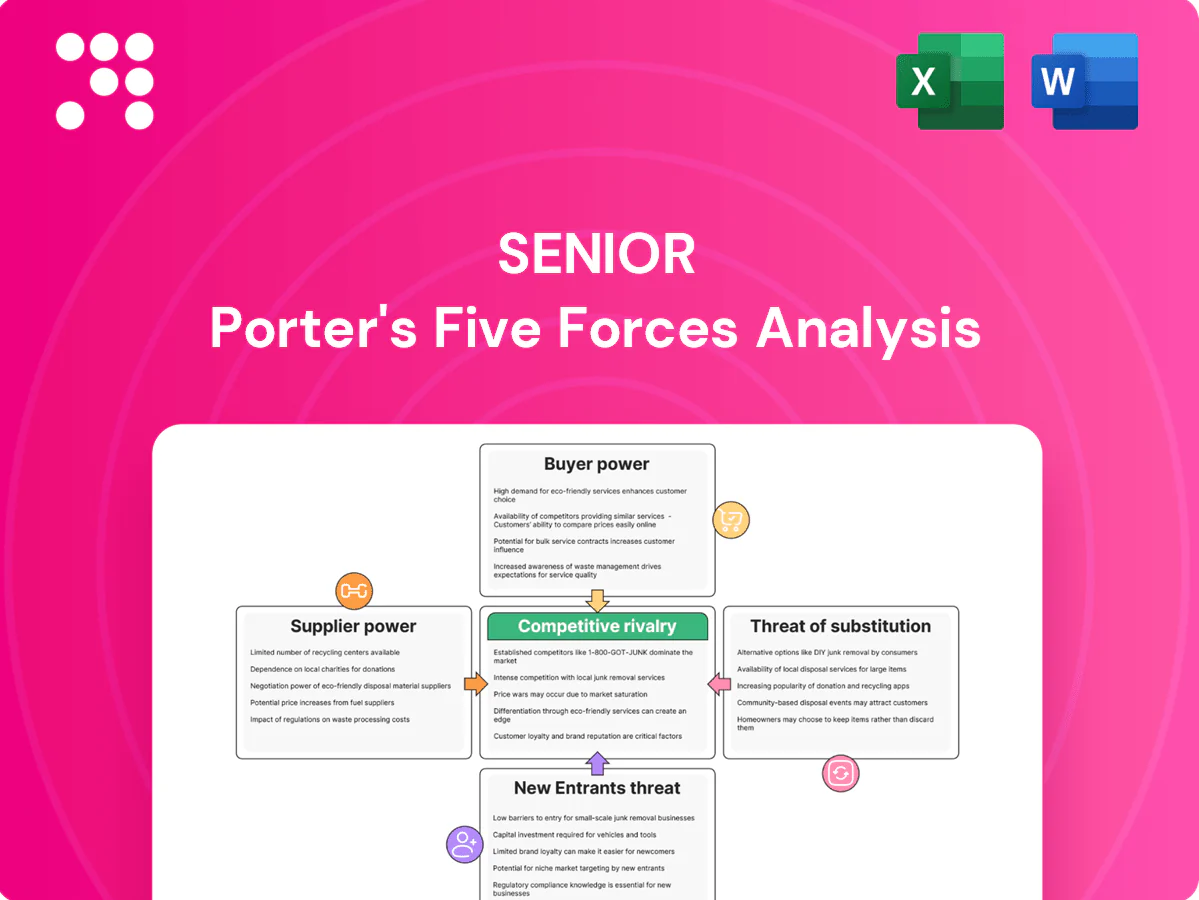
Senior Porter's Five Forces Analysis

From Overview to Strategy Blueprint
Senior’s Porter's Five Forces snapshot highlights supplier leverage, buyer pressure, competitive rivalry, substitution risk, and barriers to entry—revealing where margins and strategy are most exposed. This brief overview teases key competitive dynamics; the full Porter's Five Forces Analysis unlocks force-by-force ratings, visuals, and tactical recommendations tailored to Senior. Ready to act on precise, consultant-grade insights?
Suppliers Bargaining Power

Specialized materials
Senior relies on aerospace-grade alloys, composites and high-temp materials from a concentrated pool of certified suppliers, and qualification plus lot traceability typically extends switching lead-times to 12–18 months, constraining alternatives. This supplier concentration increases input pricing power and can lift material cost pass-through; hedging and dual-sourcing implemented by 2024 partially mitigate but do not eliminate exposure.
Process certifications
NADCAP accreditation and AS9100 compliance restrict which processors can legally perform aerospace heat treatment, plating and NDT, concentrating capability among certified firms. Scarcity of certified capacity raises supplier leverage during peak cycles, extending lead times and forcing buyers to hold higher inventory. Supplier on-time quality and certification maintenance become strategically critical to program delivery.

Precision tooling
Custom precision tooling embeds switching costs because vendor-specific fixtures require requalification; in 2024 OEMs report typical requalification plus PPAP cycles add 6–12 weeks and tens of thousands of dollars in overhead. Suppliers leverage this to negotiate premium terms on replacements and spares, while long-term agreements are used to cap escalation risk.

Logistics constraints
Global logistics volatility in 2024 disrupted titanium, nickel and composite feedstock flows, with episodic port congestion and blank sailings raising lead times and uncertainty. Freight bottlenecks gave logistics providers episodic leverage, forcing Senior to hold 30–60 days of safety stock and diversify routes and carriers. Cost pass-through to customers depends on contract structure and hedging of freight and commodity clauses.
- Safety stock: 30–60 days
- Diversify: alternate ports and carriers
- Contract focus: fixed vs spot freight clauses
- Monitor: lead-time and spot freight volatility
Skilled labor inputs
- Skilled labor scarcity: ~40% of firms (2024 surveys)
- Wage pass-through: ~4–6% y/y
- Capacity tightness: raises schedule risk, premium costs
- Mitigation: joint planning, supplier development cut lead-time variability ~15%
Certified-supplier concentration drives pricing power; switching 12–18 months
Senior depends on a concentrated pool of certified suppliers (switching 12–18 months), boosting supplier pricing power and cost pass-through. NADCAP/AS9100 limits processors, causing 30–60 days safety stock and peak-period leverage. Skilled-trade shortages (~40% firms) and 4–6% wage inflation plus logistics shocks keep supplier bargaining strong despite hedging/dual-sourcing.
| Metric | 2024 |
|---|---|
| Switching lead-time | 12–18 months |
| Safety stock | 30–60 days |
| Skilled-trade shortage | ~40% firms |
| Wage pass-through | 4–6% y/y |
| Lead-time variability cut | up to 15% |
What is included in the product
 Detailed Word Document
Comprehensive Porter's Five Forces analysis tailored to Senior, uncovering competitive drivers, buyer and supplier power, barriers to entry, substitute threats and disruptive forces, with strategic commentary and industry data to inform pricing, profitability and defensive opportunities.

 Customizable Excel Spreadsheet
A concise senior-level Porter's Five Forces one-sheet that surfaces strategic pain points and recommended relief actions, with adjustable pressure levels and a radar chart for instant prioritization. Clean, presentation-ready layout—easy to customize for scenarios, decks, or cross-functional decision-making.
Customers Bargaining Power

OEM concentration
Airbus and Boeing together capture roughly 90% of large commercial aircraft demand, while GE Aerospace and Rolls-Royce dominate high-thrust engine segments and defense primes (top five contractors) account for a majority of prime defense spend. Their scale and consolidated buying compress supplier pricing power and drive long-term contracts with aggressive cost-down targets, though deep supplier relationships and sole-sourced content limit full margin erosion.
Qualification lock-in
Once parts are qualified on a platform, requalification typically takes 12–24 months and can cost up to tens of millions of dollars, making mid-program switching costly and reducing buyer leverage. At new platform bid stages buyers in 2024 pushed aggressive price and technology demands, driving multi-year supplier RFPs. Widespread dual-sourcing practices continue to cap supplier margins.

Aftermarket leverage
OEMs increasingly control spares and MRO channels, capturing a majority of aftermarket share by 2024 (over 50% in many asset-heavy industries) and centralizing lifecycle pricing and inventory terms.

Defense procurement
Government primes contract under cost-plus and fixed-price frameworks, driving tight margins even as the US DoD enacted a roughly $858 billion FY2024 budget; compliance and audit rights increase transparency and cost scrutiny, while annual budget cycles and multi-year appropriations (commonly 3–5 year buys) dictate reorder timing and volumes. Long program lives (often 20+ years) provide revenue visibility despite pricing pressure.
- Frameworks: cost-plus and fixed-price
- 2024 US DoD budget: ~858 billion
- Procurement cadence: 3–5 year multi-year buys
- Program life: 20+ years, revenue visibility
Value-in-use
For high-performance components, demonstrable value-in-use—reliability and weight savings that cut lifecycle costs—shifts bargaining power away from customers; 2024 procurement studies show TCO-focused buyers reduce price pressure by roughly 30% when suppliers quantify savings. Engineering collaboration builds long-term stickiness, while missed deliveries erode negotiated premiums within a single quarter.
- Reliability drives premium pricing
- Weight savings → lower TCO (~30% buyer concession)
- Collaboration = retention
- Poor delivery = rapid loss of leverage
Duopoly buyer power compresses supplier pricing despite high switching costs and DoD demand
Airbus/Boeing ~90% share and dominant engine/defense primes concentrate buyer power, compressing supplier pricing despite some sole-source content.
Part requalification 12–24 months and up to tens of millions in cost makes switching costly; dual-sourcing limits margins.
OEMs >50% aftermarket share; 2024 US DoD budget ~858B; TCO focus cuts price pressure ~30%.
| Metric | 2024 Value |
|---|---|
| OEM market share | ~90% |
| Aftermarket share | >50% |
| DoD budget | ~858B |
| TCO effect | ~30% price concession |
Same Document Delivered
Senior Porter's Five Forces Analysis
This Senior Porter's Five Forces Analysis preview is the exact, fully formatted document you'll receive immediately after purchase—no placeholders or mockups. It delivers a complete competitive assessment ready for download and use. Purchase grants instant access to this identical file.

From Overview to Strategy Blueprint
Senior’s Porter's Five Forces snapshot highlights supplier leverage, buyer pressure, competitive rivalry, substitution risk, and barriers to entry—revealing where margins and strategy are most exposed. This brief overview teases key competitive dynamics; the full Porter's Five Forces Analysis unlocks force-by-force ratings, visuals, and tactical recommendations tailored to Senior. Ready to act on precise, consultant-grade insights?
Suppliers Bargaining Power
Specialized materials
Senior relies on aerospace-grade alloys, composites and high-temp materials from a concentrated pool of certified suppliers, and qualification plus lot traceability typically extends switching lead-times to 12–18 months, constraining alternatives. This supplier concentration increases input pricing power and can lift material cost pass-through; hedging and dual-sourcing implemented by 2024 partially mitigate but do not eliminate exposure.
Process certifications
NADCAP accreditation and AS9100 compliance restrict which processors can legally perform aerospace heat treatment, plating and NDT, concentrating capability among certified firms. Scarcity of certified capacity raises supplier leverage during peak cycles, extending lead times and forcing buyers to hold higher inventory. Supplier on-time quality and certification maintenance become strategically critical to program delivery.
Precision tooling
Custom precision tooling embeds switching costs because vendor-specific fixtures require requalification; in 2024 OEMs report typical requalification plus PPAP cycles add 6–12 weeks and tens of thousands of dollars in overhead. Suppliers leverage this to negotiate premium terms on replacements and spares, while long-term agreements are used to cap escalation risk.
Logistics constraints
Global logistics volatility in 2024 disrupted titanium, nickel and composite feedstock flows, with episodic port congestion and blank sailings raising lead times and uncertainty. Freight bottlenecks gave logistics providers episodic leverage, forcing Senior to hold 30–60 days of safety stock and diversify routes and carriers. Cost pass-through to customers depends on contract structure and hedging of freight and commodity clauses.
- Safety stock: 30–60 days
- Diversify: alternate ports and carriers
- Contract focus: fixed vs spot freight clauses
- Monitor: lead-time and spot freight volatility
Skilled labor inputs
- Skilled labor scarcity: ~40% of firms (2024 surveys)
- Wage pass-through: ~4–6% y/y
- Capacity tightness: raises schedule risk, premium costs
- Mitigation: joint planning, supplier development cut lead-time variability ~15%
Certified-supplier concentration drives pricing power; switching 12–18 months
Senior depends on a concentrated pool of certified suppliers (switching 12–18 months), boosting supplier pricing power and cost pass-through. NADCAP/AS9100 limits processors, causing 30–60 days safety stock and peak-period leverage. Skilled-trade shortages (~40% firms) and 4–6% wage inflation plus logistics shocks keep supplier bargaining strong despite hedging/dual-sourcing.
| Metric | 2024 |
|---|---|
| Switching lead-time | 12–18 months |
| Safety stock | 30–60 days |
| Skilled-trade shortage | ~40% firms |
| Wage pass-through | 4–6% y/y |
| Lead-time variability cut | up to 15% |
What is included in the product
Detailed Word Document
Comprehensive Porter's Five Forces analysis tailored to Senior, uncovering competitive drivers, buyer and supplier power, barriers to entry, substitute threats and disruptive forces, with strategic commentary and industry data to inform pricing, profitability and defensive opportunities.
Customizable Excel Spreadsheet
A concise senior-level Porter's Five Forces one-sheet that surfaces strategic pain points and recommended relief actions, with adjustable pressure levels and a radar chart for instant prioritization. Clean, presentation-ready layout—easy to customize for scenarios, decks, or cross-functional decision-making.
Customers Bargaining Power
OEM concentration
Airbus and Boeing together capture roughly 90% of large commercial aircraft demand, while GE Aerospace and Rolls-Royce dominate high-thrust engine segments and defense primes (top five contractors) account for a majority of prime defense spend. Their scale and consolidated buying compress supplier pricing power and drive long-term contracts with aggressive cost-down targets, though deep supplier relationships and sole-sourced content limit full margin erosion.
Qualification lock-in
Once parts are qualified on a platform, requalification typically takes 12–24 months and can cost up to tens of millions of dollars, making mid-program switching costly and reducing buyer leverage. At new platform bid stages buyers in 2024 pushed aggressive price and technology demands, driving multi-year supplier RFPs. Widespread dual-sourcing practices continue to cap supplier margins.
Aftermarket leverage
OEMs increasingly control spares and MRO channels, capturing a majority of aftermarket share by 2024 (over 50% in many asset-heavy industries) and centralizing lifecycle pricing and inventory terms.
Defense procurement
Government primes contract under cost-plus and fixed-price frameworks, driving tight margins even as the US DoD enacted a roughly $858 billion FY2024 budget; compliance and audit rights increase transparency and cost scrutiny, while annual budget cycles and multi-year appropriations (commonly 3–5 year buys) dictate reorder timing and volumes. Long program lives (often 20+ years) provide revenue visibility despite pricing pressure.
- Frameworks: cost-plus and fixed-price
- 2024 US DoD budget: ~858 billion
- Procurement cadence: 3–5 year multi-year buys
- Program life: 20+ years, revenue visibility
Value-in-use
For high-performance components, demonstrable value-in-use—reliability and weight savings that cut lifecycle costs—shifts bargaining power away from customers; 2024 procurement studies show TCO-focused buyers reduce price pressure by roughly 30% when suppliers quantify savings. Engineering collaboration builds long-term stickiness, while missed deliveries erode negotiated premiums within a single quarter.
- Reliability drives premium pricing
- Weight savings → lower TCO (~30% buyer concession)
- Collaboration = retention
- Poor delivery = rapid loss of leverage
Duopoly buyer power compresses supplier pricing despite high switching costs and DoD demand
Airbus/Boeing ~90% share and dominant engine/defense primes concentrate buyer power, compressing supplier pricing despite some sole-source content.
Part requalification 12–24 months and up to tens of millions in cost makes switching costly; dual-sourcing limits margins.
OEMs >50% aftermarket share; 2024 US DoD budget ~858B; TCO focus cuts price pressure ~30%.
| Metric | 2024 Value |
|---|---|
| OEM market share | ~90% |
| Aftermarket share | >50% |
| DoD budget | ~858B |
| TCO effect | ~30% price concession |
Same Document Delivered
Senior Porter's Five Forces Analysis
This Senior Porter's Five Forces Analysis preview is the exact, fully formatted document you'll receive immediately after purchase—no placeholders or mockups. It delivers a complete competitive assessment ready for download and use. Purchase grants instant access to this identical file.
Original: $10.00
-65%$10.00
$3.50Description
From Overview to Strategy Blueprint
Senior’s Porter's Five Forces snapshot highlights supplier leverage, buyer pressure, competitive rivalry, substitution risk, and barriers to entry—revealing where margins and strategy are most exposed. This brief overview teases key competitive dynamics; the full Porter's Five Forces Analysis unlocks force-by-force ratings, visuals, and tactical recommendations tailored to Senior. Ready to act on precise, consultant-grade insights?
Suppliers Bargaining Power
Specialized materials
Senior relies on aerospace-grade alloys, composites and high-temp materials from a concentrated pool of certified suppliers, and qualification plus lot traceability typically extends switching lead-times to 12–18 months, constraining alternatives. This supplier concentration increases input pricing power and can lift material cost pass-through; hedging and dual-sourcing implemented by 2024 partially mitigate but do not eliminate exposure.
Process certifications
NADCAP accreditation and AS9100 compliance restrict which processors can legally perform aerospace heat treatment, plating and NDT, concentrating capability among certified firms. Scarcity of certified capacity raises supplier leverage during peak cycles, extending lead times and forcing buyers to hold higher inventory. Supplier on-time quality and certification maintenance become strategically critical to program delivery.
Precision tooling
Custom precision tooling embeds switching costs because vendor-specific fixtures require requalification; in 2024 OEMs report typical requalification plus PPAP cycles add 6–12 weeks and tens of thousands of dollars in overhead. Suppliers leverage this to negotiate premium terms on replacements and spares, while long-term agreements are used to cap escalation risk.
Logistics constraints
Global logistics volatility in 2024 disrupted titanium, nickel and composite feedstock flows, with episodic port congestion and blank sailings raising lead times and uncertainty. Freight bottlenecks gave logistics providers episodic leverage, forcing Senior to hold 30–60 days of safety stock and diversify routes and carriers. Cost pass-through to customers depends on contract structure and hedging of freight and commodity clauses.
- Safety stock: 30–60 days
- Diversify: alternate ports and carriers
- Contract focus: fixed vs spot freight clauses
- Monitor: lead-time and spot freight volatility
Skilled labor inputs
- Skilled labor scarcity: ~40% of firms (2024 surveys)
- Wage pass-through: ~4–6% y/y
- Capacity tightness: raises schedule risk, premium costs
- Mitigation: joint planning, supplier development cut lead-time variability ~15%
Certified-supplier concentration drives pricing power; switching 12–18 months
Senior depends on a concentrated pool of certified suppliers (switching 12–18 months), boosting supplier pricing power and cost pass-through. NADCAP/AS9100 limits processors, causing 30–60 days safety stock and peak-period leverage. Skilled-trade shortages (~40% firms) and 4–6% wage inflation plus logistics shocks keep supplier bargaining strong despite hedging/dual-sourcing.
| Metric | 2024 |
|---|---|
| Switching lead-time | 12–18 months |
| Safety stock | 30–60 days |
| Skilled-trade shortage | ~40% firms |
| Wage pass-through | 4–6% y/y |
| Lead-time variability cut | up to 15% |
What is included in the product
Detailed Word Document
Comprehensive Porter's Five Forces analysis tailored to Senior, uncovering competitive drivers, buyer and supplier power, barriers to entry, substitute threats and disruptive forces, with strategic commentary and industry data to inform pricing, profitability and defensive opportunities.
Customizable Excel Spreadsheet
A concise senior-level Porter's Five Forces one-sheet that surfaces strategic pain points and recommended relief actions, with adjustable pressure levels and a radar chart for instant prioritization. Clean, presentation-ready layout—easy to customize for scenarios, decks, or cross-functional decision-making.
Customers Bargaining Power
OEM concentration
Airbus and Boeing together capture roughly 90% of large commercial aircraft demand, while GE Aerospace and Rolls-Royce dominate high-thrust engine segments and defense primes (top five contractors) account for a majority of prime defense spend. Their scale and consolidated buying compress supplier pricing power and drive long-term contracts with aggressive cost-down targets, though deep supplier relationships and sole-sourced content limit full margin erosion.
Qualification lock-in
Once parts are qualified on a platform, requalification typically takes 12–24 months and can cost up to tens of millions of dollars, making mid-program switching costly and reducing buyer leverage. At new platform bid stages buyers in 2024 pushed aggressive price and technology demands, driving multi-year supplier RFPs. Widespread dual-sourcing practices continue to cap supplier margins.
Aftermarket leverage
OEMs increasingly control spares and MRO channels, capturing a majority of aftermarket share by 2024 (over 50% in many asset-heavy industries) and centralizing lifecycle pricing and inventory terms.
Defense procurement
Government primes contract under cost-plus and fixed-price frameworks, driving tight margins even as the US DoD enacted a roughly $858 billion FY2024 budget; compliance and audit rights increase transparency and cost scrutiny, while annual budget cycles and multi-year appropriations (commonly 3–5 year buys) dictate reorder timing and volumes. Long program lives (often 20+ years) provide revenue visibility despite pricing pressure.
- Frameworks: cost-plus and fixed-price
- 2024 US DoD budget: ~858 billion
- Procurement cadence: 3–5 year multi-year buys
- Program life: 20+ years, revenue visibility
Value-in-use
For high-performance components, demonstrable value-in-use—reliability and weight savings that cut lifecycle costs—shifts bargaining power away from customers; 2024 procurement studies show TCO-focused buyers reduce price pressure by roughly 30% when suppliers quantify savings. Engineering collaboration builds long-term stickiness, while missed deliveries erode negotiated premiums within a single quarter.
- Reliability drives premium pricing
- Weight savings → lower TCO (~30% buyer concession)
- Collaboration = retention
- Poor delivery = rapid loss of leverage
Duopoly buyer power compresses supplier pricing despite high switching costs and DoD demand
Airbus/Boeing ~90% share and dominant engine/defense primes concentrate buyer power, compressing supplier pricing despite some sole-source content.
Part requalification 12–24 months and up to tens of millions in cost makes switching costly; dual-sourcing limits margins.
OEMs >50% aftermarket share; 2024 US DoD budget ~858B; TCO focus cuts price pressure ~30%.
| Metric | 2024 Value |
|---|---|
| OEM market share | ~90% |
| Aftermarket share | >50% |
| DoD budget | ~858B |
| TCO effect | ~30% price concession |
Same Document Delivered
Senior Porter's Five Forces Analysis
This Senior Porter's Five Forces Analysis preview is the exact, fully formatted document you'll receive immediately after purchase—no placeholders or mockups. It delivers a complete competitive assessment ready for download and use. Purchase grants instant access to this identical file.











