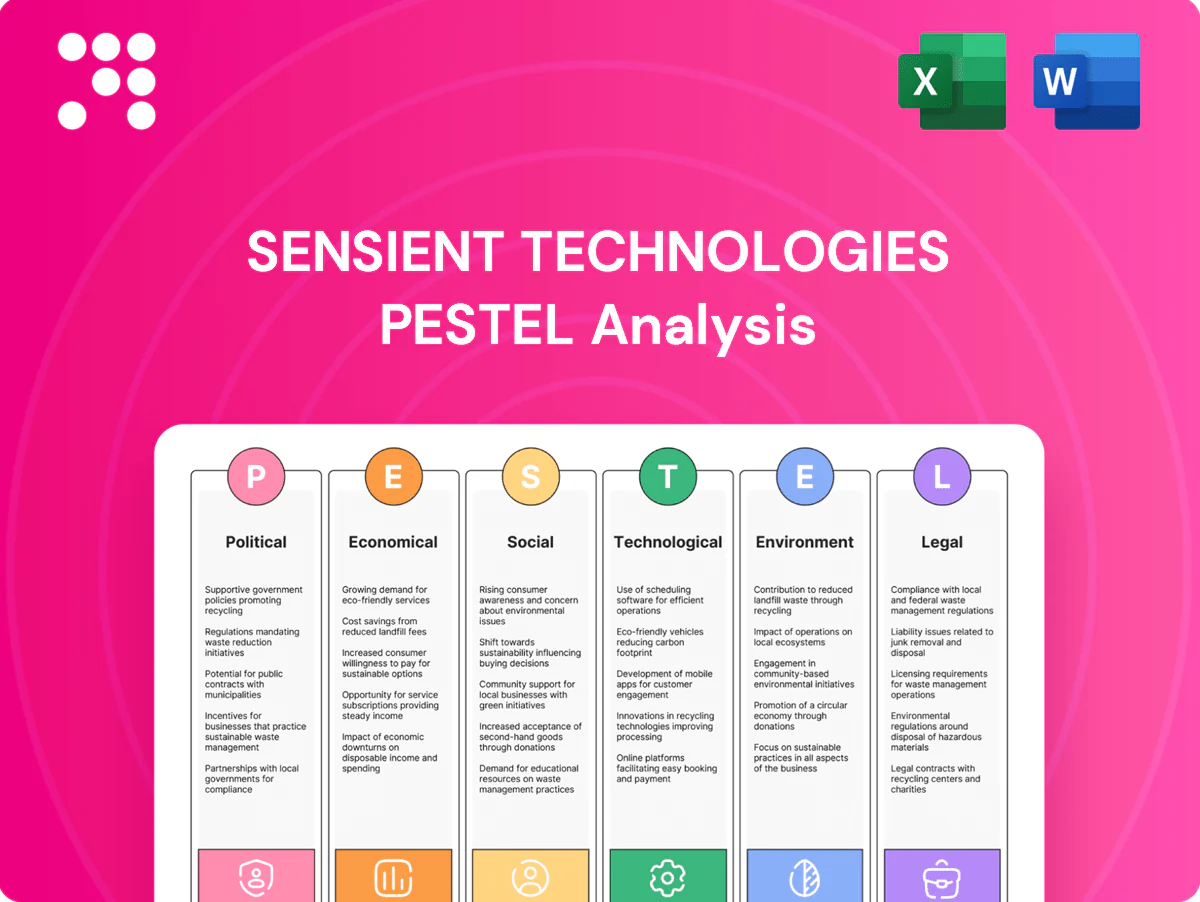
Sensient Technologies PESTLE Analysis

Your Shortcut to Market Insight Starts Here
Discover how regulatory shifts, consumer health trends, and technological innovation are reshaping Sensient Technologies' competitive landscape in our focused PESTLE snapshot. This concise analysis highlights key risks and growth levers to inform investment and strategy decisions. Purchase the full PESTLE for detailed, actionable insights and ready-to-use recommendations.
Political factors

Food and pharma regulatory alignment
Global shifts in food safety and pharmaceutical ingredient approvals—led by FDA, EFSA and emerging agencies such as China NMPA and India FSSAI—directly shape market access for Sensient color, flavor and excipient portfolios; FDA food contact notifications target a 120-day review window, highlighting regulatory pace variance.
Harmonization between FDA and EFSA shortens time-to-market, while divergence in emerging markets extends local approvals and compliance complexity.
Active participation in standards-setting can lock in favorable specs; conversely, stricter reviews or delays reallocate R&D and compliance budgets, increasing go-to-market costs and timing risk.
Trade policy and tariffs
Sensient’s global supply chain for botanicals, solvents and chemical intermediates is highly exposed to tariffs and export controls, especially given US tariffs on roughly $370 billion of Chinese goods since 2018 and US goods imports from China near $506 billion in 2023, which can raise landed costs and shift sourcing. Changes in US–China/EU trade relations rapidly alter sourcing choices, while preferential trade agreements such as USMCA/EU deals can create lower‑cost routes for natural inputs. Geopolitical disruptions underscore the need for multi‑region redundancy to protect margins and continuity.

Agri-commodity subsidies and policies
Government agriculture policies strongly affect availability and prices of natural colorants such as annatto, carmine and turmeric; India accounted for about 75–80% of world turmeric production in 2023, so its policy shifts materially move markets. Subsidies, quotas and pesticide restrictions (EU Farm to Fork/Green Deal measures) can tighten supply and lift input costs, while sustainability incentives and premiums for certified sourcing favor certified suppliers. Strategic supplier development in policy-stable regions mitigates geopolitical and regulatory shocks.

Public health and nutrition agendas
Political stability in sourcing regions
Instability in Latin America, Africa or South Asia (eg Peru 2022–23, Sri Lanka 2022–23, Sudan 2023) has disrupted harvesting and extraction, while logistics bottlenecks, currency controls and labor unrest raise costs; Sensient reported roughly 1.4 billion USD revenue in 2024, making supply resilience critical.
- Diversified sourcing reduces single-country risk
- Local partnerships improve continuity
- Insurance and inventory buffers protect service levels
Regulatory, tariff and supply shocks push clean-label reformulation and higher ingredient costs
Regulatory shifts (FDA, EFSA, NMPA, FSSAI) shape Sensient product approvals; FDA food-contact reviews ~120 days.
US tariffs on ~$370B Chinese goods and $506B China imports (2023) raise landed costs; Sensient revenue ~1.4B USD (2024) increases exposure.
India supplied ~75–80% of world turmeric (2023), so agri policy/sustainability rules materially affect natural color supply.
WHO sugar <10% guideline accelerates clean-label reformulation demand.
| Factor | Key data | Impact |
|---|---|---|
| Trade & tariffs | $370B/$506B | Higher costs, sourcing shifts |
What is included in the product
 Detailed Word Document
Explores how macro-environmental forces—Political, Economic, Social, Technological, Environmental, and Legal—uniquely affect Sensient Technologies, with data-backed trends, forward-looking scenario insights, and industry-specific subpoints to help executives, investors, and strategists identify risks, opportunities, and actionable responses for plans and pitches.

 Customizable Excel Spreadsheet
A concise, visually segmented PESTLE summary for Sensient Technologies that simplifies external risk assessment and market positioning, making it easy to drop into presentations or share across teams during planning sessions.
Economic factors

Input cost volatility
Input costs for vanilla, spices, citrus oils and petrochemical derivatives remain highly volatile, with vanilla bean prices having swung by several hundred percent since 2016 and petrochemical feedstocks closely tracking crude (Brent averaged about $86/bbl in 2024). Cost pass-through to CPG and pharma varies by fixed versus pass-through contract terms. Hedging programs and formula optimization materially dampen margin swings. Value-engineering of formulations protects profitability during downturns.
Consumer spending cycles
Consumer spending cycles directly affect Sensient as food, beverage and personal care demand track disposable income; Sensient reported roughly $1.8B in sales in FY2024 and sells specialty ingredients that benefit from premiumization trends.
Private label penetration in US grocery rose near 20% in 2024, pressuring prices during downturns while Sensients geographic footprint across 30+ countries smooths regional volatility. Innovation in flavors, colors and encapsulation supports trade-up even in slow growth markets.

Currency movements
Sensient’s revenue and costs span USD, EUR and emerging‑market currencies, with reported FY2024 net sales near $1.33 billion, creating both translation and transaction risk.
A strong dollar (US Dollar Index ~105 in mid‑2025) can compress reported sales in non‑USD terms while trimming some dollar‑priced input costs.
Company disclosure cites natural hedges and active FX programs to stabilize earnings, alongside pricing discipline and expanding local production to reduce exposure.

Customer consolidation
Mega-CPGs and global pharma buyers concentrate purchasing power—Walmart reported $611.3B revenue in FY2024—pushing longer payment terms and larger, centralized contracts that compress supplier margins. Consolidation raises specification complexity and global supply requirements, forcing Sensient to invest in compliance and logistics to serve multinational pipelines. A strategic key-account focus and differentiated technology/service allow Sensient to secure long-term contracts and command premium pricing.
- Concentration: Walmart $611.3B (FY2024)
- Risk: extended payment terms reduce cash flow
- Opportunity: key-account focus = long-term pipelines
- Value: tech/service differentiation supports premium pricing
Emerging market growth
IMF projects emerging market growth at about 4.1% in 2024, boosting demand for flavored beverages, snacks and personal care as rising middle classes increase discretionary spending; local tastes force region-specific sensory solutions, while Sensient’s regional technical centers speed product adoption; EM volatility requires agile inventory and credit management.
- IMF 2024: EM growth ~4.1%
- Middle-class-driven demand rises for flavors/AROMA
- Regional tech centers = faster adoption
- EM FX/credit volatility => agile inventory & credit controls
Regulatory, tariff and supply shocks push clean-label reformulation and higher ingredient costs
Sensient faces volatile input costs (vanilla swings, Brent ~86/bbl in 2024) and FX/translation risk with FY2024 net sales ~1.33B USD; strong USD (DXY ~105 mid‑2025) compresses non‑USD sales but offsets some input costs. Consumer premiumization and EM growth (~4.1% IMF 2024) support demand, while mega‑CPG consolidation (Walmart rev $611.3B FY2024) pressures terms and margin, offset by hedging, local production and key‑account focus.
| Metric | Value |
|---|---|
| FY2024 net sales | ~1.33B USD |
| Brent 2024 avg | ~86 USD/bbl |
| DXY mid‑2025 | ~105 |
| Walmart FY2024 | 611.3B USD |
| IMF EM growth 2024 | ~4.1% |
What You See Is What You Get
Sensient Technologies PESTLE Analysis
The Sensient Technologies PESTLE Analysis presented here offers a concise, actionable assessment of political, economic, social, technological, legal, and environmental factors affecting the company. The preview shown is the exact document you’ll receive after purchase—fully formatted and ready to use. No placeholders or teasers; the file you see is the final, downloadable version.

Your Shortcut to Market Insight Starts Here
Discover how regulatory shifts, consumer health trends, and technological innovation are reshaping Sensient Technologies' competitive landscape in our focused PESTLE snapshot. This concise analysis highlights key risks and growth levers to inform investment and strategy decisions. Purchase the full PESTLE for detailed, actionable insights and ready-to-use recommendations.
Political factors
Food and pharma regulatory alignment
Global shifts in food safety and pharmaceutical ingredient approvals—led by FDA, EFSA and emerging agencies such as China NMPA and India FSSAI—directly shape market access for Sensient color, flavor and excipient portfolios; FDA food contact notifications target a 120-day review window, highlighting regulatory pace variance.
Harmonization between FDA and EFSA shortens time-to-market, while divergence in emerging markets extends local approvals and compliance complexity.
Active participation in standards-setting can lock in favorable specs; conversely, stricter reviews or delays reallocate R&D and compliance budgets, increasing go-to-market costs and timing risk.
Trade policy and tariffs
Sensient’s global supply chain for botanicals, solvents and chemical intermediates is highly exposed to tariffs and export controls, especially given US tariffs on roughly $370 billion of Chinese goods since 2018 and US goods imports from China near $506 billion in 2023, which can raise landed costs and shift sourcing. Changes in US–China/EU trade relations rapidly alter sourcing choices, while preferential trade agreements such as USMCA/EU deals can create lower‑cost routes for natural inputs. Geopolitical disruptions underscore the need for multi‑region redundancy to protect margins and continuity.
Agri-commodity subsidies and policies
Government agriculture policies strongly affect availability and prices of natural colorants such as annatto, carmine and turmeric; India accounted for about 75–80% of world turmeric production in 2023, so its policy shifts materially move markets. Subsidies, quotas and pesticide restrictions (EU Farm to Fork/Green Deal measures) can tighten supply and lift input costs, while sustainability incentives and premiums for certified sourcing favor certified suppliers. Strategic supplier development in policy-stable regions mitigates geopolitical and regulatory shocks.
Public health and nutrition agendas
Political stability in sourcing regions
Instability in Latin America, Africa or South Asia (eg Peru 2022–23, Sri Lanka 2022–23, Sudan 2023) has disrupted harvesting and extraction, while logistics bottlenecks, currency controls and labor unrest raise costs; Sensient reported roughly 1.4 billion USD revenue in 2024, making supply resilience critical.
- Diversified sourcing reduces single-country risk
- Local partnerships improve continuity
- Insurance and inventory buffers protect service levels
Regulatory, tariff and supply shocks push clean-label reformulation and higher ingredient costs
Regulatory shifts (FDA, EFSA, NMPA, FSSAI) shape Sensient product approvals; FDA food-contact reviews ~120 days.
US tariffs on ~$370B Chinese goods and $506B China imports (2023) raise landed costs; Sensient revenue ~1.4B USD (2024) increases exposure.
India supplied ~75–80% of world turmeric (2023), so agri policy/sustainability rules materially affect natural color supply.
WHO sugar <10% guideline accelerates clean-label reformulation demand.
| Factor | Key data | Impact |
|---|---|---|
| Trade & tariffs | $370B/$506B | Higher costs, sourcing shifts |
What is included in the product
Detailed Word Document
Explores how macro-environmental forces—Political, Economic, Social, Technological, Environmental, and Legal—uniquely affect Sensient Technologies, with data-backed trends, forward-looking scenario insights, and industry-specific subpoints to help executives, investors, and strategists identify risks, opportunities, and actionable responses for plans and pitches.
Customizable Excel Spreadsheet
A concise, visually segmented PESTLE summary for Sensient Technologies that simplifies external risk assessment and market positioning, making it easy to drop into presentations or share across teams during planning sessions.
Economic factors
Input cost volatility
Input costs for vanilla, spices, citrus oils and petrochemical derivatives remain highly volatile, with vanilla bean prices having swung by several hundred percent since 2016 and petrochemical feedstocks closely tracking crude (Brent averaged about $86/bbl in 2024). Cost pass-through to CPG and pharma varies by fixed versus pass-through contract terms. Hedging programs and formula optimization materially dampen margin swings. Value-engineering of formulations protects profitability during downturns.
Consumer spending cycles
Consumer spending cycles directly affect Sensient as food, beverage and personal care demand track disposable income; Sensient reported roughly $1.8B in sales in FY2024 and sells specialty ingredients that benefit from premiumization trends.
Private label penetration in US grocery rose near 20% in 2024, pressuring prices during downturns while Sensients geographic footprint across 30+ countries smooths regional volatility. Innovation in flavors, colors and encapsulation supports trade-up even in slow growth markets.
Currency movements
Sensient’s revenue and costs span USD, EUR and emerging‑market currencies, with reported FY2024 net sales near $1.33 billion, creating both translation and transaction risk.
A strong dollar (US Dollar Index ~105 in mid‑2025) can compress reported sales in non‑USD terms while trimming some dollar‑priced input costs.
Company disclosure cites natural hedges and active FX programs to stabilize earnings, alongside pricing discipline and expanding local production to reduce exposure.
Customer consolidation
Mega-CPGs and global pharma buyers concentrate purchasing power—Walmart reported $611.3B revenue in FY2024—pushing longer payment terms and larger, centralized contracts that compress supplier margins. Consolidation raises specification complexity and global supply requirements, forcing Sensient to invest in compliance and logistics to serve multinational pipelines. A strategic key-account focus and differentiated technology/service allow Sensient to secure long-term contracts and command premium pricing.
- Concentration: Walmart $611.3B (FY2024)
- Risk: extended payment terms reduce cash flow
- Opportunity: key-account focus = long-term pipelines
- Value: tech/service differentiation supports premium pricing
Emerging market growth
IMF projects emerging market growth at about 4.1% in 2024, boosting demand for flavored beverages, snacks and personal care as rising middle classes increase discretionary spending; local tastes force region-specific sensory solutions, while Sensient’s regional technical centers speed product adoption; EM volatility requires agile inventory and credit management.
- IMF 2024: EM growth ~4.1%
- Middle-class-driven demand rises for flavors/AROMA
- Regional tech centers = faster adoption
- EM FX/credit volatility => agile inventory & credit controls
Regulatory, tariff and supply shocks push clean-label reformulation and higher ingredient costs
Sensient faces volatile input costs (vanilla swings, Brent ~86/bbl in 2024) and FX/translation risk with FY2024 net sales ~1.33B USD; strong USD (DXY ~105 mid‑2025) compresses non‑USD sales but offsets some input costs. Consumer premiumization and EM growth (~4.1% IMF 2024) support demand, while mega‑CPG consolidation (Walmart rev $611.3B FY2024) pressures terms and margin, offset by hedging, local production and key‑account focus.
| Metric | Value |
|---|---|
| FY2024 net sales | ~1.33B USD |
| Brent 2024 avg | ~86 USD/bbl |
| DXY mid‑2025 | ~105 |
| Walmart FY2024 | 611.3B USD |
| IMF EM growth 2024 | ~4.1% |
What You See Is What You Get
Sensient Technologies PESTLE Analysis
The Sensient Technologies PESTLE Analysis presented here offers a concise, actionable assessment of political, economic, social, technological, legal, and environmental factors affecting the company. The preview shown is the exact document you’ll receive after purchase—fully formatted and ready to use. No placeholders or teasers; the file you see is the final, downloadable version.
Original: $10.00
-65%$10.00
$3.50Description
Your Shortcut to Market Insight Starts Here
Discover how regulatory shifts, consumer health trends, and technological innovation are reshaping Sensient Technologies' competitive landscape in our focused PESTLE snapshot. This concise analysis highlights key risks and growth levers to inform investment and strategy decisions. Purchase the full PESTLE for detailed, actionable insights and ready-to-use recommendations.
Political factors
Food and pharma regulatory alignment
Global shifts in food safety and pharmaceutical ingredient approvals—led by FDA, EFSA and emerging agencies such as China NMPA and India FSSAI—directly shape market access for Sensient color, flavor and excipient portfolios; FDA food contact notifications target a 120-day review window, highlighting regulatory pace variance.
Harmonization between FDA and EFSA shortens time-to-market, while divergence in emerging markets extends local approvals and compliance complexity.
Active participation in standards-setting can lock in favorable specs; conversely, stricter reviews or delays reallocate R&D and compliance budgets, increasing go-to-market costs and timing risk.
Trade policy and tariffs
Sensient’s global supply chain for botanicals, solvents and chemical intermediates is highly exposed to tariffs and export controls, especially given US tariffs on roughly $370 billion of Chinese goods since 2018 and US goods imports from China near $506 billion in 2023, which can raise landed costs and shift sourcing. Changes in US–China/EU trade relations rapidly alter sourcing choices, while preferential trade agreements such as USMCA/EU deals can create lower‑cost routes for natural inputs. Geopolitical disruptions underscore the need for multi‑region redundancy to protect margins and continuity.
Agri-commodity subsidies and policies
Government agriculture policies strongly affect availability and prices of natural colorants such as annatto, carmine and turmeric; India accounted for about 75–80% of world turmeric production in 2023, so its policy shifts materially move markets. Subsidies, quotas and pesticide restrictions (EU Farm to Fork/Green Deal measures) can tighten supply and lift input costs, while sustainability incentives and premiums for certified sourcing favor certified suppliers. Strategic supplier development in policy-stable regions mitigates geopolitical and regulatory shocks.
Public health and nutrition agendas
Political stability in sourcing regions
Instability in Latin America, Africa or South Asia (eg Peru 2022–23, Sri Lanka 2022–23, Sudan 2023) has disrupted harvesting and extraction, while logistics bottlenecks, currency controls and labor unrest raise costs; Sensient reported roughly 1.4 billion USD revenue in 2024, making supply resilience critical.
- Diversified sourcing reduces single-country risk
- Local partnerships improve continuity
- Insurance and inventory buffers protect service levels
Regulatory, tariff and supply shocks push clean-label reformulation and higher ingredient costs
Regulatory shifts (FDA, EFSA, NMPA, FSSAI) shape Sensient product approvals; FDA food-contact reviews ~120 days.
US tariffs on ~$370B Chinese goods and $506B China imports (2023) raise landed costs; Sensient revenue ~1.4B USD (2024) increases exposure.
India supplied ~75–80% of world turmeric (2023), so agri policy/sustainability rules materially affect natural color supply.
WHO sugar <10% guideline accelerates clean-label reformulation demand.
| Factor | Key data | Impact |
|---|---|---|
| Trade & tariffs | $370B/$506B | Higher costs, sourcing shifts |
What is included in the product
Detailed Word Document
Explores how macro-environmental forces—Political, Economic, Social, Technological, Environmental, and Legal—uniquely affect Sensient Technologies, with data-backed trends, forward-looking scenario insights, and industry-specific subpoints to help executives, investors, and strategists identify risks, opportunities, and actionable responses for plans and pitches.
Customizable Excel Spreadsheet
A concise, visually segmented PESTLE summary for Sensient Technologies that simplifies external risk assessment and market positioning, making it easy to drop into presentations or share across teams during planning sessions.
Economic factors
Input cost volatility
Input costs for vanilla, spices, citrus oils and petrochemical derivatives remain highly volatile, with vanilla bean prices having swung by several hundred percent since 2016 and petrochemical feedstocks closely tracking crude (Brent averaged about $86/bbl in 2024). Cost pass-through to CPG and pharma varies by fixed versus pass-through contract terms. Hedging programs and formula optimization materially dampen margin swings. Value-engineering of formulations protects profitability during downturns.
Consumer spending cycles
Consumer spending cycles directly affect Sensient as food, beverage and personal care demand track disposable income; Sensient reported roughly $1.8B in sales in FY2024 and sells specialty ingredients that benefit from premiumization trends.
Private label penetration in US grocery rose near 20% in 2024, pressuring prices during downturns while Sensients geographic footprint across 30+ countries smooths regional volatility. Innovation in flavors, colors and encapsulation supports trade-up even in slow growth markets.
Currency movements
Sensient’s revenue and costs span USD, EUR and emerging‑market currencies, with reported FY2024 net sales near $1.33 billion, creating both translation and transaction risk.
A strong dollar (US Dollar Index ~105 in mid‑2025) can compress reported sales in non‑USD terms while trimming some dollar‑priced input costs.
Company disclosure cites natural hedges and active FX programs to stabilize earnings, alongside pricing discipline and expanding local production to reduce exposure.
Customer consolidation
Mega-CPGs and global pharma buyers concentrate purchasing power—Walmart reported $611.3B revenue in FY2024—pushing longer payment terms and larger, centralized contracts that compress supplier margins. Consolidation raises specification complexity and global supply requirements, forcing Sensient to invest in compliance and logistics to serve multinational pipelines. A strategic key-account focus and differentiated technology/service allow Sensient to secure long-term contracts and command premium pricing.
- Concentration: Walmart $611.3B (FY2024)
- Risk: extended payment terms reduce cash flow
- Opportunity: key-account focus = long-term pipelines
- Value: tech/service differentiation supports premium pricing
Emerging market growth
IMF projects emerging market growth at about 4.1% in 2024, boosting demand for flavored beverages, snacks and personal care as rising middle classes increase discretionary spending; local tastes force region-specific sensory solutions, while Sensient’s regional technical centers speed product adoption; EM volatility requires agile inventory and credit management.
- IMF 2024: EM growth ~4.1%
- Middle-class-driven demand rises for flavors/AROMA
- Regional tech centers = faster adoption
- EM FX/credit volatility => agile inventory & credit controls
Regulatory, tariff and supply shocks push clean-label reformulation and higher ingredient costs
Sensient faces volatile input costs (vanilla swings, Brent ~86/bbl in 2024) and FX/translation risk with FY2024 net sales ~1.33B USD; strong USD (DXY ~105 mid‑2025) compresses non‑USD sales but offsets some input costs. Consumer premiumization and EM growth (~4.1% IMF 2024) support demand, while mega‑CPG consolidation (Walmart rev $611.3B FY2024) pressures terms and margin, offset by hedging, local production and key‑account focus.
| Metric | Value |
|---|---|
| FY2024 net sales | ~1.33B USD |
| Brent 2024 avg | ~86 USD/bbl |
| DXY mid‑2025 | ~105 |
| Walmart FY2024 | 611.3B USD |
| IMF EM growth 2024 | ~4.1% |
What You See Is What You Get
Sensient Technologies PESTLE Analysis
The Sensient Technologies PESTLE Analysis presented here offers a concise, actionable assessment of political, economic, social, technological, legal, and environmental factors affecting the company. The preview shown is the exact document you’ll receive after purchase—fully formatted and ready to use. No placeholders or teasers; the file you see is the final, downloadable version.











