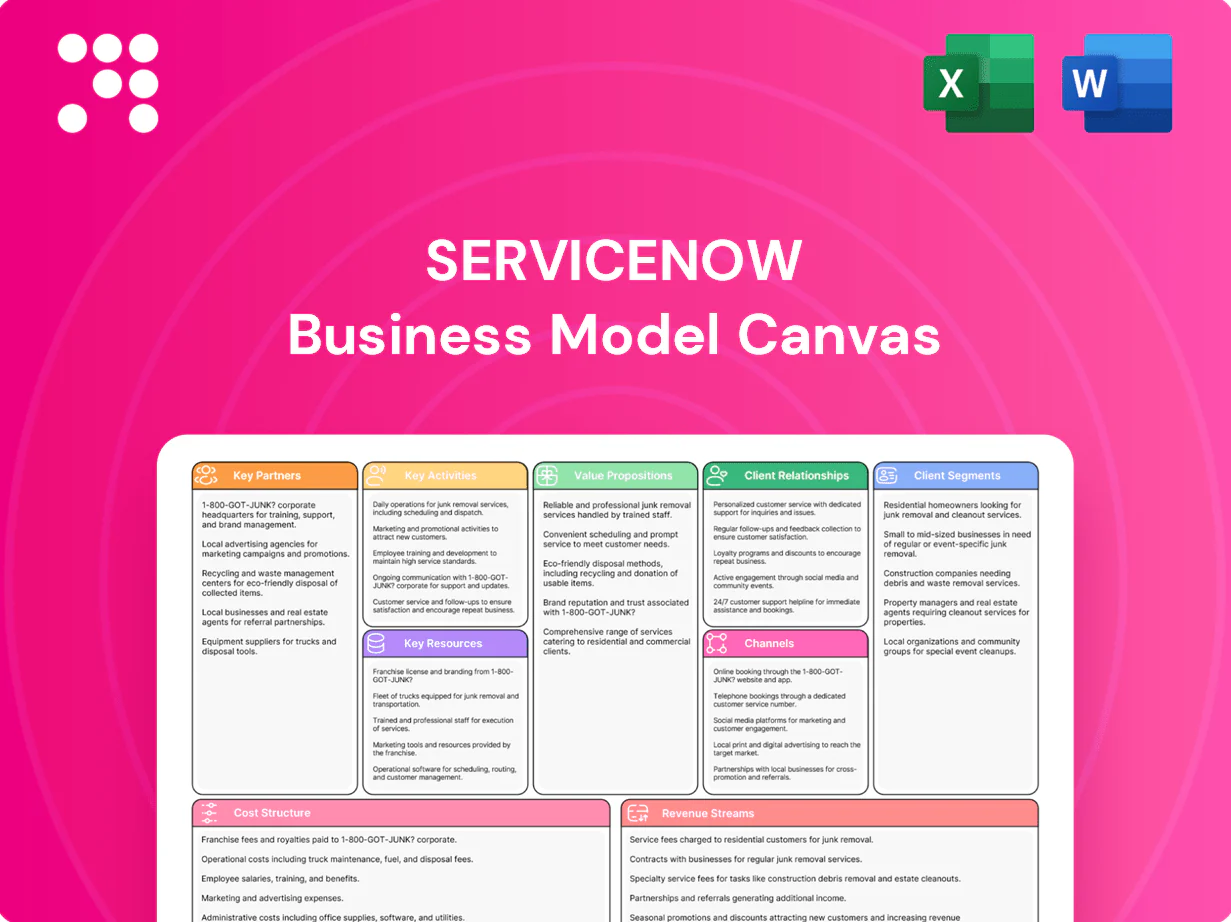
ServiceNow Business Model Canvas

Unlock the strategic blueprint of leading enterprise workflow platforms in one Business Model Canvas
Unlock the full strategic blueprint behind ServiceNow’s business model with our in-depth Business Model Canvas—three to five concise, actionable sections reveal how the company creates value, scales revenue, and sustains competitive edge. Ideal for investors, consultants, and founders, the downloadable Word and Excel files let you benchmark, adapt, and apply proven strategies to your own growth plans. Purchase the full canvas to turn insight into execution.
Partnerships

Cloud hyperscalers (AWS, Azure, GCP)
Cloud hyperscalers provide global infrastructure to host and scale ServiceNow workloads across AWS (31 regions), Azure (60+ regions) and GCP (35 regions), with market shares ~32%, 23%, 12% respectively (Canalys 2024). Co-selling and marketplace listings expand reach and reduce procurement friction, speeding deployments. Joint reference architectures and technical alignment accelerate secure, high‑performance deployments and offer sovereignty and compliance options.
Global SIs and consulting partners
Accenture and Deloitte, among other global SIs, deliver implementation, integration, and change management for ServiceNow, unlocking complex enterprise deals and accelerating time to value; Accenture reported $64.1B revenue in FY2024 and Deloitte roughly $64B in FY2024, underscoring scale. Vertical expertise tailors workflows to industry needs, while partner-delivered outcomes drive adoption and expansion across large accounts.

Technology and ISV ecosystem
Security, observability, ERP, CRM and ITOM vendors integrate with ServiceNow to enable unified workflows and incident response; the platform is used by over 80% of the Fortune 500 (2024). Prebuilt connectors and certified apps extend use cases and accelerate deployments. Data interoperability across partners increases platform stickiness. Joint solutions with ISVs address end-to-end workflows from detection to remediation.

Managed service providers
Managed service providers run and optimize ServiceNow deployments at scale, bundling operations, SLAs and platform enhancements to lower entry cost and operational burden for mid-market and cost-sensitive segments. They deliver ongoing services that drive continuous improvement and faster ROI, aligning upgrades and automations with customer KPIs. Adoption via MSPs expands reach into customers preferring OpEx over CapEx models.
- MSP role: run, optimize, scale
- Offerings: bundled ops, SLAs, enhancements
- Target: mid-market, cost-sensitive segments
- Impact: continuous improvement, faster ROI
Education and training partners
Authorized trainers and more than 1,000 partner institutions and university programs expand ServiceNow talent pipelines, feeding certified practitioners into the market; ServiceNow-certified credentials (over 200,000 certificates issued by 2024) ensure baseline skill quality.
Community-led learning (forums and local user groups with 300k+ members) boosts adoption velocity while workforce readiness cuts customer ramp time by ~30% in published case studies.
- Authorized trainers: scale supply
- Certifications: quality control
- Community learning: faster adoption
- Workforce readiness: ~30% ramp reduction
Hyperscalers, SIs & ISVs expand reach via marketplaces; 200K+ certs
Cloud hyperscalers (AWS 31 regions, Azure 60+, GCP 35; market shares ~32/23/12 in 2024) host and scale ServiceNow, enabling co-selling and marketplace reach. Global SIs (Accenture $64.1B FY2024, Deloitte ~$64B FY2024) deliver implementations and vertical expertise. ISV integrations, MSPs and certified training (200,000+ certificates by 2024) drive adoption and stickiness.
| Partner Type | Metric | 2024 |
|---|---|---|
| Hyperscalers | Regions / Market share | AWS 31 / 32% ; Azure 60+ / 23% ; GCP 35 / 12% |
| SI | Revenue | Accenture $64.1B ; Deloitte ~$64B |
| Training | Certs issued | 200,000+ |
What is included in the product
 Detailed Word Document
A comprehensive, pre-written Business Model Canvas for ServiceNow that maps customer segments, channels, value propositions and revenue streams across the 9 classic BMC blocks with real-world operational detail. Ideal for presentations and investor discussions, it includes competitive advantage analysis, linked SWOT insights, and practical guidance for strategic decision-making.

 Customizable Excel Spreadsheet
Streamlines enterprise workflow pain points into a one-page ServiceNow Business Model Canvas, enabling teams to quickly map value propositions, key processes, and customer needs for faster problem resolution and alignment.
Activities

Platform R&D and roadmap
Continuous R&D advances workflow, AI and low-code capabilities with security, scalability and reliability prioritized; regular quarterly releases deliver new modules and industry solutions, and customer feedback directly shapes feature prioritization. In 2024 ServiceNow supported over 8,000 enterprise customers and invested more than $2B in R&D to accelerate platform roadmap.
Ecosystem enablement
Ecosystem enablement scales by recruiting, certifying, and supporting thousands of partners and by curating ServiceNow Store quality and governance to protect customer trust. Robust SDKs, APIs, and integration frameworks accelerate deployments and reduce TCO. Joint marketing and solution playbooks drive demand—supporting ServiceNow’s platform that generated about $8.5B revenue in 2024.

Enterprise sales and success
Enterprise sales target large accounts and expand an installed base—ServiceNow reported fiscal 2024 revenue of $8.6B—using value engineering and ROI storytelling to win deals. Customer success teams drive adoption, measurable outcomes and renewals, while executive alignment secures multi-year commitments and expansion paths.

Service delivery and support
Developer community growth
Events, forums and hackathons spur innovation and feed ServiceNow's ecosystem; the Developer Program grew to over 1.3 million members by 2024. Low-code/no-code education scales citizen developers and accelerates delivery. Publishing reusable components and accelerators shortens time-to-value, while recognizing contributors sustains momentum and retention.
- Events & hackathons
- Low-code/no-code education
- Reusable components & accelerators
- Contributor recognition
R&D $2.0B fuels scale and reliability for enterprises
Continuous R&D drove platform advances with ~$2.0B R&D spend and quarterly releases; platform reliability targeted 99.99% uptime. Ecosystem scaling supported 8,000+ enterprise customers and a Developer Program of ~1.3M members. Commercial motion generated $8.61B revenue in fiscal 2024 through enterprise sales, partners and customer success.
| Activity | 2024 metric |
|---|---|
| R&D spend | $2.0B |
| Revenue | $8.61B |
| Enterprise customers | 8,000+ |
| Developer Program | ~1.3M |
| Uptime target | 99.99% |
Preview Before You Purchase
Business Model Canvas
The document you're previewing is the actual ServiceNow Business Model Canvas deliverable. When you purchase, you'll receive this exact file—complete, editable, and formatted as shown. No samples or placeholders—what you see here is the same professional document you'll download and use.

Unlock the strategic blueprint of leading enterprise workflow platforms in one Business Model Canvas
Unlock the full strategic blueprint behind ServiceNow’s business model with our in-depth Business Model Canvas—three to five concise, actionable sections reveal how the company creates value, scales revenue, and sustains competitive edge. Ideal for investors, consultants, and founders, the downloadable Word and Excel files let you benchmark, adapt, and apply proven strategies to your own growth plans. Purchase the full canvas to turn insight into execution.
Partnerships
Cloud hyperscalers (AWS, Azure, GCP)
Cloud hyperscalers provide global infrastructure to host and scale ServiceNow workloads across AWS (31 regions), Azure (60+ regions) and GCP (35 regions), with market shares ~32%, 23%, 12% respectively (Canalys 2024). Co-selling and marketplace listings expand reach and reduce procurement friction, speeding deployments. Joint reference architectures and technical alignment accelerate secure, high‑performance deployments and offer sovereignty and compliance options.
Global SIs and consulting partners
Accenture and Deloitte, among other global SIs, deliver implementation, integration, and change management for ServiceNow, unlocking complex enterprise deals and accelerating time to value; Accenture reported $64.1B revenue in FY2024 and Deloitte roughly $64B in FY2024, underscoring scale. Vertical expertise tailors workflows to industry needs, while partner-delivered outcomes drive adoption and expansion across large accounts.
Technology and ISV ecosystem
Security, observability, ERP, CRM and ITOM vendors integrate with ServiceNow to enable unified workflows and incident response; the platform is used by over 80% of the Fortune 500 (2024). Prebuilt connectors and certified apps extend use cases and accelerate deployments. Data interoperability across partners increases platform stickiness. Joint solutions with ISVs address end-to-end workflows from detection to remediation.
Managed service providers
Managed service providers run and optimize ServiceNow deployments at scale, bundling operations, SLAs and platform enhancements to lower entry cost and operational burden for mid-market and cost-sensitive segments. They deliver ongoing services that drive continuous improvement and faster ROI, aligning upgrades and automations with customer KPIs. Adoption via MSPs expands reach into customers preferring OpEx over CapEx models.
- MSP role: run, optimize, scale
- Offerings: bundled ops, SLAs, enhancements
- Target: mid-market, cost-sensitive segments
- Impact: continuous improvement, faster ROI
Education and training partners
Authorized trainers and more than 1,000 partner institutions and university programs expand ServiceNow talent pipelines, feeding certified practitioners into the market; ServiceNow-certified credentials (over 200,000 certificates issued by 2024) ensure baseline skill quality.
Community-led learning (forums and local user groups with 300k+ members) boosts adoption velocity while workforce readiness cuts customer ramp time by ~30% in published case studies.
- Authorized trainers: scale supply
- Certifications: quality control
- Community learning: faster adoption
- Workforce readiness: ~30% ramp reduction
Hyperscalers, SIs & ISVs expand reach via marketplaces; 200K+ certs
Cloud hyperscalers (AWS 31 regions, Azure 60+, GCP 35; market shares ~32/23/12 in 2024) host and scale ServiceNow, enabling co-selling and marketplace reach. Global SIs (Accenture $64.1B FY2024, Deloitte ~$64B FY2024) deliver implementations and vertical expertise. ISV integrations, MSPs and certified training (200,000+ certificates by 2024) drive adoption and stickiness.
| Partner Type | Metric | 2024 |
|---|---|---|
| Hyperscalers | Regions / Market share | AWS 31 / 32% ; Azure 60+ / 23% ; GCP 35 / 12% |
| SI | Revenue | Accenture $64.1B ; Deloitte ~$64B |
| Training | Certs issued | 200,000+ |
What is included in the product
Detailed Word Document
A comprehensive, pre-written Business Model Canvas for ServiceNow that maps customer segments, channels, value propositions and revenue streams across the 9 classic BMC blocks with real-world operational detail. Ideal for presentations and investor discussions, it includes competitive advantage analysis, linked SWOT insights, and practical guidance for strategic decision-making.
Customizable Excel Spreadsheet
Streamlines enterprise workflow pain points into a one-page ServiceNow Business Model Canvas, enabling teams to quickly map value propositions, key processes, and customer needs for faster problem resolution and alignment.
Activities
Platform R&D and roadmap
Continuous R&D advances workflow, AI and low-code capabilities with security, scalability and reliability prioritized; regular quarterly releases deliver new modules and industry solutions, and customer feedback directly shapes feature prioritization. In 2024 ServiceNow supported over 8,000 enterprise customers and invested more than $2B in R&D to accelerate platform roadmap.
Ecosystem enablement
Ecosystem enablement scales by recruiting, certifying, and supporting thousands of partners and by curating ServiceNow Store quality and governance to protect customer trust. Robust SDKs, APIs, and integration frameworks accelerate deployments and reduce TCO. Joint marketing and solution playbooks drive demand—supporting ServiceNow’s platform that generated about $8.5B revenue in 2024.
Enterprise sales and success
Enterprise sales target large accounts and expand an installed base—ServiceNow reported fiscal 2024 revenue of $8.6B—using value engineering and ROI storytelling to win deals. Customer success teams drive adoption, measurable outcomes and renewals, while executive alignment secures multi-year commitments and expansion paths.
Service delivery and support
Developer community growth
Events, forums and hackathons spur innovation and feed ServiceNow's ecosystem; the Developer Program grew to over 1.3 million members by 2024. Low-code/no-code education scales citizen developers and accelerates delivery. Publishing reusable components and accelerators shortens time-to-value, while recognizing contributors sustains momentum and retention.
- Events & hackathons
- Low-code/no-code education
- Reusable components & accelerators
- Contributor recognition
R&D $2.0B fuels scale and reliability for enterprises
Continuous R&D drove platform advances with ~$2.0B R&D spend and quarterly releases; platform reliability targeted 99.99% uptime. Ecosystem scaling supported 8,000+ enterprise customers and a Developer Program of ~1.3M members. Commercial motion generated $8.61B revenue in fiscal 2024 through enterprise sales, partners and customer success.
| Activity | 2024 metric |
|---|---|
| R&D spend | $2.0B |
| Revenue | $8.61B |
| Enterprise customers | 8,000+ |
| Developer Program | ~1.3M |
| Uptime target | 99.99% |
Preview Before You Purchase
Business Model Canvas
The document you're previewing is the actual ServiceNow Business Model Canvas deliverable. When you purchase, you'll receive this exact file—complete, editable, and formatted as shown. No samples or placeholders—what you see here is the same professional document you'll download and use.
Description
Unlock the strategic blueprint of leading enterprise workflow platforms in one Business Model Canvas
Unlock the full strategic blueprint behind ServiceNow’s business model with our in-depth Business Model Canvas—three to five concise, actionable sections reveal how the company creates value, scales revenue, and sustains competitive edge. Ideal for investors, consultants, and founders, the downloadable Word and Excel files let you benchmark, adapt, and apply proven strategies to your own growth plans. Purchase the full canvas to turn insight into execution.
Partnerships
Cloud hyperscalers (AWS, Azure, GCP)
Cloud hyperscalers provide global infrastructure to host and scale ServiceNow workloads across AWS (31 regions), Azure (60+ regions) and GCP (35 regions), with market shares ~32%, 23%, 12% respectively (Canalys 2024). Co-selling and marketplace listings expand reach and reduce procurement friction, speeding deployments. Joint reference architectures and technical alignment accelerate secure, high‑performance deployments and offer sovereignty and compliance options.
Global SIs and consulting partners
Accenture and Deloitte, among other global SIs, deliver implementation, integration, and change management for ServiceNow, unlocking complex enterprise deals and accelerating time to value; Accenture reported $64.1B revenue in FY2024 and Deloitte roughly $64B in FY2024, underscoring scale. Vertical expertise tailors workflows to industry needs, while partner-delivered outcomes drive adoption and expansion across large accounts.
Technology and ISV ecosystem
Security, observability, ERP, CRM and ITOM vendors integrate with ServiceNow to enable unified workflows and incident response; the platform is used by over 80% of the Fortune 500 (2024). Prebuilt connectors and certified apps extend use cases and accelerate deployments. Data interoperability across partners increases platform stickiness. Joint solutions with ISVs address end-to-end workflows from detection to remediation.
Managed service providers
Managed service providers run and optimize ServiceNow deployments at scale, bundling operations, SLAs and platform enhancements to lower entry cost and operational burden for mid-market and cost-sensitive segments. They deliver ongoing services that drive continuous improvement and faster ROI, aligning upgrades and automations with customer KPIs. Adoption via MSPs expands reach into customers preferring OpEx over CapEx models.
- MSP role: run, optimize, scale
- Offerings: bundled ops, SLAs, enhancements
- Target: mid-market, cost-sensitive segments
- Impact: continuous improvement, faster ROI
Education and training partners
Authorized trainers and more than 1,000 partner institutions and university programs expand ServiceNow talent pipelines, feeding certified practitioners into the market; ServiceNow-certified credentials (over 200,000 certificates issued by 2024) ensure baseline skill quality.
Community-led learning (forums and local user groups with 300k+ members) boosts adoption velocity while workforce readiness cuts customer ramp time by ~30% in published case studies.
- Authorized trainers: scale supply
- Certifications: quality control
- Community learning: faster adoption
- Workforce readiness: ~30% ramp reduction
Hyperscalers, SIs & ISVs expand reach via marketplaces; 200K+ certs
Cloud hyperscalers (AWS 31 regions, Azure 60+, GCP 35; market shares ~32/23/12 in 2024) host and scale ServiceNow, enabling co-selling and marketplace reach. Global SIs (Accenture $64.1B FY2024, Deloitte ~$64B FY2024) deliver implementations and vertical expertise. ISV integrations, MSPs and certified training (200,000+ certificates by 2024) drive adoption and stickiness.
| Partner Type | Metric | 2024 |
|---|---|---|
| Hyperscalers | Regions / Market share | AWS 31 / 32% ; Azure 60+ / 23% ; GCP 35 / 12% |
| SI | Revenue | Accenture $64.1B ; Deloitte ~$64B |
| Training | Certs issued | 200,000+ |
What is included in the product
Detailed Word Document
A comprehensive, pre-written Business Model Canvas for ServiceNow that maps customer segments, channels, value propositions and revenue streams across the 9 classic BMC blocks with real-world operational detail. Ideal for presentations and investor discussions, it includes competitive advantage analysis, linked SWOT insights, and practical guidance for strategic decision-making.
Customizable Excel Spreadsheet
Streamlines enterprise workflow pain points into a one-page ServiceNow Business Model Canvas, enabling teams to quickly map value propositions, key processes, and customer needs for faster problem resolution and alignment.
Activities
Platform R&D and roadmap
Continuous R&D advances workflow, AI and low-code capabilities with security, scalability and reliability prioritized; regular quarterly releases deliver new modules and industry solutions, and customer feedback directly shapes feature prioritization. In 2024 ServiceNow supported over 8,000 enterprise customers and invested more than $2B in R&D to accelerate platform roadmap.
Ecosystem enablement
Ecosystem enablement scales by recruiting, certifying, and supporting thousands of partners and by curating ServiceNow Store quality and governance to protect customer trust. Robust SDKs, APIs, and integration frameworks accelerate deployments and reduce TCO. Joint marketing and solution playbooks drive demand—supporting ServiceNow’s platform that generated about $8.5B revenue in 2024.
Enterprise sales and success
Enterprise sales target large accounts and expand an installed base—ServiceNow reported fiscal 2024 revenue of $8.6B—using value engineering and ROI storytelling to win deals. Customer success teams drive adoption, measurable outcomes and renewals, while executive alignment secures multi-year commitments and expansion paths.
Service delivery and support
Developer community growth
Events, forums and hackathons spur innovation and feed ServiceNow's ecosystem; the Developer Program grew to over 1.3 million members by 2024. Low-code/no-code education scales citizen developers and accelerates delivery. Publishing reusable components and accelerators shortens time-to-value, while recognizing contributors sustains momentum and retention.
- Events & hackathons
- Low-code/no-code education
- Reusable components & accelerators
- Contributor recognition
R&D $2.0B fuels scale and reliability for enterprises
Continuous R&D drove platform advances with ~$2.0B R&D spend and quarterly releases; platform reliability targeted 99.99% uptime. Ecosystem scaling supported 8,000+ enterprise customers and a Developer Program of ~1.3M members. Commercial motion generated $8.61B revenue in fiscal 2024 through enterprise sales, partners and customer success.
| Activity | 2024 metric |
|---|---|
| R&D spend | $2.0B |
| Revenue | $8.61B |
| Enterprise customers | 8,000+ |
| Developer Program | ~1.3M |
| Uptime target | 99.99% |
Preview Before You Purchase
Business Model Canvas
The document you're previewing is the actual ServiceNow Business Model Canvas deliverable. When you purchase, you'll receive this exact file—complete, editable, and formatted as shown. No samples or placeholders—what you see here is the same professional document you'll download and use.











